The best machine for black coffee is the one that puts the most coffee in the puck.
A cappuccino is mostly milk, and milk is forgiving. Six ounces of steamed dairy will carry a fast, thin, nine-gram shot to the table and nobody at the table will say a word about it. A long black will not do that for you. There is nothing in the cup except water and whatever the machine managed to pull out of the coffee, which is why the same appliance can be somebody's favourite kitchen purchase and somebody else's return, depending entirely on what they poured into it afterwards.
Espresso Den has now written the site's full review of every machine on this page, and reading those reviews back to back the pattern is embarrassingly simple. Almost every complaint about weak, watery, anonymous coffee traces to two numbers: how many grams the grinder throws into the brew unit, and how much water the machine then pushes through them. Nothing else on a spec sheet comes close as a predictor. Not the pump pressure, not the number of grind steps, not the recipe count, and certainly not the screen.
The uncomfortable consequence is that the machines marketed hardest at coffee lovers are frequently the ones built around milk, and the money in them has gone into a carafe, a hose, a touchscreen and a menu of drinks you will never press. A machine with no milk system at all can be the better buy for you and cost less to run, which is the argument Jura makes explicitly when it describes the E4 as especially suitable for black coffee specialties.
What a black cup actually asks of a machine
Three things, in this order.
Enough coffee. A café double is sixteen to eighteen grams. Bean-to-cup machines are almost all built below that, and the spread between them is enormous. Philips publishes a brew unit that handles roughly six to nine grams, and it is the same brew unit from the 1200 at the bottom of the range to the 5500 at the top, which is why a reviewer who brewed a 2200, a 3200 and a 5400 side by side on identical beans and settings could not tell the shots apart. Seattle Coffee Gear reached the same conclusion putting a 3300 next to a 5500. At the other end, Home Coffee Expert puts the KitchenAid's maximum at around fifteen grams. That is not a small difference in a drink with nothing else in it.
| Machine or family | Reported maximum dose | What that means in a black cup |
|---|---|---|
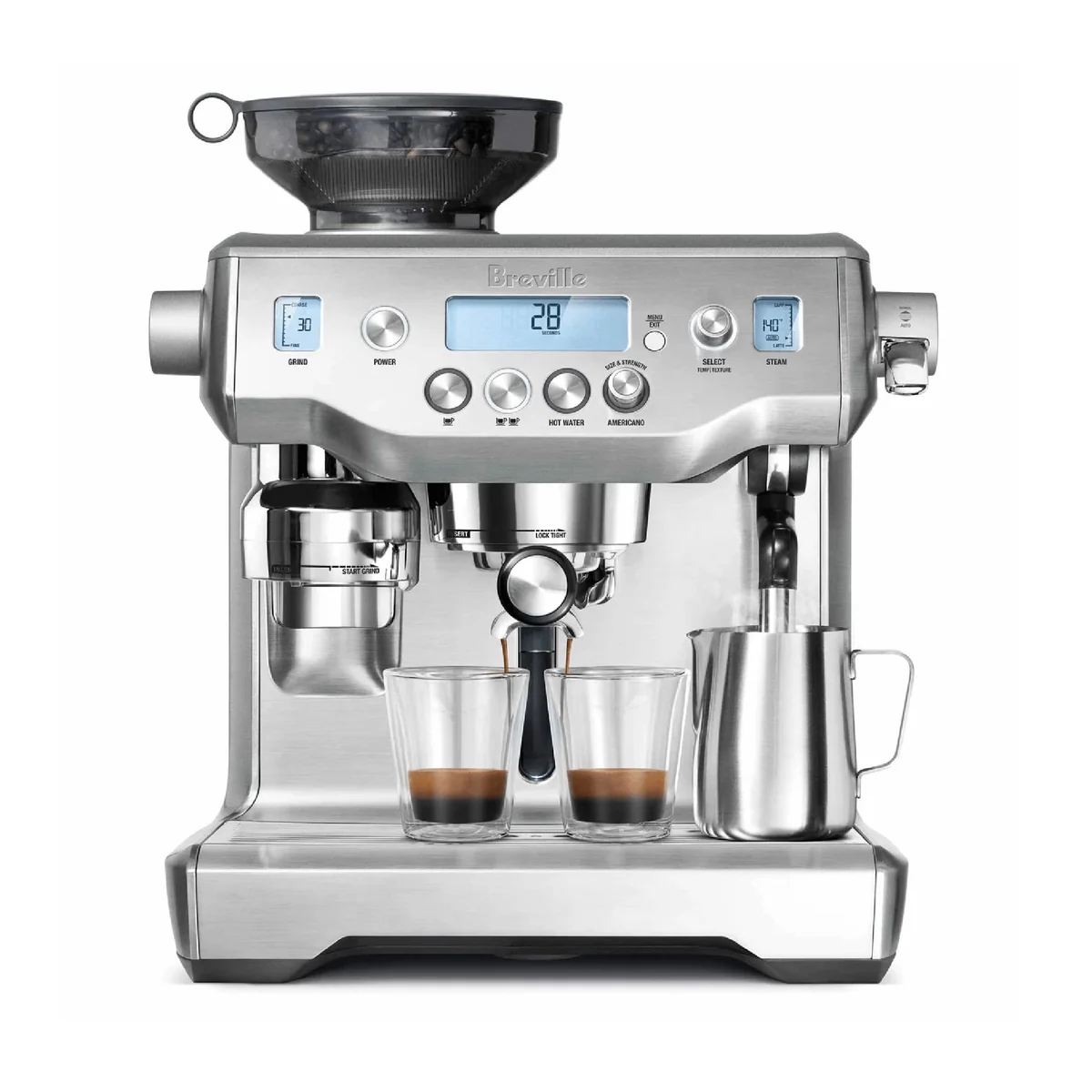
| Breville Oracle BES980XL | About 22 g, fixed | Café dose, but you lock in a portafilter and knock out a puck |
| Jura E4 and J8 twin | About 16 g | Full-size Jura dose, plus a separate hot water outlet |
| De'Longhi Dinamica Plus | About 15 g at ten seconds of grinding | The strongest bean-to-cup shot here |
| KitchenAid KF6, KF7, KF8 | About 14 to 15 g | Same across all three, whatever the strength scale says |
| De'Longhi Magnifica Start | About 10 to 12 g | Good in a small cup, thin in a mug |
| Jura ENA 4 | At most about 10 g | One espresso's worth, or twenty grams via Doppio |
| Philips 1200 to 5500 | Roughly 6 to 10 g | Mild by design, on every rung of the ladder |
| Gaggia Brera, Bosch 300 | Not publicly measured | Judge them on how they build a long drink instead |
A way to make a long drink that is not dilution. This is the part nobody explains at the point of sale, and it produces more angry reviews than any other single thing. Press the long-coffee or lungo button on most of these machines and you do not get more coffee, you get more water through the same puck. An owner arrived on the super-automatic forum at their wits' end about watery, horrible-tasting Gaggia Brera coffee, having already stripped and scrubbed the brew group, and the top reply explained that they had been pressing the lungo button, which uses more water and not more coffee, and that a double means pressing the espresso button twice. That single misunderstanding is doing an enormous amount of work in this category's one-star reviews, and the wider causes of watery bean-to-cup espresso are worth reading before you blame the machine.
The fix is the same everywhere and it is worth learning before you buy rather than after: pull a short, strong shot and add hot water to it. Which is why a genuine hot water outlet matters more on this page than it does anywhere else on this site. The Jura E4 has one on a physical knob and Jura built the machine around that fact. The Gaggia's Pannarello wand doubles as a hot water dispenser for exactly this purpose. The Philips 2200 and 1200 both dispense hot water for tea, which makes them better americano machines than their dose alone suggests. If you want the long version of what a bean-to-cup machine can and cannot do with a mug, we wrote it up separately in getting a normal cup of coffee out of one of these.
Heat that survives the pour. Black coffee shows temperature the way a latte never does, because there is no warm milk arriving to rescue it and, on the short drinks these machines are best at, there is very little liquid to hold heat in the first place. One Philips owner put a thermometer in the stream at the top temperature setting and read about 196°F, which is inside the range the National Coffee Association recommends and still lands lukewarm by the third sip if it goes into a cold ceramic mug. The Philips 5500's listing quotes three settings between roughly 190°F and 210°F, and the mid-range default is where most owners leave it without realising. The two habits that fix most of this cost nothing: set the machine to its highest temperature during setup, and run hot water into the cup before you brew into it. Our piece on why these machines run cool covers the cases where that is not enough.
One thing that is not on this list is milk hardware, and if you genuinely never use it, every dollar in it is a dollar that did not go into the cup. That is worth being honest with yourself about before you spend, and the case for each kind of milk system is the place to test the assumption rather than a product page. Beans matter more here than on a milk machine too, because there is nothing to hide behind: keep the oily dark roasts out of the hopper, and read what survives a bean-to-cup grinder before you buy a kilo of anything glossy.
The sixteen machines, and what each one does to a black cup
These run from the most machine to the least, and the ordering is not a ranking of how good the coffee is. Read the dose line on each one, then read the limitation, and the shortlist will make itself.
The first entry is the odd one out, and it is here because Amazon files it under super-automatics and thousands of people search for it that way. It is not one. Breville's listing describes a fully automatic machine that grinds, doses and tamps twenty-two grams, all of which is true, and omits that you still lock a 58 mm portafilter into a group head and knock a puck out afterwards. Our full explainer on whether Breville makes a bean-to-cup machine at all will save anyone a wasted purchase.
Café dose and café heat, if you will accept a portafilter
Twenty-two grams into a single-wall basket behind two boilers is the most coffee under the water of anything on this page, and a year-long owner's summary was that for the fastest route to consistently good americanos it is hard to beat.
It is a semi-automatic that automates grinding, dosing, tamping and milk, it wants five to ten minutes of warm-up before you can use it, and the built-in grinder is the part long-term owners replace first.
Then the Philips ladder, which is three machines and one brew unit. The 3200 is the interesting one for this job because its americano button builds a longer drink rather than flushing the puck, and an owner writing about that exact setting praised its rich flavour while noting in the same breath that the crema is thin but present. The listing sells five drinks and a touch display; two of those five are milk. Below it, the 2200 and the 1200 drop the milk carafe entirely and keep the hot water spout, which is a better trade than the model numbers imply. One 2200 owner who had been buying americanos from a famous chain for twenty years cracked the code to his own inside a week. If you are working out where to get off this ladder, our guide to which LatteGo to buy lays the whole thing out.
The americano button is the best thing on it and the dose is the worst
Its americano setting adds hot water to a shot instead of running a long stream through a small puck, which is the correct way round and the reason this is the Philips to pick if you drink black.
The brew unit doses roughly half a café shot, so the espresso underneath stays mild whatever you set, and no amount of dialling in changes that arithmetic.
The same brew unit and burrs, with the milk automation deleted
Espresso, coffee and a hot water spout that runs around 84°C is precisely the toolkit an americano drinker needs, driven by the same brew group and ceramic burrs Philips fits several rungs higher.
Weighed pucks come in near 6.5 grams, so even at the shortest volume this is a mild long coffee rather than a shot, and every setting lives behind a held button with no display to confirm what you changed.
The cheapest door into the Philips brew unit
Fresh-ground espresso, coffee and hot water at one button press with a tank that pulls out from the front, which matters if the machine has to live under a wall cabinet.
Owners measure somewhere between eight and twelve grams in the puck, the coffee setting stops around eight ounces, and the AquaClean filter named in the title is not in the US box.
The Gaggia is here because it still sells in volume and because its listing does something quietly useful for this page: it points out that the wand doubles as a hot water dispenser for americanos and tea, which is the whole workaround stated on the box. The same listing specifies cup clearance of 3.25 to 4.5 inches, which is the number to measure your mug against before anything else.
Small, simple, and the wrong shape for a mug
It is genuinely compact, the brew group pulls out for a rinse, and pressing the espresso button twice gives you two real grinds rather than one diluted shot.
Its long drink is made by pushing more water through the same puck, which is exactly why owners describe the lungo as watery, and cup clearance stops at four and a half inches.
Now the three Jura machines, which are the only ones on this page designed around the assumption that you do not want milk. The E4 is a full-size chassis with the milk system taken out: a 64-ounce tank, a ten-ounce bean container, and five drinks that are all black. A year-long owner's verdict was that it makes fantastic espresso, coffee and americanos, that her husband drinks nothing but plain coffee and americanos and is very pleased, and that the hot water is not as hot as she would like for tea. If you are still mapping the range, our Jura buying guide and the E4 against the ENA 4 are the two pages to read next.
The machine on this page built for exactly this job
Jura describes it as especially suitable for black coffee specialties and means it: full-size dose, full-size tank, no milk circuit to clean, and a physical hot water knob so an americano is espresso topped with fresh water.
A single press tops out around eight ounces, the hot water arrives warm rather than boiling, and the front panel speaks only in icons that owners still look up after years.
The same machine in white, on much thinner evidence
Identical hardware and word-for-word identical listing copy to the black one, so this is a decision about which finish you want on the counter and nothing else.
Its rating rests on a far smaller pool of buyers than the black listing's, which makes it less evidence rather than a better record.
Jura's small-dose one, and the dose is what you came for
It is compact, milk-free, quiet and unfussy, and the Doppio function gives you around twenty grams when a single is not enough.
The brewing unit takes at most about ten grams against the E4's sixteen, there is no hot water spout at all, and one owner reports that an American-sized mug will not fit under it.
The Bosch is the quiet one, and the machine most likely to be bought by somebody who wants a coffee rather than an espresso. Its listing offers five strength levels and a double cup function that will either make two drinks at once or double the size of one. An owner describes the coffee setting adjusting up to about a twelve-ounce cup, which sounds generous until you remember where that volume comes from. The same owner has taught himself to underfill the hopper each morning so he can swap to decaf at lunchtime, because there is no comfortable way to change beans. If that is your household, the machines built for two beans answer it properly.
A quiet one-touch machine whose black coffee is a long pour
It grinds, brews and delivers a coffee up to roughly twelve ounces at a single press across five strength levels, and owners consistently describe it as quieter and simpler than whatever it replaced.
That twelve ounces comes out of one puck rather than being built from a shot plus water, and the single hopper makes an afternoon decaf a genuine chore.
Two grinders, so the decaf argument ends permanently
Two bean containers each with their own conical grinder sit on top of Jura's full-size brewing hardware, with a one-touch americano poured from a third spout at the back.
Black coffee still tops out around eight ounces per press, so an owner reckons a large americano is roughly two and a half machine cycles, and the premium buys a second grinder rather than a better cup.
The two De'Longhis are the clearest illustration of the whole argument on this page, because they share a brew group and a steel conical burr and differ mainly in how long the grinder runs. The Magnifica Start's entire menu is espresso, coffee and americano on thirteen grind settings, which is an unusually honest product for a black coffee drinker. One owner of the family put the trade neatly: the americano programme was not as good as he had hoped, so he pulls a double and tops it up to his own liking instead. Two rungs up, the Dinamica Plus grinds for ten seconds rather than eight, and its owners note that drink temperature is adjustable in the settings, which is where the heat complaints usually get solved. The full ladder is in our De'Longhi comparison, and the specific step is argued out in Dinamica Plus against Magnifica Evo; if neither shape fits, the Magnifica Evo sits between them.
Espresso and americano on three buttons, and nothing you did not ask for
The whole menu is espresso, coffee and americano, driven by the same steel conical burr and brew group De'Longhi fits well above this price, with a manual wand for the days somebody wants a cappuccino.
The maximum dose lands around ten to twelve grams, which is fine in a small cup and thin the moment you stretch it into a mug.
The biggest puck of any bean-to-cup machine here
At maximum strength it grinds for ten seconds where the cheaper De'Longhis stop at eight, roughly fifteen grams against ten, and that single specification predicts a strong black cup better than anything else on its spec sheet.
Its long coffee and coffee-pot programmes push far too much water through that one puck and should be ignored in favour of a short shot topped up by hand.
The Philips 5500 is the flagship of a range whose brew unit does not change, which puts it in an awkward position on a page about grams. What it does add is an Extra Shot key that grinds and brews a second puck, and that is the only control on any Philips that genuinely raises the dose. Home Coffee Expert reached its best result on the machine at the second-finest grind, maximum temperature and a one-ounce volume, and was honest about the cost, which is twenty to twenty-two grams of beans per drink. That is the correct way to use it and it roughly doubles what a cup costs you in beans.
The nicest Philips interface wrapped around the same small brew unit
Twenty presets, four saved profiles and an Extra Shot key on almost every coffee drink, which is the most effective single fix for a thin cup anywhere in the LatteGo range.
The brew unit is the one Philips also fits to the 3300 and below, so the espresso is the cheap machine's espresso and the money has gone on the screen.
Which leaves the three KitchenAids, built in Switzerland on the platform behind Miele, sharing a brew unit, a grinder and a dose across all three. The listings sell the difference as recipe count, with more than forty options on the KF8 and fifteen on the KF6, and that count is reached by pairing every drink with its dairy and plant-milk versions. The thing worth paying attention to instead is the fourteen to fifteen grams they all put in the puck, and the brew unit that slides out so you can look at it. One owner who also runs a portafilter machine said the shots are as good as he could pull himself. Our KF6 against KF7 against KF8 guide takes the family apart properly, and Jura against KitchenAid is the cross-shop most buyers at this level actually make.
Swiss hardware with five strength steps instead of three
A removable brew unit, a hopper that twists off so you can switch roasts in under a minute, and a dose at the top of the bean-to-cup range at around fifteen grams.
The americano will not go below about 2.7 ounces of water, the two extra strength steps are finer increments rather than a bigger dose, and owners report a clogging fault that the machine's own cleaning cycle does not clear.
The middle KitchenAid, and the one its own owners keep recommending
Identical brew unit, grinder and dose to the KF8 with a friendlier screen than the KF6, plus the removable hopper and grinder purge that make running decaf alongside regular practical.
Early-failure reports are frequent enough to notice, and one documented warranty case ran six weeks at the repairer before throwing the same fault two days after it came home.
The one to buy if you want the shots strong and the kitchen quiet
It doses fourteen to fifteen grams into a brew unit you can pull out and rinse, grinds quieter than almost anything else you can put on a counter, and skips the milk carafe that the money would otherwise have gone into.
The americano will not go below about 2.7 ounces of water, the coffee setting tops out near seven and a half ounces, and the factory settings need a week or two of dialling in before the shot is worth drinking.
One last thing worth saying plainly, because it decides more purchases than any table. If your actual drink is a large mug of filter-style coffee rather than a short strong one, none of these machines is really your answer, and the fairest advice anyone gave a shopper in the Jura threads was that a person who only wants a ten-ounce black coffee probably does not want a super-automatic at all. The honest version of that argument is in whether these machines are worth it.
Frequently Asked Questions
Why does my espresso taste like brown water no matter what I set?
Almost always because the machine is doing what it was built to do, since a dose under ten grams stretched across a long pour cannot taste like a café double however fine you grind it.
What is the right way to make an americano on one of these?
Pull the shortest, strongest shot the machine will give you and add hot water to it in the cup, rather than pressing a long-coffee button that simply flushes more water through the same puck.
Which machine here has a real hot water spout?
The Jura E4 and the J8 twin, along with the Philips 1200 and 2200 and the Gaggia Brera through its wand, while the Jura ENA 4 has none at all.
Does buying a more expensive Philips get me a stronger shot?
No, because the brew unit and grinder are shared from the 1200 to the 5500, so what the money buys is presets, profiles and a display rather than more coffee.
Is the Extra Shot button on the Philips 5500 worth using?
Yes, since it grinds and brews a second puck rather than adding water, but it roughly doubles the beans per drink and that is the real cost of fixing the dose.
Can any of these fill a large travel mug in one press?
Not well, because the Jura machines top out around eight ounces per press and the KitchenAids near seven and a half, and the Bosch's twelve ounces is one puck's worth of coffee diluted rather than a bigger drink.
Does a machine without a milk system make better coffee?
Not automatically, but it means none of the price went into a carafe or a hose, which is why the coffee-only Jura punches above what its sticker suggests for anyone who never wanted milk.
Why is my black coffee lukewarm when the machine claims to brew hot?
A small volume of liquid poured into a cold mug loses heat fast, so set the machine to its highest temperature during setup and flush hot water into the cup before you brew.
Our Top Recommendation
Based on our research, the Breville Oracle BES980XL is our top pick — it grinds, doses and tamps 22 grams and steams the milk unattended, but you still lock in a 58 mm portafilter, still dial in a grind, still knock out a puck, and the built-in grinder is the part long-term owners replace first..
Sources (5)
- Amazon listings and customer reviews
- Owner reports across r/superautomatic, r/espresso threads
- Owner and reviewer video, 1 channel
- Seattlecoffeegear — Article — www.seattlecoffeegear.com
- Homecoffeeexpert — Article — homecoffeeexpert.com