The Magnifica Evo is the best-selling super-automatic in America and a 3.9-star machine at the same time
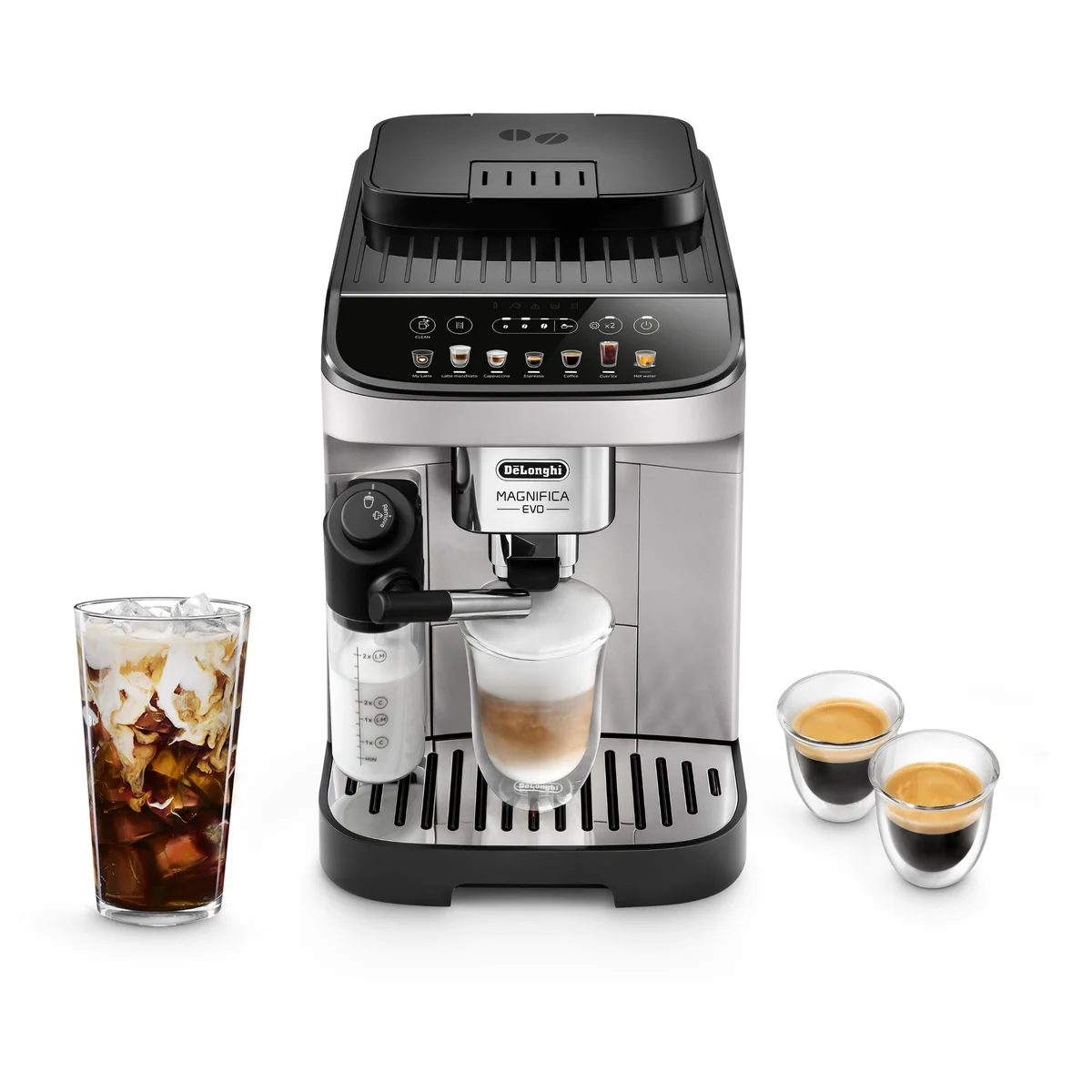
Buy the Magnifica Evo if you mostly drink cappuccinos and lattes and want them without thinking about it; look elsewhere if you drink straight espresso, want scalding drinks, or pour oat milk every morning.
Based on 961 owner ratings, 9 owner discussions and 7 other sources. We have not tested this machine ourselves.
We earn a commission if you buy through our links, which does not affect what we say.
Read how this site works →
Who should press buy
Buy it if your household drinks cappuccinos, lattes and iced coffee, wants them at a button, and is coming from capsules, drip or the café queue. That buyer gets a machine with better foam than its price suggests, a brew group shared with the tier above, and a repair path that keeps it alive for years. Set the water hardness and the temperature on day one, grind finer than the factory sends it, give it a week before you judge it, and clean the carafe every day without negotiating.
Do not buy it if you drink your coffee black and strong, because the dose ceiling is the one thing settings cannot fix and the machines built for black coffee handle it better. Do not buy it if oat milk is your default, because owners who need plant milk consistently point at the Dinamica Plus instead, and one who chose it said it was the only option in the house for exactly that reason. Do not buy it if you want a flat white, because it does not make one. And if you never use the milk system, the Magnifica Start pours the same coffee from the same brew group for less, which owners work out for themselves often enough that the Evo against the Start is the comparison this range most needs. If the model names have stopped meaning anything, our guide to the whole De'Longhi range puts them in order.
Buy the Magnifica Evo if you mostly drink cappuccinos and lattes and want them without thinking about it; look elsewhere if you drink straight espresso, want scalding drinks, or pour oat milk every morning.
Best for: Both of those things are earned, and which one you end up living with depends almost entirely on what you drink.
Two facts about this machine sit awkwardly next to each other. Amazon has it ranked first in super-automatic espresso machines, and the same listing shows it holding 3.9 stars across 961 ratings. Neither number is a mistake. The Evo is the cheapest honest route into De'Longhi's one-touch milk carafe, which is why it sells, and it ships configured in a way that reliably disappoints one specific kind of buyer, which is why the rating sags. Working out which kind of buyer you are takes about ninety seconds, and it is the whole job of this page.
The machine's own reviewers agree on the target. Home Coffee Expert, who tested the LatteCrema version, put it plainly: the Evo is best suited to someone graduating from a capsule machine, and it will not draw out the delicate character of a specialty single origin. That is not a backhanded compliment. Against pods, against a drip machine, against the eight-minute ritual of a portafilter before work, it wins comfortably. Against a well-run café espresso it does not, and no amount of dialling in changes the arithmetic, because the arithmetic is in the software.
Three things will annoy the wrong owner, and Espresso Den would rather put them at the top than bury them at the bottom. The grinder is capped at roughly ten to thirteen grams a shot, which is a single dose stretched over a double's worth of water. The drinks come out cooler than a café's, and the milk temperature is not adjustable at all. And the milk carafe, the exact part you are paying extra for, is the component owners complain about most. If none of that describes your morning, this is a very good machine for the money.
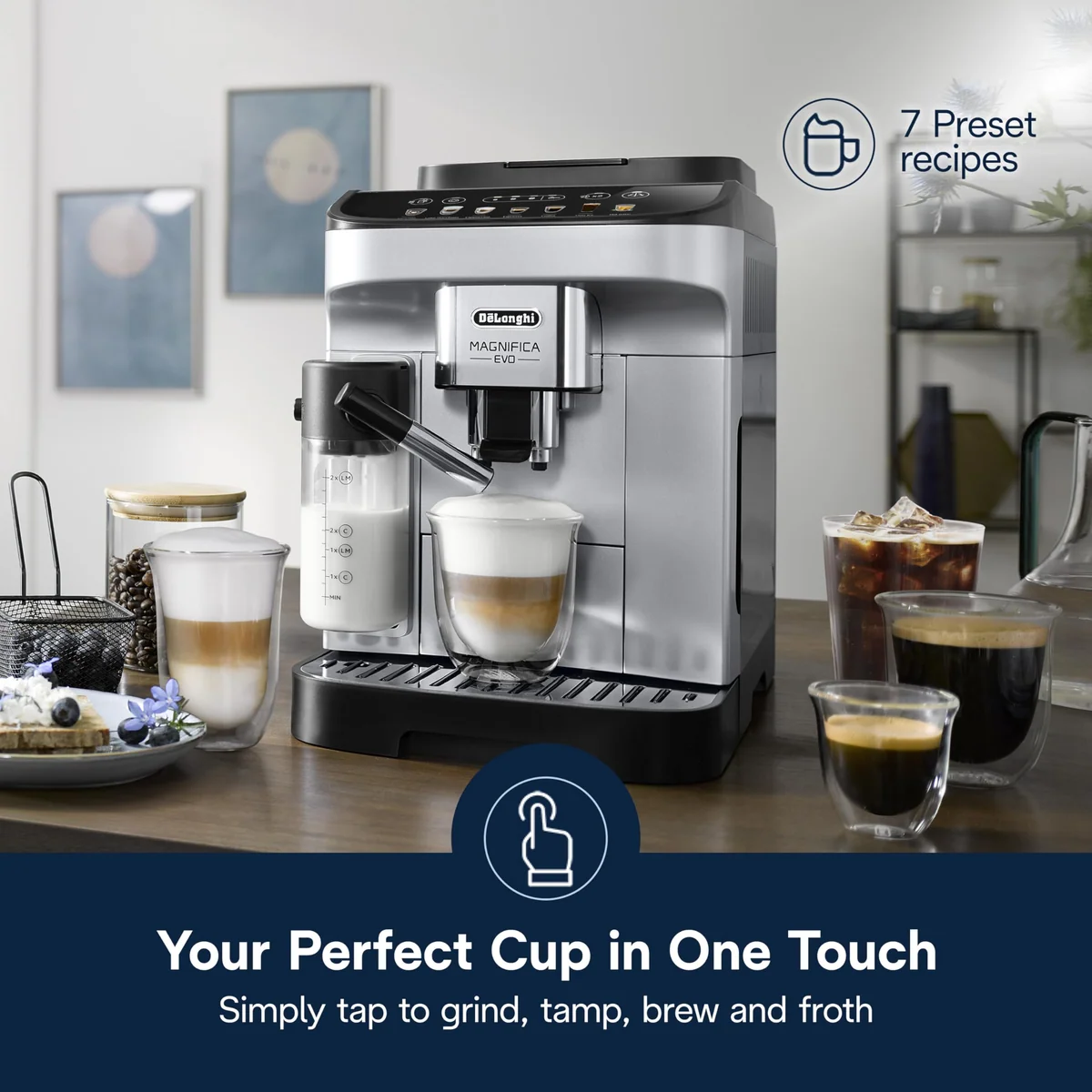
De'Longhi Magnifica Evo with LatteCrema milk carafe, bought new
The most machine you can get for one-touch cappuccinos and lattes without stepping up to a screen, a second carafe and a considerably larger bill.
Its grinder is capped well below a true double dose, so straight espresso comes out closer to a short lungo than a café shot.
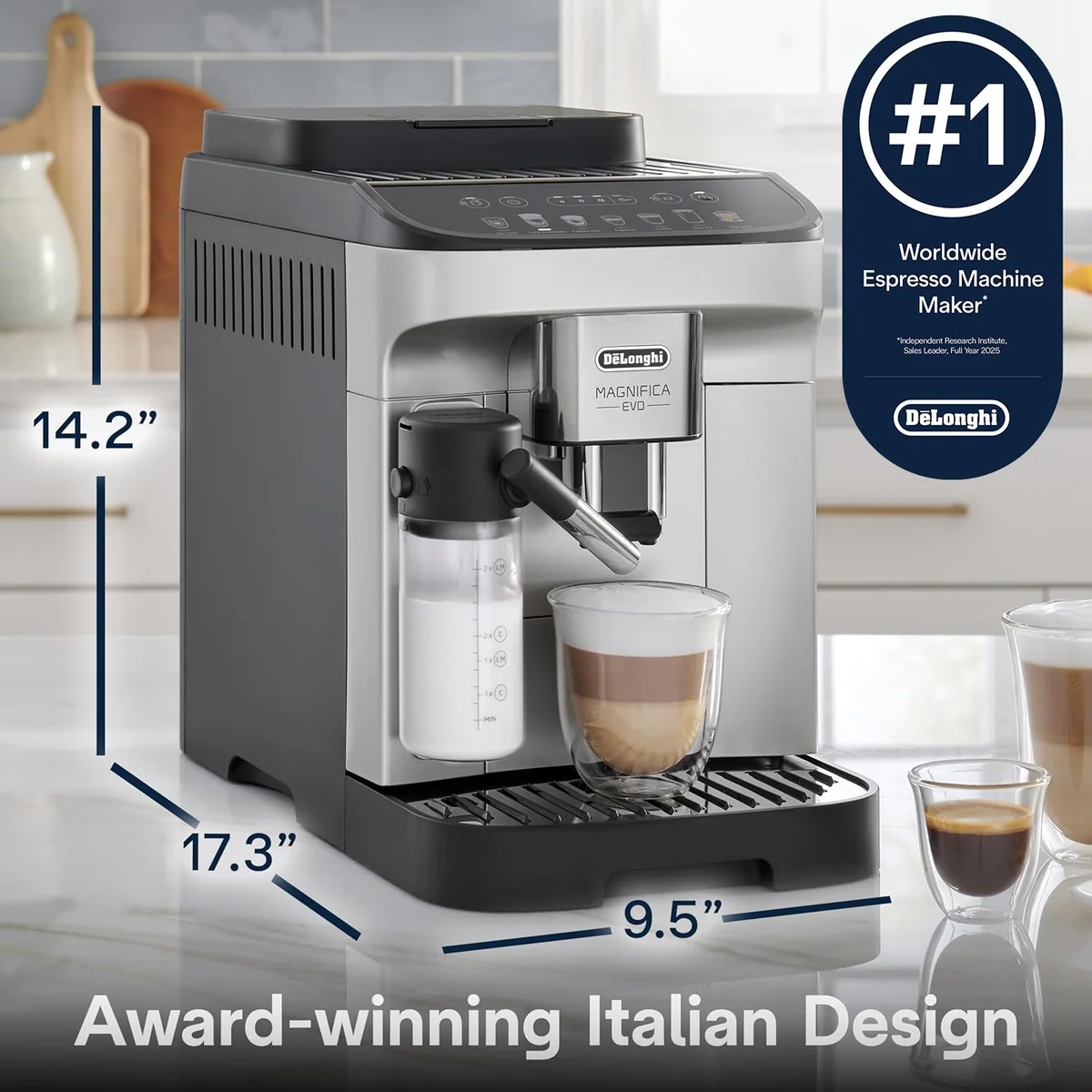
Key Specifications
Seven recipes, five drinks, and one of them is hot water
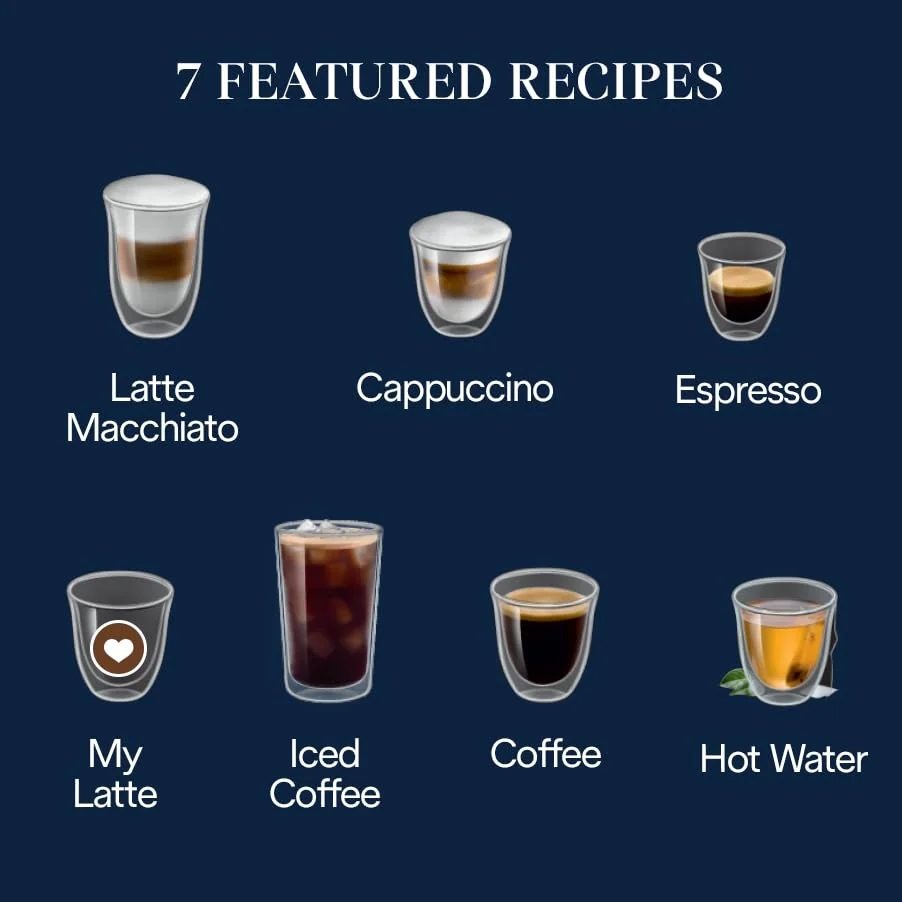
The listing promises seven one-touch recipes: espresso, cappuccino, latte macchiato, iced coffee, coffee, hot water and My Latte. Home Coffee Expert counted the same seven and then discounted one of them, on the grounds that hot water is not a coffee. That is fair. You are buying five drinks plus a programmable slot, and the slot is genuinely clever: My Latte froths every drop of milk you pour into the carafe and stops when a sensor sees the carafe run dry, so you set the ratio by how much milk you pour rather than by wrestling a menu.
What is not on the panel matters more than what is. There is no flat white, a gap an owner confirmed after seven months with the machine. There is no extra-shot button, so a stronger cappuccino means standing at the machine for nearly two minutes and then pressing espresso by hand. There are no user profiles at all. And the foam density is fixed: Whole Latte Love's tester put it bluntly, that there is no way to adjust the milk froth in any way, so if you want more milk and less foam you are out of luck. The Magnifica Plus adds a dial for exactly that, and on the Evo the pour order is fixed too, milk first, then coffee.
Owners have found their way around some of this. The neatest fix in the whole record reverses the cappuccino: pull an espresso, then press the pre-ground bypass button with nothing in the chute so the machine skips the grind, then press cappuccino, and it froths milk straight onto the shot you already made. That is a café-order cappuccino out of a machine that does not offer one. It also tells you something about the design, because a stock recipe good enough to leave alone does not accumulate workarounds.
| The claim | What survives |
|---|---|
| Seven one-touch recipes | Five real drinks, a custom slot and hot water |
| Textures milk and milk alternatives | Dairy and oat both frothed well in testing, but the density is fixed |
| Precise, consistent dose | Consistent, yes; large enough for a true double, no |
| Over Ice adjusts dose and brew | Real, but it brews hot and cool, not cold, and needs the ice to be drinkable |
| Removable, dishwasher-safe parts | True, and the auto-clean only rinses the spout; the carafe is still a hand job |
That last row is the daily cost of the milk system. Whichever way you cut it, the LatteCrema carafe strips down to considerably more pieces than the two dishwasher-safe parts of a Philips LatteGo, which is the trade the two brands have been making against each other for years. De'Longhi's foam is better; Philips's carafe is faster to clean. If you have never decided which of those you care about, our piece on choosing between a steam wand, a milk hose and a one-touch carafe is the argument in full, and the Philips LatteGo versus Magnifica Evo comparison settles it for these two specifically. On the iced setting, our explainer on whether these machines really brew cold covers why Over Ice is a cooler hot brew rather than cold brew.
Strengths & Limitations
Strengths
- The milk foam is genuinely excellent for an automatic carafe, thicker in one side-by-side test than the adjustable carafes on two costlier De'Longhis.
- It uses the same removable brew group and steel conical burr as machines costing twice as much, so the coffee itself is not the compromise.
- My Latte drains whatever milk you pour in, so you size the drink by the pour rather than by fighting a settings menu.
- The water tank pulls out of the front, which matters more than it sounds if the machine lives under wall cabinets.
- Spare parts are cheap and widely sold, and the brew group comes out in your hand for cleaning without a service visit.
- Against pods, drip or a daily café habit, it pays for itself quickly and keeps paying.
Limitations
- The grinder is capped at roughly ten to thirteen grams, so straight espresso lands closer to a short lungo than a café shot.
- Drinks arrive cooler than most people expect and the milk temperature cannot be adjusted at all.
- The milk carafe has a seating sensor that regularly refuses to recognise the carafe, a part De'Longhi deleted from the cheaper Magnifica Start.
- Foam density is fixed, so a low-foam latte or a proper flat white is beyond it.
- Anything past strength and volume is buried behind press-and-hold button combinations that need the manual every single time.
- The auto-clean only rinses the spout, leaving the carafe itself to be stripped and washed by hand.
- There is no extra-shot button and no user profiles, so a second drinker in the house reprograms rather than switches.
- The grinder is loud, which several owners raise even in five-star reviews.
The ten grams that explain most of the one-star reviews
De'Longhi uses the same removable brew group and the same steel conical grinder across most of its super-automatic line, and separates the models by how much coffee the software lets the grinder deliver into it. Tom's Coffee Corner published the ladder, measured as grind duration, and the Evo stops three rungs short of the machines above it.
| Strength setting | Magnifica Evo | Dinamica Plus, Eletta Explore, Magnifica Plus |
|---|---|---|
| One bean | about 5 seconds | about 5 seconds |
| Two beans | about 6 seconds | about 6 seconds |
| Three beans | about 7 seconds, the ceiling | about 7 seconds |
| Four beans | not available | about 8.5 seconds |
| Five beans | not available | about 10 seconds |
Put a number on the top of that column and the sources start arguing. Tom's Coffee Corner reads it as about ten grams. A reviewer who weighed each setting on his own Evo got 6.8, 10.1 and 13.2 grams. A Reddit reviewer who tested the machine reported 9, 12 and 15 grams and was immediately contradicted by an owner in North America who weighed 7, 9 and 11. Espresso Den is not going to pretend that spread resolves into a single figure. Call it somewhere between ten and thirteen grams at maximum, note that everyone agrees it is a single dose rather than a double, and understand that this is the mechanical reason a machine can be well made, well liked and still produce a cup that a Breville owner calls thin. The forty millilitres it pours over that dose is, as one reviewer said of his own shot, closer to a lungo than an espresso.
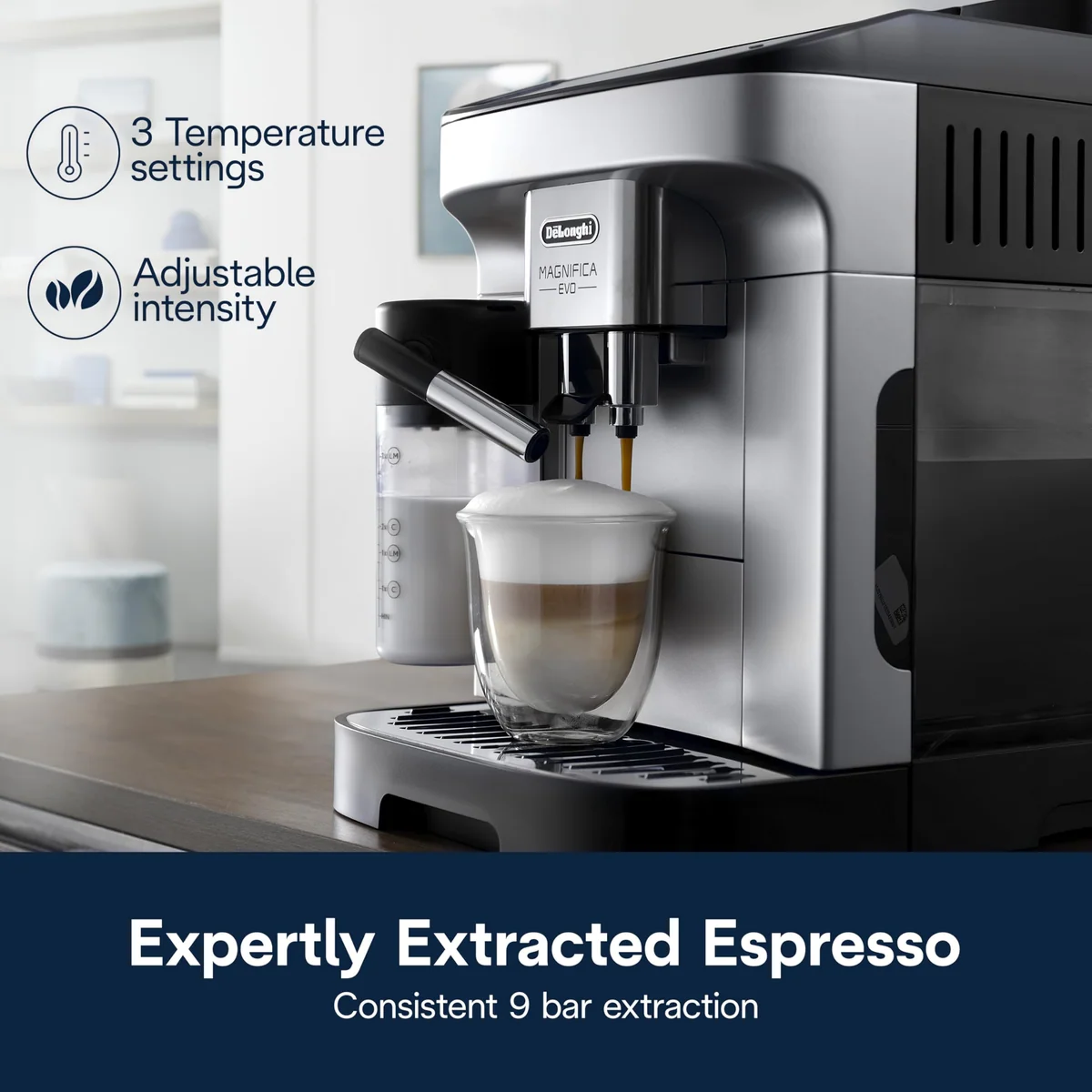
The other ceiling is heat. One measured review of the Evo found brew temperature topping out around 85°C, below the 90-plus the specialty world asks for, and the milk steaming at 71°C even on the lowest setting. A separate reviewer measured the adjustable brew range at 66°C to 72°C. Those two readings cannot both be describing the same thing, and neither can be checked from here. What can be checked is what owners report in the cup, which is consistent: one Evo owner said his coffee and milk both arrive around 60°C and that preheating the cup does not close the gap. On the older auto-frother machines an owner identified the mechanism precisely, that the heat setting only affects the shot and the frothed milk cannot be raised at all. The specification sheet for this model still lists no adjustable milk temperature. The bigger the milk ratio, the colder the drink, which is why cortado drinkers are happy and latte drinkers reach for the microwave. Our page on why these machines serve lukewarm milk has the fixes that actually help.
Then there is the setup, which De'Longhi does badly and which accounts for a real slice of the bad reviews. The machine leaves the factory on a middle temperature setting and a middle grind, and several owners describe a genuine break-in of roughly ten cups before the coffee stops tasting like dishwater. The manual is close to useless for anything beyond first power-on, which is how a thread from a surgeon three days into ownership, having wasted an entire bag of beans trying to make one espresso, ends up being the most-read Evo post on Reddit. Four things fix most of it: set the water hardness during setup, turn the temperature to maximum, take the grinder finer one click at a time and only while it is actually grinding, and shorten the programmed volume rather than reaching for the 2x button, which adds water rather than coffee and waters the drink down. If your cup is still thin after that, our guide to watery bean-to-cup espresso and the beans these machines actually like are where to go next; medium roasts that are dark brown and matte rather than shiny are the safe starting point, and oily beans are the fastest way to gum up a grinder.
Do all that and the reports turn warm rather than ecstatic, which feels right. One long-term owner's summary is the fairest sentence anyone has written about it: it is not life-changing espresso, but it is good and it is easy. Seattle Coffee Gear, comparing the Evo against two costlier De'Longhis, found its fixed carafe produced the thickest milk texture of the three. A three-year owner clocks a cappuccino at one minute forty-seven from a standing start and says the machine barely makes a mess. Tom's, having bought the whole range himself, still calls the Evo the best budget option in it and better than any Philips he has used.
The renewed listing is not the same purchase
There is a second way to buy this machine, and it deserves its own reckoning rather than a footnote. The renewed ECAM29084SB carries 3.5 stars from 47 ratings. That is not the same product being rated worse; it is a different transaction being rated. Every hands-on review of the new machine in this research was positive, so the gap is almost certainly a condition and warranty signal rather than a design one. Espresso Den could not find a single first-hand account of a renewed Evo anywhere in the material we read, which is its own kind of answer: the sample is small, recent and unexplained.
What is knowable is the warranty trade. A new Magnifica Evo carries two years from De'Longhi, extended to three if you register it. The renewed listing carries a ninety-day limited warranty. For context, De'Longhi's own factory-refurbished machines have been sold with six months, and a specialist retailer's B-class grade explicitly means a working machine that may carry more cosmetic blemishes than a standard refurbished unit. On a device with a boiler, a pump and a gearbox inside a plastic shell that has now been shipped at least twice, three months is a short window in which to discover a seal.
So the renewed unit is worth buying only when it is clearly cheaper than a new one at the moment you look, and De'Longhi discounts the new Evo often enough that this is a real question rather than a rhetorical one. If you do buy renewed, use the ninety days deliberately: confirm the milk carafe, water filter, scoop and hot-water spout are all in the box, run a milk drink on day one to prove the carafe sensor sees it, take the grinder through its full range while it runs to prove the adjuster is not jammed, and run a descale early so a previous owner's scale becomes your problem while you can still return it. Our page on whether renewed and refurbished bean-to-cup machines are a safe buy goes through the grading language in detail.
De'Longhi Magnifica Evo, renewed
The same LatteCrema machine for less money, worth taking if the discount against a new one is genuinely large.
Its ninety-day warranty is a fraction of the two to three years a new unit carries, on a machine whose failures often arrive in year two.
Either way, the running cost is where this class of machine wins. One owner who tracked four years and more than four thousand coffees on an older Magnifica put his all-in cost, machine included, at about a third of a dollar a cup, and reckoned the machine had paid for itself against café prices inside ninety days. Beans are the ongoing expense and they are not trivial, because a bean-to-cup machine gets through them far faster than a drip maker. But nobody in the record regrets the arithmetic. If you are weighing this against pricier one-touch machines, our roundup of the best super-automatics under a thousand dollars sets the field out.
What actually breaks, and when
De'Longhi's reputation for durability is real and it is also mostly borrowed from an older generation of machine. The headline numbers are extraordinary: an Australian owner retired a Magnifica S at 49,022 shots, and another posted a service docket reading 38,078 brews at eight years with a technician saying it had another twenty thousand in it. Ten-year, ten-thousand-cup Magnificas are common enough on Reddit to be unremarkable. But the tail is ugly, and it is not model-wide so much as unit-level: leaking thermoblocks and worn seals at two to four years, a jammed brew unit, a pump. One Amazon buyer of this exact machine had it stop dead ten days in and said the build felt cheap next to the ten-year-old Magnifica it replaced.
What separates the two outcomes, on every account, is water and habit. The most useful ownership document in the whole record is a two-year Amazon review that reads like a chore list rather than a rave: water refills daily, milk carafe daily, spent grounds every two or three days, a full cleaning cycle every three or four weeks that runs closer to ninety minutes than the hour he expected, and the brewing parts behind the water tank cleaned regularly because if you skip them they get mouldy. That is the machine's actual price. Descaling runs around forty-five minutes and, on soft water with the hardness set correctly, may not be needed more than twice a year. Owners who never set the hardness get nagged for a descale within weeks and assume the machine is broken. Our cleaning and descaling schedule lays the whole cycle out, and how long these machines last covers what a repair typically costs when the tail catches you.
The single most likely thing to go wrong on this particular model is the milk system, and the strongest evidence comes from De'Longhi itself. The Evo uses a photo-eye sensor to detect milk in the carafe, and if the carafe is not seated exactly right the milk drinks simply refuse to illuminate. One Amazon owner described precisely that, the machine beeping when the frother goes in but never recognising it, with the drink options staying dark. Owners of the sibling Magnifica Plus describe a full carafe being heavy enough to drag the connector out of alignment. A reviewer hit the fault live on camera and could not make a cappuccino. And when De'Longhi built the cheaper Magnifica Start, it deleted the sensor, reportedly because users complained about it. A manufacturer removing a part from the next machine is about as clear a verdict on that part as you will get.
Against all of that, the reason people keep buying De'Longhi rather than something Swiss is that the brew group slides out in your hand and the spare parts are cheap and widely stocked. A machine you can rinse, grease and eventually rebuild is a different long-term proposition from a sealed one, and it is why the ten-year stories exist at all. It is also why the not-repairable complaints sting: an owner whose Magnifica S sprang an internal leak at three years found the case held shut by deep-set security screws and gave up rather than pay two thirds the price of a new machine to a shop.
Frequently Asked Questions
Is the Magnifica Evo worth the money?
For milk drinks at a button, yes; for straight espresso at café strength, the dose ceiling means you are better served by a machine a tier up or a semi-automatic at the same price.
Why does its espresso taste weak?
The grinder is capped around ten to thirteen grams and the factory volume is generous, so the fix is a finer grind, maximum strength and a shorter programmed pour rather than the 2x button, which only adds water.
Why are the drinks not hot?
The machine ships on a middle temperature setting and its milk temperature cannot be raised at all, so turn the coffee temperature to maximum, preheat the cup with a rinse, and accept that milk-heavy drinks will always run cooler than a café's.
Does it make a flat white?
No, and because the foam density is fixed you cannot approximate one convincingly either.
Can it handle oat milk?
Testers got good results from oat in the LatteCrema carafe, but households where plant milk is the default consistently end up recommending the Dinamica Plus instead.
How long will it last?
Well-maintained Magnificas routinely run eight to twelve years and tens of thousands of shots, but the failure tail clusters at two to four years around seals, leaks and the milk system, and correct water hardness plus regular brew-group cleaning is what separates the two outcomes.
Is the renewed version safe to buy?
It is the same machine with roughly a tenth of the warranty, so it is worth it only at a real discount and only if you test the milk carafe, the grinder adjuster and a full descale inside the first ninety days.
Why does it keep asking to be descaled?
Almost always because the water hardness was never set during setup, which leaves the machine assuming the worst and nagging far sooner than your water warrants.
Sources (9)
- Amazon listings and customer reviews — Delonghi Magnifica Evo
- Owner reports across r/superautomatic threads
- Owner and reviewer video, 6 channels
- Homecoffeeexpert — Article — homecoffeeexpert.com
- Coffeeness — Article — www.coffeeness.de
- Wholelattelove — Article — www.wholelattelove.com
- Tomscoffeecorner — Article — tomscoffeecorner.com
- Au — Article — www.productreview.com.au
- Seattlecoffeegear — Article — www.seattlecoffeegear.com