The Breville Barista Touch is filed under super-automatics, and it is not one
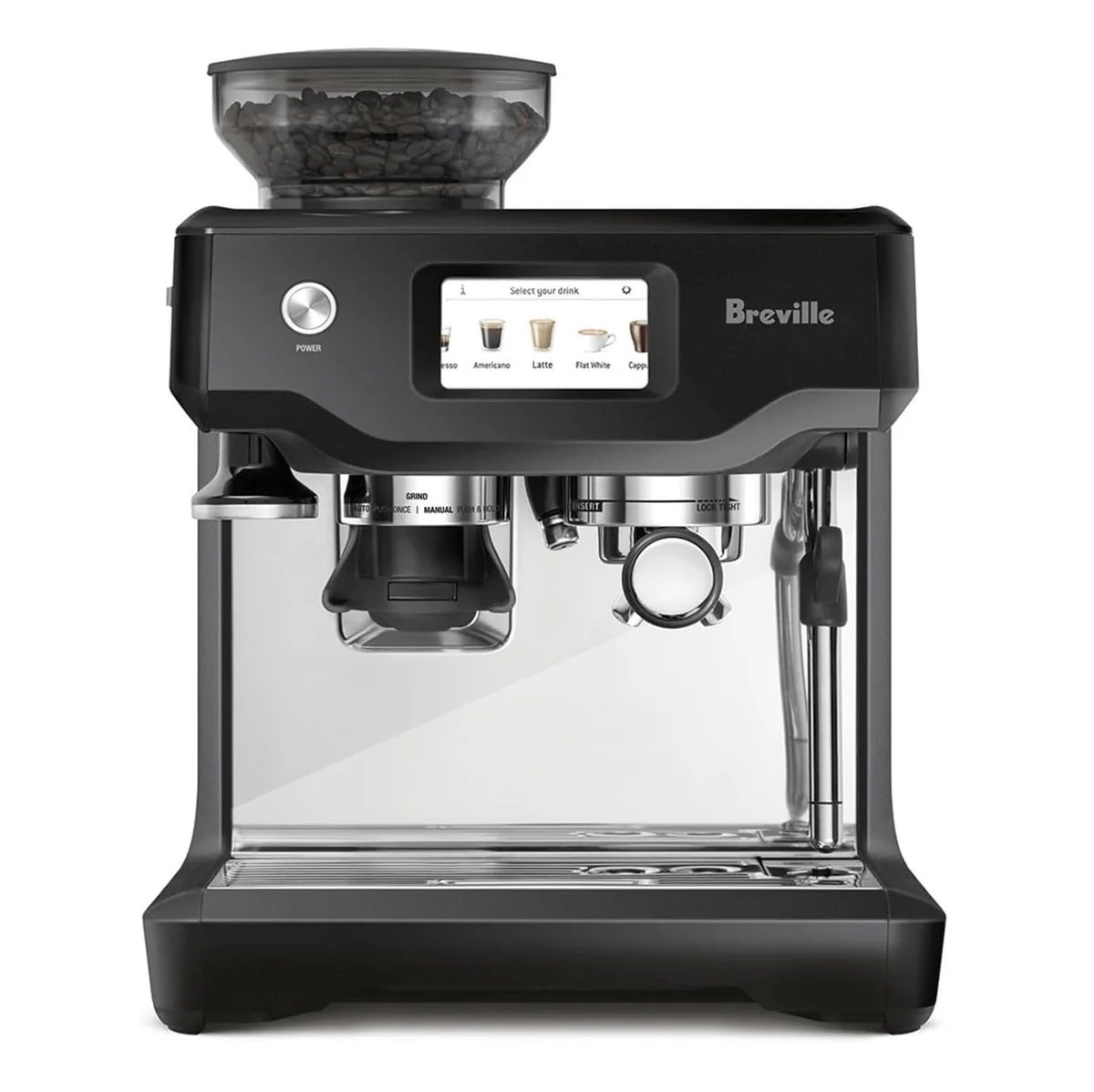
Buy the Barista Touch if you want a machine that handles the grinding, the shot timing and the milk while leaving the tamp and the pour in your hands, and treat the certified remanufactured version as a genuine bargain only after you have checked what the new one is going for that week, because the refurb carries six months of warranty instead of two years.
Based on 417 owner ratings, 9 owner discussions and 6 other sources. We have not tested this machine ourselves.
We earn a commission if you buy through our links, which does not affect what we say.
Read how this site works →
Who this machine is actually for
The cleanest description of the target buyer comes from a retailer who sells the whole Breville range and pitches this model at people coming off a super-automatic who want better coffee but are not ready to do everything themselves. That is exactly right, and it also describes most of the traffic arriving at this listing from the wrong search. The inverse is just as clear: a reviewer who spent a week with the machine noted that it will not be loved by anyone who enjoys playing with shots, steaming milk by hand and pouring latte art, because that person has just paid a premium to have the interesting parts taken away.
So: the Barista Touch is a very good machine for the pod graduate with ten minutes and a milk habit, and a slightly frustrating one for anyone who is going to get seriously interested. Take the remanufactured unit if the discount is real on the day you look, take the new one if it is not, and either way spend the first fortnight weighing everything and buying beans with a roast date on them. The whole question of whether any of these machines are worth the money comes down to how many drinks a week you actually make, and this one rewards a habit rather than an intention.
Buy the Barista Touch if you want a machine that handles the grinding, the shot timing and the milk while leaving the tamp and the pour in your hands, and treat the certified remanufactured version as a genuine bargain only after you have checked what the new one is going for that week, because the refurb carries six months of warranty instead of two years.
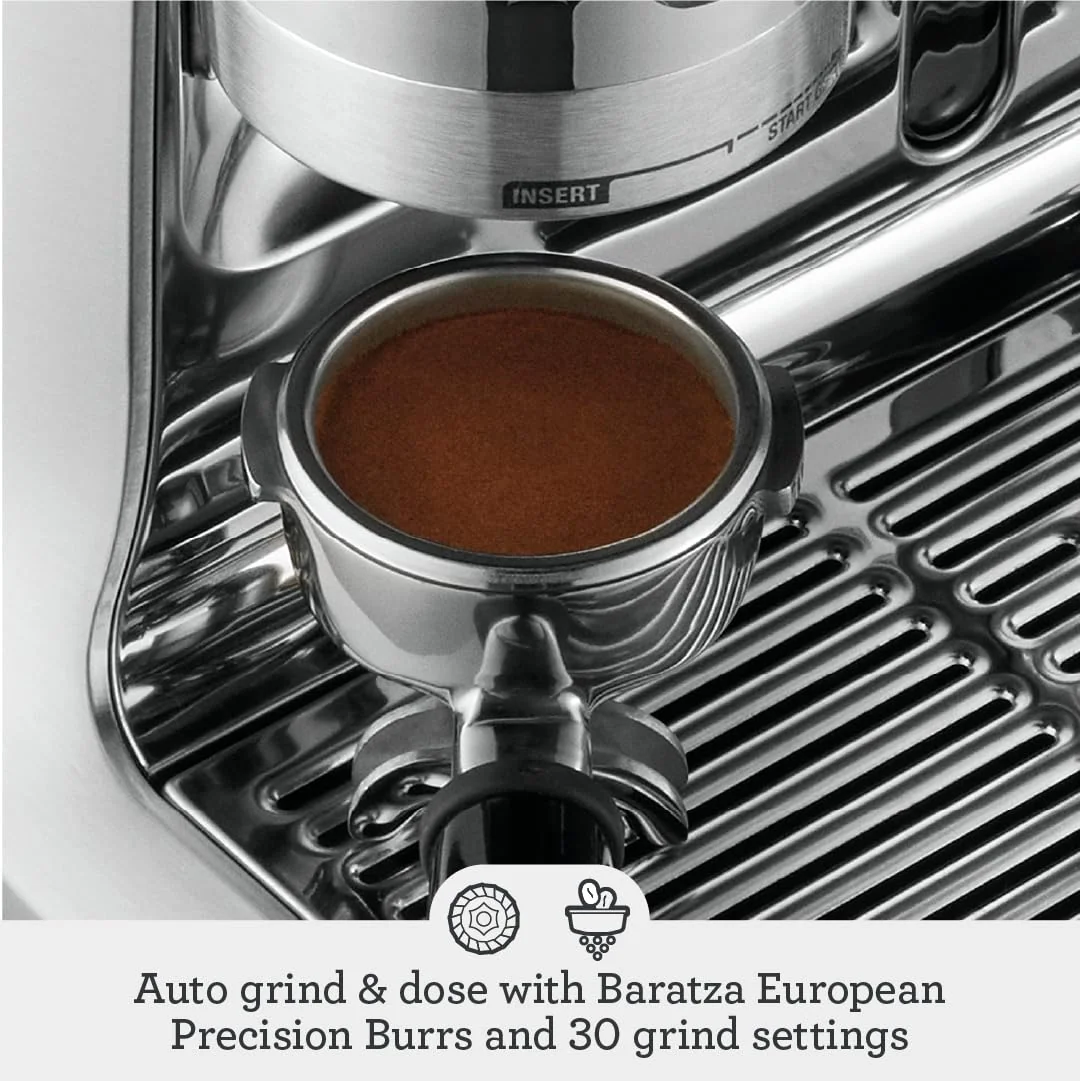
Best for: The BES880 grinds, times and textures for you, but you still tamp the coffee and pour the milk yourself, and almost everything that delights or disappoints an owner follows from that one fact.
Amazon lists this machine in the Super-Automatic Espresso Machines category. It is not a super-automatic. Amazon's own product copy for the Black Truffle listing calls it a semi-automatic espresso maker in the same breath as it promises café drinks in three easy steps, and both statements are true at once. The reviewer at Coffeeness, who bought the machine and used it as a trained barista would, puts the consequence more bluntly than any listing ever will: the Barista Touch is very much a semi-automatic, tamping is on you, and that will be a deal-breaker for some people.
This matters more here than on almost any other page on this site, because the phrases that lead people to the BES880 are saturated with the word automatic. If what you actually want is a machine you load with beans and milk and then walk away from, read what a super-automatic really is first, and then what Breville does and does not automate, because Breville does not make the machine you are picturing. The Barista Touch is the halfway house, and it is a good one.
| The machine handles | You handle |
|---|---|
| Grinding and dosing straight into the portafilter | Levelling and tamping the puck |
| Water temperature, pre-infusion and shot timing | Choosing the grind size, and re-choosing it for every new bag |
| Heating and texturing the milk to a set temperature and foam level | Pouring the milk into the cup |
| Purging the steam wand and prompting you to clean and descale | Emptying the drip tray, the knock box and the puck |
Two listings sit on this page and they are the same machine in different clothes. The BES880BTR is the Black Truffle finish. The RM-BES880BSS is a Breville certified remanufactured unit in brushed stainless, which the listing describes as showing limited or no wear, arriving with the original accessories, and carrying a six month Breville limited warranty from the date of purchase. That warranty line is the entire trade, and it is worth reading twice. Two of the eight Amazon reviewers on the remanufactured listing docked stars purely because they had not registered that the machine was refurbished, which is a startling thing to miss in a title that says so.
Key Specifications
The milk wand is the product
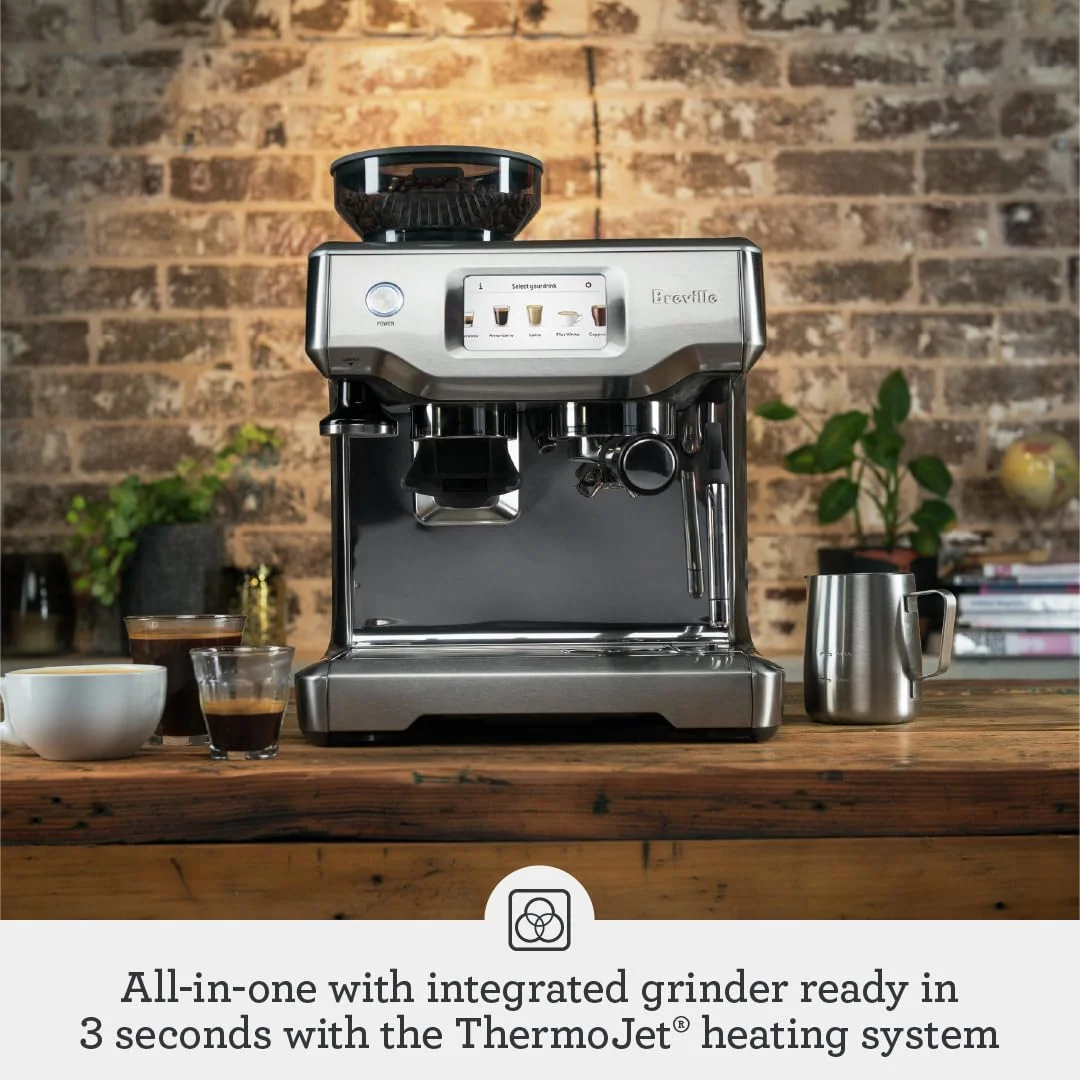
Strip away the touchscreen glamour and there is one feature here that a cheaper Breville does not have, and it is the automatic steam wand. Breville's specification gives you milk temperature adjustable between 104 and 167 degrees Fahrenheit and eight levels of texture, with a sensor in the drip tray that stops the wand when the jug reaches your number. The claim survives contact with people who had every reason to sneer at it. The Coffeeness reviewer went in expecting to beat the machine with his own technique and reported, with visible irritation, that his mind was blown and that the wand produced sublime froth time after time. The five-year owner writing for Food & Wine singled out the same sensor as the thing that separates this machine from its rivals, and uses the wand for matcha as well as coffee, with soy at 130, oat at 140, almond at 130 and dairy at 150 degrees. Those four numbers are the most useful thing anyone has published about this machine, and they only mean anything because the temperature is a dial rather than a fixed setting.
The dissent is real and you should hear it. The foam number is not absolute: a setting of four in a small jug is not a setting of four in a large one, and non-dairy milk generally wants two steps higher than you would give dairy. One owner who bought a Touch and regretted it within a week says the auto steaming leaves foam on top and plain hot milk underneath, and another who likes the machine still gets occasional large bubbles. The honest summary is that this wand performs like someone who has been steaming milk for a few months, which is better than most buyers of this machine will ever be and worse than a competent café. If the milk system is the deciding factor for you, the broader argument between a wand and an automatic frother is worth an hour of your time.
The touchscreen is the second headline and it earns rather less of its billing. You get five preset café drinks and eight slots you can name and save yourself. Save a profile per bag of beans, with its grind size, dose time, shot time and froth level, and the machine becomes genuinely quick. The catch is that the presets are barely distinct from each other: put the latte and the cappuccino side by side and the only difference is one step of milk texture on a scale of eight, which means most people pick one and stay there.
Two omissions deserve naming, and both come from the reviewer who otherwise loves the machine. There is no pressure gauge, which the cheaper Barista Express has and which he missed. And the pre-infusion is fixed at ten seconds with no way to change it, described as a huge oversight on Breville's part. Neither will bother a Nespresso graduate. Both will start to bite the moment you get interested, which is the exact moment people start reading about the Oracle Touch and what its extra money buys.
Strengths & Limitations
Strengths
- The automatic steam wand textures milk well enough that a trained barista who expected to beat it publicly admitted he could not.
- Milk temperature is adjustable across a wide range, which is what makes oat, soy and almond milk behave rather than merely get hot.
- The touchscreen shows grind, dose and shot time on one screen, which makes dialling in faster than hunting through button combinations.
- Eight nameable saved recipes mean a second bag of beans or a second person in the house does not undo your settings.
- Water is at temperature in about three seconds, so the machine is usable on a weekday morning in a way that a warm-up machine is not.
- The included dosing funnel and razor tool genuinely reduce the mess that puts people off owning a grinder.
- Owners who stay with medium and dark roasts report years of daily service without touching anything beyond routine cleaning.
Limitations
- It is not a super-automatic, so you tamp every drink and pour every jug of milk yourself.
- The grinder doses by time rather than weight, which means every grind adjustment quietly changes your dose until you re-set the timer.
- The three second heating figure applies to the water and not to the group head, so the first shot of the day needs a flush to be worth drinking.
- Pre-infusion is fixed at about ten seconds with no way to adjust it, and there is no pressure gauge to diagnose a bad shot.
- Dense light roasts push this grinder past its comfortable range, which rules out a whole style of coffee that the listing never mentions.
- The temperature sensor behind the automatic milk wand is the component owners most often report failing, typically well after the first year.
- The remanufactured listing carries six months of warranty rather than two years, which lands short of when this machine's known fault tends to appear.
- A scale is effectively mandatory, so the real purchase price is higher than either listing suggests.
Getting a decent shot out of it takes a fortnight, not an afternoon
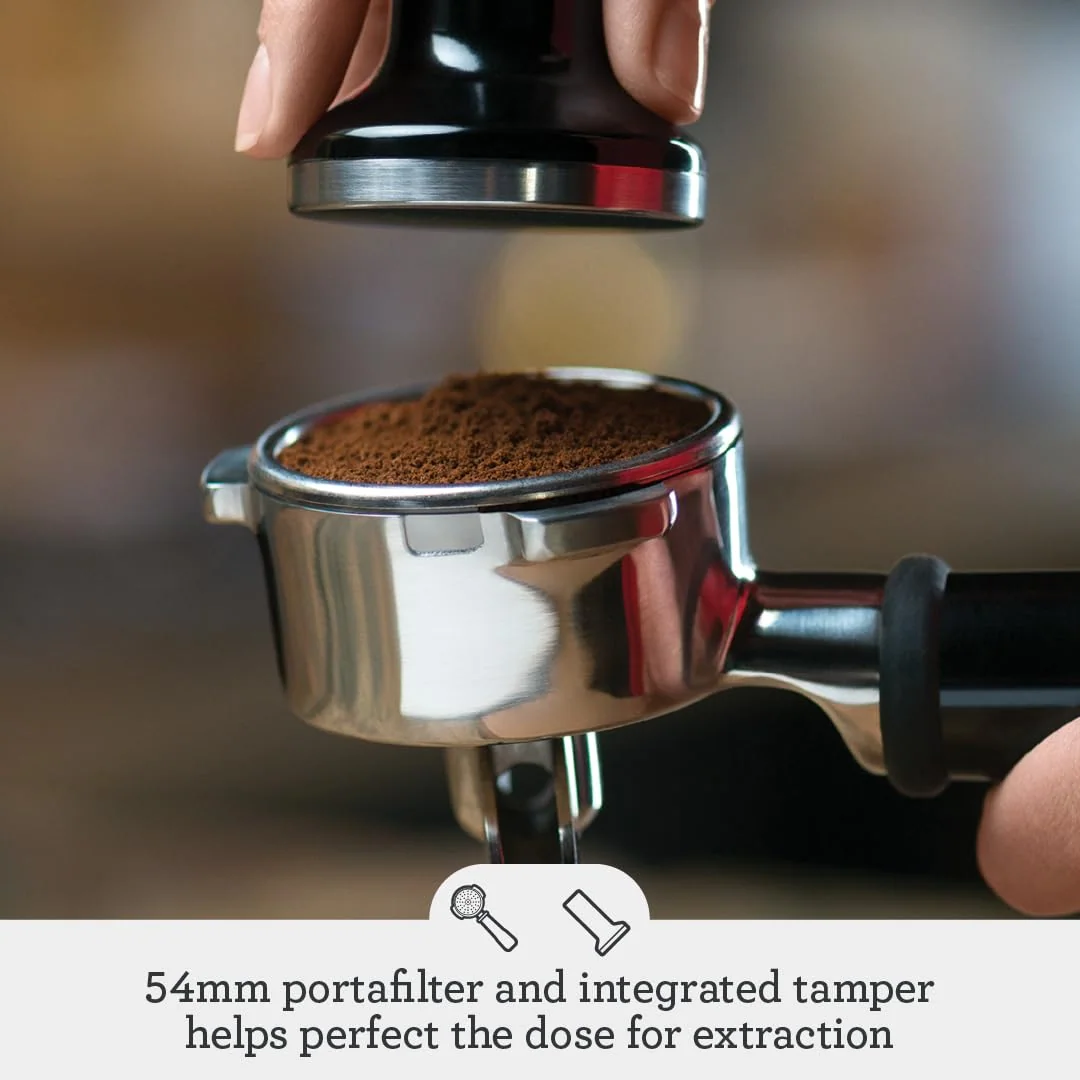
The single most important mechanical fact about this machine is that it doses by time, not by weight. The grinder runs for a set number of seconds and whatever falls into the basket is your dose. Change the grind size and the same number of seconds delivers a different weight of coffee, so every grind adjustment silently invalidates your dose setting. Coffeeness names this as his least favourite thing about the machine and recommends a scale twice in the same review. Owners arrive at the same conclusion independently: one Amazon reviewer says plainly that he weighs his beans every time rather than trusting the timer. Budget for a scale with the machine, not later.
Here is every published starting point in one place, because the numbers are scattered and they contradict each other in an instructive way.
| Setting | Figure | Source of the number |
|---|---|---|
| Opening grind setting | 14 of 30 | Breville's own advice, via a five-year owner |
| Grind that worked on a rested medium-light blend | 18 of 30 | A reviewer who bought and dialled the machine |
| Dose in the double basket | 18 to 19 g | Breville's masterclass and the same reviewer |
| Target in the cup from a double | about 2 oz, or 38 g by weight | Breville's masterclass and the same reviewer |
| First drips at the spout | around 10 seconds | Breville's masterclass |
| Total shot time worth accepting | 22 to 37 seconds | Breville's masterclass |
Breville's own trainer is unusually good on the method: never move more than two or three grind steps at once, or you will chase your tail. Food & Wine's household ended up with two saved profiles because one of them prefers 25 seconds and the other prefers 30 for the same beans, which is exactly what the eight custom slots are for. The reviewer who landed on grind 18 also reported that the shots were genuinely consistent once he found the window, with citrus, red fruit and caramel, and that finding the window took him a while even as a professional.
Three things that make people think the machine is broken
The first is the three second heat-up, which is true and misleading in the same sentence. The ThermoJet brings the water to temperature almost instantly, but it does not bring the group head and the portafilter with it, and the reviewer had to run the hot water function through the portafilter and flush the head before the machine performed. That is the mechanism behind a lot of the complaints about the first drink of the day, and it is the same mechanism explained on our page about coffee that comes out lukewarm. Pull a blank shot before the real one and the problem disappears.
The second is the pressurised basket. The machine ships with single-wall and dual-wall baskets in both sizes, and the dual-wall ones are for pre-ground or stale coffee. Use them with fresh beans you have just ground and you get impressive-looking crema that collapses instantly and a flat, unfixable flavour, which is precisely what happened to one owner who spent months blaming himself before the thread told him about the baskets. The same swap explains pucks that weld themselves to the basket and refuse to knock out. If you cannot dial the machine in at any grind size, check which basket is in the portafilter before you conclude anything else.
The third is the beans. Conical burrs at this price struggle with dense light roasts, and Breville owners hit that wall repeatedly: medium to dark is where this grinder is comfortable. This is not a defect, it is a ceiling, and it is not printed anywhere on the box. If your favourite roaster works in the light and bright end of the spectrum, this is the wrong machine, and our guide to which beans behave in a machine with a built-in grinder explains why the burrs mind so much.
Set your expectations from the honest end. One complete beginner who bought a Barista Touch on impulse got a latte better than her usual chain order out of the first shot, watched the second and third produce nothing at all after twenty seconds, and had the fourth and fifth come out better than the first. Two failures in the first five shots, and she kept the machine. That is the real first evening. On the ceiling rather than the floor, the fairest verdict on this page comes from an Amazon reviewer who gave it three stars: if you always add milk you will love it, and if you drink your espresso straight and know what a specialty bar tastes like, you will not.
New, remanufactured, or a different machine entirely
The certified remanufactured listing is the interesting one, and the arithmetic is simple even without naming a figure. You save a meaningful slice of the new price, and in exchange you accept six months of warranty in place of the two years Breville puts on a new BES880, on a machine whose best-documented failure mode tends to show up somewhere between eighteen months and three years. That is the trade in one sentence, and it is not automatically a bad one. Refurbished machines are a normal and respected way to buy in this category, as our guide to renewed and certified remanufactured machines sets out. It is a bad trade specifically if the new machine happens to be discounted heavily when you look, which Breville and Amazon both do to this model, and which can narrow the gap to almost nothing. Check both listings on the same day before you decide, because the saving is not a constant.
Espresso Den found no independent testing of the remanufactured units at all: every published hands-on review of this machine was carried out on a new one, mostly in brushed stainless rather than Black Truffle, and the finish is the only difference between them. What exists is eight Amazon reviews, and the most informative of them comes from a buyer who already owned a three-year-old Barista Touch and described the refurbished one as beautiful and better than new when it arrived. One data point in the right direction, not a pattern.
Three alternatives deserve honest mention. If you will not use the drink menu or the automatic wand, the Barista Pro sits below this machine with the same fast heating and the same thirty-setting grinder, and the reviewer who liked the Touch says outright that you should buy the Pro instead in that case. If you would rather put your money into grinding than into a screen, a Bambino Plus paired with a real grinder gives you the same automatic milk texturing from a much cheaper machine, and the Bambino Plus is the most consistently recommended espresso machine among the people who argue about this for fun; the difference between the two Bambinos is entirely that milk wand.
And if, having read this far, you have realised that what you wanted all along was to press one button and walk away, buy a super-automatic instead. The clearest account of that trade comes from someone who moved from a Breville with a separate grinder to a bean-to-cup machine: the Breville made better espresso, but with much wider variance, while the bean-to-cup machine is consistently good rather than occasionally great, and the convenience won. Higher ceiling, lower floor. One or two drinks a day favours the Breville, four or five favours the push-button machine. We set the two philosophies against each other directly in the Barista Touch against the Dinamica Plus, and the wider field is ranked in the best machine for a household that mainly drinks milk drinks. If you are simply weighing up Breville's own ladder, our roundup of the range is the shorter route.
What breaks, when, and what it costs to fix
This is not a horror story, but it is not bulletproof either, and the pattern in the evidence is uncomfortably specific. The component that fails most often on a Barista Touch is the temperature sensor that drives the automatic milk wand, which is to say the very feature you paid the premium for. An owner of eighteen months names it as a design weakness that wears out and throws error code 5, and advises anyone buying to take an extended warranty. A buyer on the remanufactured listing corroborates it from the other direction: his original Barista Touch was three years old when it gave an E05 thermistor code, and he bought the refurbished machine as a stopgap while the part shipped from Australia.
Around that sit the other documented faults. A one-star Amazon reviewer had a unit stop working outright at seven months, and rated the machine one star not for the fault but for the support that followed it. One long-term owner developed a steady internal drip into the drip tray at four or five years, had it repaired by Breville in a custom shipping box, and found the repair held only a few months before the leak came back worse. A Touch owner had the grinder die inside two months and Breville replaced the entire machine, which he described as a pleasant support experience. Espresso Den could not reconcile those support stories into a single verdict, because they genuinely diverge: the same company has replaced machines quickly for some owners and left others emailing into a void.
On money, the thing to hold in your head is that one BES880 owner facing a dead machine was quoted a repair bill amounting to well under half the cost of buying the machine again, and the owners who weighed in broadly called that fair. One useful warning from that same thread: do not attempt a factory reset to clear an error code, because the owner who tried it ended up with a machine stuck in setup mode on top of the original fault.
Against all of that, the durability evidence is decent. Breville owners in general report three, five and eight years of daily use with nothing worse than a seal and a deep clean of the grinder, alongside one hand-me-down that died soon after changing hands. One Amazon owner is three years in, using it twice a day, and says she has no complaints at all. There is no reliable average lifespan for this machine and anyone quoting you one has made it up, though the general shape of how long these machines last and what fails first holds here too.
Frequently Asked Questions
Is this the fully automatic Breville that keeps coming up in searches?
No, Breville does not make a true bean-to-cup machine of this kind, and the Barista Touch grinds and textures for you while leaving the tamping and the pouring in your hands.
Is the BES880BTR different from the BES880BSS?
They are the same machine in different finishes, Black Truffle and brushed stainless, so every review of one applies to the other.
What grind setting should I start on?
Breville suggests starting at 14 of the 30 settings, and one reviewer working with a rested medium-light blend ended up at 18, so treat 14 as a first guess rather than an answer.
Why does my first coffee of the day taste thin and lukewarm?
The fast heating system brings the water to temperature in seconds but not the metal, so run a blank shot through the locked-in portafilter before the real one.
Can it handle light roast beans?
Not comfortably, because dense light roasts push this grinder past its usable range, and Breville owners consistently report better results with medium and dark.
Should I buy the certified remanufactured one?
Only if the saving is genuinely large on the day you look, because you are giving up eighteen months of warranty on a machine whose best-known fault tends to surface after the first year.
How long will it last?
There is no trustworthy average, but owner reports across the Breville espresso range cluster between three and eight years of daily use with routine cleaning.
Is the Barista Pro a better buy than this?
If you will not use the automatic milk wand or the saved drink menu, yes, because the Pro shares the same grinder and heating system for less money.
Sources (8)
- Amazon listings and customer reviews — Breville Barista Touch
- Owner reports across r/espresso, r/BrevilleCoffee, r/superautomatic threads
- Owner and reviewer video, 4 channels
- Coffeeness — Article — www.coffeeness.de
- Breville — Article — www.breville.com
- Foodandwine — Article — www.foodandwine.com
- Thingtesting — Article — thingtesting.com
- Redditrecs — Article — redditrecs.com