Your milk drinks are lukewarm because the machine was built that way, and only some of that is fixable
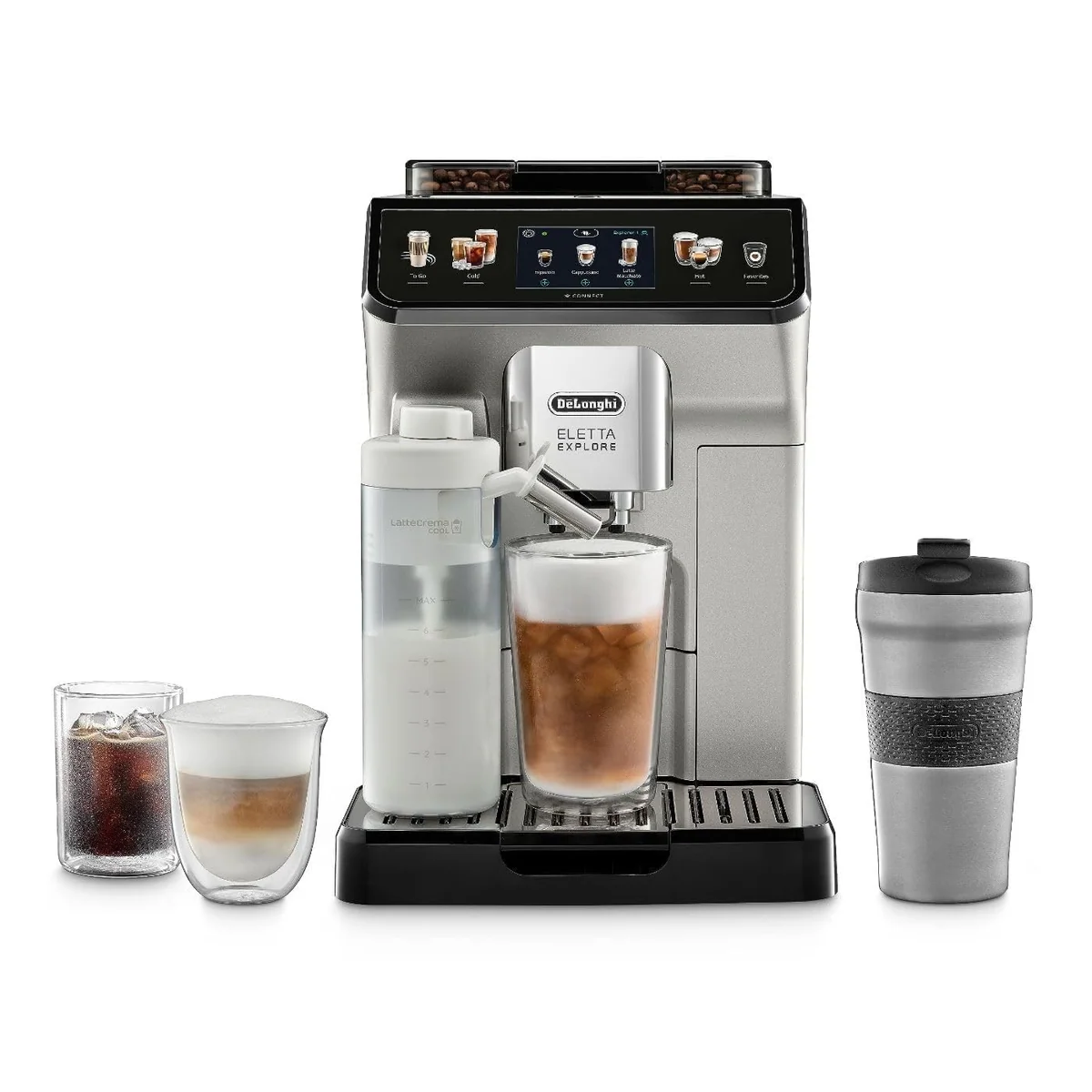
The most useful measurement anyone has published on this subject came from a man with a calibrated digital thermometer and a very expensive De'Longhi. His flat white left the machine at 125°F. Black coffee from the same machine, on the same probe, measured 157°F. He rang De'Longhi, had several conversations, preheated his cup as instructed, filmed himself making the drink, and was eventually sent a replacement unit. The replacement measured 125°F as well.
That is the whole problem in one story, and it is worth being precise about what it proves. Two machines behaved identically, so this was not a defect. Coffee came out thirty-two degrees hotter than milk on the same appliance in the same minute, so the machine is perfectly capable of making something hot. What it will not do is hand you hot milk, because the coffee and the milk take two different routes through the machine and only one of them is a heating system.
Espresso Den has not put a thermometer in any of these machines. Everything numeric on this page belongs to somebody who did, and we have named them so you can weigh each figure yourself. What we have done is set every measurement we could find beside every manufacturer statement we could find, and the two turn out to agree far more often than the complaints suggest.
The number your machine is aiming at
Start with the possibility that nobody wants to consider, which is that the machine hit its target and the target is lower than yours. De'Longhi has said as much for years: the house rationale for its LatteCrema system is that milk tastes sweetest below scalding and loses its apparent sweetness as it gets hotter, and the machine's own literature warns about curdling.
KitchenAid has gone further and put a number on it in public. When a KF8 owner posted that he had measured his flat white at 51°C into an unwarmed glass, KitchenAid's own customer service replied on the review to say that the milk temperature is not adjustable, that it is designed to arrive at around 57°C so that every kind of milk heats without burning, and that the fix they recommend is pre-warming the glass. That is not a company apologising for a fault. That is a company describing a specification.
Jura reaches the same place from the opposite direction. Its flagship compact machines advertise intelligent preheating on the box, and owners still measure a latte macchiato at about 141°F; when one of them took his machine to a Jura repair centre to ask about it, he was told the temperature was within specification and had been from day one.
| Drink and machine | Reading | Whose figure |
|---|---|---|
| Flat white, De'Longhi Eletta Explore | 125°F, on two separate units | An owner with a calibrated thermometer |
| Black coffee, same machine, same probe | 157°F | The same owner, the same morning |
| Flat white into a cold glass, KitchenAid KF8 | 51°C, about 124°F | An owner, answered in public by KitchenAid |
| Frothed milk, KitchenAid KF7 and KF8 | 135°F to 140°F | Owners, collected in our KF7 review |
| Warm, unfrothed milk recipes on the same machines | around 120°F | The same owners |
| Latte macchiato, Jura J8 twin | about 141°F, confirmed in specification | Two owners, plus a Jura service centre |
| Milk in the cup, Bosch 800 Series | about 110°F | An owner, in our Bosch 800 review |
| Black coffee, Bosch 800 Series | 129°F on one owner's thermometer, 135°F to 146°F on another's | Two Amazon owners who disagree |
| Steamed milk, Breville Bambino Plus | around 144°F | Coffeeness, with a wand rather than a carafe |
Read that column downwards and the spread is remarkably tight. Milk from a one-touch system lands somewhere between about 110°F and the low 140s regardless of brand, badge or price, and the machines that cost the most are not the ones at the top of the range. A chain café serves a latte hot enough to be uncomfortable, well north of anything in that table, which is why the gap feels like a malfunction to almost everybody who notices it for the first time.
None of the listings tell you this, and the language they use instead is worth learning to read. De'Longhi promises milk textured "to perfection" and cold foam at "the ideal temperature" without saying whose ideal it is. KitchenAid's bullet points advertise an "automatic milk frothing and heating feature" that gives you the exact amount of milk, which is a precise claim about volume standing where a claim about heat should be. Bosch sells the 300 Series with "steam wand" in its title and then describes what it actually has, an in-cup frother with an adjustable setting that adjusts duration rather than heat.
Why the milk always loses
A super-automatic has one heater doing two incompatible jobs. Brewing wants water at roughly 90 to 96°C arriving under pressure for about twenty-five seconds. Milk texturing wants steam, and it wants it for the two or three seconds the machine spends dragging your milk through a tube. Those two demands sit either side of a compromise, and the compromise is resolved in favour of the coffee, because coffee brewed too cool tastes sour and thin in a way that generates far more complaints than warm milk does.
Then look at what the milk actually goes through. It starts in the fridge at around 4°C. It gets pulled up a length of unheated plastic tubing, meets steam and a deliberate slug of air in a chamber the size of a thimble, and is dispensed through a spout that has been sitting at room temperature since yesterday. Air is the entire point of foam and air is also excellent at carrying heat away, which is why the thicker you set the froth, the cooler the drink lands. Nothing in that sequence is a heating stage. It is a mixing stage that happens to involve steam.
The espresso cannot rescue it either, because the espresso is the smaller half. A latte is mostly milk by volume, so the finished temperature is set by the milk with the shot making a modest contribution, and the cup takes its own cut before you get near it. A cold ceramic mug is a genuine heat sink; a thin glass latte vessel, which is exactly what these machines are photographed with, is worse.
Above all of that sits a real ceiling that no manufacturer can engineer around. Push milk much past about 70°C and the proteins and sugars change character, the sweetness goes, and it starts to taste cooked. A barista working a jug by hand stops just short of that line by feel. A machine with no feel and no jug has to be programmed to stop, and it stops early, because an appliance that occasionally scalds a customer's oat milk is a worse product than one that reliably runs cool. One reviewer who has spent longer with these machines than most puts the practical line exactly where it belongs: if you want milk at 60°C or above, you need a machine with a steam wand.
What actually moves the needle
Some of the advice circulating on this subject works, some of it is folklore, and one popular suggestion will damage your machine. Here is the order Espresso Den would work through, best first.
- Preheat the vessel, properly. Not a splash of hot water and a shake. Run the hot water spout or a full rinse cycle into the cup, leave it while the machine grinds, then tip it out at the last moment. The Eletta owner who was most upset about his flat white got his drink from unacceptable to fine by putting the cup in the microwave for two and a half minutes while he did something else, and the fact that a two-thousand-dollar machine needs that is annoying rather than untrue.
- Set brew temperature to maximum, and find out what it governs. On some machines the setting is global, which is why one Bosch 800 owner can report genuinely hot black coffee and lukewarm milk from the same appliance: the dial lifted the coffee and the frother's own ceiling held the milk down. On most one-touch De'Longhi and KitchenAid machines the milk temperature is not exposed at all, so turning the coffee up is the only lever you have.
- Order a smaller milk drink. This is the single most effective change nobody wants to hear. A cortado-sized drink is mostly coffee and arrives noticeably hotter than the same machine's latte, and it stays hotter because there is less of it sitting in the cup going cold while you read your phone.
- Run the milk twice. On the Bosch 300, whose temperature genuinely cannot be adjusted, an owner four months in gets an acceptable large latte by running the latte macchiato cycle twice and by extending the frothing time with the milk button, which is not a temperature control but does put more steam into the same volume.
- Drop the foam density where you can set it. Less air means less of the heat you paid for escaping into bubbles, and on machines that lock the ratio, choosing the drink with less foam in its recipe does the same job.
- Descale on the schedule, not when the machine finally shouts. Scale on a heating element is an insulating layer between the element and your water, so a limed-up boiler cannot deliver what its thermostat thinks it is delivering. Nobody in the public record has measured a machine before and after a descale to quantify the recovery, so treat this as sound physics rather than a proven number, and read what the cleaning routine actually involves before you assume you have been doing it.
- Warm the milk before it goes in the carafe, or the drink after it comes out. A Bosch owner writing a five-star review says plainly that she started warming the milk in the microwave first, and the man with the calibrated thermometer microwaves the finished flat white. It is the least elegant answer on this list and it is the only one that always works.
The thing not to do is force the frother. One Jura owner who moved up the range reports that running the milk system at its maximum temperature setting causes frothing problems over time, which is a bad trade: a few degrees now against a milk circuit that stops texturing properly later. If your machine offers a milk temperature setting at all, use it, but do not live at the top of it.
And be clear about what none of this buys. Preheating, maximising and shrinking will move a lukewarm latte into the range where most people stop complaining. They will not produce the drink you get from a café, because the café has a wand, a jug and a person deciding when to stop. If that is the drink you actually want, the honest answer is a different category of machine, which is the argument we set out in full in steam wand versus automatic frother.
How each of these machines behaves
Temperature is not evenly distributed across this market, and the differences are not the ones the marketing emphasises. Here is where each machine on this page actually sits, with the catch that comes attached to it.
| Machine | On temperature | The honest catch |
|---|---|---|
| De'Longhi Eletta Explore | The best hot foam in the category and the coolest headline measurement on this page, because the two facts are the same design decision seen from either end. | Everything on its cold menu except the cold brew is hot coffee poured over ice cubes it counts out for you, which we unpick in our look at iced modes. |
| De'Longhi Magnifica Evo, renewed | The same LatteCrema foam a tier down, with the milk temperature not adjustable at all and the coffee temperature shipped on a middle setting that owners should raise on day one. | The renewed listing carries a ninety-day warranty against the two or three years on a new machine, on a device whose failures often arrive in year two, which is the calculation we run in our guide to renewed machines. |
| De'Longhi Magnifica Start, manual frother | The temperature of the milk is entirely yours, because there is no carafe and no software ceiling, only a wand and a knob. | Its dose ceiling is small enough that long black coffee comes out thin, and the grinder is measurably louder than the machine it replaced. |
| KitchenAid KF6 | Fixed at the target KitchenAid states, with no milk temperature control of any kind and black coffee that owners describe as properly hot. | The foam is fine and silky for a latte and too light for a proper cappuccino, and no milk container comes in the box. |
| KitchenAid KF7 | Frothed drinks land hot enough to pass, and any recipe built on warm rather than frothed milk reads as tepid unless the cup is preheated. | The record contains a cluster of hard failures inside the first four months, including one owner on his third machine. |
| KitchenAid KF8 | Identical to its siblings, which is the point: the extra strength steps buy finer increments and not a hotter or larger drink. | Its brew unit needs pulling and rinsing by hand roughly weekly, and the machine's own cleaning cycle does not do that job. |
| Bosch 300 Series | No temperature setting exists, so the frothing-time workaround is the only lever, and owners are consistent that the milk is warm rather than hot. | Its listing title promises a steam wand and its own description describes an in-cup frother, and one owner's brew path died at four months. |
| Bosch 800 Series, black and stainless | The temperature setting is global, so black coffee genuinely runs hot while the frother caps the milk regardless of what the screen says. | There is no bypass chute for a single decaf, and every enthusiastic owner account we found came from a discounted purchase; the black one ships with the milk hose and the stainless with the carafe, and owners prefer the hose. |
| Jura J8 twin | The warmest one-touch figure in the table and the only one a manufacturer's service centre has confirmed on the record as correct rather than faulty. | You cannot remove or inspect the brew group, and the second grinder is the only thing here you cannot buy more cheaply elsewhere in the same range. |
| Breville Bambino Plus with Encore ESP | Three selectable milk temperatures and three foam textures on a wand that will also work manually, which is the actual answer to this whole page. | It is not a super-automatic despite where it is shelved, it cannot brew and steam at the same time, and its own espresso arrives cool because the group head and part-plastic portafilter stay cold until you flush them. |
Two rows of that table deserve pulling out, because they point in opposite directions and both are correct. The Bambino Plus bundle is the only machine here that hands you the temperature dial, and Breville prints the fact in its own bullet points; it is also a machine you grind for, dose, level, tamp and lock in yourself, which is a different life from pressing a button. At the other end, the Magnifica Start's traditional frother is a wand attached to a bean-to-cup machine, and owners report exactly what you would expect from that arrangement: the foam is perfect once you have practised, and not before.
If lukewarm milk is the specific thing that would ruin the purchase for you, that pair is the shortlist, and our pick for people who mainly drink lattes takes the argument further. If you drink your coffee black, none of this applies to you very much, and the machines built for black coffee run hot enough that the complaint barely appears.
When it is not the design, it is a fault
All of the above assumes your machine is working. Some are not, and the two cases are easy to separate if you know what to compare.
Run the hot water spout into a cup and take its temperature, then brew a black coffee and take that. If the water is properly hot and the coffee is not, the heater is fine and the problem is in the brew path: a clogged brew unit, a saturated puck screen, scale, or a group that has stopped sealing. That is a fault and it is usually a cheap one. If both are cool, the heating system itself is suspect. And if the coffee is hot and only the milk is cool, you have read the rest of this page and you already know the answer.
Two specific failures in the record look like temperature problems and are not. A Bosch 800 buyer at about three weeks found his machine pouring warm water instead of coffee, opened the side panel on Bosch's instructions and found a broken part inside; the same brew path, on a Bosch 300, simply died at four months while the milk frother and the start-up rinse both kept working perfectly. A brew unit that has stopped brewing produces a warm, weak, wrong drink that looks for all the world like a temperature setting somebody has fiddled with.
Weak and cool also travel together for a duller reason, which is that a thin, under-extracted shot in a large cup of anything will taste like neither coffee nor heat. Before you chase degrees, rule that out with our page on watery bean-to-cup espresso, and if what you actually want is a large mug rather than a small strong cup, read what these machines can and cannot do with filter-style coffee first. Where a machine has aged into genuine unreliability rather than a bad afternoon, how long these machines last and what breaks first is the more useful page.
Where these figures came from, and it was not from us
Espresso Den owns none of these machines and took none of these readings. Every figure above is attributed to the person who produced it: an owner with a calibrated thermometer, a reviewer with a probe, a service centre giving an answer over a counter, a manufacturer replying in public on a retailer's review page. Where two owners of the same machine disagree, as the two Bosch 800 owners flatly do about black coffee, we have printed both readings rather than picking the one that made a tidier sentence.
Where we have reasoned rather than reported, we have said so. The account of why milk arrives cooler than coffee is mechanism rather than measurement, drawn from what the machines are and how they are built, and the claim that descaling should recover lost heat is physics that nobody in the record has tested on a kitchen counter. Nothing here is presented as a test we ran, because we did not run one.
So the verdict stands where it started: preheat, maximise, shrink the drink, and buy a wand if none of that is enough. What you should not do is send a working machine back, because somebody already tried that, and the replacement measured exactly the same.
Frequently Asked Questions
Why is the coffee hot when the milk is not?
They travel different routes, and the milk one is a two-second pass through unheated plastic where fridge-cold liquid meets steam and a deliberate slug of air, so it arrives at whatever that mixture settles at rather than at brewing temperature.
Is a lukewarm latte a fault I can have repaired?
Almost never, because one owner's replacement machine measured identically to the one it replaced and a Jura service centre told another owner his machine was inside specification.
What is the single most effective thing I can do?
Preheat the cup for longer than feels reasonable, since a room-temperature vessel takes its share of the drink's heat before you have lifted it.
Does turning the temperature setting up help?
It helps the coffee and usually does nothing at all for the milk, because most one-touch machines expose brew temperature only and cap the frother separately.
Should I just microwave it?
Owners of machines costing thousands do exactly that, warming the milk before it goes in or the finished drink after it comes out, and on a fixed-temperature carafe there is no better answer available.
Will a smaller drink really come out hotter?
Yes, because milk is the larger and cooler half of a latte, so dropping to a cortado-sized drink moves the finished temperature further than any setting in the menu will.
Can I turn the milk system's own temperature to maximum and leave it there?
You can, but one Jura owner reports that running the frother at its maximum setting causes frothing problems over time, which is a poor trade for a few degrees.
Which machine actually solves this?
One with a real steam wand you control, which on this page means the Bambino Plus bundle or the manual-frother Magnifica Start rather than any of the one-touch carafes, and if you want the wider field first, start from our roundup of the best super-automatics .