Breville does not make a super-automatic, and four of its listings will not tell you so
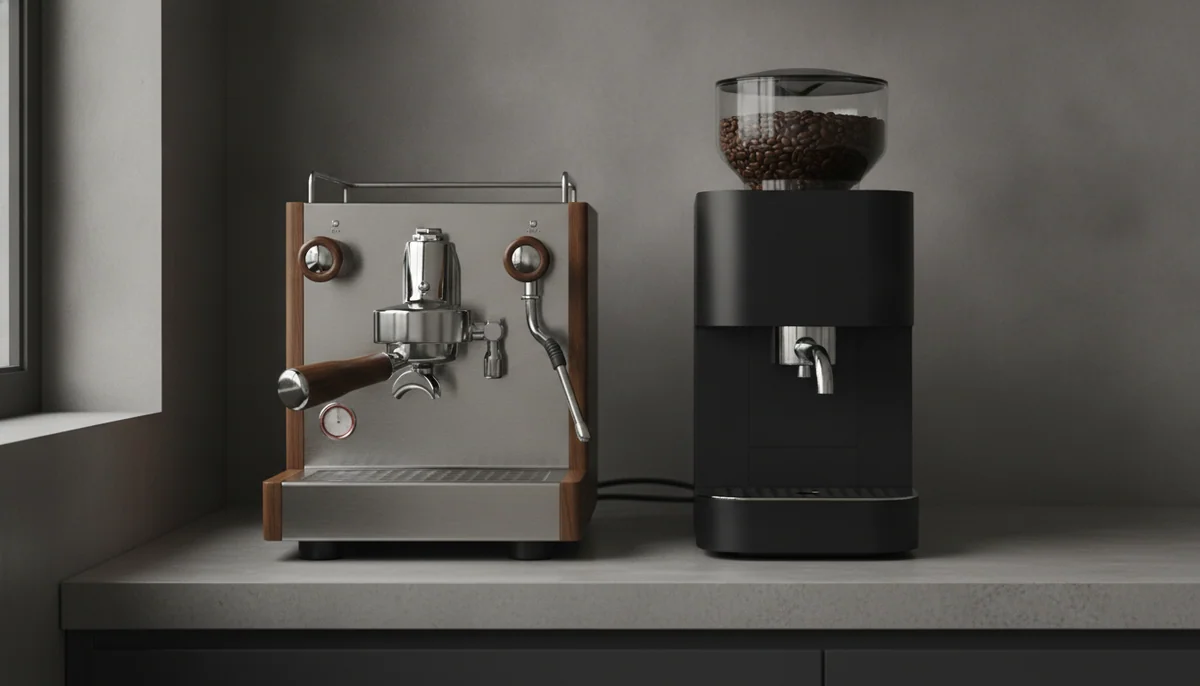
The confusion is not the reader's fault, because it is manufactured on the listings themselves. Amazon files four Breville machines under Super-Automatic Espresso Machines. The Oracle Touch's own description opens by announcing "the next generation of fully automatic espresso makers." The older Oracle's description calls it "a fully automatic espresso machine" in its first line. And the Barista Touch's copy calls the machine a semi-automatic espresso maker in the same paragraph as it promises café drinks in three easy steps, which is the only listing on the shelf that tells the truth and buries it.
The most honest phrase anyone at Breville has used appears in the company's own getting-started video for the Oracle, which calls it the world's first automatic manual espresso machine. That is exactly right, and it is the sentence the marketing department stopped saying. Espresso Den's answer to the question in the headline is a flat no, followed by a much more useful question: which parts of the job do you actually want handed over?
What a super-automatic is, and why no Breville qualifies
A true super-automatic has a sealed brew group inside it. Beans go into a hopper, the machine grinds them, compresses them in a chamber you never see, pushes water through, and ejects the spent puck into a bin. There is no portafilter, because there is nothing for you to hold. That single structural fact is the whole definition, and the longer version of it is worth five minutes if the category is new to you.
Breville has never built one. A reviewer who lived with the Oracle Touch for weeks put it plainly: retailers classify it as bean-to-cup, but it is a traditional espresso machine with a portafilter, real baskets and no brew unit inside. Epicurious reached the same conclusion more gently, describing it as not quite a super-automatic but as close as Breville gets. Both are describing the top of the range. Everything below it automates less.
The ladder, rung by rung
Here is the whole Breville proposition in one table, with a real super-automatic at the bottom for scale. Read down the column you care about most, because the machines differ from each other far less than they differ from the last row.
| Machine | Grinds and doses | Tamps | Carries the portafilter | Textures the milk | Clears the puck |
|---|---|---|---|---|---|
| Bambino Plus with Encore ESP | Separate grinder, you dose | You | You | Machine | You |
| Barista Touch (BES880) | Machine, into the basket | You | You | Machine | You |
| Oracle (BES980XL) and Oracle Touch (BES990) | Machine, 22 g | Machine | You | Machine | You |
| An actual super-automatic | Machine | Machine | No portafilter exists | Machine, into the cup | Machine, into a bin |
Notice that the fourth column never changes until the last row. Whichever Breville you buy, you pick up a hot metal handle, twist it into a group head, twist it back out, and knock a wet puck into something. That is the line the brand has chosen not to cross, and the three machines above it are separated by how much of the fiddly work happens before you touch it.
Bambino Plus with the Encore ESP: the least automation and the fewest lies
The bundle automates two things and is upfront about both: an automatic steam wand with three temperatures and three foam textures, and a shot volume roughly set for you. The wand is genuinely good, and Wirecutter, comparing it with the automated frothers it had disliked elsewhere, described the result as basically indistinguishable from a café. Everything else is on you, including the grinding, the dosing, the levelling and the tamping, and Serious Eats lists having to buy a grinder in its cons without softening it, which is the problem this particular carton was assembled to solve.
The drawbacks are real and worth naming before you get excited about the price. It has one heater, so it cannot pull a shot and steam milk at the same time. The espresso arrives cooler than it should, because the fast heating element warms the water and not the group head or the part-plastic portafilter, which Coffeeness graded the machine down for more than anything else. And the two halves of the box carry different cover, two years on the machine and one on the grinder, which nobody expects from a single price. If you want the full account, our review of the bundle goes through what wears out, and the two Bambinos compared settles whether the automatic wand is worth its premium at all.
Barista Touch: the grinding goes, the tamping stays
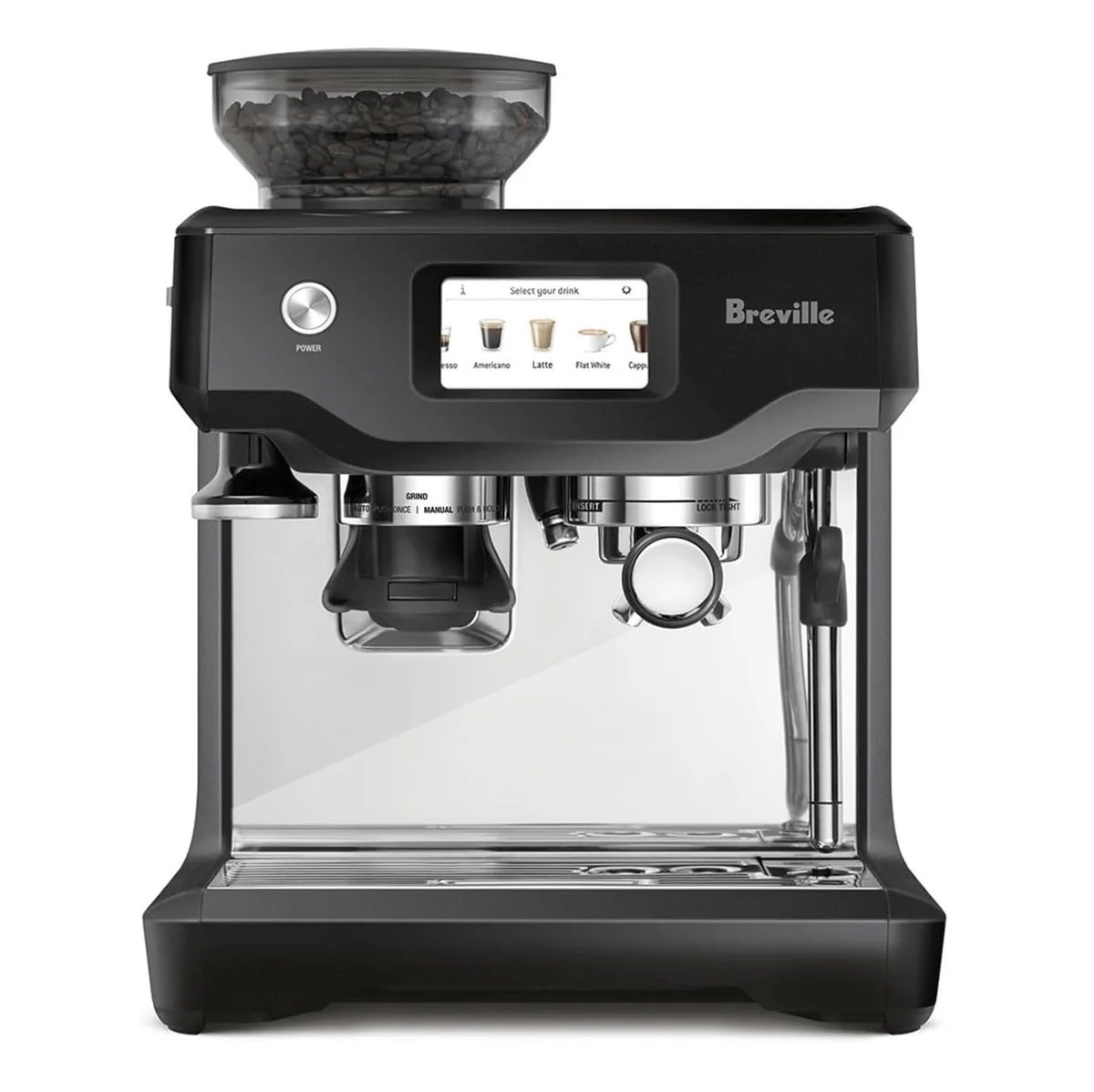
This is the machine most people actually mean when they search for a Breville super-automatic, and it is the halfway house. The grinder doses straight into the portafilter, the touchscreen holds five preset drinks and eight recipes you can name and save, and the wand takes milk to a temperature you set anywhere between 104 and 167 degrees Fahrenheit at eight levels of texture. That temperature range is the reason a five-year owner writing for Food & Wine can run soy at 130, oat at 140, almond at 130 and dairy at 150, and it is far more useful in practice than the drink menu above it. The retailer who sells the whole range pitches this model precisely at people coming off a super-automatic who want better coffee without doing everything themselves, which is an unusually accurate piece of marketing.
What it hands back to you is the tamp, the pour and the grind size, and a reviewer who bought the machine and used it as a trained barista would is blunt that tamping is on you and that this will be a deal-breaker for some buyers. Three specific faults deserve to be on the table before you act. The grinder doses by time rather than weight, so every grind adjustment silently changes how much coffee lands in the basket until you reset the timer. Dense light roasts sit outside what these conical burrs handle comfortably, which quietly rules out a whole style of coffee that appears nowhere on the box. And the component owners most often report failing is the temperature sensor behind the automatic milk wand, which is to say the feature you paid the premium for: one owner names it as a design weakness that throws an error code and advises buying an extended warranty, and a buyer on the refurbished listing reports the same E05 thermistor code on a three-year-old machine. One more trap that has nothing to do with Breville's engineering: the box contains pressurised dual-wall baskets alongside the single-wall ones, and using the wrong pair with fresh beans produces crema that collapses instantly and flavour you cannot fix at any grind setting.
The certified remanufactured unit is the same machine in brushed stainless rather than Black Truffle, described as showing limited or no wear and arriving with the original accessories. The catch is the entire trade in one line: it carries a six month Breville limited warranty instead of the two years on a new one, which lands short of when this machine's best-documented fault tends to surface. Two of the eight reviewers on that listing docked stars purely because they had not registered that they were buying a refurbished machine, in a title that says so twice. Take it if the saving is genuinely large on the day you look, and read how renewed and remanufactured machines actually work first. Our review covers both listings.
Oracle and Oracle Touch: tamping automated, ceiling unmoved
This is as far as Breville goes. The integrated grinder automatically grinds, doses and tamps 22 grams for you, and the self-cleaning wand textures the milk on a dedicated boiler. Two physical moves and a jug of milk is the entire skill requirement, which is genuinely remarkable and still two moves more than the category name implies.
The constraints arrive fast. The dose is fixed at roughly 22 grams with no setting anywhere in the menu, and changing it means going into the grind and tamp station and turning an auger lock nut, which the Coffeeness reviewer called astonishing at this price. The machine brews to time rather than weight, running the pump for a set number of seconds regardless of what comes out, so every gram of dose drift lands in the cup as a different ratio. The grinder is the part that caps everything above it, and a long-standing member of the home-barista forums puts it at roughly the class of Breville's own standalone Smart Grinder, sitting inside a machine that costs many multiples of one. Owners report it degrading in ways that are not obvious from outside, with caked interiors and worn upper burrs behind a machine that has simply stopped grinding well. A repair technician who services these refuses to use the onboard grinder at all in his own testing, and separately flags the internal plastic diffusion plate as brittle enough that he never reuses one on a machine he is servicing.
Two more things belong in the open. Breville's own US product page for the BES990 now carries a discontinued notice and points visitors to newer Oracles instead, so the touchscreen flagship is a design its own maker has moved past. And the Amazon listing shows 3.4 stars from 596 ratings against the 4.3 Breville's own site reports, a spread wide enough that it is not noise. Where the Oracle earns its money is milk: the Epicurious reviewer, who steams by hand, said the automatic function produced better milk than she had ever managed herself, and added the corollary that matters most, which is that the machine is at its best for milk drinks rather than for a flawless straight espresso. The older BES980XL is the same automation behind an LCD instead of a colour screen, and the choice between them is mostly the screen; the long versions are in our BES980XL review and our Oracle Touch review, and the Barista Touch against the Oracle Touch is the comparison most buyers actually agonise over.
The four jobs no Breville will ever do
Whatever you spend, four things stay yours. You choose the grind size and re-choose it every time you open a new bag, because none of these machines tastes the coffee. You move the portafilter, which sounds trivial until you have done it half-asleep with a hot handle. You clear the puck into a knock box or a bin. And you pour the milk out of a jug and into the cup, which is the step that separates every machine on this page from a one-touch carafe, a distinction worth understanding before you buy in the argument between a wand and an automatic frother.
There is a fifth, unlisted job: warming up properly. The Oracle's boilers want five to ten minutes to reach temperature and longer again for the group head and portafilter to stop stealing heat from the shot. The fast-heating machines below it are ready in seconds only in the sense that the water is, which is why a first coffee of the day tastes thin unless you flush the group first. None of that is a defect. It is what owning a portafilter machine is, and the whole category is on the other side of that line.
If it was the walking away you actually wanted
Then buy a super-automatic, and buy it without apology. The clearest account of the trade comes from someone who moved from a Breville and a separate grinder to a bean-to-cup machine and found that the Breville made better espresso with much wider variance, while the bean-to-cup machine is consistently good rather than occasionally great, and that the convenience won. Higher ceiling, lower floor. One or two careful drinks a day favours the Breville; four or five on a weekday morning, made by more than one person, favours the machine with no portafilter in it.
The honest alternatives on this site are the Philips LatteGo range, which pours the milk into the cup for you and is laid out rung by rung in our guide from the 1200 to the 5500, and De'Longhi's ladder, which we take apart in Magnifica Start through Eletta Explore. If you want the single shortest route, the Magnifica Evo is the sensible landing spot for someone who wants coffee rather than a craft, the 5500 LatteGo is the one to read if milk drinks are the point, and the full roundup ranks the field. Whether the automation is worth paying for at all is the wider question, and we have answered it separately.
The reverse case is just as clean, and the fairest statement of it came from an Amazon reviewer who gave the Barista Touch three stars: if you always add milk you will love it, and if you drink your espresso straight and know what a specialty bar tastes like, you will not. That sentence sorts most of the people arriving at these listings. If you want a milk drink better than the one you are buying on the corner and you will accept two physical moves to get it, Breville's ladder is a good one and our range guide puts each rung in order. If you want to press a button and leave the kitchen, no amount of reading will turn a portafilter into a brew group, and the machine you are picturing has somebody else's name on it. If you land between the two, the Barista Touch set directly against a Dinamica Plus is the page where the two philosophies argue it out.
Frequently Asked Questions
Does Breville make a bean-to-cup machine at all?
No, every Breville espresso machine uses a portafilter you lock in and empty yourself, so none of them has the sealed internal brew group that defines the category.
Then why are they listed under super-automatic espresso machines?
Amazon's category is a shelf rather than a specification, and Breville's own listing copy on the Oracle and the Oracle Touch describes them as fully automatic, which compounds the error rather than correcting it.
Which Breville comes closest to a super-automatic?
The Oracle and the Oracle Touch, because they grind, dose and tamp 22 grams and texture the milk, leaving you only to move the portafilter, pour the milk and knock out the puck.
Is the Barista Touch fully automatic?
No, it grinds and doses into the basket and textures the milk, but you tamp every shot and pour every jug yourself.
What does the Bambino Plus bundle actually automate?
Only the milk texturing and a rough shot volume, which makes it the least automated machine on this page and the most honest about what it is.
Is the Sage version of these machines different?
No, Sage is simply the name Breville trades under in Europe, and the machine underneath is the same one.
Do any of these machines handle light roast beans?
Not comfortably, because the built-in conical burrs across the range are happiest with medium and dark roasts, which is a ceiling rather than a defect and appears nowhere on the box.
Will a Breville save me money against a café habit?
It can, but only if you actually make the drinks, because these machines reward a daily habit rather than an intention and every one of them asks for a few minutes and a clean-up.
Sources (10)
- Amazon listings and customer reviews
- Owner reports across r/BrevilleCoffee, r/superautomatic threads
- Owner and reviewer video, 5 channels
- Epicurious — Article — www.epicurious.com
- Nytimes — Article — www.nytimes.com
- Seriouseats — Article — www.seriouseats.com
- Coffeeness — Article — www.coffeeness.de
- Breville — Article — www.breville.com
- Foodandwine — Article — www.foodandwine.com
- Home Barista — Article — www.home-barista.com