The KitchenAid KF6 is a Swiss machine wearing an American badge, and the espresso is the best part of it
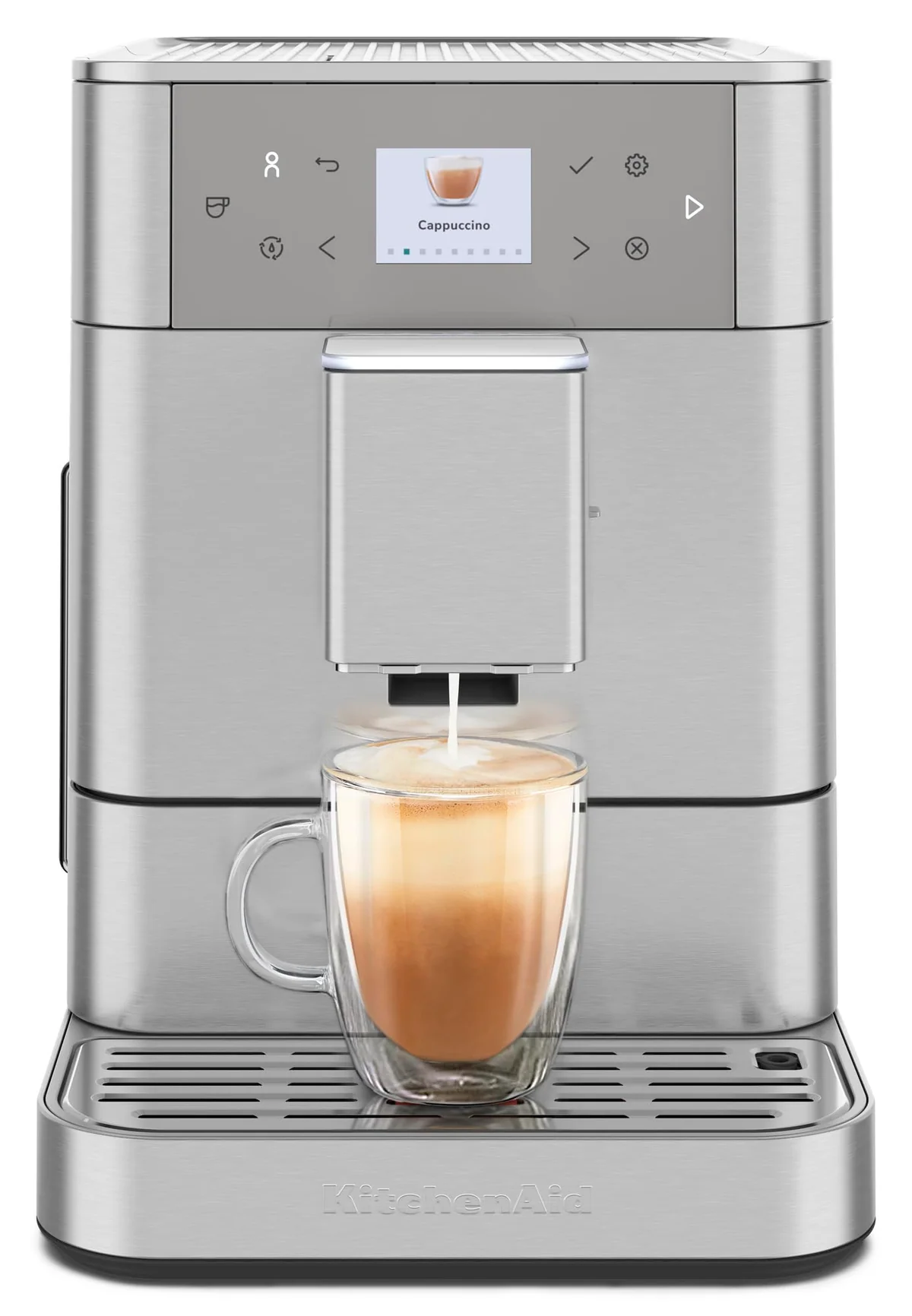
Buy the KF6 if you drink espresso, americanos and the occasional latte and you want a metal-clad machine with a brew unit you can pull out and rinse under the tap; skip it if dense cappuccino foam and scalding milk are what get you out of bed.
Based on 186 owner ratings, 11 owner discussions and 7 other sources. We have not tested this machine ourselves.
We earn a commission if you buy through our links, which does not affect what we say.
Read how this site works →
Who should actually buy this one
The KF6 is a specialist pretending to be a generalist. Strip away the recipe count and what you have is a quiet, heavy, Swiss-built espresso machine with an unusually large dose, a brew unit you can hold in your hand, and a hopper you can swap. That is a precise description of a machine for someone who drinks espresso and americanos, keeps decaf in the house for the evening, and wants to be able to see inside the thing they are cleaning. If that is you, it is one of the better buys in its class, and it belongs in the conversation with the machines we rate for black coffee and with the quietest super-automatics, where its Quiet Mark certification is not marketing but a measured result.
It is a worse buy for the household that lives on cappuccinos, wants scalding milk, or expects the box to contain everything the pictures imply. The fixed milk temperature is not a defect you can return, and the foam limitation is a design characteristic three reviewers found separately. Go in knowing that, warm the cup, run the strength down from maximum until the shot tastes like coffee rather than tar, and the KF6 will very likely be the machine that ends your coffee-shop habit. Go in expecting a latte at 65°C and you will be the next 1-star review.
Buy the KF6 if you drink espresso, americanos and the occasional latte and you want a metal-clad machine with a brew unit you can pull out and rinse under the tap; skip it if dense cappuccino foam and scalding milk are what get you out of bed.
Best for: It grinds quieter than almost anything else you can put on a kitchen counter and pulls a genuinely strong shot, but the milk is where the money stops working.
The first thing worth knowing about the KES8556SX is that KitchenAid did not design it in the sense most people mean. The machine is built in Switzerland by Eugster/Frismag, the contract manufacturer behind Jura, Miele and a run of European brands, and enthusiasts who have had the side panel off report that the brew unit is interchangeable with Miele's and shared with Melitta. One long-time owner of both put it bluntly: for practical purposes the KitchenAids are updated Mieles.
That is not a criticism. It is the single most useful fact for anyone deciding whether a stand-mixer brand can be trusted with an espresso machine near the top of the home price ladder, because the answer is that the coffee path is a decade-old European platform with a good record, and what KitchenAid added is the industrial design, the interface and the badge. Home Coffee Expert, who spent real time with this exact model, describes the casing as genuinely metal at a price where competitors are still using plastic.
The second thing worth knowing is where the money stopped. The KF6 is the entry rung of three, and the retailer who sells all three says the quiet part out loud in a video whose entire purpose is to upsell you: the taste of the coffee is the same across the range, and what you buy going up is user-friendly features.
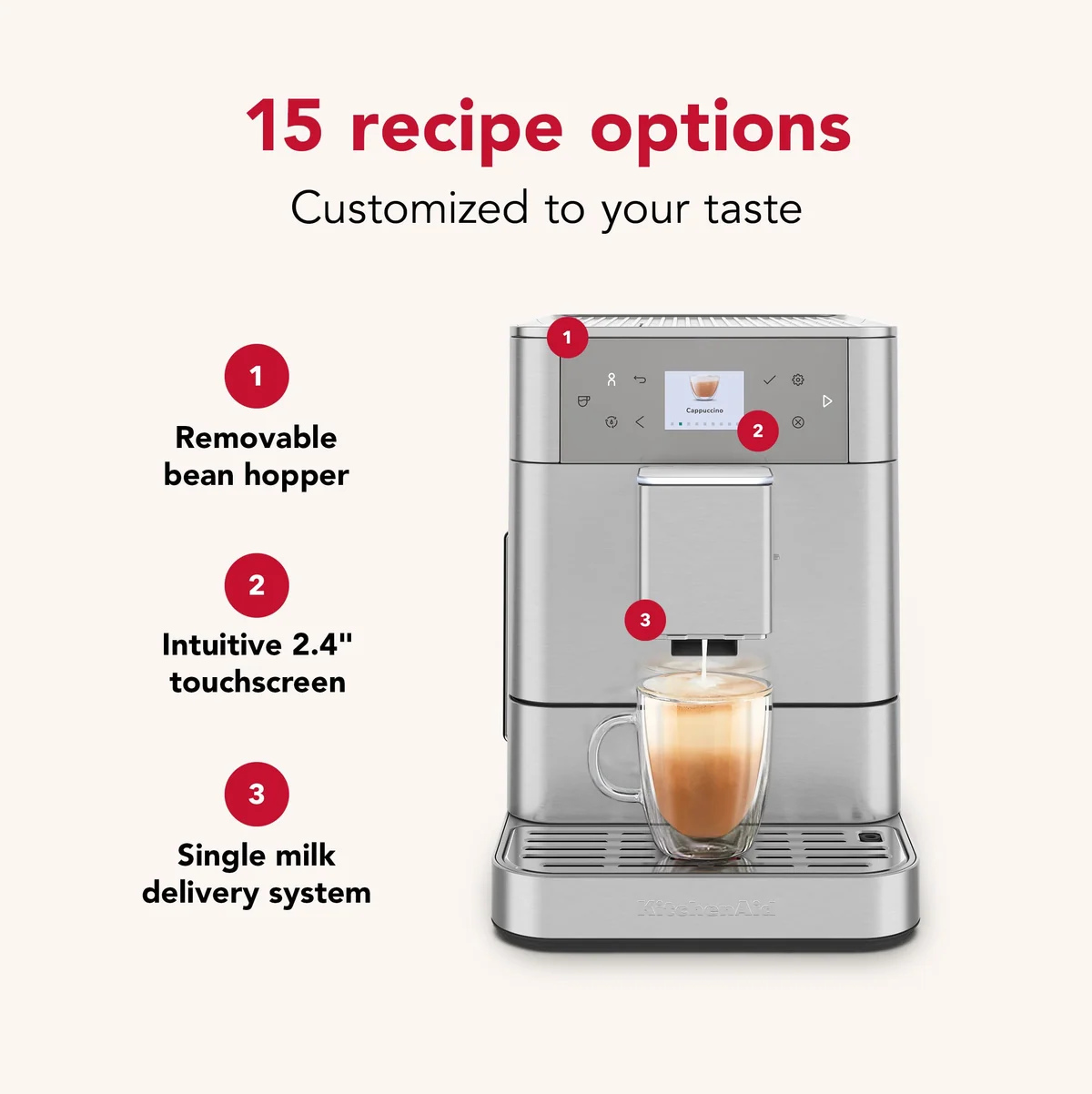
So the KF6 is the interesting one. It is also the one that arrives without a milk container, with a 2.4-inch screen you press buttons around rather than touch, and with a milk system whose temperature you cannot change. Espresso Den's read of the evidence is that those three omissions decide who this machine is for, and that the last one is the reason a good machine carries a 3.7-star average on Amazon rather than the 4.6 the brand's own syndicated reviews show.
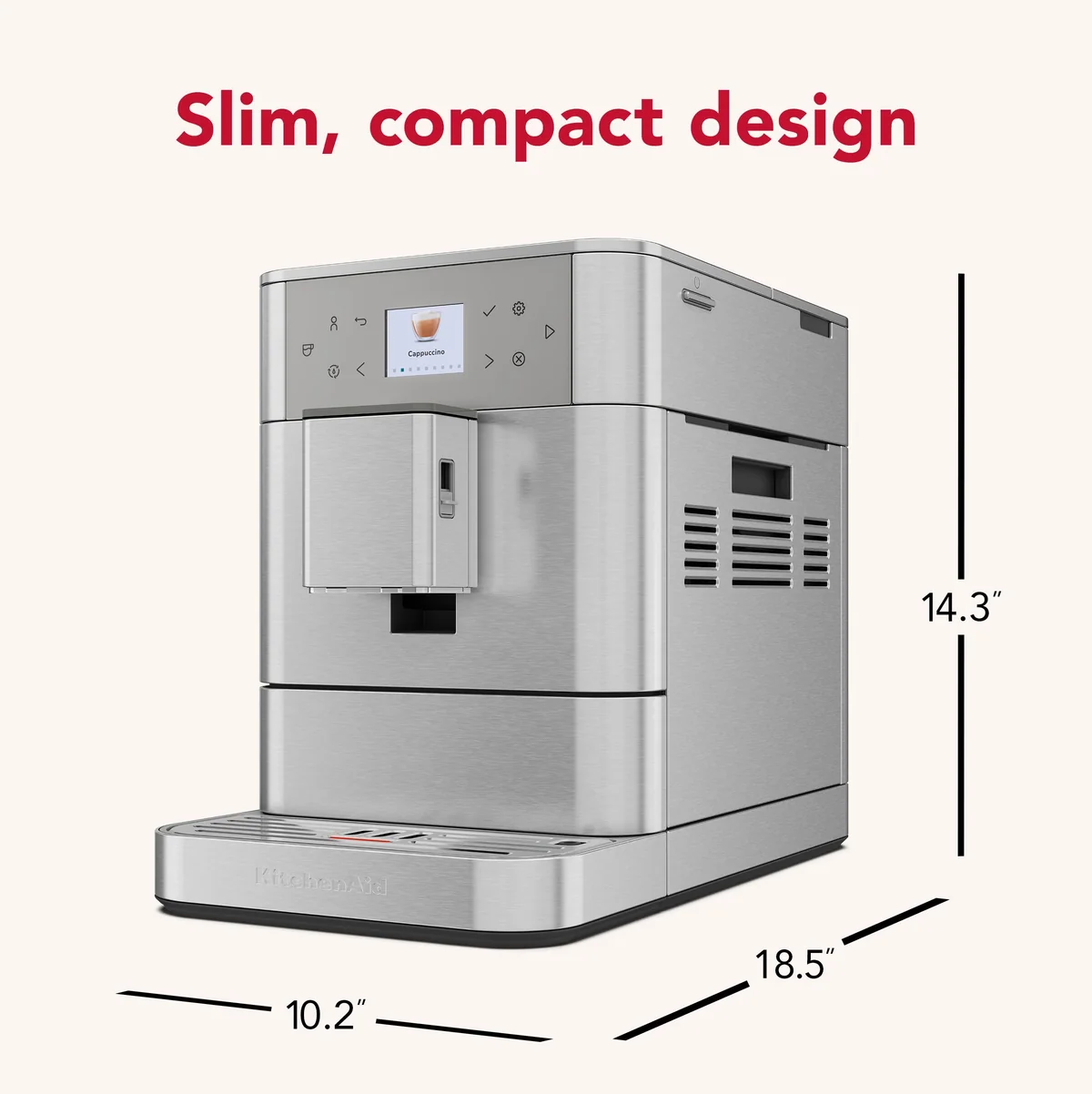
Key Specifications
What the metal actually buys you
The hardware list is short and mostly excellent. A 2.2-litre tank that slides out sideways and needs about an inch of lift, which matters if the machine lives under a wall cabinet, with a water window on the outside so you are not guessing. A stainless conical burr grinder with seven settings, adjusted behind the right-hand side panel next to the brew unit rather than down inside the hopper. Wheels on the back so 37 pounds of machine can be rolled forward for cleaning instead of dragged. A flat top that is a shelf, not a cup warmer: one reviewer put a thermal camera on it and found it sitting around 40°C after fifteen to twenty minutes.
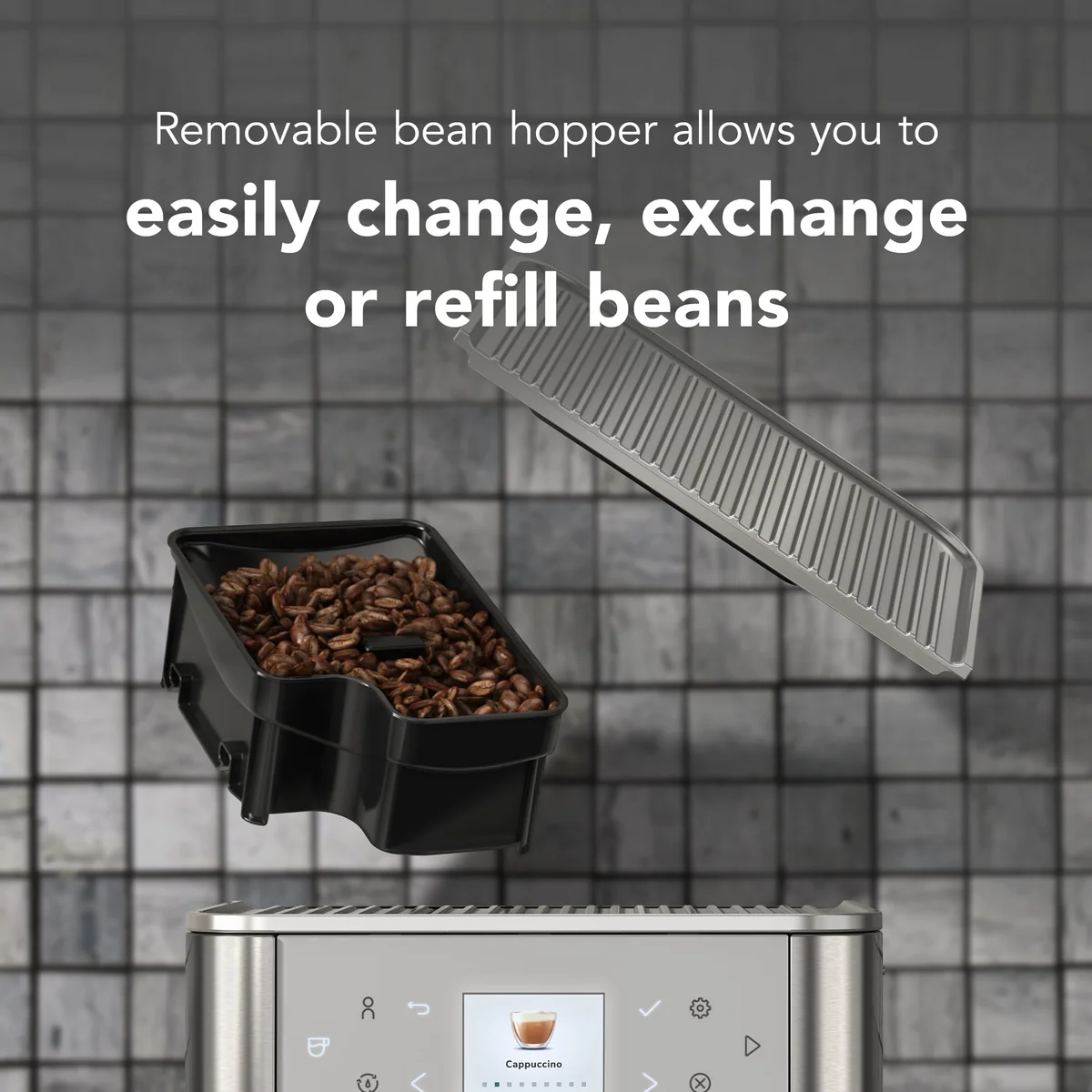
Two features are the genuine reason to choose this platform over a Philips or a De'Longhi at similar money. The brew unit comes out. You unclip the side door, pull the unit, rinse it, look at it. Owners who have lived with sealed machines are vocal about this, and one KF6 owner who has also owned a Jura and a Miele said the KitchenAid has been more reliable than either and is the only one whose internals they can reach.
The other is the removable bean hopper, which twists and lifts out. It is not a party trick. One owner keeps a second hopper loaded with decaf for their partner's evening coffee and swaps it in; the cleaning menu has a purge routine that grinds out whatever is left in the burrs so the next bean is not contaminated. The honest cost is that purging throws away roughly a shot's worth of coffee each time, and the machine ships with one hopper, so using the feature as intended means buying a second one from KitchenAid's accessories list along with the milk container that is not in the box.
Then the cuts. The screen is small, not a touchscreen, and both of the reviewers who spent the longest with the machine landed in the same place from opposite directions: it works fine, and they would still have preferred the touchscreen. There is no Wi-Fi and no path to a firmware update, which nobody wanted for remote brewing but several people noticed as an odd omission on a machine at this price.
And the milk system is a bare hose you drop into a jug of your choice. The listing calls this a feature, "simply place the milk hose into a separate milk container of your choice," which is a graceful way of saying the carafe is on the KF7. One reviewer called the tube alone a little sad; the retailer selling it recommends adding the milk container twice, unprompted, in his own demo. There is a real counter-argument, though: a hose has no carafe to disassemble, the machine flushes it with hot water on demand, and leftover milk goes straight back in the fridge in whatever it was already in. If you have read our piece on which milk system you will actually live with, this is the low-effort end of that spectrum.
Strengths & Limitations
Strengths
- Built in Switzerland on the same platform as Miele and Melitta, with a brew unit you can remove, inspect and rinse yourself.
- Independently measured at just over 60 dB while grinding and the mid-50s while brewing, against a class norm the same reviewer puts at 68 to 71 dB.
- A high dose for the category, roughly 14 to 15 grams at maximum strength, which is why the shots read as strong rather than thin.
- The removable bean hopper plus a grinder purge routine makes running decaf and regular, or two different beans, genuinely practical.
- Metal-clad casing, rear wheels and a tank that slides out sideways with an inch of clearance, which matters under wall cabinets.
- Two years of parts and labour in the US, and at least one owner's warranty replacement shipped the same day it was reported.
Limitations
- Milk arrives at a fixed temperature KitchenAid confirms is around 57°C and cannot be adjusted, and one owner measured his flat white at 51°C.
- Three independent reviewers agree the foam is too light and airy for a proper cappuccino, even though it suits a latte.
- No milk container in the box, so the machine most people want costs the price of the accessory on top.
- The two-cup button on a milk drink gives you a double shot with milk for one, not two drinks, because there is a single central milk spout.
- The cappuccino recipe pours milk before coffee and the order cannot be changed on this model.
- The factory settings are poor enough that both hands-on reviewers advise a week or two of dialling in before you waste good beans on it.
- The listing's "15 recipe options" is really seven drinks counted with their single and double versions plus hot water and warm milk.
- Owners report leaks under the drip tray, a start-up error about a chute that is already closed, and a "fill beans" fault that in one case arrived at the one-year mark.
Strong espresso, lukewarm milk
On coffee alone, this machine punches well above the bean-to-cup average, and the reason is dose. Home Coffee Expert puts the maximum at 15 grams; the reviewer who weighed his own pucks got 12 to 14 depending on the bean, and a KF8 owner who weighs everything reports a consistent 15. Call it high-fourteens, and compare that with the 11 to 11.5 gram ceilings on several rivals at the same money. A bigger puck with a fine grind is why owners keep describing the shots as strong rather than adequate. One KF6 owner coming off a De'Longhi said the machine makes a much stronger shot than his old one, to the point where he had to work down from maximum strength to find something drinkable.
Measured extraction backs that up. The independent reviewer who ran it for two months recorded TDS of 6 to 7 percent, thick stable crema, espresso landing in the cup at 167 to 170°F, and a heat-up of about 40 seconds. His verdict was that it gets about as close as this category can get, with the caveat that it demands patience. The ceiling is still real, and the same family of reviewers is honest about it: less body, less intensity and less crema than a portafilter machine you tamp yourself.
Now the drawback, and it is structural rather than a defect. The milk is not hot. A KF8 owner measured his flat white at 51°C and said he microwaves it. KitchenAid's own customer service replied on that review, and the reply is the most useful sentence in the entire research file: the milk temperature is not adjustable and is designed to arrive at around 57°C so that every milk type heats without burning, and the fix they recommend is pre-warming your glass. The KF6 has no milk temperature control either, only volume. Two independent reviewers volunteer the pre-heat-your-cup advice without being asked, which tells you how consistent this is.
Be fair about the scope of it. Black coffee reads as properly hot to owners, and a KF6 owner on the highest temperature setting says it comes out so hot he keeps it on medium. The KF8's stated brew temperatures run to about 96°C on the high setting, with KitchenAid itself specifying a tolerance of plus or minus 3°C. So it is milk drinks specifically, and if you drink a latte slowly in a cold cup you will notice. Our piece on why bean-to-cup milk arrives lukewarm covers why almost every machine in this class behaves this way.
Foam density is the second milk complaint, and three separate reviewers reached the same verdict independently: fine and silky enough for a latte, too light and insufficiently compact for a proper cappuccino. Coffeeness, writing about the KF7, called the foam acceptable without being anything special and not quite up to De'Longhi or Jura standards. If cappuccinos are your daily drink, this specific gap should send you to the machines we rate for milk drinks instead.
Two behaviours will confuse you in week one. The cappuccino recipe pours milk first and then coffee and you cannot reverse it, which one reviewer described as the wrong way round and wondered aloud whether the programmers had gone to lunch; coffee-first and milk-first selection is a KF8 feature. And the two-cup button on a milk drink does not make two milk drinks, because the KF6 has one central milk spout. The retailer explains it three times across two videos: press two on a café latte and you get milk for one and two shots of espresso, so it is really a double-shot option rather than a two-drink option.
Finally, the listing's boldest claim does not survive contact. "Automatic smart dosing technology allows you to get the right grind without the guesswork" is marketing for a machine whose factory settings both hands-on reviewers describe as bad. One says outright that it will take a week or two of fiddling with grind, strength, length and body before the espresso is what you want, and advises not to waste good beans on the first fortnight. Their two arrived-at recipes are close enough to publish as a starting point:
| Setting | Home Coffee Expert, KF6 | Coffeeness, KF7 |
|---|---|---|
| Grind | Second finest | Second finest |
| Strength | Maximum | Maximum |
| Body | Strong | Strong |
| Volume | 30 ml | 40 ml |
| Temperature | Medium | Medium |
One operating hazard goes with that: the grind adjuster must only be moved while the grinder is actually running, a warning Coffeeness prints with an explicit callout. And if your shots start fast and turn to drips halfway through, the advice from people who have chased it is to change the bean before you change the grind. Our guide to beans that suit a bean-to-cup grinder is the shortcut, and the standing rule applies here too: nothing oily, nothing flavoured.

KF6, KF7 or KF8, and the rating gap nobody explains
The upgrade case is weaker than the price ladder implies, and the most persuasive voices against upgrading are people who did. One owner bought the KF7 out of fear of missing out and says he does not think the extra money was worth it and that the KF6 would have done just as well for what he drinks. Another regular commenter's advice to a shopper agonising over it was to buy the KF6 and stop second-guessing, on the grounds that a husband will not taste the difference in his cappuccinos. Here is what actually differs:
| KF6 | KF7 | KF8 | |
|---|---|---|---|
| Display | 2.4 in, buttons | 3.5 in touch | 5 in touch |
| Milk container | Hose only | Included | Included |
| Two milk drinks at once | No | Yes | Yes |
| User profiles | 4 | 4 | 6 |
| Plant-milk mode | No | No | Yes |
| Choose pour order | No | No | Yes |
| Espresso quality | Identical across all three | ||
Flat white and cortado are the two drinks the KF6 genuinely lacks, and if you want either, the KF7 is the cheapest way to get them. The plant-milk setting on the KF8 is not, on the evidence, a reason to spend the difference: a KF7 owner ran oat milk through his and got a decent result, and one long-term owner argues the KitchenAid and Miele share the same hose terminal so there is little the machine could be doing differently. We lay the whole range out in our KitchenAid buying guide.
The rating gap deserves a plain explanation. Amazon shows 3.7 from 186 ratings for this listing. The brand's own syndicated reviews, the ones that appear on retailer pages, sit near 4.6. On the retailer page carrying KF8 reviews, most of the five-star entries are literally tagged as collected as part of a promotion, and even there, with a 79 percent five-star share, there is a stubborn tail of one- and two-star failures. Espresso Den's reading is that neither number is a lie: the machine that works is a 4.6, the tail that leaks or dies is a 1, and Amazon's buyer pool is simply less filtered than the brand's.
Where the KF6 looks weakest is Europe, and the criticism comes from people who own one. A UK buyer was asked directly why on earth he had bought a KitchenAid there when a near-identical Melitta costs a fraction, a Miele costs less, and a Jura S8 undercuts it. A French commenter in the same thread called the KF6 an entry-level experience at a flagship price. The KF6 owner's own reason for buying the entry model was that the pricing gets worse as you climb the range. In the US the calculus is different, because the machine's closest relative, the Miele CM53, is older and smaller in both tank and drip tray.
The most honest cross-shops are elsewhere on this site. A De'Longhi Rivelia is built around bean-swapping and ships with two hoppers, which is the KF6's headline feature done properly. The Eletta Explore does far more drinks including cold ones. A Jura ENA 4 makes lovely black coffee and very little else, and matching the KF6's functionality in a Jura means climbing to a machine priced against the KF8, which is the argument we work through in Jura versus KitchenAid.
Living with it, and what goes wrong
Start with the thing nobody warns you about: water consumption. The machine rinses itself on power-on and again on power-off, and a KF7 owner reports refilling the 2.2-litre tank two or three times a week for roughly three drinks a day. Other owners describe it as obsessive cleaning and shrug, because it is probably why the brew path stays healthy. A KitchenAid owner writing for The Kitchn about the newer compact line keeps an espresso cup parked permanently under the spout so she is not scrambling for a mug to catch the rinse. It is good advice for this one too.
The rest of the routine is genuinely light. The milk hose goes back into the drip tray and the machine purges it, and on the KF7 at least it nags you until you let it. The drip tray with its puck drawer wants emptying roughly every ten drinks. The brew unit gets a rinse under the tap every week or two and a cleaning tablet cycle around every 200 drinks, with two tablets in the box to start you off. Our general cleaning and descaling guide covers the rhythm.
One claim needs correcting, because a retailer makes it twice in two videos: that using the included water filter means you do not have to descale. That is not what the machine does. The reviewer who lived with a KF6 for two months reports the machine prompting for descaling and a guided cycle of around 45 minutes; Home Coffee Expert puts descaling at every couple of months; there is a full step-by-step procedure on video for exactly these models, and it requires you to remove the filter first. The filter stretches the interval. It does not abolish it.
Now the faults, reported by owners rather than found by us. Three separate people describe a brand-new machine refusing to finish start-up because it insists the ground-coffee chute is open when it is closed, one of them told by KitchenAid there was no fix and given a warranty replacement. A "fill beans" error crops up repeatedly, usually with dark roasts, and in the mild version it clears itself within a week; in the bad version, reported at almost exactly a year, the machine grinds, pre-infuses, then throws the error and jams pucks inside. Water appearing under the drip tray and running down the cabinet is reported by more than one owner. One owner found the aluminium surface corroding at eight months. And a well-documented failure mode is the brew screen clogging so the machine silently dumps coffee into the waste tray instead of the cup, which floods the drain and then leaks if you keep pressing the button; the fix is to pull the brew unit and rinse the screen with your thumb.
Against that, the longest-running accounts in the file are good. A KF6 owner making at least eight drinks a day on very hard water reported four brew-unit cleans and a first descale prompt at the four-month mark and nothing broken. KF7 and KF8 owners at the one-year mark describe daily use without a hitch. And one warranty story is worth telling in full: KitchenAid shipped a replacement the same day, before receiving the dead machine back, and agreed to let the owner test the replacement before deciding which unit to return to the retailer.
The counterweight is brand-level and it is fair to raise. KitchenAid's parent group has a poor consumer-complaint record across its major appliances, dominated by parts backorders and warranty runaround rather than anything to do with coffee. There are no espresso machines in that complaint pool at all, so it is not evidence about this product, but it is the service organisation you will be dealing with if the Swiss hardware fails outside the two-year US warranty. If longevity is your real question, we answer it properly in how long these machines actually last.
Frequently Asked Questions
Do you actually need KitchenAid's own water filter?
Owners with soft or already-filtered water widely say no and the machine asks during setup whether you are using one, though KitchenAid's position is that the filter slows limescale, so the honest answer is that it buys you longer gaps between descales rather than being mandatory.
Can you use cheaper cleaning tablets instead of KitchenAid's?
Owners report good results running generic brew-unit tablets such as Urnex or Durgol through KitchenAid, Jura and Miele machines alike, on the reasoning that a brew-unit tablet is essentially soap, and any descaler you buy simply has to be approved for fully automatic espresso machines.
What is the largest drink it will make?
A KF6 owner who checked reports a maximum of about 3 oz of coffee plus 9 oz of water on the americano, or 7.5 oz on the coffee setting, with the coffee setting being the one that also accepts the double-cup button.
Does it handle oat milk?
It will froth it, but plant milks are where the light-foam weakness shows most and one owner comparing it against a dedicated frother struggled to get dense foam from either barista oat or concentrated oat milk.
Should you wait for the newer, smaller KitchenAid machines instead?
KitchenAid's newer compact line is around 25 percent smaller and adds iced coffee, which the KF6 cannot do at all, so if cold drinks or counter space are your priority the newer range answers a question this machine does not.
Sources (9)
- Amazon listings and customer reviews — Kitchenaid Kf6
- Owner reports across r/superautomatic threads
- Owner and reviewer video, 7 channels
- Walmart listing
- Homecoffeeexpert — Article — homecoffeeexpert.com
- KitchenAid — Article — www.kitchenaid.com
- Coffeeness — Article — www.coffeeness.de
- Thekitchn — Article — www.thekitchn.com
- Pissedconsumer — Article — kitchenaid.pissedconsumer.com