The Philips 2200 Series is a very good long-coffee machine that keeps insisting it makes espresso
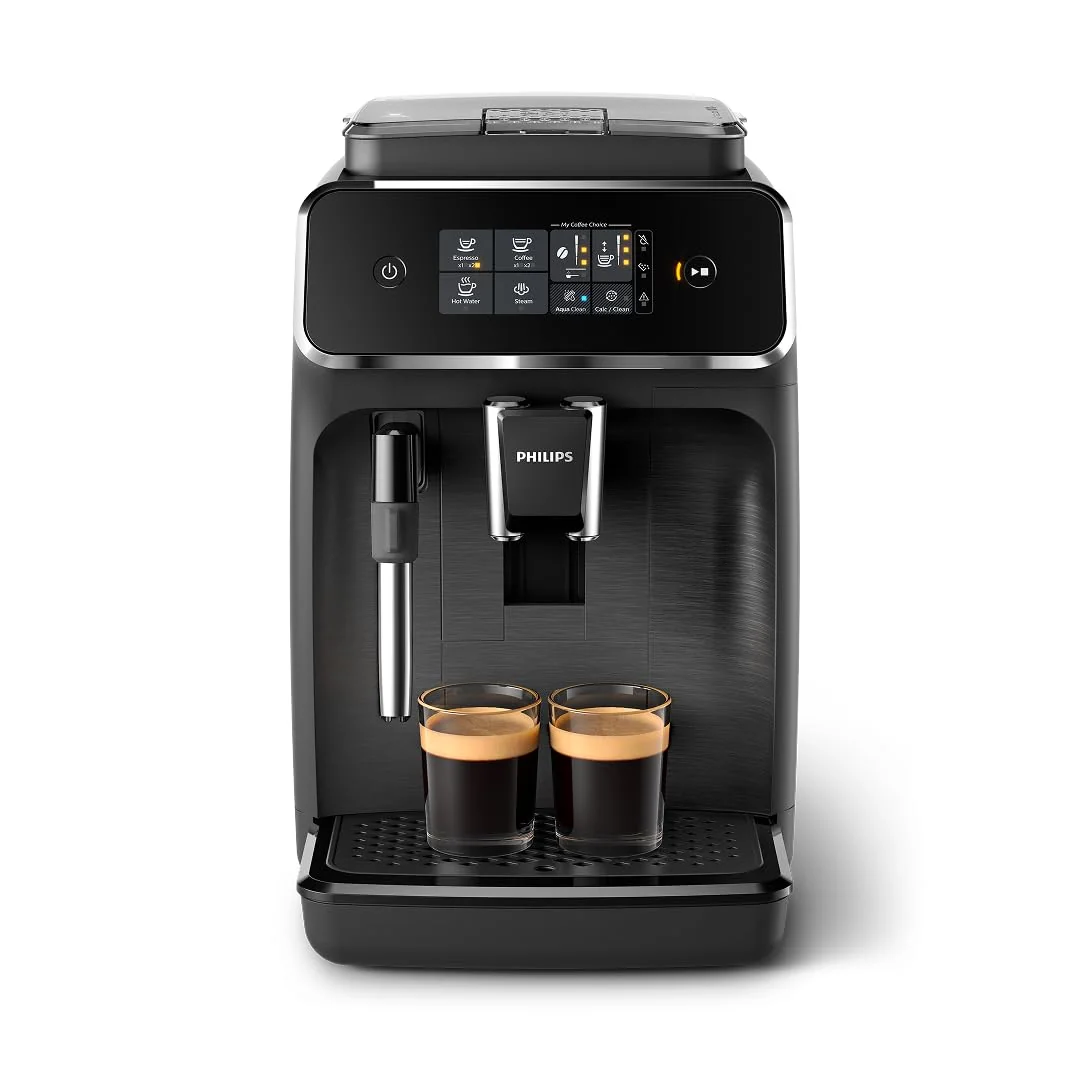
Buy the EP2220/14 if you want fresh-ground coffee from one button and will accept a mild, long shot and a manual steam wand in exchange for the same brew group and ceramic grinder Philips puts in machines with three times the buttons, but go in knowing that the failure reports on this listing are not about taste, they are about units that leak.
Based on 1400 owner ratings and 4 other sources. We have not tested this machine ourselves.
We earn a commission if you buy through our links, which does not affect what we say.
Read how this site works →
Who should press the button
Buy it if your morning is a strong black coffee or an Americano, you would rather grind fresh than open a bag of stale pre-ground, and the idea of steaming your own milk on the two days a week you want a cappuccino sounds like a small price for keeping the machine cheap and the cleaning trivial. Set the volume short, the aroma and temperature high, take the panarello off before you decide what the milk is like, and you will spend the next several years quietly pleased.
Do not buy it if you are coming from a portafilter and expect the same drink, because the puck is too light and the ratio too long for that to happen, and the reviewer who returned this machine as a self-described coffee snob was not wrong about what he was tasting. Do not buy it if you want one-touch cappuccinos, because that is a rung up the range and the machines that do it are on this site. And do not buy it without brewing on the first day and checking underneath, because the failure mode that shows up repeatedly in the reviews shows up immediately or not at all.
Buy the EP2220/14 if you want fresh-ground coffee from one button and will accept a mild, long shot and a manual steam wand in exchange for the same brew group and ceramic grinder Philips puts in machines with three times the buttons, but go in knowing that the failure reports on this listing are not about taste, they are about units that leak.
Best for: Two reviewers put the EP2220/14 puck on a scale and got ratios no barista would recognise, which matters less than you think, and far less than the water some owners found underneath a brand-new machine.
The listing sells a fully automatic espresso machine with three presets, one-touch operation and silky smooth milk, and finishes by claiming the machine pays for itself in about three months against a daily coffee shop habit. Two of those claims survive contact with the evidence, one survives only if you take a plastic sleeve off the steam wand, and the arithmetic on the fourth quietly assumes that beans, milk, filters and descaler are free.
None of which makes it a bad machine. It makes it a mislabelled one. What the 2200 actually does, reliably and without asking anything of you, is grind fresh beans, tamp them, brew a mild and pleasantly sweet long coffee, eject the puck and rinse itself on the way to sleep. Owners who wanted exactly that are delighted: one describes cracking the code to a perfect Americano inside a week after years of paying a famous chain for the same drink, and dismisses the shot-quality complaints as the coffee equivalent of arguing about art. Owners who wanted a portafilter shot from a button are not, and one of them returned it.
The drawback that deserves to be at the top, before any of that, is the failure pattern. Of the thirteen Amazon reviews retained for this machine, every single one-star is a hardware fault or a missing part, not a complaint about the coffee. One reviewer has bought this model three times: the first arrived with an internal leak, the second ran well for about four years before developing one, and the third arrived dead, producing no coffee, no puck, and water under the machine and in the used-grounds bin. A Spanish-language reviewer reports the same symptom independently, water escaping from underneath on the day of delivery, confirmed as defective by Philips after they sent video evidence. That is two people describing the same day-one fault. It is not a reason to avoid the machine outright, but it is a reason to unbox it in front of a sink, brew immediately, and look underneath before the return window starts closing.

Key Specifications
Three buttons, one boiler and a great deal of plastic
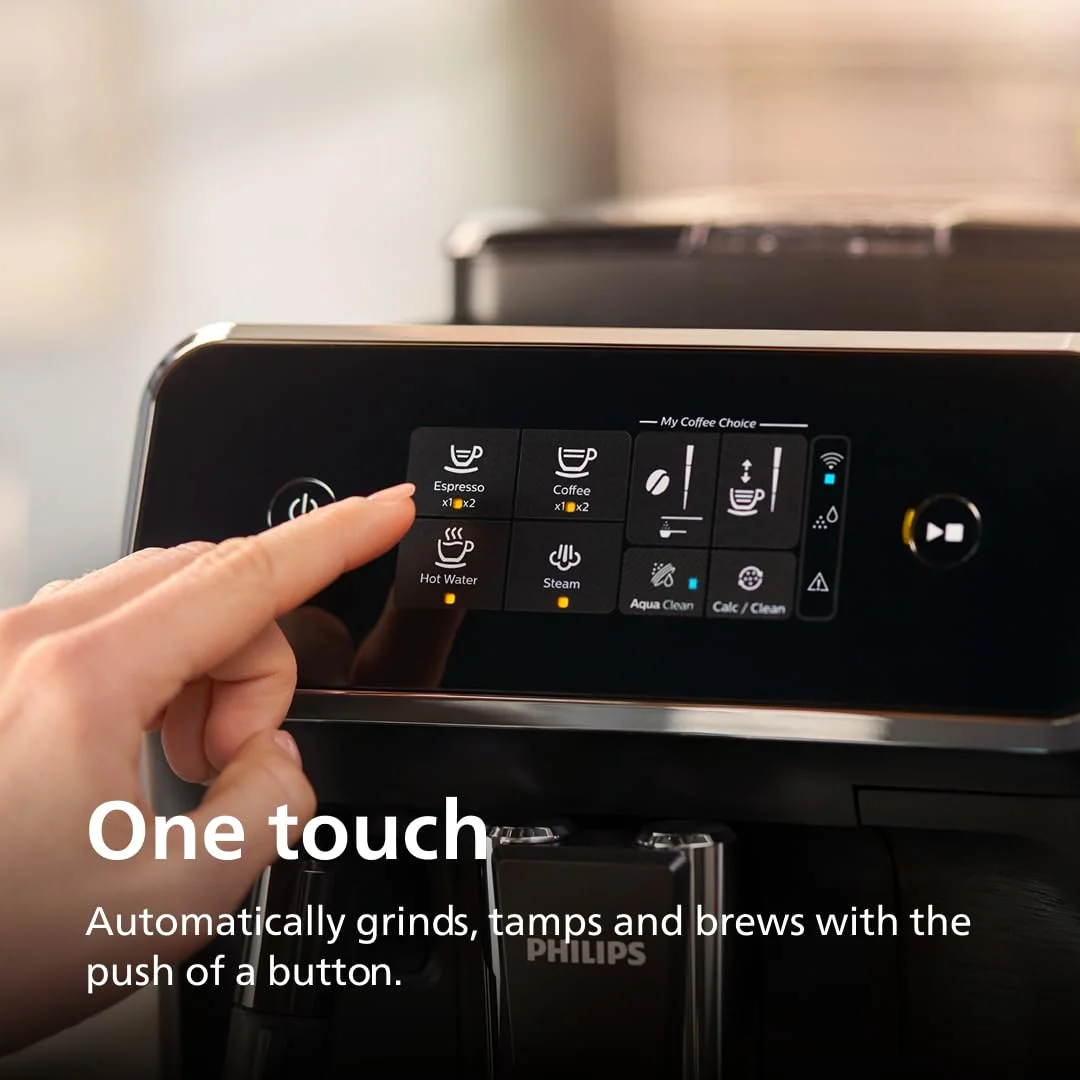
Start with the word display, because the listing leans on it. There is no screen. There is a panel of backlit touch buttons with illuminated scale icons that reads like a display from across the kitchen, which Coffeeness notes plainly while also conceding that it does not miss a real display here, since there is very little to adjust and you can see exactly what you are doing. That honesty cuts both ways: the layout is genuinely easy to learn, and the absence of a screen is exactly why setting the temperature or starting a descale involves holding a button and counting.
The rest of the specification is unglamorous and mostly sensible. A 1.8 litre tank that pulls out from the front, which matters more than it sounds if the machine lives under wall cabinets, as one owner's does. A 270 gram hopper under an Aroma Seal lid with a silicone gasket, big enough that another owner refills it roughly every ten days. Ceramic flat burrs with twelve grind steps. Fifteen bar pump, single boiler, 1450 watts, a shade over nine kilos, and a spout that adjusts to take cups from about 8.4 to 17.5 centimetres tall. Everything you touch is plastic, including the drip tray cover that other makers do in metal, which one video reviewer calls out as feeling cheap because it is cheap. Espresso Den will offer one defence of the plastic: the water tank is made of a slightly yielding, unusually stable grade that would probably survive a drop, where most tanks splinter.
The controls nobody tells you about
The most-searched thing about this machine is not whether it is good. It is where the manual went. One five-star reviewer, who otherwise loves the machine, opens their review with a caveat in capitals: no instructions in the box at all, a QR code that led to a 404, and a web address that funnelled them through filter offers and extended warranties in several languages until they gave up and worked it out by pressing buttons for a day. Other unboxings do show printed quick-start material in the carton, so this varies by box rather than being universal, but the search demand tells you how many people ended up in the same position.
So here is the part Philips buried. Every one of these is a press-and-hold on a button that appears to do something else.
| What you want | What you actually do |
|---|---|
| Raise the brew temperature | With the machine off, hold the cup-volume button for two to three seconds until the lights flash, then choose the top level. |
| Set water hardness | With the machine off, hold the bean button for three seconds and pick one to four using the supplied test strip. |
| Use pre-ground or decaf | One level scoop into the bypass chute, select the drink, then hold the aroma button for three seconds so the machine skips the grinder. |
| Activate a new AquaClean filter | Shake it for five seconds, hold it upside down in cold water until the bubbles stop, fit it, hold the AquaClean icon three seconds and press start. |
| Start a descale | Hold Calc/Clean for three seconds with a full bottle of Philips descaler in the tank and a 1.5 litre container under both spouts. |
Two more pieces of folklore worth killing here. The double-cup button does not pull a double shot: it runs two complete cycles back to back, grinding and brewing twice, which is why you can get four mugs of black coffee out of it in a couple of minutes if you select two cycles on the coffee setting. And the three warning lights, which people search for constantly and which carry no text, mean empty the dregs box in the middle, fill the water tank at the top, and a door open or drip tray not fully home at the bottom. If you want the whole hidden-menu tour rather than the abbreviated one, our guide to operating a Philips super-automatic covers the same ground across the range, and the pre-ground and decaf bypass has its own quirks worth reading before you waste a scoop.
Strengths & Limitations
Strengths
- The brew group and ceramic burr grinder are the same parts Philips fits to machines several rungs up the range, and in a controlled three-way test the shots were indistinguishable.
- Grind, tamp, brew, puck ejection and a self-rinse on both startup and shutdown all happen without you touching anything.
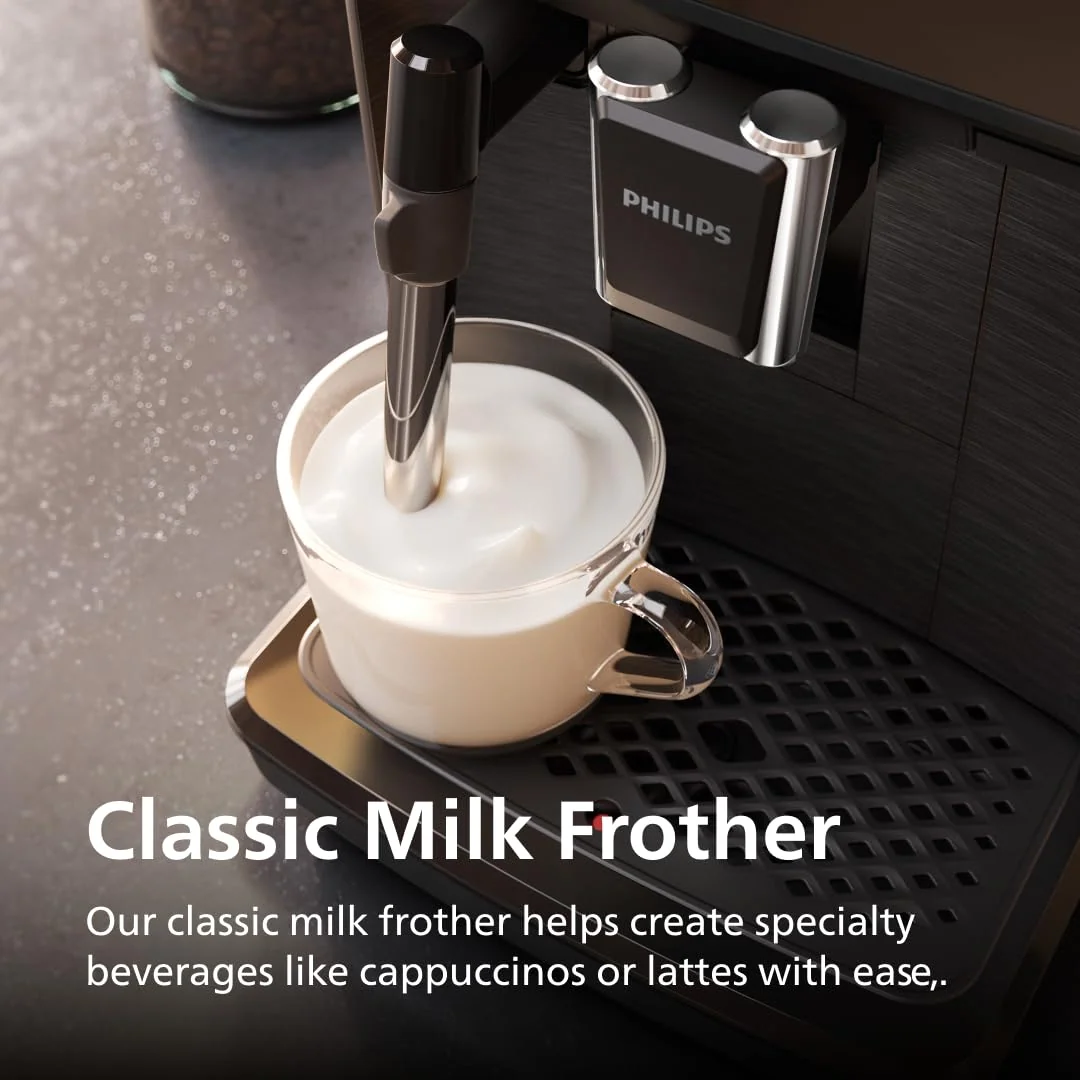
- Strip the panarello sleeve off the wand and the bare steam tip makes milk one experienced reviewer rates as nearly comparable to a normal espresso machine, silky enough for latte art.
- The 1.8 litre tank comes out from the front, which is the difference between usable and infuriating if the machine lives under a wall cabinet.
- The sealed 270 gram hopper means one owner refills beans only about every ten days.
- Hot water from the wand runs at around 84 degrees, which serves for tea and for preheating a cold cup before a short shot.
- With three buttons and no menus to speak of, it is learnable in an afternoon even if your box arrives without a printed word in it.
Limitations
- The dose is small enough that even the shortest, strongest setting produces a mild long coffee rather than anything a barista would serve as espresso.
- The milk system delivers large bubbles rather than microfoam until you remove the frothing sleeve the machine ships with and learn to steam by hand.
- The grinder can only be adjusted while the burrs are turning, one step at a time, and every step costs you several cups before you can judge it.
- Two owners independently report water pooling under a brand-new machine, one of them across more than one unit of the same model.
- A steam vent passes the grinder and leaves damp grounds caking inside the body, which is a cleaning job the marketing never mentions.
- Some US boxes arrive with no printed instructions and a QR code that lands on an empty page, which is why half this product's search traffic is people hunting for a manual.
- Every visible surface is plastic, down to the drip tray cover that the mid-range models do in metal.
- The pump is loud enough that two separate reviewers flag it, and there is no heated cup shelf to compensate for the small, quickly-cooling drinks it makes.
What a kitchen scale says is in the cup
This is where the machine stops matching its own badge. One reviewer stopped the cycle after the grind and weighed the charge going into the brew group: about 6 grams on the low aroma setting, about 7 on the high, roughly 6.5 in the middle. Volume out runs 30 millilitres at the shortest setting, about 40 in the middle and around 65 at the longest. His conclusion was blunt: at 6.5 grams in and 40 millilitres out you are at something like 1:6 or 1:7, which makes it a lungo if it is anything, and it is pretty good but it is not a classic espresso, and in fact it cannot be. A second reviewer weighed pucks from the same family of machines and consistently got 8 to close to 11 grams, noting that dose varies with the settings and with the density of the bean, and that even two examples of the same Philips can differ slightly.
Espresso Den is not going to pretend that disagreement resolves cleanly, because both people used a scale and both are experienced. What matters is that they agree on the direction: the dose is low for espresso, Philips designs these machines that way, and every gram you are short is a gram of resistance the puck cannot offer.
| Volume setting | In the cup | Ratio on a 6.5 g puck | Ratio on a 10 g puck |
|---|---|---|---|
| Shortest | about 30 ml | roughly 1:4.5 | roughly 1:3 |
| Middle | about 40 ml | roughly 1:6 | roughly 1:4 |
| Longest | about 65 ml | roughly 1:10 | roughly 1:6.5 |
The practical instruction falls straight out of that table, and both reviewers arrive at it independently: use the shortest volume. Aroma to maximum, temperature to maximum, volume to minimum, and you are brewing something in the 1:3 to 1:4.5 range, which is a proper drink. Leave the volume where Philips sets it and you are drinking a mild long black with crema on top. There is a factory oddity here too, noted with visible puzzlement in the Coffeeness review: Philips presets the reference volume lower than normal, so setting the machine up for the first time means increasing it rather than trimming it back. One owner puts the same thing in plainer language, saying you simply have to get used to this machine's idea of cup sizes.
Temperature holds up better than the ratio does. A short shot came off at around 68 to 70 degrees Celsius, the long coffee setting at about 72, and the hot water spout at 84, which is honest tea water. And when the 2200 was put alongside the 3200 and the 5400 with the same beans and the same settings, the shots weighed 37, 32 and 35 grams respectively and no meaningful difference in taste or temperature could be identified between them. Hold on to that finding, because it decides the buying question later.
The grind, and why dialling it in costs you cups
Adjusting the burrs on a Philips is a genuine irritation. The knob sits inside the bean hopper, it can only be turned while the grinder is actually running, because a hopper full of beans jams it solid otherwise, and you are told to move one step at a time to avoid damaging it. Then you have to brew a few more cups before the new setting has fully worked through. One returning buyer is scathing about the compound effect, pointing out that going from coarse to fine costs you several cups just to see the difference, and that the manual's instruction not to touch the grinder for the first hundred cups or first month is far too long to wait for a decent coffee.
Where should you actually set it? The two most careful sources contradict each other outright. Coffeeness settles on level 3 of 12 and deliberately refuses to go finer, arguing that an economy machine like this is susceptible to blockages and overloaded pumps, and adding the sceptical aside that twelve settings is partly a marketing device to attract people who know what grind size means. Cafelista goes to the finest position available and finds that even then the water passes through the puck a little too easily. Both can be true on different machines with different beans, which is the honest answer: start mid-fine, move one step, brew three cups, and judge. If the drink gushes and tastes thin, go finer; if it tastes harsh, go back. Our explainer on why bean-to-cup espresso comes out watery works through the same loop in more detail, and if the drink is fine but lukewarm, that is a separate problem with a separate fix.
One more piece of advice that contradicts the machine's own button: if you want a long coffee or an Americano, do not send more water through the puck. Put hot water in the cup from the steam wand first and drop a single or double espresso on top, because running the long setting risks over-extracting into bitterness. That trick also preheats the cup, which takes ten to thirty seconds and makes a real difference to a drink this size. There is no heated cup shelf on the 2200, and at least one reviewer calls that a missed opportunity. The same approach is worth knowing if you mostly want a normal mug of coffee out of a machine like this.
The milk, and the single best thing you can do to this machine
As shipped, the wand wears a panarello, the plastic sleeve that drags air in through a pinhole and does the frothing for you. It produces a great deal of foam and very little of what anyone would call silk: big bubbly foam, in the words of one reviewer who could not get a flat white or latte art out of it after several attempts, because the sleeve's wide opening makes microfoam hard. Another describes the result as very, very frothy but not really silky, a traditional cappuccino with large bubbles sitting on top.
Then he took the sleeve off. Steaming on the bare single-hole tip, positioned to the side of the pitcher to get a whirlpool going while injecting air, he got milk he described as very good, nearly comparable to a normal espresso machine, silky enough to put a heart on top and to practise latte art with. The two jugs poured side by side in the same video are not close. This is the highest-value thing on this page: the machine's weakest advertised claim becomes its quiet strength the moment you remove a piece of plastic and buy a proper pitcher. It is not free, of course. You are now steaming milk by hand, which means learning to keep the tip submerged, working in bursts of five to ten seconds, and wiping and purging the wand immediately afterwards so milk does not dry inside it. The single boiler also means you wait between brewing and steaming while the machine changes gear, and you cannot do both at once.
Use a jug with enough volume to get the milk hot before the froth reaches the brim, and expect roughly 65 degrees in the pitcher landing at around 53 to 55 in the glass. That is warmer than the one-touch 3200 managed in the same test and cooler than the 5400, which is the trade you are making. Whether you want that trade at all is really the question in our guide to steam wands versus automatic milk systems. At least one owner is emphatic about which side they are on, saying the wand pops off and rinses in seconds and that a milk carafe would be a nightmare to clean by comparison.
The cheapest door into a Philips brew group
Here is the finding that should decide your purchase. The 2200 is, in hardware terms, the 800, the 1200 and the Carina under different badges, and the brew group inside it is the same one Philips fits to the 3200 and the 5400, and to Saeco and Incanto machines besides. Same grinder, same build. What the money buys as you climb the range is automated drinks and ease of use: the 2200 gives you espresso, coffee and hot water, the 3200 adds an americano, a cappuccino, a latte macchiato and the LatteGo carafe, the 4300 goes to eight drinks with two profiles and the 5400 to twelve with four. The other physical differences are a metal drip tray instead of plastic on the mid-range machines and a metal top on the 5400.
So the buying question is not which machine makes better coffee, because in a controlled comparison they did not. It is whether you are content pressing a button for espresso, coffee or hot water and doing the milk yourself. If you are, the 2200 is the whole range's engine with the trim removed, and the honest sibling comparisons are 1200 against 2200, where you are choosing between two versions of the same machine, and 2200 against 3200, where you are deciding what one-touch milk and three more drink buttons are worth. Our full walk up the Philips ladder from 1200 to 5500 lays out where each rung stops making sense, and if the 2200's milk routine sounds like too much work, the 3200 LatteGo is the next machine to look at rather than something from another brand. If it sounds like more machine than you need, the 1200 Carina is the same coffee for less.
Outside the Philips family, the machine's long-standing rival is the De'Longhi Magnifica, and the comparison is closer than either brand would like: thirteen grind settings against twelve, a steel conical burr against Philips' ceramic flat burrs, and a De'Longhi that Coffeeness treats as the benchmark for good espresso and milk foam from a cheap plastic machine. Their verdict on the Philips is worth quoting whole, because it is the fairest sentence written about this machine anywhere: a fraction unrefined when it comes to preparation and setting options, somewhat louder, not quite as convincing in terms of beverage results, but much more modern in style and, sitting in your kitchen, less obviously the cheap plastic shell that it is. They also find it more straightforward and intuitive to operate. Not better, just as enjoyable. If that is the fork you are at, our Philips against Magnifica Evo comparison and the Magnifica Evo review take it further.
Two claims on the listing deserve to be tested rather than repeated. The first is that this is the number one super-automatic espresso machine in the US and Canada combined; nothing in the research supports or contradicts it, and Amazon's own category ranking does not put it first, so treat it as marketing until someone shows their working. The second is the payback claim, and it is arithmetically defensible only on its own terms: it requires you to buy a six-dollar drink every single day without a break, and it counts no beans, no milk, no filters, no descaler and no electricity. Since two separate reviewers insist that fresh, quality beans are the foundation of everything this machine does, and one owner says outright that the coffee you use matters enormously to the result, the bean line in that budget is not optional. Whether the sums work for you at all is the argument in our piece on whether these machines are worth it.
The maintenance Philips does not put on the box
Philips' own cleaning video sets the real schedule, and it is more than a marketing bullet implies: rinse the milk frother after every use, clean it properly daily, clean the brew group weekly, do a deeper brew group clean monthly, grease it periodically, and empty the drip tray and grounds container as the lights ask. One owner of a year's standing rates the coffee far above the design and says the effort to clean it was more than they bargained for, and then makes the sharpest technical observation in the entire review corpus: there is a steam vent that passes the grinder, it wets any lingering grounds, and the residue builds up over time, so the machine needs improvement to stop grounds caking inside and going mouldy. Another owner independently complains that grounds get everywhere inside and that rinsing with water is all you are supposed to do, because of the food-grade grease on the brew group's mechanism.
That second owner is mistaken on one point, and it is worth correcting rather than passing on: a tube of grease is in the box, along with the water hardness test strip and the measuring scoop. Their real complaint is that Philips does not supply more of it for people who like to strip things down often, which is fair. Relubricate the brew group roughly every six months, rinse it under the tap weekly, and it stays happy.
Descaling, and the two numbers that matter
The AquaClean bullet on the listing promises no descaling for up to 5,000 cups, provided you replace the filter when prompted. The retailer guidance puts that in units a person can act on: with the filter fitted and always replaced in time, you descale roughly once every eighteen months, and without a filter you should assume once every three months. That gap is the whole story, and plenty of owners walk into the wrong side of it without realising: one says the filter annoys them so they skip it and use filtered water instead, another uses filtered water from the fridge and never tap water. Filtered water is good for taste and does nothing about the fact that the machine now expects a descale four times a year. It is also worth checking whether a filter came in your box at all, because coverage varies: some unboxings show one included, one retailer's review states plainly that it is not supplied with this model.
When the Calc/Clean light comes on, three rules from Philips itself. Use Philips descaler and nothing containing sulfuric, hydrochloric, sulfamic or acetic acid, which means vinegar is out and using it voids the warranty. Do not interrupt the cycle once it starts, and allow up to thirty minutes. Take the AquaClean filter out before you begin and fit and activate a fresh one at the end, when the light flashes to remind you. Philips also states that skipping descaling voids the warranty by itself. Set your water hardness when you first unbox the machine and it will nag you at the right interval instead of the default one. Our Philips descaling and AquaClean guide goes through the cycle step by step, and the general cleaning schedule covers what the weekly and monthly jobs actually involve on any bean-to-cup.
There is a diagnostic buried in all this that could save someone an RMA. A frother that has stopped producing foam is one of the most common complaints about this machine, and one reviewer's neighbour reported exactly that; investigation showed the machine simply had not been descaled properly, and after the descale it steamed just fine. Before you conclude the wand is dead, check three things: descale the machine, clear the pinhole in the panarello's steel sleeve where the air is drawn in, and check that the small tube protrudes about a quarter of an inch out of the bottom of the sleeve, pushing it down with a pen if it does not, because if it is retracted you get no foam at all.
What actually fails, and when
Set the leak reports next to the longevity reports and a shape emerges. The reviewer who bought three of these got about four good years out of the working one, and mentions that an older Philips lasted a good ten years and the machine before this one lasted five before it sprang a leak. Another owner, who had previously spent roughly double on a higher-trim Philips with stainless steel plates and an LED menu, watched that one fail at three years and out of warranty, decided that shipping it to Philips' US service operation just for a diagnosis was not worth the money, bought this cheaper one, and had the frother go wrong at about a year. Their verdict was that they would not buy the brand again. That is a fair thing for a reader to weigh, and so is the counterweight: the same person notes they had none of the leakage other people report.
Note also that US service is ship-in and centralised, so a warranty repair means going without the machine for however long it takes, which the same owner points out with some feeling. And check your own warranty paperwork rather than trusting any published figure: the Coffeeness specification table records a one-year term, Amazon's catalogue entry lists two, and the owner above was counting days against a one-year deadline. That is not a difference you want to discover at month fourteen. For context on how long these machines last generally and what a repair costs when they do not, we have a piece on exactly that.
One habit worth adopting from day one, since nothing tells you to: after you finish steaming, run the hot water function before shutting down, so the pressurised steam left in the circuit is released instead of sitting against the seals. And keep oily, dark, shiny beans out of the hopper entirely; you want a matte-looking roast, because oily beans are what clog the chute on machines like this. Our guide to which beans survive a bean-to-cup grinder is the short version of a long and expensive lesson.
Frequently Asked Questions
Is what comes out of this machine really espresso?
Not by ratio: a puck weighed at around 6.5 grams into a 40 millilitre cup is a lungo, and even at the shortest volume setting you are drinking something milder and longer than a portafilter shot.
What is the difference between this and the 800, the 1200 or the Carina?
In hardware terms there is essentially none, since those are the same machine sold under different badges in different markets.
Is it worth paying up to the 3200?
Only if you want the LatteGo carafe, three more drink buttons and a metal drip tray, because in a like-for-like test the coffee itself was indistinguishable.
Where do I find the manual if my box did not have one?
Philips publishes it on their site, though several buyers have found the printed QR code leads nowhere, which is why the hidden-control table earlier on this page exists.
Does the double-cup button pull a double shot?
No, it runs two complete grind-and-brew cycles one after the other, which is a different drink entirely.
Can I descale it with vinegar instead of buying Philips descaler?
Philips states that acetic, sulfuric, hydrochloric and sulfamic acids damage the machine and void the warranty, so vinegar is a false economy here.
Should the AquaClean filter stay in the tank while descaling?
No, remove it before you start the cycle and fit and activate a fresh one when the machine prompts you at the end.
How often do I have to descale if I skip the filter entirely?
Roughly every three months rather than roughly every eighteen, which is the real cost of the filter you decided not to buy.
My frother stopped working after about a year, is it broken?
Descale the machine and check the panarello's air pinhole and the small tube protruding from its base before you assume it is, because a badly-scaled machine produces exactly this symptom and steams normally again afterwards.
Which grind setting should I start on?
Start around a third of the way toward fine, move one step at a time, and brew three cups between changes, because the two most careful published recommendations for this machine contradict each other and your beans will decide it anyway.