Cleaning a bean-to-cup machine costs about ten minutes a week, and the ten minutes people skip are the ones that kill it
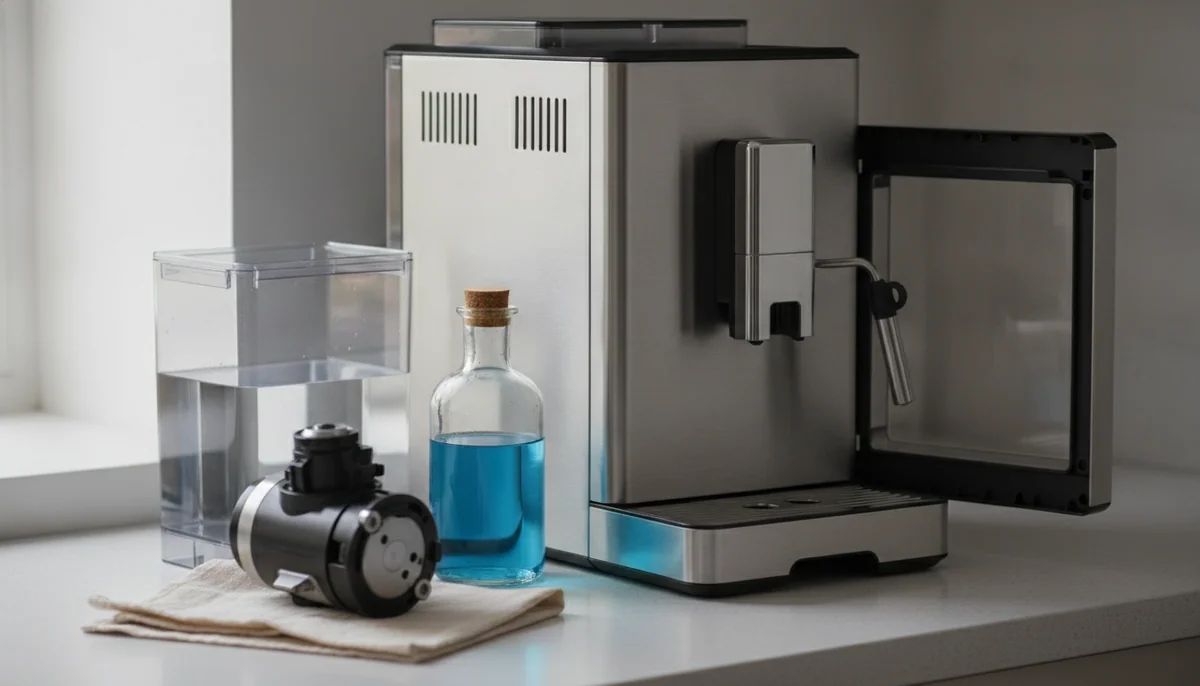
A super-automatic automates the drink, not the ownership. That is the sentence every honest owner arrives at eventually, and it is the reason this page exists. The machine grinds, doses, tamps, brews, ejects the puck and rinses its own spout, and in exchange it asks you to do a small number of unglamorous things on a schedule it only partly reminds you about. Do them and these machines run for years on cheap parts. Skip them and you get exactly two outcomes, in this order: the coffee quietly gets worse, and then something expensive stops moving.
The picture of what happens at the far end of that is easy to find. A repair shop in Bulgaria photographed the brew group of a Philips EP1220 that had come in after its owner finally admitted something was wrong, and their caption was that this is not a barbecue, it is a coffee group, with the observation that the repair would have been cheap a year earlier. That machine was not old. It had simply never been rinsed.
The routine that prevents that is genuinely light, and Espresso Den's view is that the reason people skip it is not laziness but ignorance of what the actual list is. Manufacturers publish the descaling procedure, because descaling is a warranty condition, and then bury the weekly brew group rinse in a pictogram. So we are going to lay the whole thing out by frequency, note which parts your machine will nag you about and which parts it silently will not, and then be specific about which machines ask the least of you and what each of them costs you in return.
The whole schedule, before we argue about any of it
Every machine in this category runs on the same four rhythms. The names change, the intervals shift with your water and your habits, and the milk hardware differs enormously, but the shape does not.
| How often | What | Does the machine prompt you? |
|---|---|---|
| Every milk drink | Rinse or run the milk clean cycle | Usually yes, and on some machines it will refuse to shut down until you do |
| Daily | Grounds bin, drip tray, milk carafe, water refill | Yes, by counter rather than by inspection |
| Weekly | Brew group out, rinsed under a warm tap, no detergent, left to dry | Almost never |
| Monthly to two-monthly | Food-safe grease on the brew group rails, coffee-oil removal tablet, milk system deep clean | Sometimes for the tablet, rarely for the grease |
| Every few hundred cups | Descale, and change the water filter on its own separate counter | Yes, loudly, and it will eventually stop making coffee until you comply |
Read that middle row twice. The weekly brew group rinse is the single most important thing on the list, it takes about ninety seconds, and it is the one job most machines will not remind you to do. A Bosch 300 Series owner worked out the whole cadence for himself and then wrote the sentence that should be printed on the box: the machine does not tell you this, but you should, because the coffee dust gets everywhere inside.
After every drink, and what the rinse water is for
Your machine rinses its coffee path when it wakes up and again before it sleeps, and on a lot of models after every milk drink as well. New owners consistently read this as a fault. A Bosch owner opened the door, found the drip tray full of water and wrote that he had no idea where it was coming from; another owner of the same machine had already counted it at roughly a cup per rinse and concluded he would far rather the machine did it than do it himself. Philips owners describe the same thing on the 4400 and the 2300, where the tray fills faster than anyone expects and the fix is simply to empty it more often than the counter demands.
The practical answer, and it comes from De'Longhi owners rather than from any manual, is to keep a spare glass permanently under the spout. One Dinamica Plus owner does exactly that and warns that without it you will have a tray of dirty water instead of a tidy machine, since the purge fires on boot, after a drink and on shutdown. It costs you nothing and it converts an irritation into a non-event.
Milk is the part you cannot defer. Whatever system you have, the rule is that milk residue at room temperature is a biology experiment by lunchtime. A Bosch 800 Series owner describes the whole job as dropping the hose into the drip tray and running a two-minute cycle, which he does after every couple of drinks for peace of mind. Philips owners with a LatteGo carafe rinse two pieces of plastic under a tap in about ten seconds. Anyone with a steam wand purges it with steam and wipes it immediately, because dried milk inside a wand tip is the reason wands stop frothing, and a Philips 1200 owner found that a silver frother collar pushed on too tightly blocks the air hole and reads exactly like a dead machine. If you have not yet chosen between these, the differences between a wand, a hose and a one-touch carafe are mostly differences in what you will be washing.
Daily: the two bins, and the counter that lies to you
The grounds bin fills faster than new owners expect, because a bean-to-cup machine ejects a whole puck per drink. A Bosch 300 owner clocks his at seven to nine drinks, with the drip tray needing attention roughly every second bin. A Philips 2300 owner making four drinks a day is emptying the base every second day. None of that is unusual and none of it is a fault.
Two quirks catch people out, and both look like broken machines. The first is the puck counter. Several machines only register that you emptied the bin if you pull it out while the power is on, and if you do it with the machine switched off it stays convinced the bin is full and refuses to brew. A Philips 1200 owner learned this the hard way and put it in her review in capitals, and the manual archives are full of people who cleared three flashing lights by switching the machine on and taking the already-empty bin out a second time. The second is liquid rather than solids. A Magnifica Start owner reports that his knockbox collects a fair amount of water alongside the pucks, so he drains it before tipping it into the food waste. Wet pucks are normal on some machines and a symptom on others, which we come back to below.
The grim version of skipping this is documented and short. A Café Affetto owner, otherwise happy with the machine, notes that wet grounds spatter onto the inside walls of the internal waste bin, and that if you leave them for a few days they will mould. Empty it daily and you will never see that. Treat it like a pod bin and you will.
Weekly: take the brew group out
On any machine where the brew group slides out, this is the job that decides how long the machine lives. Rinse it under warm water with no detergent, shake it, stand it somewhere to dry, put it back. Philips publishes the cadence as a rinse every week with a deeper clean monthly, and the same guidance covers greasing the rails with the food-safe tube that ships in the box. De'Longhi's is the same idea with the machine switched off at the rear.
The reason it matters is that a brew group is a wet chamber full of coffee oil and fines, sitting in the dark at room temperature. The most useful ownership document anywhere in our research is a two-year Magnifica Evo review that reads like a chore list rather than a rave: water daily, milk carafe daily, spent grounds every two or three days, and the brewing parts behind the water tank cleaned regularly because that part gets super dirty and, if you skip it, can get mouldy. That owner is not complaining. He is describing the actual price of the machine and then saying he would buy another.
Two things make this easier than it sounds. Almost everyone finds reassembly awkward exactly once, which a Philips 2300 owner records honestly, saying she had trouble getting it back together the first time and expects it to get easier. And on the machines with alignment marks, lining them up before sliding the group home is the whole trick; put it back out of position and the machine will run water through and produce no coffee at all, which reads like a dead grinder and is not one.
There is one category where none of this applies, and it deserves saying plainly rather than being smuggled into a footnote. Jura's brew group is sealed and you will never see it. Owners split hard on whether that is a feature or a dealbreaker, and we have taken the question apart separately in whether mould really grows inside a sealed machine. What is not in dispute is that the maintenance you do instead is tablet-driven, prompt-driven and genuinely simple, with a J8 twin owner calling the cleaning cycles the easiest she has seen on an automatic espresso machine. You are trading inspection for convenience, and Jura's own manual is explicit about running the cycles when the machine asks.
Monthly: grease, oil and the tablet nobody mentions at the till
Three separate monthly-ish jobs get conflated constantly, so here they are apart.
Greasing is the one owners forget and then pay for. The brew group slides on rails, rinsing it strips the lubricant, and a dry group starts binding. Philips ships a small tube with the machine and expects it roughly every couple of months. It matters enough that a Philips 5500 owner in Mexico noticed the tube was missing from her box and had to buy the food-grade grease separately, which she flagged in her review because nothing else in the kit substitutes for it.
Coffee-oil removal is a different chemical to descaler and does a different job: descaler attacks mineral scale in the water path, an oil tablet attacks rancid coffee oil in the brew path. Owners who run both keep them on separate schedules. One Philips owner descales with citric acid and distilled water, uses a degreasing tablet every few months, and relies on the daily rinse in between, which is about as clear a statement of the split as you will find. A Philips 5500 buyer arriving from an older model wrote out his own reorder list before he needed it: replacement filters, oil remover tablets and a lubricant tube, with the observation that it seems daunting and is not difficult if you keep a schedule.
Milk deep cleaning is the third, and its burden varies more between machines than anything else on this page. A LatteGo carafe is two pieces and a dishwasher. A De'Longhi LatteCrema jug is more pieces and a habit, and the dial must go to Clean after every milk drink and back before the next one. A Rivelia owner summarised the whole trade in his review title, saying the time saved making drinks is returned when it is time to clean, and then described the machine as a diva about it: disassembling, soaking, cleaning, rinsing, drying, reassembling. He kept the machine. He also stopped using the more interesting menu items at his office because of it.
Descaling: the job with the rules
Descaling is the only maintenance task manufacturers treat as a contract term. Philips states the procedure takes around half an hour, wants a container of about 1.5 litres under the spouts, names sulfuric, hydrochloric, sulfamic and acetic acids as things that damage the machine, and says in terms that skipping descaling voids the warranty. Read that acid list twice, because the folk remedy everyone's uncle recommends is vinegar, and acetic acid is on it. Whatever you use, it should not be vinegar.
What owners actually use is a live argument that this page is not going to pretend it has settled. Plenty of them run third-party descalers rated for super-automatic machines and report no problems, and at least one owner was told to do exactly that by a repair technician. The Philips owner above uses two tablespoons of citric acid mixed with distilled water to the fill line and follows the manufacturer's own video for the rest of the cycle. Both of those things are true at once: it very probably works, and it is your warranty. Choose knowingly rather than by accident.
How often is decided by your water, not by the calendar, and this is the setting people never touch. Every machine ships with a hardness test strip and a menu entry, and left alone most of them assume the worst and nag you within weeks. Set it correctly and the interval stretches enormously; a Magnifica Evo owner on soft water may not need a descale more than twice a year, while an owner who never opened that menu concludes the machine is broken. Bosch buries the procedure behind a guided Calc'n Clean routine that walks you through it on screen, which is genuinely good and still does not tell you in advance that the tablet goes into the bean container and that you need a large vessel underneath. Owners of the same Bosch split on difficulty in a way that resolves once you notice the timeline: one calls descaling probably the hardest thing to do and says it takes time, another calls it super easy because the machine does the rest, and a third documented the arc across seven months from a bit involved to easier to simply easy.
Two brand-specific traps. On Philips, the AquaClean filter and the descale counter are separate systems, the filter must come out before you descale and a fresh one goes in and gets activated afterwards, and the famous five-thousand-cups figure is Philips' own arithmetic based on eight filter replacements you buy yourself. New filters also refuse to sink and bob around the tank, which is trapped air rather than a defect, and owners fix it by shaking and tapping the filter while submerged until the bubbles come out of the slits. We unpack the whole claim in what the AquaClean promise really means. On De'Longhi, the cycle runs around twenty minutes of standing near the machine with a bowl, and the procedure differs enough between generations that the manufacturer publishes separate videos for pre- and post-2016 Magnificas. Use the one for your machine and not the one at the top of the search results.
How much of your life this actually costs
The honest total, on a machine with a simple milk system, is a couple of minutes on most days and about ten minutes in a week where you also rinse the brew group. That is less than a stovetop kettle and a French press generate in washing up. Where it stops being trivial is at the two extremes.
At the heavy end, the two-year Magnifica Evo owner reckons the full cleaning cycle every three or four weeks runs closer to ninety minutes than the hour he expected, on the grounds that you do it around other things at the weekend rather than standing over it. At the other end sits the Café Affetto owner who dismissed his machine's monthly thirty-to-forty-minute descale as a ridiculous waste of time, next to a heavy user of the same machine who descaled three or four times in fifteen months and reported no ill effect. Those two are not really disagreeing about the machine. They are disagreeing about water hardness and about risk tolerance, and only one of them has told you which.
The thing that is not optional is the milk. Café's own care video treats the milk path and the brew unit as the two routine jobs, and the Affetto's internal grounds bin is the reason its owners talk about mould at all.
What neglect actually breaks, in order
Machines do not usually fail all at once. They fade, and the fade has a recognisable sequence.
First the coffee gets worse and you blame the beans. Extraction quality drops as the drainage valve seals wear and as oil accumulates in the brew path, which is why the same beans on the same settings stop tasting like they did in month two. If your shots have gone thin, our page on watery bean-to-cup espresso covers the dial-in causes, but a machine that has never been degreased belongs on that list too.
Then the pucks turn to soup, and this one is diagnostic rather than cosmetic. A working technician on a German repair forum, walking a De'Longhi owner through a machine that had stopped brewing entirely at roughly 2,500 drinks, made the useful aside that mushy pucks and water in the grounds bin usually mean stiff seals rather than a dying machine, and are cured by replacing them; the actual culprit in that machine turned out to be a failed lower solenoid valve, and the brew piston itself is expected to last something like twenty thousand brews. That is the good news buried in a repair thread: the parts that fail from neglect are cheap rubber, and the parts that would be expensive mostly outlive you.
Then things seize. Scale blocks solenoid valves, dry rails bind the brew group, a milk carafe port grips hard enough that a Dinamica Plus owner expects to snap the connector every time he pulls the jug off. And finally something stops moving and the machine goes to a shop, which is where the barbecued brew group came from. The consolation is that these are repairable appliances rather than sealed boxes: a European parts specialist catalogues well over two hundred spares for a single Philips model, down to the pump, the flow switch, the grinder motor, the brew unit O-rings and the official grease. Our page on how long these machines last and what breaks first puts the odds around that, and if you own a Jura, what one really costs to run is the version of this argument with service invoices in it.
Three habits that halve the work
Set the water hardness the day the machine arrives, using the strip in the box, because everything about the descale interval flows from it and nothing else you do will fix a wrong answer here.
Do not put oily beans in it. Dark, shiny, glossy beans coat the grinder chute and the brew path, and they are the single most common cause of blockages that end up looking like a fault; Philips 4400 owners report standing over the hopper stirring oily beans to make them feed at all. Medium to medium-dark and matte is the target, and our guide to beans that survive a bean-to-cup grinder is worth reading before you commit to a kilo of anything.
And keep the consumables ahead of the counter. Buy the next filter before the current one expires, keep a strip of oil tablets in the drawer, and know where the grease tube is. The owners who describe maintenance as easy are not doing less work than the owners who describe it as a burden; they have simply stopped being ambushed by it.
The machines that ask least of you, and what each one costs
If cleaning burden is genuinely a deciding factor rather than an afterthought, it should change which machine you buy, so here are the honest trades on the ones this site has taken apart.
The Philips 5500 LatteGo is the easiest milk system in the category to live with, because the carafe is two pieces of plastic with no tubes and no hidden channels and milk never enters the body of the machine. Its drawback is the cup: the brew chamber doses small, so the espresso reads mild next to a De'Longhi and no menu setting lifts that ceiling. The same carafe logic applies further down the range, and our guide to which LatteGo to buy covers where the ladder stops mattering.
The Philips 1200 is the cheapest way into a machine whose brew group comes out by hand with no tools and which rinses its own circuit at both ends of the day. Its drawback is that the AquaClean filter named in the product title is not in the US box at all, so the descaling headline depends on a purchase you have not yet made.
The De'Longhi Magnifica Evo makes the best automatic milk foam at its price and its brew group lifts out for a rinse like every other De'Longhi. Its drawback is that the LatteCrema carafe strips into meaningfully more pieces than a LatteGo, and the auto-clean function only rinses the spout, so the jug itself is still a hand job every day.
The Bosch 300 Series captures its grounds internally, so nothing lands on the counter and there is no knock box to deal with. Its drawback is that the machine never prompts the weekly brew unit rinse it needs, which means the most important job on the list is one you have to remember unaided.
The Jura J8 twin has the simplest daily routine of any machine here, since the milk clean runs itself from a two-chamber container and the machine will not let you shut down without it. Its drawback is the sealed brew group you can never inspect, which for some owners is exactly the point and for others is the reason they buy something else.
And the cautionary one. The Café Affetto is narrow, pretty and quick, and it is the only machine on this page whose owners report grounds going mouldy inside the waste bin within days if the bin is not emptied. Its drawback is bigger than the cleaning: failure reports on it cluster just past the twelve-month warranty, so a maintenance routine will not save you from the thing most likely to go wrong.
Whichever way you go, the wider shortlists are in our roundup of the best super-automatics, and if the whole question of whether this class of machine earns its keep is still open for you, we have argued that separately with the maintenance counted as a cost rather than hidden.
Frequently Asked Questions
How often do I really need to descale?
It depends entirely on your water hardness setting rather than on a calendar, with soft-water owners going many months and hard-water owners being prompted far sooner, which is why setting the hardness correctly on day one is the single highest-value thing you can do.
Can I use vinegar to descale?
No, because Philips explicitly names acetic acid among the substances that damage the machine, alongside sulfuric, hydrochloric and sulfamic acids.
Do I have to buy the manufacturer's own descaler?
Manufacturers tie the warranty to their own product, while owners and at least one repair technician report that any descaler rated for super-automatic machines works fine, so the choice is a warranty decision rather than a chemistry one.
Why does my drip tray keep filling with water I never poured?
The machine rinses its coffee path at startup, after drinks and at shutdown, which is roughly a cup of water each time and the reason experienced owners leave a spare glass under the spout.
Why does the machine say the grounds bin is full when I just emptied it?
Several machines only register the reset if the bin is removed while the power is on, so switch the machine on and take the already-empty bin out again.
Does the brew group need soap?
No, warm water and a shake is the whole procedure, and detergent residue in a brew group is a good way to taint the next fortnight of coffee.
How often does the brew group need greasing?
Roughly every couple of months with the food-safe grease supplied in the box, and forgetting it is why a machine that was fine at four months starts binding.
Can I put the milk carafe in the dishwasher?
Most manufacturers say yes, but owners of several models report that repeated dishwasher cycles age the plastic and the seals faster than hand washing does, so a rinse under the tap is the safer default for a part you use daily.
What is the difference between a descaling tablet and a coffee oil tablet?
Descaler attacks mineral scale in the water circuit while an oil tablet attacks rancid coffee oil in the brew path, and they run on separate schedules because they are solving unrelated problems.
My pucks are wet and sloppy, is the machine broken?
Usually not, because a repair technician working on a De'Longhi that had stopped brewing entirely noted that mushy pucks and water in the grounds bin most often mean stiff seals that need replacing rather than a dying machine.
Is a Jura harder to keep clean because you cannot open it?
It is easier day to day, since the cleaning cycles run from tablets and prompts and one owner calls them the easiest she has used, and the cost is that you are trusting the cycle rather than inspecting the group yourself.
What single habit protects the machine most?
Rinsing the brew group under a warm tap once a week, because it is the one job that prevents the caked, oil-glued group that repair shops photograph and that costs real money to fix.
Sources (8)
- Amazon listings and customer reviews
- Owner reports across r/superautomatic, r/espresso threads
- Owner and reviewer video, 7 channels
- Fr — Article — www.modesdemploi.fr
- Jura — Article — ca.jura.com
- Philips — Article — www.usa.philips.com
- Komtra — Article — komtra.de
- Fixpart — Article — fixpart.co.uk