Philips LatteGo or De’Longhi Magnifica Evo: one wins on the carafe you rinse, the other on the puck you drink
Buy the De’Longhi if the coffee itself is the thing you are buying, buy a Philips LatteGo if the milk carafe is what will decide whether you actually use the machine on a wet Tuesday, and buy the cheapest LatteGo that has the buttons you want, because every rung above it brews an identical shot.
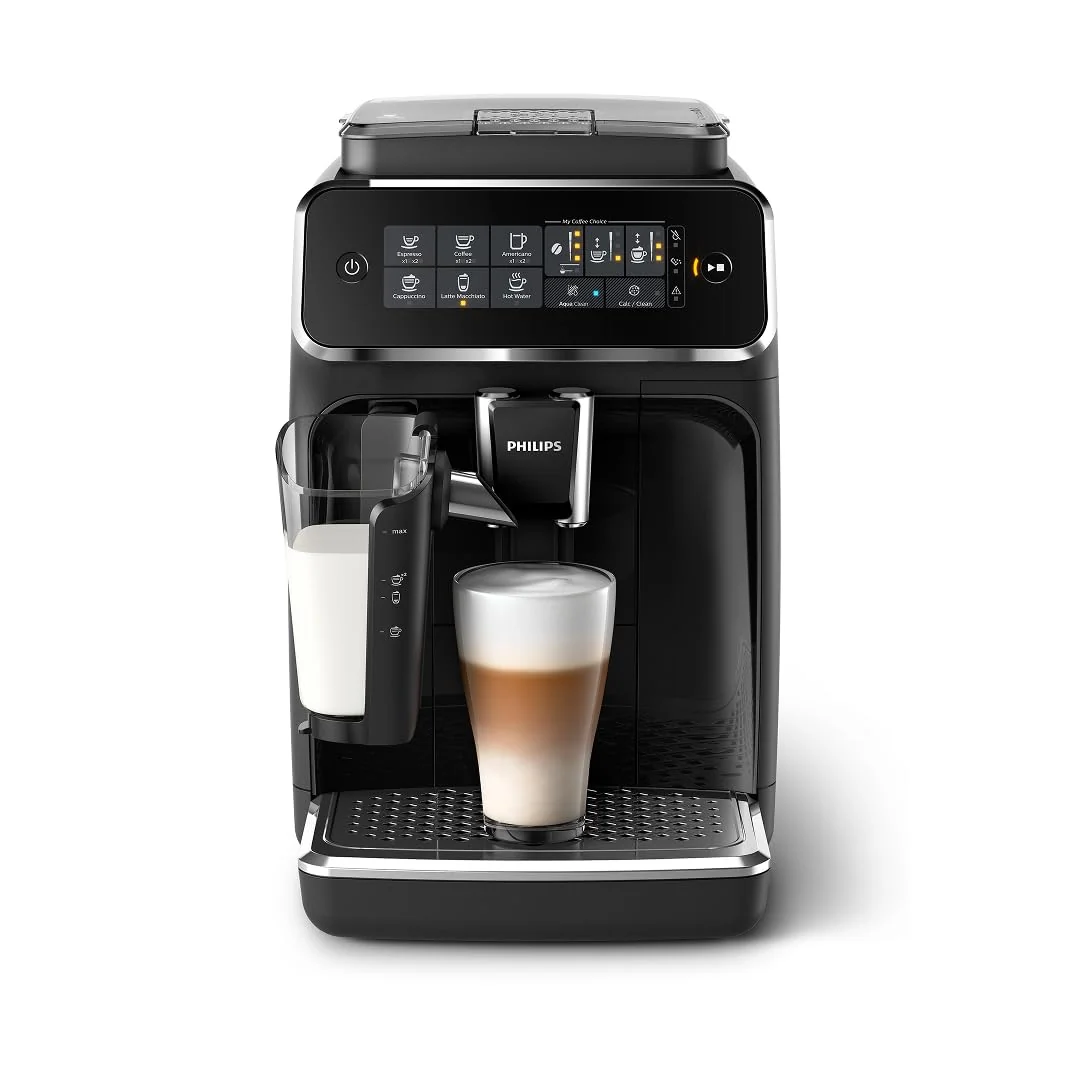
Philips 3200 LatteGo
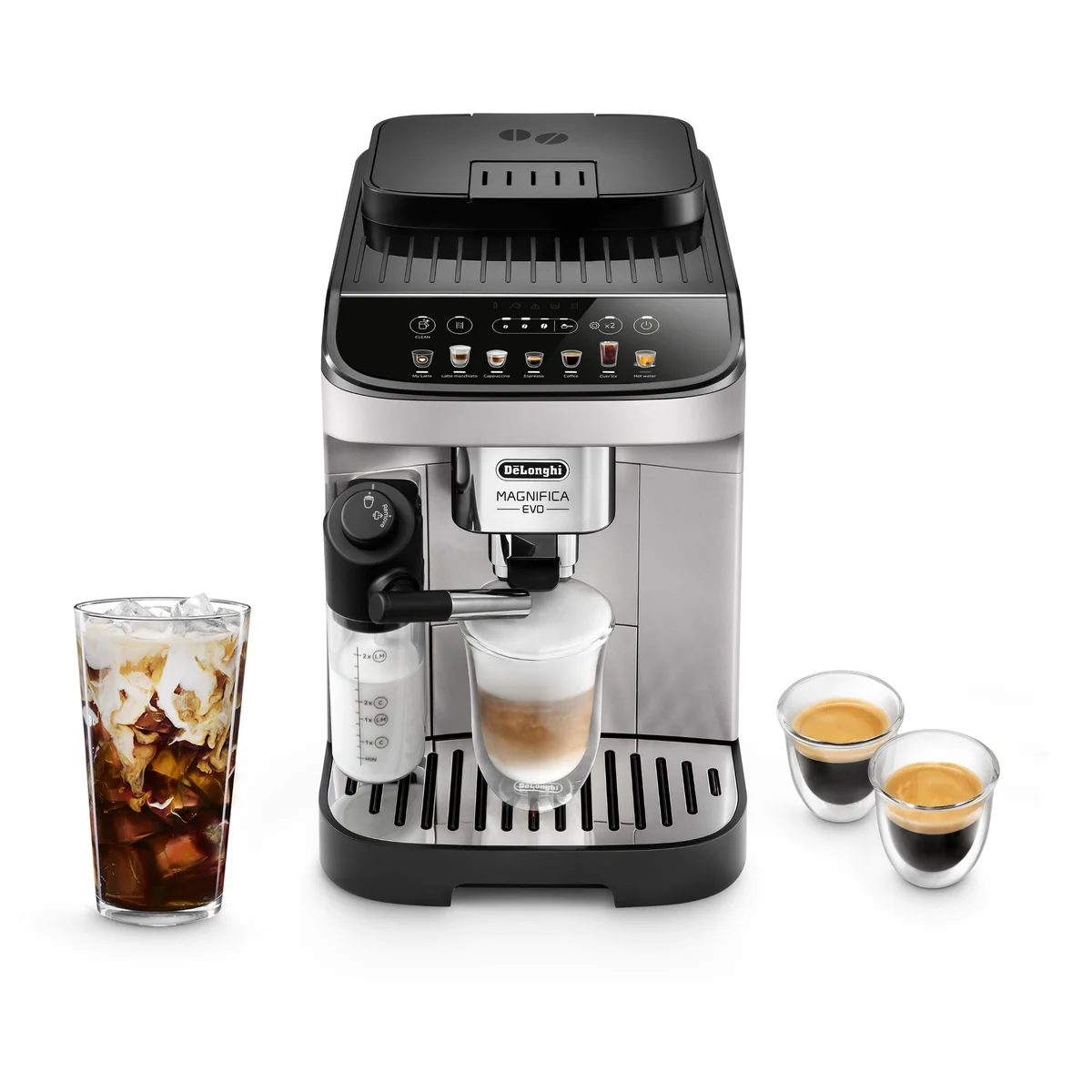
De'Longhi Magnifica Evo
Ask the internet this question and you will get an answer inside thirty seconds, delivered with more confidence than the evidence supports. In a forty-six comment thread asking whether to buy a Philips 4400 or a Magnifica Evo, the top reply was that De’Longhi over Philips is not even a debate, and not one comment in it argued for the Philips. A filmed head-to-head of the Evo against the 3200 LatteGo exists and lands in roughly the same place. Even the reviewer who weighed a 3200's puck on camera says he prefers the Evo without hesitation, citing metal burrs, a larger puck and better foam.
Espresso Den thinks that verdict is right about the coffee and incomplete about the purchase. Forums are where dissatisfied owners go, and a man who has just spent five hundred dollars on a machine that makes pale espresso posts about it; the fifty people quietly making cappuccinos do not. More importantly, the thread is answering a question about shots, and a large share of the people reading this page are not buying a shot. They are buying a cappuccino that arrives without a jug, a wand or a milk hose to scrub, and on that specific axis the answer inverts.
So here is the honest frame before any of the detail. These are not machines that produce café espresso and differ in how well. They are convenience appliances built to a dose ceiling, and the published weighings put a Philips LatteGo puck somewhere between about eight and eleven grams against a De’Longhi Evo ceiling that Tom's Coffee Corner reads at around ten grams, with higher estimates reaching into the low teens. A café double is sixteen to eighteen. De’Longhi wins that comparison and it is still not winning the argument it is often assumed to be winning. Home Coffee Expert put the Evo's audience plainly: it suits somebody graduating from a capsule machine, and it will not draw the character out of a delicate single origin. The same sentence, word for word, applies to every Philips on this page.
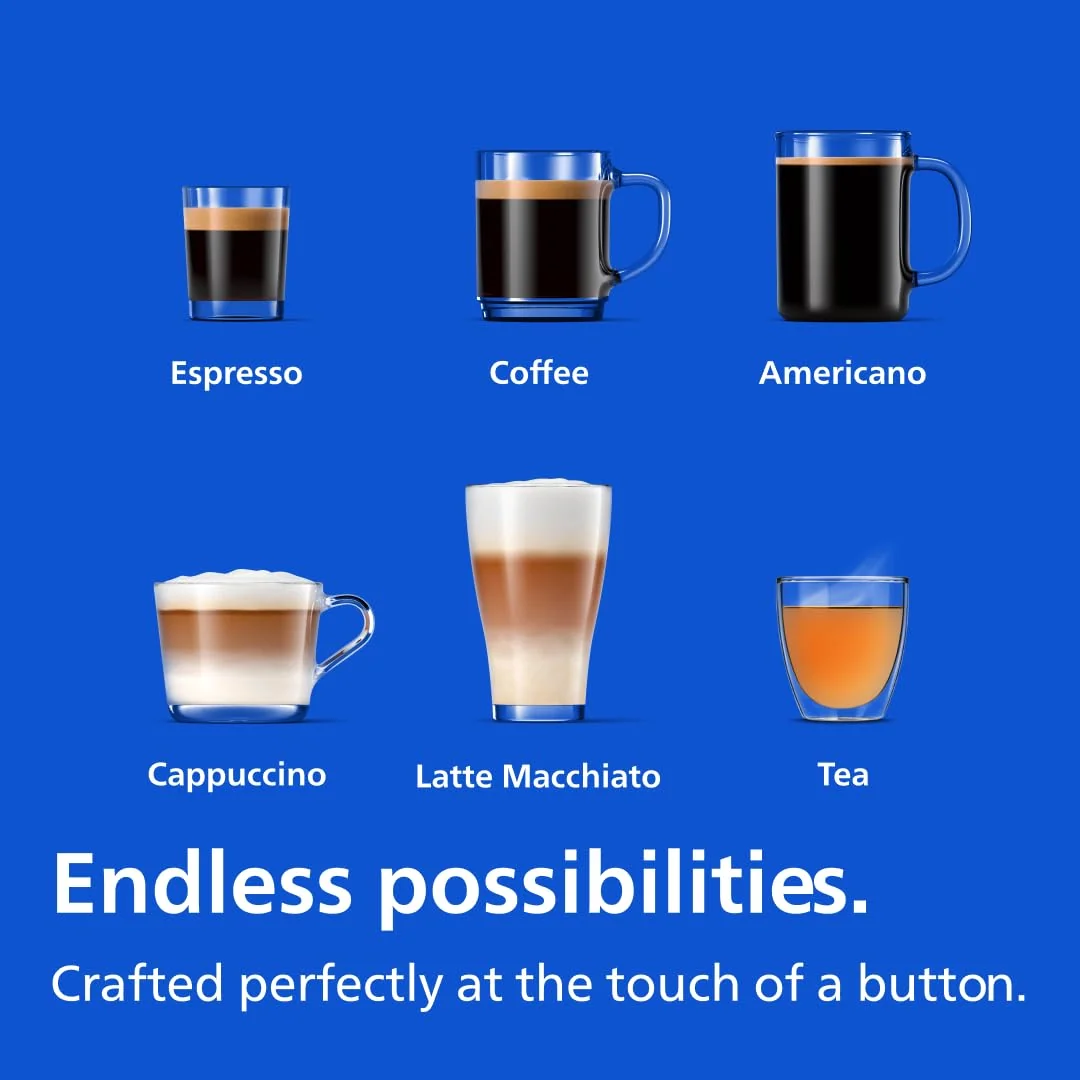
Philips 3200 LatteGo
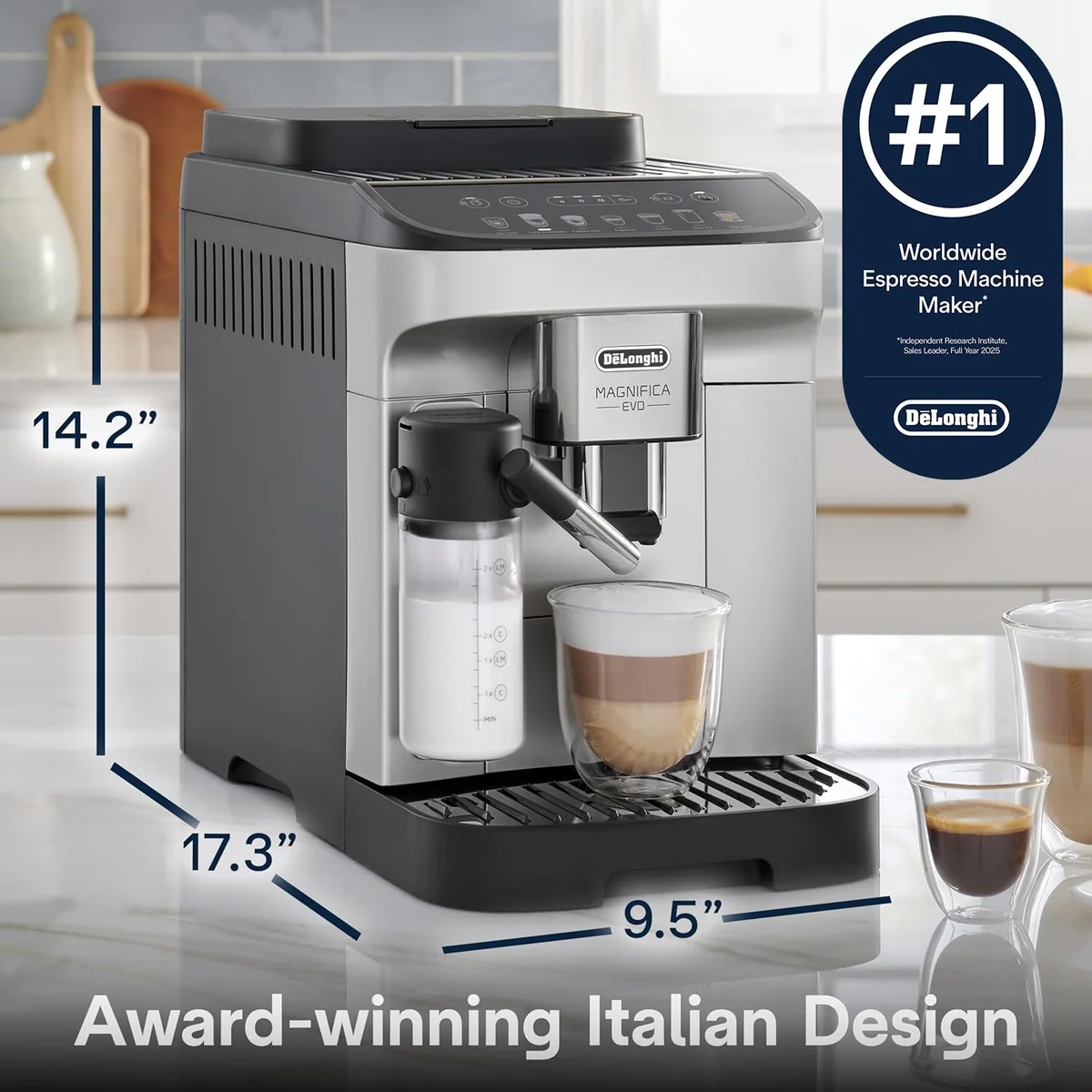
De'Longhi Magnifica Evo
At a Glance
| Feature | Philips 3200 Series Fully Automatic Espresso Machine, LatteGo Milk Frother, 5 Coffee Varieties, Intuitive Touch Display, 100% Ceramic Grinder, AquaClean Filter, My Coffee Choice, Black (EP3241/54) | De'Longhi Magnifica Evo Automatic Espresso & Coffee Machine with Auto Milk Frother, Built-in Grinder & Auto-Clean Function - For Latte, Cappuccino, Americano, Iced Coffee, ECAM29084SB , Silver |
|---|---|---|
| Price Range | $500–$1,000 | $500–$1,000 |
| Configuration | (EP3241/54) | Magnifica Evo with Automatic Milk Frother |
| Finish | Black | Silver |
| Items In Box | 1 | 1 |
| Check Price on Amazon | Check Price on Amazon |
Two or three grams, and everything that follows from them
The De’Longhi's advantage is real and it is mechanical. Its steel conical burr feeds a brew chamber the software will fill for longer, and its thirteen grind positions give you a slightly wider window to work in. The Philips ceramic burr runs to twelve positions and the machine tops out earlier. Put roughly thirty grams of water over a Philips puck at its shortest volume setting and you have a ratio closer to four to one than the two to one a café shot is built on. The De’Longhi lands a notch closer to sanity. It does not land on the other side of the line.
What that means in the cup is consistent across every account we read. The De’Longhi tastes rounder and carries more body; the Philips tastes lighter and thins out the moment you stretch it into a mug. Neither tastes like something pulled on a portafilter, and an owner who came to the Evo from a Breville said exactly that before returning it. The clearest summary of the Philips side came from an owner who had lived with one: so-so for straight espresso and americano, excellent for milk drinks, and a bargain if that is your ratio of drinks. If your morning is a short black coffee you want to taste of something, both of these will disappoint you and the machines built around black coffee are a better use of the money. If your morning is a milky drink, the two or three grams matter far less than everything below.
One trap is worth naming because it accounts for a startling number of disappointed Philips owners. On the LatteGo machines the cappuccino and latte macchiato buttons pull a single shot, and there is no way to make a double the default; one owner spent three days convinced his machine was broken before working out that the café cappuccino he was comparing it to had twice the coffee in it. The fix is unglamorous and free: build the milk drink, then run a separate espresso into the same cup. Do that and the gap between these two machines narrows to almost nothing. Fail to do it and the Philips loses a comparison it was never actually in.
Milk: the part that decides which one you keep using
This is where Philips wins, and it is not close. LatteGo is two plastic pieces that clip together with no tube and no hidden channel, so nothing milky ever enters the body of the machine; it rinses under a tap in seconds or goes in the dishwasher. Philips markets it as two parts on one listing and three on another, which tells you something about the copywriting rather than the carafe. De’Longhi's LatteCrema is the better frother and the worse chore: a stack of parts to strip and wash, with an auto-clean that only rinses the spout. The two-year Evo owner who wrote the most useful review on that listing describes cleaning the carafe as a daily job he had to build into his routine, alongside daily water, grounds every two or three days, and a full cleaning cycle every three or four weeks that runs closer to ninety minutes than the hour he expected.
Against that, De’Longhi's foam is genuinely better and its milk system is more flexible in one direction and less in another. Whole Latte Love found no way to adjust froth density on the Evo at all, so a low-foam latte is out of reach. Philips gives you one cappuccino-tuned texture too, and neither machine will hand you the thin glossy layer a flat white wants. Where the Evo pulls ahead is the My Latte slot, which froths every drop you pour into the carafe and stops when the carafe runs dry, so you size the drink by the pour rather than by fighting a menu. A three-year owner clocks a cappuccino at one minute forty-seven from a standing start and says the machine barely makes a mess doing it.
The Evo's milk system also carries the single most reported hardware annoyance in this comparison. It uses a sensor to see the carafe, and when the carafe is not seated exactly right the milk drinks simply refuse to light up; one owner described the machine beeping as the frother went in and then never recognising it. There is no equivalent failure on a LatteGo, because there is nothing to detect. If you have never decided which milk system you actually want to live with, our piece on wands, hoses and carafes is the argument in full, and it is the decision that matters most on this page.
Heat, and why your latte goes cold
Neither machine is hot enough for people who like scalding drinks, and both are hotter than their critics claim. An owner who put a thermometer in a 3200's coffee stream at the top temperature setting read about 196°F, which sits at the low end of the band recommended for extraction. That is in spec, and it is also why four ounces of it poured into cold ceramic and hit with fridge-cold dairy is lukewarm by the third sip. The milk is the weaker half on the Philips: its temperature is not adjustable at all, and one cross-model comparison measured cappuccino milk at 45°C on one unit and 54°C on another run minutes apart. The De’Longhi has the same structural problem from the other side, ships on a middle temperature setting, and does not let you raise milk temperature either, which our Evo review goes through properly. Preheat the cup on either machine, and read why these machines run cool before you assume yours is faulty.
The drink lists, and the ladder trap
Here is the thing most comparisons get wrong. "Philips LatteGo" is not one machine; it is five rungs sharing one Saeco brew group and one ceramic grinder. A reviewer who pulled shots from three of them side by side with the same beans and settings could not tell them apart in the cup. Climbing the range buys presets, a screen and profiles, which is exactly what the range comparisons find when they line the machines up. So the fair question is not whether the Evo beats a 4400. It is whether the Evo beats the cheapest LatteGo that has the buttons you want, and the answer to that is the same answer, arrived at for a lot less money.
| Philips LatteGo | De’Longhi Magnifica Evo | |
|---|---|---|
| Dose ceiling | About eight to eleven grams | About ten grams, higher by some readings |
| Milk carafe | Two pieces, no tubes, rinsed in seconds | More parts, better foam, daily strip-down |
| Foam control | One cappuccino texture | One cappuccino texture, thicker |
| Americano | One press on the 3200, and Evo owners say they want it | A coffee preset rather than a shot plus water |
| Drink count | Four on the 2300, six on the 3300, twelve on the 4400 | Seven, one of which is hot water |
| Cup volume | Small enough that a mug means two cycles | Larger, with the coffee preset around six ounces |
| Descaling | Deferred by AquaClean filters, on a schedule | Roughly twice a year on soft water, hardness set correctly |
Two rows there need their footnotes. The americano is a real Philips advantage: the 3200's /54 version brews the shot and then runs hot water through the same spout at a single press, and it is a thing Evo owners raise as a gap in their own machine. The 3300 that replaced the 3200 swapped that button for an iced setting which does not chill anything; it brews cooler and slower so the result survives being poured over ice. Whether that is a trade or a downgrade depends entirely on which drink you make, and our page on what these iced modes really do covers the mechanics. The 4400 pushes the count to twelve including four iced presets, which is the number the machine is sold on and the number that buys you the least.
Volume is the underrated one. The Philips serving sizes are European: a 4400 owner measured the maximum from the latte and latte macchiato presets at 2.7 ounces, phoned Philips, was walked through the menus on a video call and told that was the ceiling. A 2300 owner who wanted a travel mug got about three ounces per press and had to run it four times. The Evo's plain coffee preset lands nearer six ounces, which one owner flagged as the number nobody publishes anywhere. If your cup is a mug rather than a demitasse, that difference will annoy you more often than the dose will.
Noise, leaks and the parts that fail
The old Philips machines were loud and the new ones are measurably less so, because Philips put a thick rubber gasket around the bean hopper and called it SilentBrew, claiming forty percent less noise than earlier models. An owner who moved from a 3200 to a 3300 confirmed the mechanism from the inside: grinding is significantly quieter, and the frother makes exactly the same racket as before. That matches the older machines, where owners reported the milk frothing being louder than the grinding in the first place. The Evo gets no such treatment, and its owners raise noise even in five-star reviews. If a quiet six o'clock coffee is the deciding factor, start from the machines built for that rather than from either of these.
On reliability, both brands buy you the same structural advantage: a brew group that slides out in your hand for a weekly rinse, and cheap parts. Both also buy you leaks. Philips leak reports run through the LatteGo listings persistently, including a 3300 three weeks old pouring warm water from underneath during the brew cycle, and a 2300 that leaked from the back during steaming and purging and soaked through a mat into a new wooden counter before the owner saw it. The De’Longhi failure tail clusters differently, around seals and the milk system rather than the rear of the case, and the same two-year Evo owner warns that the brewing parts behind the water tank go mouldy if you skip them. Philips owners are told the same thing about the cavity under their brew group, where one owner's wife noticed a smell he had never thought to clean. The chore is non-negotiable on both, and what actually breaks first puts the odds in context.
The maintenance arithmetic is close enough to call a draw. Philips owners describe about four minutes daily and ten minutes weekly, plus coffee-oil tablets monthly and grease on the brew group rails every couple of months. Philips advertises up to 5,000 cups without descaling, and its own footnote adds that the figure assumes fitting eight AquaClean filters, which makes it a consumables schedule dressed as a maintenance holiday. It is still a genuine advantage over a De’Longhi that wants descaling perhaps twice a year on soft water with the hardness set correctly at setup. Do not reach for vinegar on the Philips: the company names acetic acid among the substances that damage the machine and void the warranty. The whole filter question is unpicked on our AquaClean page, and the general routine on the cleaning and descaling schedule.
Both of them are bad out of the box, and both recover
The single most common one-star review of either machine is written in week one. Philips ships the grind coarse and the temperature below its top step, and one owner who nearly gave up reported the espresso becoming excellent around the twentieth cup. The De’Longhi asks for the same patience and a similar dial-in on grind before the coffee stops tasting thin. The recipe is identical on both: temperature to maximum, strength to maximum, volume to minimum, grind finer one step at a time and only while the burrs are turning, then throw two shots away before judging the change. Medium to medium-dark beans that are matte rather than shiny, because oily beans gum a grinder and light roasts go sour at these doses, which the beans guide covers properly. If the cup is still pale after all that, the watery-espresso diagnosis is the next stop, and on a Philips the hidden button-holds are where those settings actually live.
The practical consequence is the same on both sides and it is the one piece of advice on this page worth acting on today: a break-in that runs twenty to fifty drinks against a return window that runs thirty days is a trap. Drink hard in week one with cheap beans and make the keep-or-return decision early, not politely.
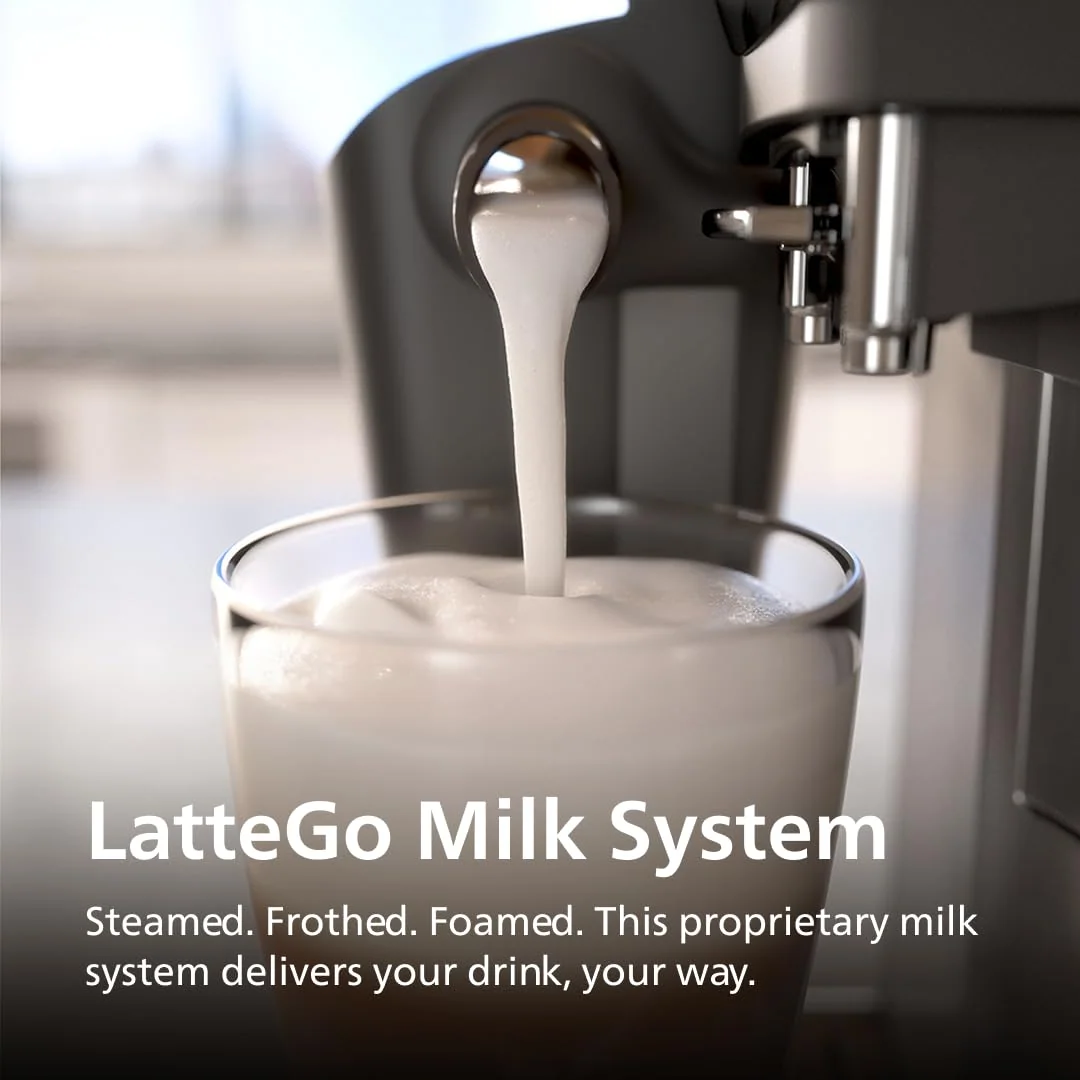
Philips 3200 LatteGo
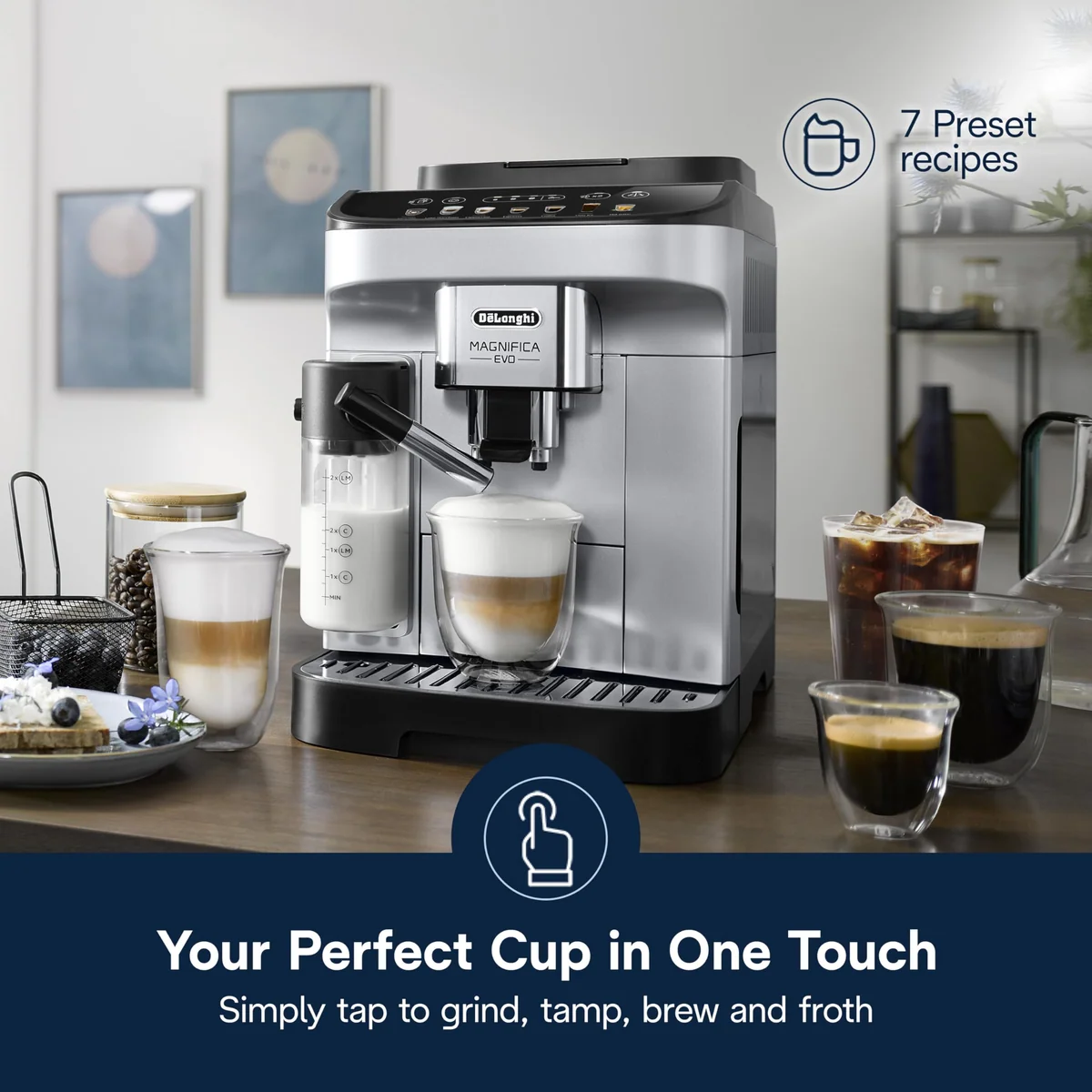
De'Longhi Magnifica Evo
Which one, and which rung
Take the De’Longhi if the coffee is the point, if you drink from a normal mug, if your household is one or two people and nobody needs a screen to operate an appliance, and if a daily carafe wash is a fair price for better foam. Take a Philips if the milk system is the point, if you want an americano on one button, if the machine has to be usable by people who will not read anything, and if what will really determine whether you use it is how long the cleanup takes. The 4400 owner who broke his in properly, loved it, and then volunteered that he could have got away with the cheaper machine because he does not need twelve drinks is the most useful voice in the whole record.
If the milk system is not the point at all, neither of these is your machine: the Magnifica Start pours the same coffee from the same brew group with a manual frother for less, and the Evo against the Start is the comparison that saves the most money in this range. If you want a bigger dose than either side offers, the answer is up the De’Longhi ladder rather than up the Philips one, which is what the Dinamica Plus comparison is for.
The LatteGo to buy if the americano button is the drink you press
It is the cheapest honest way into the two-piece milk carafe with a one-press americano still on the panel, and its coffee is identical to every Philips above it.
There is no display, so every setting and every fault arrives as a blinking icon you have to memorise or look up.
The 3200's replacement, and the quietest grinder Philips has shipped
The gasketed hopper genuinely takes the edge off grinding, which is the one Philips upgrade of recent years that you can hear from across the kitchen.
It trades that americano button for an iced setting that only brews cooler and slower, and the frother is exactly as loud as it ever was.
The cheapest way to own the carafe, if four drinks are enough
You get the same LatteGo carafe and the same brew group as the machines above it for the least money in the range.
Four presets is the thinnest drink list Philips sells and there is no americano among them, so the long black is a two-step job.
The Philips you buy so that nobody in the house asks you how it works
The colour screen, five strength steps, saved profiles and iced presets make it the LatteGo a household will operate without a tutorial.
None of that money reaches the cup, because the grinder and brew group are the ones from the cheaper machines.
The same 4400 for less, if the discount is genuinely large
It is the identical machine with the identical screen and presets, sold at a saving that can be worth taking.
Its ninety-day cover expires well before the seal and gasket failures this platform is known for, and the listing's own bullets overstate the machine by promising a touch screen and three profiles.
The one to buy if the espresso underneath the milk is what you are paying for
It doses more coffee than any Philips here, textures the thickest milk of the two brands, and pours a mug-sized coffee without running twice.
The LatteCrema carafe is a daily strip-down rather than a rinse, and its seating sensor sometimes refuses to see it at all.
The Evo without the warranty, for people who will test it hard in week one
It is the same LatteCrema machine at a lower price, which is a real saving on a model De’Longhi rarely discounts to nothing.
Ninety days of cover replaces two to three years on a machine whose failures cluster later, and the renewed listing's own rating sits below the new one at 3.5 from a few dozen ratings.
Whichever way you go on a renewed unit, use the window deliberately rather than politely: prove the milk system works on day one, run the grinder through its range, and run a descale early so a previous owner's scale becomes your problem while you can still send it back. Our guide to buying renewed covers what the grading language actually promises. And if the model numbers have stopped meaning anything, the whole Philips ladder and the whole De’Longhi range put them in order, while the 3200 against the 3300 and the 2300 against the 3300 settle the two Philips questions this page raises but does not close.
The closing thought is the one the forums skip. The De’Longhi wins the shot and it wins it by two or three grams, not by a category. The Philips wins the ninety seconds after the drink is made, every single day, for as long as you own it. Decide which of those you will still be thinking about in six months, because that is the machine you should buy, and the reviews we read to build this page split almost perfectly along that line: the Philips owners talk about their mornings, and the De’Longhi owners talk about their coffee.
Frequently Asked Questions
Which one actually makes the stronger espresso?
The De’Longhi, because its brew chamber takes a couple more grams than a LatteGo's, though both are single doses stretched over a double's worth of water rather than café shots.
Is the Philips milk carafe really easier to clean?
Yes, and by a wide margin, because LatteGo is two pieces with no tube and no milk path inside the machine, while the De’Longhi carafe strips into considerably more parts that want washing every day.
Will either of them make a proper flat white?
No, because both produce one thick cappuccino-style foam with no way to thin it, which is the texture a flat white specifically does not want.
Why do my milk drinks taste weaker on the Philips than the espresso does?
Because the cappuccino and latte macchiato buttons pull a single shot and cannot be set to double, so the fix is to run a separate espresso into the finished cup.
Which is quieter?
The current Philips machines are quieter while grinding thanks to a gasketed bean hopper, but their milk frothing is unchanged and the De’Longhi is loud throughout.
Do I need to spend up to the 4400 to compete with the Evo?
No, because every LatteGo shares the same brew group and grinder, so a cheaper Philips loses to the Evo by exactly the same margin as an expensive one.
Does the Philips iced setting brew cold coffee?
No, it brews cooler and slower so the result survives being poured over ice you supply yourself.
Which one needs less descaling?
The Philips defers it much longer, provided you keep buying and fitting AquaClean filters on the machine's schedule, which is the part the five-thousand-cup claim does not say out loud.
Can I fill a travel mug on either machine?
Not on a Philips in one press, since the servings are small enough that owners run two cycles into the same cup, and the De’Longhi's plain coffee preset gets you closer without quite getting you there.
Which should I buy if I mainly drink lattes and cappuccinos?
The Philips, because the daily cleanup is the thing that decides whether a milk machine keeps getting used, and our shortlist for milk drinkers reaches the same conclusion.
Ready to Choose?
Sources (8)
- Amazon listings and customer reviews — Philips 3200 Lattego and Delonghi Magnifica Evo
- Owner reports across r/superautomatic, r/Coffee threads
- Owner and reviewer video, 6 channels
- Tomscoffeecorner — Article — tomscoffeecorner.com
- Homecoffeeexpert — Article — homecoffeeexpert.com
- Wholelattelove — Article — www.wholelattelove.com
- Seattlecoffeegear — Article — www.seattlecoffeegear.com
- Philips — Article — www.usa.philips.com