All three KitchenAid espresso machines pull the same shot, so buy the one whose milk arrangement you can live with
The most useful sentence anyone has said about this range came from a retailer whose entire video exists to move you up it. Walking through the differences between the three machines, he says out loud that the taste of the coffee is the same on all of them, and that what the extra money buys is user-friendly features. That is not a slip. It is the single fact that should organise your decision, because once you accept it, the question stops being which KitchenAid makes better espresso and becomes which set of conveniences you are prepared to pay for.
The second fact worth having before you compare anything: KitchenAid did not engineer these. They come out of Eugster/Frismag, the Swiss contract manufacturer behind Jura, Miele and a run of European badges, and the most experienced owner in the public record, someone who has lived with Jura and Miele machines and taken the side panel off this one, reports that the brew unit is interchangeable with Miele's. His way of describing what KitchenAid added on top of that platform is still the best line written about these machines: if Miele was Microsoft D.O.S., KitchenAid rolled up and installed Windows. So the anxiety about a stand mixer company selling a machine at this end of the market is misplaced, and so is the assumption that the badge is buying you anything mechanical.
The model numbers, decoded once
KitchenAid sells these under two names simultaneously, which is why the numbers are so heavily searched. KES8556 is the KF6, KES8557 is the KF7, KES8558 is the KF8. The letters trailing the number are the finish and nothing else: SX is the brushed stainless reviewed here, BK the black, JP the juniper, PL the porcelain white. A KES8558PL and a KES8558SX are the same machine in different clothes, and a colour change never moves a specification.
| KF6 | KF7 | KF8 | |
|---|---|---|---|
| Model number | KES8556 | KES8557 | KES8558 |
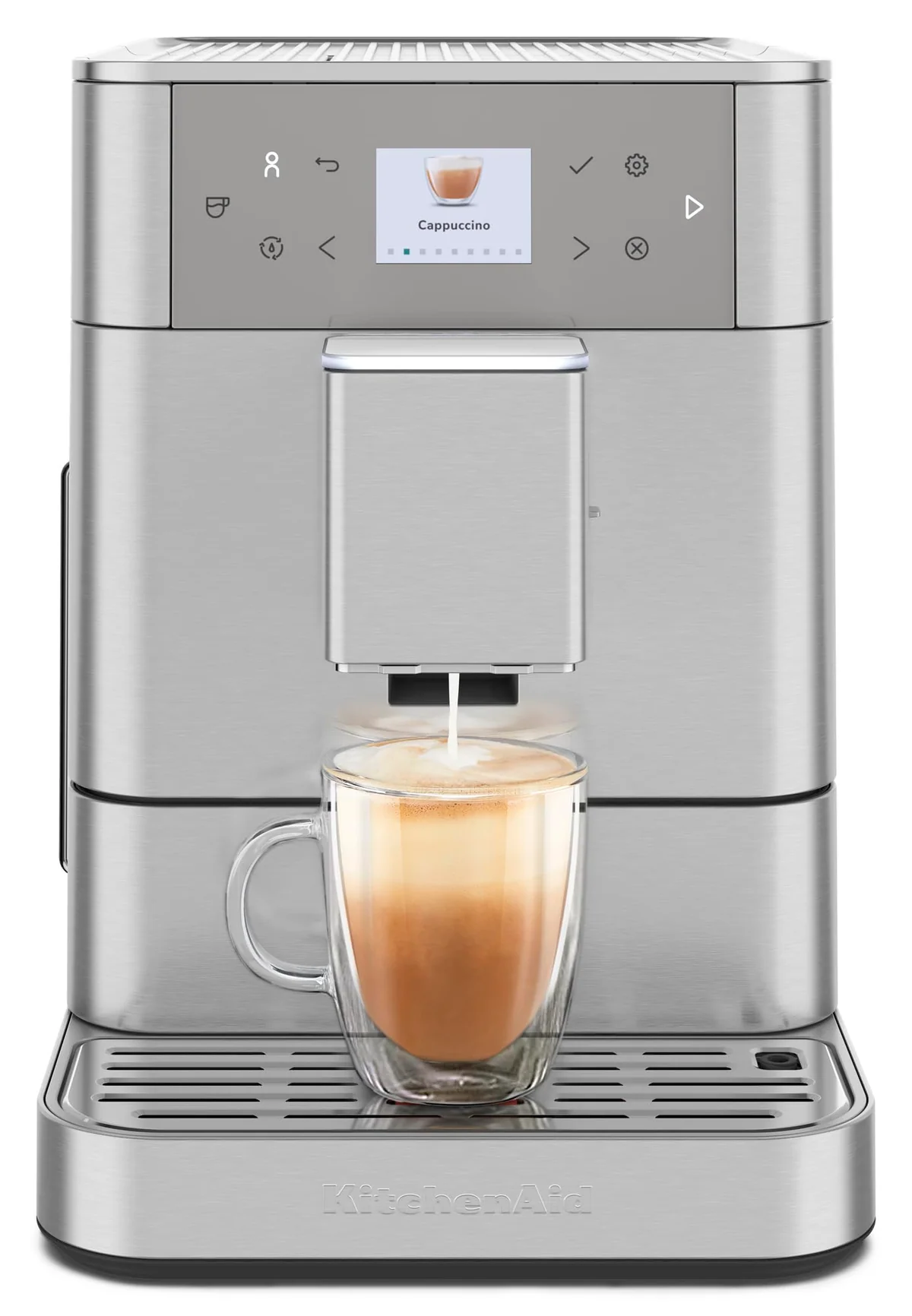
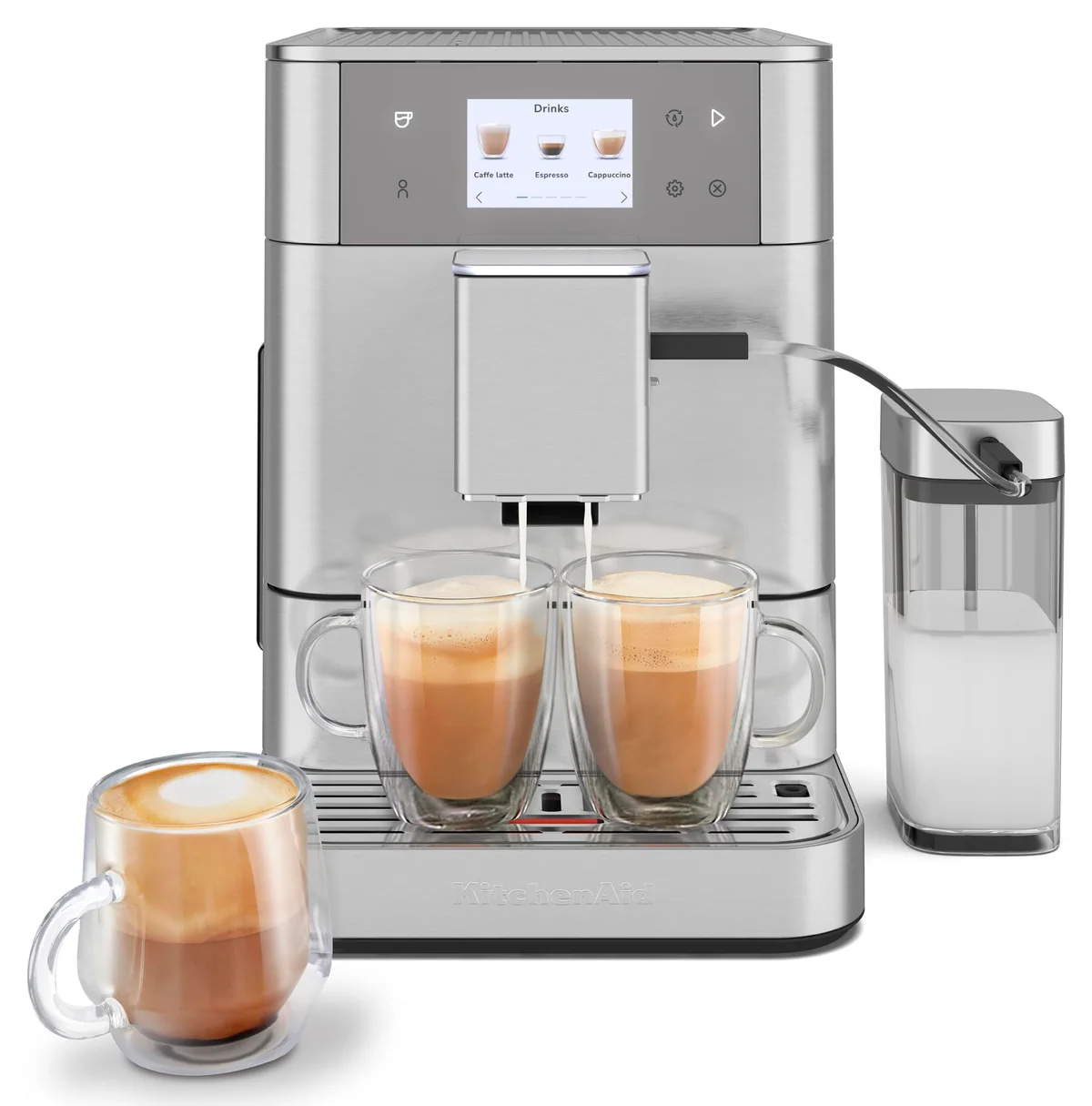
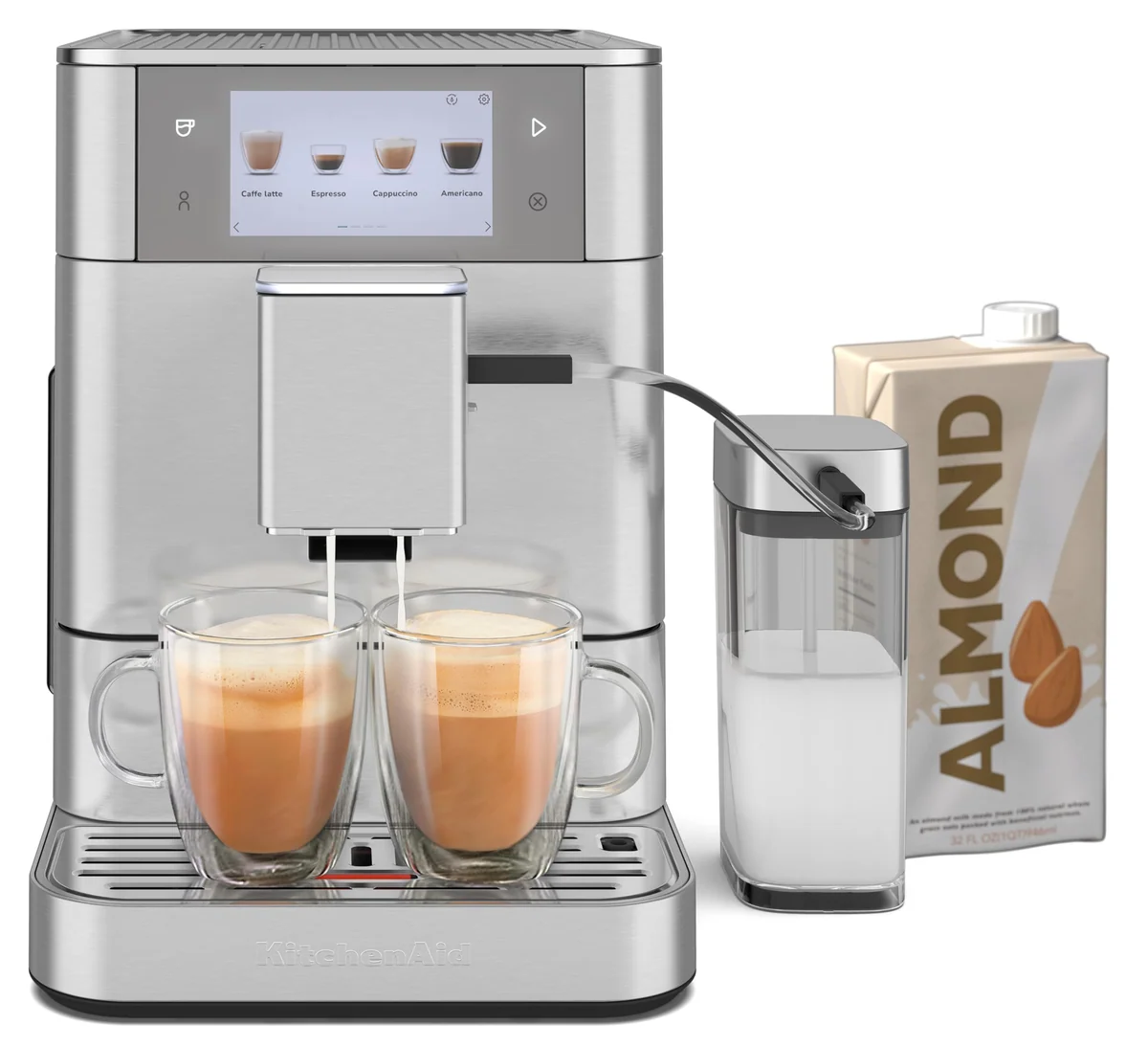
| Drink tiles before you scroll | 2 | 3 | 4 |
| Strength steps | 3 | 3 | 5 |
| User profiles | 4 | 4 | 6 |
| Milk container in the box | No, hose only | Yes | Yes |
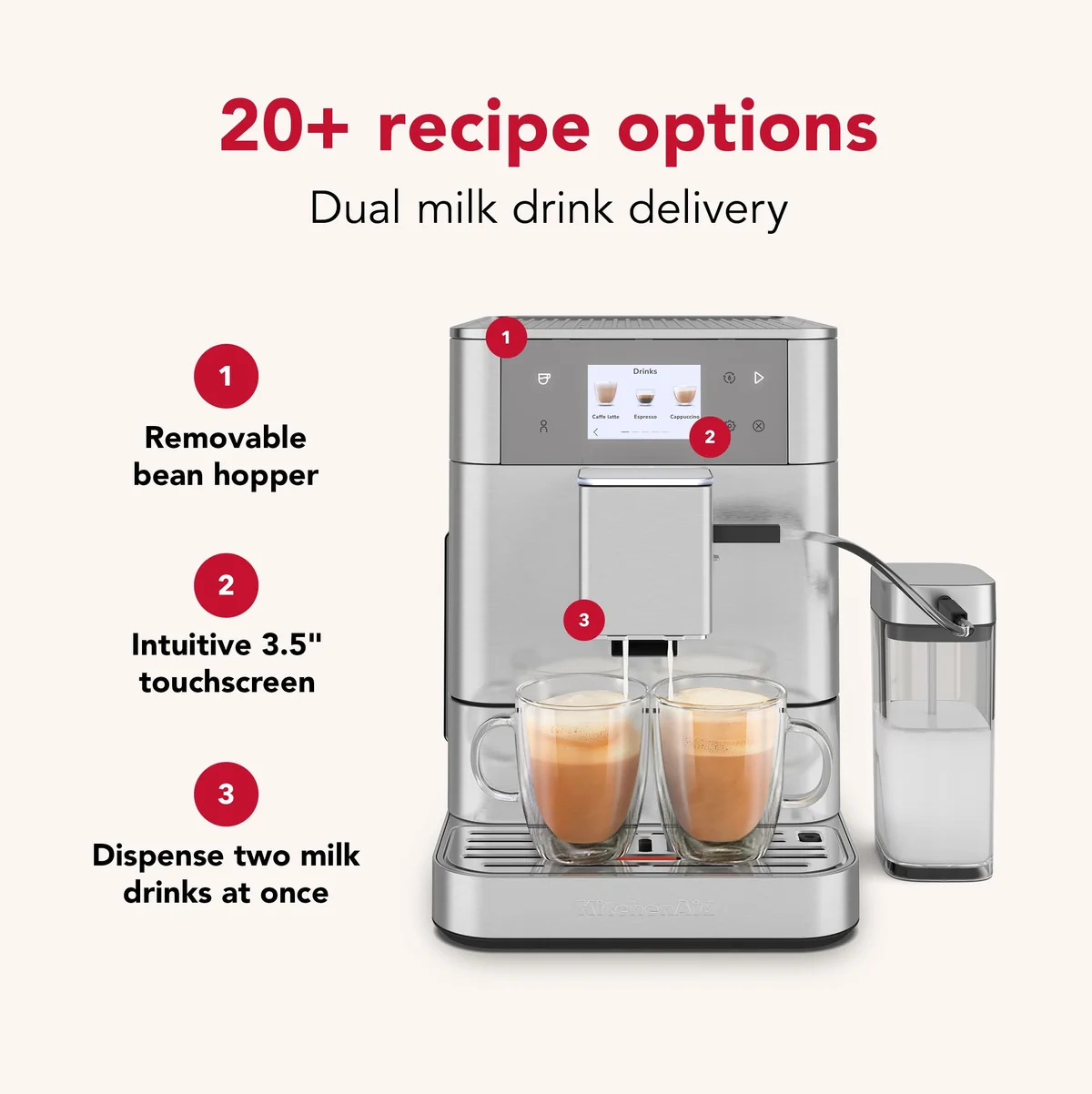
| Drink delivery | Single | Dual | Dual |
| Plant milk preset advertised | No | No | Yes |
| Advertised recipe count | 15 | Not stated | 40 plus |
| Brew unit, grinder, dose, milk terminal | Identical across all three | ||
One row is missing on purpose. Espresso Den's own reviews of the KF7 and the KF6 disagree about whether the KF7 lets you choose milk first or coffee first, and nothing in the record settles it, so the honest position is that the option is confirmed on the KF8 and unresolved one rung down. Screen sizes are reported inconsistently by different retailers too, which is why the table counts drink tiles instead of inches: the number of drinks visible before you scroll is what you actually live with, and the list cannot be reordered, so a favourite can sit one swipe off screen forever.
Read the last row of that table again, because it is where the money goes strange. The recipe counts are the two listings talking to each other in bad faith. KitchenAid reaches fifteen on the KF6 by counting seven drinks with their single and double versions and adding hot water and warm milk, and it reaches forty plus on the KF8 by counting each drink twice, once for dairy and once for plant milk, then folding in a printed booklet of espresso martinis you assemble yourself. Neither number describes a machine that makes more coffee than the other one.

Quick Picks at a Glance
| Feature | Editor's Pick KitchenAid Fully Automatic Espresso Machine KF6, KES8556SX, Stainless Steel | KitchenAid Fully Automatic Espresso Machine KF7 with Milk Attachment, KES8557SX, Stainless Steel | KitchenAid Fully Automatic Espresso Machine KF8 with Milk Attachment and Plant Based Milk Options, KES8558SX, Stainless Steel |
|---|---|---|---|
| Price Range | $1,000–$1,500 | Under $200 | Under $200 |
| Configuration | 2.2L | 2.2L With Milk Attachment | 2.2L With Plant Based & Milk Attachment |
| Finish | Stainless Steel | Stainless Steel | Stainless Steel |
| Items In Box | 1 | 1 | 1 |
| Check Price on Amazon | Check Price on Amazon | Check Price on Amazon |
The three machines, and who each one is honestly for
What follows assumes you have accepted the premise: the cup is the same, so pick on ergonomics. The order below is the order of the range, not the order of preference, and the machine Espresso Den would put in most kitchens is the middle one.
The one for people who drink espresso and americanos and treat milk as an occasional event
It carries the same Swiss brew unit, the same seven-setting steel burr grinder and the same unusually large dose as the two machines above it, so what you give up going down to it is furniture rather than coffee.
There is no milk container in the box, only a bare hose you drop into a jug of your own, which means the machine the photographs imply costs the price of an accessory on top.
The KF6 punches above the bean-to-cup average on coffee alone, and the reason is dose. Home Coffee Expert puts the maximum at 15 grams; the owner who weighed his own pucks got 12 to 14 depending on the bean. Against the 11 gram ceilings common at similar money, that is why owners keep describing the shots as strong rather than adequate rather than merely acceptable. The independent reviewer who ran one for two months recorded dissolved solids of 6 to 7 percent, thick stable crema, espresso arriving at 167 to 170°F and a heat-up of around 40 seconds, and he also put a sound meter on it: just over 60 dB while grinding and the mid-50s while brewing, against a class norm he places at 68 to 71 dB. The Quiet Mark certification on these is a measured result rather than a sticker, which is why the range keeps appearing in our shortlist of the quietest super-automatics.
Two things about the KF6 will confuse you in week one and neither is fixable. Press the double button on a café latte and you do not get two lattes; you get milk for one drink and two shots of espresso, because there is a single central milk spout, and the retailer who demonstrates this on camera has to explain it three times across two videos before it lands. And the cappuccino recipe pours milk before coffee with no way to reverse it. The same retailer, selling the thing, recommends adding the milk container twice unprompted in his own demo, which tells you what he thinks of the hose. In fairness to the hose: there is no carafe to disassemble, the machine flushes it with hot water on demand, and the milk goes back in the fridge in whatever it was already in. Whether that is a downgrade or a relief is the argument in our piece on which milk system you will actually live with, and the full KF6 review goes further into the dialling-in it needs.
The one most households should buy, and the one with the most to prove
It adds the milk container, the dual drink delivery and a third drink tile, which are precisely the three things people notice missing on the KF6 without noticing anything else missing at all.
It also carries the ugliest tail in the public record, including one documented warranty case that ran six weeks at an authorised repairer, came back without its milk hose, and threw the identical fault two days later.
The ratings tell the story better than any summary. Amazon shows this listing at 4.1 from 165 ratings, which is mediocre for an appliance in this class. KitchenAid's own product page shows 4.6 from 245, and the shape of that distribution matters far more than the average: 188 five-star reviews, then a fat tail of thirteen one-stars with almost nothing at two. That is not a curve that says fine but slightly disappointing. It is two populations, one delighted and one whose machine died young.
The most detailed failure accounts sit on an Australian brand review page that covers mixers and kettles as well as coffee, attracts complaints by design, and describes a service operation that is not necessarily the American one. State those caveats and then read the accounts anyway, because they are specific: a verified owner whose machine insisted the bean hopper was not in position when it was, told by the repairer that thirty KitchenAid coffee machines were waiting in the shop; a second owner on his third KF7 after all three broke down, weighing up whether to contact them again or cut his losses. Those are individual eyes, not a failure rate, and KitchenAid did replace that man's machine three times. Against the tail, the day-to-day reports are warm: the only long-form editorial that bought and used a KF7 got sweet, chocolatey espresso under thick crema once the grinder was dialled to its second finest step, and was markedly cooler about the milk than KitchenAid is, calling the foam acceptable without being anything special and not quite up to De'Longhi or Jura standards. If cappuccino foam is the thing you get out of bed for, that limitation applies to the whole range, and the machines we rate for milk drinks are the better hunting ground.
What you are actually buying at this rung is household access. The clearest statement of it in the whole record comes from a Breville owner of five years who switched and counted: grinding, tamping, extracting, knocking out the puck, steaming and washing the jug took about seven minutes of standing there, every time, and his KitchenAid routine is plug the hose into the milk, press two buttons, walk away. A second owner keeps a Rancilio Silvia and a KF7 side by side and reaches for the KF7 on the mornings he cannot think, partly because his spouse will not touch the Silvia at all. The full KF7 review works through what that convenience costs you if the machine goes wrong.
The one to buy for the bigger screen and the finer strength steps, and for nothing else
Five strength increments instead of three, six user profiles and four drink tiles on a larger panel are real conveniences on a machine that is otherwise mechanically identical to the two below it.
Its headline plant milk mode is believed by the range's most knowledgeable owner to be a menu label on the same frothing terminal the KF7 and the Miele it descends from already use.
Amazon has this one at 3.8 from 162 ratings, and the retained reviews are polarised rather than lukewarm: five fives, one four and two ones. The most useful of them is a five-star review, which is not a sentence anyone expects to write. Its author's first machine began clogging daily after a week, sometimes delivering almost nothing during extraction before letting go with a loud pop and venting steam out of the side; KitchenAid replaced it on one phone call, the replacement clogs less often, and he keeps it healthy by pulling the brew unit out and rinsing it in the sink. His diagnosis of the rest of the review pile is the part worth carrying: the smoke, the steam, the leaking water and the missing espresso volume other reviewers describe are, in his experience, all the same fault, and the machine's own automated cleaning cycle does not fix it because that cycle flushes lines rather than clearing grounds out of the brew unit. A separate one-star review reports mold around the brewing unit after a long weekend away, blamed on ventilation, with a replacement machine as the only remedy offered. One report is one report, and Espresso Den is not inflating it into a pattern, but it points the same direction as the clogging does: wet grounds sitting in a closed compartment.
The reason the KF8 is not this page's recommendation is that its own advocates will not recommend it. The owner who identified the machine's Swiss origins and evangelised the range across half a dozen threads points buyers at the KF7, on the reasoning that the frother hardware is shared and the plant milk billing exists to sell the larger screen. That leaves five strength steps and two extra profiles as the honest case for the step up, and there is no evidence anywhere that those five steps reach a bigger maximum dose than the other two machines manage with three. They buy finer increments, not more coffee. The full KF8 review lays out the maintenance job that decides whether you enjoy this machine, and the Eletta Explore comparison is the cross-shop that most KF8 buyers actually face.
How Espresso Den judged this without owning one
Espresso Den has not had a KF6, a KF7 or a KF8 on a bench, and no number on this page is our measurement. Every figure came from someone who did take one, and we have said who: a reviewer who ran a KF6 for two months with a dissolved-solids meter, a sound meter and a thermal camera; a long written review by someone who dialled a KF7 in over weeks and published both the settings that failed and the ones that worked; Home Coffee Expert, who spent real time with the entry machine and weighed what came out of it; a retailer whose demo videos are excellent on mechanics and unreliable the moment they start evaluating; and roughly two years of owner threads, plus the customer reviews on each listing.
Two editorial rules shaped what got in. Where a finding comes from one model and is applied to another, it is because the platform is shared, which the evidence supports for the brew unit, grinder, dose and milk terminal and does not support for screens, strength steps or drink counts; anything in the second category is stated per machine. And where credible sources disagree, on maximum dose, on milk temperature, on whether the KF7 can reverse its pour order, we have printed both rather than choosing the tidier number. Espresso Den also threw a great deal away. The very large pile of complaints about KitchenAid ranges, fridges and dishwashers describes a different division with a different service chain, and laundering that anger into a coffee page would be dishonest, which is why it appears below only where it genuinely applies.
What you are signing up for, whichever one you pick
The milk is warm, and it is warm by design
This is the single most common disappointment across the range and it is not a defect you can return. An owner measured his flat white at 51°C and said he microwaves it; KitchenAid's own customer service replied to that review in public and confirmed that milk temperature is not adjustable, that it is designed to arrive at around 57°C so every milk type heats without burning, and that the recommended fix is pre-warming your glass. Two independent reviewers volunteer the same advice without being asked. Black coffee is a different story and reads as properly hot to owners, so the problem is milk drinks specifically, and the mechanism behind it is not unique to KitchenAid: why almost every bean-to-cup machine runs cool is the fuller explanation. Foam density is the second complaint, and plant milks are where the lightness shows most, with one owner unable to get dense foam out of either barista oat or concentrated oat.
A mug of black coffee is not what this range does
The dose is fixed and the water is not, so a big cup dilutes the same shot. A KF6 owner who checked the limits reports a maximum of about 3 oz of coffee plus 9 oz of water on the americano, or 7.5 oz on the coffee setting, and anyone filling an American mug from that describes the result as weak, correctly. The fix that works is to stop asking for a mug and keep the cup small, which is a fine answer for an espresso drinker and no answer at all for a partner who wants filter-style coffee. Settle that before you buy, using what a bean-to-cup can and cannot do with a normal mug, and if espresso is the whole point for you then the machines we rate for black coffee is the shortlist that matters.
Pull the brew unit out and rinse it, on a schedule the manual does not give you
This is the most valuable habit on the page and it applies to all three machines, because they share the part. The brew unit unclips, comes out in your hand and rinses under the tap in about two minutes, and doing it weekly is what prevents the clogging and overpressure that generates this range's angriest reviews. There is a video devoted entirely to correcting dispensing problems on these machines, which tells you how common the fault is and how mechanical the fix is. Owners who rinse every week or two report no trouble at all; the machine's own prompted cleaning cycle is not a substitute. That the brew unit comes out is also the range's quiet advantage over a sealed Jura group, and one owner who has had both plus a Miele says the KitchenAid has been the more reliable of the three and is the only one whose internals he can reach.
The water filter does not abolish descaling, whatever the demo video says
A retailer claims across two videos that using the supplied filter means you never have to descale. That is not what these machines do. The reviewer who lived with one for two months reports the machine prompting for descaling and a guided cycle of around 45 minutes, Home Coffee Expert puts the interval at every couple of months, and there is a step-by-step descaling procedure filmed for exactly these three models which requires you to remove the filter before you start. The filter stretches the interval, and that is all it does. Budget on top of that for the constant rinsing: these machines rinse on power-on, on power-off and after every milk drink, and a KF7 owner making about three drinks a day refills the 2.2 litre tank two or three times a week. Keep a cup parked under the spout permanently so the startup rinse has somewhere to go. Our cleaning and descaling guide sets out the real rhythm.
What goes wrong, and who you end up talking to
The faults reported by owners cluster early rather than late. Several describe a brand-new machine refusing to finish start-up because it insists the ground-coffee chute is open when it is closed, one of them told there was no fix and given a warranty replacement. A fill-beans error crops up repeatedly, usually with dark roasts, clearing itself within a week in the mild version and, in one account at almost exactly a year, grinding and pre-infusing before throwing the error and jamming pucks inside. Water appearing under the drip tray and running down the cabinet is reported by more than one owner, and one found the surface corroding at eight months. Against that, the warranty stories are frequently excellent: replacements shipped the same day, before the dead machine was returned, on a single phone call.
The counterweight is brand-level and it is fair to raise. KitchenAid's parent group has a poor consumer-complaint record across its major appliances, dominated by parts backorders and warranty runaround. There is not a single espresso machine in that complaint pool, so it is not evidence about these products, but it is the service organisation you will be dealing with if Swiss hardware fails, and the worst KF8 account in the record is exactly that shape: two failures, then being told his replacement could not be supplied in the brushed finish he had bought, leaving him to wait indefinitely or accept another colour, with nobody having contacted him proactively. Nobody in the public record has owned any of these past about a year, because the line only launched in 2024, so anyone telling you how they age is guessing; what actually breaks first on machines like these is the closest honest proxy.
Two reasons to leave this range entirely
The first is that KitchenAid now undercuts itself. Its newer compact line is around a quarter smaller and adds an iced setting that brews cooler over ice, which none of these three can do at all, plus automatic grind adjustment that handles a roast change without dialling in. Buying the flagship of an outgoing generation while a smaller, newer range sits beneath it deserves more thought than it usually gets, and if cold drinks are the point, the machines that genuinely brew cold should be your list instead. The second is that the step up inside the range persuades almost nobody who takes it: one owner bought the KF7 out of fear of missing out and says plainly that he does not think the extra money was worth it, and that the KF6 would have done just as well for what he drinks.
If the ladder itself is the problem rather than the machine, the honest alternatives on this site are specific rather than generic. The De'Longhi Rivelia is built around bean-swapping and ships with two hoppers, which is the KitchenAid hopper trick done properly, and we put the two head to head in the KF7 against Rivelia comparison. The Bosch 800 Series is the closest like-for-like, argued out in Bosch against KitchenAid. If you want hotter drinks and a quieter machine and will pay for them, Jura against KitchenAid is the page. And the most deflating comparison of all comes from a KitchenAid owner who also runs a Philips and says the build quality is in a different stratosphere while the drinks are not a lot better, which is a good reason to look at the Philips 5500 LatteGo and at what is available under a thousand dollars before you commit. Whichever way you go, the beans you put in the hopper will move the cup more than the model number does, and whether any of this is worth automating is the question underneath the whole category.

Frequently Asked Questions
Which model number belongs to which machine?
KES8556 is the KF6, KES8557 is the KF7 and KES8558 is the KF8, and the letters after the number name the finish rather than any difference in what the machine does.
Do you actually need KitchenAid's own water filter?
Owners with soft or already-filtered water widely say no and the machine asks during setup whether you are using one, so the filter buys you longer gaps between descales rather than being mandatory.
Can you use cheaper cleaning tablets instead of KitchenAid's?
Owners report good results running generic brew-unit tablets such as Urnex or Durgol through KitchenAid, Jura and Miele machines alike, and any descaler you buy simply has to be approved for fully automatic espresso machines.
What is the largest drink any of them will make?
A KF6 owner who checked reports a ceiling of about 3 oz of coffee plus 9 oz of water on the americano, or 7.5 oz on the coffee setting, which is also the setting that accepts the double-cup button.
Do any of these three make iced coffee?
No, there is no cold or iced mode on the KF6, KF7 or KF8, and that gap is now conspicuous because KitchenAid's own newer compact machines brew over ice at a lower temperature.
Can the KF6 and KF7 froth oat milk without the KF8's plant setting?
They will froth it, and a KF7 owner photographed a decent oat milk result, but plant milks are where this range's light foam shows most regardless of which model you buy.
Can you run decaf and regular without wasting half a bag of beans?
Yes, and it is the range's best trick: the hopper twists out, a purge routine clears the burrs so the next bean is not contaminated, and one owner keeps a second hopper loaded with decaf for his partner's evening coffee, at the cost of roughly a shot's worth of coffee thrown away per purge and a spare hopper bought separately.
Our Top Pick
The KitchenAid KF6 is our #1 recommendation — it grinds quieter than almost anything else you can put on a kitchen counter and pulls a genuinely strong shot, but the milk is where the money stops working..
Check Price on Amazon: KitchenAid KF6Sources (11)
- Amazon listings and customer reviews
- Owner reports across r/superautomatic threads
- Owner and reviewer video, 7 channels
- Walmart listing
- KitchenAid — Article — www.kitchenaid.com
- Webstaurantstore — Article — www.webstaurantstore.com
- Homecoffeeexpert — Article — homecoffeeexpert.com
- Au — Article — www.productreview.com.au
- Coffeeness — Article — www.coffeeness.de
- Pissedconsumer — Article — kitchenaid.pissedconsumer.com
- Thekitchn — Article — www.thekitchn.com