The best compact super-automatic is the one you can refill without dragging it out from under the cupboard
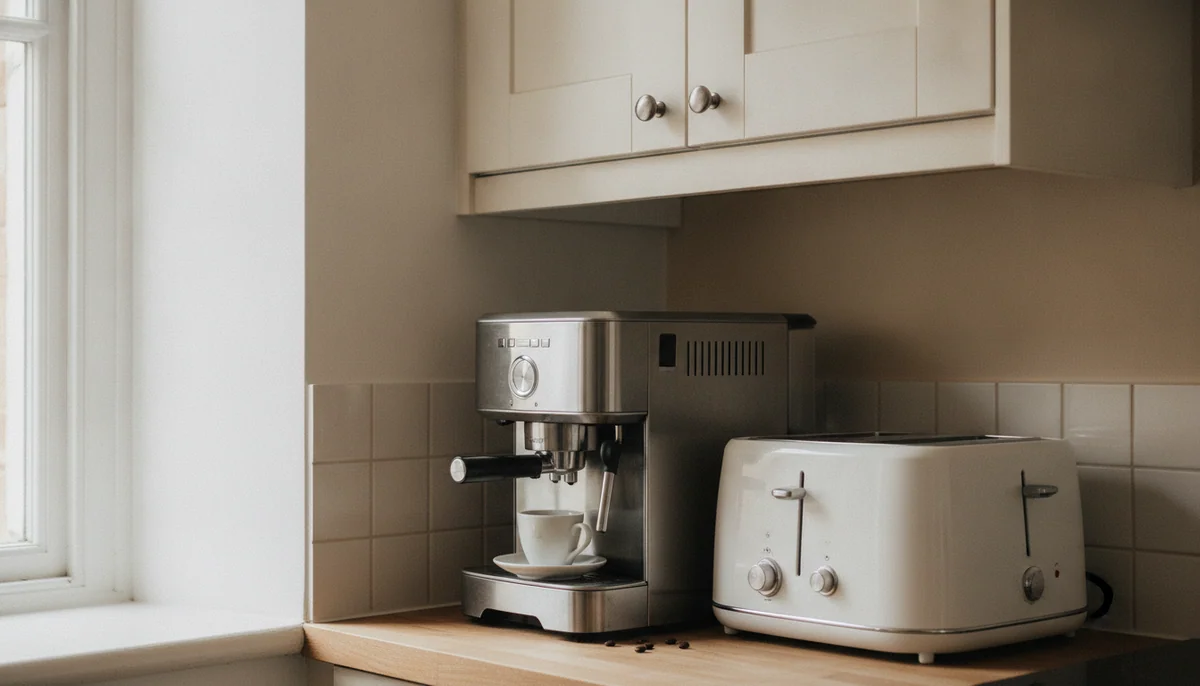
Almost everyone shopping for a small espresso machine measures the wrong gap. They measure the counter, left to right, and then buy the narrowest thing they can find. The gap that actually decides whether you keep using the machine is the vertical one, between the worktop and the underside of the wall cabinet, and the question is not whether the machine fits in it. The question is what has to pass through it every single day: a water tank lid, a bean hopper lid, your forearm and a jug.
That is why the narrowest machine on this page is also the one Espresso Den would steer a cupboard-topped kitchen away from. The Café Affetto is barely wider than a pod machine, and its water reservoir loads from the top at the back. One owner spelled out the consequence in a single sentence: the reservoir lifts out from the top, so if it is under your cabinet you will need to pull the unit out to do so. Another described the machine as almost teetering at the edge of the counter before there was enough clearance to reach the tank, then mounted it on a rolling cutting board to make daily use possible. Compare that with the Philips 2200 owner who wrote that the reservoir is accessible from the front, and added that this mattered specifically because the machine lives under a cabinet. Same job, opposite outcomes, and the width of the two machines has almost nothing to do with it.
So this page sorts machines by how they are fed rather than by footprint. Four shapes show up. There is the genuinely tiny old-school machine, which is the Gaggia Brera and nothing else here. There is the narrow-but-deep, rear-loading machine, which is the Affetto. There is the ordinary bean-to-cup body with a front-loading tank, which is where the Philips and De'Longhi machines sit and where most readers should end up. And there are the two Brevilles, which arrive on this page because people search for them alongside the rest and which are not super-automatics at all: on both of them you still tamp the coffee yourself, and one of them weighs as much as a toddler. If that distinction is new to you, what a super-automatic actually does for you and what Breville does and does not automate are the two pages to read before you spend anything.
Three gaps to measure, in the order they will annoy you
The first is headroom above the machine. Every bean-to-cup machine on this page fills its hopper through a lid on the roof, so you need the machine's height plus enough clearance to lift a lid and tip a bag. Fifteen inches between worktop and cabinet is the number a lot of American kitchens land on, and it is enough for most of these machines to stand there and not quite enough to comfortably load one. A Philips 3200 owner put the warning better than any specification could: make sure you have counter depth front to back and cupboard clearance height to put the beans in the top. The De'Longhi Rivelia is the one machine here that sidesteps the problem outright, because the hopper lifts off and comes to you, and an owner who had previously been hauling the whole appliance forward to refill beans named that as the single best thing about upgrading.
The second is which direction the water tank comes out. This is the difference between a machine you top up in three seconds and a machine you shove around twice a day.
| Machine | Water | Beans | What it means in a cupboard-topped kitchen |
|---|---|---|---|
| Gaggia Brera | Front | Top lid | Tank, drip tray and dregs drawer all pull forward, so only the hopper needs headroom |
| Philips 1200, 2200 and 3200 | Front | Top lid | Same again, and one owner reports a milk jug still fits on top of theirs under the cabinets |
| Café Affetto | Top, at the back | Top, at the back | You slide the whole machine out for both, every time |
| De'Longhi Magnifica Evo | Front | Top lid | An owner names the front tank as the reason it works with overhead cupboards |
| De'Longhi Rivelia | Side, refillable in place from a jug | Lift-off hopper | Nothing has to be lifted up through the gap at all |
| Breville Barista Touch and Oracle Touch | Not the constraint | Top lid | Depth, mass and swing room for a portafilter are what rule these out |
The third gap is the one under the spout, and it is the one that quietly ends a lot of purchases, because the mug you actually drink from is usually the tall one. Here are the figures we have, each attributed to whoever published it, since Espresso Den has not put a ruler to any of these machines.
| Machine | Cup clearance | Where the figure comes from |
|---|---|---|
| Gaggia Brera | 3.25 to 4.5 inches | Gaggia's own listing |
| Philips 2200, and the 1200 that shares its body | About 8.4 to 17.5 cm | Coffeeness, whose published spec table for the EP2220 goes into more detail than Philips does |
| Café Affetto | Adjustable spout, and the drip tray comes out for a travel mug | The product listing |
| Breville Oracle Touch | About 4 inches | Home Coffee Expert's hands-on review |
| De'Longhi Rivelia | Roughly 13 cm | Our own Rivelia review, which works through the same constraint |
One last thing that only matters in a small kitchen, and matters a lot: a compact kitchen is usually an open one, and a grinder at six in the morning carries into a bedroom that a bigger house would keep at arm's length. None of these machines is quiet. Rivelia owners coming from a Magnifica consistently say theirs is noticeably less loud without being silent, and Magnifica Evo owners raise the noise even inside five-star reviews. If that is your binding constraint rather than the cabinet, start at our shortlist of the quietest super-automatics instead of here.
Ten machines, and the job each one is actually for
Read the headings below as jobs rather than as a league table. The recommendation is the one in the box at the top of this page, and the reason the rest are here is that a small kitchen is not one situation: a studio with fifteen inches of clearance, a galley with deep counters, and a household that wants a one-touch cappuccino without a jug on the drainer are three different problems with three different answers.
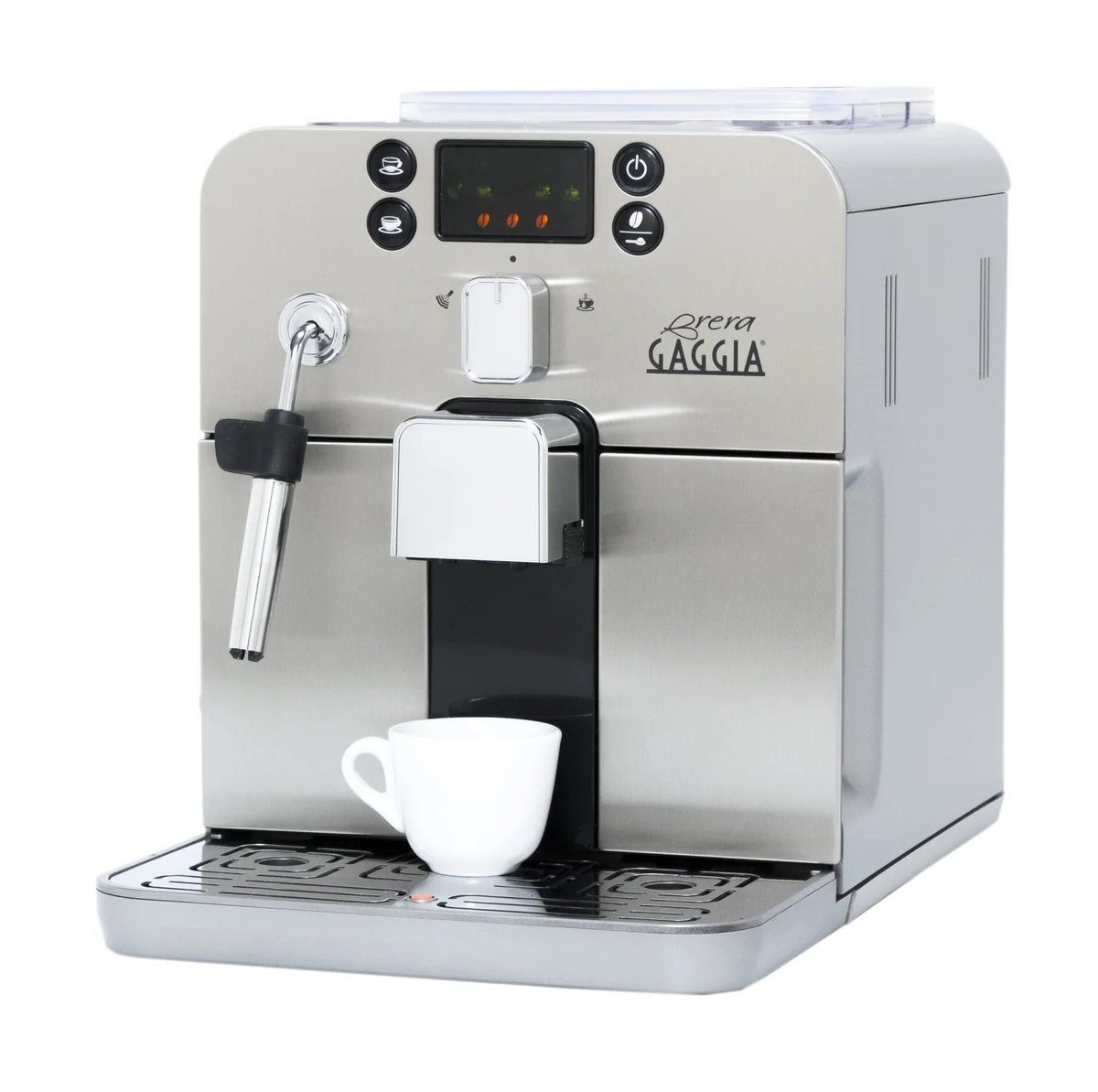
The smallest body on this page, on a design that has not been redrawn since about 2010.
Nothing else here takes so little counter while still grinding and brewing behind a single button, and owners describe it unprompted as taking up almost no space at all.
Cup clearance stops at 4.5 inches and milk is entirely manual at a Pannarello wand, so travel mugs and one-touch lattes are both off the menu.
The Brera is the only machine here whose compactness is uncontested by every kind of source there is: the manufacturer claims it, reviewers repeat it, and owners volunteer it, including one who called it completely adorable and noted how little counter it eats. Everything you touch comes out of the front, and the wand doubles as the hot water spout, so tea does not need a second appliance. What has changed is the shelf it stands on rather than the machine: somebody was still asking whether it makes sense this year, and the thread drew two replies. Read our full Brera review before you commit, because the case for it collapses the moment it stops being the cheap option in its own comparison set, and the budget end of the category is where that comparison happens.
The cheapest way into the front-loading Philips body, if espresso and black coffee are the whole menu.
An owner reports it fitting under their upper cabinets with room left on top for a milk pitcher, which is the most useful sentence anyone has written about this machine.
The dose is small and the shot runs long, so the espresso is mild no matter how fine you grind, and the AquaClean filter named in the product title is not in the US box.
That owner's review is worth reading whole, because it also covers the things that matter in a tight kitchen and nowhere else: the water carafe is reached through the front rather than the top, and the machine was quiet enough not to wake the family. The listing sells two coffee varieties, a classic milk frother and up to 5,000 cups without descaling, and Philips' own product page for the EP1220/04 states plainly that the filter which claim depends on is not included. Our 1200 Series review covers the settings that rescue the first fortnight, and the 1200 against the 2200 is the shortest way to work out whether the step up is worth anything to you.
The machine to buy for most small kitchens, because everything it asks of you is on the side facing you.
A 1.8 litre tank that pulls out of the front, a sealed hopper one owner refills only about every ten days, and a spout that adjusts from a demitasse to a tall mug add up to the least irritating machine here to live with under a cabinet.
Two separate owners report water pooling under a brand-new unit, so unbox it near a sink, brew on day one, and look underneath while the return window is still wide open.
The specification behind that is unglamorous and sensible: ceramic burrs, a fifteen bar pump, a 270 gram hopper under a sealed lid, and a cup clearance range wide enough to cover almost anything you own. The listing promises three presets and one-touch operation, which is honest, and pays for itself in about three months, which assumes beans, milk, filters and descaler are free. Both leak reports sit in the same handful of retained customer reviews, and neither is a complaint about the coffee. Our 2200 review has the hidden button-holds that Philips buried, and the walk up the Philips ladder explains where the extra money stops buying better coffee and starts buying convenience.
The compact machine that makes a cappuccino without you holding a jug.
The LatteGo carafe is two plastic parts with no tube, it rinses under the tap in seconds or goes in the dishwasher, and it needs no permanent counter space of its own.
The espresso is deliberately mild, the machine is loud enough that owners mention it in five-star reviews, and the hopper still fills through the roof, so you need clearance above the machine as well as around it.
Philips advertises the milk system as cleanable in as little as fifteen seconds, and that claim is the rare one that survives contact with owners. In a kitchen with no room for a steam wand routine, a milk jug and a drying rack, it is a genuinely different proposition from a wand, which is the argument in our piece on which milk system you will actually live with. Go in knowing the dose is small: our 3200 review works through what people measured and what it means in the cup, and the 2200 against the 3200 is really a question about milk rather than coffee. If milk drinks are the entire point of the purchase, our pick for latte drinkers is the better list to be reading.
The narrowest machine here, and the one least suited to the job this page exists for.
It takes barely more counter than a pod machine, puts a drink in front of you in under ninety seconds, and makes a genuinely good shot once you rebuild the recipe in the app.
Both the water tank and the beans load from the top at the back, so under a wall cabinet you slide the whole appliance forward every time it needs either.
The listing describes the 1.2 litre reservoir as stored in the body of the machine with a handle built into the lid, and owners describe lifting it out of the top at the back and resenting it daily. Both things are true, which is exactly why width is a bad proxy for whether a machine suits a small kitchen. Two other things belong in the same sentence as the tank: the manual wand only tilts one way, and the machine is loud enough that a reviewer heard the heating, grinding and rinsing from across her house. Our Affetto review sets out the reliability record honestly, including the cluster of failures that arrive just after the one-year warranty ends.
The compact route to a one-touch latte with a carafe that lives in the fridge rather than on your counter.
An owner in a small space names the combination that matters, a body that is compact for the counter and a water container that pulls out of the front so it can sit under overhead cupboards.
Drinks arrive cooler than a café's and the milk temperature cannot be raised at all, so a large latte is warm rather than hot by the third sip.
The same owner lists the bean bin as small and the machine as loud, which is a fair trade to know about in advance. De'Longhi sells seven one-touch recipes and a LatteCrema carafe you can store in the fridge between drinks, which is worth more in a cramped kitchen than the recipe count is. Home Coffee Expert's read of who it suits is the right one: someone graduating from a capsule machine rather than someone chasing a specialty single origin. Our Evo review covers the dose ceiling that explains most of its one-star reviews, and if the two beans in your household are decaf and regular, the machines built for that are a better starting point than any of these.
Not a super-automatic and not compact, but the smallest Breville that textures milk for you.
If you would rather tamp your own coffee than press a button, this is the Breville that fits an ordinary counter and still heats milk to a temperature you set to the degree.
It needs swing room for a portafilter and headroom for a top-fill hopper, and this certified remanufactured listing carries a six month Breville warranty rather than the two years a new one gets.
Breville describes the remanufactured units as showing limited or no wear, arriving with the original accessories, and covered for six months from purchase. Two of the retained customer reviews dock stars purely because the buyer had not registered that the machine was refurbished, which is a startling thing to miss in a title that says so, while the most informative one comes from an owner who already had a Barista Touch and called the refurbished unit better than new. The thing to be clear about before you buy is what it is: a reviewer who used it as a trained barista would puts it plainly, that this is very much a semi-automatic and the tamping is on you. Our Barista Touch review takes that apart, and our guide to renewed and remanufactured machines covers whether the discount is worth the shorter cover.
The wrong machine for a small kitchen and a very good one for a large kitchen.
Automatic grinding, dosing, tamping and milk texturing make it about the least demanding café-grade machine anyone sells, and the milk it produces is the part almost nobody argues with.
It is a 35 pound dual-boiler with roughly four inches of cup clearance and a hopper on the roof, which is the exact opposite of what a cupboard-topped counter can absorb.
Amazon files it under super-automatics and the listing calls it the next generation of fully automatic espresso makers, while the same page describes a 22 gram dose ground, dosed and tamped into a 58mm portafilter. A reviewer who spent weeks with one settles it: retailers classify it as bean-to-cup, but it is a traditional espresso machine with a portafilter and real baskets, and there is no brew unit inside. Its published weight and clearance figures are the reason it is on this page as a caution rather than a candidate. If the automation is what attracted you and the counter is what is stopping you, our Oracle Touch review is the honest version, and one of the front-loading machines above will serve the small kitchen better.
The best-designed machine here for a kitchen with cupboards over the counter.
The bean hopper lifts off and comes to you rather than being filled in place, the side water tank refills from a jug without the machine moving at all, and buyers who needed something short enough to slide under a countertop chose it for exactly that.
The milk lands warm rather than hot, and the second hopper shares one set of burrs at one grind setting, so two beans that want different grinds cannot both be right.
De'Longhi sells it on two 8.8 ounce interchangeable hoppers, a thirteen setting burr grinder and a 3.5 inch touch display, and the hopper swap is the rare headline feature that does exactly what the box says. What owners add is more useful than the marketing: one bought it because it had to be short enough to fit underneath the countertop, another because refilling beans no longer meant hauling the whole unit forward, and several report it running noticeably quieter than the Magnifica it replaced. Our Rivelia review is blunt about the rest, including large coffees that taste thin until you learn which buttons add coffee rather than water.
The same machine in beige, for a kitchen that does not want another black box on the counter.
Identical brew unit, carafe, hoppers, screen and specification, so the only thing left to decide is which finish disappears into your kitchen.
The touchscreen sits on the roof, and an owner with tall counters found she could not see it well enough to use the machine where she wanted to put it.
That is not a small point in a room where the machine ends up wherever it fits. The screen faces upward, so the ideal spot is a low counter or an island rather than a tall worktop, and the owner who hit this had to rearrange her kitchen around it. Otherwise the two listings are the same appliance and the same bullet points, down to the eighteen preset recipes and the LatteCrema Hot system. If neither colour is right and the counter is genuinely tiny, the Jura ENA 4 is the narrowest premium machine on this site, and our ENA 4 review is where to weigh it.
Frequently Asked Questions
What does a super-automatic espresso machine actually do that a normal one does not?
It grinds, doses, tamps, brews and ejects the puck inside a sealed brew unit, so the only thing you handle is the cup, which is covered properly in our explainer on the category .
Which of these is genuinely the smallest?
The Café Affetto is the narrowest and the Gaggia Brera is the smallest overall, though neither is the easiest to live with under a wall cabinet.
Will one of these fit under standard upper cabinets?
Most of them will stand there, but only the front-loading and side-loading machines can be refilled there, which is the difference that decides whether you keep the machine.
Which one should I buy if I can only reach the machine from the front?
The Philips 2200, whose water tank, drip tray and grounds bin all come out toward you and whose sealed hopper means beans are a weekly job rather than a daily one.
Is the Gaggia Brera still worth buying?
Only as the cheapest way into fresh-ground, one-button espresso in a genuinely small space, because it is a fifteen-year-old design with a manual milk wand and a one-year warranty.
Does Breville make a compact super-automatic?
No, on both counts: the Breville machines here still require you to tamp, and both need more counter and more headroom than a bean-to-cup machine of the same price.
Will a travel mug fit under any of them?
The Café Affetto is the one designed for it, since the drip tray lifts out to make room for a tall container, while the Gaggia Brera's 4.5 inch ceiling rules travel mugs out entirely.
Which is the quietest of these?
Espresso Den has not measured any of them, and the only consistent owner testimony is that the Rivelia runs quieter than the Magnifica it usually replaces without being anything like silent.
Do any of them make a one-touch cappuccino without a jug on the counter?
Yes, the Philips 3200, the Magnifica Evo and the Rivelia all use a carafe that clips on for the drink and lives in the fridge the rest of the time.
How much cleaning does a machine like this add to a small kitchen?
Expect a daily grounds bin and carafe rinse, a weekly brew group rinse under the tap and a descale on a schedule the machine sets, all of which our cleaning and descaling guide lays out week by week.
Why does the espresso from a compact machine taste thin?
Almost always because the factory grind is too coarse and the programmed volume too generous for a small dose, which our page on watery bean-to-cup espresso works through in order.
Our Top Recommendation
Based on our research, the Gaggia Brera is our top pick — a compact two-button bean-to-cup from the ipad era, a manual steam wand, a one-year warranty and a 3.8 average from more than fifteen hundred buyers: here is who should still want one in 2026, and who should not..