Breville's Oracle BES980XL is not the super-automatic its listing implies, and knowing that is half the buying decision.
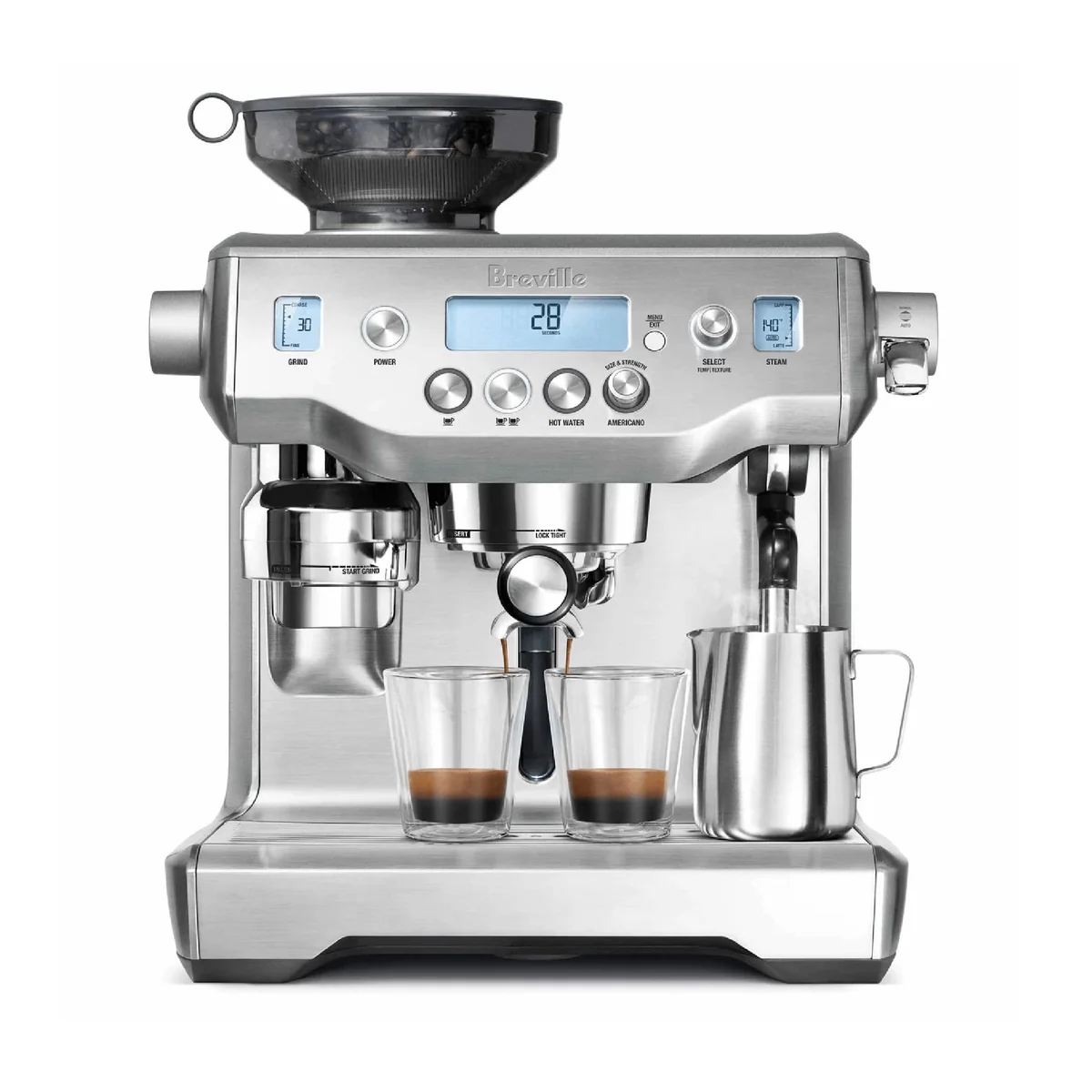
Buy the Oracle if you want café-standard milk drinks with the least fuss a portafilter machine can offer and you can live with a grinder that tops out well below the rest of the machine; look elsewhere if you want a one-button bean-to-cup, or if espresso is about to become a hobby.
Based on 346 owner ratings, 11 owner discussions and 5 other sources. We have not tested this machine ourselves.
We earn a commission if you buy through our links, which does not affect what we say.
Read how this site works →
Who should actually buy one
The best-calibrated sentence anyone has written about this machine comes from an owner who used one for a year and then moved on to manual machines: if you are looking for the fastest, easiest route to consistently good Americanos, it is hard to beat, but if coffee might turn into a hobby, the same money buys better separates and those machines will ask you to learn. Note where the emphasis falls. Good, not great.
There is a second buyer, less discussed and probably more common: the household one. The same thread contains an owner who kept his despite a year of fighting the grinder, because everyone else in the house wants a decent cup with no fuss and the Oracle delivers exactly that. Coffeeness reaches the corresponding conclusion from the reviewer's chair, calling it the middle ground where super-automatic devotees and portafilter obsessives can drink from the same cup, while warning that a professional will feel the limits of how much they can express. If your household contains one person who wants to dial in shots and three who want a flat white before school, that is a real problem this machine solves and very few others do.
So the verdict stands where it started, with the reasoning now visible behind it. The Oracle earns its keep on milk, on the dual boiler and on the sheer absence of mess, and it loses on a grinder that will not hold a dose, on shots timed instead of weighed, and on a maintenance profile that punishes hard water and rewards a screwdriver. Buy it for the drinks it makes reliably, not for the ceiling it might one day reach, and go in knowing which of those two things you actually want.
Buy the Oracle if you want café-standard milk drinks with the least fuss a portafilter machine can offer and you can live with a grinder that tops out well below the rest of the machine; look elsewhere if you want a one-button bean-to-cup, or if espresso is about to become a hobby.
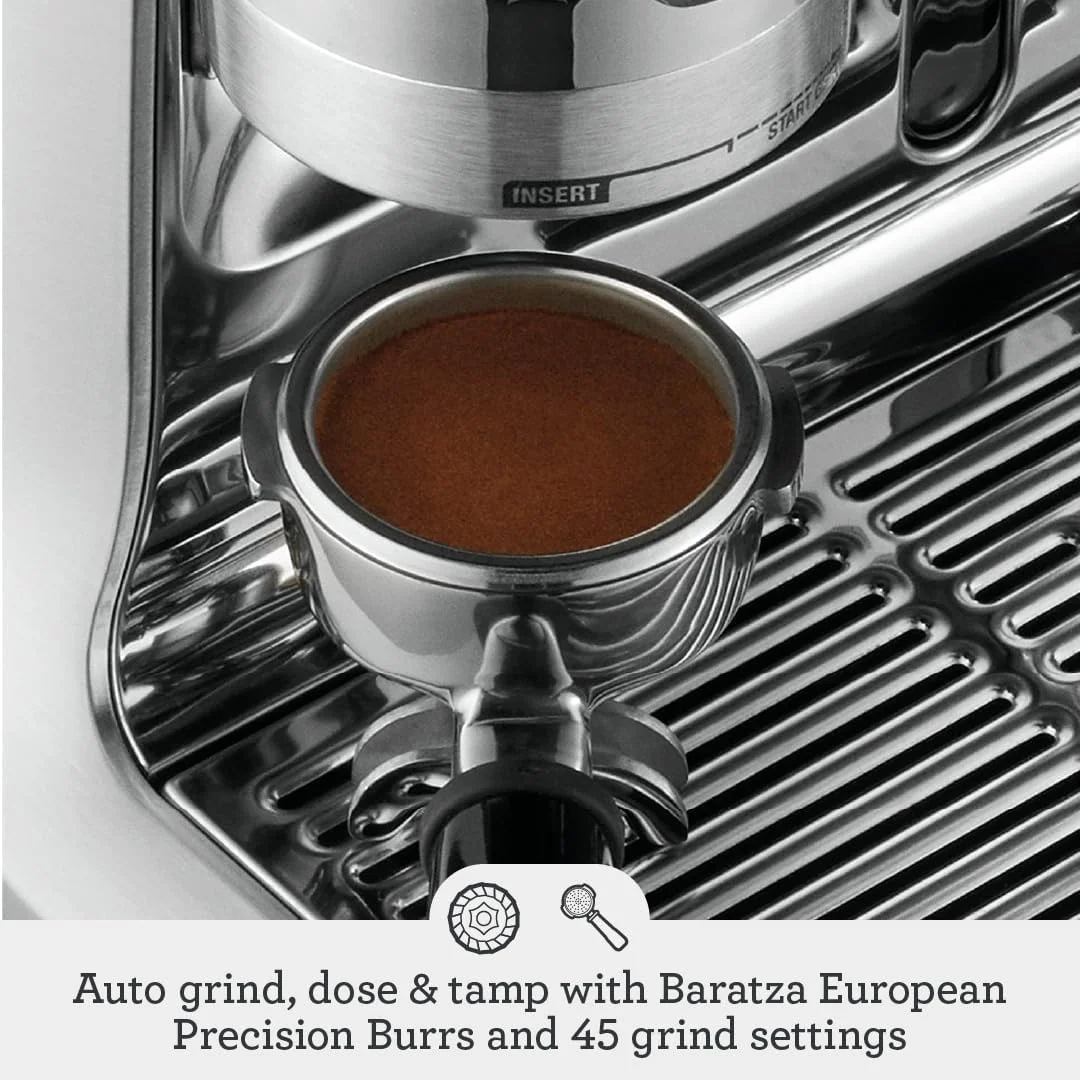
Best for: It grinds, doses and tamps 22 grams and steams the milk unattended, but you still lock in a 58 mm portafilter, still dial in a grind, still knock out a puck, and the built-in grinder is the part long-term owners replace first.
Amazon files this machine under super-automatic espresso machines, and the listing describes it as "a fully automatic espresso machine" that "automatically grinds, doses, and tamps 22 grams of freshly ground coffee." Breville's own launch video is more careful about it, calling the Oracle the world's first automatic manual espresso machine. Those are not the same claim, and the gap between them is where most of the disappointment on this product lives.
Here is what the second description means at seven in the morning. You lock a 58 mm portafilter into a group head. You knock a spent puck out into a bin. You choose a grind number on a dial and change it when you change beans. You wipe a group seal. What the machine takes off your hands is the grinding, the dosing, the tamping and the milk, which are genuinely the four things that most often ruin home espresso, but everything else about the workflow is a semi-automatic's. If you arrived here from a search for a Breville bean-to-cup, our piece on whether Breville makes a super-automatic at all will save you a step, and what a super-automatic actually is sets out the difference in full.
Espresso Den read every first-person account of this machine it could find, and the pattern in them is not subtle. Almost nobody complains about the boilers, the milk or the build. Almost everybody, sooner or later, complains about the grinder. That single fault line runs through the price argument, the resale argument and the who-is-it-for argument, so the rest of this review keeps returning to it.
Key Specifications
Automatic manual, part by part
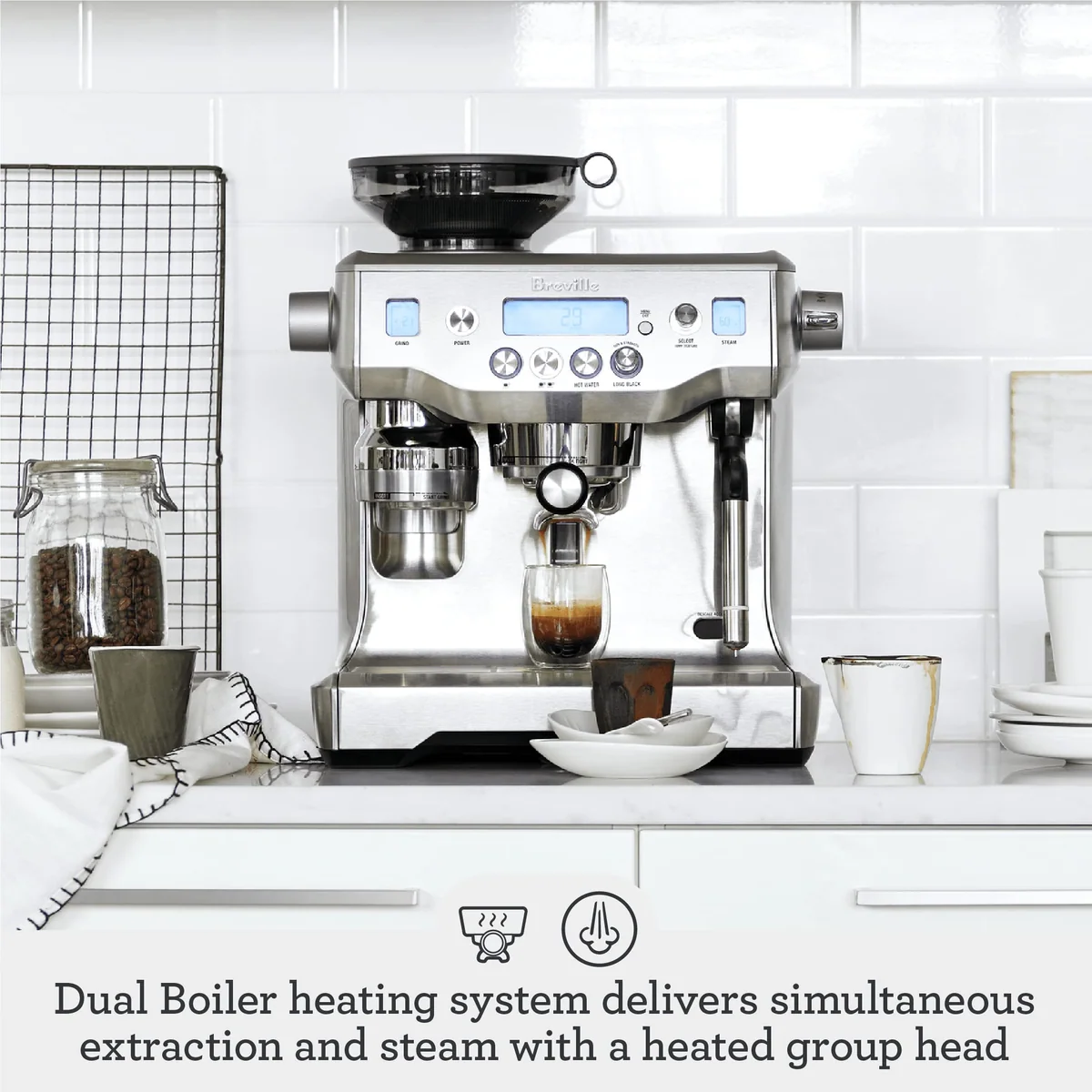
The dual boiler is the reason the machine is the size it is, and it does the thing dual boilers are bought for: pull the shot and steam the milk at the same time, rather than waiting for one boiler to change its mind about what temperature it is. Coffeeness, reviewing the touchscreen sibling on the same platform, confirms two boilers with PID control on the brew boiler and the group head, which is the specification Breville leans on hardest.
The portafilter is 58 mm, full stainless, and it ships with single-wall baskets rather than the pressurised dual-wall baskets that manufacture crema out of nothing. Coffeeness makes the point bluntly: you are handling exactly the portafilter a working barista would. It is worth understanding why that matters, because on cheaper machines the pressurised basket is the thing that quietly caps the ceiling, and buyers in beginner threads keep discovering it after purchase.
The steam wand is automatic and it self-purges. Watch a retailer demonstration count the cycles and you will hear five bursts of steam after the milk is done, which is the step that keeps the four tip holes from silting up. Coffeeness describes the same behaviour and the one manual job left over, which is wiping the outside of the wand. Self-cleaning is not the same as clog-free, and an owner in one of the bigger Oracle threads has a whole routine for unscrewing the tip and soaking it in descaler two or three times over.
Two details that reviews of the touchscreen model will mislead you about. This is the LCD Oracle, not the colour touchscreen one, so every paragraph you read praising the Oracle Touch's interface is describing a different, more expensive machine; we set the two side by side in Oracle versus Oracle Touch and review the screen version separately in our Oracle Touch review. And the auto-on timer is real and useful: the demonstration machine is set to wake at 7:30 a.m., and an owner who later moved on to prosumer kit still named the warm-up time and the timer as things he missed.
Twenty-two grams, whether you asked for them or not
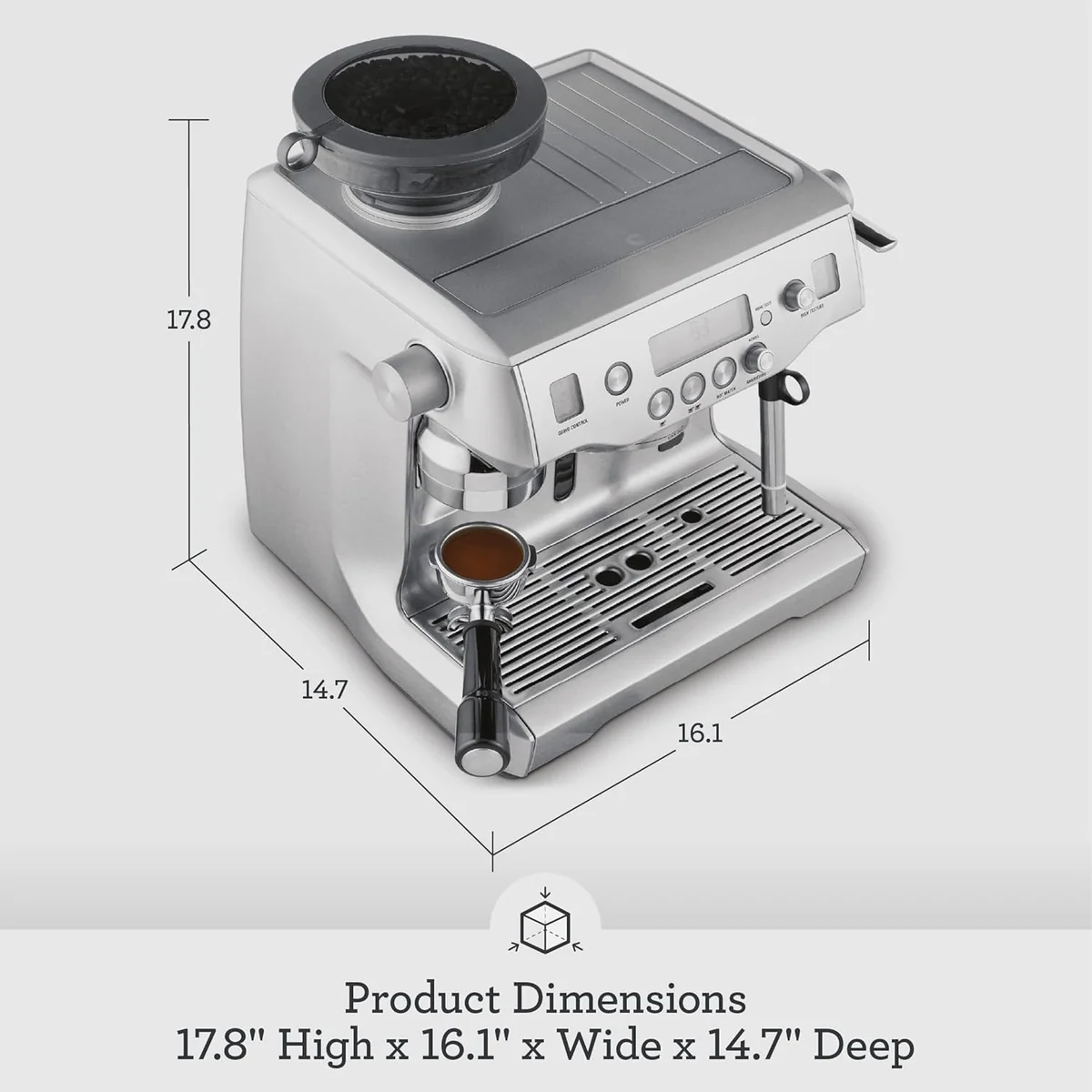
The dose is fixed at roughly 22 grams and there is no dose setting anywhere in the menu. A retailer weighing an actual dose on camera got 22.5 g and put the grinder's practical ceiling at 23 or 24. The only way to change it is mechanical: you go into the grind and tamp station and adjust the auger lock nut, extending it so the machine reads the basket as full sooner. Coffeeness calls that astonishing at this price, and it is hard to disagree.
Whether the adjustment works appears to depend on your machine. One long-term owner set his to about 19 g, calls it super easy, and says he set it once and never touched it again. A BES980XL owner in a different thread has unscrewed the thread as far as five turns and is still getting consistently over 20 g into the basket. The most plausible mechanism anyone has offered is that the tamp force setting keeps the grinder running until the target force is reached, so a high tamp number drags more coffee in behind it; that theory was floated, the original poster said he would try dropping tamp force from 7 to 2, and no one ever posted the result. Treat it as untested.
This matters because the stock basket is around 22 g, and 22 grams of coffee in a 22 gram basket leaves no headroom above the puck. That is the mismatch a parts vendor built an entire product pitch on, arguing that automatic dosing machines tend to overfill and that the overfill directly attacks the space the puck needs to pressurise. They are selling something, so weigh it accordingly, but the failure they describe is the one owners describe for free.
Strengths & Limitations
Strengths
- Two boilers mean the shot and the milk happen at once, which is the whole reason this class of machine exists.
- The automatic steam wand produces microfoam that owners with years of hand practice concede is better than their own.
- Grinding, dosing and tamping happen inside the machine, so the counter stays clean and the beginner skips the two steps that ruin most home espresso.
- It runs single-wall baskets in a full stainless 58 mm portafilter, not the pressurised baskets that manufacture fake crema on cheaper machines.
- Grounds never pass through a sealed brew unit, so it cannot develop the mouldy internal brew group that eventually finishes off a bean-to-cup.
- The hidden service menu logs shots, steam minutes, descales, filter changes and calcium level, which makes a second-hand one unusually easy to vet.
- The auto-on timer can have it at temperature before you have reached the kitchen.
Limitations
- The built-in grinder is roughly Smart Grinder class inside a machine priced far above that, and it is the part long-term owners replace first.
- It doses about 22 grams with no dose control in software, so changing it means taking a screw out of the tamp assembly and hoping.
- Shots are timed rather than weighed, which is a generation behind the machines it is now cross-shopped against.
- Shot volume drifts upward as the machine and the beans heat through a session and only resets when it has cooled overnight.
- Leaking o-rings are the platform's signature failure and can drip onto electrics, which is how owners end up tripping a household breaker.
- The internal diffusion plate is plastic, and both a repair technician and a parts vendor describe it warping and cracking in service.
- It needs five to ten minutes to reach temperature and longer to settle thermally, so it is not a machine you can walk up to cold.
- Some repair shops refuse to touch Breville machines at all, which makes local service a lottery you should settle before you buy rather than after.
What a morning on it actually looks like
It is not a walk-up machine. Dual boilers take five to ten minutes to reach the point where the display says 93 °C, and Breville's own advice, relayed in the retailer demonstration, is to give it another ten or fifteen minutes so that the pipes, the group head and the portafilter are hot rather than merely the water. You can shortcut some of that by running a blank shot to flush heat into the group and the cup, and you can leave the portafilter locked in overnight so the auto-on timer preheats it for you. That is also the honest answer to the reviewer at Epicurious who says an espresso machine taking twenty minutes to heat up is not for her: on the Oracle it is five to ten to ready and considerably longer to genuinely settled, which is precisely why the timer exists.
The single most important workflow fact about this machine is that it brews to time, not to weight. Defaults are 25 seconds for a single and 30 for a double, and the demonstration is explicit that it does not matter how much coffee comes out, the pump runs for the same duration every time. Coffeeness rates those defaults as right on the money. One owner reports his singles at 20 seconds, easily changed in the menu. You can stop a shot early by pressing the button again, which is how most people actually manage output. It is worth saying plainly that machines now cross-shopped against this one have scales built into the drip tray and stop on a number, and owners rate that convenience highly; brewing by stopwatch is a design decision from 2014 showing its age.
Dialling in is a real exercise, not a formality. Breville's setup video suggests starting at grind 30. The retailer working through a fresh machine on camera went 20 (too fast), then 15 (visibly too slow, shot abandoned), and settled at 18, which produced 49 g out of 22.5 g in over 27 seconds with an even, symmetrical flow. That is a long way from 30 on the same dial, on ordinary supermarket beans, which tells you the recommended number is a place to begin and nothing more. The same source puts the cost of getting there at 200 to 500 grams of wasted coffee before you are set. Budget for it.
Where the grinder runs out
Every serious source converges here, and they converge from different directions. A one-year Oracle owner: the big letdown is the grinder, hit and miss all year, eventually solved by buying a standalone Eureka Specialita, and he notes other Oracle owners have done the same. Another owner puts it more precisely: he could work with plus or minus two or three grams if it were consistent, and his machine "is mostly consistent but sometimes it's consistently inconsistent." A third says the further he sank into espresso the more he found the grinder not up to the task, especially when changing beans regularly. A Team HB member on home-barista gives the benchmark that makes the whole thing click: the built-in unit is probably comparable to Breville's own Smart Grinder, which is to say a couple of hundred dollars of grinder inside a machine that costs many multiples of that.
There is a genuine dissent worth recording. The most detailed owner account in the whole corpus rates the grind quality as good, notes the conical steel burrs are small and need regular attention, and says the upper burr comes out easily and a shop vac does the job. A repair technician on YouTube goes the other way as hard as it is possible to go, refusing to use the onboard grinder at all in his own testing and telling viewers not to buy machines with built-in grinders. Both of those people have handled the machine. Neither is lying. Where they agree is on the direction of the ceiling: the grinder is the part that limits the machine, and light roasts and frequent bean changes are where it shows first.
Then there is drift, which is the sharpest technical observation anyone has made about this machine. The same detailed owner could not work out why shot volume at a fixed grind setting climbed steadily through a day's use and reset to normal from cold the next morning; he suspected heat, because the machine runs very hot and needs time to shed it. Coffeeness independently makes the structural version of the same point: as the machine warms, the grinder becomes less stable and grind settings shift. Two sources, no contact between them, same conclusion. If you pull four drinks back to back at the weekend, expect the fourth to differ from the first. The workaround owners land on is single dosing the hopper, or keeping the built-in grinder for a second bean such as decaf and using an external grinder for the main one; if you drink both, our guide to running two beans covers the machines built for that.
Milk, and the one thing everybody agrees on
The automatic wand is the least controversial part of the machine. It defaults to 60 °C with the froth slider mid-travel, slides down toward flat-white texture and up toward cappuccino, stops itself at target temperature, and has a manual mode if you want to practise latte art. Coffeeness admits to having started sceptical and been converted. The Epicurious reviewer is blunter still, saying the automatic steam function produces better milk than she has ever managed by hand.
Where reviewers disagree is on the target itself. Coffeeness places the latte-art sweet spot in the mid-fifties Celsius and warns that going hotter boils the milk to death; the Epicurious reviewer settled on 152 °F, which is above that ceiling, because she wants a hot drink more than she wants a rosetta. That is not a contradiction to resolve, it is the actual choice you will make in the first week. Two practical notes from owners: centre the jug properly on the base or the milk will not roll, and if you are a plant-milk drinker be aware the automatic logic is tuned for dairy, with one owner's poor texture never conclusively pinned on the oat milk he suspected. If milk drinks are the whole point of the purchase, the case for each type of milk system is worth reading before you commit, as is our pick for latte-first households.
What comes out of it
The most striking claim in the record comes from an owner who also ran a Quickmill QM67 with a Compak K10 grinder, serious equipment by any standard, and who reported the Oracle's coffee as astonishingly good and better than the Quickmill's, sweeter, with a second layer of flavour underneath. A forum moderator flatly refused to accept it, pointing out that a double boiler E61 machine with a K10 is capable of the highest quality there is and that the difference almost certainly lay on the handle side of the portafilter. Both positions are on the same page and we are not going to adjudicate them. What the exchange usefully shows is that a well-set Oracle is at least in the argument, and that the argument gets decided by preparation.
Set against that, a repair technician pulling 21 g in to 36 g out in 30 seconds on a bean he knows well called the result "definitely not a bad coffee, it's just a bit bland," missing the caramel and milk chocolate he normally gets, and he was using an external grinder, so that judgement lands on the brew group rather than the dosing. The most balanced formulation belongs to a former owner who moved to a Lucca: the Oracle makes it easier to produce good shots because the temperatures are stable and the parameters are controllable, but less satisfying. That sentence is the machine.
The argument you will have with the internet
Ask any espresso forum whether to buy an Oracle and the answer comes back with unusual unanimity: buy the plain Breville Dual Boiler without the grinder, and put the difference into the best standalone grinder you can afford. The top-voted comment in a recent buying thread says exactly that. The one-year Oracle owner says in hindsight he might have done it. The structural version of the argument is the strongest one: put a grinder and a machine in the same box and a failure in either costs you both. Our own view on that trade-off is in whether a grind-and-brew all-in-one is a good idea, and if the separates route appeals, the closest thing on this site is the Bambino Plus paired with a Baratza Encore ESP, which is the same philosophy at a fraction of the outlay.
There is a counter-argument and it is better than it looks. When one owner suggested keeping an external grinder for daytime shots and the Oracle's hopper for evenings, another shot back that doing so surrenders the exact advantage you paid for. He is right. An Oracle whose grinder you have stopped using is a Dual Boiler you overpaid for, and if you already suspect you will end up there, the internet's advice is simply correct in your case.
Against the touchscreen version, one prospective buyer rang Breville and was told the internals are identical, which makes the price difference roughly the cost of a screen; that is unverified but it comes from the manufacturer's own phone line, and it is the strongest argument for choosing this model over the Touch. We take that decision apart properly in Oracle versus Oracle Touch. Against the Barista Touch, the trade is concrete rather than cosmetic: the smaller machine gives you a 54 mm portafilter, a single boiler and manual tamping, and Coffeeness's own conclusion is that if you are fine tamping by hand it is worth considering at a fraction of the price. That comparison runs in full in Barista Touch versus Oracle Touch and our Barista Touch review, and our Breville range guide places the rest of the line.
The comparison that goes the Oracle's way is against actual super-automatics, and it is worth taking seriously because that is the category it is listed in. A home-barista member who tried an Oracle in-store on stale Illy beans still saw the potential, was impressed by the automatic frother, and then, tasting it back to back against a Jura, found the Jura lacking in mouthfeel and flavour by comparison; his verdict was that for anyone shopping the super-automatic market, the Oracle is a better use of the money. The honest limit case runs in the opposite direction: an owner who swapped a Breville for a Jura did so for a reason the Oracle cannot answer, wanting something faster and easier in the morning, in and out the door. Five to ten minutes of warm-up and a portafilter to knock out is not that machine, and if that description is you, start with the Jura range or our super-automatic roundup instead.
On whether the money comes back: the Epicurious reviewer's household of two coffee drinkers in New York used to buy a latte most days, and at roughly seven dollars each that is over four thousand dollars a year walking out the door, which is why she describes the machine as feeling like value after six months. That arithmetic is the entire case for a machine at this level, and it only works if you actually drink the drinks. Our longer piece on whether these machines pay for themselves runs the same sums for cheaper equipment.
Two closing notes on how to buy it. Amazon shows four stars from 346 ratings, which is thin for a decade-old flagship and worth reading as low sales velocity rather than as a quality signal in either direction. And the used and refurbished market is a genuinely sensible route into this machine, precisely because of the service menu: it will tell you exactly how many shots a seller's machine has pulled, how many minutes it has steamed, its calcium reading and its stored error codes, which is a level of provenance almost no other espresso machine offers. Pair that with lifting the top cover to check for weeping o-rings before you hand over money and you have a better inspection than most people manage on a used car; our guide to buying renewed and refurbished machines covers the rest of the checks. What you should not expect is for this to be the machine enthusiasts reach for now: in a recent thread asking for a replacement in the fifteen-hundred to two-thousand dollar bracket, the suggestions ran to Lelit, Rancilio, Profitec, Quick Mill and La Spaziale, and nobody mentioned an Oracle at all.
What breaks, and what to do before it does
Ask an experienced owner what to replace pre-emptively on a three-year-old Oracle and the answer comes back immediately: leaking o-rings are the frequent failure point on both the Oracle and the plain Dual Boiler, so take the top cover off periodically, look for signs of water, and stop a weep before it becomes a drip onto electrical components. That is not theoretical. One buyer of a used machine had to change o-rings straight away because the leak was tripping his breaker. The teardown video on the sibling dual boiler is the technical backing: the leak traced to the port where the steam boiler feeds the brew boiler, with calcium residue built up from years of sputtering, and the culprits were thinner-walled o-rings that had cracked and aged badly. Two sizes cover most of the machine, large blue and small orange, and some ports carry a washer you will not know about until you pull the hose out.
The second cluster is the machine refusing to stop. One owner had the pump run on twice in the first weeks of a brand new unit, continuing even after unplugging and resting it. Another, three years in, describes the machine clicking and shooting water and steam while switched off. Someone in an appliance repair forum working the same fault names the triac board as the suspect part alongside the o-rings. If yours starts heating or pumping when it should not, that is where to point a technician.
The third is noise plus a late or absent shot, and it is almost always scale. An eleven-year-old Oracle in daily service, regularly maintained and cleaned the week before, suddenly made a loud noise and delayed every shot. A second-hand machine of unknown history squealed whenever water ran through the head, portafilter in or out, and sometimes produced nothing at all. A separate owner reports the grinder slowing until it needs a second cycle to fill the basket, with wire-brushing, tamper cleaning and bean changes all failing to fix it.
| Symptom | What the sources point at | First thing to check |
|---|---|---|
| Water under the top cover, or a tripped breaker | Cracked o-rings on boiler and hose ports | Lift the cover and look for wet or calcified fittings |
| Pumping, clicking or heating while switched off | Pump, solenoid or triac board | Stop using it and get it to a shop that knows Brevilles |
| Loud pump, late shot, or no flow at all | Scale in the boiler and lines | Descale history and the calcium reading in the service menu |
| Grinder slow, basket underfilled, second cycle needed | Burr wear or clogging, cause unresolved in the reports | Pull the upper burr and vacuum, then the tamp fan assembly |
| Steam wand texturing badly | Blocked tip holes | Unscrew the tip and soak it in descaler until you can see through it |
Water hardness is the variable underneath most of that, which is why Breville's setup video makes the test strip step one and tells you to program the result correctly, because it determines the descale and filter interval. The hidden service menu is genuinely useful here and almost nobody writes about it: it reports espresso shot count, hot water uses, minutes steamed, calcium level, descale cycles, cleaning cycles, filter changes and stored error codes. One owner who has had his machine in the shop repeatedly, roughly every eighteen months since 2018, attributes the whole pattern to horrible hard water where he lives. If you are on hard water, read what descaling actually involves and take the interval seriously; it is the single largest lever you have over how long this machine survives.
One design flaw is worth a small budget line. The internal diffusion plate behind the shower screen is plastic, and a repair technician who services these says it is brittle and horrible and that he never reuses one on a machine he is servicing, preferring the stainless version for its heat retention and shot repeatability. A parts vendor independently describes the same plate warping and cracking and affecting every extraction. Two sources with different incentives describing the same part failing the same way is about as good as evidence gets in this category.
Whether it can be fixed is a local question
This is the sharpest disagreement in the record and it will not resolve nationally. One owner's local repairman told him these machines contain so many plastic parts that they are not worth repairing and that he no longer works on them; another owner sent his to Breville's own service operation, got it running, and concluded he would not buy another. A third owner rebuts both of them: find a shop that works on higher-end machines and specifically on Brevilles, because his is always full of exactly that. And the repair technician on YouTube settles the technical question by rebuilding a machine that was beyond feasible repair for its owner, replacing boilers, electronics, a fried mainboard, the button and the screen. So it is repairable. Whether it is repairable near you, at a price that beats replacement, is the thing to establish before you buy rather than after.
Parts are available, from Breville and from third-party specialists, which is why "parts" is one of the most common things people type after this model number. One warning that nobody else seems to give: the 980XL is the 110 V machine and the 980 is the 230 V one, so while many parts interchange, nothing on the mains-voltage side does. Check before you order a heating element from another continent.
On lifespan, the honest range from the accounts runs from a pump fault in the first three weeks to an eleven-year-old machine still pulling shots daily, with one commenter on the same platform describing twelve years as a good run for a Breville dual boiler. Somewhere in the middle sit the machines that need a shop visit every year and a half and keep going. Backflushing discipline and water quality are the clearest dividing lines anyone has identified. What actually breaks first on these machines goes into the economics of that decision in more detail.
The maintenance regimen that the surviving machines have in common is unglamorous and cheap: backflush with a blind basket after every session and run the cleaning cycle when prompted, descale on schedule, and use water that is not trying to kill you. The retailer demonstration adds four habits worth stealing: a blank shot before and after the shot to rinse the group and the portafilter, drying the portafilter with a tissue before grinding so the coffee does not clump, wiping the group's rubber seal after use to prolong it, and wiping the steam wand the instant you finish so the milk does not bake on. One structural advantage over the category Amazon files this in: because grounds only ever touch the portafilter and the screen, there is no sealed internal brew unit to grow mould inside.
Frequently Asked Questions
Is this a super-automatic espresso machine?
No, it is a semi-automatic portafilter machine that automates grinding, dosing, tamping and milk texturing, which is why Breville's own launch material calls it an automatic manual machine rather than a bean-to-cup.
Can you change how much coffee it puts in the basket?
Only mechanically, by adjusting the auger lock nut inside the tamp fan assembly, because there is no dose setting anywhere in the menu.
Why does the same grind number pour differently by the afternoon?
The most consistent explanation owners and reviewers give is heat, with the machine and the beans warming through a session until the shot runs long, resetting only once it has cooled overnight.
Has Breville discontinued it?
Nothing Espresso Den read says so, only that this is the original Oracle design and that newer Oracle models now sit alongside it in the range.
Can you still get parts for it?
Yes, from Breville and from third-party specialists, but note that the 980XL is the 110 V machine and the 980 is the 230 V one, so nothing on the mains-voltage side interchanges between them.
Does it handle light roasts?
The brew group is not the limit here, the grinder is, and owners who chase light roasts are the ones who end up buying a standalone grinder within the year.
Is the Sage-branded version a different machine?
No, Sage is simply the name Breville trades under in Europe, and the machine underneath is the same one.
How long should one last?
The accounts run from a pump fault in the first three weeks to an eleven-year-old machine still in daily service, with water hardness and backflushing discipline being the clearest thing separating the two outcomes.
Sources (6)
- Amazon listings and customer reviews — Breville Oracle Bes980xl
- Owner reports across r/espresso, r/appliancerepair, r/BrevilleCoffee threads
- Owner and reviewer video, 6 channels
- Coffeeness — Article — www.coffeeness.de
- Home Barista — Article — www.home-barista.com
- Epicurious — Article — www.epicurious.com