Philips 1200 Series (EP1220): the cheapest way into Philips, if you dial it in before the return window closes
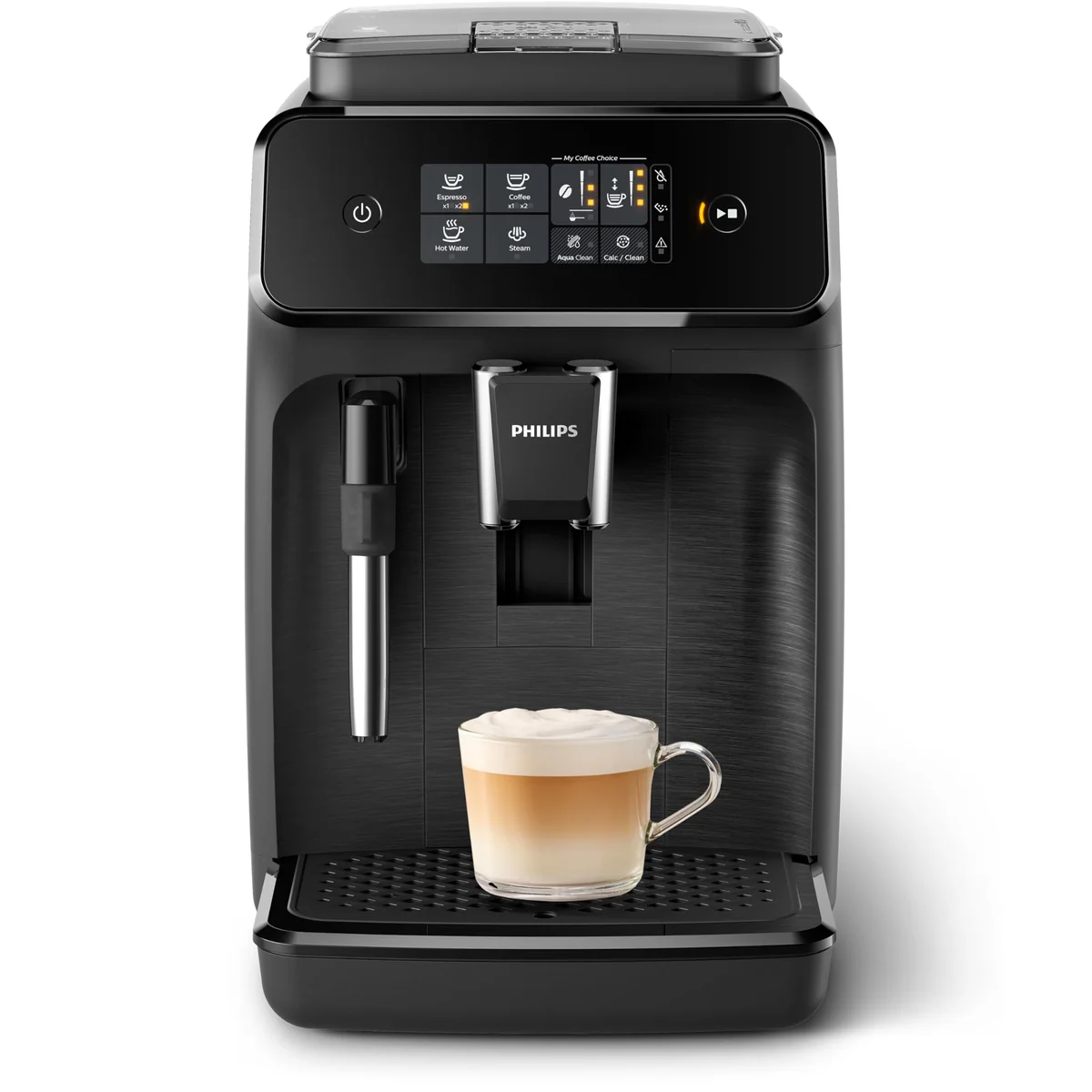
Buy the EP1220 if you are escaping pods and want espresso, coffee and a steam wand you work yourself at one button press, and skip it if crema and body are what you are paying for, because the dose is small, the shot runs long and no grind setting fully rescues it.
Based on 1200 owner ratings, 14 owner discussions and 7 other sources. We have not tested this machine ourselves.
We earn a commission if you buy through our links, which does not affect what we say.
Read how this site works →
So who should actually buy it
Buy it if your reference point is a pod machine and your drink is a latte, a cappuccino or a black coffee you are not going to photograph. On that job it is very good, it is quiet enough for most households, it makes a mess of nothing, and the running cost against pods is not close. One independent reviewer scored it a little over six out of ten and said openly that their recommendation depended entirely on what you pay for it, which is about the fairest summary anyone has offered. A specialist site rated it eight out of ten and reached the same conclusion by a different route: excellent for beginners, wrong for anyone wanting café-level control.
Do not buy it if crema is what you are buying, if you want to tinker, or if microfoam matters enough that you would be annoyed to spend a fortnight learning to steam without the sleeve. A machine that spends most of its life making Americanos is a different purchase from one that has to make flat whites, and our pick for latte drinkers and our pick for black coffee split along exactly that line. If a Portuguese owner's arc is instructive, they bought a used EP1220 cheaply, cleaned and descaled it meticulously, tried every setting, found it bodyless and watery, sold it and bought a manual machine they were happier with even using supermarket pre-ground. That ending is available to you too, and it is cheaper to reach it before you buy.
Buy the EP1220 if you are escaping pods and want espresso, coffee and a steam wand you work yourself at one button press, and skip it if crema and body are what you are paying for, because the dose is small, the shot runs long and no grind setting fully rescues it.
Best for: The Carina grinds fresh, rinses itself and asks almost nothing of you, and it will hand you a pale, watery shot for the first fortnight unless somebody tells you exactly what to change.
Amazon has this machine sitting at 3.9 stars across more than a thousand ratings, which is a peculiar number for a bean-to-cup machine from a company that owns Saeco. The reviews explain it better than the average does. They are bimodal, and the split is almost entirely about one thing: whether the person writing arrived from a pod machine or from something with a portafilter. Everyone escaping a Keurig calls it a life changer. One owner who runs a Rocket as their daily machine bought this for quick afternoon coffees, made forty-five cups trying to get a solid puck out of it, and gave up.
Worth knowing before you weigh any star rating on this product: the retailer pages that show it at 4.4 are carrying reviews where nearly every positive text entry is tagged as collected as part of a promotion, and the unpromoted ones skew noticeably harder. Amazon's 3.9 is the ugliest number and also the largest, least-incentivised sample. Espresso Den's reading is that both figures are honest about different populations rather than one of them being wrong.
The cleanest statement of what this machine is came from a stranger answering a new owner on r/espresso: it does the dosing, tamping, timing and pressure for you, which is the entire point, and it also means you do not get to fix any of them when the shot is thin. If that trade sounds good, read on. If it sounds like a compromise you will resent by March, our explainer on what a super-automatic actually automates will save you a purchase.
Key Specifications
Two buttons, and everything the two buttons hide
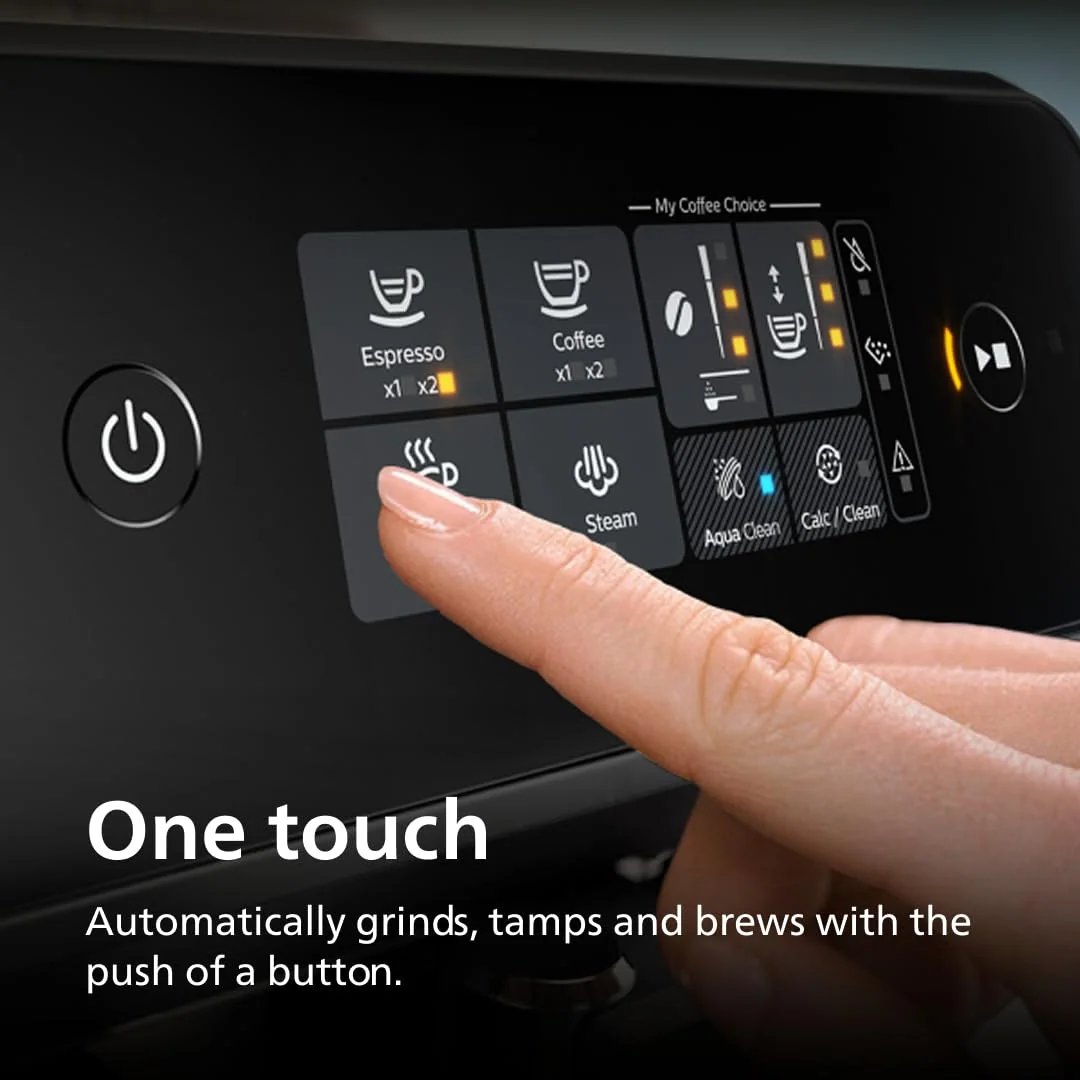
The drink list is espresso and coffee, each once or twice, plus hot water and steam from a manual wand. That is the whole machine, and for a lot of households it is genuinely all of it. What is not obvious from the fascia is that the two adjustment controls do not mean what their labels imply. The strength setting people read as "aroma" is a dose control, not a flavour profile: it changes how many grams the grinder throws into the brew group and nothing else. The volume setting is measured in what lands in the cup, and reviewers who put a scale under it recorded roughly 30 ml at the lowest setting, about 40 ml in the middle and around 65 ml at the top, which makes even the middle position a lungo by ratio rather than an espresso.
The two-cup button is the single most misunderstood control on the machine, and it is not a double shot. It runs two complete cycles back to back: grind, brew, eject the puck, grind again, brew again. That is useful when two people want coffee. Sent into one cup it is actively counterproductive, because each cycle includes its own rinse, so you get two small shots plus rinse water, cooler and weaker than one properly sized drink would have been. The higher Philips models have a true grind-twice-into-one-cup function. This one does not, which matters more here than anywhere else in the range.
There is also a ceiling nobody advertises: the coffee setting maxes out around eight ounces per press. The spout clears a tall mug comfortably, so the machine physically accommodates your twelve-ounce cup, it just will not fill it in one go, and one reviewer said that quirk alone nearly sent the machine back.
Against that, the unglamorous things it gets right are real and repeat across owners. The water tank pulls out from the front, so it never has to be shuffled off the counter. It rinses the brew group on every startup and shutdown, so the circuit stays reasonably clean without you doing anything, which is why a cup left under the spout collects rinse water you did not order. The indicator lights punch above the class: an empty tank locks brewing out entirely rather than letting you waste a dose, which is more than several pricier machines manage. The brew group slides out by hand with no tools. And the sealed, tinted bean hopper lid, the thing the listing calls Aroma Seal, is the one piece of marketing language here that survives contact with reviewers.
The build is plastic throughout, including the drip tray and the top plate, and it is worth being blunt that the top plate is not a heated cup warmer whatever you may have read; any warmth up there is incidental after the machine has idled for an hour. The listing, incidentally, refers to this product as the 2200 Series halfway through its own description, which tells you something about how interchangeably even Philips treats these machines.
Strengths & Limitations
Strengths
- Fresh-ground espresso and coffee at one button press, roughly a minute from cold, which is a genuine upgrade on any pod machine in both cup and running cost.
- The ceramic burrs draw praise even from owners who dislike the shot, and Philips rates them for tens of thousands of cups.
- Front-loading water tank, compact enough to live under wall cabinets, and a spout that clears a tall mug.
- Empty-tank and full-bin indicators actually stop the machine rather than letting you waste a dose, which several dearer machines do not manage.
- It rinses its own circuit on every startup and shutdown, and the brew group comes out for a rinse with no tools.
- If the tank runs dry mid-brew it waits for a refill and finishes the drink instead of dumping the grounds.
- AquaClean genuinely pushes descaling much further out than most rivals in the class demand.
- Spares down to the pump, flow switch, grinder motor and every seal are individually available, so this is a machine you can keep alive.
Limitations
- The dose is small and the shot is long, so the espresso is mild and thin on crema no matter what you do to the grind.
- Owners measure the coffee landing in the cup well below the temperatures the listing's brewing figures imply, and the first shot of the day is noticeably cooler than one pulled after the machine has idled.
- The two-cup button runs two whole cycles with two rinses, so using it for a double dilutes and cools the drink rather than strengthening it.
- The coffee setting stops around eight ounces, which will not fill the mug most American kitchens actually own.
- The panarello sleeve produces bubbly cappuccino foam and no microfoam unless you remove it and learn to steam on the bare tip.
- Everything is plastic, including the drip tray and the top plate, and the top plate is not a heated cup warmer.
- The grind adjustment can only be moved safely while the grinder is running, which is awkward and easy to get wrong.
- The AquaClean filter named in the product title is not in the box on the US EP1220/04, and the 5,000-cup claim assumes you buy eight of them.
- The documentation is pictogram-heavy and does not cover the states owners actually hit, which is why the same handful of questions repeat across every forum.
- Two owners report this exact model dying at four and five years, with a rear leak near the boiler described by more than one of them as a common failure.
Why your first shots taste like weak filter coffee
The dominant complaint about this machine, across Amazon, Reddit, retailer pages and YouTube, is one sentence long: the espresso comes out thin, pale and short on crema. It is not a defect report. It is a design consequence, and the number that explains it is the dose.
| Who | Method | Result |
|---|---|---|
| Superautomatic reviewer "Tom" | Stopped the cycle after grinding, weighed the catch | About 6 g at the low setting, about 7 g at the high one |
| Cafelista | Repeated scale tests across settings and beans | Roughly 8 g to 11 g per shot |
| Reviewer "Joe" | Dehydrated the spent pucks at maximum strength before weighing | 11 g to 12 g |
Nobody gets near the 18 to 19 g a conventional double uses. Pair the smallest of those figures with the 40 ml middle volume setting and you are pulling somewhere around a 1:6 ratio, which is not a bad espresso, it is a lungo wearing an espresso's clothes. Add that every super-automatic in this class uses a pressurised basket, and that the grinder does not travel fine enough to hit a 1:2 in twenty-five seconds even if you wanted it to, and the ceiling on this machine is set before you touch anything.
The good news is that the gap between a bad cup and a decent one on this machine is almost entirely settings, and the people who are happy have all independently converged on the same corner of the adjustment range.
| Control | Where to put it | Why |
|---|---|---|
| Temperature | Maximum, set with the machine off by holding the cup-volume button for about three seconds | Hotter water pulls more soluble material out of a small dose |
| Strength | Maximum, or one step below it | It is a dose control, and dose is the thing you are short of |
| Volume | Minimum | Flavour concentrated into 30 ml beats the same flavour stretched across 65 |
| Grind | Fine, around 2 or 3 of 12, moved one step at a time and only while the grinder is running | Turning the knob with the burrs stopped can damage the mechanism and may not seat the setting |
| Beans | Bold and dark but not oily, ideally with some robusta in the blend | Oily beans produce sludge instead of a puck and are the most common cause of the watery first week |
| Cup | Preheated from the hot water spout | The shot lands cooler than the listing's brew figures suggest, and a cold cup takes more of it |
That protocol is not our invention, it is what the happy owners describe: maximum heat, minimum water, fine grind, and dark non-oily beans. The bean point is the one that flips outcomes most reliably. One Amazon owner started with an oily medium roast, got nothing but sludge and watery brew, switched to a darker and less oily roast, and reported solid puck discs and rich coffee from the same machine on the same settings. If you want the longer version of why, our guide to which beans survive a bean-to-cup grinder covers it, and the watery-espresso explainer covers the rest.
The break-in period, and the argument about whether it exists
You will be told to run shots through it before judging it. The numbers people give are all over the place: five to ten, ten to fifteen, one reviewer counted about twelve before it came good, and a Philips-savvy commenter puts calibration at fifteen to thirty cups. One mechanical explanation is more convincing than the vague talk of the machine learning: the tamper's rubber seal is stiff on a new unit and needs working in before it compresses the grounds properly.
The dissent deserves equal space. A vocal minority argue there is no such thing, that once the grinder chamber is full you are seeing what the machine does, and that the break-in advice conveniently runs the clock down on your return window. That is a sharp point and we would rather you act on it than adjudicate it. Do your calibration shots on cheap beans in the first week, not the fourth. One owner spent almost a full thirty-day window chasing watery pucks and returned the machine on the last days; another gave up at six months, past the point of returning anything at all.
The milk wand is better than its reputation, once you take part of it off
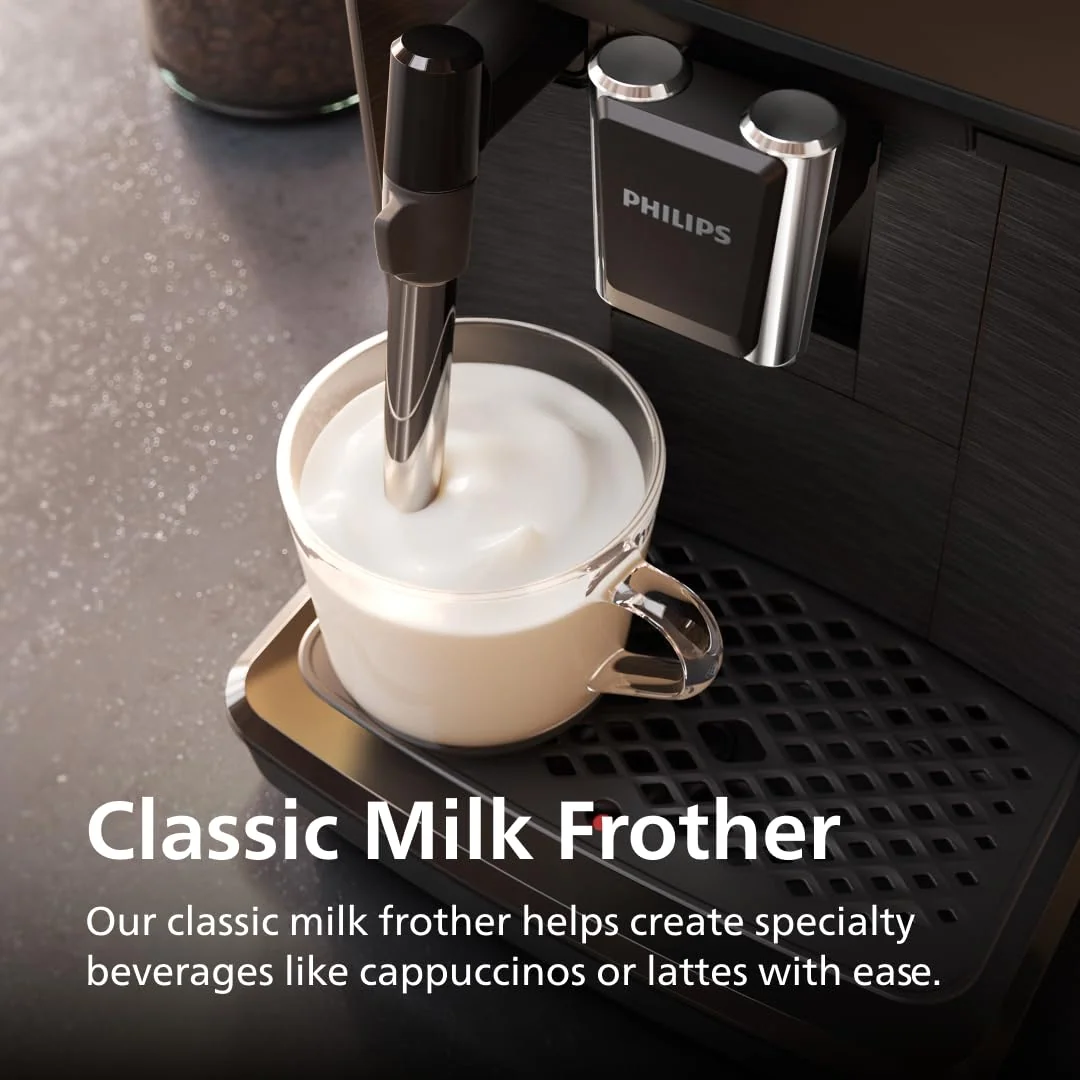
Three separate reviewers say the same thing about the classic frother: the panarello sleeve pulls in so much air that you get large-bubble cappuccino foam and no microfoam, so latte art is off the table. Then a fourth pulled the sleeve off, steamed on the bare single-hole tip, got a whirlpool going, called the result nearly comparable to a proper espresso machine and poured latte art with it on camera. That is not a contradiction, it is the answer: the wand underneath is capable, and the sleeve is what is stopping it. Use a pitcher with enough volume that the foam is not climbing the rim before the milk is hot, and purge the wand with hot water immediately afterwards.
Two other milk notes owners had to discover for themselves. If the silver outer part of the frother is pushed on too tightly it blocks the small air hole and the thing simply will not froth, which reads exactly like a dead machine. And weak or absent steam is a descaling symptom before it is a fault; one reviewer took in a neighbour's machine that had stopped frothing, ran a proper descale and it steamed fine afterwards. If milk drinks are actually the main event for you, a manual wand is a choice rather than a compromise, and our piece on which milk system you will live with is the honest test of whether you want one.
What moving up the Philips range actually buys you
This is the question the internet asks about this machine more than any other, and it has a demonstrated answer rather than a marketing one. A reviewer put a 2200, a 3200 and a 5400 side by side, noted that all of them use the same brew group and the same grinder, set all three to the same grind, maximum strength and shortest volume with identical beans, and pulled shots: 37 g, 32 g and 35 g out, indistinguishable in intensity and temperature. Owners on r/superautomatic say it more bluntly: an espresso or an Americano tastes the same out of a 1200 as it does out of the flagship, because it is the same brewing unit and heater doing the work.
So paying up the range buys drink automation, milk convenience, a display that makes descaling and temperature-setting less of a button-holding ritual, a metal drip tray, and on the higher models the genuine grind-twice function. It does not buy a better shot. If you drink black coffee and Americanos, that reframes the whole ladder, and our guide to which Philips to buy and the 1200 against the 2200 are both built on that fact. The 2200 is the same machine with chrome trim; the meaningful jump is to the 3200 with LatteGo, and that jump is about milk, not espresso.
There are two honest reasons to look sideways instead of up. The first is the Costco-only 800 Series, understood by owners to be this machine with a steam wand made for that channel, and at least one buyer said outright that they chose it over the 1200 purely because that retailer's return policy makes a machine with mixed reviews a safer bet. That is a real argument and we are not going to pretend otherwise.
The second is De'Longhi. In head-to-head threads, the Philips loses on espresso body and milk foam with striking consistency: owners who moved to a Magnifica Evo describe it as better from day one with the same beans. The counter-argument is worth hearing too, from an owner of both brands who says De'Longhi's brew unit clogs at its finest grind settings, so if you want dark, fine-ground, strong black shots the Philips is the one that will actually grind there. Our Magnifica Evo review and the Philips against the Evo lay that fork out properly, and if the budget is firm, our roundup of the cheaper end of the category is where to start.
Living with it: the filter that is not in the box, and the lock that is not in the manual
Start with the headline claim, because it is the one that needs decoding. The listing promises up to 5,000 cups without descaling thanks to AquaClean. Philips' own product page states, in plain text, that the AquaClean filter is not included with the US EP1220/04, and its own disclaimer says the 5,000-cup figure is based on eight filter replacements. Eight filters at roughly 600 cups each, bought by you, on a filter that did not come with the machine. Reviewers confirm the absence independently, and one retailer buyer said flatly that at this machine's price the filter should have been in the box. The filter is a real convenience and it does push descaling much further out than a De'Longhi's typical interval, but it postpones descaling rather than replacing it: when the counter runs out, you descale. We unpack the whole claim in our piece on Philips descaling and AquaClean.
Two small filter irritations, both fixable. New AquaCleans often refuse to sink and bob around the tank, which is trapped air; owners fix it by shaking and tapping the filter submerged until the bubbles come out of the slits, and some packets include a small rubber ring for the nozzle that solves it outright. And a filter must come out before you descale and a new one goes in and gets activated afterwards, which the procedure spells out.
The descale itself takes about thirty minutes end to end, roughly a quarter of an hour for the solution and about three minutes for the rinse, and needs a 1.5 litre container under the spouts. Philips ties the warranty to its own descaler and explicitly names sulfuric, hydrochloric, sulfamic and acetic acids as things that damage the machine, which means vinegar is the one folk remedy to actually avoid, and it also says skipping descaling voids the warranty. Owners routinely use other super-automatic-rated descalers and report no problems, and at least one repair technician told a customer to do exactly that. Both of those things are true at once; choose knowingly.
The routine is otherwise light. Philips' own maintenance sequence is: rinse the frother after every use, rinse the brew group weekly, do a deeper brew group clean monthly, and grease it roughly every two months with the food-safe grease that comes in the box. Owners argue about how much of the wider Philips advice applies to a machine this simple, since the 1200 has no automated cleaning cycle of its own, so the safe answer is that your manual outranks anything you read in a thread about a 5400. Weekly, check the grounds chute for a plug of packed coffee and clear it with the handle of the scoop; that is Philips' own fix and it is in almost none of the reviews.
Two gotchas that generate most of the "my new machine is broken" posts
The first is a lock, not a fault. This machine counts pucks, and it only registers that you emptied the grounds bin if the bin comes out while the power is on. Empty it with the machine off and it stays convinced the bin is full and refuses to brew. The fix, from an owner on a French manuals site who cracked it for a queue of frustrated people, is to switch the machine on and empty the already-empty bin again. An Amazon owner learned the same thing the hard way. That single behaviour explains a striking share of the three-flashing-lights reports, including from machines ten coffees old.
The second is the brew group. Reinsert it out of position after washing and the machine will run water through and produce no coffee at all, which reads exactly like a dead grinder. Philips' own video shows the fix: line the reference marks up before sliding it home, and do not press the PUSH button while you do it. This is also the most plausible explanation for the cluster of owners who report that the pre-ground chute delivers nothing but water, alongside the step people miss, which is holding the strength button until the scoop icon lights before starting the brew. Our guide to Philips settings and warning lights collects the rest, and the pre-ground guide covers the decaf use case that chute actually exists for.
How long it lasts, honestly
Espresso Den has no long-term unit of its own and will not pretend otherwise, so here is the spread from owners. Several report two contented years. One Philips owner reports eight years at six espressos a day. Against that, one EP1220 died at five years and another owner in the same thread lost theirs at four, and there is a specific, repeated complaint about this exact model leaking from the rear near the boiler, which one owner attempted to fix and abandoned. Two separate owners have also posted photographs of a part that fell out during routine cleaning that the parts documentation did not help them replace.
The redeeming fact, and it is rarely made in reviews of machines at this level, is that this is a repairable appliance. A European parts specialist catalogues well over two hundred spares for the EP1220: the pump, the flow switch, the grinder motor, the brew unit O-rings, the official grease. The fasteners are Torx, so buy the bit before you start. What kills these machines is neglect rather than age, a point made with unusual clarity by a repair shop that photographed an EP1220 brew group so caked that they compared it to a barbecue, and noted that the repair would have been cheap a year earlier. Our piece on how long these machines last and what breaks first puts that in context.
Frequently Asked Questions
Why does only water come out when I use the pre-ground chute?
Either the strength button was not held until the scoop icon lit before starting, which the machine requires, or the brew group went back in out of alignment after cleaning, which produces exactly the same symptom.
What do three flashing lights mean?
It is the general error state, and the fixes that clear it most often are re-seating the water tank, removing and rinsing the brew group, and emptying the grounds bin again with the power switched on.
Why does the machine think the grounds bin is full when I just emptied it?
Because it only registers the reset if the bin is removed while the machine is powered on, so switch it on and take the empty bin out again.
Can I use vinegar or a supermarket descaler instead of the Philips one?
Philips explicitly names acetic acid as damaging and ties the warranty to its own descaler, so vinegar is the one thing to genuinely avoid, while owners and at least one repair technician report that any descaler rated for super-automatic machines works fine.
Is the AquaClean filter in the box?
Not on the US EP1220/04: Philips' own specification page states the filter is not included, even though the Amazon title lists it as a feature.
Does the filter really mean I never descale?
No, it means you descale far less often, because the machine counts through eight filters before it demands a descale anyway.
Can you pour latte art with the classic frother?
Not through the panarello sleeve, which aerates everything into large bubbles, but one reviewer removed the sleeve, steamed on the bare single-hole tip and poured latte art with it.
What grind setting should I use?
Most owners who are happy sit at 2 or 3 out of 12 with dark, non-oily beans, moving one step at a time and only while the grinder is actually running.
How many shots before it tastes right?
Reports range from five to thirty and one experienced owner ran forty-five without improvement, so treat the first dozen as calibration and do them on cheap beans inside your return window rather than after it.
Is the 2200 worth the extra money over this?
It is the same brew group, the same grinder and the same drinks with chrome trim and a metal drip tray, so the difference is how it looks rather than how it tastes.
Will it fill a large travel mug?
The spout clears a tall mug, but the coffee setting tops out around eight ounces per press, so anything larger needs the two-cycle button or hot water added afterwards.
How long should I expect it to last?
Owner reports cluster around two contented years with one at eight, against two separate EP1220 failures at four and five years, which is a spread rather than a lifespan.
Sources (8)
- Amazon listings and customer reviews — Philips 1200 Series Espresso
- Owner reports across r/espresso, r/superautomatic, r/cafept threads
- Owner and reviewer video, 12 channels
- Homedepot — Article — www.homedepot.com
- Philips — Article — www.usa.philips.com
- Fr — Article — www.modesdemploi.fr
- Fixpart — Article — fixpart.co.uk
- Home Baristas — Article — homebaristas.com