The De'Longhi Dinamica Plus sells you 24 recipes, but what you are actually paying for is two extra seconds of grinding
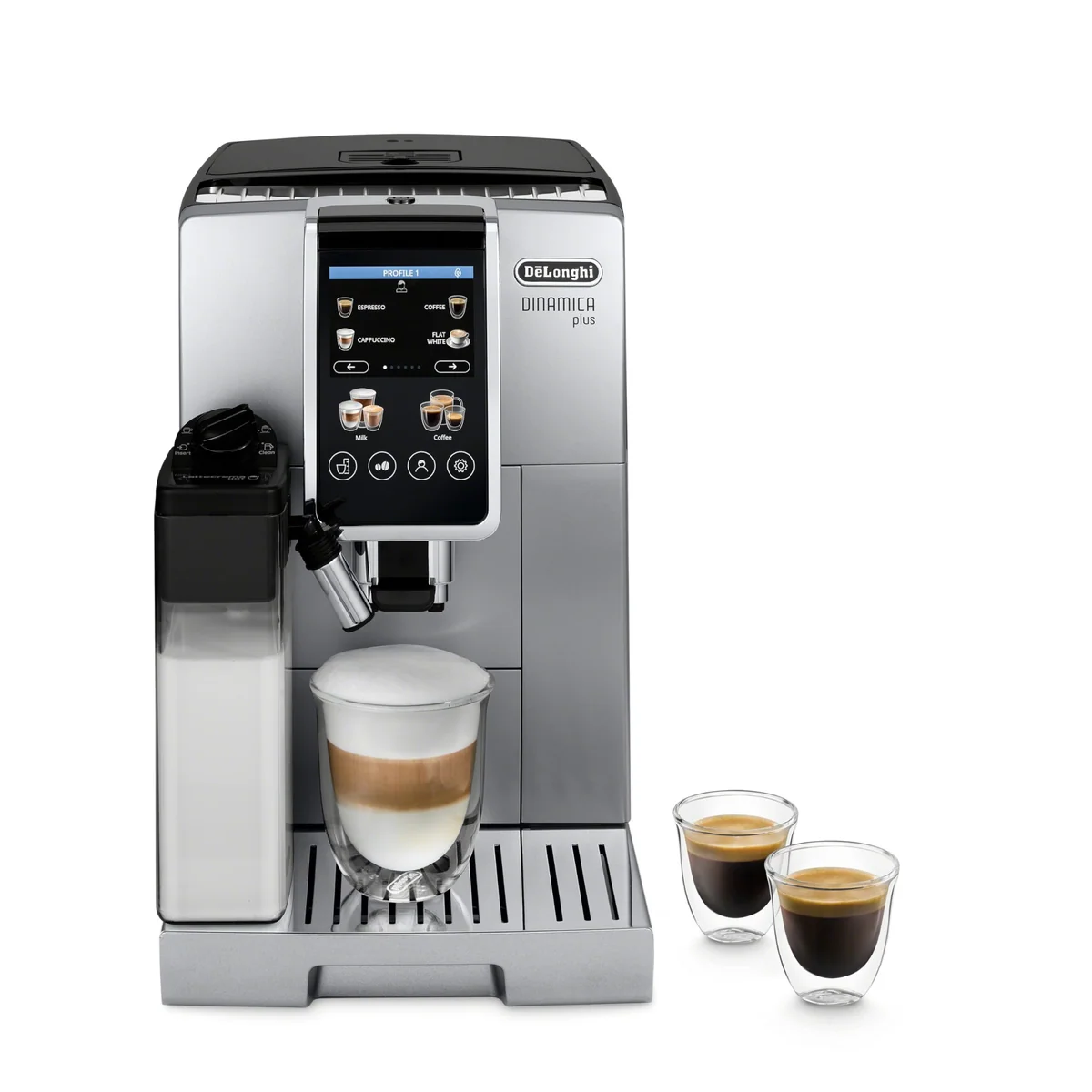
Buy the Dinamica Plus for the fifteen-gram puck and the LatteCrema carafe rather than for the recipe count or the app, and only if you can live with milk drinks that arrive warm instead of café-hot.
Based on 160 owner ratings, 8 owner discussions and 11 other sources. We have not tested this machine ourselves.
We earn a commission if you buy through our links, which does not affect what we say.
Read how this site works →
The bottom line
The Dinamica Plus is the cheapest way into a De'Longhi that grinds a fifteen-gram puck, and that single specification is what separates a shot you would serve a guest from one you would apologise for. It is not a better machine than a Magnifica Evo in any other respect that reaches the cup, its recipe count is padding, its app is an afterthought wearing a Wi-Fi icon, and its milk will never be as hot as the café down the road. Buy it if you drink espresso, cappuccinos and cortados, will run medium-roast beans, will spend a hundred drinks learning it, and want the whole thing to happen while you are doing something else. Skip it if you drink sixteen-ounce lattes, if you want a flat white with real microfoam, or if any part of you would enjoy tamping.
Buy the Dinamica Plus for the fifteen-gram puck and the LatteCrema carafe rather than for the recipe count or the app, and only if you can live with milk drinks that arrive warm instead of café-hot.
Best for: Two listings, one machine, and a single hardware difference that decides whether the shot in your cup is espresso or a turbo approximation of it.
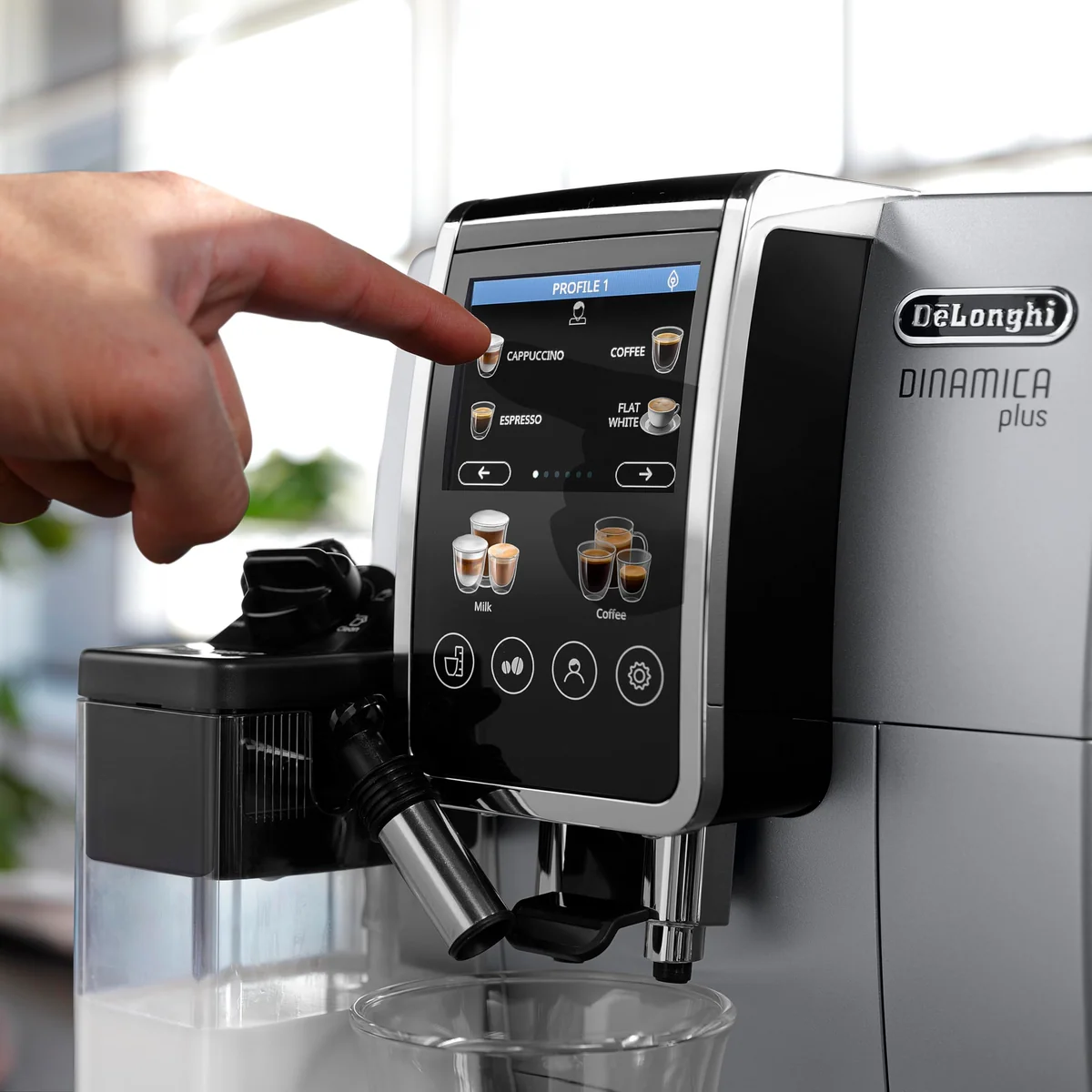
De'Longhi sells the Dinamica Plus twice, and the two boxes do not say the same thing. The Connected model, the titanium ECAM37095TI, leads on Bluetooth and the Coffee Link app, promises eighteen recipes in its title and then says sixteen in its own description four lines further down, and stores three user profiles. The newer silver ECAM38085SB drops the app entirely, claims twenty-four one-touch drinks and four profiles, and is the machine De'Longhi's own US product page now presents as the Dinamica Plus. That page also lists the machine at fifteen bar with thirteen grind settings, and, in a row that undercuts a decade of app marketing, answers "Ability to create your own recipes" with a flat No.
Owners on the forums cannot keep them straight either, and one long-running thread exists mostly so people can be told that the Plus and the Plus Connected are not the same machine. So here is the part that matters before any of the naming: under the panel, both machines are the same as every other current De'Longhi super-automatic. The brew unit is shared from the Magnifica Evo all the way up to the Eletta Explore, and owners who have taken theirs apart say the same thing every time it comes up, which is that the real difference between models is what appears in the menu and how it is displayed. When a reviewer claimed the Dinamica Plus had a bigger brew group, the correction came within hours from someone who owns several of them.
Which leaves one genuine mechanical advantage, and it is worth the page. Both Dinamica Plus models will grind for ten seconds at maximum strength where the cheaper Magnifica Evo stops at eight, and the grinder goes fine enough that the pump can actually struggle against the puck. That is the whole argument for the money. Everything else you are buying is a screen.
The honest drawbacks arrive early too, because they apply to both listings. Milk from the LatteCrema carafe tops out around 59 °C on a thermometer, which is enough for a cortado and not enough for a sixteen-ounce latte. And the Connected model's app, the only thing that distinguishes it from its silver sibling, takes about a minute to connect and sometimes crashes, by the account of the reviewer who liked the machine most.
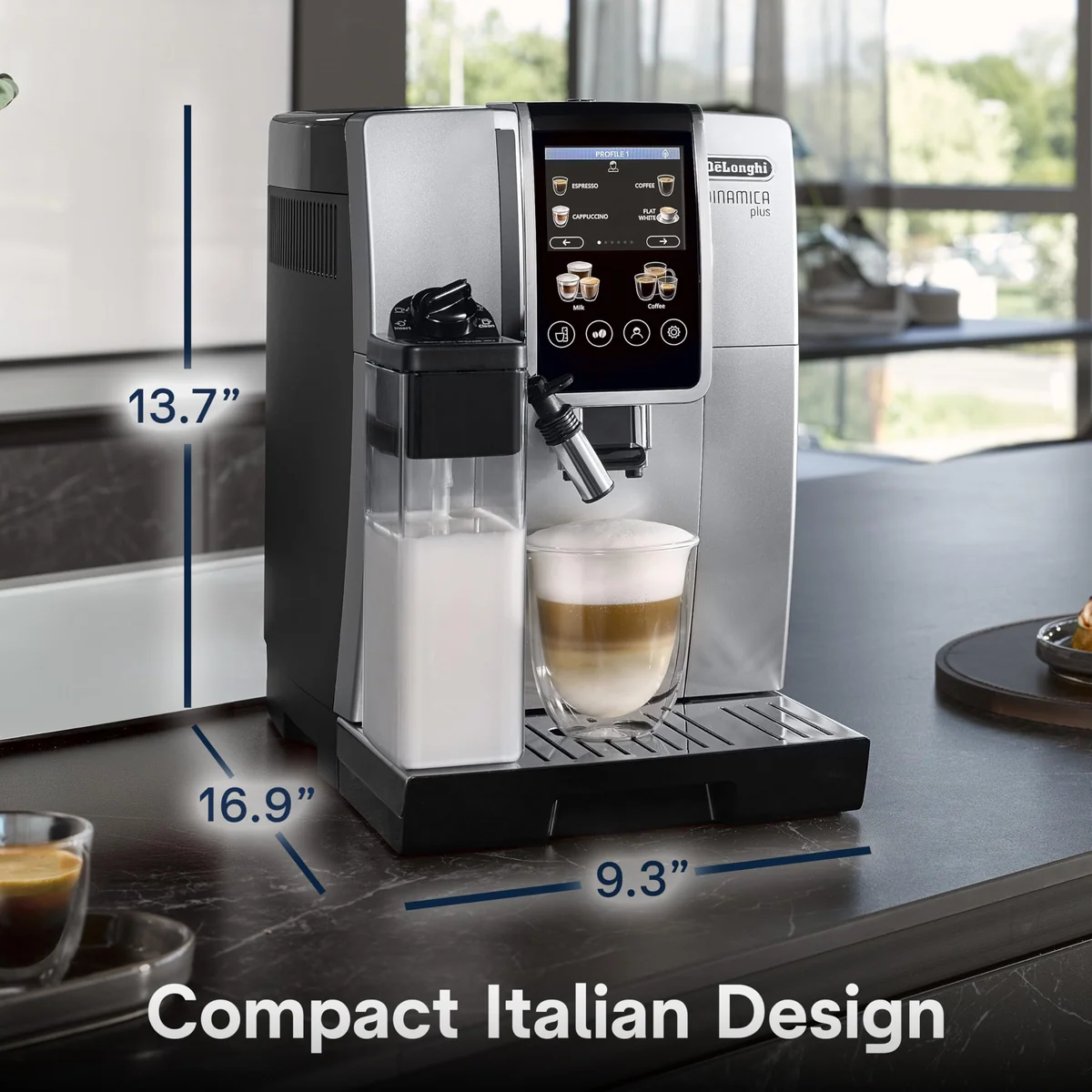
Key Specifications
Two extra seconds of grinding, and why they decide everything
The strength setting on a De'Longhi is drawn as a row of coffee beans, and what it really controls is how long the burr spins. The published mapping runs like this, and the Dinamica Plus is one of the models allowed to reach the top of it.
| Setting | Grind time | Approximate dose | Magnifica Evo |
|---|---|---|---|
| 1 bean | 5 s | 7.5 g | yes |
| 2 beans | 6 s | 8.5 g | yes |
| 3 beans | 7 s | 10 g | yes, and this is its ceiling |
| 4 beans | 8.5 s | 12.5 g | no |
| 5 beans | 10 s | 15 g | no |
Treat the grams as indicative rather than gospel: the same reviewer's video puts the Magnifica Evo's ceiling nearer twelve grams than ten, and his own numbers do not perfectly agree with each other. The ceiling itself is consistent everywhere, though, and so is the consequence. A Philips LatteGo works with roughly seven grams. The Magnifica Evo stops around twelve. The Dinamica Plus packs fifteen, and fifteen grams under a fine grind is the difference between coffee that tastes of coffee and something that tastes of hot brown water with crema on it.
The dose is not as fixed as the bean icons imply. One owner who weighed the puck bin before and after, drink by drink, across different beans and grind sizes, logged doses anywhere from nine to fifteen grams at the same maximum setting. Another, roughly two hundred shots in, settled on nine to thirteen grams as his real-world range and recommends pinning strength at maximum permanently so it stops being a variable.
The grind dial runs one to seven in half steps, thirteen positions, and must be turned while the burr is actually spinning. Most owners land between three and four and a half. Go finer than that and you may choke it: one reviewer calls that a feature, because it proves the grinder can reach espresso fineness, and another calls it a design fault, because the machine lets you select settings its own pump cannot push water through. Both are describing the same behaviour and both are right about what it means, which is that this grinder has more range than the brewing hardware behind it.
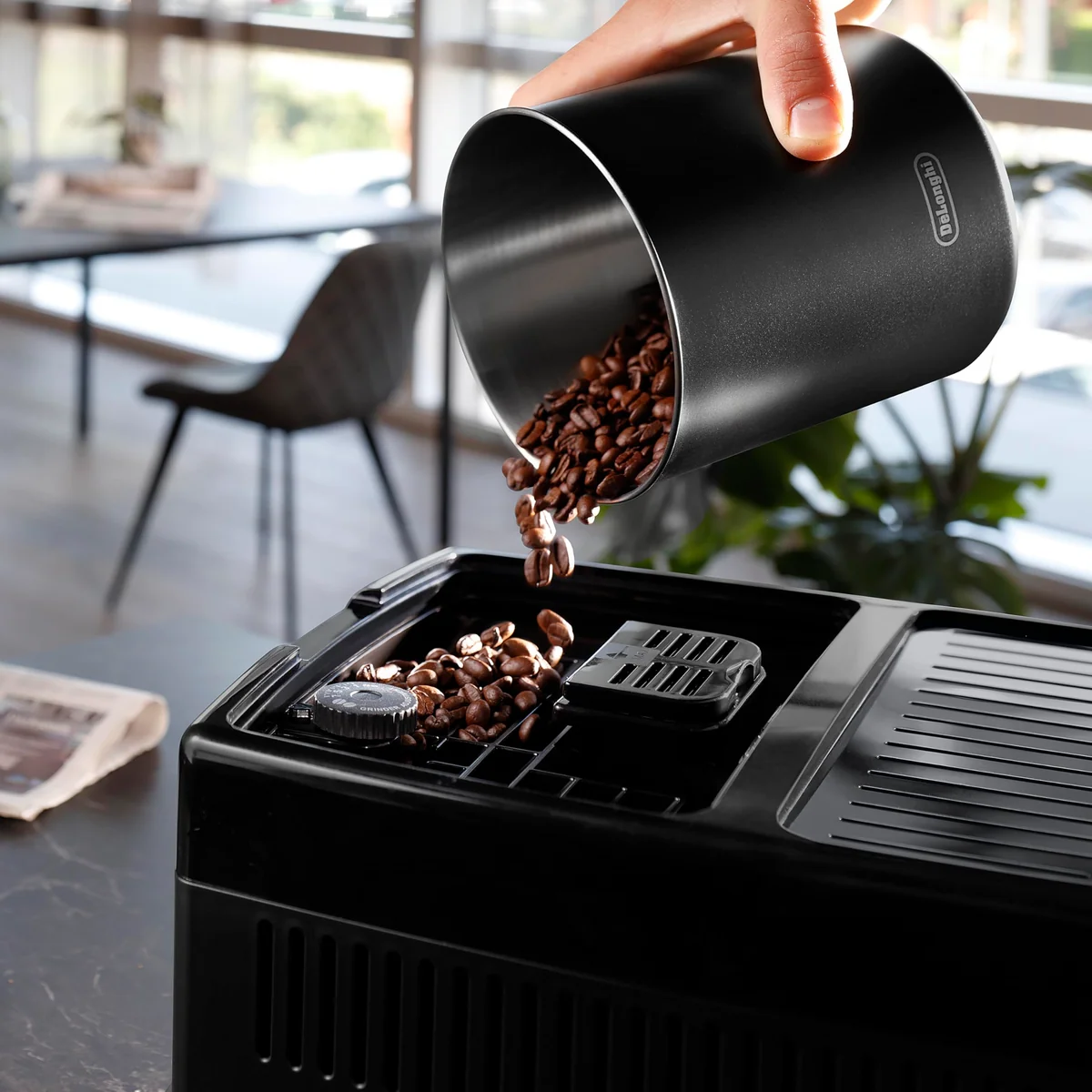
Two practical constraints. Oily dark roasts clog the chutes and can eventually wreck the brew group, so medium and non-oily is the standing advice from every direction, and it is worth reading up on which beans survive a bean-to-cup machine before you buy a kilo of anything glossy. And it takes time to settle: De'Longhi's own setup guidance suggests four or five drinks before it performs, while owners talk about a hundred shots before the grinder feels seasoned and the taste stops moving. A meaningful slice of the angry one-star reviews on both listings were written inside that window.
One fault in this area is specific, dated and comes from someone who owns three of these machines: the Dinamica Plus sometimes reverts to grinding eight seconds instead of ten, has to be reset by running the grinder empty several times, and then drifts back again. That is the machine failing at the one thing it is sold on, and the newer Magnifica Plus reportedly does not do it.
Strengths & Limitations
Strengths
- The fifteen-gram maximum dose and a grinder fine enough to strain the pump put its espresso a real step above the Magnifica Evo and well above any Philips LatteGo.
- LatteCrema foam is the closest thing to hand-steamed milk available at a button press, with texture set on a dial rather than dictated by the drink you chose.
- Oat, almond and cashew milk all froth properly, which is not something every automatic carafe manages.
- The brew unit lifts out for a rinse under the tap, which is why nobody in the research found mould inside one and why home repair is realistic.
- Grounds bin, drip tray and milk carafe come apart easily and the machine nags you clearly when it needs something.
- A drink lands in about ninety seconds from a cold start, including steamed milk.
Limitations
- Milk peaks near 59 °C, so anything larger than a cappuccino arrives warm rather than hot unless you preheat the cup or reprogram the ratio.
- The Doppio+ programme demands a minimum of eighty millilitres, so every proper double means standing there and pressing stop.
- The foam is too firm to pass as microfoam, which makes the flat white on the menu a flat white in name only.
- The coffee pot and long coffee programmes pour too much water through too little coffee and are best ignored.
- The Connected model's app is Bluetooth-only behind a Wi-Fi-looking icon, takes about a minute to connect, and crashes often enough that the reviewer who liked it most abandoned it after setup.
- Water tanks arriving cracked or refusing to prime is the most repeated out-of-box failure on both listings, and the milk carafe port can seize tight enough that owners fear breaking the connector.
- De'Longhi support ships parts quickly and stonewalls diagnosis, and at least one reviewer has watched his own Dinamica Plus quietly revert to grinding eight seconds instead of ten.
What actually lands in the cup
A traditional espresso lives near a one-to-two ratio and takes about thirty seconds to brew. This machine does not let you control brew time at all, and what it pours is closer to a turbo shot, so the owners who have worked hardest at it aim for one-to-three or one-to-four and stop pretending otherwise. One published working recipe is nine grams in, thirty-five out, which is one-to-three point eight and tastes, by his account, consistently good. Push past that ratio in a single pull and the puck over-extracts, which is why a large milk drink is best made by pulling a separate shot into it rather than by running more water through one basket. His summary of the limitation is the honest one: one-push custom drinks with good shots at higher volumes are not possible on this machine.
Within its range it is genuinely good. A single espresso at grind three came out at roughly twenty-one grams from a seven-gram puck, intense and chocolatey, and the Doppio+ produced enough crema to make a reviewer swear on camera. Against a Magnifica Evo, same beans, same grind, same morning, the Dinamica Plus shot looked better and tasted more intense, but the two were indistinguishable on the longer coffee crema programme, because that one only grinds eight seconds on both machines. If you drink long coffee, you are paying the Dinamica premium for nothing. If you drink espresso and milk, you are paying it for something real. Our full Dinamica Plus against Magnifica Evo comparison takes that apart properly.
There is an operating annoyance you will hit on day one. The Doppio+ programme insists on a minimum of eighty millilitres, which overflows an ordinary cup, so every single time you want a proper double you stand there and press stop early. You cannot program it away.
The milk is the best part, right up until you want it hot
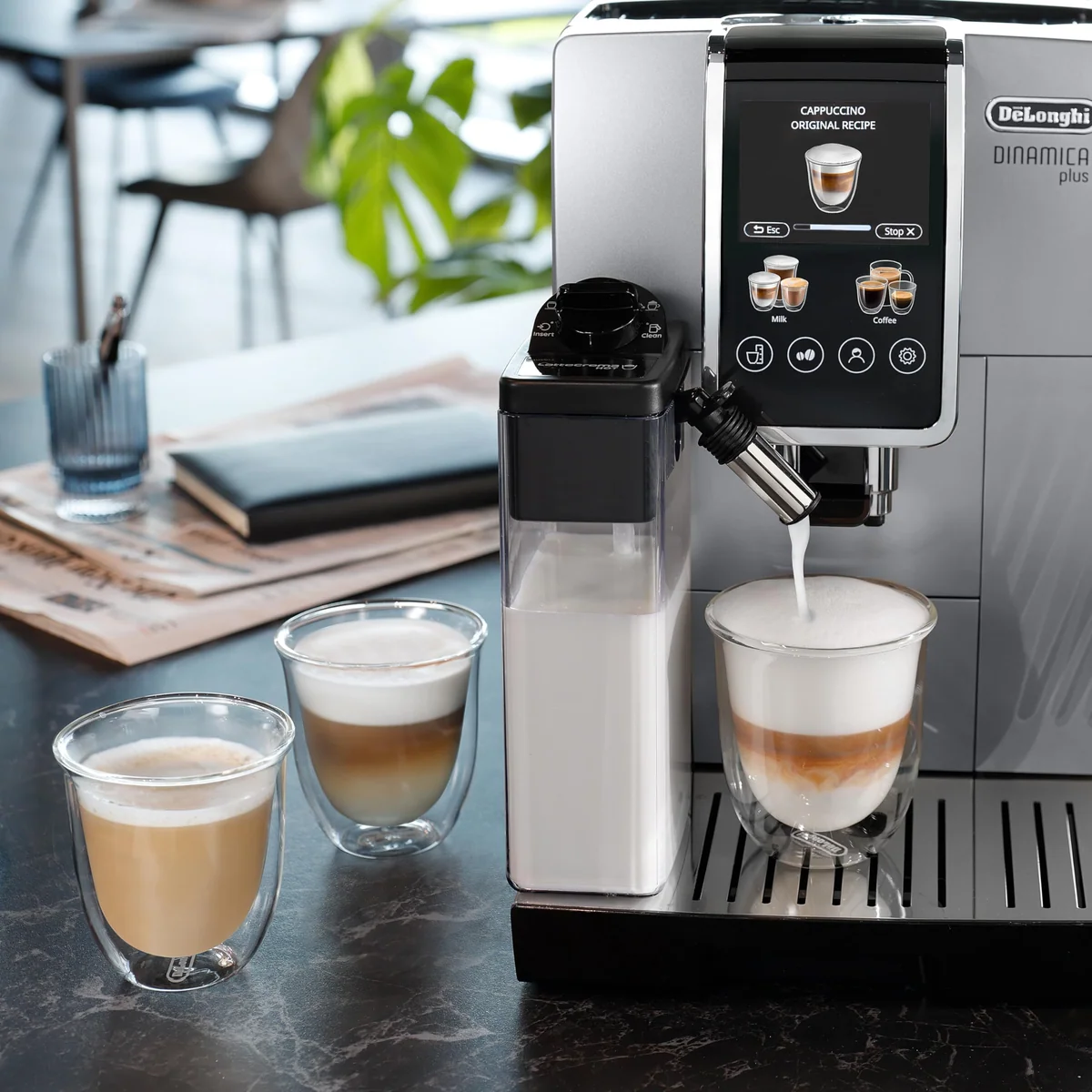
The LatteCrema carafe is the reason people choose this line over a Philips. It is a double-walled thermal jug that lives in the fridge, texture is set on a dial rather than by drink type, and the foam is close enough to hand-steamed that a reviewer poured recognisable latte art out of a super-automatic. Plant milks work, which is not a given: one owner in a dairy-free household reports almond, oat and cashew all behaving, and another bought the Dinamica Plus specifically because oat milk froths on it and said plainly that without oat milk he would have bought the Magnifica Evo instead.
Two independent editorial reviews land on the same failure, though, and it is a drink that appears on the box: the foam never gets fine enough to be true microfoam, so a flat white comes out firm rather than silky and a flat white drinker will notice. If that is your drink, read the case for a steam wand over a carafe first, because the Dinamica Plus has no manual wand option at all.
Then the temperature. On a thermometer, hot milk from the Dinamica Plus stalled around 59 °C where the newer Magnifica Plus reached 64 °C. That is the mechanism behind the most repeated complaint on every De'Longhi owner forum. It is invisible in a cortado, obvious in a latte, and dreadful in anything over twelve ounces: one Dinamica Plus owner of more than a year says the machine is fine for six-ounce drinks and barely warm at sixteen, and solved it by buying a heated mug. On the Australian owner reviews for a sibling Dinamica the complaint dominates the page, and so does the fix that actually works, which is to stop using the preset buttons and program your own drinks with less milk and more coffee. Espresso Den found no owner who reported hot milk without either raising the temperature setting from its middling default, preheating the cup, or reprogramming the ratio. Our piece on why these machines run lukewarm covers why 60 to 65 °C is the category norm rather than a defect.
The drinks to ignore
The coffee pot function, which brews several long coffees in a row into a carafe, is the one thing every editorial reviewer agrees to condemn: too much water, not enough coffee, and the advice is to buy a drip machine instead. The preset long coffee has the same problem, and an americano is the better route to a big mug. One owner does use the pot feature happily for a work thermos, so it is not literally unusable, just weak. The iced setting brews cooler and slower rather than actually cold, which produces a decent room-temperature shot to pour over ice and not cold brew; whether that is a feature or a gimmick is genuinely contested, and what these iced modes really do is worth understanding before you pay for one.
As for the drink count, the useful framing came from the reviewer who tested all of them: the long menu is slight variations on the same drinks, the way a fast-food chain relaunches the same ingredients in a new wrapper. Every long-term owner in the research had settled on one or two drinks and ignored the rest.
Speed, at least, is not in dispute. Rinse and heat-up runs under a minute, a single espresso takes about thirty-two seconds from button to last drop, and a cappuccino with steamed milk lands at roughly one minute thirty-seven.
Connected, not connected, or neither
The Connected model's app is the only thing separating the two listings on this page, so it deserves a straight answer. It is Bluetooth, not Wi-Fi, despite an icon on the machine that looks exactly like a Wi-Fi symbol, which means you cannot start a drink from anywhere except a few feet away. Pairing is a coin flip: one owner's phone connected instantly and the second phone in the same house needed a call to De'Longhi support. The reviewer who rates this machine highest describes the app as slow, clunky and prone to closing itself, and says he stopped opening it after setup.
And yet there is one real reason to want it. Without the app, customising a drink means brewing it and hitting stop at the volume you like, which is guesswork with a mug in the way; with the app you type a number in millilitres. Owners who defend the Connected model defend it on exactly that ground and nothing else. An owner who bought it summed the whole proposition up better than the marketing did: you do not buy this machine for the app, you buy it for good coffee.
| Dinamica Plus Connected (ECAM37095TI) | Dinamica Plus (ECAM38085SB) | |
|---|---|---|
| App | Coffee Link over Bluetooth, proximity only | None |
| Recipes claimed | 18 in the title, 16 in the description | 24 |
| User profiles | 3 | 4 |
| Numeric drink volumes | Yes, in the app | Brew and press stop |
| Grinder and brew unit | Identical, and shared with the rest of the current De'Longhi range | |
| Review history | Long, with a lower average score | Short, with a higher one |
Our recommendation, and it is not the flattering one for either box: if you will set your drinks once and never touch them again, buy the non-connected model, take the fourth profile and the longer menu, and lose nothing that reaches the cup. If you are the sort of person who will actually want a 34 ml espresso rather than roughly-a-third-of-a-cup, the Connected model's app is the only route to it on this line, and you should expect to fight it for ten minutes and then never open it again. We take the two apart side by side in Dinamica Plus Connected against the Dinamica Plus without the app.
The blunter version of the value question came from a reviewer with a commercial coffee background: the step up from a standard Dinamica to the Plus buys you a better interface and app control, not better espresso. That is true of the step from the Magnifica Evo too, with the fifteen-gram exception noted above.
Where the money goes instead
If you drink big milky mugs and the temperature ceiling worries you, look at the machines built around milk before committing. If two people in the house drink different beans, the Rivelia with its swappable hoppers solves a problem the Dinamica Plus answers with a pre-ground chute and six button presses. If you want cold brew that is actually brewed cold, that is the Eletta Explore. If you would rather spend less and accept a twelve-gram puck, the Magnifica Evo makes the same milk with the same carafe technology; our guide to the whole De'Longhi ladder maps the rest. Against the obvious rival, the Philips 5500 LatteGo is far easier to clean and doses smaller, which we put head to head in Philips 5500 against the Dinamica Plus. And if reading the phrase "one-to-three point eight" made you want to touch a portafilter, you want a Breville Barista Touch instead and you should stop looking at super-automatics.
The parts that fail, and the ones that do not
The best single line written about this machine is not about coffee at all: it automates the drink-making, not the ownership. Budget a minute or two a day for the grounds bin and drip tray, a weekly wash of the milk carafe, a monthly rinse of the brew unit under the tap with no soap and the machine switched off at the rear, a water filter every couple of months and a descale every two to three depending on your water. Our cleaning and descaling walkthrough covers the rhythm; the descale itself is around twenty minutes of standing nearby with a bowl.
Two habits are not optional. The carafe dial must be turned to Clean after every milk drink, and it must be turned back before the next one or you get rinse water in your cup. And the milk intake tube has to be seated inside the lid, a detail that cost one new owner three ruined drinks before she found the tube in her drying rack.
The rinse cycle runs on power-up, after drinks and on shutdown, and it is a genuine irritation rather than a theoretical one. One owner keeps a glass permanently on the counter to catch it and warns that without one you will have a tray of dirty water instead. Against that, the constant flushing is also why nobody in the research reported mould: the brew unit comes out, the machine opens up and dries, and the carafe is simple enough that there is nowhere for milk to hide.
Now the failures, ordered by how often they appear. Out-of-box water-path faults are the most common: a renewed unit that leaked internally and a new one that would not prime, both returned by the same buyer, two machines returned by another owner for leaks from two different parts of the water tank, and a tank whose plastic locating lip snapped in transit so the machine never registered it was fitted. If you buy one, unpack it and inspect the tank before you fall in love with it, and think twice about a renewed listing; our notes on buying renewed bean-to-cup machines apply here with force.
Second, the milk carafe port. It seizes. One owner needs so much force to pull the carafe off after a brew that he expects to snap the connector; another bought an entire replacement carafe, reproduced the fault exactly, and concluded the problem is the machine side rather than the jug. With a full carafe going in and out of the fridge several times a day, this is friction you meet every single latte.
Third, and further out, the hydraulics. A German repair forum thread on a sibling Dinamica is the most useful longevity document in the whole research file: a three-year-old machine at roughly 2,500 brews stopped brewing entirely, ejected dry pucks and dumped every drop into the drip tray, and after the owner had already wasted money on a brew piston the actual culprit was a failed lower solenoid valve. The repairer's aside is the reassuring part, which is that the brew piston itself is expected to last around twenty thousand brews, and that mushy pucks and water in the grounds bin usually mean stiff seals rather than a dying machine, curable by swapping the black seals for orange ones. Editorial estimates put a well-maintained Dinamica at seven to ten years with grinder burr wear as the usual end, which lines up with what these machines generally manage.
Support splits cleanly along one line, and it is worth knowing which side of it you are on before you call. Ask De'Longhi for a part and it goes well: a replacement water tank shipped same day with a tracking number and arrived within the week. Ask them to diagnose something and you get a request for the invoice, then photographs of the serial number, then a video, then silence, which is the same script two separate owners describe. Register the machine when you unbox it, because owners consistently report a third year of warranty on top of the standard two for doing so, and De'Longhi's own product page says the same.
One last quirk worth knowing: opening the drip tray resets the grounds counter, so if you pull the tray out to wipe it and slide it back with a full puck bin, the machine will happily overflow it. And if you use the pre-ground chute for decaf, note that it takes several presses of the bean button to reach the scoop icon every time and no profile can default to it, which is the single most-cited interface complaint from people who otherwise love the machine; using pre-ground and decaf properly is its own small skill.
Frequently Asked Questions
What is the actual difference between the Dinamica Plus and the Dinamica Plus Connected?
They are the same machine underneath, with the Connected model adding a Bluetooth app that lets you set drink volumes as numbers, while the newer non-connected version drops the app and claims more recipes and a fourth user profile instead.
Does the Dinamica Plus make real espresso?
It gets closer than almost any other super-automatic because it will grind fifteen grams fine enough to strain the pump, but it brews in well under thirty seconds and lives happily at one-to-three or one-to-four rather than the classic one-to-two.
Why is my latte only warm?
The carafe tops out around 59 °C by thermometer, so the fix is to raise the coffee temperature setting from its middling default, preheat the cup, and reprogram the drink with less milk and more coffee rather than to expect a hotter machine.
Will it froth oat milk?
Yes, and owners in dairy-free households report almond and cashew working as well, which is the single most decisive reason to choose this line over a cheaper automatic frother.
Which beans should I put in it?
Fresh medium roast that is not visibly oily, because oily beans coat the grind chutes and eventually cause the blockages that end up looking like a broken machine.
Is the coffee pot function worth using?
No, because it runs far too much water through far too little coffee, and a dedicated drip brewer will beat it for less than the cost of one descaling kit.
How long should one of these last?
Seven to ten years is a reasonable expectation with monthly brew-unit rinses and regular descaling, with the caveat that the most common early failures are cheap water-circuit parts rather than anything terminal.
Do I have to buy the Connected version to customise drinks?
No, but without the app you customise by brewing a drink and pressing stop at the volume you want rather than by typing a number, which is exactly as imprecise as it sounds.
Sources (13)
- Amazon listings and customer reviews — Delonghi Dinamica Plus
- Owner reports across r/superautomatic, r/DeLonghi threads
- Owner and reviewer video, 3 channels
- De'Longhi — Article — www.delonghi.com
- Tomscoffeecorner — Article — tomscoffeecorner.com
- Cicadacoffeebar — Article — cicadacoffeebar.com
- Coffeenestiq — Article — coffeenestiq.com
- Whatsavvysaid — Article — www.whatsavvysaid.com
- Coffeeness — Article — www.coffeeness.de
- Au — Article — www.productreview.com.au
- Homecoffeeexpert — Article — homecoffeeexpert.com
- Co — Article — balancejournal.co
- Komtra — Article — komtra.de