The KitchenAid KF7 is a Swiss machine wearing an American badge, and the coffee is not the part you are gambling on
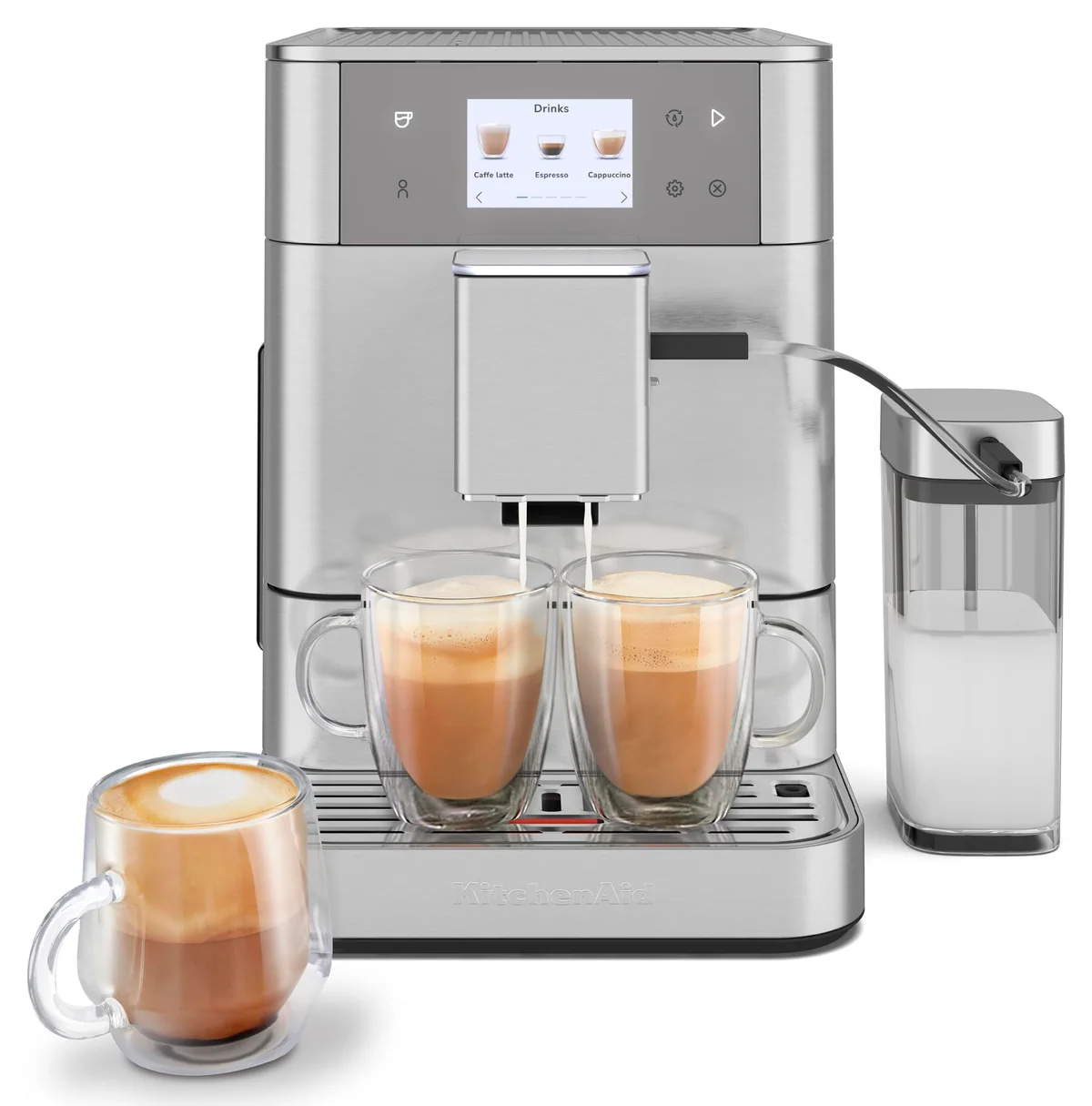
Buy the KF7 if you want Miele-grade hardware behind an interface the whole household will actually use and you can get it on KitchenAid's discount channel rather than at sticker, and walk away if a repair queue measured in weeks would poison the purchase for you.
Based on 165 owner ratings, 5 owner discussions and 7 other sources. We have not tested this machine ourselves.
We earn a commission if you buy through our links, which does not affect what we say.
Read how this site works →
So should you buy one
The KF7 is the best-built, easiest-to-live-with machine of its type that most people will ever put on a counter, and it is a mature Swiss platform rather than a badge exercise. It also carries a risk profile that its glossy first-party reviews do not show you, because people who spend six weeks in a repair queue write about it on forums, not on the page they bought from. Buy it on a discount, from a retailer whose returns process you trust, with the understanding that you are paying for convenience and finish rather than for a cup that beats a good semi-automatic. If you would rather not take that bet at all, the wider shortlist has machines with longer track records, and the beans you put in the hopper will move the cup more than the model number does, which is the subject of our guide to what actually works in a bean-to-cup.
Buy the KF7 if you want Miele-grade hardware behind an interface the whole household will actually use and you can get it on KitchenAid's discount channel rather than at sticker, and walk away if a repair queue measured in weeks would poison the purchase for you.
Best for: It shares a brew unit with Miele, it is the easiest machine in this category to walk up to half awake, and what decides whether you should buy it is what happens if it breaks.
Every thread about this machine contains the same slightly embarrassed question: KitchenAid makes stand mixers, so what is a KitchenAid doing on the shelf next to a Jura? The answer is that the KF7 is not really a KitchenAid design at all. It comes out of Eugster/Frismag, the Swiss contract manufacturer that builds for Jura, Miele and a handful of European badges, and the most experienced owner in the public record, someone running a Jura Giga 10 alongside a Miele CM5300, is blunt about the lineage: the KitchenAid and the Miele share a brew unit, and the brew units are interchangeable. His summary of what KitchenAid added on top is the best line anyone has written about this machine: "The best way to explain it is if Miele was Microsoft D.O.S., and Kitchenaid rolled up and installed windows."
That single fact resolves the anxiety and deflates the brand premium at the same time. You are not buying a first-generation appliance from a company learning espresso in public; you are buying a platform that has been evolving under other names for well over a decade, newly white-labelled for the American market. You are also not buying anything KitchenAid engineered, which matters when you start comparing the sticker to a Miele or to the rest of the family on the KF6 against KF7 against KF8 question.
Key Specifications
The two parts of this machine that no rival matches
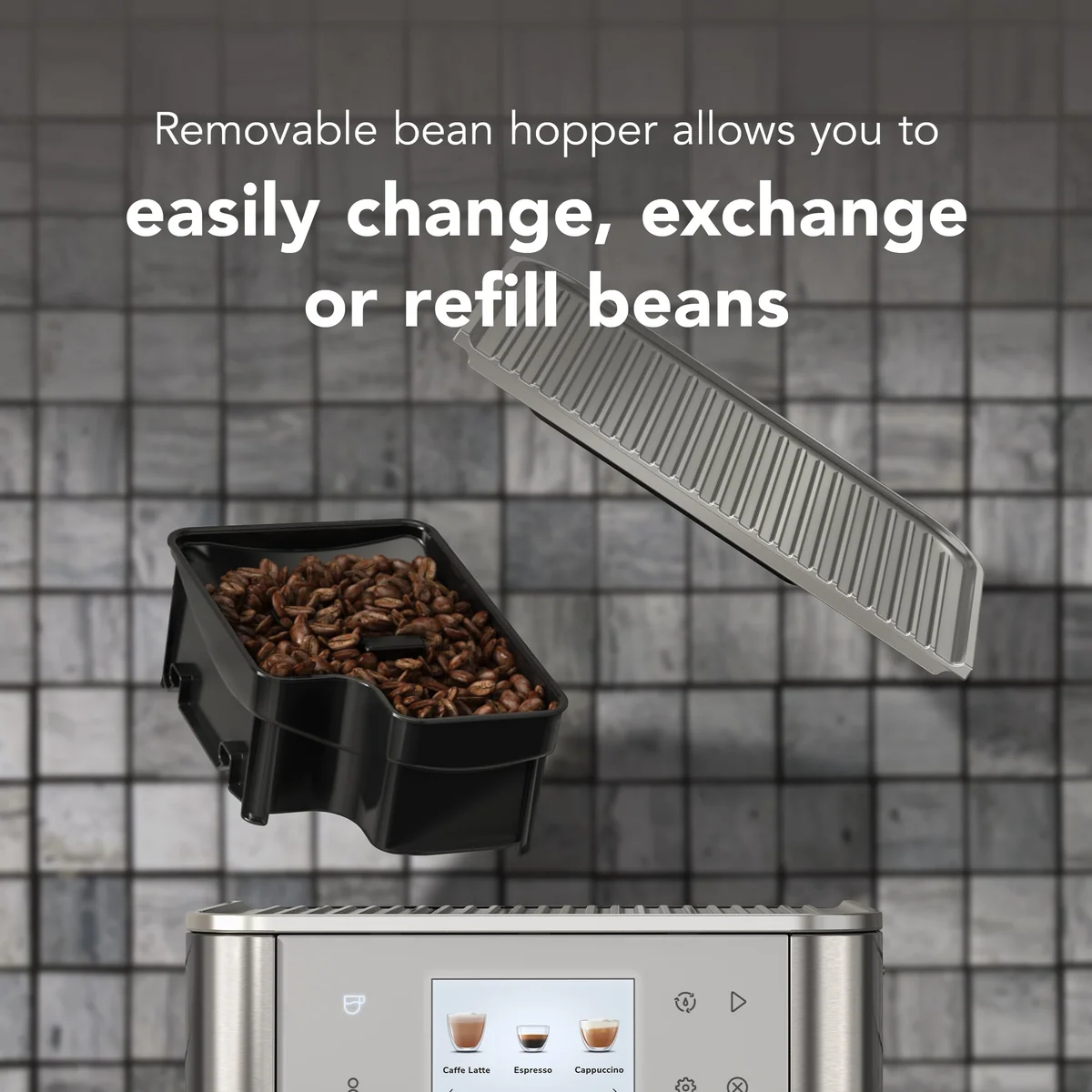
KitchenAid's own bullets lead with a removable bean hopper you twist and lift, and for once the marketing is pointing at the right thing. The hopper comes out, and the machine will then purge the grinder of whatever is still in it before the next bean goes through. One owner describes keeping a second hopper loaded with decaf for his wife and swapping the whole assembly when he wants to try a new bag, which is a workflow no Philips or De'Longhi offers at any price. The honest footnotes: the purge throws away roughly a shot's worth of ground coffee each time, the spare hopper's lid is not airtight so beans want a proper container for storage, and if two people in the house drink different things at the same time of morning, nobody is going to swap hoppers twice before work. It is a feature for households that keep a decaf and a regular, or for people who buy a new bag every fortnight, and it is genuinely excellent for them.
The second thing is that the brew unit slides out. Compared with the sealed group in a Jura, you can see what is growing inside your machine instead of trusting a cleaning tablet to have dealt with it, and unlike a Philips there is no grease to reapply. That is also the reason a KF7 owner reported running oat milk through the machine successfully with a photograph to prove it, despite KitchenAid reserving its plant-milk marketing for the KF8: the frothing terminal is reported to be the same part on both, and the KF8's advantage is a set of presets rather than different hardware. If milk is the reason you are on this page at all, the choice between a wand, a hose and a carafe is worth settling before the model number is.
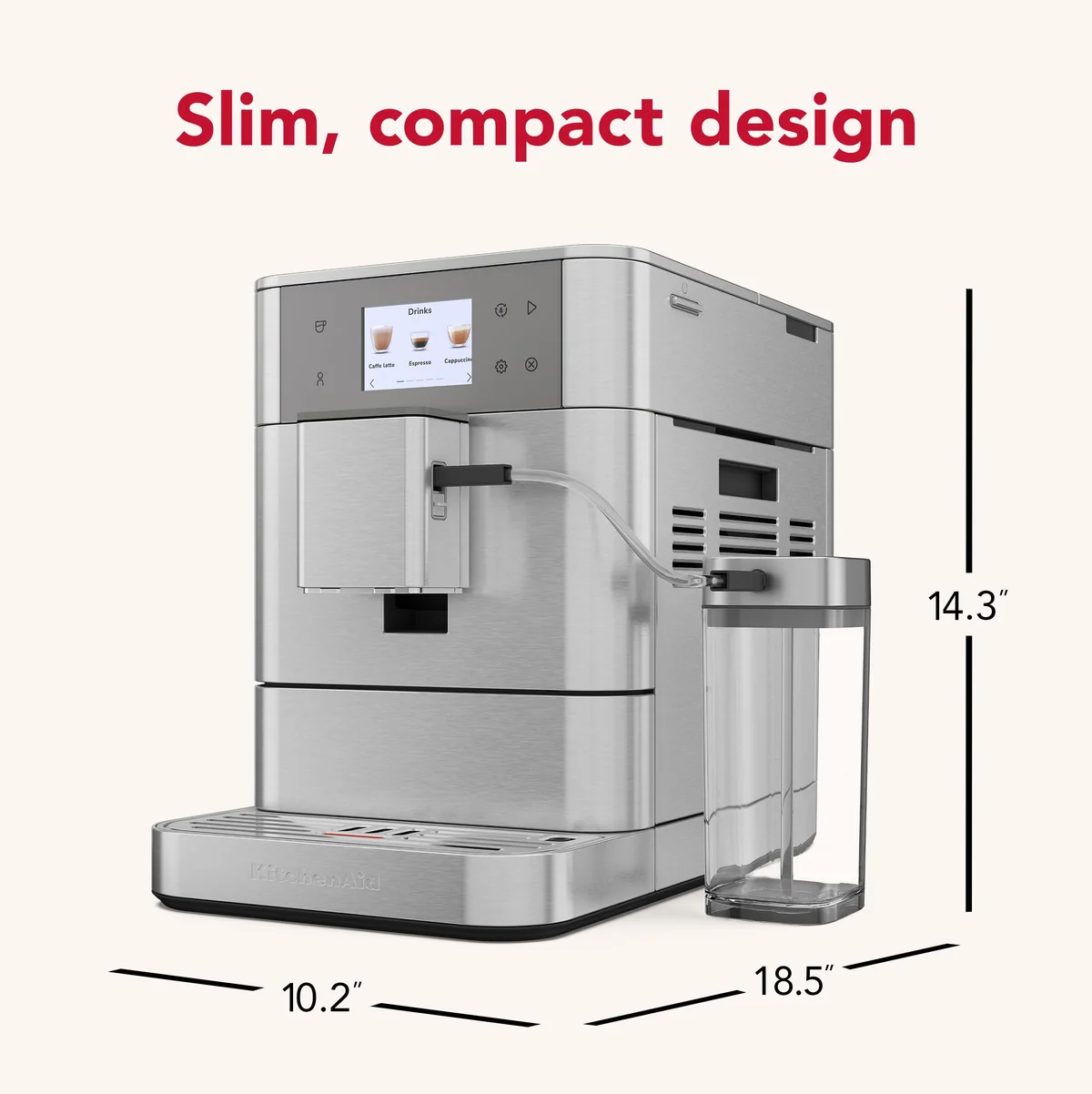
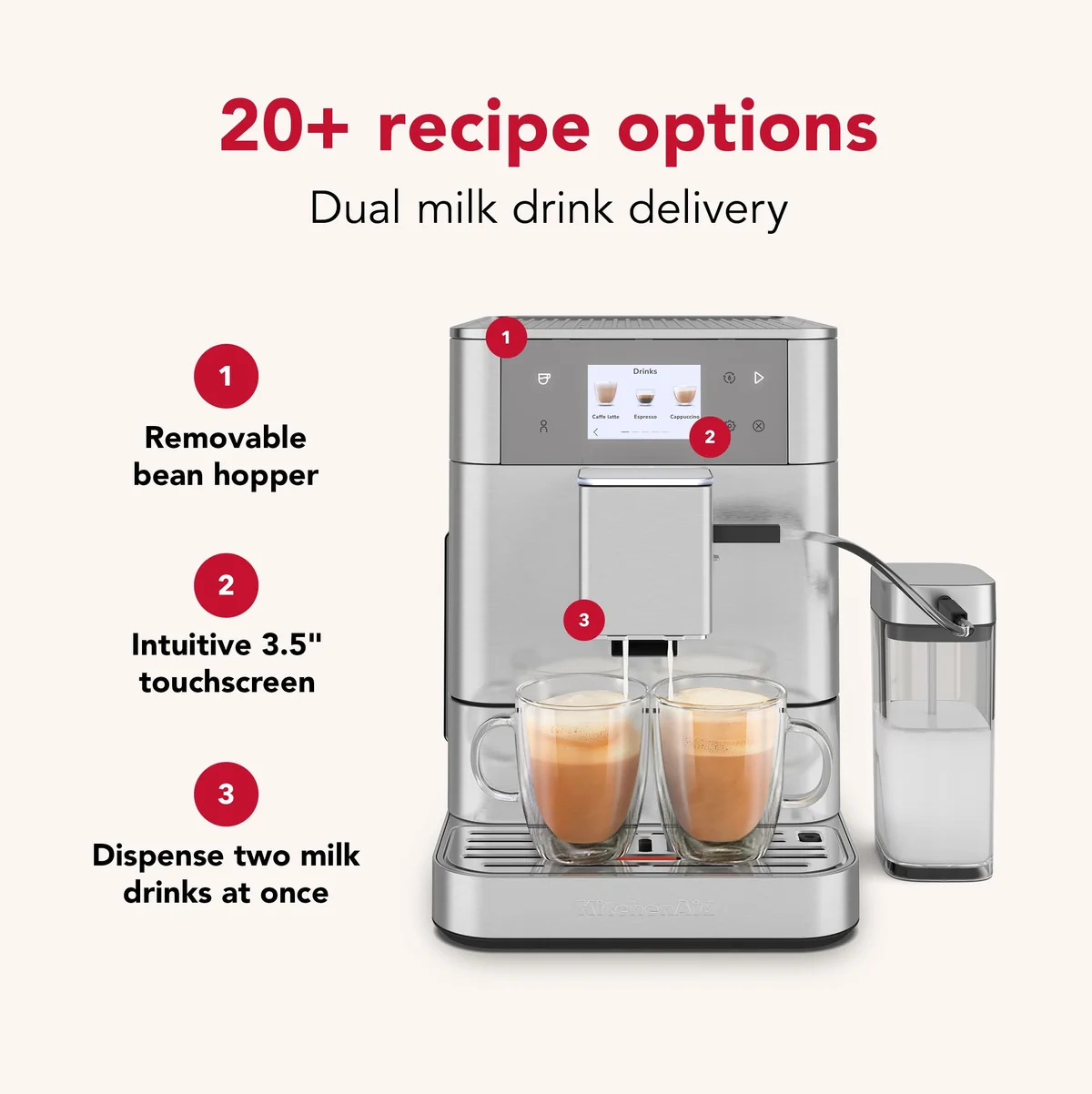
The rest of the hardware is unremarkable in the good way. A 2.2 litre removable tank you can also fill in place with a jug, a 270 gram hopper, a conical steel burr grinder with seven settings that you are told to adjust only while it is running, a 15 bar pump on a single boiler, 1450 watts, four user profiles, a bypass chute for pre-ground, and an adjustable spout that takes cups from roughly three to five and a half inches. The box includes a water filter, two brew-unit cleaning tablets and a water hardness strip. The consumables you will re-buy are the KESWF filters, the KESCT8 tablets and, if the hopper trick appeals, the KESRBHF spare hopper. Retail listings put the screen at three and a half inches and describe the two-cup function as filling two cups with espresso, wording that points at coffee rather than milk drinks; owners of the larger KF8 routinely double whole milk recipes into one big cup, so whether the KF7 shares that is the one specification Espresso Den could not settle from the record.
It is built in Switzerland, it weighs about thirty-seven pounds, it rolls on small wheels so you can slide it out from under a wall cabinet, and it comes with a two-year warranty. Colour is the other thing people shop: stainless as reviewed here, plus cast iron black, juniper and porcelain white variants of the same KES8557 body.
Where the KF7 sits between its siblings
| KF6 | KF7 | KF8 | |
|---|---|---|---|
| Drink icons visible on screen | 2 | 3 | 4 |
| Strength levels | 3 | 3 | 5 |
| Milk container in the box | No, sold separately | Yes, 26.7 oz | Yes |
| Choose milk first or coffee first | No | Yes | Yes |
| Plant-milk recipes advertised | No | No | Yes |
| Brew unit, grinder, dose, milk terminal | Identical across all three, same firmware scaled to each screen | ||
Reported screen sizes disagree between retailers and owners, which is why the row above counts icons instead of inches. The count of visible drinks is what you actually live with, because you cannot reorder or filter the drink list, so your favourite may sit one scroll off screen forever.
The upgrade to the KF8 is therefore two more strength steps, one more icon and a set of plant-milk presets, and the step down to the KF6 costs you the included milk container and the milk-first ordering. The gap in either direction is smaller than the price ladder implies.
Strengths & Limitations
Strengths
- The brew unit, grinder and dose come from the Swiss manufacturer that builds for Miele and Jura, and the brew unit is reportedly interchangeable with Miele's.
- The bean hopper twists out and the grinder purges itself, so switching between decaf and regular takes seconds rather than a wasted bag.
- The brew group slides out for inspection with no grease to reapply, which a sealed Jura group will never let you do.
- The interface is the friendliest in the category, which is why households with one enthusiast and several non-enthusiasts get on with it.
- It is quiet for a super-automatic, with the grind being the only genuinely loud moment.
- Ready to brew in around 45 seconds including the startup rinse, and it rolls out from under a wall cabinet on its own wheels.
- The metal-clad body and door feel heavier and better finished than machines costing the same or more.
Limitations
- The early-failure reports are frequent enough to notice, and the one detailed warranty account runs to six weeks at a repairer, a machine returned without its milk hose, and the same fault again two days later.
- Milk arrives at roughly 135 to 140°F frothed and cooler still when it is not, so a cold cup will hand you a lukewarm latte.
- The Americano will not go below about 2.7 oz of water and coffee tops out around 7.4 oz, which is why anyone filling a mug calls it weak.
- There is no iced or cold setting, and KitchenAid's own newer compact line has one.
- No wifi means the low-resolution screen, the always-on backlight and the drink list you cannot reorder are permanent.
- The constant rinsing has you refilling a 2.2 litre tank two or three times a week at modest use.
- Foam density is not adjustable, the milk and foam split is locked per recipe, and the supplied milk container has no measurement lines.
- The polished drip tray cover scratches easily and there is no float to tell you the tray is full.
What comes out of it, measured and tasted by people who are not us
The best instrumented numbers in the record come from a reviewer working on the KF8, which shares this machine's brewing hardware. He recorded extraction peaking around 80°C and settling near 75°C, and dissolved solids of 7 to 9 against the 10 to 12 a commercial machine hits, which he called good for a bean-to-cup and which is the correct framing. His conclusion after a year of ownership was that the machine had been mechanically stable and that the extraction was above average for the category while remaining a step below what a portafilter machine with a real steam wand can do. Asked directly whether it beat a Breville Oracle Touch, he did not defend it: less richness, less texture, especially on flat whites. He also measured heat-up including the startup rinse at 44 seconds, which an independent owner corroborated at "40ish secs", and he noted that a machine this expensive still ships with a low-resolution screen and no smooth scrolling. Most usefully for anyone reading this page, he thought the KF6 or KF7 was the better value in the family than the machine he had bought.
The only long-form editorial that bought and used a KF7 itself reported sweet, chocolatey espresso under a thick crema once the grinder was dialled in, and published the settings it took to get there: grind at the second finest step, volume around 1.4 oz, medium temperature, strong body, strength at maximum, which on this model means all three bean icons lit. It also warns that the machine needs four or five throwaway brews before it settles, and it is markedly cooler about the milk than KitchenAid is, calling the foam "acceptable without being anything special. Let's just say it's not quite up to DeLonghi or Jura standards." The same review rates it among the quieter super-automatics it has used, which matches almost every other account: the grind is the loud part, it is nowhere near the 75 dB a typical machine hits, and it is not silent either. If that is the deciding factor, the quiet-machine shortlist puts it in context, and one owner running a KF7 alongside a Jura J8 says the Jura is the quieter of the two.
Three things this machine will not do, and you should know now
Milk lands cooler than you expect. Owners consistently report frothed milk arriving around 135 to 140°F and unfrothed milk around 120°F, well below the single high reading one reviewer published and immediately had challenged in his own thread. One new owner measured his first latte into a cold glass and got roughly 50°C in the cup. Preheat the vessel, use the high temperature setting, and read why these machines run cool before you decide it is faulty. You also cannot control foam density or split the milk and foam volumes independently; you set a total and the recipe decides the rest.
Black coffee is a compromise. The Americano will not go below about 2.7 oz of water, the regular coffee tops out around 7.4 oz, and owners who fill an American mug describe the result as weak, which it is, because the dose is fixed and the water is not. The fix from the most experienced owner in the record is to stop asking it for a mug: keep the cup under 3.5 oz and it is excellent. That is worth weighing against what any bean-to-cup can do with filter-style coffee, and against machines built for people who drink it black.
There is no cold or iced mode at all, which in 2026 is a real absence rather than a quibble, and the machine has no wifi, so every interface shortcoming named above is permanent. If iced drinks matter, start with the machines that actually brew cold instead.
What you get in exchange
The clearest statement of the trade in the whole record comes from a Breville owner of five years who switched: grinding, tamping, pouring, extracting, knocking out the puck, steaming, washing the jug and rinsing took him about seven minutes of standing there, every time. His KitchenAid routine is switch on, plug the hose into the milk, press two buttons, walk away, come back to a hot drink, then plug the hose into the drip tray for a three-second rinse. He also pointed the person asking him, who was on a budget, at the KF7 rather than his own machine, and made the argument that actually sells these things: multiply that seven minutes by three when friends are over. A second owner keeps a Rancilio Silvia and a KF7 side by side and reaches for the KF7 on the mornings he is too tired to think, partly because his spouse will not touch the Silvia at all. Household access is the feature.

What it needs to cost before this is a sensible purchase
This is the rare machine whose verdict swings entirely on which channel you buy it through. At full sticker, the people who own one and love one start hedging and begin naming Juras instead. On KitchenAid's discount channel, the same people call it a no-brainer, and the reason is straightforward: at a discount you are buying Eugster/Frismag hardware and a Miele brew unit for less than the Miele, with a bigger tank, a bigger drip tray and an interface from this decade. Whirlpool's insider programme, brand sale events and cashback stacking all show up repeatedly in owner accounts, and several buyers report paying substantially less than list. If you are not in a hurry, wait for one of them.
Two things complicate the value case in 2026. The first is that KitchenAid now undercuts itself: the compact KF2, KF3 and KF4 launched below the KF7's list price, in a body about a quarter smaller, and the KF4 pairs automatic milk and a supplied container with an iced setting that brews cooler over ice, which the KF7 cannot do at all. The KF7 answers with the bigger tank, the heavier build, the removable hopper and the auto-purge, and that is a real answer, but it is no longer the obvious one. The second is that the drinks are not as far ahead of cheaper machines as the price suggests: one owner who bought a KitchenAid and would buy another says candidly that the drinks are not a great deal better than his Philips, and that what he is paying for is build quality and ease.
If the sticker is the problem rather than the machine, the honest alternatives on this site are the De'Longhi Rivelia, which also swaps bean hoppers and which we set against this machine directly in the KF7 against Rivelia comparison; the Bosch 800 Series, weighed up in the Bosch against KitchenAid piece; and, if you want the drinks hotter and the machine quieter and will pay for it, the Jura J8, with the case for and against set out in Jura against KitchenAid. A KF7 owner who runs a J8 alongside it gives the Jura a slight edge on both cup quality and heat, and still calls the KitchenAid great for the money.
The part of this purchase that is genuinely a gamble
Start with the numbers that disagree. The Amazon listing for this exact machine sits at 4.1 from 165 ratings, which is a mediocre score for an appliance in this price class. KitchenAid's own product page for the KF7 shows 4.6 from 245, and the shape of that distribution is more interesting than the average: 188 five-star reviews, and then a fat tail of 13 one-stars with almost nothing at two. That is not a curve that says "fine, slightly disappointing". It is two populations, one delighted and one whose machine died. On the same manufacturer page, one reviewer upgraded her rating to five stars while describing a machine that stopped working at four months and a weekend with nobody to call, and a second buyer posted, unresolved, that her four-month-old machine had spent two of those months in a workshop and asked for her money back. Several dealer pages carry higher scores drawn from small pools syndicated from KitchenAid's own reviews rather than from that dealer's buyers, which is worth knowing before you average them together.
The most detailed failure accounts are Australian, and they need their caveats stated plainly: they sit on a brand-level review page covering mixers, pans and kettles as well as coffee, that page attracts complaints by design, and Australian service is not necessarily the same operation as American service. With that said, one verified KF7 owner documented the fault by name. His machine threw "Bean hopper is not in position", spent six weeks with an authorised repairer waiting on KitchenAid to approve parts, came back without its milk hose, took another ten days of arguing to get the hose returned, and threw the identical error two days later. He reports being told by the repairer's owner that thirty KitchenAid coffee machines were sitting in the shop awaiting repair, and seeing three identical KF7s already on the returns counter when he took his back. Those are one person's eyes in one country and they are not a failure rate, but they are the kind of detail a buyer should be allowed to weigh. A separate owner on the same page is on his third KF7 after all three broke down, and his line is the one that stays with you: he is deciding whether to contact them again or "just cut my losses". Fairness cuts both ways here. KitchenAid replaced that man's machine three times, replies publicly to complaints, and several owners describe service that was outstanding when it landed with the right person.
| When | What the owner reported | Outcome |
|---|---|---|
| Out of the box | Machine insisted the bypass door was open when it was not | Replacement shipped the same day, before the faulty unit was returned |
| First week | "Fill bean" error on dark roast, reproduced independently by a second owner | Cleared itself after about a week |
| One month | Screen flickering | Corrected itself after several restarts |
| One month | Water filter replacement light earlier than expected | Cost of ownership, not a fault |
| Four months | Machine stopped working, no support reachable over a weekend | Replacement agreed by the Monday |
| Four months | Two months in a workshop with no fix | Unresolved, owner requesting a refund |
| In warranty, twice | "Bean hopper is not in position", six weeks at the repairer, same error two days after return | Returned for a refund |
| Across three units | All three broke down | All three replaced under warranty |
Against that, the positive long-term evidence is real but thin: one instrumented reviewer at a clean year with no mechanical issues, and a KF6 owner who says his has been more reliable than the Jura and the Miele he owned before it, and that unlike either of those he can get at the internal parts. It is also worth knowing that KitchenAid's coffee products run through their own customer service group rather than the major-appliance chain, so the ovens-and-fridges reputation you may have read is not automatically this machine's reputation. What nobody can tell you yet is how a KF7 behaves in year four, because the line only launched in 2024; what actually breaks first on these machines is the best available proxy, and the cleaning regime that determines it is set out in our descaling guide.
Living with it, week to week
Expect to refill the tank two or three times a week at two to three drinks a day, because the machine rinses on every power-on, every power-off and after every milk drink. Owners split on whether that is obsessive or simply what every super-automatic does, and both are true. Keep a cup permanently under the spout so the startup rinse has somewhere to go. Budget a filter roughly every two months, a descale roughly every 200 cycles, and a brew-unit rinse under the tap every week or two, which is less than the machine's prompting implies. One office running a KF7 hard reports about ten minutes of cleaning every few days; a home owner making three or four drinks a day reports one deep milk clean and one descale in three months. Your mileage is a function of volume, not of the machine.
Frequently Asked Questions
Is the KF7 reliable?
The hardware is a proven Swiss platform and one instrumented owner reached a year with no mechanical issues, but the record also contains a cluster of failures inside the first four months and one owner on his third replacement, so treat the two-year warranty and the retailer's returns policy as part of what you are buying.
What does "Bean hopper is not in position" mean?
It is the fault reported by the most detailed KF7 warranty account in the record, thrown by a machine whose hopper was correctly seated, and because the hopper is heavily sensored it is a service issue rather than something you can reseat your way out of.
Can the KF7 froth oat and almond milk, or do you need the KF8?
A KF7 owner posted a photograph of a decent oat milk result, and the frothing terminal is reported to be the same part on both machines, so what the KF8 adds is preset recipes rather than different hardware.
Why does the coffee taste weak in a large mug?
The dose is fixed at around 14 grams while the water volume is not, so a large cup dilutes the same shot, and the fix is to keep the cup small rather than to raise the strength setting.
Why is my latte only warm?
Owners consistently measure frothed milk at roughly 135 to 140°F and unfrothed milk nearer 120°F, and a cold cup takes a further bite out of that, so preheat the vessel and use the high temperature setting.
Does the KF7 make iced coffee?
No, and there is no cold extraction mode, which is now a real gap given that KitchenAid's newer compact models brew over ice at a lower temperature.
How often do you replace the water filter, and what part is it?
It is the KESWF, and owners report the replacement light arriving sooner than expected with a change roughly every two months, on top of a descale about every 200 brew cycles.
Is the KF8 worth the step up from the KF7?
Only if you want five strength levels instead of three or the plant-milk presets, because the brew unit, grinder, dose and milk system are the same and one reviewer who owns the KF8 thinks the KF7 is the better deal.
Sources (9)
- Amazon listings and customer reviews — Kitchenaid Kf7
- Owner reports across r/superautomatic threads
- Webstaurantstore — Article — www.webstaurantstore.com
- Oakvilleappliance — Article — oakvilleappliance.com
- Coffeeness — Article — www.coffeeness.de
- KitchenAid — Article — www.kitchenaid.com
- Au — Article — www.productreview.com.au
- Thekitchn — Article — www.thekitchn.com
- Themodestman — Article — www.themodestman.com