The Philips 3200 LatteGo sells you an effortless cappuccino and a deliberately mild shot.
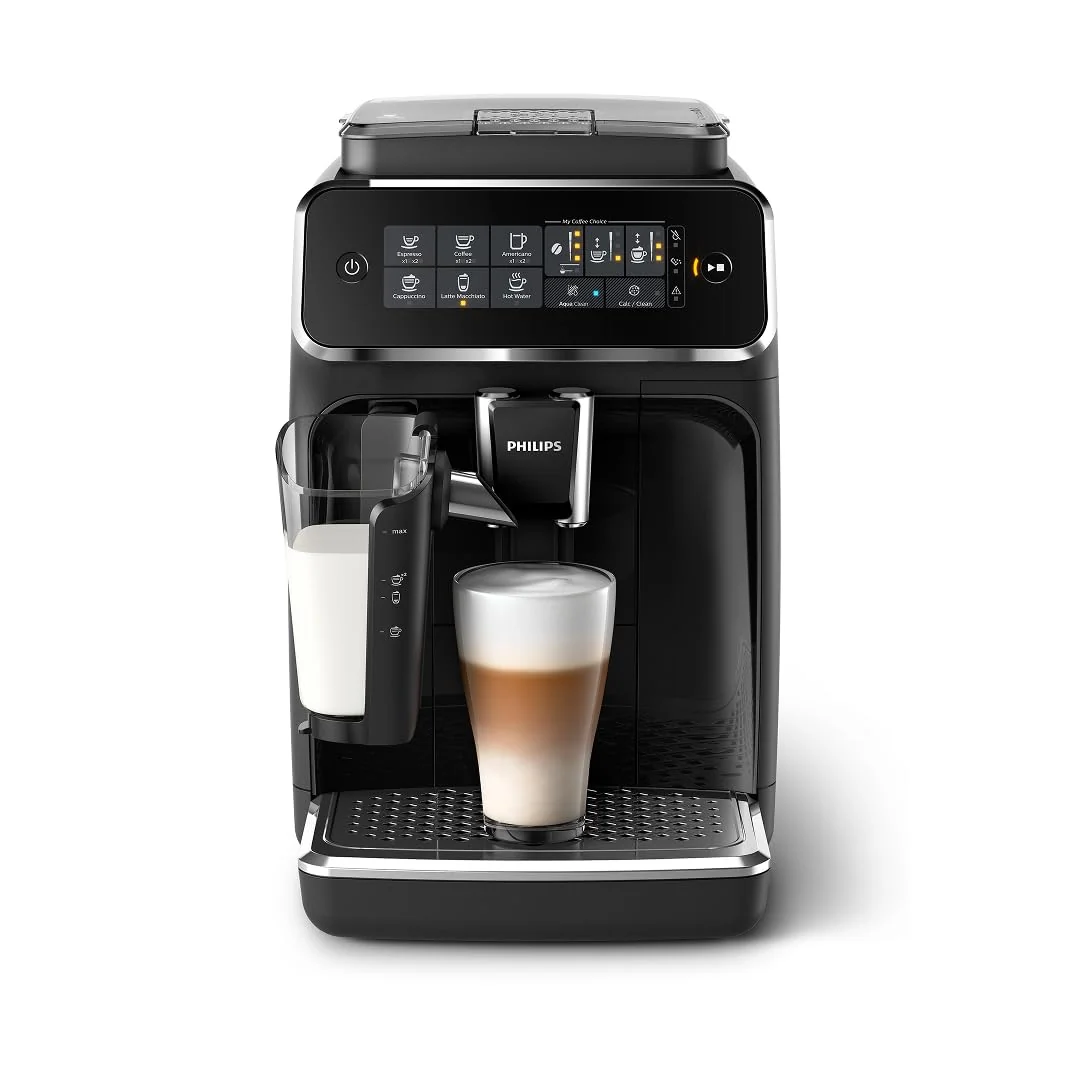
Buy the 3200 LatteGo if you want milk drinks with no technique and no washing-up, and look elsewhere if you want an intense espresso, because the dose is small, the shot runs fast, and no setting on the machine completely fixes that.
Based on 6200 owner ratings, 14 owner discussions and 6 other sources. We have not tested this machine ourselves.
We earn a commission if you buy through our links, which does not affect what we say.
Read how this site works →
The verdict, stated plainly
This is a convenience appliance that happens to make espresso, and it is very good at being that. If your morning is a cappuccino you do not want to think about, the LatteGo carafe justifies the machine on its own and you will forgive the mild shot within a week. If your morning is a short black coffee you want to taste like something, the dose will disappoint you and no amount of dialling in will change the arithmetic. Buy it where you can send it back, judge it at fifty drinks rather than five, and do the weekly brew group rinse from the first week rather than the month you first smell something. Do those three things and the odds are strongly in your favour; skip them and you will end up writing one of the reviews we read to build this page.
Buy the 3200 LatteGo if you want milk drinks with no technique and no washing-up, and look elsewhere if you want an intense espresso, because the dose is small, the shot runs fast, and no setting on the machine completely fixes that.
Best for: It carries the easiest milk carafe on any bean-to-cup machine bolted to a grinder that doses roughly half a café shot, and almost every argument about this machine traces back to that one fact.
There is a version of this machine's story that is entirely true and entirely useless: it grinds beans, it brews five drinks, it froths milk from a two-piece carafe you rinse under the tap, and thousands of owners adore it. Espresso Den read the whole public record on the EP3241/54, from the Amazon reviews to a Romanian-built unit taken apart on a workbench, and the useful story is narrower than that. Two people measured what actually lands in the portafilter, and they agree on the shape if not the number: somewhere between about eight and eleven grams of coffee per shot, against roughly thirty grams of liquid out on the shortest volume setting.
That is a four-to-one ratio at worst and a three-to-one at best, where a café shot is nearer two-to-one from eighteen grams. So the machine is not broken when your espresso tastes thinner than the one you paid five dollars for. It is doing exactly what it was built to do, which is produce a mild, drinkable, crema-topped coffee that nobody in the house has to learn anything to make. One reviewer who weighed it called the result closer to a capsule machine than to a café espresso, and he meant it as a description rather than an insult.
Whether that is a flaw depends entirely on what you are walking away from. The people arriving from a Keurig, a Nespresso Vertuo or a sludgy drip machine write five-star reviews about a life transformed. The people arriving from a Breville, a Gaggia or their own hand-frothing phase write about crema that is thin but present and a body that never fills out. Same appliance, opposite verdicts, and the split is so clean you can predict which review someone will write from the machine they owned before.

Key Specifications
Five drinks, two of which are nearly the same drink
The listing promises espresso, coffee, americano, cappuccino and latte macchiato from a touch panel. That count is honest arithmetic and slightly dishonest marketing, because the machine builds both milk drinks milk-first and the difference between the cappuccino and the latte macchiato is small enough that three separate reviewers noticed independently and one asked why Philips did not simply offer a proper latte instead. If you count drinks the way a drinker does, this is a machine that makes black coffee at two lengths, an americano, and a milky coffee.
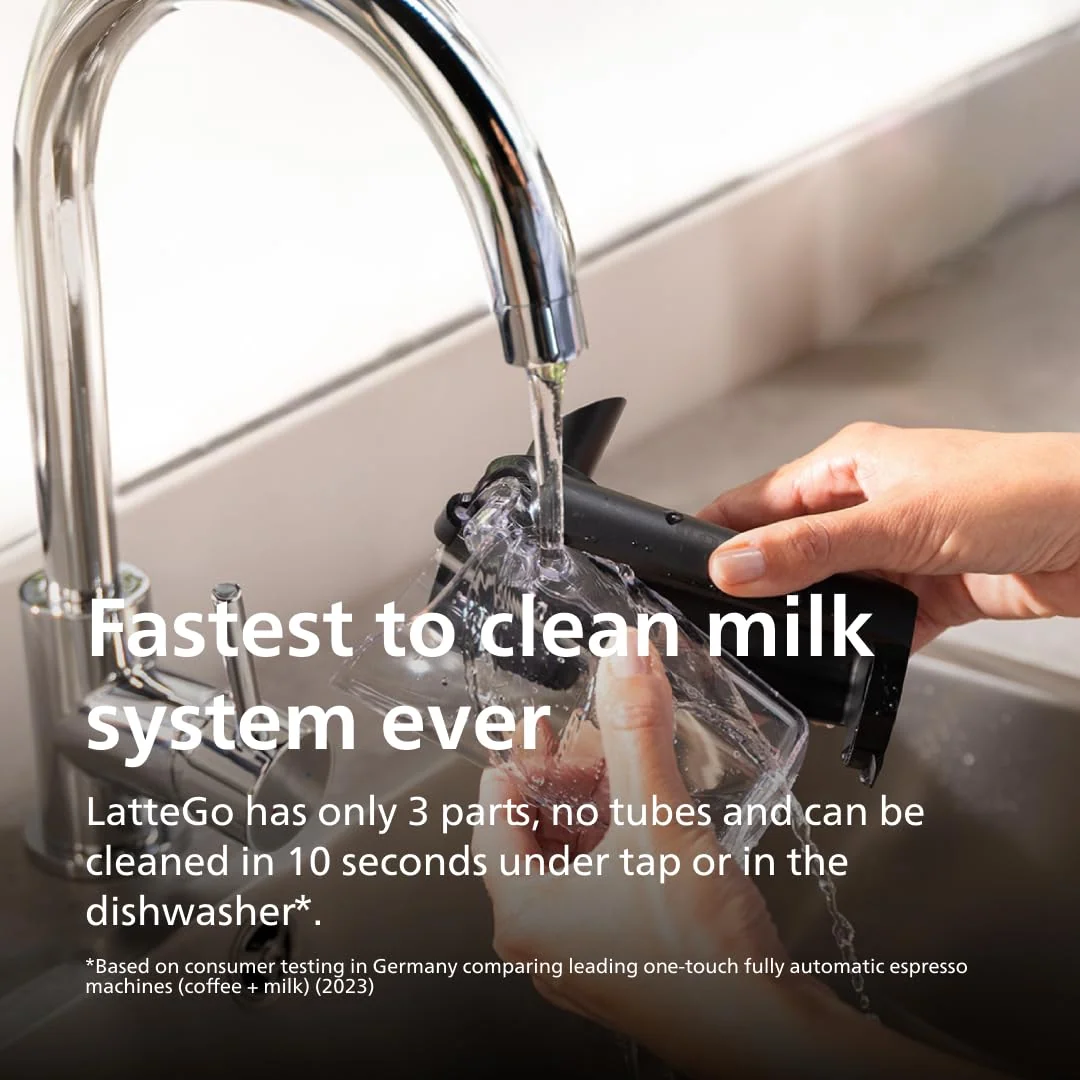
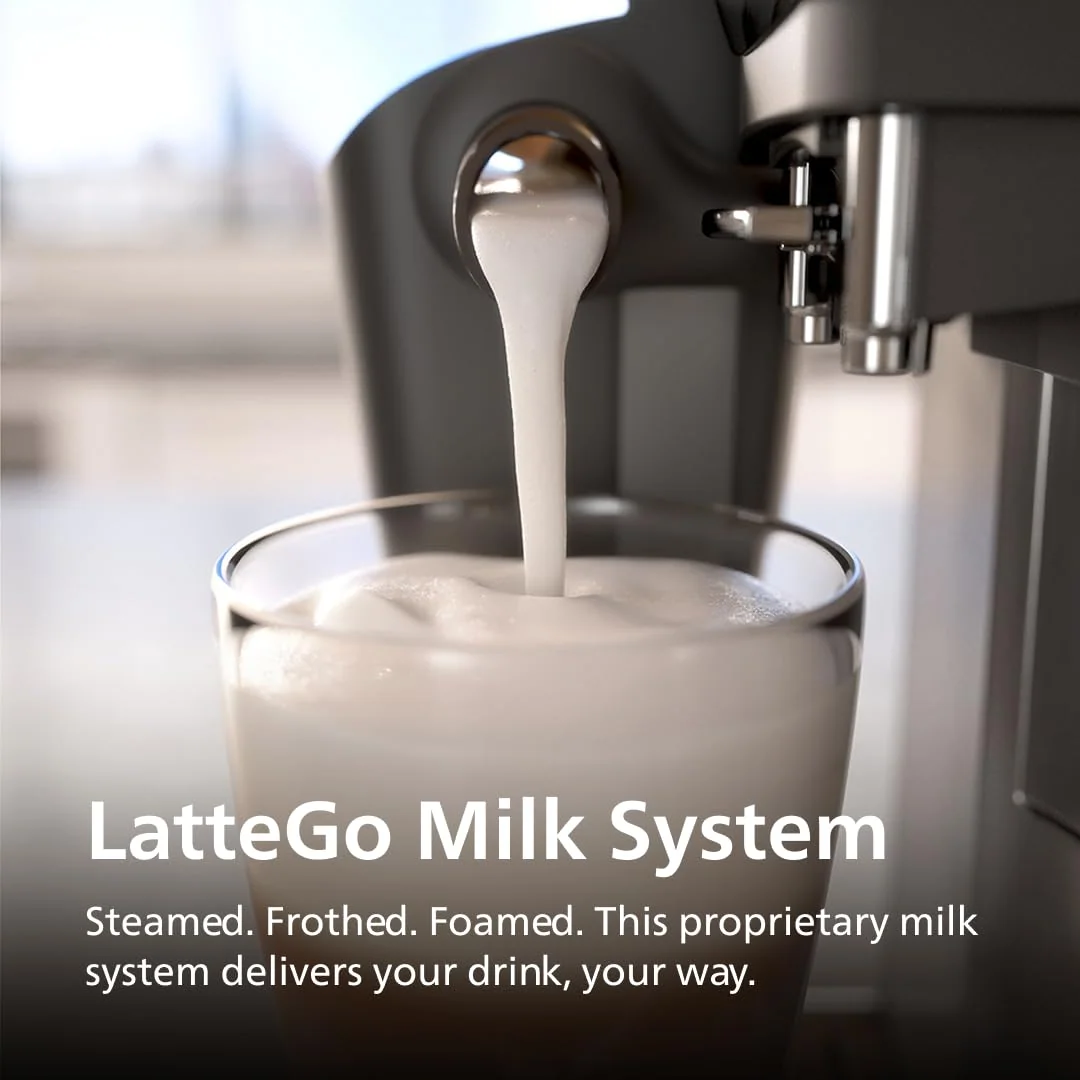
The LatteGo carafe is the reason to buy it, and it survives every test the internet has thrown at it. Two plastic parts, no tube, no hidden channel, no bit that lives permanently inside the machine growing something. You clip it off, rinse it, and you are done in about the time it takes to read this sentence; it goes in the dishwasher if you would rather. Anyone weighing a carafe against a wand should read our piece on which milk system you will actually live with before deciding, because this is the decision that determines whether you use the machine on a Tuesday.
Its limits are equally specific. There is no milk-only button, so hot chocolate and any drink the machine does not already know are off the menu unless you start a latte macchiato and abort it before the coffee arrives. Foam quality genuinely divides reviewers: one found it merely medium and not microfoam, one found it too dense, and one got almost no foam at all on the highest setting. Oat milk froths but the carafe draws less of it because it is thicker, and one owner simply runs the drink twice to fill a mug.
Which 3200 you are actually looking at
Philips has made this confusing enough that buyers argue about it on forums. The EP3241/54 reviewed here is the black one with the americano button. The EP3241/74 swaps that americano button for an iced coffee setting, which does not chill anything: it brews cooler and slower so the result survives being poured over ice. The EP3246 is, as far as anyone comparing spec sheets could determine, the same machine with chrome trim, and one long-term owner reports the chrome scratches where the matte plastic does not.
Losing the iced button costs you nothing worth mourning. The consensus among people who own machines with one is that pulling two hot shots over a glass of ice gets you the same drink, and our guide to whether these iced modes actually brew cold reaches the same conclusion. For a household that drinks hot coffee, the /54 is arguably the better trade, because the americano button is the one you will press.
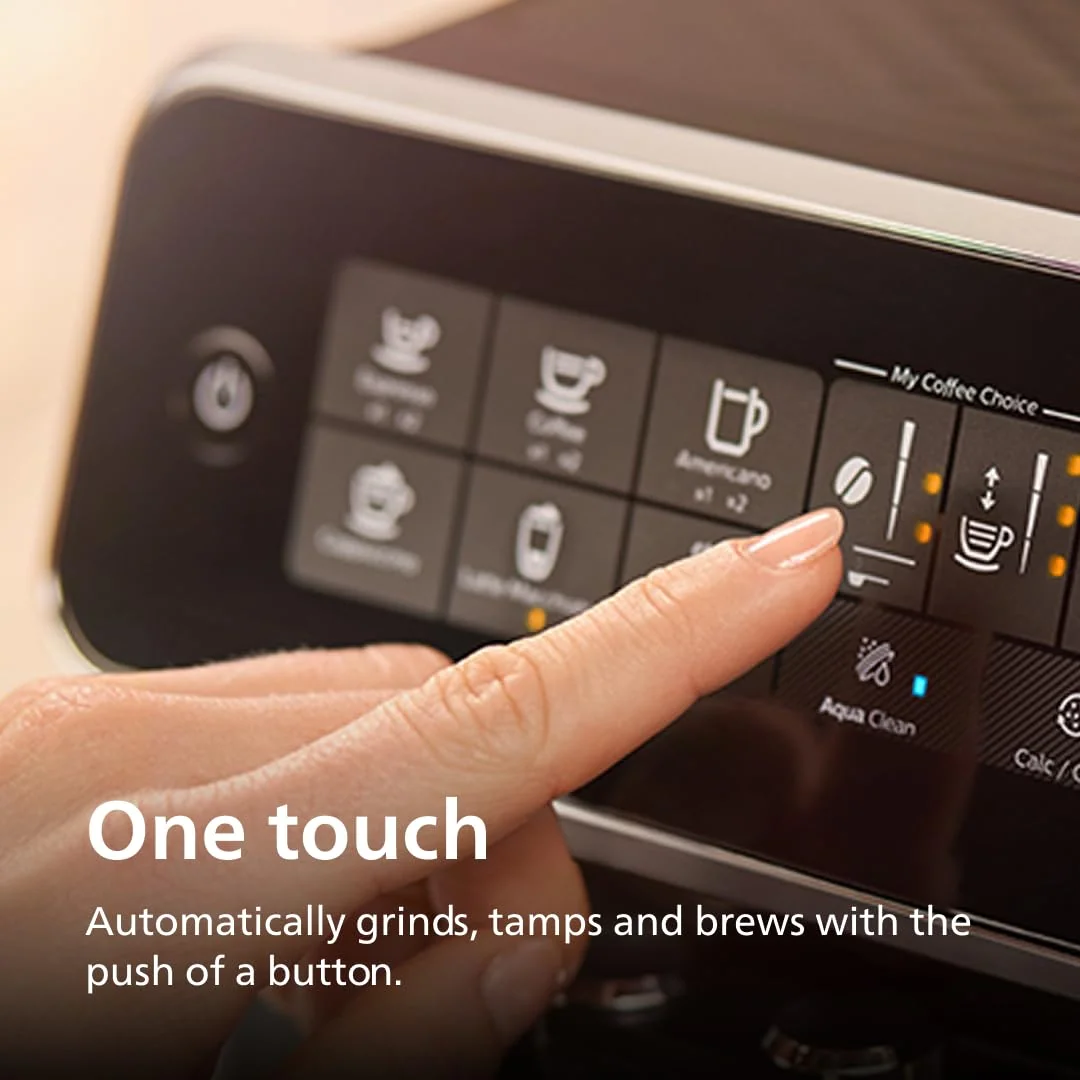
The panel is icons and lights rather than a screen, and that is the single real difference between this and the 4300 above it. With a display you set volume in ounces, get walked through filter setup, and read alerts in words; here you learn what a slow flash means and which two buttons to hold. One teardown found the capacitive buttons deliberately over-tuned against false touches to the point of needing a magic finger, though most reviewers had no complaint at all. If deciphering blinking lights sounds like a chore, our page on Philips settings and warning lights is the translation, and the 4300 exists precisely because some households would rather not need one.
Strengths & Limitations
Strengths
- The LatteGo carafe is two plastic parts with no tube, and it genuinely does rinse clean in seconds or go in the dishwasher.
- The brew group pulls out for a weekly rinse under the tap, which several rival brands do not allow at all.
- The 2x button grinds and brews two real pucks in sequence rather than diluting one.
- AquaClean pushes descaling out by many months rather than the few weeks some rivals demand, provided you keep buying filters.
- Failures cluster in known places and most of them come apart with a single Torx bit, with parts and exploded diagrams published.
- The americano button on this /54 version is arguably more useful day to day than the iced setting it was later replaced with.
Limitations
- The dose is roughly half a café shot and the shot runs fast, so the espresso is mild no matter how you set it.
- The cappuccino and latte macchiato buttons pull a single shot each and cannot be set to double.
- Milk temperature is not adjustable and drinks have been measured landing lukewarm.
- It is loud enough that brewing at six in the morning will wake the house.
- Blinking lights instead of a display make settings and maintenance a matter of memorised button-holds.
- The maintenance schedule is genuinely non-optional, and the mould reports are what happens when it is skipped.
- Reports of failures inside the first two years are frequent enough to take seriously, even though most owners report none.
Why it tastes weak out of the box, and the five things that change it
Almost nobody's first week with this machine is good. Watery, sour, thin coffee is the most-reported complaint on the 3200, and the tell is what lands in the grounds bin: instead of a firm puck you get wet slush with no formed edge. There are three explanations for that in circulation and they are not mutually exclusive. The ratio is too wide. The brew basket's holes are large enough that water runs through before it has extracted much, which is a mechanism one reviewer inspected rather than assumed. And the brew group leaves the factory stiff with grease, which one owner proved by pulling it out, working the mechanism by hand until the action smoothed, and getting a firm puck on the very next shot.
That last one is the honest explanation for the folklore about a fifty-shot break-in period. Estimates range from six shots to two months depending on who you ask, but the direction is consistent across every source: early shots are worse than the machine's real capability, and a large share of one-star reviews are written in week one. If you are chasing this problem right now, our piece on why bean-to-cup espresso comes out watery covers the causes that are not specific to Philips.
| Setting | Do this | Because |
|---|---|---|
| Temperature | Hold the volume button with the machine off and set it to high or max | Three levels exist, the machine ships below the top one, and there is no display to confirm it |
| Strength | Maximum beans | It is the only control you have over the dose, and the dose is the whole problem |
| Volume | Minimum or medium, never maximum | More water on a small puck is dilution, not a bigger coffee |
| Grind | Work down from the factory setting towards 2 or 3, turning the knob only while the grinder is running | Reviewers found roughly half the twelve settings usable, and adjusting a stationary grinder is how people damage them |
| After any grind change | Throw away two shots | The old grind is still in the chute, so the change you just made is not in the cup yet |
The specific numbers vary by reviewer: one settles at grind three or four with medium volume, one goes to the finest position and minimum volume, one warns that the very finest setting can restrict flow so far that extraction stalls or the funnel clogs. Finer is better right up until it is not, and finding the edge costs you a few shots. Bean choice matters more here than on a forgiving machine, and oily dark roasts are the classic way to gum up a ceramic grinder, which our guide to beans for bean-to-cup machines goes into properly.
The single-shot trap nobody warns you about
Here is the fact most likely to explain a disappointed owner, and it took a Reddit thread to surface it: the cappuccino and latte macchiato buttons pull one shot, not two, and there is no way to make a double the default. One owner spent three days convinced his machine was broken because he was drinking milk drinks all day without the caffeine hit he expected, then worked out that his old café cappuccino had twice the coffee in it; a second owner replied to say the post had solved the same mystery for him. The fix is unglamorous: build the milk drink, then run a separate espresso into the same cup.
The 2x button, by contrast, is genuinely well engineered. It grinds and brews two real pucks in sequence rather than pushing extra water through one, which is more than some rivals do. The same logic applies to long drinks: a good americano here is a short strong shot with hot water added, not a long one where the machine has flushed water through a small puck until it turned bitter.
Heat
One owner put a thermometer in the coffee stream at the top temperature setting and read about 196°F, which sits at the low end of the 195 to 205 band the National Coffee Association recommends for extraction. That is in spec, and it is also why so many people say it is not hot enough: four ounces of liquid at the bottom of that band, poured into cold ceramic and then hit with fridge-cold dairy, is a lukewarm drink by the third sip. Preheat the cup with the hot water spout, and warm your milk if you add it separately.
Milk is the weaker half. Its temperature is not adjustable at all, and one cross-model comparison measured cappuccino milk at 45°C on one unit and 54°C on another run minutes apart, the lower of which is frankly tepid. If yours has become noticeably cooler than it used to be, that is a fault signature rather than a preference problem, and our page on machines that stop running hot explains what usually causes it.
Who should buy this, and who should buy something else
One Reddit reply distilled the buyer better than any spec sheet: when somebody says they are not a coffee snob and what they want is convenience, what they are describing is the Philips. Add the person who went through a latte-art phase, got tired of it, and now wants a cappuccino at seven in the morning without a jug to wash. Add the household where four people of varying interest need to make their own drinks. The clearest owner summary in the whole record runs: so-so for straight espresso and americano, excellent for milk drinks, and if that is your ratio of drinks the machine is a bargain.
Now the people who should not. If you are a tinkerer, you will find yourself missing control within a month, in the words of an owner who was one. If you drink black espresso and want it intense, this dose will not get you there, and one owner gave up on the 3200 specifically because it could not build a strong enough americano. If you want to skip maintenance, the mould reports are the receipt for what happens.
The alternatives that are actually different
Within the Philips line, resist the urge to spend more for the wrong reason. Every model from the 2200 to the 5400 shares the same brew group and the same grinder, and a reviewer who pulled shots from three of them side by side, weighing each, could not tell them apart in the cup. You are paying for drink presets, profiles and a screen, not better coffee. That makes the 2200 against the 3200 a real question if you only drink two things, and the 4400 or the 5500 the right call only if profiles and a proper display are worth the difference to you. The 3300 is this machine's successor and the question of which to pick is enough of a puzzle that we gave it its own page.
Outside Philips, the sharpest disagreement in the whole record is with De'Longhi. One reviewer who tested both prefers the Magnifica Evo without hesitation, citing metal burrs, a larger puck and better foam, and the super-automatic subreddit leans the same way hard enough that the top comment on one thread called it not even a debate. We take that fight seriously on our Philips versus Magnifica Evo page, and the Evo review is where to go if the milk carafe is not what sold you. If milk is the whole point, though, the LatteGo remains the reason people pick Philips at all, and it is why this machine appears on our shortlist for latte drinkers.
One buying note that costs nothing and saves everything. The sticker price on this line is largely theatrical, discounts recur so often that owners treat them as the normal price, and the thing worth optimising is not the number but the returns policy behind it. Judge the machine at forty or fifty drinks, not at five. If the pucks are still slush after you have worked the brew group and dialled the grind, you have a dud rather than a settling-in period, and the owner who fought his to a standstill and then swapped it found the replacement made proper pucks straight out of the box. That advice applies double to a renewed unit, which we cover in our guide to buying refurbished.
What owning one actually costs you in time
The most useful review of this machine on Amazon is not the most enthusiastic one; it is the one that itemises the chores. About four minutes daily to empty the grounds bin and drip tray, rinse both, rinse the carafe and refill the water. About ten minutes weekly to do all that plus pull the brew group out, rinse it under the tap and wipe up the grounds and moisture that migrate under it. Coffee oil tablets monthly, food-grade grease on the brew group every couple of months, a new filter whenever the light asks. That schedule is not one owner's invention; it is what the manual specifies.
| Job | Interval | Consequence of neglect |
|---|---|---|
| Empty and rinse grounds bin, drip tray, milk carafe | Daily, or every few days at low volume | A full bin stops the machine mid-drink |
| Rinse the brew group under the tap, wipe the cavity beneath it | Weekly | This is where the mould smell comes from |
| Coffee oil remover tablet | Monthly | Oils build in the lines and eventually block the dispensing head |
| Grease the brew group rails | Every two months | Stiff action, strained noises, poorly compressed pucks |
| AquaClean filter | When the light asks | Scale, which the machine will eventually demand a full descale to clear |
The mould stories are worth being precise about, because there are two of them and they have different fixes. One is the cavity where used grounds fall; an owner who ignored it got a smell his wife noticed, and he lives in the driest region of the United States, which tells you what a humid kitchen would do. The other is the pre-ground chute, which doubles as a vent, so overfilling it or leaving grounds in it invites damp. Neither is a design defect exactly, and neither goes away on its own. If you plan to use the bypass doser for decaf, our guide to pre-ground coffee in a bean-to-cup machine covers the sequence, because owners report it takes a couple of attempts to get right the first time.
Descaling, AquaClean, and the claim that only half survives
Philips advertises up to 5,000 cups without descaling if you change the filter when prompted. The company's own footnote adds the part that changes the meaning: that figure is based on fitting eight filters, so it is a consumables schedule dressed as a maintenance holiday. It is still a real advantage. Owners with soft water report going eight to ten filters, and well over a year of daily use, before the machine asked for a descale at all, where other brands ask every few months.
Two practical notes that cost people hours. A new AquaClean often floats instead of seating, because there is air trapped inside it; the fix is to submerge it and tap and shake it aggressively until the bubbles come out of the slits, and to check the packaging for the small rubber ring that holds it down. And a Calc/Clean light that is steady rather than flashing is a state the manual does not document, which has left more than one owner guessing. The descale itself is a documented procedure: the whole bottle of descaler, the tank topped to the Calc/Clean line, a large container under both spouts, and a three-minute rinse cycle at the end, taking up to half an hour in total.
Do not reach for the vinegar. Philips forbids acetic, sulfuric, hydrochloric and sulfamic acids by name, and states that both using the wrong product and failing to descale can void the warranty, which puts the enthusiast advice about generic descalers in direct conflict with your warranty terms while you still have one. We unpack the whole filter-and-descale question on our Philips descaling and AquaClean page.
What breaks, and when
Espresso Den could not find a clean answer to the reliability question, and any page that gives you one is guessing. What we can give you is the shape of the failures, which is consistent enough to be useful. The most common one, according to the repairer with the most-watched teardown of this machine, is worn O-rings on the water inlet nozzle: the seal to the brew group goes, water sprays inside the chassis and ends up in the drip tray, and the nozzle is a two-screw part. The second is a dispensing head caked with coffee oils until nothing reaches the spouts, which turned up in his comments at four and five years of ownership and came apart with a Torx T10 and an hour's soak.
Against that, the darker reports. A heating element that died at fourteen months and would only reach around 150°F. A one-star owner whose machine at roughly eight months diverted brown water into the tray and groaned as the brew group returned, who had already cleaned and greased it, and who was told replacement would not be considered until the machine had been serviced three times; that is one person's account of one conversation, not published Philips policy, and we are not going to present it as such. A grinder whose plastic outlet to the funnel snapped, dumping half the grounds inside the housing.
Set against those, the sub is full of two-year and four-year owners with nothing to report, and the standing rebuttal is that for every person posting a fault there are fifty people quietly making coffee. Both things are true. The honest summary is that the failure points are known, they cluster around seals, the heater and the grinder funnel, most of them are user-repairable with a Torx bit, and the control board is the one part that is not, because a replacement panel has to be programmed at a service centre. Our page on how long these machines last puts that in context against the rest of the category.
One more thing worth saying plainly: it is loud. The teardown author called it one of the loudest consumer devices he has ever heard, and even sympathetic owners will not claim it is quiet, with one noting that the milk frothing is louder than the grinding. A six o'clock double espresso will be noticed by the rest of the house. If that is a dealbreaker, start with our quietest super-automatic shortlist instead.
Frequently Asked Questions
Why does my coffee come out weak and watery?
Most often the ratio is wrong and the brew group is still stiff from the factory, so set strength to maximum with volume at minimum, work the grind finer while the grinder is running, and give it forty drinks before judging it.
Do I really have to descale it every month?
No; with the AquaClean filter fitted and changed when prompted, owners routinely go eight or more filters and well over a year before the machine asks for a descale at all.
The Calc/Clean light is on but not flashing, so what does that mean?
The manual documents the slow flash as the descale prompt but not the steady state, which has stumped enough owners that the safest response is to run the descale cycle and see whether it clears.
Why is water collecting in the drip tray?
Steam condensate from milk drinks plus the automatic rinses at startup and shutdown fill it normally, but brown brewing water arriving there instead of in your cup is a fault, most commonly worn O-rings on the water inlet nozzle.
Can I make iced coffee on a model without the iced button?
Yes, and it is the same drink: pull two shots straight over a glass of ice, since no super-automatic actually dispenses cold coffee.
What is the difference between the /54 and the /74?
The /74 trades this model's americano button for an iced coffee setting that brews cooler and slower for pouring over ice, and otherwise they are the same machine.
My grinder has stopped working, so what should I check?
Check for a clogged funnel first, then for a stone or debris from the beans, and be aware that a snapped grinder-to-funnel outlet or a failed motor sensor is a parts-replacement job rather than a cleaning one.
Can I use vinegar to descale it?
No, because Philips names acetic acid among the substances that damage the machine and void the warranty.
Is the espresso good enough that I will not miss a café?
For milk drinks most owners say yes without hesitation, and for straight espresso most of them quietly say the convenience is worth the compromise rather than that there is no compromise.
Sources (8)
- Amazon listings and customer reviews — Philips 3200 Lattego
- Owner reports across r/espresso, r/Coffee, r/superautomatic threads
- Owner and reviewer video, 6 channels
- Afoodloverskitchen — Article — afoodloverskitchen.com
- Homecoffeeexpert — Article — homecoffeeexpert.com
- Seattlecoffeegear — Article — www.seattlecoffeegear.com
- Blogspot — Article — hackcorrelation.blogspot.com
- Philips — Article — www.usa.philips.com