The difference between a super-automatic and a semi-automatic is whether you ever touch the coffee
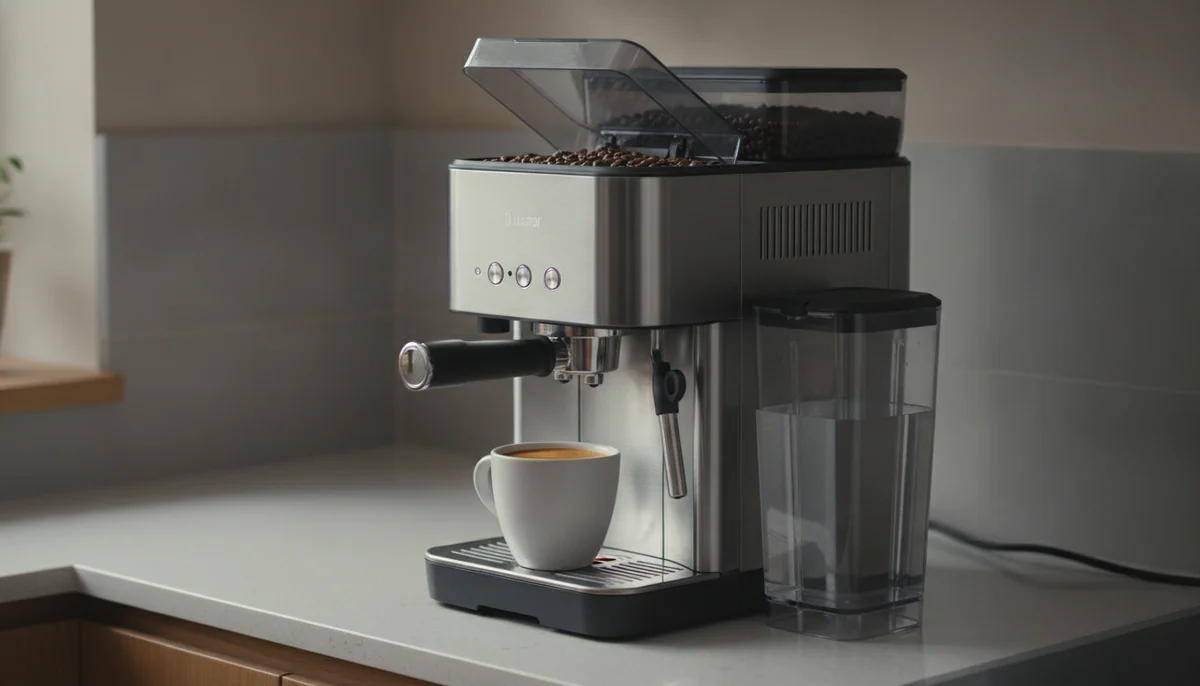
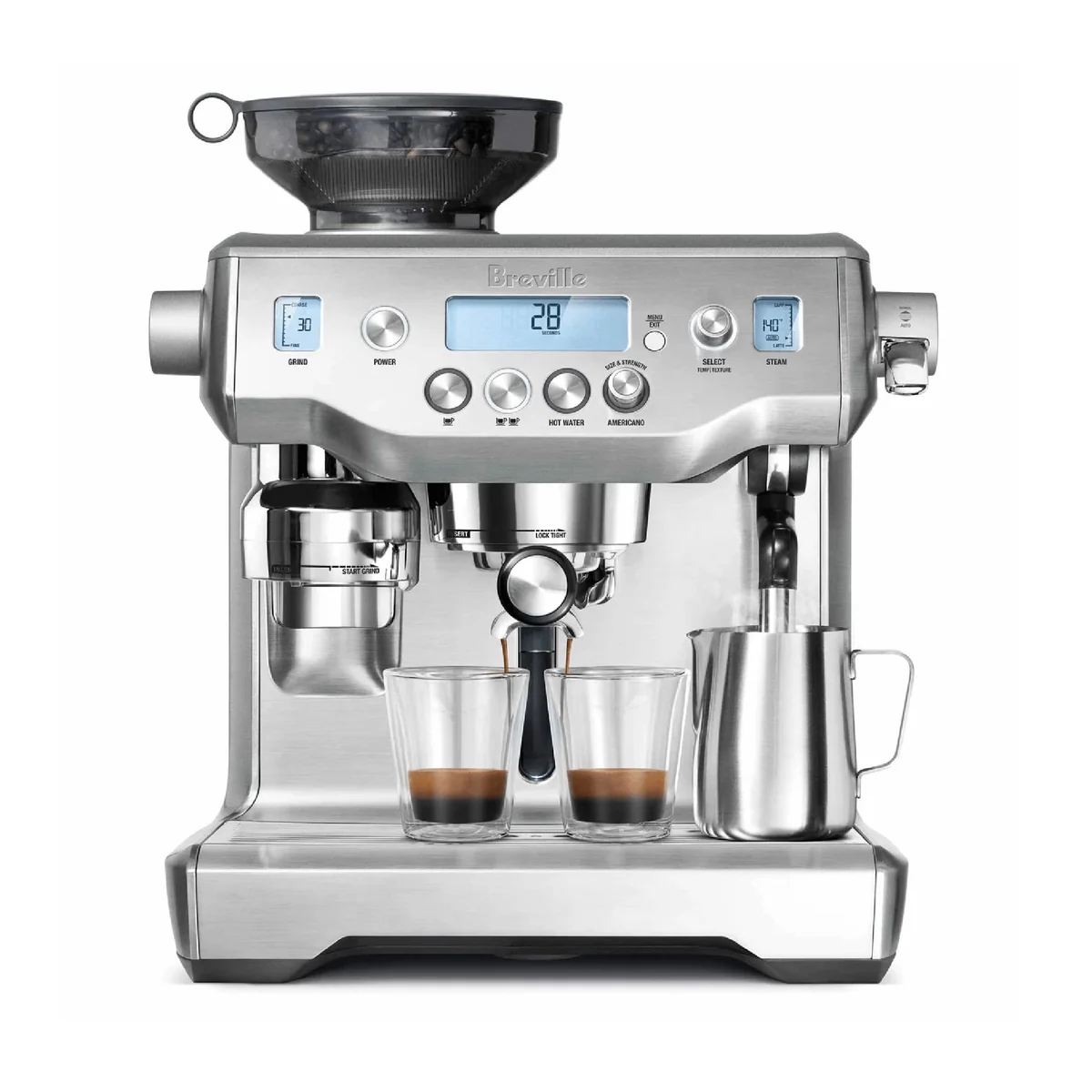
The category name is not reliable, and that is where most of the confusion starts. Amazon's shelf marked Super-Automatic Espresso Machines contains a Breville Oracle whose own description calls it "a fully automatic espresso machine" that "automatically grinds, doses, and tamps 22 grams of freshly ground coffee," which is true and which leaves out that you carry that 22 grams to the group head in a 58 mm portafilter and knock the spent puck into a bin afterwards. A few rows along sits a Breville Barista Touch whose Amazon copy describes it as a "semi-automatic espresso maker" in the same paragraph as it promises café drinks in three easy steps. Further down again are twenty-bar machines from brands with no history, sold on the promise that you will "extract rich espresso every time, no barista skills needed," and supplied with a plastic tamper.
So ignore the shelf and apply one test instead. At any point in making your drink, do you hold the coffee? If ground coffee travels from a grinder to a group head in a metal handle that you twist into place, you own a semi-automatic, no matter what the listing says. If the beans go in the top and the drink comes out the bottom and the only thing you ever touch is a bin of spent pucks, you own a super-automatic. Everything else on this page follows from that single difference, because it decides what the machine can do for you, what it cannot do at all, and which of its parts will eventually annoy you.
Espresso Den runs a site full of both kinds of machine, and the pattern in the owner record is remarkably stable: almost nobody regrets which category they chose, and a great many people regret not knowing which category they were buying. This page is the fifteen minutes that prevents that.
The four jobs, and who does each of them
Espresso is four mechanical jobs and one optional fifth. You grind beans to a fineness that will resist water for about half a minute. You dose a measured amount into a basket. You compress that dose into a level, even puck. You force hot water through it at pressure. Then, if you drink milk, you texture some milk. A machine's category is simply a statement about which of those five it has taken off you.
| The job | Super-automatic | Semi-automatic | The Breville middle ground |
|---|---|---|---|
| Grinding | Built in, adjusted by a dial you rarely move | You, on a separate grinder you also had to buy | Built in, adjusted by a dial you move often |
| Dosing | Fixed by the brew chamber, nudged by a strength setting | You, ideally on a scale | The machine, timed rather than weighed |
| Tamping | A piston inside a sealed brew group | You, by hand, and it is a skill | The machine on an Oracle, you on a Barista Touch |
| Brewing | Preset volume, one button | You start it and you decide when to stop | Preset, with the numbers on screen |
| Milk | Carafe, tube or wand depending on the model | A wand and a jug you hold | An automatic wand, into a jug you then pour |
| The spent puck | Ejected into an internal bin you empty | You knock it out | You knock it out |
| What your hands touch | Buttons, a water tank, a grounds bin | Portafilter, tamper, jug, knock box, cloth | Portafilter, tamper, jug |
Read the marketing copy for any bean-to-cup machine and you will see that whole list collapsed into one bullet. De'Longhi's Magnifica Evo is sold on seven one-touch recipes, thirteen grind settings and a conical burr that delivers "a precise, consistent dose of freshly ground coffee," which is an accurate description of a machine doing four jobs while you stand there. Bosch says the same thing in fewer words: bean to cup, one touch brewing.
The brew group is the whole invention
Inside every super-automatic is a component that has no equivalent on a semi-automatic: a brew group. Ground coffee drops into a chamber, a piston squeezes it, water is forced through it, and then the piston pushes the compressed puck out into a bin. It is the portafilter, the tamper and your hands rebuilt as one mechanism that runs in a straight line, and it is why the drink can be finished before you have found a cup.
It is also the part that decides how pleasant the machine is to own, because it sits in a warm, dark, permanently damp cavity. The good news is that on most European machines it comes out: Philips advertises its removable brew group as something you clean thoroughly just by rinsing it under the tap, and De'Longhi and Bosch make the same promise. The bad news is what happens if you take the promise as an invitation to ignore it. The most useful review on the Philips 3200 listing is not the most enthusiastic one; it is the owner who itemised the chores, at roughly four minutes daily for the grounds bin, drip tray and milk carafe, and about ten minutes weekly to pull the brew group out, rinse it under warm water and wipe up the grounds and moisture that migrate underneath it. His flat conclusion, having done that for the better part of a year without incident, is that the people with mould problems are not doing this regularly. Our week-by-week cleaning and descaling guide sets out the full cadence, and the question of sealed brew groups you cannot reach at all is its own argument.
A semi-automatic has none of that, and it is a real structural advantage that almost nobody mentions when comparing them. Coffee grounds on a portafilter machine touch a basket and a shower screen and nothing else, so there is no wet puck sitting inside a closed chamber and no internal brew unit to develop a smell. What you get instead is a counter to wipe, a knock box to empty and a group seal to keep clean. The work does not go away. It moves from a schedule you can neglect to a ritual you cannot.
Why the espresso is milder, and why that is not a fault
Here is the thing that surprises most people arriving from a café. Breville's Oracle listing puts 22 grams into a 58 mm basket, which is roughly what a working bar uses for a double. The sealed brew chamber in a super-automatic is a much smaller vessel, and every reviewer who has interrupted one mid-cycle and weighed what fell out has found the same shape of answer: the puck is closer to a single than a double, while the water passing through it is sized for a bigger drink. We work through those measurements machine by machine in our Philips 3200 review and our Magnifica Evo review, and the ordering barely moves as you spend more money.
That single fact explains the most common complaint in the whole category, which is that the coffee tastes thin. It is usually not a defect and usually not your beans. It is the ratio, and the levers you have are the ones the machine gives you: grind finer, set strength to maximum, set the drink volume shorter than feels generous, and pull two shots into one cup rather than asking for one long one. Our full diagnosis of watery bean-to-cup espresso goes through them in order. The corollary matters just as much: if you drink large mugs of black coffee, this is the wrong category and no setting rescues it, which is the point of our piece on getting a normal mug of coffee out of one of these.
The upside of the same design is consistency. A super-automatic makes the same drink on Tuesday that it made on Monday, because nothing about it depends on how well you tamped at seven in the morning. A semi-automatic has a far higher ceiling and a far lower floor, and where you land inside that range on any given day is a function of your attention. Bean choice also stops being decorative on either machine: oily dark roasts gum up a bean-to-cup grinder, and light roasts sit beyond what most built-in burrs can grind fine enough to extract.
Milk is a separate decision, and it is the one you will live with
Nothing about being a super-automatic tells you how a machine handles milk, and buyers assume otherwise constantly. There are three arrangements in the wild and they demand completely different things of you.
A wand is what a semi-automatic gives you and what plenty of cheaper super-automatics give you too. The Gaggia Brera froths through a Pannarello, the sleeved kind that drags air in for you, and the same wand doubles as the hot water spout for americanos and tea. You stand there holding a jug, and nothing gets poured for you. A carafe is the opposite: De'Longhi's LatteCrema is a thermal jug that lives in your fridge, plugs into the machine and delivers textured milk straight into the cup. Philips splits the difference with a two-part carafe that has no tubes and no hidden channels, which the company says rinses under a tap in about fifteen seconds or goes in the dishwasher. And a tube system simply dips a hose into whatever carton you own.
Check which one you are buying rather than trusting the title, because the titles are not careful. Bosch sells its 300 Series as a machine "with Grinder and Steam Wand" and then, in its own description on the same page, calls the milk system a Milk Express in-cup frother that makes "silky milk froth made directly in your cup." Those are two different appliances for two different people. Our comparison of the three milk systems is the honest way to settle which annoyance you would rather own, and if milk drinks are the entire purpose of the purchase, our shortlist for latte households starts from that assumption.
One warning that applies across the category regardless of which system you pick: automatic milk runs cooler than a café's, by design rather than by fault, and it is the complaint that survives all the way up the price ladder. Why these machines serve warm milk explains the mechanism and the three things that genuinely help.
The machines in the middle, and why Breville confuses everybody
A large share of the people searching for a Breville bean-to-cup are searching for a machine that does not exist. Breville automates grinding, dosing, shot timing and milk texturing, and on the Oracle it automates tamping too, but the portafilter never leaves your hands. Breville's own launch material for the Oracle called it the world's first automatic manual espresso machine, which is a more honest phrase than anything on the Amazon listing. The Barista Touch goes further and calls itself a semi-automatic in its own product copy.
What that middle ground actually buys you is the two steps that ruin most home espresso, taken away, while the parts that reward attention stay yours. These machines run single-wall baskets in a full-size portafilter rather than the pressurised, dual-wall baskets that manufacture crema out of nothing on cheap machines, which is the difference between coffee that looks right and coffee that tastes right. If you arrived here from a search for a Breville super-automatic, our page on exactly what Breville does and does not automate is the shorter answer, and the Barista Touch set against a Dinamica Plus is the two philosophies argued head to head.
Two other pieces of marketing deserve the same scepticism while we are here. A twenty-bar pump rating describes what the pump can generate against a closed valve, not the pressure the coffee sees, and espresso is brewed at roughly nine; the bar number is worth understanding before it sells you a machine. And an iced setting on a super-automatic almost always means brewing hot coffee cooler and slower onto ice you supply, which we take apart separately.
So which one are you?
This is a question people ask out loud, repeatedly, and the answers they get are not as tribal as you would expect. One buyer with a four-figure budget posted the choice as semi-auto against super-auto and got a thread of people arguing both ways in good faith. Another asked why nobody builds a machine that is both, which is a fair question that nobody has a satisfying answer to. A third asked simply whether all-in-one machines are any good and drew a long, mixed, useful thread rather than a pile-on.
The most instructive account Espresso Den has read is from an owner leaving a Nespresso behind who explained her entire reasoning in one line: it was really easy to use, and that was the main thing she wanted. Set against that, the beginner threads are full of people who budget the whole amount for a machine and then discover, in the replies, that a semi-automatic is only half the purchase and that a grinder good enough to feed it is not a sixty-dollar item. Whichever way you go, know which of those two people you are before you spend anything, and read our argument about grind-and-brew all-in-ones if you are leaning towards putting the grinder inside the machine.
| If this is true of you | Buy |
|---|---|
| Several drinks a day, more than one person making them, mostly with milk | A super-automatic, and read our roundup |
| One or two drinks a day, black, and you would enjoy the process | A semi-automatic with a real grinder beside it |
| You want a large mug of black coffee first thing | Neither, or a super-automatic plus a drip machine |
| Two beans in the house, one of them decaf | A super-automatic, and see the two-bean machines |
| Fifteen inches between worktop and wall cabinet | Start from the compact shortlist |
| You have already tried a machine and stopped using it | Automation, every time |
Names, with the catch attached to each
Espresso Den has reviewed all of these individually, and none of them is a clean win. That is the point of naming the catch alongside the case.
On the super-automatic side, the Philips 3200 LatteGo is the machine to beat if the deciding factor is how much washing-up your milk system creates, because the two-piece carafe genuinely rinses in seconds; its catch is that the dose is roughly half a café shot, so the espresso is mild no matter how you set it, and the cappuccino button pulls a single shot with no way to make a double the default. The De'Longhi Magnifica Evo is the cheapest honest route into one-touch milk drinks and its foam is better than its price suggests; its catch is a dose ceiling that leaves straight espresso closer to a short lungo, milk that arrives warm rather than hot, and a carafe sensor that De'Longhi thought poorly enough of to delete from the next machine down. That next machine, the Magnifica Start, shares the brew group and the burr and hands the milk back to you on a wand, which many owners prefer; its catch is that the same small dose stretched across a long drink is exactly where its coffee falls apart. The Gaggia Brera remains a genuinely small machine that grinds, brews and then leaves you alone; its catch is a manual Pannarello, a lungo made by pushing more water through the same puck, and a one-year warranty on a machine people keep for five. If the budget is the binding constraint, our shortlist for the bottom of the category is where that argument gets settled.
On the other side, the Breville Barista Touch is the fastest way to café-grade milk drinks with a fortnight of learning rather than a year of it; its catch is that it doses by time rather than weight, so every grind adjustment quietly invalidates your dose, and the temperature sensor behind the automatic wand is the component owners most often report failing. The Oracle BES980XL adds automatic tamping and two boilers so the shot and the milk happen at once; its catch is a built-in grinder that long-term owners replace first and shots timed rather than weighed, which is a design decision from a decade ago showing its age. And the Bambino Plus bundled with a Baratza Encore ESP is the separates approach sold as one carton, which solves the mistake that ruins most first setups; its catch is that it is not remotely a super-automatic, and owners consistently report it losing its composure by the third drink in a row.
The words, briefly, because nobody uses them consistently
Super-automatic, fully automatic and bean-to-cup all mean the same machine, and the industry itself does not agree on which to say; specialist retailers have made whole videos trying to untangle fully automatic from super-automatic for customers who cannot tell them apart. Semi-automatic means a portafilter machine where you dose and tamp and the pump runs until you stop it. Automatic, unqualified, is the word listings use when they want the halo of the first without the obligations of it. Manual or lever means no pump at all, and if you were looking for one of those you would already know.
None of the vocabulary matters as much as the test at the top of this page. Somewhere in the process, do you hold the coffee? Answer that about the specific machine in front of you and everything else, the price, the cleaning, the ceiling, the thing that will eventually break, follows from it. If you want the money argument rather than the mechanical one, whether a super-automatic is worth it runs the sums, and how long these machines last and what fails first is the part most buyers only read afterwards.
Frequently Asked Questions
What actually makes a machine super-automatic?
It grinds, doses, tamps and brews inside a sealed brew group and ejects the spent puck into an internal bin, so the coffee is never in your hands at any point.
Is a semi-automatic harder to use, or just slower?
Both, because you are dosing, tamping and steaming yourself, and the skill takes a few weeks to become reliable rather than a few minutes.
Does a super-automatic make worse espresso?
It makes milder espresso, because the brew chamber holds a smaller dose than a portafilter basket and the drink volumes are set generously against it.
Does a super-automatic always froth milk for you?
No, plenty of them fit a manual wand you hold a jug under, so check whether the machine has a wand, a tube or a carafe before you assume.
Is a Breville a super-automatic?
No, Breville automates grinding, dosing, shot timing and milk texturing while leaving the portafilter, and on most models the tamping, to you.
Which one needs more cleaning?
A super-automatic asks for a schedule you can neglect and regret, while a semi-automatic asks for a small ritual after every single drink.
Can I put pre-ground coffee or decaf into a super-automatic?
Most of them have a bypass chute for exactly that, though it is fussier than the marketing suggests, which is why we wrote it up separately .
Does a higher bar rating mean a better machine?
No, because espresso is brewed at around nine bar and the figure on the box describes the pump rather than the pressure the coffee ever sees.
Which should a complete beginner buy?
Buy the super-automatic if you want coffee and the semi-automatic if you want a hobby, because the machine you resent is the one that ends up unused on a shelf.
Sources (4)
- Amazon listings and customer reviews
- Owner reports across r/espresso, r/superautomatic threads
- Owner and reviewer video, 2 channels
- Coffeeness — Article — www.coffeeness.de