The Magnifica Start with the manual frother is the De’Longhi worth buying, provided you are willing to steam your own milk
Buy this one if you drink espresso, cappuccino or any short milk drink and will spend twenty minutes learning a steam wand; skip it if what you actually want is a big mug of black coffee.
Based on 961 owner ratings, 9 owner discussions and 7 other sources. We have not tested this machine ourselves.
We earn a commission if you buy through our links, which does not affect what we say.
Read how this site works →
Where this leaves you
The Start is the machine to buy in this range if you accept its terms, and the terms are unusually clear. You are getting De'Longhi's real espresso hardware in the least decorated box they make it in, and you are giving up the automation around the milk, the menus that would make configuration painless, and the extra couple of grams that would let it stretch to a mug. Two of those three are things the more expensive machines are frequently criticised for anyway. The third is the one to think hard about, because no amount of dialling in will turn ten grams into a satisfying half-litre of black coffee.
So the buying rule is short. Espresso, cappuccino, flat white, a short americano, and a willingness to hold a milk jug: this is a lot of machine for the money and the honest recommendation. A mug of drip-style coffee first thing, or a household that wants to press one button and walk away: buy something else, and buy it knowing why.
Buy this one if you drink espresso, cappuccino or any short milk drink and will spend twenty minutes learning a steam wand; skip it if what you actually want is a big mug of black coffee.
Best for: It shares its brew group and steel burr with De’Longhi machines well above it, deletes the automatic milk carafe that generates most of their owner complaints, and asks for a fortnight of dialling in that nobody warns you about.
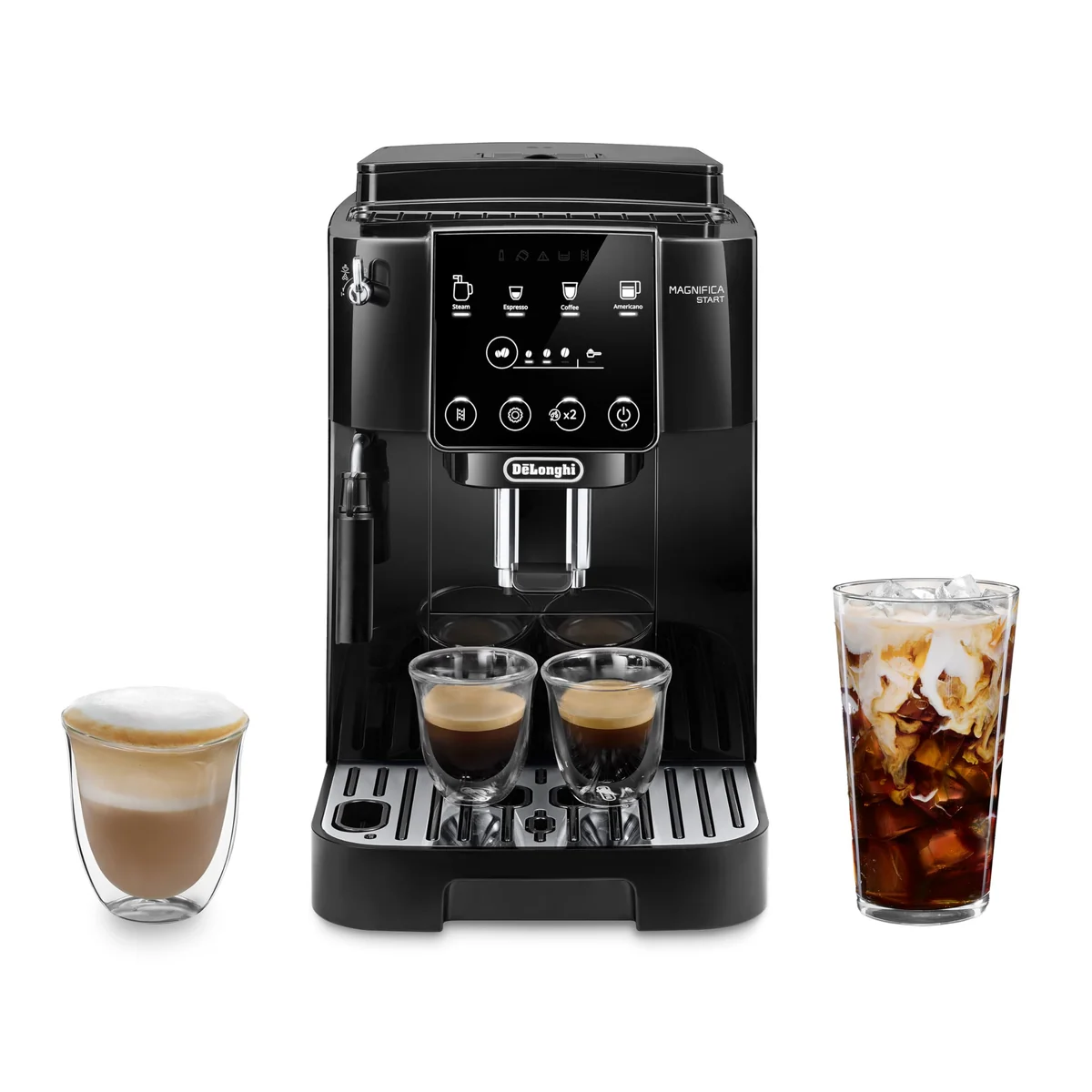
De'Longhi sells a lot of machines called Magnifica, and the differences between them are mostly invisible from the listing photographs. This is the plain one: a black box with three lit icons on the front for espresso, coffee and americano, thirteen grind steps on a conical burr, and a traditional frothing wand on the right-hand side that you operate yourself with a knob. There is no carafe, no touchscreen, no app, no user profile, and no timer that wakes the machine before you do. The whole proposition is that the part of a super-automatic that actually makes coffee is identical to the part inside machines costing considerably more, and everything you are not paying for here is a convenience rather than a component.
That claim comes from owners rather than marketing, and it comes up repeatedly. One buyer who researched the Start against its glossier sibling concluded it would make the exact same coffee, espresso and americano, and that the sibling looked better but not enough better to justify the gap; another Start owner in the same thread simply replied that he loved his. Tom's Coffee Corner, which has tested most of the range, tabulates the Start and the Evo in a single shared row of its dose chart, because on the numbers that matter they are one machine in two shells.
Before any of that is useful, though, there is a problem with the evidence, and Espresso Den would rather put it at the top than bury it.
The reviews on this listing are not all about this machine
Amazon groups this black manual-frother model with a silver sibling that has De'Longhi's automatic milk carafe, and the customer reviews pool across the family. Reading through the retained set, several of the most enthusiastic entries name the Evo outright, praise an automatic milk frother, or describe a self-cleaning milk nozzle; one one-star review complains that the machine beeps when the frother is inserted but never recognises it, which is a sensor on a carafe this model does not have. The star average on the page is therefore an average of two products. If you are reading the reviews to decide, read the words and discard anything that mentions a carafe, a milk container or a milk detection problem. What is left is a smaller, duller and more useful pile: a machine that people mostly like, that a few received broken, and that is louder than they expected.
Key Specifications
What you are buying, once you strip the name back
The Start is best understood as the tidied-up successor to the Magnifica Evo. It moves the controls from a slanted top panel to the front of the machine and, more importantly, it deletes the optical sensor that the Evo used to confirm a milk container was seated and full. That sensor is a documented source of Evo frustration, the reason a batch of owners find their latte and cappuccino buttons refuse to light, and one commenter who watched people arrive in the forums with the wrong box told a buyer who had bought the Start by mistake that he had accidentally bought the better of the two machines. Tom's Coffee Corner reaches the same conclusion from the other direction, reading the omission as De'Longhi quietly removing a part that generated complaints.
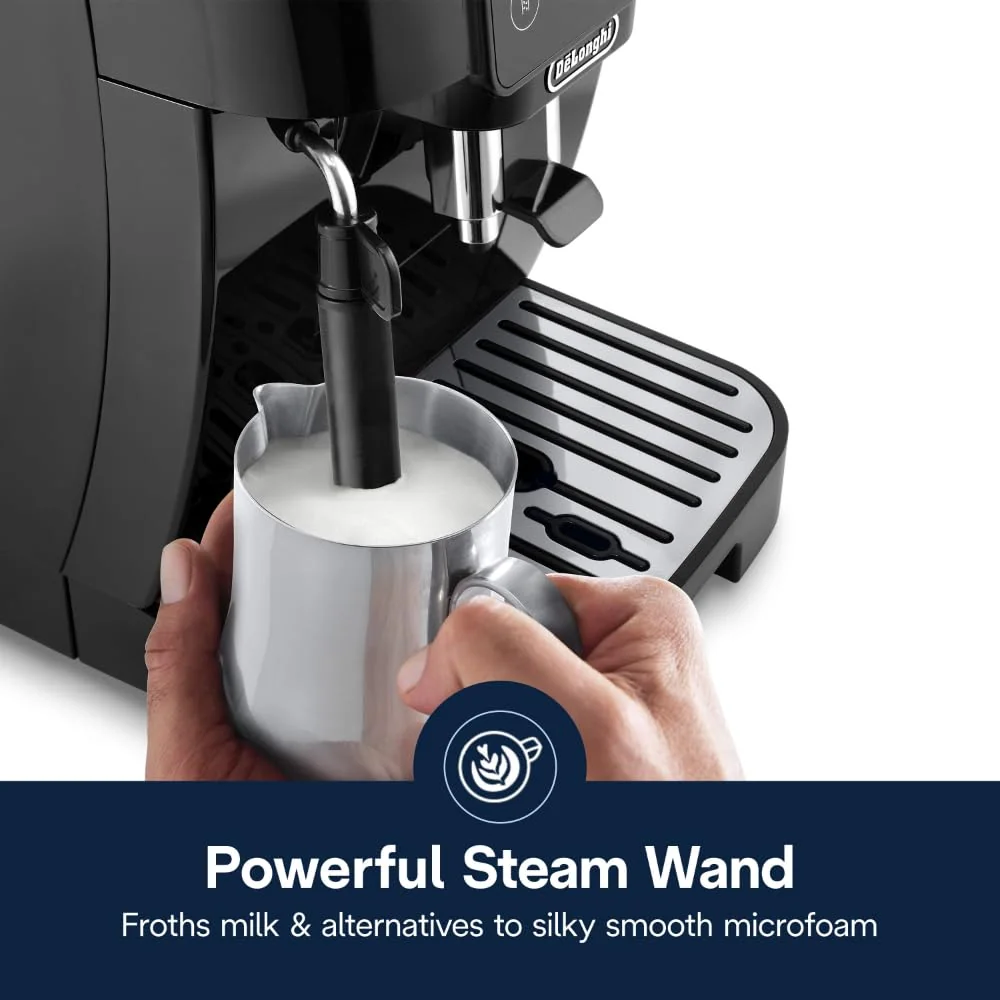
On this particular model the point goes further, because there is no milk carafe at all. Everything that fails on an automatic milk system, the seven-part disassembly, the daily rinse, the tube that clogs, the detection that stops working, is simply not fitted. What you get instead is a panarello wand: a plastic sleeve over the steam pipe with an air hole in it, which drags air into the milk the whole time it is heating. That is why the foam it produces is thick and bubbly rather than glossy, and it is a real limitation, not a matter of taste.
It is also a limitation with a well-known fix. The sleeve pulls off, leaving a bare steam pipe that behaves like a proper wand, and at least three independent sources say the same thing: take the panarello off and the milk gets meaningfully better, with one owner reporting that latte art becomes easy once it is gone. If you have never met a steam wand, our guide to choosing between a wand, a milk hose and a one-touch carafe is the honest version of that decision, because the wand costs you time every morning and buys you control every morning too.
| Missing | Consequence | Where it lives instead |
|---|---|---|
| One-touch milk carafe | You hold the jug and judge the milk yourself | Magnifica Evo, Philips LatteGo machines |
| User profiles | One saved volume per drink for the whole household | Dinamica Plus and up |
| Larger dose settings | Three strength steps, with a low ceiling on grams per puck | Magnifica Plus, Dinamica Plus, Eletta Explore |
| Screen and menus | Settings live behind icon combinations and button holds | Almost everything above this price band |
| Genuine cold extraction | Iced drinks are hot coffee poured over ice | Only the top of the line, as we set out in the iced coffee explainer |
If the model numbers are what is defeating you, that is not your fault and you are in large company; even reviewers who cover the brand full time have had readers write in asking them to explain the range without a spreadsheet. Our comparison of the whole De'Longhi line untangles it, and if the choice has narrowed to two, the Evo against the Start is the one people actually search for.

Strengths & Limitations
Strengths
- The brew group and steel conical burr are shared with De'Longhi machines well above this one, so the espresso quality is not where the savings were made.
- Removing the automatic milk carafe removes the component that generates most of the complaints on its siblings, along with the daily cleaning it demands.
- You control milk temperature and texture yourself, which is the standard answer to the lukewarm-latte complaint that dogs one-touch machines.
- The brew group comes out for rinsing, so the inside of the machine stays reachable in a way that sealed rivals do not allow.
- Parts are cheap and widely available, and there is a large body of published repair guidance for this platform.
- The water tank loads from the front, which matters under wall cabinets.
Limitations
- The maximum dose is small enough that long drinks come out thin, which is the mechanical reason behind most complaints about weak coffee.
- The grinder is measurably louder than the older Magnifica it replaces, with a shrill note on every cycle.
- Settings live behind held buttons and icon combinations, and at least one owner could not reach the water hardness options his own instructions described.
- The printed manual explains setup and maintenance but not how to actually make or configure drinks.
- The panarello sleeve produces stiff, big-bubbled foam unless you take it off and learn to steam properly.
- There are no user profiles, no scheduled wake-up, and no genuine cold extraction.
- Reviews on the listing are pooled with an automatic-frother sibling, so the star average describes two different machines.
The espresso is good, the long coffee is where people get burned
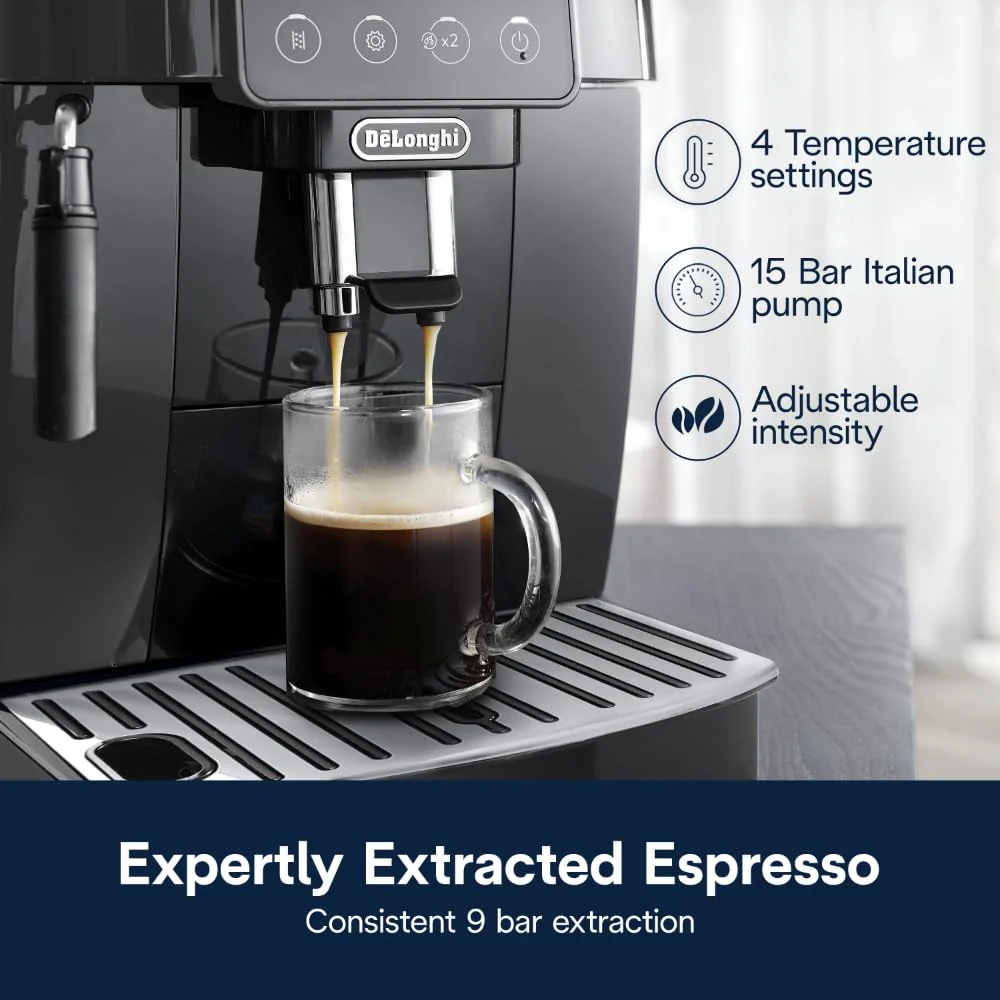
Take the two drinks separately, because the machine does. As an espresso maker in its price band, the Start is well regarded by people who compare machines for a living. Home Coffee Expert, reviewing the Evo, went out of its way to say that the Start is very similarly priced and brews a better-tasting cup. Coffeeness, testing the Start against the older Magnifica S it descends from, found the internals had genuinely improved and the coffee had more depth, with the qualifier that this applies to the espresso.
That qualifier is the whole story. Tom's Coffee Corner has measured the dose across De'Longhi's line by timing the grinder, and the Start's three strength settings top out at roughly seven seconds of grinding, in the region of ten grams, where the Dinamica Plus and its relatives keep going to around fifteen; other testers timing the same platform put the ceiling nearer twelve grams, so treat the exact figure as contested and the ordering as settled. Ten to twelve grams into a thirty millilitre cup is a good ratio. The same ten to twelve grams stretched across a mug is not, and that single fact explains almost every complaint in the corpus about weak, watery, anonymous coffee. We have written the general version of this at why bean-to-cup espresso comes out watery; on this machine it has a specific mechanical cause.
The clearest case Espresso Den found was a buyer who had come off pod machines wanting a 230 millilitre mug and had arrived at a hybrid of hot water plus two shots, describing the result as fine but somehow anonymous, and worse than the instant he had been drinking. The advice he got was blunt and correct: these machines make espresso and things built from espresso, so this might not be the machine for you. A second Start owner reported exactly the same thing, that the espresso was fine but the coffee button produced something watery with an off-putting taste, while a third owner in the same thread said his coffee button was good once he set it to around eight ounces and that the americano was the weaker of the two. They are all right, and they are describing the edge of what the machine can do. If your household mostly drinks black mug coffee, read what a super-automatic can and cannot do with filter-style coffee before you spend anything, or start from the machines we would pick for black coffee drinkers.
Dialling it in, and the two rules nobody prints on the box
New owners routinely conclude the machine is broken in week one. The pattern is consistent enough that owners have named it themselves: one Evo owner said the first week of coffees were like dishwater and she nearly sent it back, then persisted and was glad she had; another described his first espresso in unrepeatable terms before it turned out fine. Nobody has a convincing mechanism for a machine breaking in, and it is probably the buyer learning the controls, but the practical advice is the same either way: do not judge it on the first few cups.
Two rules matter more than anything else, and both are easy to miss. The grind adjuster only does anything while the grinder is actually turning, so if you set it with the machine idle you have moved a dial and changed nothing; one Start owner discovered exactly this after concluding his coffee was terrible, and noted the quick-start guide had not mentioned it. And any change takes two or three brews to appear, because the old grind is still sitting in the chute. The second rule is that the 2x button does not add coffee, it adds water, which means people pressing it to make their coffee stronger are diluting it. If you want more coffee in the cup, pull two separate espressos rather than one double.
| Goal | Grind | Notes |
|---|---|---|
| Espresso, roughly 30 to 40 ml | Third finest, around 2 to 3 | Maximum strength; Coffeeness settles on the third finest step |
| Long drink near 230 ml | Around 4.5 | Coarser, or the swelling puck chokes; waste two shots after any change |
| Any change to the dial | While grinding only | One step at a time, judged three cups later |
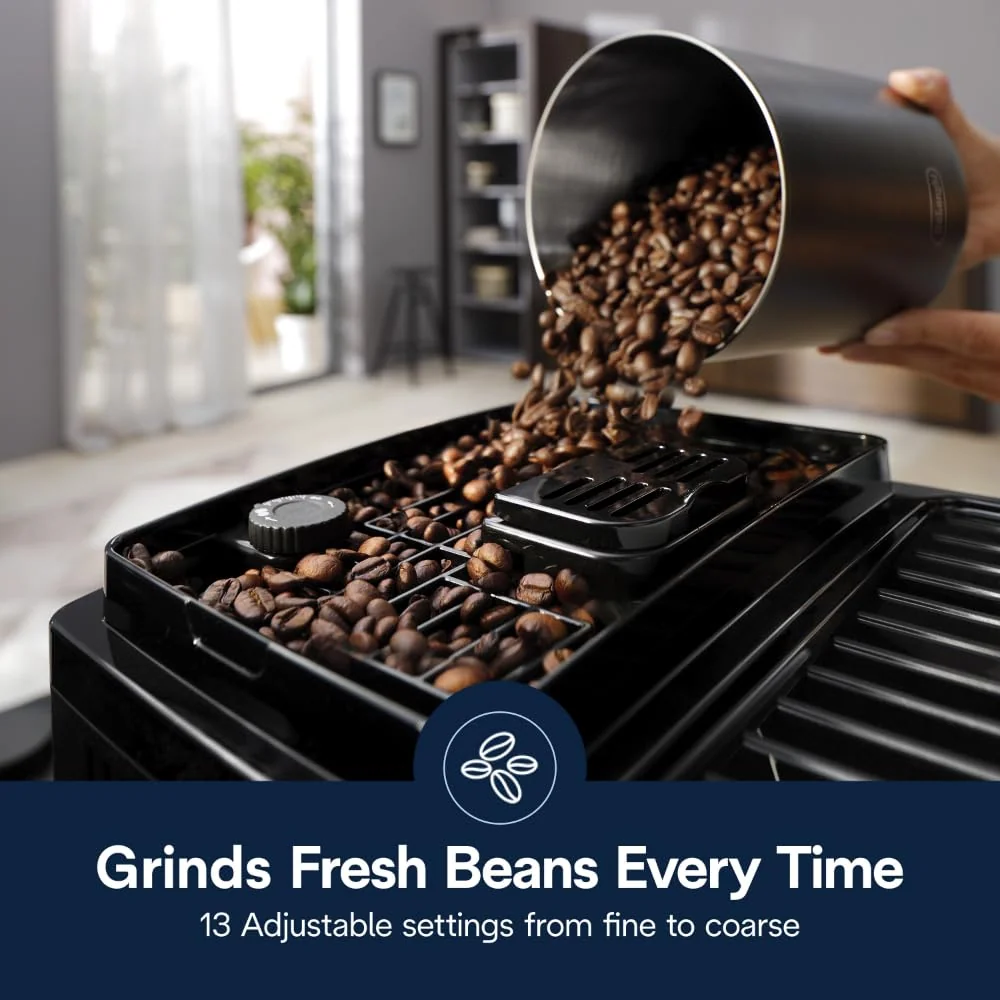
The finest one or two settings are effectively decorative. Coffeeness reports that on this platform the grinder is overwhelmed and the pump cannot generate the pressure, so the coffee barely reaches the spout. Beans matter more than any of it, and the roast style matters most: bean-to-cup machines want a well developed espresso-style roast, not a bright filter roast, and never an oily or flavoured bean. Our guide to beans that work in a bean-to-cup machine covers the ones that jam grinders.
Milk, heat and noise
Milk drinks out of any super-automatic run cooler than a café's, and this whole family is no exception; the standard mitigation is to run a rinse into your cup before brewing, which flushes cool water from the lines and warms the cup at once. What is genuinely different here is that the temperature of the milk is yours. Owners of the older automatic-carafe De'Longhis fill pages complaining that their lattes arrive lukewarm and that the heat setting only affects the coffee, and one of them notes he was steered away from the automatic model at the shop specifically because the wand version made hotter drinks. That is the case for this machine stated by people who bought the other one. If lukewarm coffee is your recurring complaint, our piece on why these machines run cool goes further into it.
Noise is the drawback nobody disputes. Coffeeness measured the Start's grinder at 75.9 dB, several decibels above the older Magnifica S it replaces, and describes a shrill note on every grind cycle that would not survive a sleeping baby. Owners agree without much resentment: loud, brief, and worth it, is roughly the consensus. If a quiet kitchen is a hard requirement rather than a preference, the quietest machines we know of are a different shortlist entirely. One more physical quirk, reported by TechGearLab on a wand-equipped Magnifica: during warm-up it can spit water onto the counter instead of into the drip tray, which they called an annoying design flaw and which matches the Amazon owner who keeps a saucer under the grate.
What the cheapest machine in the line actually costs you
The argument for spending more inside De'Longhi's range is thinner than the price ladder implies, because the brew group and the steel conical burr are shared. The argument against spending less is the dose ceiling, which is real and which we have already put a number on. So the honest framing is this: money spent above the Start buys features, a bigger puck, and a milk system that works without you, in that order of certainty.
Not everyone agrees this model earns its place. Coffeeness, reviewing the Start line, wrote flatly that "There is no reason to buy the manual milk frother DeLonghi Magnifica Start." That is the sharpest dissent aimed at this exact configuration, and it deserves to be quoted rather than paraphrased. It also deserves context: the same reviewer, writing about the Magnifica S, says he will not classify a manual wand as a disadvantage at all and that with experience you will love it. The two positions are only reconcilable through price. Judged against a carafe model that costs a good deal more, the wand looks like a subtraction; judged as the entry point to the range, it looks like the version with fewer parts to fail.
The genuine cross-shop is Philips. The trade there is stable across dozens of owner accounts: De'Longhi tends to win on dose and extraction strength, Philips wins comfortably on milk cleaning, because the LatteGo carafe is two pieces with no tubes. But that Philips advantage is an advantage over a De'Longhi carafe, and this machine does not have one, which quietly removes most of the reason to switch. If you want the Philips case put properly, we have the 3200 LatteGo reviewed and the 5500 set directly against this machine. If your shortlist has drifted towards a steam wand at a similar level, the Bosch 300 Series comparison is the other one worth reading, and our roundup of the best budget-tier super-automatics is where this machine sits in the wider field.
On running cost, the owner arithmetic is more persuasive than any review. One Magnifica owner who tracked four thousand cups worked his all-in cost, machine included, to about thirty-four cents a cup. Another, who counted more than thirty-eight thousand brews from his, reckoned his beans at under ten cents a shot. Whatever the machine costs you, the beans and the descaler are what you pay for afterwards, and both are cheap relative to a daily café habit.
Living with it, and how long these actually last
The single best structural feature of a De'Longhi, and the reason people keep buying them after a bad experience elsewhere, is that the brew group comes out. You rinse it under the tap, you put it back, and mould never gets a chance to establish itself where you cannot reach. On the Start there is a wrinkle: Coffeeness notes that part of the brew group stays inside the machine when you remove the rest, so you have to clean the cavity more thoroughly than you would on the older models. Not a defect, but worth knowing before the first month passes.
Set the water hardness on day one. Left alone, these machines default to the hardest setting and will demand descaling far more often than your water justifies, which is the source of a good deal of published irritation about descale prompts arriving after three weeks. Here is where the Start's interface bites: one owner, following the printed instructions step by step, could only reach the two hardest options and never the softer ones his documentation described, watched a dozen videos that did not match his machine's icons, and got no answer from anyone. That is the machine's real weakness. The hardware is right and the software is unfriendly.
The manual is part of the same problem, and one Start buyer took the trouble to score it: the written manual covers first-time start-up and maintenance and contains nothing about making drinks, configuring settings or loading coffee, while the graphical quick-start guide explains the rest in unlabelled pictograms, which he put at about sixty per cent of an explanation and thought one extra page would fix. Save a PDF of the manual to your phone on day one; you will use it more than you expect. And keep the drip tray discipline: empty the grounds bin every time you pull the tray out, because the machine resets its counter when the tray goes back and grounds will otherwise overflow inside the body.
Lifespan is where De'Longhi's reputation is genuinely earned and genuinely overstated at the same time. On the long tail, owners report figures like 38,078 brews at eight years with a technician saying it was good for twenty thousand more, and one machine that reached 49,022 shots before it died and was replaced with another of the same model. Against that, an owner who took his apart to repair it made the fair point that plenty of the moving parts are plastic and were never meant to last a lifetime, so it cannot honestly be called a buy-it-for-life machine even after ten thousand cups. The failure modes are consistent across the line: leaking thermoblocks, dripping steam valves, cracked plastic, clogging from scale. Parts are cheap by appliance standards, with a brewing unit and a pump each running well under the cost of a service call, and repair guides are plentiful. Whether that is reassuring depends entirely on whether you are the sort of person who will open it. Our broader piece on how long these machines last and what breaks first sets the odds out properly, and the cleaning and descaling guide covers the routine that decides which tail you end up on.
Two smaller notes from owners. Warranty is two years, with a third widely reported for registering the machine, which takes a few minutes and is free. And the water tank pulls out towards you from the front, which sounds trivial until you have a machine under a wall cabinet and no headroom to lift a tank out of the back.
Frequently Asked Questions
Is the Magnifica Start the same machine as the Magnifica Evo?
Not identical, but close enough that the coffee is the same: they share the brew group and grinder, while the Start moves the controls to the front and deletes the optical milk sensor that causes trouble on the Evo.
Why does the coffee button produce something so weak?
Because the machine's maximum dose is around ten to twelve grams, which is a fine ratio for an espresso and a thin one once it is stretched across a mug, so the fix is to reduce the volume rather than chase it with a finer grind.
Does turning the grind dial actually do anything?
Only while the grinder is running, and only after two or three subsequent brews have cleared the previous grind out of the chute, which is why so many owners conclude the adjuster is broken.
Can it make a decent cappuccino without an automatic milk carafe?
Yes, though the plastic panarello sleeve produces stiff, bubbly foam, and the widely repeated fix is to slide the sleeve off and use the bare steam pipe like a proper wand.
Does the 2x button give me a stronger drink?
No, it runs twice the water through the same puck, so pulling two separate espressos is the correct way to get more coffee into a larger cup.
Will it handle oat and other plant milks?
The listing states the frother is intended for milk and milk alternatives including oat, almond and soy, though Espresso Den found no independent testing of plant milk on this specific wand, so treat it as a manufacturer claim rather than a verified result.
How often will it need descaling?
Far more often than necessary if you skip the water hardness setting at first setup, because the machine defaults to assuming the hardest water and counts litres rather than measuring scale.
Sources (9)
- Amazon listings and customer reviews — Delonghi Magnifica Start
- Owner reports across r/superautomatic, r/DeLonghi, r/BuyItForLife threads
- Owner and reviewer video, 2 channels
- Tomscoffeecorner — Article — tomscoffeecorner.com
- Coffeeblog — Article — coffeeblog.co.uk
- Au — Article — www.productreview.com.au
- Homecoffeeexpert — Article — homecoffeeexpert.com
- Coffeeness — Article — www.coffeeness.de
- Techgearlab — Article — www.techgearlab.com