The Breville Oracle Touch is a superb machine that Breville itself has moved on from
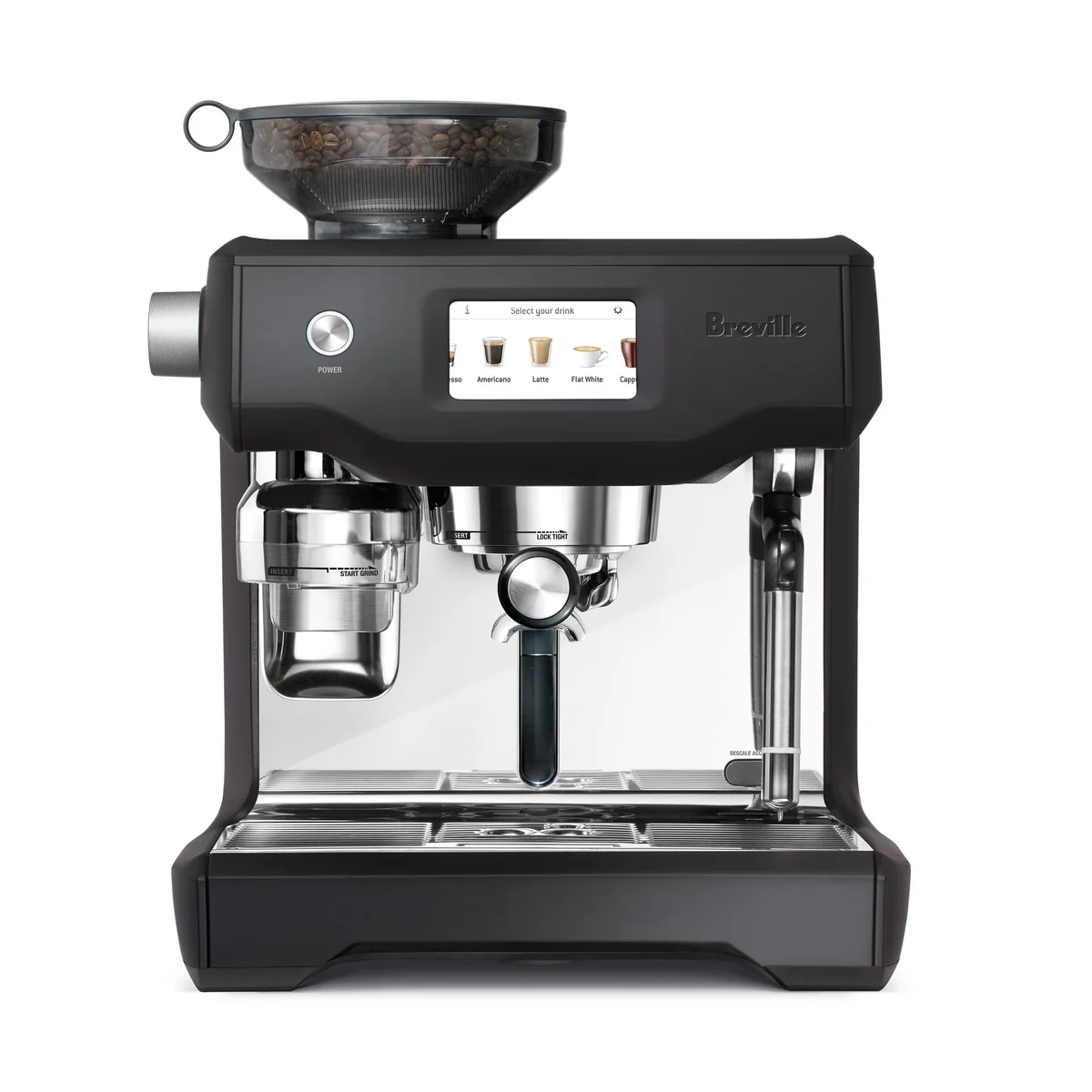
Buy the Oracle Touch if you want café-grade milk drinks with almost no technique, and only if you can live with a 22-gram dose that will not be argued down, a grinder that dislikes light roasts, and a repair record that starts costing money at roughly the moment the two-year warranty ends.
Based on 596 owner ratings, 15 owner discussions and 6 other sources. We have not tested this machine ourselves.
We earn a commission if you buy through our links, which does not affect what we say.
Read how this site works →
Who this is still right for
The sharpest description of the Oracle Touch anyone has written came from a forum comment, not a review: it has all the power of a serious prosumer device married to an almost-super-automatic, it is let down by a middling integral grinder, and there is nothing else quite like it. The audience is narrow, and inside that audience it does a terrific job. That is exactly right, and it is worth spelling out who is in the audience.
Buy it if your household drinks lattes, flat whites and cappuccinos, if more than one person needs to make them, if at least one of those people will not be learning to tamp, and if you are the sort of owner who will actually run the monthly grinder teardown and budget for a service around year three. Buy it if you have priced out what your household spends on café coffee and the number embarrasses you. Buy it if you specifically want the touchscreen, having read the case against it above.
Walk away if you drink espresso black and care about clarity, if you buy light roasts, if you already have a recipe built around 16 to 18 grams, or if the idea of a discontinued flagship at flagship money bothers you, because it should at least give you pause. Walk away if you want true one-touch, in which case the machine you want does not have a portafilter at all and our roundup of proper super-automatics is the right list.
If you land somewhere between those, three machines on this site are the honest alternatives. The Barista Touch keeps the touchscreen and the automatic milk, drops to a 54mm portafilter, one boiler and manual tamping, and costs a great deal less. The original Oracle is the same automation with buttons instead of a screen, which the reviewer who disliked the touchscreen preferred outright. And the Bambino Plus bundled with a Baratza Encore ESP is the closest thing on this site to the separates approach the enthusiasts keep recommending, with a real grinder you can service or replace independently of the machine. The full Breville range, ranked covers where each of them sits.
The verdict, restated with everything above behind it: the Oracle Touch makes very good milk drinks with almost no skill, and it asks you to accept a fixed dose, a fussy grinder, a timed extraction that punishes drift, and a repair curve that steepens right after the warranty ends. If those terms suit the way your kitchen actually runs, few machines do this job. If any one of them is a dealbreaker, one of the alternatives above is a better use of the money.
Buy the Oracle Touch if you want café-grade milk drinks with almost no technique, and only if you can live with a 22-gram dose that will not be argued down, a grinder that dislikes light roasts, and a repair record that starts costing money at roughly the moment the two-year warranty ends.
Best for: It grinds, doses, tamps and steams so you barely have to learn anything, and the honest question now is whether you want the flagship its own maker has replaced twice.
Start with the number that should give any buyer pause. Amazon shows this machine at 3.4 stars from 596 ratings. Breville's own site shows 4.3 from 726 reviews for the same model. Published reviews from coffee sites are close to rapturous, with scores in the mid-nines and phrases like "we LOVE this machine" doing a lot of load-bearing work. Three sets of numbers, one machine, and a spread that wide is not noise.
Espresso Den thinks the spread has a straightforward explanation, and it is the thing this review is actually about. The glowing reviews are written by people with a new machine on a bench and a deadline. The angry ratings and the owner forums are written by people six months to five years in. Almost none of the serious complaints are about whether the Oracle Touch can make good coffee on day one, because it plainly can. They are about grinders that stop grinding evenly, doses that drift, boiler seals that weep steam into electronics, and an air pump that quietly dies and takes your microfoam with it. This is not a bad-coffee story. It is a durability and consistency story, and those are the only kinds of story that matter at this price.
There is a second fact that outranks every spec on the page. Breville's own US product listing for the BES990 now carries a discontinued notice, and points visitors instead to two newer Oracles: a cheaper, faster one and a dearer, more capable one. The machine came to North America in 2017. Anyone buying it in 2026 is paying flagship money for a nine-year-old design that its manufacturer has already superseded, in a category where the successor's marketing openly advertises fixes for the exact complaints below. That does not make it a bad machine. It makes the price the whole argument.
If you already know you want a machine of this shape and you are just deciding which one, two comparisons on this site will get you there faster than the rest of this page: the Oracle against the Oracle Touch, which is really a question about whether a touchscreen is worth the gap, and the Barista Touch against the Oracle Touch, which is the one most buyers actually agonise over.
Key Specifications
Whatever Amazon's category says, this is not a super-automatic
Amazon files the Oracle Touch under Super-Automatic Espresso Machines and ranks it 32nd there. Breville's own page has used the words "Super Automatic" too, and the listing copy calls it "the next generation of fully automatic espresso makers." Every one of those labels is misleading, and the mismatch generates a steady drip of disappointed buyers who expected a bean-to-cup box with a spout.
The clearest statement of what it actually is comes from a reviewer who spent weeks with one: retailers classify it as bean-to-cup, but it is a traditional espresso machine, with a portafilter, real baskets, nine bars of pressure and pre-infusion, and no brew unit inside. That last part is the structural difference. A true super-automatic pucks the coffee in a sealed internal group and ejects it into a bin. The Oracle Touch puts the grounds in a 58mm portafilter that you carry three inches to the left. Epicurious put it more gently and just as accurately: it is not quite a super-automatic, but it is as close as Breville gets. If you are not sure which side of that line you want to be on, the difference between a super-automatic and a machine you tamp yourself is worth five minutes before you spend anything, and what Breville's machines actually automate covers the rest of the range.
What you do, in practice, every single time: dock the portafilter under the grinder, press grind, and the machine doses and tamps 22 grams for you. The grind button turns green when it is satisfied with what it produced. You move the portafilter to the group head, lock it in, and press the drink you want. Separately, you fill the milk jug, put it under the wand, and press. If the machine senses the wrong amount of coffee in the basket, the screen reads "stopped" and adjusts the grind time itself for the next attempt. Two physical moves and a jug of milk is the entire skill requirement, which is genuinely remarkable, and it is also two more moves than the machine's own category name implies.
The specification, including the parts that do not agree
| Item | Figure | Note |
|---|---|---|
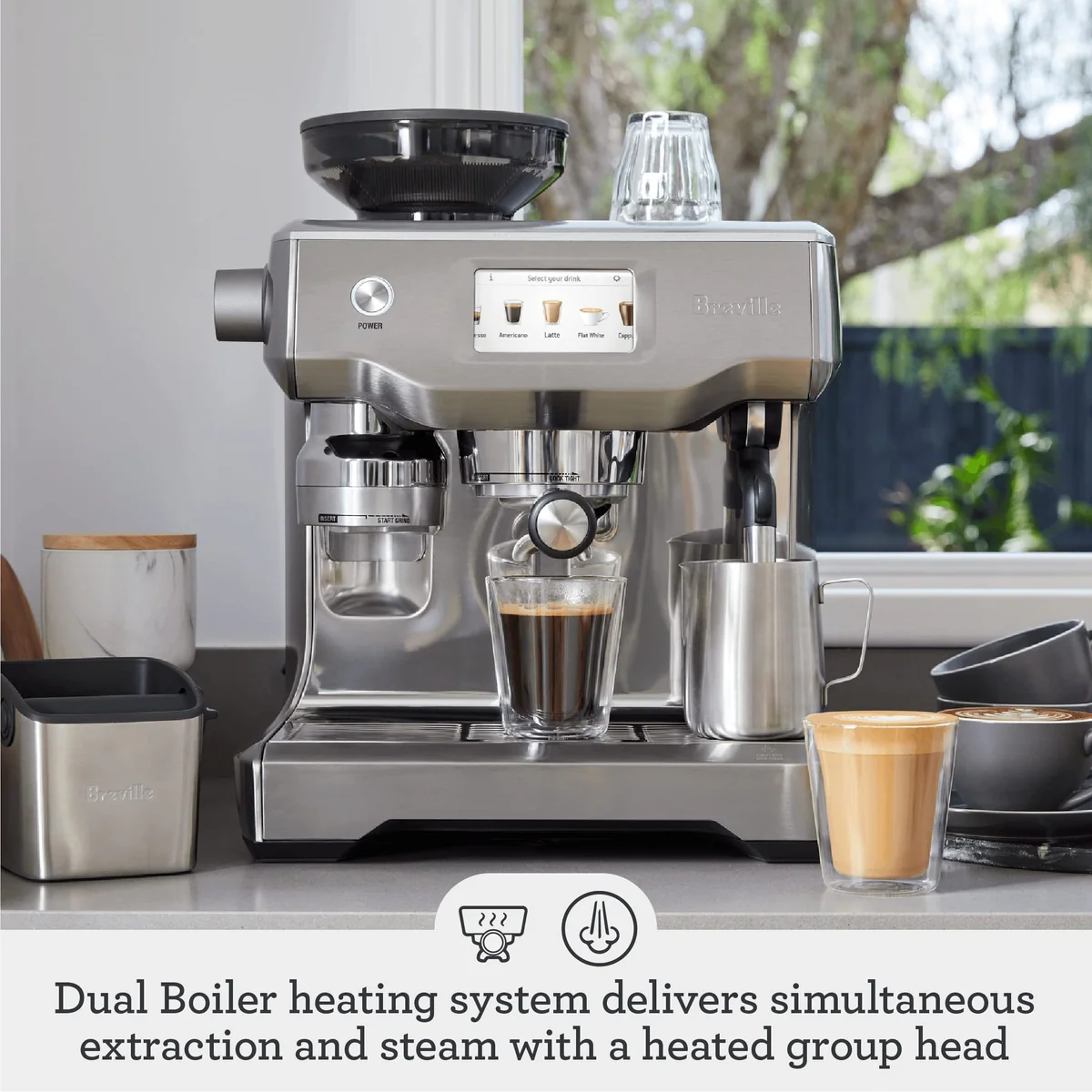
| Boilers | Two, plus a PID-heated group head | Brew and steam at the same time |
| Portafilter | 58mm stainless, single-wall baskets | Commercial size, not pressurised |
| Dose | 22 g, ground, dosed and tamped automatically | Not adjustable from the screen |
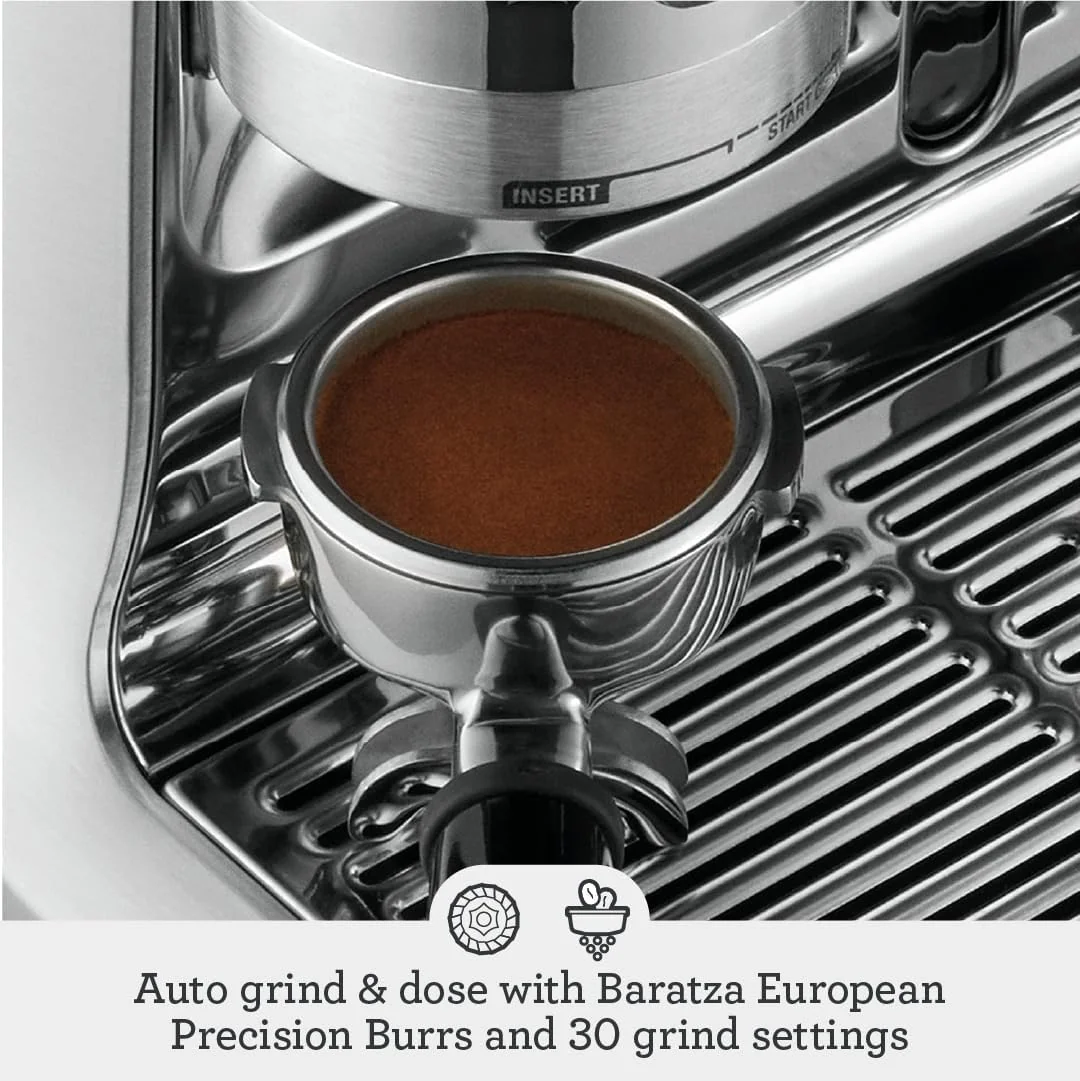
| Grinder | Conical burrs, 45 settings | Breville credits Baratza precision burrs |
| Pump | 15 bar, capped to 9 bar by an over-pressure valve | Low-pressure pre-infusion first |
| Milk | 104°F to 167°F, nine texture levels, self-purging wand | Adjustable to the degree |
| Bean hopper | 1/2 lb | Half that if you care about freshness |
| Water tank | 84 oz per Breville, 67 oz per Amazon bullet 10 | The listing appears to be wrong |
| Max cup height | About 4 in | Travel mugs are out |
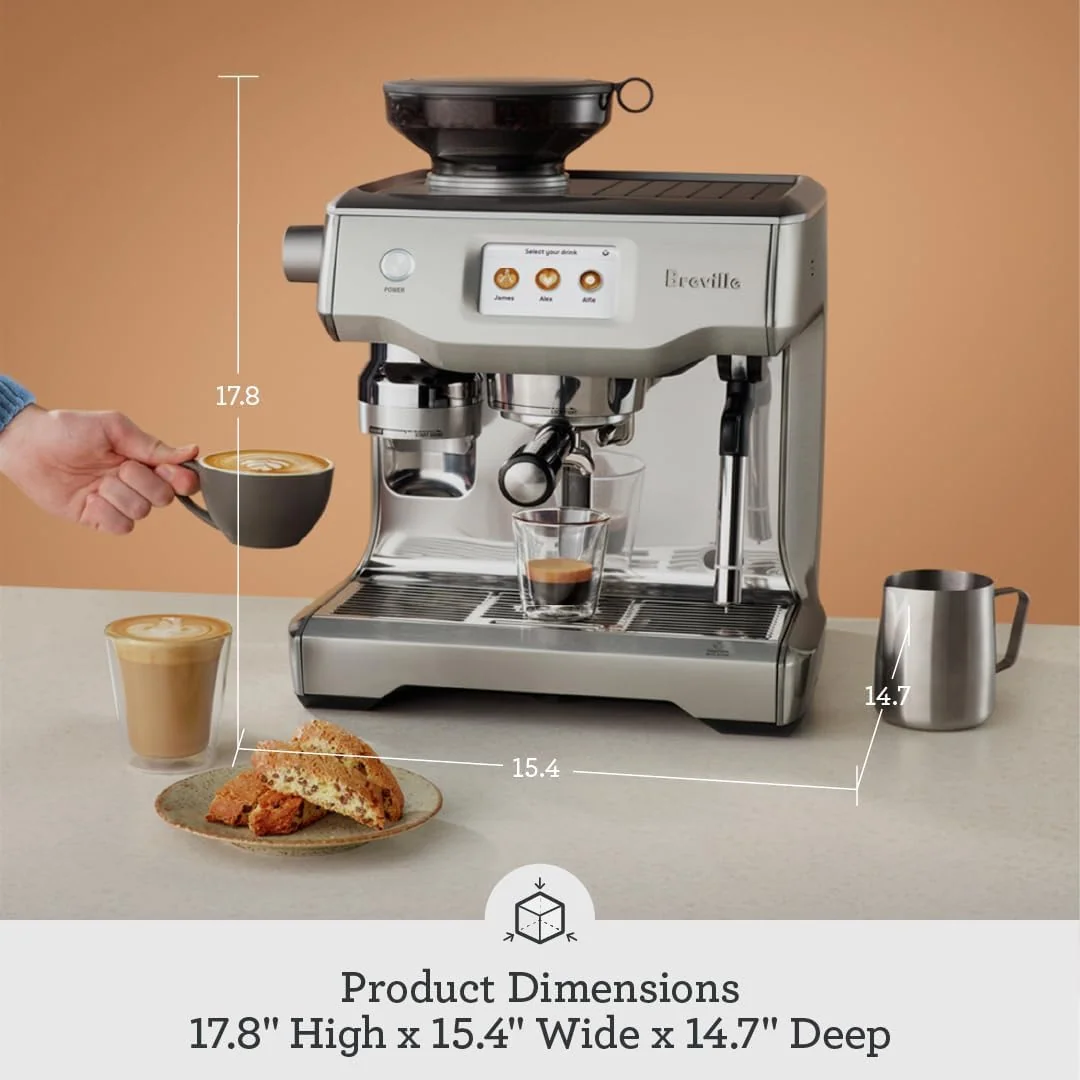
| Weight | 35.5 lb to 37.3 lb depending on who is measuring | You site it once and leave it |
| Power | 1800 W, 110 to 120 V | Roughly five minutes from cold |
| Warranty | 2 years limited | Read the reliability section before you weigh this |
Two of those rows deserve a flag rather than a quiet averaging. Amazon's tenth bullet claims a 67 oz tank; Breville's own specification says 84 oz, and independent measurement of 2.5 litres agrees with Breville. Sixty-seven ounces is roughly the tank on the smaller Barista Touch, so this reads like copy that wandered in from another product page. And a review video circulating under this exact model number claims the machine "can handle up to 5.3 lbs of coffee beans," which is more than ten times the half-pound hopper Breville publishes; that video has no hands-on content and should not be part of anyone's buying decision.
The maintenance story is genuinely better than a super-automatic's, and this is underrated. Grounds never enter the brewing components; they touch the portafilter and the shower screen and nothing else. There is no wet puck sitting in a sealed brew group growing things, which is the single grimmest failure mode of the bean-to-cup format and the reason sealed brew groups are a recurring argument. You backflush with a blind basket and a cleaning cycle, you wipe the wand it has already purged for you, and you dismantle the grinder monthly. Clean as you go, rather than a dreaded deep clean.
Strengths & Limitations
Strengths
- The automatic milk texturing is the best part of the machine and produces microfoam that reviewers who steam by hand admit they cannot beat.
- Grind, dose and tamp happen without you, which removes most of the technique that makes espresso hard for a household of casual drinkers.
- It is a real portafilter machine underneath, with a 58mm basket, dual boilers, PID control and pre-infusion rather than a sealed brew unit.
- No wet puck sits inside a brew group, so it avoids the mould and gunk problem that defines cleaning on true bean-to-cup machines.
- Breville stocks roughly seventy replacement parts for this model, from o-rings to shower screens, which makes it repairable long after the warranty.
- A wake-up scheduler lets you set the machine to heat itself before you get to the kitchen, at more than one time of day.
Limitations
- The 22-gram dose cannot be changed from the screen and adjusting it means turning a nut inside the tamp fan, with owners reporting the grub screw starts losing grip below about 19 grams.
- Extraction runs for a set number of seconds rather than to a target weight, so every gram of dose drift lands straight in the cup as a different ratio.
- Dose consistency is the most repeated long-term complaint, with owners resorting to pre-weighing beans or pulling shots manually to work around it.
- The built-in grinder is consistently reported as a medium-and-dark-roast device that struggles with light roasts.
- The documented failure chain of steam probe o-rings leaking into the triac board, plus a milk air pump that dies quietly, both tend to arrive after the two-year warranty.
- Breville's own US page lists this model as discontinued and points to two newer Oracles instead.
- Amazon's rating of 3.4 from 596 buyers sits far below both Breville's own 4.3 and the near-perfect scores from published reviews.
- Maximum cup height is only around four inches, so travel mugs will not fit under it.
Twenty-two grams, and no negotiating
The marketing line is that the Oracle Touch "automatically grinds, doses and tamps 22 grams of freshly ground coffee." That claim is true. The trap is in the word 22. There is no dose control on the touchscreen. If you want a different dose you go into the grinding and tamping station and start turning the auger lock nut on the tamp fan, and the review that first flagged this called it astonishing given the price. Owners have since put numbers on the operation: roughly one gram of dose per thread of adjustment, down to about 18 grams before it gets risky, at which point the grub screw holding the tamp fixture together starts showing more of itself than anyone is comfortable with.
People try anyway, because a lot of modern espresso recipes live at 16 to 18 grams. The results are consistent and discouraging. One owner working through eight different baskets, including a 15 g VST, reported that with the tamper coupling wound out as far as it will go, the machine still puts about 22 g in. Another chasing 14 to 16 g got stuck at 20 to 21 in the double basket. An IMS 16 g competition basket physically fits but looks half empty, and dropping the tamp fan far enough to suit it makes the auto-tamp unreliable. The honest summary is that the Oracle Touch is a 20 to 22 gram machine and it will not be talked out of being one. If you are arriving from another setup with a recipe you love, you are not bringing it with you.
It brews by the clock, which is why the dose matters so much
Here is the mechanism almost nobody explains to buyers. The machine does not brew to a target weight in the cup. It runs the pump for a set number of seconds: 25 for a single, 30 for a double, adjustable one second at a time. The pump gives the same time every shot, and the grind size decides how much liquid gets through in that time. Watch a single dial-in run on camera and the sensitivity is startling: grind 20 produced 28 g in 30 seconds, grind 22 produced 45 g in 23 to 24 seconds, from the same beans on the same day. One step on a 45-step dial is the difference between a ristretto and a mess.
Now put those two facts together. Extraction is timed, so every gram of dose variance and every scrap of grind drift lands directly in the cup as a different ratio. That is why dose consistency is the complaint that comes up most often from people who have owned one for a while. "My oracle is pretty lousy at dose consistency so I pre weigh and store beans in 20g batches and thrown one it each morning," wrote one owner, describing a workaround that defeats the entire point of an automatic doser. Another Oracle Touch owner says they usually end up pulling manually, "because the same grind setting, beans, filter, etc. on the same day will sometimes vary greatly in time required." A third, on a machine bought from an official refurbishment centre, watched yield swing between 20 g and 40 g on identical settings, with pucks whose centres were compressed far harder than their edges and visible imprints from the tamper wing.
Two fixes from owners are worth more than anything in the manual. The first: wet the basket before grinding, because dry grounds spin on a polished basket wall and the tamp never bites, and the problem is worse with aftermarket baskets precisely because they are more highly polished. The owner who suggested it reports their tamping and shot-quality problems largely went away. The second: purge the grinder for three or four seconds whenever you change beans, change grind size, or come back after a few days, because retained grounds in the chute are silently ruining the next dose. Breville does not tell you to do either. If your shots have started running thin and fast, the usual causes of watery espresso apply here too, with the timed-brew quirk on top.
The grinder has a roast preference, and it is not subtle
Espresso Den found this stated four separate ways across four separate threads, by four different people, with no dissent about the direction and only mild disagreement about the severity. The built-in grinders are for medium and dark roast beans. If you like medium and darker you are fine; if you prefer light roasts the grinder may not be up to the task. Despite the improvements Breville has made, they are still not the best at light roasts. And the strongest version: light roasts will eventually break the built-in grinder, softened by a reply that this is only true of extremely light roasts. One owner discovered the problem after buying five pounds of light roast that needed grind setting 25 to move at all, and wrote, plainly, "Well, that's disappointing."
This is not on the listing, it is not in the marketing, and for a household that has fallen for a Nordic-style roaster it is a purchase-shaping constraint rather than a footnote. Our guide to which beans actually work in machines with built-in grinders covers the same ground across the category. One more thing that will bite you when reading forums: grind numbers do not transfer between units. Owners report needing anywhere from 9 to 15 on the same internal burr setting, so somebody sitting at 25 and struggling is showing you a symptom, not a taste.
The milk is the part almost nobody argues with
Everything above is the case for the prosecution. This is where the Oracle Touch earns its reputation, and it does so decisively. The auto-steam wand pulls milk to a temperature you set to the degree and a texture you set on a nine-point scale, purges itself, and stops. A reviewer who opened by saying no barista worth their salt would stick the wand in the jug and wander off admitted flatly that it really works, with no need to second-guess the settings and no ifs or buts. Another, less hedged: setting the automatic steam function to a chosen temperature and foam preference produced better milk than they had ever achieved by hand.
Settings, since the machine gives you more range than is useful: around 131°F to 140°F is where latte art behaves, above 140°F you are cooking the milk, and level 9 texture produces what one reviewer accurately called a bubble bath. Level 3 or so is where the latte artists sit, and 7 is plenty for a cappuccino. That said, one long-term user runs 152°F at level 4 and is delighted, so treat the bands as a starting point rather than a law. The microfoam is good enough for real latte art in ordinary hands, not just in demo footage. If a one-touch carafe would suit your household better than a jug and a wand, the comparison between the two milk systems is the honest place to settle that, and our pick for milk drinkers covers the machines that pour without you holding anything.
The corollary is the most important sentence in the Epicurious review, and it deserves to be louder than it usually is: this machine is at its best for milk drinks. Asked whether it will produce a competition-winning espresso that tastes flawless without milk, the answer was probably not. Someone who drinks nothing but straight espresso and cares about clarity in the cup is paying a great deal for automation aimed at a drink they do not order, and the fixed 22 g dose and timed extraction are exactly the constraints that hurt most in that use case. If black coffee is your whole habit, the machines built around espresso and long blacks are a better shortlist.
The touchscreen is not a universal upgrade
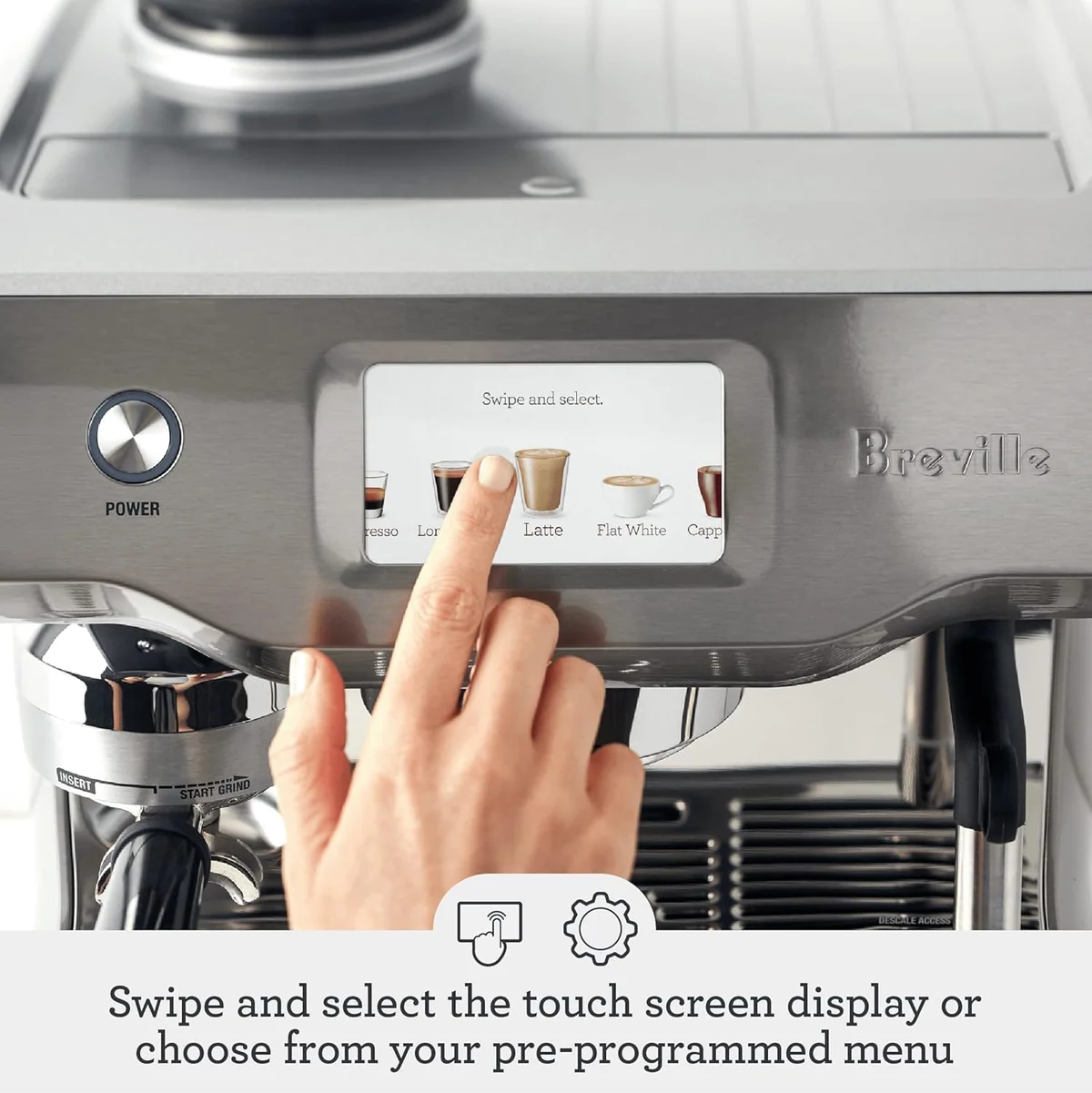
Reviewers call the interface idiot-proof and easy to read, and for anyone who has never owned an espresso machine that is probably right. A reviewer who came from traditional machines hated it after weeks of use, for a concrete reason rather than nostalgia: presses that do nothing, and the requirement to select a drink on screen before the machine will let you grind. His conclusion is the useful one. If you are used to traditional machines, the touchscreen may be a hindrance rather than a help, and if you are not a home barista, you will probably prefer it. The screen also has a bluish cast that the newer Oracle's reviewer noticed immediately by contrast. If the button-and-dial version appeals more, that is precisely what the non-touch Oracle BES980XL is.
The money question, and the one comparison Breville makes for you
Espresso Den will not tell you what the Oracle Touch costs today, because that number moves and this page will outlive it. What matters is the shape of the decision. It launched in North America in 2017 at a list price that put it in prosumer territory rather than kitchen-appliance territory, and it has stayed near the top of Breville's range ever since. It is now discontinued on Breville's own US site, which lists two newer Oracles in its place: one positioned below it that leads on speed and automation, and one positioned above it that leads on performance. Go and look at all three on the manufacturer's own pages before you commit to this one, because the successor's feature list reads like a point-by-point response to the complaints above: self-adjusting grind control that monitors shots in real time, isolated boilers so you can extract before the steam side has finished heating, and motorised drain valves for descaling. When a maker advertises the fixes that loudly, it is telling you what was broken.
The enthusiast community's answer to this price is emphatic and consistent, and it is not any Oracle. The top-voted comment in a fifty-comment thread about what to buy in this bracket was to get the plain Breville Dual Boiler without a grinder and the best separate grinder you can afford. The same recommendation appears in other threads unprompted, on the reasoning that built-in grinders are the compromise you feel every day and the part that fails first, and one commenter was blunt that every expert ever has said to keep the machine and the grinder separate for exactly this reason. Espresso Den reports that as the strong consensus among people who make espresso as a hobby, and notes what it costs you: a workflow that a household of non-enthusiasts will not use. If you have been weighing a grind-and-brew all-in-one against separates in general, the case for and against a built-in grinder lays out the same trade in the abstract.
The counter-argument, and it is a good one, is arithmetic rather than taste. A two-coffee-drinker household in New York that used to buy a latte most days found the machine feeling like value after six months, producing lattes noticeably better than the seven-dollar ones from the café on the corner. In an office, the maths is even more lopsided: if the alternative is fifty people walking twenty minutes to a café twice a day, one reviewer's verdict was that it will probably pay for itself pretty quickly, while being honest that you are not going to make anything better than good-enough coffee with them. That is the Oracle Touch's real value proposition. It is not the best espresso per dollar. It is the most espresso-shaped output per unit of human effort, and for some households that is the only currency that matters. Whether automation is worth paying for at all is the wider version of this question.
On the office idea specifically, the record is genuinely split and the dissent is worth hearing. Against: one owner keeps their old Oracle Touch at work and is the only person who uses it, because the Keurig next to it gets all the traffic and the level of effort for espresso is too involved for everyone else. Another argued against putting any espresso machine in an office without a dedicated person to maintain it, on the grounds that office machines are frequently downright filthy within days and almost nobody will purge and wipe the steam wand after each use. A third predicted that nobody will keep it dialled in, the coffee will end up weaker than drip, and the machine will be abandoned and badmouthed. The pro-office case survives, but only with the condition its advocates attach: somebody has to own it, and people have to be kept away from the grind setting.
What breaks, and what it costs you in patience
This is where the 3.4 lives, so it gets the detail it deserves. The most specific failure chain in the whole record runs like this: an o-ring at the steam probe fails, steam leaks internally, and triac board components short as a result, leaving a machine that heats indefinitely and will not report a steam temperature. An owner rebuilding a used unit described exactly that symptom, with clear evidence of steam having leaked inside, and got the diagnosis from someone who had seen it before: the probes carry an o-ring between the stainless and the ceramic that fails, plus an external one, and it is very common for triac components to short as a consequence. Three weeks earlier and in a different forum entirely, an unrelated owner posted about an Oracle that "doesn't stop heating" and asked whether replacing the triac board and the o-rings would do it. Two independent reports of one fault inside a single month is a pattern, not bad luck.
Second, and more insidious because it looks like user error: there is a small air pump that mixes air into the steam, and when it dies your milk comes out thin no matter which texture level you choose. One owner had tried settings 2, 5, 6, 8 and 9 with whole milk in the stock pitcher and got nothing. The test is to pull the top off the machine, find the small silicone tube, disconnect it, run the steam wand and feel for air. In that same thread, a second owner ran the test, failed it, and asked whether SP0020575 was the right part number. It was. If your Oracle Touch has quietly stopped texturing, that is where to look before you blame the milk.
Third, the grinder degrades in a way that is not obvious from the outside. An owner whose Oracle had stopped grinding well got a full set of answers: the upper burr may need replacing; the interior is likely caked; the felt ring may have perished; and taking out just the top burr is not a thorough clean, so the whole assembly has to come apart with attention paid to every washer. One respondent also warned that a wire brush will scratch and damage the burr, which is exactly the tool an unprepared owner reaches for. Note the tension with the published reviews, which sell the same teardown as a once-a-month convenience. It is a convenience right up until it is a diagnosis, and most owners only learn the procedure when something has already gone wrong.
Beyond those three, the record thins into individual reports rather than patterns: a second-hand unit that squeals loudly whenever water runs through the head, with or without the portafilter in, and sometimes produces no coffee at all; an older Oracle that, in its owner's words, "finally but the dust" and was replaced with something else entirely, to a chorus of congratulations from enthusiasts who treat leaving the Oracle as the upgrade. And there is a four-year-old comment that has aged unnervingly well. Asked about reliability, one commenter deadpanned that it will be fine for two years, no problem. Two years is the warranty term.
There is a real service interval behind that joke. A reseller who refurbishes trade-ins described the routine work on one as the two-or-three-year service: new seals on the boilers, new steam boiler sensors, a full boiler clean and flush, then testing. So the recognised maintenance milestone on this machine involves boiler seals and steam sensors, and it arrives just after the warranty ends. Breville's own parts catalogue for the BES990 runs to roughly seventy items, mostly o-rings, seals and screens. That is genuinely good news for a machine you intend to keep, since it is repairable in a way most bean-to-cup boxes are not, and it is also a fairly clear statement about what is expected to wear out. Our broader piece on how long these machines last and what a repair costs puts that in context.
Descaling is its own small drama. One owner in the thin-milk thread wrote, "I'm scared to descale it from all the horror stories I have read," which is a striking thing to say about a routine maintenance cycle on a machine at this level. Another had cleared what they thought was the same fault with 30 g of citric acid in a litre of water, and was told in reply that dual boilers do not normally show scale symptoms like that. Meanwhile the newer Oracle's headline feature list includes motorised valves that drain the boilers straight into the drip tray specifically to make descaling less painful, which is about as clear an admission as you will get that it was painful before. Owners do manage water actively here: the machine has a hardness setting, ships with a test strip and a filter, and at least one owner is running jug filters and test strips to justify dropping the hardness setting a notch. What descaling actually involves is worth reading before you own one, not after.
Now the counterweight, because none of the above means every Oracle Touch dies. One owner bought theirs used off Facebook Marketplace years ago and reports the fully automatic aspect has made it easy to use and popular with their spouse and most guests. Another, shopping for an upgrade rather than a replacement, said simply that their Oracle Touch has been pretty reliable and makes a good cup of coffee. And two of them have survived an office of fifty people where roughly two thirds drink at least one coffee a day, taking, in their custodian's words, an absolute beating. The failures are real, they are specific, and they are documented. They are not universal.
One caution about buying used or refurbished, since this machine has an active second-hand market and a factory refurbishment channel. The most detailed catalogue of problems in the entire record, the inconsistent pucks, the tamper-wing imprints, the 20-to-40-gram yield swings and the total absence of crema, came from a machine bought from an official Sage repair and refurbishment centre, whose owner spent three months getting nowhere with support and technicians. That is one data point, but it is a loud one, and it argues for buying a refurb from somewhere with a return window rather than assuming the factory badge has settled the matter. Whether a renewed machine is a safe buy is a question worth answering before you save the money.
Frequently Asked Questions
Is the Breville Oracle Touch being discontinued?
It already has been: Breville's own US product page for the BES990 carries a discontinued notice and points to two newer Oracles in its place.
Is the Oracle Touch a super-automatic espresso machine?
No, it is a traditional portafilter machine with automated grinding, dosing, tamping and milk texturing, so you still move the portafilter to the group head and put the jug under the wand yourself.
Can you change the 22-gram dose?
Only by adjusting the auger nut on the tamp fan inside the machine, where owners report roughly one gram per thread and increasing risk of losing the grub screw below about 19 grams.
Does it work with light roast beans?
Owners consistently report the built-in grinder is happiest with medium and dark roasts, with light roasts pushing the grind dial towards its limits and, in the strongest accounts, wearing the burrs out.
What are the common problems with this machine?
The recurring ones are grinder clogging and burr wear, inconsistent dosing, steam probe o-rings that leak into the triac board and leave the machine heating forever, and a small air pump whose failure makes the milk come out thin.
How long does a Breville Oracle Touch last?
No source Espresso Den found publishes an average, though the warranty runs two years, refurbishers describe a two-to-three-year boiler seal and steam sensor service, and some owners are years into trouble-free use.
What is the difference between the Barista Touch and the Oracle Touch?
The Oracle Touch adds automatic tamping, a 58mm portafilter, dual boilers and an over-pressure valve, where the Barista Touch uses a 54mm portafilter, a single boiler and your own hand on the tamper.
Why is my Oracle Touch making thin milk at every froth setting?
Check the small air pump before you blame the milk, by pulling the top off the machine, disconnecting the small silicone tube and feeling for airflow while the steam wand runs.
How long does it take to heat up from cold?
About five minutes, which the built-in scheduler makes largely irrelevant if you set it to wake before you do.
Sources (7)
- Amazon listings and customer reviews — Breville Oracle Touch
- Owner reports across r/BrevilleCoffee, r/espresso, r/appliancerepair threads
- Owner and reviewer video, 5 channels
- Breville — Article — www.breville.com
- Homecoffeeexpert — Article — homecoffeeexpert.com
- Coffeeness — Article — www.coffeeness.de
- Epicurious — Article — www.epicurious.com