The KitchenAid KF8 is barely a KitchenAid, and that is the most interesting thing about it
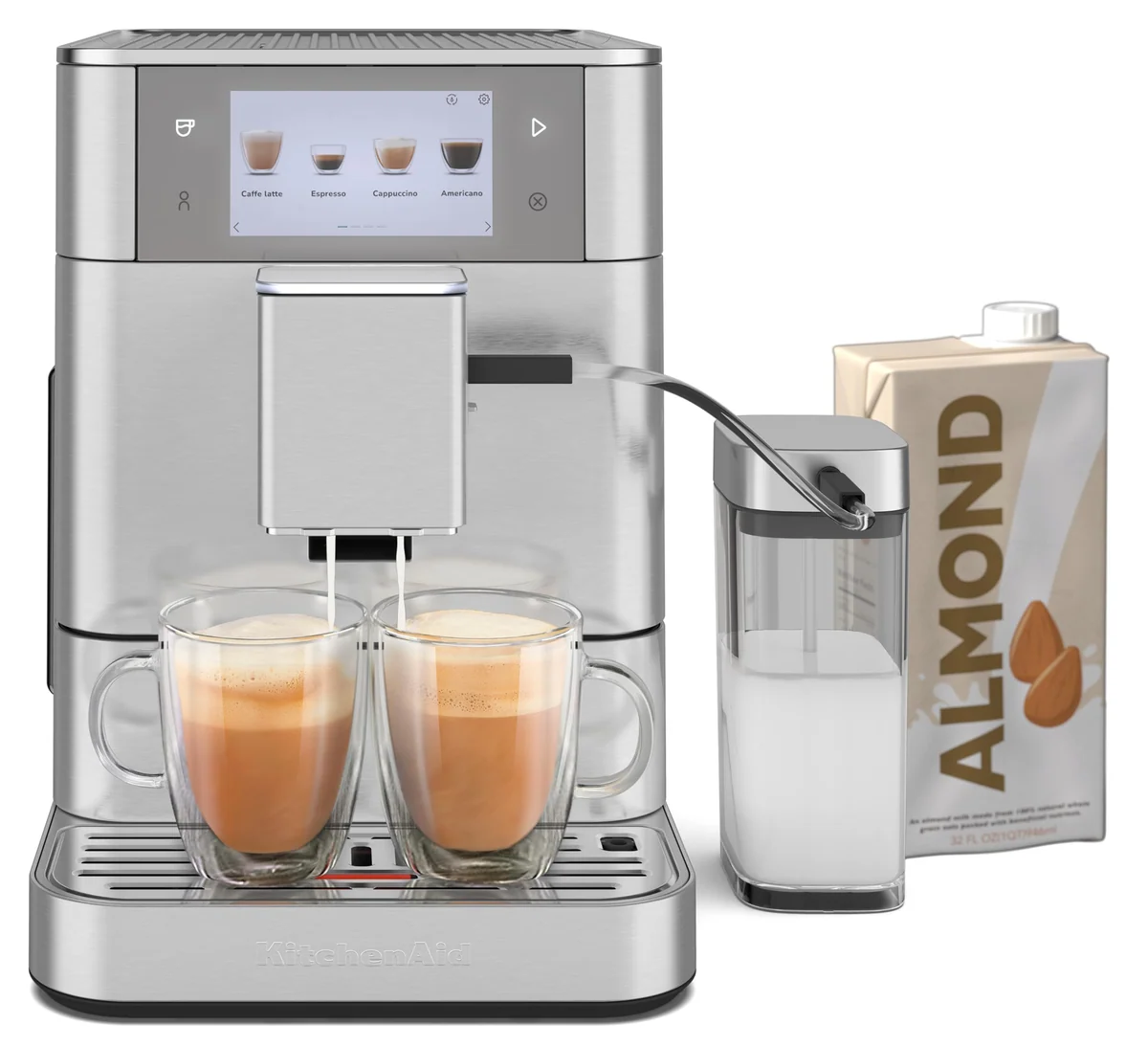
Buy the KF8 for the near silence, the swappable bean hopper and a chassis that feels more expensive than machines that cost more, but plan on pulling the brew unit out and rinsing it under the tap every week, because the clogging, the loud pop and the steam venting out of the side that fill the angriest reviews are what happens when nobody does.
Based on 162 owner ratings, 9 owner discussions and 3 other sources. We have not tested this machine ourselves.
We earn a commission if you buy through our links, which does not affect what we say.
Read how this site works →
Who should buy it
Buy the KF8 if your kitchen is open-plan or your household sleeps late, if you change roasts often enough for the hopper swap to matter, and if you want a machine that other people in the house will actually operate without a lesson. Buy it knowing that you are signing up for a two-minute weekly rinse the manual does not ask for, that the drinks built on warm rather than frothed milk will need a preheated cup, and that if it does fail you are relying on a service operation whose good days and bad days are both well documented. Do not buy it for the plant milk mode, do not buy it expecting forty drinks, and think hard before buying the flagship of an outgoing generation while a smaller, newer line sits beneath it. If you want the KitchenAid experience for less, the KF7 is the machine its own most credible advocates keep recommending, and if you want a shortlist that goes wider than one brand, start with our roundup of the best super-automatics.
Buy the KF8 for the near silence, the swappable bean hopper and a chassis that feels more expensive than machines that cost more, but plan on pulling the brew unit out and rinsing it under the tap every week, because the clogging, the loud pop and the steam venting out of the side that fill the angriest reviews are what happens when nobody does.
Best for: A Swiss-built bean-to-cup machine wearing a mixer company badge, quieter than almost anything else on a kitchen counter, and carrying one maintenance job that nobody puts in the manual.
Start with the fact that reframes everything else on this page: the KF8 is not built by the company whose name is on the front of it. The most experienced owner in the enthusiast threads, someone who has lived with Jura, Miele, Saeco, Philips and De'Longhi machines, identifies it as a product of the Swiss contract manufacturer that also builds for Jura and Miele, and reports that the brew unit is interchangeable with Miele's. His read is that KitchenAid took an existing Swiss platform and rewrote the experience around it, and his own reaction to that is worth borrowing: he did not expect a Whirlpool brand to have either the appetite or the internal room to pull it off.
This matters because of what a nervous buyer finds when they search KitchenAid and reliability. They find a long-running pile-on about KitchenAid appliances that has become something of a landmark, and it is about refrigerators, ranges, wall ovens and dishwashers built by Whirlpool in the United States. Not one line of it concerns a countertop espresso machine assembled in Switzerland. Espresso Den's view is that you should set that thread aside when you judge the hardware, and pick it straight back up when you judge the aftercare, because the warranty desk, the parts logistics and the replacement stock genuinely are Whirlpool's, and that is exactly where the KF8's worst owner experiences happen.
What KitchenAid sells you on the box is a metal-clad machine with more than forty recipes, automatic smart dosing, a removable hopper and a milk system that handles dairy or plant milk from a container you fill yourself. Two of those claims survive contact with owners intact, one is a marketing count that does not, and one is the feature you are being asked to pay the step-up money for. Taking them in that order is the honest way through this machine.
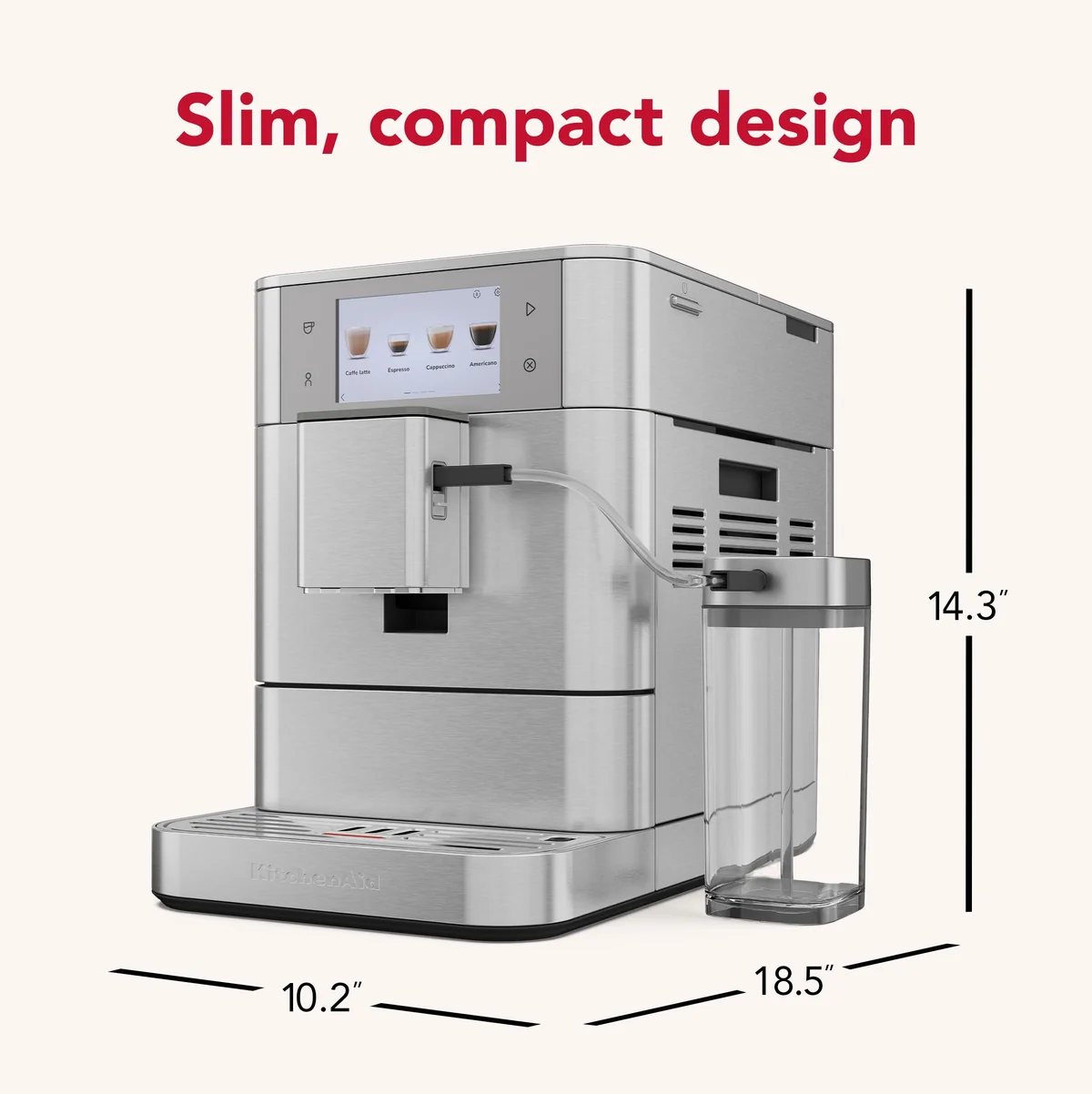
Key Specifications
The quiet is real, and it is the thing nobody advertises
The single most consistent thing owners say about the KF8 is that they cannot hear it. One reviewer who published numbers puts the grinder at 65 dB, the pump at 55 dB and the milk frother between 50 and 53 dB, against the 75 dB he says most automatic machines exceed, with the figures carrying a third-party acoustic certification rather than a marketing asterisk. A dealer walking through the machine on camera noted something more telling than any decibel figure: on the KF8, the milk preparation is louder than the grinder. If you have ever crept into a kitchen at six in the morning and set off what sounds like a coffee grinder having an argument with a vacuum cleaner, that is the entire pitch.
Two honest qualifiers. An owner three months in says it is not silent, and would still wake someone sleeping in the next room. And an owner who runs a KF7 alongside a Jura J8 gives the quietness crown to the Jura, while conceding the KitchenAid is close. Neither of those contradicts the headline. If low noise is the whole reason you are shopping, our roundup of the quietest super-automatics puts this class of machine against the rest of the field.
The removable hopper is the genuine invention here
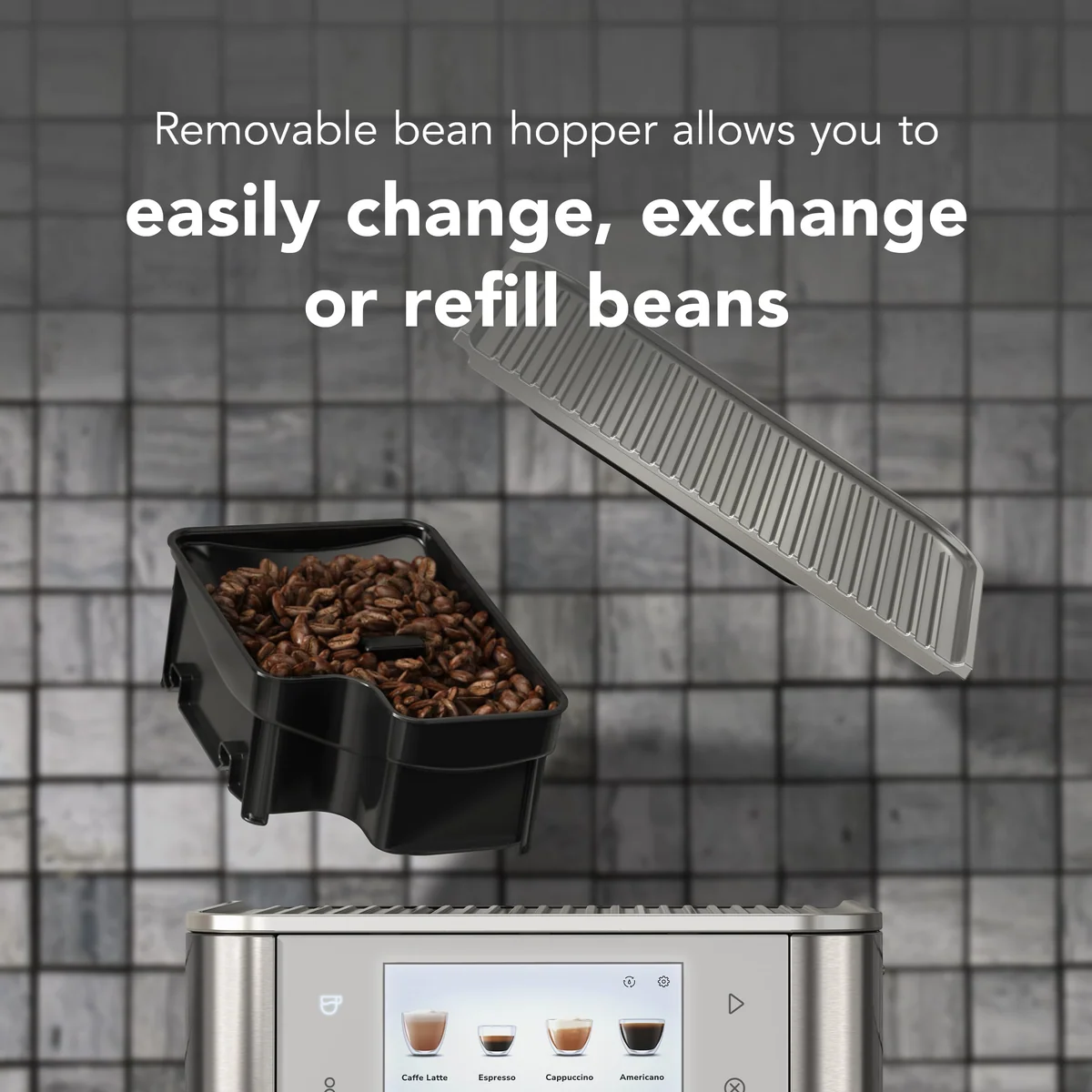
Twist, lift, and the bean hopper comes off in your hand. Empty it back into the bag, drop in a different hopper, run the purge cycle to clear the old beans out of the grinder, and you have switched roasts in under a minute. One owner keeps a second hopper loaded with decaf for his wife's evening coffee and calls it the feature that separates this machine from every other super-automatic he has used; a retailer demonstrating it end to end said flatly that he had never seen it on a bean-to-cup machine before.
Two things temper it. The purge throws away roughly a shot's worth of coffee each time, so this is a feature for switching roasts on a Tuesday, not for alternating between two beans cup by cup. And the same owner is realistic about households: two coffee drinkers are not going to swap hoppers every time one of them wants a drink. If your real problem is one decaf drinker and one regular drinker under the same roof, read what actually works for a two-bean household before you buy the KF8 for this alone.
Forty recipes is about sixteen
KitchenAid's own product page invites you to choose from more than forty recipe options. An owner three months in is blunt about how that number is reached: the same drink made with dairy and again with plant milk is counted twice, so it is really about half of what is claimed. A dealer who read the on-screen menu tile by tile on camera counted sixteen programs, and reframed the question better than any spec sheet does: what you want to know is how many drinks are actually on the menu. The balance is a printed recipe booklet of espresso martinis and iced drinks, which is to say drinks you assemble yourself.
Sixteen one-touch drinks is a lot of drinks. It is not forty, and a machine at this end of the market should not need the padding.
The milk system asks for no carafe and no tablets
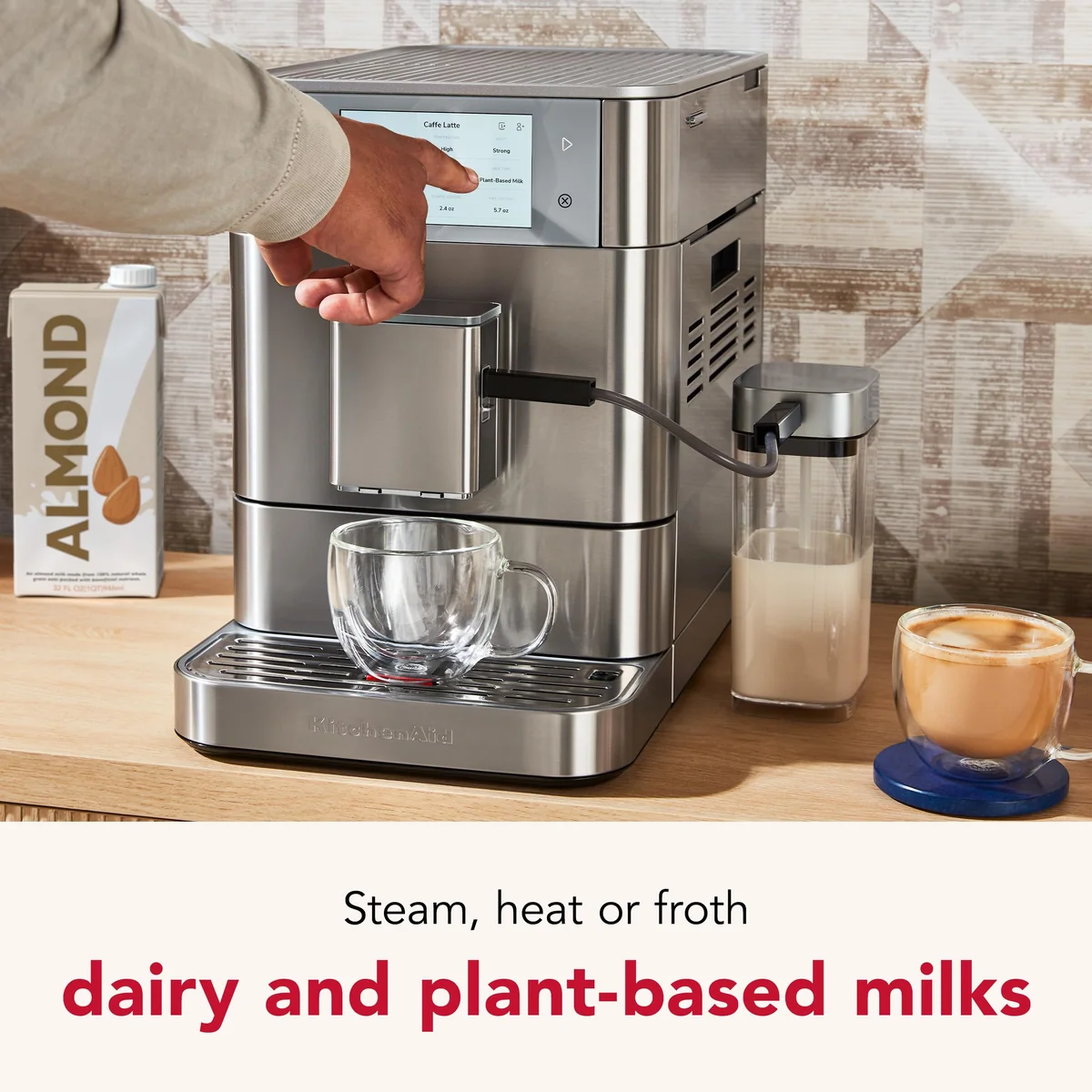
A hose drops into the milk container, or into any container you like, and when you have finished you plug the hose end into a port in the drip tray and let the machine flush it with hot water. There is no plastic tub to store in the fridge, no enzyme tablet to buy, and owners coming from Jura consistently call this the better arrangement. One partner in a household that had both preferred the hose to a carafe outright, bought a longer hose, and dips it straight into her own milk jug. If you have not yet decided which milk arrangement you can live with, our guide to steam wands, hoses and one-touch carafes is the argument in full.

Strengths & Limitations
Strengths
- Genuinely quiet, with certified figures well under what most automatic machines make, and owners reporting the milk system is louder than the grinder.
- The removable hopper and purge cycle let you change roasts in under a minute, which no rival in this class offers.
- Build quality is repeatedly called exceptional by owners who also own Jura and Miele machines, and the metal is real rather than a finish.
- The dose sits at the larger end of the super-automatic range, above what De'Longhi's machines put in the puck.
- Milk cleaning is a hose into the drip tray with no carafe to store and no enzyme tablets to buy.
- The interface is simple enough that owners report other people in the house will actually use it, which is not true of every machine at this price.
Limitations
- The brew unit needs pulling and rinsing by hand roughly weekly, and the machine's own cleaning cycle does not do that job.
- Owners report a clogging failure that shows up as no espresso, a loud pop and steam venting from the side of the machine.
- Warm-milk recipes land around 120 °F and will taste tepid unless you preheat the cup.
- The forty-plus recipe count is reached by counting each drink twice for dairy and plant milk and folding in a printed booklet.
- The plant milk mode, which is the main reason to pay for a KF8 over a KF7, is disputed as a real hardware difference by the machine's own most knowledgeable advocate.
- There is no wifi, so the interface annoyances, including being unable to reorder drinks or dim a screen that never sleeps, are permanent.
- When a unit fails, at least one owner spent months in a replacement loop and was told their finish was unavailable, with no proactive contact.
- KitchenAid's newer compact machines are smaller, add iced coffee and automatic grind adjustment, and sit below the KF8 in the range.
The coffee is good, the milk is warm, and one of those is a problem
On the espresso itself the reports converge. An Amazon reviewer who owns a portafilter machine says the KF8 pulls shots as good as he could pull himself and singles out the true double shot. The reviewer who lived with it for a year is more measured and, to his credit, said so again twelve months in: good espresso, less body and less intensity than a real portafilter machine, and asked directly whether it beat a Breville Oracle Touch he answered that it does not, that the Oracle gives you control and steam the KF8 cannot, and that the KF8's case is convenience.
The dose is where the KF8 has an actual structural advantage. Owners weighing it put the puck at around 15 g, matching Miele, above De'Longhi's ceiling and below Jura's 16 g; the reviewer who measured it by a different method reports 12 to 14 g at maximum strength and wishes it went nearer 16. Nobody has resolved that gap and Espresso Den is not going to pretend otherwise. What matters practically is the ceiling, and there is no evidence anywhere that the KF8's five strength steps buy a bigger maximum dose than the KF6 and KF7's three. They buy finer increments, not more coffee.
The milk temperature question
This is the most useful disagreement in the whole record, so here it is undigested.
| Reported milk temperature | Who reported it |
|---|---|
| About 167 °F, average | The published year-long review, challenged in its own comment thread and never re-measured |
| 135 to 140 °F for frothed milk, about 120 °F for warm milk recipes | An owner three months in, measuring independently |
| About 122 °F into an unwarmed glass | A new owner measuring the drink as delivered |
The two lower figures agree with each other and with the general run of super-automatic reports; the high one is an outlier that was publicly disputed and left standing. Write your expectations from the middle row: frothed drinks land hot enough, and any recipe built on warm rather than frothed milk will read as tepid unless you preheat the cup. If lukewarm coffee is a dealbreaker for you, we have a whole piece on why these machines run cool and what you can actually do about it.
You also cannot separate milk from foam. The recipes lock the ratio, so you can ask for six ounces of milk in a latte but you cannot ask for two ounces of steamed milk and four of foam. Foam density is not adjustable either. The froth is reported as consistently fine, which is the trade the machine is making.
The two-cup button has a catch, or possibly does not
A retailer programmed a cappuccino to roughly four ounces of milk, pressed the double button, and filmed the result: two espresso shots were pulled, but the milk volume was not doubled, so each cup got half the programmed milk and both drinks came out smaller and more coffee-forward than intended. An experienced owner states the opposite, that the machine doubles everything and the ratios hold. Nobody has reconciled these. The practical advice is the same whichever is true: if you use the double function for two milk drinks, set the milk volume higher in the recipe and check the first round. Used the other way, sending a doubled recipe into one large cup, it is one of the most-liked things about the machine.
Plant milk, the feature you are paying extra for
The KF8's headline advantage over the KF7 is a dairy or plant milk selection. The evidence for it is genuinely split. An Amazon reviewer says oat milk frothed nicely; owners using almond report froth comparable to a Jura Z10. Against that, a buyer who bought the machine on the strength of a glowing review reported struggling to get quality foam from two different oat milks, including a barista blend, stripped the frother down to look for a blockage and found nothing wrong with it. And the most technically-minded owner in the record makes the sharpest accusation: he believes the frother hardware is essentially the same as the KF7's and the Miele it descends from, that the machine cannot plausibly be doing anything different for one milk than the other, and that the plant milk billing exists to sell you the bigger screen.
Nobody has produced a parts diagram to settle it. Espresso Den's position: buy a barista-blend plant milk and it will work, buy the KF8 specifically because of the plant milk mode and you are buying a menu label.
Black coffee is the weak spot, as it is on all of these
A KF6 owner puts it plainly: black coffee has a weak taste profile, as it does on every automated option. The fix offered by the machine's most enthusiastic owner is to stop asking for a big cup, never going past about three and a half ounces, which is a fine answer for an espresso drinker and no answer at all for a spouse who wants a mug of regular coffee. A related gripe from the same owner: the Americano will not go below 2.7 ounces of water, and he wants half an ounce less. If somebody in your house drinks filter-style coffee, read what a bean-to-cup machine can and cannot do with a normal mug first, because it is the most common regret in this category and the KF8 does not solve it.
One more usability note that costs people twenty minutes on day one: the grind adjuster is not in the hopper where you would look for it. It is behind the right-hand service door, on top of the brew unit.
Should you buy the KF8, or the KF7, or neither?
Here is the uncomfortable finding. The owner who did most to build this machine's reputation online, who identified its origins and evangelised it across half a dozen threads, recommends the KF7. His reasoning is that the only thing that should push you to a KF8 is wanting the included milk container arrangement, and that the plant milk billing is a way to sell the larger screen. The reviewer who lived with a KF8 for a year lands in the same place, saying the KF6 or KF7 might be the better deal. And one KF8 owner bought his precisely because that week it happened to be cheaper than the KF7.
| KF6 | KF7 | KF8 | |
|---|---|---|---|
| Drink tiles on screen before you swipe | 2 | 3 | 4 |
| Strength steps | 3 | 3 | 5 |
| Maximum dose | No evidence of any difference between them | ||
| Milk container included | No, frothing tube only | Yes | Yes |
| Dairy or plant milk selection | No | No | Yes, and disputed as a real hardware difference |
| Same firmware across all three | Yes, which is why the bigger screen carries wasted space | ||
The screen dimensions are reported inconsistently by different sources, and the number that actually matters is the one in the top row. The extra width buys you one or two more thumbnails before you swipe, and no wifi means no future firmware fix for the interface complaints, of which there are several: you cannot reorder drinks on the home screen, the backlight never sleeps on a low-resolution panel, and the brew light cannot be turned off. If you are choosing within the family, our KF6 against KF7 against KF8 comparison takes it further, and there are full reviews of the KF7 and the KF6.
The elephant: KitchenAid's own newer machines
KitchenAid has since launched a compact line, reviewed as roughly a quarter smaller than the KF6, KF7 and KF8, adding a brand-first iced coffee mode that brews at a lower temperature so it does not melt the ice, plus automatic grind and dose adjustment that handles a roast change without dialling in. The KF8 has none of that, is bigger, and sits above the whole new range. That is a real argument against buying the flagship of the outgoing generation, and Espresso Den will not talk you out of it. It is also worth knowing that the cold modes on these machines are usually cooler brewing rather than genuine cold extraction, which we unpick in our look at what the iced settings actually do.
What owners cross-shopped it against
The De'Longhi Eletta Explore is the closest real rival, and the fairest summary of the trade comes from a buyer who chose the De'Longhi: it cold extracts, does foam better with more adjustable milk settings, has more grind settings, takes tall travel mugs and has wifi, while the KitchenAid has the swappable hoppers and, in his experience, cannot choke itself on too fine a grind. An owner who ran both side by side came to the opposite conclusion and called the Eletta hollow by comparison. That is a genuine split, and we set it out properly in the Eletta Explore against KF8 comparison, with the machine's own full review here.
Against Jura, owners who have run both keep reaching for the same points: the KitchenAid is easier for other people in the house to use, the milk cleaning is simpler, and the coffee is comparable, while a KF7 owner with a Jura J8 gives the Swiss machine a slight edge on drink quality and heat. Jura against KitchenAid is the page for that argument. And the most deflating comparison in the record comes from a KF8 owner who also has a Philips: easier to use, easier to clean, build quality in a different stratosphere, and the drinks not a lot better. If that reads as a reason to spend far less, the Philips 5500 LatteGo is where to look, and the best machines under a thousand dollars is the wider field.
About the stainless finish specifically
Almost every review of this machine you will find is of the black, white or juniper version, to the point that a shopper recently went to the enthusiast forum asking for photographs of a stainless one in a real kitchen and got a link back to KitchenAid's own product page. The one stainless owner in the record is lukewarm about it: boxy, more industrial than modern, and in his view the other colours have more character. Retailers describe the same finish as both brushed and glossy, and at least one buyer reports it showing fingerprints and water spots readily. It is a handsome machine and the metal is real, but if you were choosing on looks alone, the stainless is the version its owners are least enthusiastic about.
One thing no dollar figure changes: what this machine buys you is time. The most persuasive line in the entire record comes from an owner comparing it to his Breville, roughly seven minutes of hands-on work with a manual machine against about forty seconds of attention with the KF8, during which he goes and gets the milk out of the fridge. That is the trade, and if you are not sure you want to make it, our piece on whether these machines are worth it argues both sides.
The failure that keeps coming back, and the maintenance job that prevents it
Amazon shows this machine at 3.8 stars, which sounds mediocre and is not: the retained reviews are five fives, one four and two ones. It is a polarised listing, and the two one-star reviews are the ones you need to read.
The most useful review on the entire listing is a five-star one. Its author's first unit began clogging daily after a week, sometimes delivering almost nothing during extraction before letting go with a loud pop and venting steam out of the side of the machine. KitchenAid replaced it on one phone call. The replacement clogs too, just less often, at roughly a week of brewing at two shots a day, and he keeps it healthy by pulling the brew unit and rinsing it in the sink. His diagnosis of the wider review pile is the part worth printing: the smoke, the steam, the leaking water and the reduced or absent espresso volume that other reviewers report are, in his experience, all the same fault, a clogged brew head causing overpressure. And critically, he found the machine's own automated cleaning cycle did not fix it, because that cycle flushes lines and the dispenser rather than clearing grounds out of the brew unit.
The manual does not tell you to do this. An owner three months in pushes back on the weekly framing, notes the machine only prompts a brew unit rinse during its cleaning process, and gets on fine rinsing every week or two. A dealer, with nothing to gain from adding chores, recommends doing it weekly whether or not the machine asks. Espresso Den's call is that a weekly rinse under the tap is a two-minute job and cheap insurance against a fault that has generated an entire troubleshooting culture around this machine.
Then the mold review, which is a single report and a specific one. That owner says they followed the maintenance prompts diligently, went away for a long weekend in a dry climate, and came back to mold around the brewing unit and grounds in the bottom tray; they blame inadequate ventilation, say KitchenAid's only offer was a replacement machine, and report being advised to clean daily, at about half an hour a time. One report is one report, and Espresso Den will not inflate it into a pattern. It is also plausibly the same root cause as the clogging: wet grounds sitting in a closed compartment. Both point the same direction, which is that this machine wants the brew unit out and rinsed more often than its own software asks.
When it does break, the aftercare is the gamble
Several owners report exemplary service: replacements shipped the same day, before the faulty unit was even returned, on one phone call. Set against that, one Amazon reviewer making two lattes a day had a unit stop steaming milk at three months, waited three weeks for a replacement, had that replacement fail at three months with a water hose off internally, and was then told the brushed metal finish was not available, leaving them to wait indefinitely or accept a different colour, with nobody having told them proactively. That is the finish this listing sells. Being handed a supply problem after two failures is a different experience from being handed a new machine.
The counterweight is genuine. The reviewer who kept his for a year reports no mechanical issues and a machine that has been stable over time. A KF6 owner says it has been more reliable than his Jura and his Miele, and that unlike either of those he can get at the internal parts. An Amazon owner at six months says it just keeps brewing. What nobody in the record has is a KF8 past about a year, so nobody can honestly tell you how these age; our piece on how long these machines last and what breaks first is the closest thing to an answer, and it is a category answer, not a KF8 one.
Running costs and daily friction
Two cleaning tablets come in the box and the machine wants one roughly every two hundred drinks. The water filter is a live sore point: UK owners complain the filters are expensive, that a delivery charge is added each time, and that KitchenAid caps how many you can buy in one order so you cannot reach free postage. One more thing to distrust: dealers on camera claim the filter removes the need to descale. An owner three months in had already run a descale. Treat descaling as a thing you will do, and our cleaning and descaling guide sets out what the routine really costs you in time.
Expect the drip tray to fill faster than you think. An Amazon reviewer flags the water used in cleaning cycles; a KF7 owner making about three drinks a day between two people refills the 2.2 litre tank two or three times a week. Owners of other brands respond that this is normal across the category, and they are right, but it is still a thing you will do.
Frequently Asked Questions
Where is the KF8 actually made?
Switzerland, by the contract manufacturer that also builds machines for Jura and Miele, which is why owners report the brew unit interchanges with Miele's.
Do the horror stories about KitchenAid reliability apply to this machine?
The ones you will find online are almost entirely about Whirlpool-built refrigerators, ranges and dishwashers rather than a Swiss-assembled espresso machine, though the warranty and parts handling behind the KF8 is still Whirlpool's.
How many drinks can it really make at the touch of a button?
Sixteen programs appear on the menu screen, and the advertised forty-plus is reached by counting each drink twice for dairy and plant milk and adding a printed recipe booklet.
Is the KF8 worth the step up from the KF7?
Only if you want the five strength increments and the extra drink thumbnails, because there is no evidence the KF8 doses more coffee and the plant milk mode is widely suspected of being a menu label rather than different hardware.
How often do you have to take the brew unit out?
The manual does not require it on a schedule, but owners who rinse it weekly avoid the clogging and overpressure fault that produces most of the machine's angriest reviews.
Will it froth oat milk properly?
A barista-blend oat milk works for most owners, while regular and concentrated oat milks are a coin flip that has left at least one buyer dismantling the frother looking for a fault that was not there.
Can it take a tall travel mug?
The spout is height-adjustable and owners confirm it accommodates cups from an espresso demitasse up to tall mugs.
How long will it last?
Nobody in the public record has owned one much past a year, so the honest answer is that nobody knows yet, and the failures that have been reported cluster in the first three months rather than the third year.
Sources (5)
- Amazon listings and customer reviews — Kitchenaid Kf8
- Owner reports across r/superautomatic, r/bifl threads
- Owner and reviewer video, 3 channels
- KitchenAid — Article — www.kitchenaid.com
- Thekitchn — Article — www.thekitchn.com