The Bosch 300 Series is a decent little bean-to-cup machine sold with the wrong words on the box
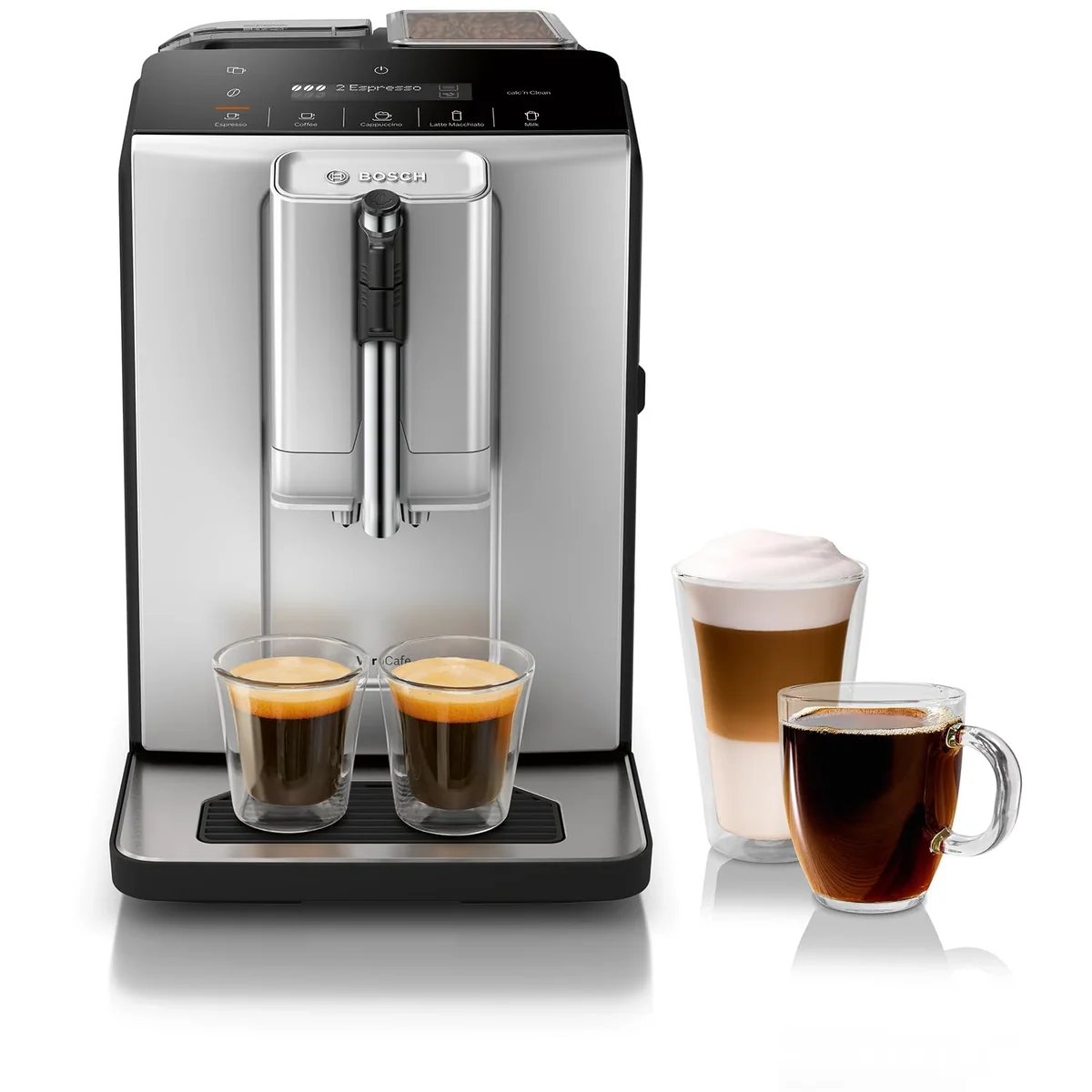
Buy the Bosch 300 Series if you want a narrow, quiet, one-touch machine for espresso and milky coffee and you can live with warm milk rather than scalding; skip it if you wanted a real steam wand, if you drink decaf in the afternoon, or if the hottest possible latte is the point.
Based on 197 owner ratings, 4 owner discussions and 1 other source. We have not tested this machine ourselves.
We earn a commission if you buy through our links, which does not affect what we say.
Read how this site works →
So, is it a buy?
Yes, conditionally, and the conditions are unusually easy to check against yourself. If your drinks are espresso, a cappuccino-sized milk drink, or a mug of coffee, if you want the machine to be an appliance rather than a hobby, if counter width matters, and if you are prepared for milk that is comfortably warm rather than dangerous, this is a good machine and the people who own it are mostly delighted with it.
If you came here because the title said steam wand, buy something else. If you want a scalding flat white, buy something else. If your household needs decaf after four, buy something else. And whatever you decide, buy it somewhere that will take it back after longer than a month, because the one hard failure in its own review set arrived at four.
Buy the Bosch 300 Series if you want a narrow, quiet, one-touch machine for espresso and milky coffee and you can live with warm milk rather than scalding; skip it if you wanted a real steam wand, if you drink decaf in the afternoon, or if the hottest possible latte is the point.
Best for: It grinds, brews and froths at one touch and the people who like it really like it, but the listing promises a steam wand it does not have, and the milk comes out warm rather than hot.
Start with the thing the listing gets wrong, because it is the first thing a buyer needs to know and nobody else seems to say it. The product title sells this machine as coming "with Grinder and Steam Wand." The description underneath, written by the same manufacturer about the same machine, calls it a "Milk Express in-cup frother" and an "adjustable milk frother" that makes "silky milk froth made directly in your cup."
Those are not the same appliance. A steam wand is a pipe you put into a pitcher of cold milk, and the texture and the temperature are yours to get right or wrong. What owners of this machine actually describe is a frother arm that clips on magnetically, delivers milk into the cup when you press cappuccino or latte macchiato, and then comes off to be rinsed. One reviewer who bought it expecting to prefer a carafe machine changed her mind about the design entirely and still described it as a frother she connects and cleans, not a wand she steams with. Another simply presses the latte macchiato button twice when the glass is large. Nobody in the owner record is holding a jug.
That distinction decides whether this is the right machine for you, so it is worth understanding which milk system you will actually live with before you commit. If you wanted control, this is not it. If you wanted to press a button and walk away while you find your keys, it is exactly it.
The second thing worth saying up front is how little independent evidence exists on this machine. Espresso Den went looking, and the honest answer is that the Bosch super-automatic line barely registers in the enthusiast conversation at all: one buyer on r/superautomatic listing exactly the priorities this machine serves, quiet operation, easy cleaning, no smart features, noted that the Bosch range is something they never see discussed anywhere.
So this review is built on the owner record, on Bosch's own material, and on what the machine's rating tells you. That rating is 3.8 across 197 ratings, which is soft for this category and which the retained reviews explain rather well: mostly delight, with one hard failure and a milk asterisk on almost every happy review.
Key Specifications
What the buttons actually do
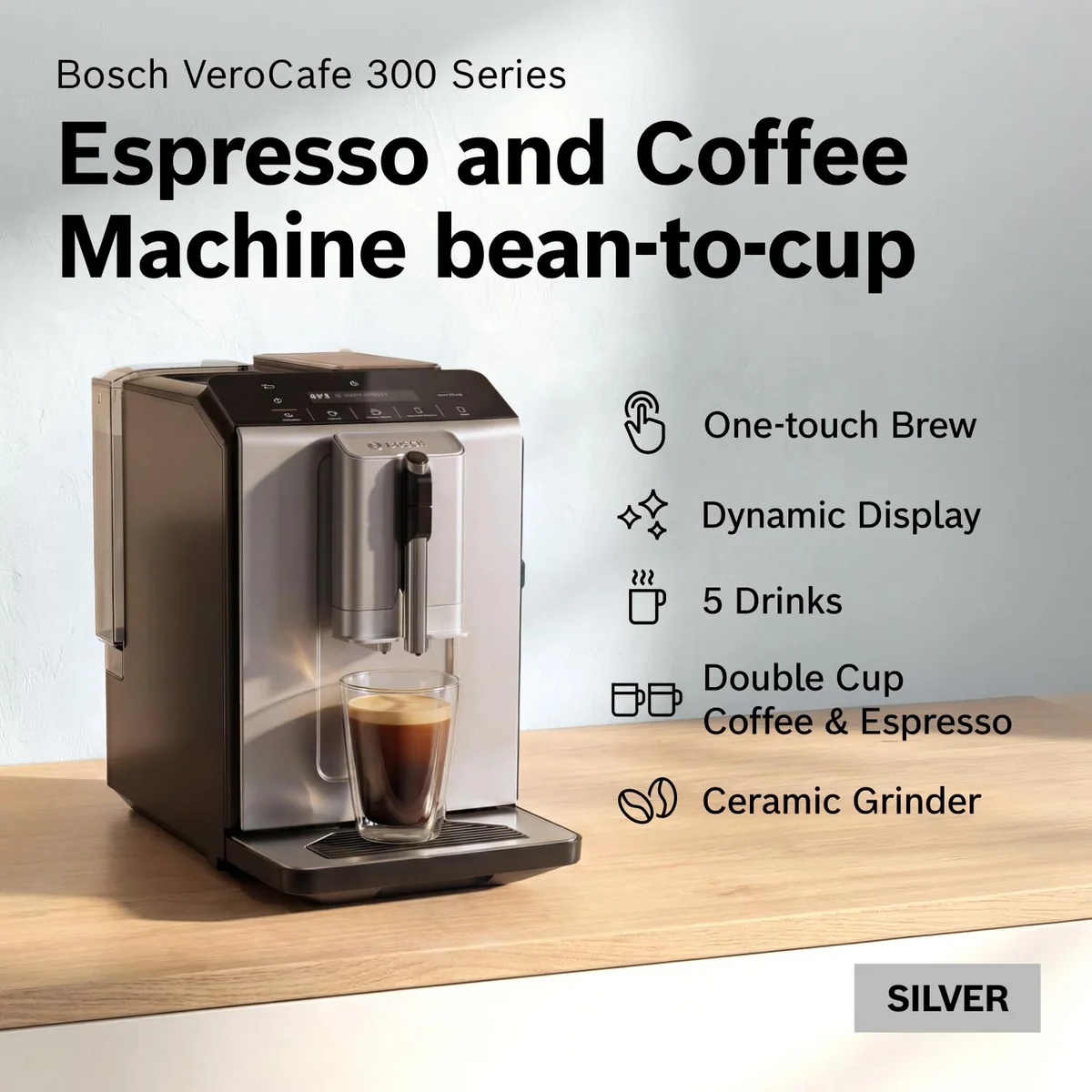
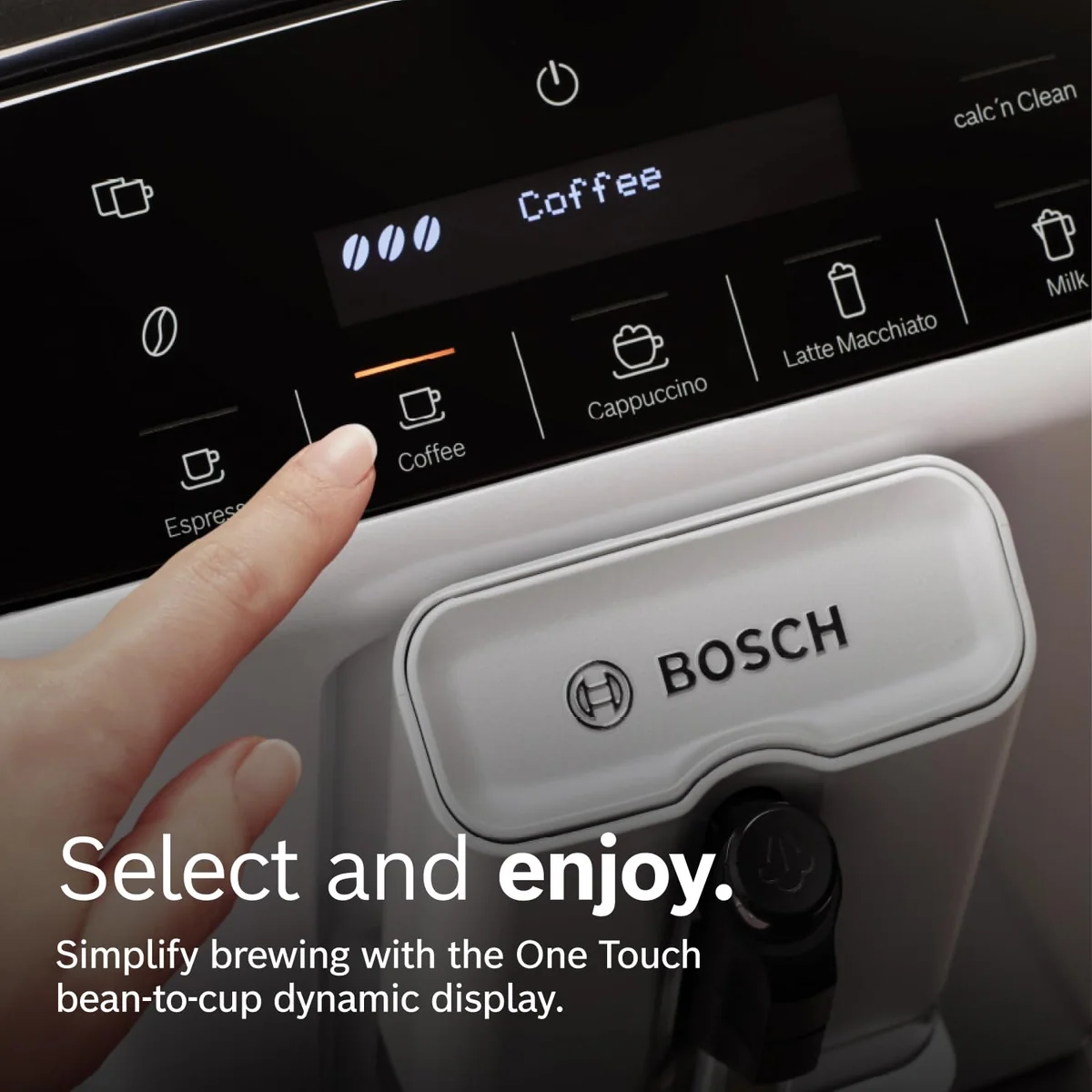
The panel is deliberately small. Bosch gives you five strength levels, an LCD with illuminated sensor keys, and a Double Cup function that will either make two drinks at once or double the size of a coffee or espresso.
The owner-level detail matters more than the bullet points. On the espresso setting you can take one shot or two. On the cappuccino and latte macchiato settings the machine froths milk and adds a single shot, and that is the ceiling. The coffee setting stretches to roughly a twelve-ounce cup. So a large milk drink built on one shot will taste thin, and the fix owners have found is the crude one: run the milk cycle twice, or use the Double Cup button to double the coffee going in.
| Setting | What you get | The limit that bites |
|---|---|---|
| Espresso | One or two shots | None worth naming |
| Cappuccino / latte macchiato | Frothed milk plus one shot | Locked to a single shot, so a big glass goes weak |
| Coffee | Adjustable up to about twelve ounces | Long, not strong; the dose does not scale with the water |
| Double Cup | Two drinks at once, or one at double size | The only real lever for a bigger, stronger drink |
If a mug of black coffee is your main drink rather than espresso, read the limits of the category before you spend anything here, because what a bean-to-cup machine calls coffee is not what a drip machine calls coffee, and no amount of dialling in changes that.
Two smaller things earn a mention because owners volunteer them unprompted. The grounds fall into an internal bin, so there is nothing to knock out and nothing on the counter. And at under ten inches wide, this is genuinely narrow, which puts it on the shortlist for a kitchen where counter width is the constraint.

Strengths & Limitations
Strengths
- Grinding, dosing, brewing and frothing happen at one button press, and multiple owners report the whole household using it without training.
- The brew unit is removable from the front, so the part that gets dirtiest is the part you can actually rinse.
- Grounds are captured internally, which means nothing to knock out and nothing on the counter.
- Under ten inches wide, it fits kitchens that will not take a full-size bean-to-cup machine.
- The frother arm attaches magnetically and comes off in a second for rinsing, which two owners praised without being asked.
- An owner replacing a fourteen-year-old Jura judged the coffee just as good for a fraction of the money.
- A cross-shopper who normally buys De'Longhi found this machine noticeably quieter with fewer parts to lose.
Limitations
- The listing title says steam wand and the machine has an in-cup automatic frother, which is a different product for a different buyer.
- There is no temperature setting, and owners repeatedly report milk that is warm rather than hot.
- Cappuccino and latte macchiato are locked to a single shot, so large milk drinks come out weak unless you run the cycle twice.
- One owner's machine stopped dispensing coffee entirely at four months, with the milk and rinse functions still working.
- A single bean hopper with no comfortable swap makes afternoon decaf a genuine chore.
- The tank empties and the drip tray fills faster than expected because the machine rinses itself twice per power cycle.
- Two experienced owners reached flatly opposite conclusions about crema, which means you cannot be confident in advance which one you will be.
The milk is the argument
Four of the thirteen retained reviews raise milk temperature, which makes it the single most consistent complaint about this machine, and it appears in the five-star reviews as often as the critical ones. One owner puts it flatly: if you like your drinks really hot you will not like this machine, because you cannot adjust the temperature. Another gave up and went back to a separate standalone frother for lattes, keeping the Bosch for the coffee. A third, comparing it to the De'Longhi machines she usually buys, said it makes good coffee but the milk is not very hot.
There is a partial counter-argument from an owner four months in, and it is worth taking seriously because it is specific rather than defensive: temperature depends on how much milk is in the cup, you can set the frothing time using the milk button, and for a large latte she runs the latte macchiato cycle twice. Read those two accounts together and they are not actually in conflict. There is no temperature setting on this machine. There is a dwell-time setting, and longer frothing puts more hot steam into the same milk. That is a workaround, not a control, and Espresso Den would rather say so than let the phrase "adjustable milk frother" do the work of a temperature dial.
It is also fair to the Bosch to say this is the weak spot of the entire category rather than one manufacturer's sin. Warm milk is the most common disappointment in bean-to-cup ownership, and the standard mitigations apply here: preheat the cup, use less milk, and accept that the espresso side comes out hot even when the milk does not. What is a genuine mark against this specific model is that Bosch does let you set brewing temperature on the screen further up its own range, on the 800 Series, which tells you the omission at the 300 level is a decision rather than an engineering limit.
On crema, two careful owners land in opposite places
This is the one thing in the record Espresso Den cannot resolve, and pretending otherwise would be dishonest. One owner returned the machine specifically because the coffee quality and the crema were lacking at the price, while granting that it looks well designed and that the brew group interface is good. Another wrote a review titled "Crema! At Last!" and said previous espresso machines she has owned do not come close. Both are experienced buyers with opinions about prior machines, so the usual explanation, that one of them has never had good espresso, does not hold.
The most useful third data point comes from a household replacing a Jura that had lasted fourteen years. Their assessment: the coffee seems just as good, it is not advertised as a high-end machine, and at a fraction of the price of those units it is simply not worth paying more. They also hedged appropriately, saying they would see how this one does over time, which is the right posture and one this page will borrow.
Noise is a quieter win. The grinder is briefly loud, a few seconds per drink, and one cross-shopper who normally buys De'Longhi described the Bosch as much quieter with fewer parts to break or go missing. If early mornings are the reason you are shopping, that puts it in the conversation for a machine you can run without waking the house, though nobody has published a measurement.

What to pay, where to buy it, and who it is wrong for
This machine's verdict is unusually price-dependent, more so than most, because it turns up in two completely different places at two completely different prices. On Amazon it sits at the top of its band, alongside machines with more grind settings, more drinks and adjustable temperature. Through warehouse-club channels it has been reported considerably lower, and at that end the value argument stops being close.
There is a second reason that channel matters, and it is the smartest thing anyone in this category says. A buyer weighing a first machine pointed out that a thirty-day window is not long enough: it takes a week or two just to work out where the machine lives and how to set it up, and if the doubts arrive after that window you are stuck. Given that the failure in this machine's own review set arrived at four months, buying somewhere with a generous returns policy is not timidity, it is the correct move.
Which Bosch, and why the numbers confuse everybody
Buyers cannot tell the 300, 500 and 800 apart, and the model codes do not help. Two things separate them that actually change daily use. The 500 uses a different milk architecture entirely, an integrated system with a hose that draws milk straight from the carton, and it explicitly takes pre-ground coffee as well as beans.
The 800 adds a screen with brewing temperature among the settings, which is the exact control the 300 lacks. If those differences sound decisive rather than incremental, read the 300 against the 800 in detail or go straight to the 800 Series review before deciding.
The decaf problem, which is the clearest reason to buy something else
Two owners raised the same design limitation without being asked, and it is the most concrete argument against this machine. There is a single bean hopper and no comfortable way to swap beans. One owner wanted regular in the morning and decaf in the afternoon and taught himself to deliberately under-fill the hopper so he could empty it at lunchtime. The other said you either finish what is in the hopper or tilt the whole machine on its side to get the beans out. Neither of them mentions using a pre-ground bypass, which on rival machines is the standard answer to exactly this question.
If a household drinks two different beans, this is a real and daily annoyance, and there are better answers: see how the pre-ground route works on machines that support it properly, or the machines built for two beans in one kitchen.
The two machines to weigh it against
At this price the sharpest comparison is the one-touch carafe alternative, because it is the same money for a completely different milk philosophy, which is the ground covered in Bosch 300 against the Philips 2300 LatteGo. The other is the machine one of this Bosch's own owners cross-shopped: she usually buys De'Longhi, still likes them, and named their advantages precisely, more features including iced coffee and hot water, against the Bosch being quieter with fewer parts to break or go missing. That trade is set out in Bosch 300 against the Magnifica Start, and the De'Longhi itself in our Magnifica Start review.
If you would rather widen the field before committing, the full shortlist under a thousand dollars is where this machine has to earn its place.
Where all that water goes, and what actually breaks
Three separate complaints about this machine turn out to be one mechanism, and explaining it once saves a lot of confusion. The machine rinses itself when it powers on and again before it shuts down. One owner measured that at roughly a cup of water per rinse. That is why the tank empties faster than you expect, and it is why a fourth owner opened the door to find a drip tray full of water and wrote that he had no idea where it was coming from. It is coming from the rinses. It is the machine keeping its own brew path clean, and the same owner who counted the water said he would far rather the machine did it than do it himself.
The rest of the cadence, from the owners who bothered to count: the grounds bin asks to be emptied every seven to nine drinks, the drip tray needs doing about every second bin, and once a week the brew unit should come out for a rinse and a dry. That last one is the important one, because the machine does not prompt for it. The owner who worked it out put it bluntly: the coffee dust gets everywhere inside. The fact that the brew unit is removable from the front at all is a real advantage over sealed-group machines, but only if you use it.
Descaling divides owners in a way that resolves neatly once you notice the timeline. One called it probably the hardest thing to do and said it takes time. Another called it super easy, tablets in, machine does the rest. A third documented the arc across seven months: a bit involved but worth the effort, then becoming easier after a couple of times, then simply easy. It is a multi-stage process on Bosch's line, a descaling tablet dissolved in the tank and a separate cleaning tablet later in the cycle, with a container under the spout and several interruptions along the way, which is exactly why it feels like a project the first time and a chore the third.
None of that is unusual, and the real cost of owning one of these machines is interaction rather than money. What is unusual is the failure sitting in the middle of an otherwise happy review set.
The four-month failure, described precisely
One owner's machine started showing a "Restart Appliance" message at four months. Pulling the power cord cleared it for a few days, then it returned, and then the machine stopped dispensing coffee entirely while making a squeaking noise. The diagnostic detail is what makes this worth reporting: the milk frother still worked, and the start-up rinse still pushed water through. Water path fine, milk path fine, brew path dead. Two Calc'n Clean cycles, run on the theory that a hose was blocked with grounds, did not fix it, and the review ends with the owner about to call Bosch and not expecting much. There is no follow-up, so how Bosch resolved it is a hole in the record.
That is one failure in a small sample, and the sample itself is generous: the retained reviews run rosier than the 3.8 average implies. But it does not stand entirely alone. On Bosch's own subreddit a 300 Series owner posted an error code and asked whether it was time to get a repair technician involved, which is a second, independent sighting of a 300 Series throwing a fault in the same window.
Set against that, an owner who bought one in late 2024 and was still happy nearly two years later gave the advice that keeps recurring across this whole category: descale as prompted and change the filters. That is not a guarantee, and it would not have saved a machine whose brew path simply stopped. But the failures in bean-to-cup machines cluster around scale, seals and the brew unit, and the owners who ignore the prompts are over-represented among them.
One more warning, cheap to give. The other one-star review in the set is a machine bought used from Amazon that arrived not working and missing a main part. That is evidence about buying this machine second-hand rather than evidence about the machine, but it is worth reading what a renewed or refurbished listing actually commits the seller to before you save money that way.
Frequently Asked Questions
Does the Bosch 300 Series actually have a steam wand?
Not in the sense most people mean: Bosch's own description calls it a Milk Express in-cup frother that delivers froth straight into the cup, and owners describe a magnetically attached frother arm rather than a wand they texture milk with in a pitcher.
Can you make the milk hotter?
There is no temperature setting, but one owner reports that setting a longer frothing time with the milk button, and running the latte macchiato cycle twice for a large glass, raises the delivered temperature enough for her.
Why does the drip tray keep filling with water I never poured?
The machine rinses itself at start-up and again before shutdown, roughly a cup of water each time by one owner's reckoning, and all of it ends up in the tray.
How often will it ask to be emptied?
Owners report the grounds bin filling after about seven to nine drinks, with the drip tray needing attention roughly every second bin.
Is there anything the machine will not remind me to clean?
Yes, and it matters: the brew unit should come out for a weekly rinse and dry, and one owner found that the machine never prompts for it while coffee dust accumulates inside.
Can I use decaf in the afternoon without emptying the hopper?
Not easily, since owners report a single hopper and no comfortable swap, with one deliberately under-filling it each morning and another describing tilting the whole machine to get the beans out.
How big a coffee will it make?
An owner reports the coffee setting adjusting up to roughly a twelve-ounce cup, with the Double Cup function available to double the size of a coffee or espresso.
How does it differ from the Bosch 500 and 800 Series?
The 500 uses an integrated milk system with a hose that draws from the carton and accepts pre-ground coffee, while the 800 adds a screen with brewing temperature among its settings, which is the control the 300 does not offer.
Should I buy this one used or renewed?
Be careful, because the only other one-star review in the set is a used unit from Amazon that arrived not working and missing a main part.
What is the single best thing I can do to keep it alive?
Descale when the machine asks and change the water filter on schedule, which is precisely the advice from an owner still happy with theirs nearly two years in.
Sources (3)
- Amazon listings and customer reviews — Bosch 300 Series Espresso
- Owner reports across r/superautomatic, r/bosch threads
- Owner and reviewer video, 3 channels