De'Longhi Eletta Explore review: you are paying for cold brew, a second carafe and room for a travel mug
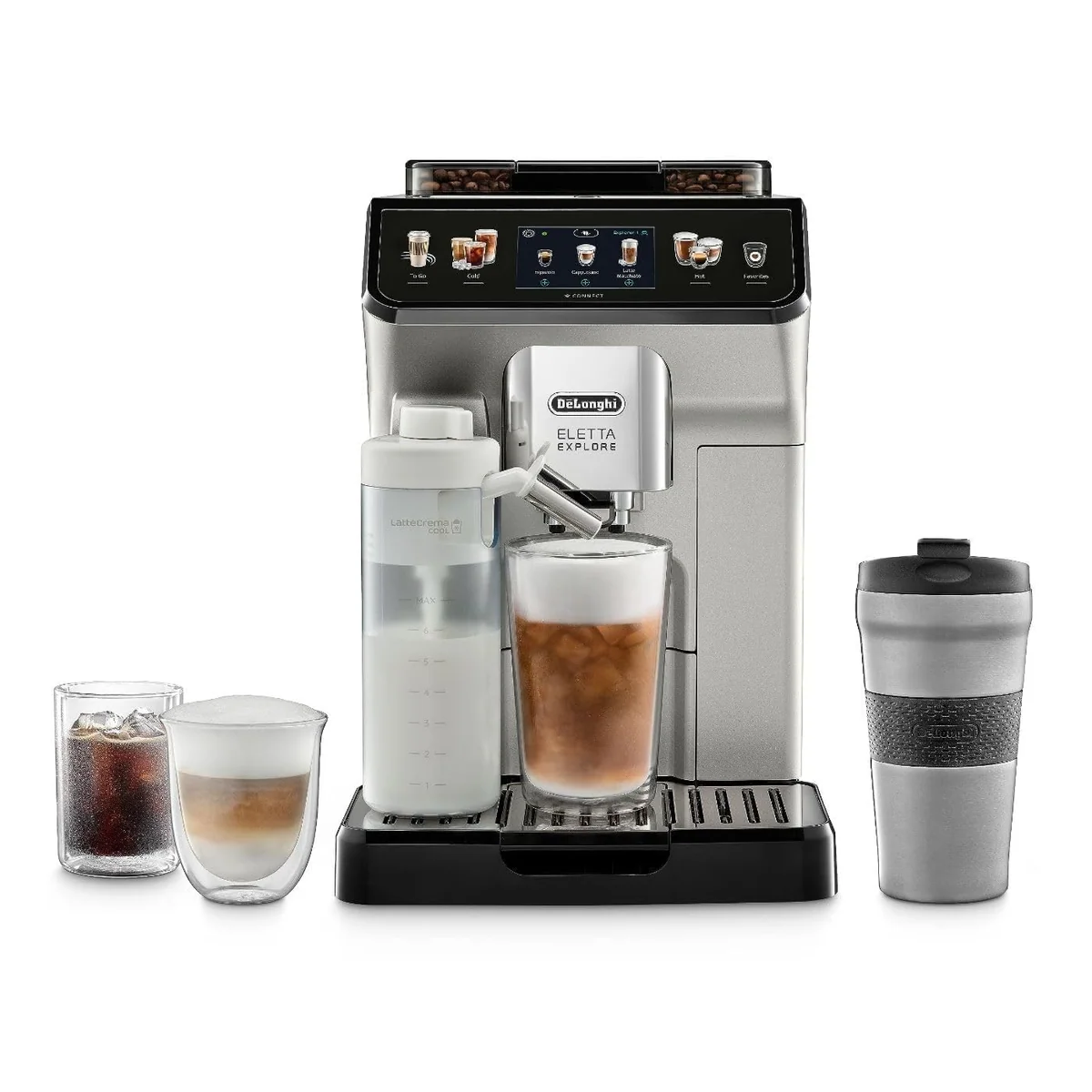
Buy the Eletta Explore only if you will genuinely use cold-extracted coffee and a travel mug, because the espresso and the hot milk it makes are excellent and no better than what a cheaper Dinamica Plus or Rivelia already pours.
Based on 409 owner ratings, 1 owner discussion and 5 other sources. We have not tested this machine ourselves.
We earn a commission if you buy through our links, which does not affect what we say.
Read how this site works →
The bottom line
The Eletta Explore is a very good machine sold on the wrong argument. The listing wants to sell you fifty recipes, an app and a three-minute cold brew, and of those the recipe count is arithmetic, the app is a liability on this generation, and the timing does not hold up. What is actually excellent is quieter than the marketing: a grinder that will choke the machine, a puck big enough to make the shot taste like something, hot milk foam that outclasses most of the category, a screen you never fight with, and a cold extraction mode that really does brew cold and really does stop your ice from ruining the drink. Set against that, the milk lands cool by design, there are two jugs of milk in your fridge, and the water tank empties faster than you would like.
So the verdict does not move: buy it if cold brew and a travel mug are things you will use weekly, and buy a cheaper De'Longhi if they are not, because the coffee in the cup will be the same either way. The one thing Espresso Den would add to that, taken from the most useful owner review on the listing, is not to judge the machine by its factory settings, since the people who are delighted with theirs are almost always the people who spent an evening dialling in their two or three favourite drinks and never touched the other forty-eight.
Buy the Eletta Explore only if you will genuinely use cold-extracted coffee and a travel mug, because the espresso and the hot milk it makes are excellent and no better than what a cheaper Dinamica Plus or Rivelia already pours.
Best for: Everyone who has put this machine next to a cheaper De’Longhi lands in the same place, so the only question that matters is whether iced coffee and a 16 oz cup are worth several hundred dollars to you.
The Eletta Explore is the top of De'Longhi's mainstream bean-to-cup range, and the temptation with a flagship is to assume the coffee at the top is better than the coffee lower down. It is not. The reviewer who bought the Magnifica Evo, the Dinamica Plus and the Eletta Explore with his own money and ran them side by side reports that the brew groups are identical between them, that all three share the same stainless conical grinder with the same fourteen clicks of adjustment, and that on espresso the Dinamica Plus and the Eletta Explore sit at exactly the same level. A second reviewer who owns both the Explore and the Rivelia says he cannot detect a difference between the two in the cup at all.
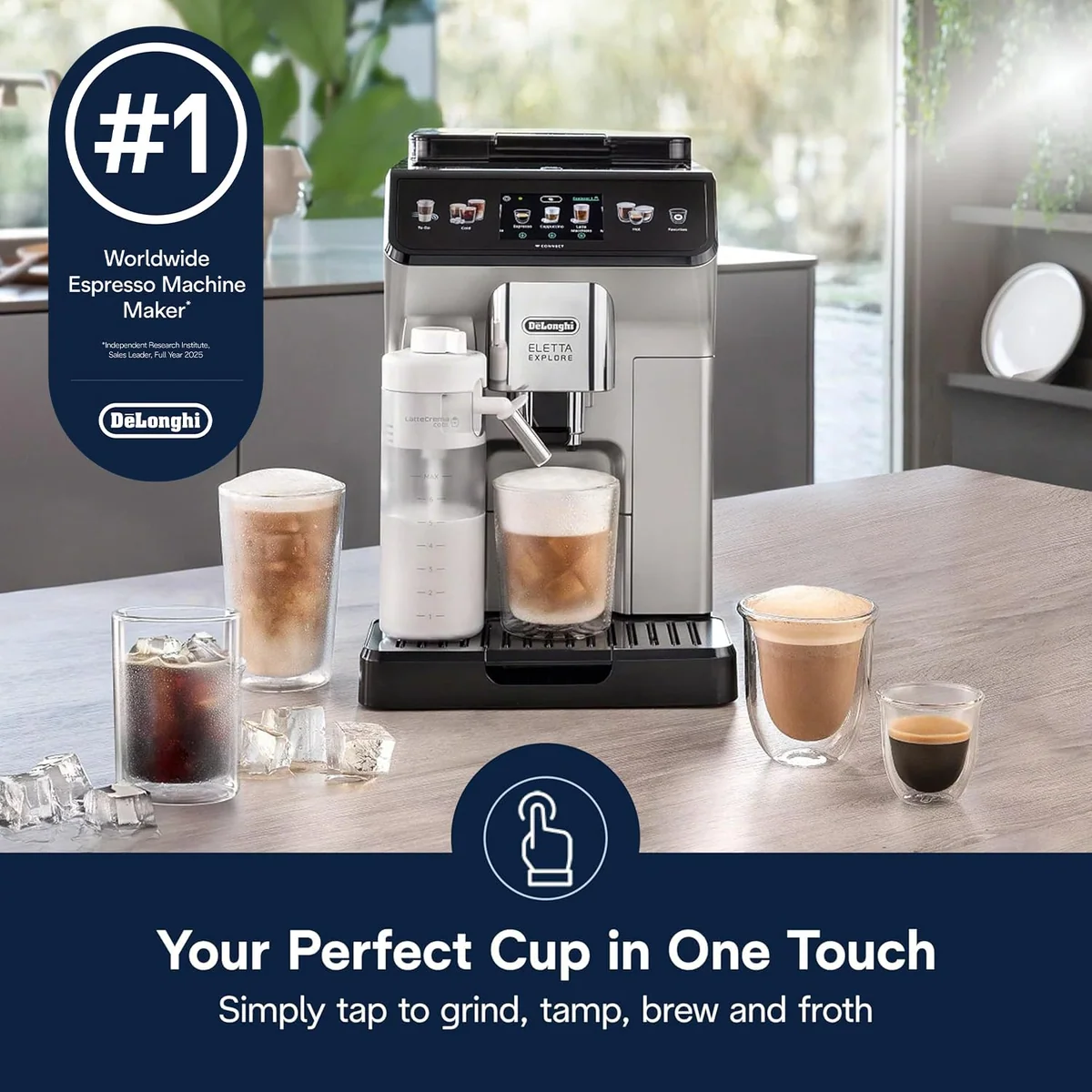
So the premium is not buying you a better shot. It is buying you three specific things: a cold extraction mode that genuinely brews cold rather than pouring hot coffee onto ice, a second milk carafe dedicated to cold foam, and enough clearance under the spouts to park a travel mug. Espresso Den's read of the whole body of evidence on this machine is that those three features are the entire buying decision, and that every honest reviewer arrives there independently. If you want the long version of that same argument across the range, it is laid out in our guide to which De'Longhi to buy, and head to head in Rivelia vs Eletta Explore.
Before anything else, check the model number on the box, because this is a genuine trap at this price. The listing here is the ECAM45086S, and its bullets promise the Coffee Link app and connected technology; owners confirm the app pairs and works on it. Elsewhere in the world the same machine ships as the ECAM450.55 and the ECAM450.65, and one reviewer warns flatly that the 45086 has app connectivity and the 45055 does not. The confusion has already reached buyers: a shopper on r/superautomatic asked whether the suspiciously cheap Eletta Explores are the 55s that lack cold brew, and nobody answered him. One well-known review site's own spec table lists the model as ECAM45055S while linking to this exact listing, which tells you how easily the SKUs get crossed. Cold extraction and the app are the reasons to buy this machine, so buy the version that has them.
Key Specifications
What "over fifty recipes" actually means
It means fifty-one, if you count the hot, cold and to-go versions of the same drink as three drinks. One reviewer sat down and counted exactly that and said so. Another site's spec table counts twenty-two distinct specialty drinks. A third reviewer simply says he cannot find fifty. A fourth lost count around thirty. The most skeptical framing is also the most useful one: the menu is a slight variation on a small number of drinks, dressed up the way a fast-food chain dresses up the same four ingredients as a new item every quarter. The number is not a lie, but it is arithmetic rather than capability, and Espresso Den would not pay a cent for it.
What saves the menu is the favourites system and the four user profiles. Two reviewers independently say the machine would be exhausting without favourites and is fine with them. The profiles are the genuinely domestic feature: an owner describes wanting more milk in her flat white than her husband does, and both of them getting exactly their own drink from one button, which is the sort of thing that stops a household arguing about a coffee machine. Programming is done by pressing stop when enough of each ingredient has come out, not by typing millilitres, and one reviewer is rightly annoyed by that because he knows how many millilitres he wants and instead has to arrive at it by trial and error. A nine-month owner also points out, more amused than alarmed, that profiles cannot be locked, so anyone can look at yours and anyone can sabotage it.
Only one of the cold drinks is actually cold
This is the single most misunderstood thing about the machine and it deserves saying without hedging. Of everything in the cold section of the menu, only cold brew is brewed cold. Iced espresso, iced cappuccino and the rest are brewed hot and then dropped onto ice, with the screen telling you how many cubes to put in the glass first; one reviewer measured the coffee hitting the cup at about 85 °C for an iced drink and observed that the result was drinkable only because the machine insisted on six ice cubes. Another put it more bluntly: choose extra cold and it tells you to add more ice. A third confirmed live on camera that an iced espresso is simply hot espresso meeting ice cubes, unlike cold brew. If that distinction is new to you, our explainer on iced modes covers what every brand means by the word.
The cold brew, though, is real, and it is the reason this machine exists. Cold extraction pumps cold water through a fine espresso-grade grind at very low pressure, trickling rather than pushing, so contact time does the work that heat normally does. One reviewer measured the liquid leaving the spout at 37 °C, roughly half the temperature of a normal brew, and called it as close to real cold brew as a super-automatic gets, still carrying good intensity. Another expected the low temperature to make it sour and instead found low bitterness and a balanced cup, while being honest that it is fresher and less intense than the jar you leave in the fridge overnight, with the compensating advantage that a bad result costs you five minutes rather than eight hours. There is a practical benefit nobody mentions in the marketing: because the coffee is already cold, the ice stops melting into it, so the drink does not water itself down the way hot-over-ice does. Owners on Reddit are notably enthusiastic, one saying the cold brew alone justified choosing this over the Rivelia, with a milder dissenter calling it merely okay.
One claim on the listing does not survive contact with a stopwatch. Cold brew "in under 3 minutes" appears twice in the marketing; the timed run took four minutes forty seconds for 100 ml, and De'Longhi's own promotional video says less than five minutes. The machine also performs a rinse to cool itself down before it starts, which is not counted in anyone's three minutes. It is a good feature undersold by an unnecessary exaggeration.
The travel mug is a bigger deal than it sounds
Flip up the cup grille and the clearance measured with a tape came to about 18 cm, with the official figure at 17 cm and one reviewer reporting up to roughly 19 cm depending how wide the cup is. Very few super-automatics will take a 16 or 20 oz travel mug at all. More importantly, To Go mode is not just a physical accommodation: selecting it makes the machine grind twice and rescale the recipe, so you get a proportioned large drink rather than, as one owner memorably put it, a tiny sad coffee in a huge cup. A US buyer also gets the mug in the box.
Two milk carafes, two cartons of milk, one refrigerator
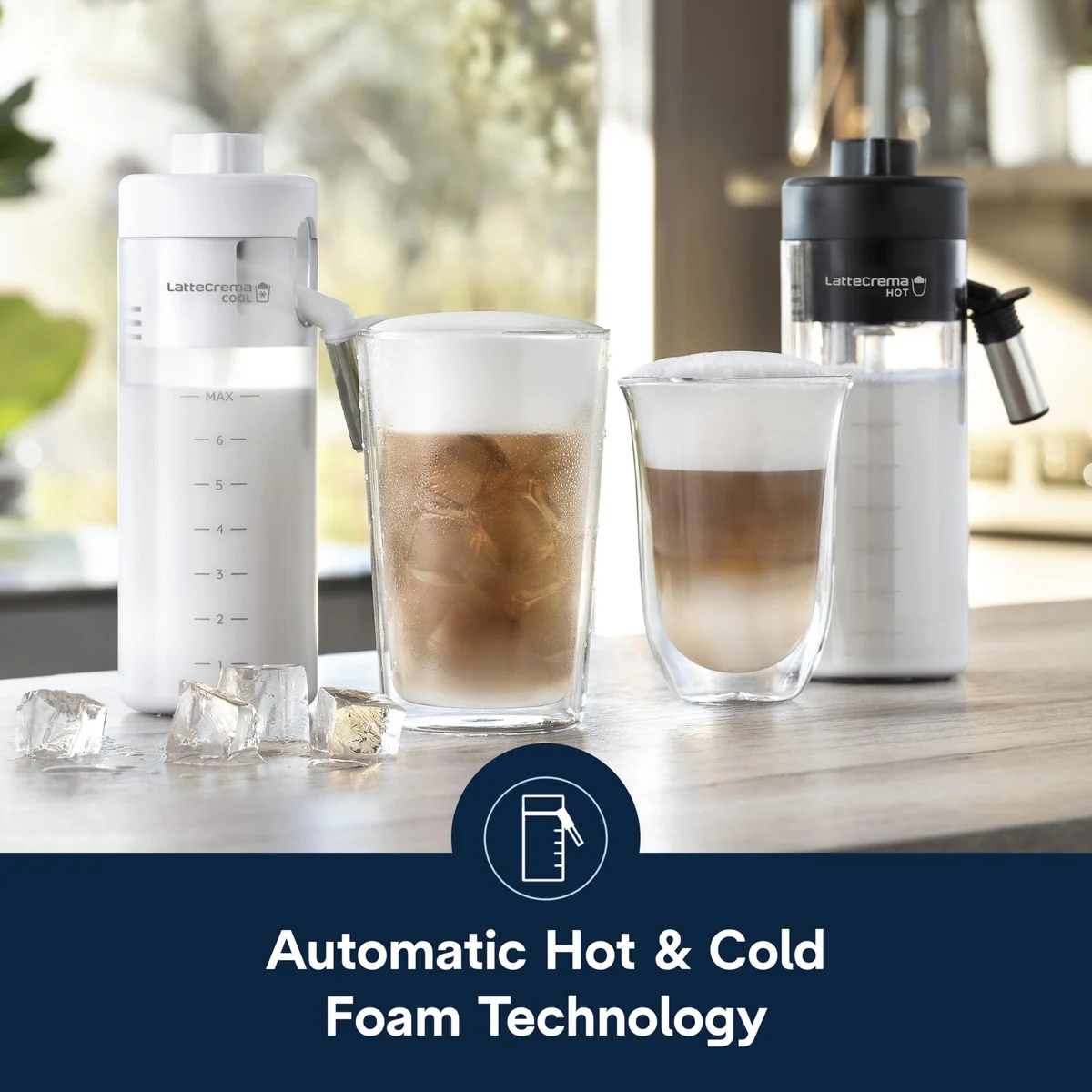
The hot foam and cold foam systems are separate physical carafes, and the machine refuses to brew if the wrong one is fitted. One reviewer devotes a section of his review to calling this the absolute worst part of the machine, because both jugs live in your fridge with milk slowly going off in them if your household drinks hot and cold; you cannot swap just the technical lid between them, and for no obvious reason the two jugs are not even the same size. He also warns that the lids do not clip to the jugs, so it is a matter of time before someone lifts one by the lid and redecorates the kitchen. A reviewer with a real household confirms the shape of the problem exactly: he wants a hot coffee, his wife wants a cold one, so there are two milks on the go. The same reviewer found something genuinely useful while poking at it, which is that the cold carafe works in a Rivelia, meaning the cold-foam capability lives in the jug rather than in the machine.
There is a milk-type restriction on top of that. The cold system asks for skimmed or plant-based milk at fridge temperature and makes you acknowledge an on-screen tip before it will start, and the hot system suggests plant-based milk for the smoothest froth. One reviewer's objection is the right one: nobody keeps two kinds of milk purely for hot and cold drinks, and semi-skimmed works fine in both. Cold foam is honestly the weaker of the two systems whatever you pour in, because without heat the proteins do not set the same way, so the cap is smaller and less stable than the hot version; a second reviewer found the cold foam durable but sitting on top rather than integrating into the drink. Oat milk works, and at least one retailer's crew singled out an iced oat cappuccino as the machine's party trick, though it is worth filtering oat milk to keep the system from clogging.
The screen is excellent and the app is not
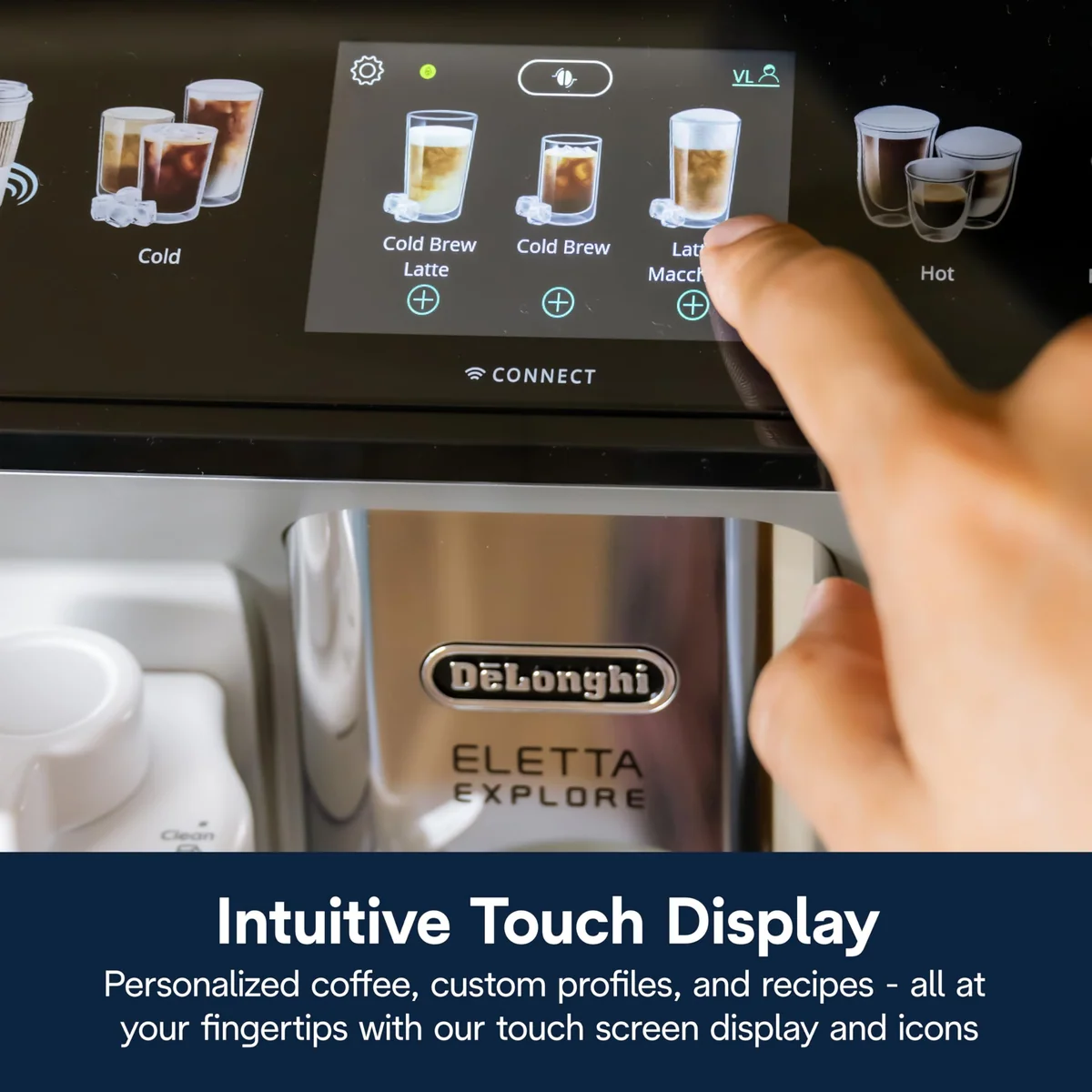
The 3.5 in touchscreen collects more unqualified praise than anything except the milk. Reviewers describe it as one of the least faffy touchscreen interfaces they have used, responsive, well contrasted and intuitive, with hot, cold, to-go and favourites acting as filters. The more interesting observation is that the software has been given something close to a personality: it narrates what it is doing in chatty language and effectively congratulates itself after serving your coffee. One reviewer thinks that matters more to long-term ownership than cold foam does; another mocks it gently and then admits it is actually pretty great, while noting that experienced users will find it pedantic. The front panel is angled so you can read it from in front rather than craning over the top, which matters if the machine lives under a wall cabinet.
The Coffee Link app is a different story, and reviewers have argued about it on the record. One called it a turd and advised buying the machine for the machine; another said he nearly spat his coffee out laughing at that and thinks it is fine, before conceding there is exactly one thing you cannot do without it. Between those poles are the specifics, and they are consistent: it is slow to start and laggy in use, it needs re-pairing each session, it logs you out, and one reviewer had persistent disconnections and simply stopped using it without missing it. One more objection is worth flagging because it is a choice rather than a bug: the sign-up bundles acceptance of marketing emails into the privacy policy tick, with no way to proceed without it. Owners who like the app like one feature in particular, the bean flavour profile that asks whether your espresso came out sour and walks you to the settings that fix it, and one was surprised by how well it worked.
That one indispensable job is Bean Adapt. You tell it your blend and roast and current grind position, it brews a shot, asks whether it was watery, balanced or bitter, and comes back with a temperature, an intensity and an instruction to move the grinder a click or two; you then name the profile and photograph the bag. On this generation you can select a saved profile at the machine but you must create it in the app, which is the criticism the successor model answers: on the newer Eletta Ultra, Bean Adapt is configured on the machine's own screen, and the reviewer covering it explicitly names having to use a phone on the previous version as the thing that made it complicated. There is a deeper conceptual muddle underneath, best articulated by the reviewer who worked it out on camera: Bean Adapt sets grind, strength and temperature together, but strength and temperature are stored per drink, so the only way to actually drink coffee made with all your dialled-in settings is to choose the dedicated Espresso Soul recipe and add milk and water separately, or go through your favourites changing each one by hand. That is a real design hole in the feature that sells the machine.
And the headline connected feature does not work. Four people found the same wall independently: the machine runs a rinse cycle the moment it powers on, so a drink started remotely either lands in a cup of rinse water or lands nowhere, because there is no way to move a cup onto the tray after the rinse. One owner's advice is the shortest version, which is that remote brewing makes zero sense and you will just end up with a watered-down drink. Wi-Fi on this machine is for pairing, not for having coffee waiting when you wake up.

Strengths & Limitations
Strengths
- Grinds fine enough to choke the machine and packs a puck up to about 15 g, which is why the espresso outclasses cheaper bean-to-cup machines.
- Hot milk foam is as good as anything in the category, creamy rather than airy, and reviewers repeatedly rate it above the Philips equivalent.
- Cold extraction genuinely brews cold, measured at 37 °C leaving the spout, so the ice stops diluting your drink.
- To Go mode combines rare travel-mug clearance with a recipe that grinds twice, so a large cup gets a proportioned drink rather than a diluted one.
- The 3.5 in touchscreen is the least frustrating interface on any machine in this class, and it explains itself as it goes.
- Four user profiles let two people who disagree about milk volume both get their own drink from one button.
Limitations
- Milk drinks come out around 125 °F, measured on two separate units by the same owner, and no amount of customer service changed it.
- Everything on the cold menu except cold brew is hot coffee poured over ice cubes the machine counts out for you.
- Two milk carafes means two containers of milk slowly going off in your fridge if your household drinks both hot and cold.
- The app is slow, disconnects, forces a marketing opt-in at sign-up, and its remote brew feature is unusable because the machine rinses on power-up.
- Bean Adapt profiles can only be created in that app on this generation, a limitation the successor model fixed by moving it onto the screen.
- Constant self-rinsing means refilling the tank and emptying a drip tray that has no spout and slops over itself on the way to the sink.
- The listing's "cold brew in under 3 minutes" did not survive a stopwatch, which timed four minutes forty seconds.
The espresso is good, and there is a mechanical reason you can check
Most cheap super-automatics make thin espresso for two boring reasons: they will not grind fine enough, and their software caps the dose. The Eletta Explore fails at neither. Testers who weighed the puck put it between roughly eight and fifteen grams depending on the intensity setting, with the grinder running about a second and a half per gram, and one weighed a dry doppio dose at 13.6 g. For comparison, the same tester measured the Magnifica Evo topping out near twelve grams and noted that Philips machines make roughly seven-gram pucks. More telling than the dose is what happens at the fine end of the grinder: two independent reviewers report stalling the machine outright, one calling that a good sign and the other reassuring people that choking it does no harm. A super-automatic that can be choked is a super-automatic with headroom.
The dose is not as tidy as the marketing suggests, though. One reviewer switched the machine off mid-cycle and weighed the grounds repeatedly at intensity level four, and got anywhere from 9.4 to 11.3 grams, with the same setting varying by 1.2 g between runs and the highest intensity not reliably producing the most coffee. The listing calls the grinder "precise, consistent"; that first word is generous and the second one does not survive a set of scales. His practical advice is to sit in the middle of the intensity range and dial the drink with water volume instead, which is the right instinct.
The drink names deserve a warning of their own. One reviewer did the arithmetic on every espresso preset and found that a two-times espresso at minimum volume and maximum strength gives roughly 50 to 55 g in the cup from 15 to 16 g of grounds, a ratio near 1:3.5, while the Doppio Plus insists on dispensing at least about 90 g, which lands it closer to 1:6. His verdict is that Doppio Plus is really a small, intense Americano, and that most buyers will reasonably assume the "plus" refers to the dose rather than the volume. The fix another tester uses is worth stealing: choose Doppio Plus, put both shots into one cup, and stop it on a scale at around 30 g, which produces a visibly better shot with more crema than the espresso preset gives you.
Set expectations honestly on the ceiling. The most measured assessment in the pile is that espresso from any automatic is never as intense as espresso from a machine you tamp yourself, so a shot from this will be weaker than the one your café pulls, and that the gap narrows to almost nothing once milk is involved. Within the category, though, the praise is close to unanimous, and the settings that produced it are worth writing down: one reviewer recommends grind setting 5 of 13 with fresh beans and coffee strength 3 or 4, another landed on 4 of 5 aroma with the grinder at its fifth-finest position, and a third found that going below grind 4 tips the shot into dripping and a bitter aftertaste. The same tester's most useful discovery was that supermarket beans that tasted flat came alive at a lower brew temperature, while a dark Ethiopian needed the highest setting, which is an argument for treating temperature as a flavour control rather than a comfort setting. Bean choice matters more than any of it, and our guide to beans for bean-to-cup machines covers which ones jam the grinder.
The hot milk is the best thing about it and the most complained-about thing about it
Those are the same fact from two ends. On texture, the consensus is emphatic: one reviewer calls it probably the best milk foam he has seen from a super-automatic, creamy rather than airy and noticeably sweeter for it, and rates De'Longhi above Philips on milk specifically; another says it is the best milk texture he has had from a bean-to-cup machine, good enough for a rough attempt at latte art; a third describes the machine as a hot milk foam monster. Owners echo it in plainer words, with thick creamy foam that looks and tastes like a coffee shop's. Two separate reviewers independently settled on about three-quarters of the way up the foam dial as the sweet spot.
Now the drawback, and it is the one a buyer most needs stated plainly. Milk drinks come out cool. One owner measured a flat white at 125 °F with a calibrated digital thermometer while black coffee from the same machine measured 157 °F on the same probe. He called De'Longhi, had several conversations, followed their instructions including preheating the cup, sent them a video of himself making the drink, and was eventually sent a replacement unit. The replacement measured 125 °F as well. That detail is what lifts this out of the "faulty unit" category: two machines behaved identically, and his conclusion was that he still has to microwave a flat white after a very expensive machine finishes making it.
It is a design choice, not a defect. The house rationale for LatteCrema, stated when the earlier Eletta launched, is that milk tastes sweetest below scalding and loses apparent sweetness as it gets hotter, and the machine's own literature warns about curdling. An independent reviewer puts the practical line exactly where it belongs: the milk runs hotter here than on some rivals, but if you want milk at 60 °C or above you need a machine with a steam wand, and our piece on steam wand versus automatic frother is the decision behind that. Note also that the complaint is specific to milk. Reviewers who made a plain hot cappuccino on camera reported it was hot, one of them saying it was slightly hotter than he would choose. If lukewarm milk would ruin the machine for you, read why these machines run cool before you spend the money, and know that preheating the cup, which one owner does for two and a half minutes in the microwave, moves the result from unacceptable to fine.
| Drink or output | Measured |
|---|---|
| Flat white, milk drink at the cup | 125 °F, on two different units |
| Black coffee, same household, same thermometer | 157 °F |
| Caffè crema | 76 °C, described as too hot to sip immediately |
| Black tea on the hottest setting | 93 to 95 °C, and steady through the pour |
| Hot cocoa on the hot milk function | 57 °C |
| Cold brew leaving the spout | 37 °C, about 2 to 3 °C in the glass once iced |
| Cold foam from the LatteCrema Cool carafe | 25 °C |
| Iced coffee that is not cold brew | about 85 °C at the cup, before the ice |
Noise: the decibels and the complaint are measuring different things
One reviewer took a meter to it and recorded under 65 dB while grinding, against a category average she puts at 68 to 70 dB, and called it one of the quietest machines she has tested. A retailer's own crew review says the opposite in the same breath as recommending it: you can hear the grinder from a room or two away, and in a small apartment everyone will know you are making coffee. Both are probably true. The two reviewers who complain hardest name the pitch rather than the volume, one calling the grinder screechy enough to set his teeth on edge, the other saying the noise is high-pitched in the way that drives his migraine-prone wife out of the room. If quiet mornings are the constraint, the machines that solve it properly are in our quietest super-automatic guide.
Who should buy it, and who should buy something cheaper
The cleanest decision rule comes from the reviewer who has spent time with this and the Rivelia: if you will really use cold extraction and really use the tall travel mug position, buy this one, and if those two features do not excite you, drop back to the Rivelia, get coffee that is just as good, and keep several hundred dollars. Another reviewer reaches the same conclusion by a different road, calling the Rivelia the better machine for anyone who mainly drinks hot coffee and reserving the Explore for people who love iced coffee, where he thinks nothing else comes close short of a Jura costing roughly twice as much. A third recommends the Dinamica Plus outright to anyone who answers no to the cold and travel-mug questions, on the grounds that it performs the same in his experience. Three reviewers, three routes, one answer.
Which means the honest alternatives are all inside the same family. The Dinamica Plus shares the brew group, the grinder and the LatteCrema hot system, and gives up cold extraction, the second carafe, Wi-Fi and about an inch of cup clearance. The Rivelia is more compact and swaps bean hoppers, which is the better machine if your household runs decaf and regular, a scenario we cover in machines for two different beans. Reddit owners weighing exactly this pair summarise it well: the Eletta has the cold drinks, the larger tank and the larger hopper, the Rivelia has the swappable hoppers and the smaller footprint, and both make more or less identical espresso. If cold coffee is the whole reason you are here, compare it against everything else in our iced coffee guide, and if you are cross-shopping outside De'Longhi, the KitchenAid KF8 comparison is the closest fight at this level.
It is a bad buy for one type of person in particular, and reviewers are unanimous about who. If you want to be involved in the process, to weigh doses, adjust ratios, tamp and steam your own milk, you will not love this or any super-automatic, and that is worth knowing before you spend the money rather than after. The person it suits is the one described by the reviewer whose Italian colleague owns an E61 machine and a Dedica and uses neither, because in the morning he wants to press a button. Our piece on whether super-automatics are worth it makes that trade explicit. The economic argument owners actually make is more modest and more convincing than the marketing version: you do not have to be buying an absurd number of café drinks for a machine that turns out a drink for pocket change to pay for itself, and one nine-month owner makes the additional point that it does not generate a cup and a lid every morning.
What owning it is actually like
It drinks water. The machine rinses on start-up, rinses on shutdown and rinses between modes, and while that is good for flavour it means the 1.8 L tank empties and the drip tray fills faster than owners expect. One reviewer's account of this is almost comic in its exasperation at constantly refilling and constantly emptying, and even a five-star owner lists emptying the tray often as her only complaint. One reviewer measured about fifty seconds of heat-up with a lot of water running through, and advises leaving a cup under the spouts permanently. A dissenting voice puts tray emptying at every ten to twelve drinks, which sounds like a household with different habits rather than a different machine. The best tip in the entire owner corpus addresses the related nuisance: use the water hardness strip in the box and set the machine to your actual water, because otherwise it assumes the worst and nags you to descale far more often than you need to.
The drip tray itself has a small, genuine design flaw. It has no spout, groove or tipping point, so carrying a full tray of water to the sink means it slops over itself, every time, as one reviewer demonstrated on camera before naming it in his conclusion as part of a general lack of elegance in the base. The same base is awkward to clean simply because of its size. The bean hopper is the other physical annoyance: several owners and reviewers report having to pull the machine out from under the cabinets to fill it, and describe pouring beans in as fiddly with no easy way to see the level.
Cleaning is genuinely light, with one important asterisk that is repeated by three separate reviewers and contradicted by a popular social clip. The automatic milk rinse only flushes the dispenser nozzle and the path through it. It does not clean the jug, and it does not clean the stem that sits in your milk. You still need to wash the carafes by hand or in the dishwasher every couple of days, and the reviewer who left one in the fridge for five days reports exactly the curdled result you would expect. The carafes are dishwasher-safe and reviewers confirm it by doing it; the brew group, drip tray and grounds bin should be rinsed under the tap instead. Advice on brew group frequency ranges from every evening to once a month, and weekly is the sensible middle. Descaling intervals depend entirely on your water, with estimates running from every two months to every six, and our cleaning and descaling guide sets out what each job actually involves.
The only long-term ownership account available reports one repeatable quirk after nine months of daily use: immediately after every descale, the milk frothing goes strange, spluttering and sometimes stopping partway, and needs coaxing for a couple of days before it settles back down. He is clear that it has happened every single time regardless of which descaler he used, which makes it a characteristic rather than a fault. He also, sensibly, uses a cheaper third-party descaler than the branded one the manual insists on, a decision the manual will not thank you for.
Two things about longevity deserve stating side by side. The warranty runs two years, extended to three if you register the machine, and the most experienced reviewer to give an estimate expects five to ten years with proper care, with the stainless grinder good for around a decade if it is kept clean and not fed oily beans. Against that, one owner writes that his unit's milk function never worked from day one, that the warranty process was impossible, that the fault was never fixed, and that two years and several self-funded repairs later the machine is dead. That review is one of two one-star reviews on the whole listing, and the other one-star owner had the opposite service experience, with De'Longhi taking his calls, accepting his video evidence and replacing his unit. A 4.2 average across several hundred ratings is not a lukewarm score here; it is a strongly liked machine with a small, specific minority of failures, and it is fair to weigh both. For the general shape of what breaks and when, see how long these machines last.
One last ownership detail that is small until it happens to you: an owner dropped the cold carafe, found the frothing head perfectly fine and the plastic jug shattered, and discovered the jug is not sold on its own, so he had to buy a complete new assembly including the electronics he did not need. That is the kind of thing worth knowing before you build a morning routine around a machine with two fragile jugs living in the fridge door.
Frequently Asked Questions
Does the Eletta Explore actually make cold coffee, or is it just hot coffee over ice?
Only the cold brew setting brews cold, at a measured 37 °C leaving the spout, and every other drink on the cold menu is brewed hot and dropped onto the ice cubes the screen tells you to add.
Why are my milk drinks not hot?
They are not meant to be, because the LatteCrema system targets sweetness rather than heat, and an owner measured a flat white at 125 °F on two different units after De'Longhi replaced the first one.
Can I do anything about the milk temperature?
Preheating the cup takes it from unacceptable to acceptable for most people, but if you want milk above 60 °C the only real fix is a machine with a steam wand.
Is it worth paying more for this than for a Dinamica Plus or a Rivelia?
Only if you will use cold extraction and the travel mug, because reviewers who own more than one of them report the espresso is effectively identical across the three.
Which model number should I be buying?
This listing is the ECAM45086S, which carries the app and cold extraction, and other regional SKUs in the 450 family reportedly drop one or the other, so check the number rather than the colour.
Do I need the app?
You need it once, to create Bean Adapt profiles, and after that most reviewers stop opening it entirely.
Can I use oat milk?
Yes, and the cold system is actually happiest with plant milk or skimmed, though it is worth filtering oat milk so the LatteCrema plumbing does not clog.
How much cleaning does it really need?
The automatic cycle rinses only the milk nozzle, so you still have to wash both carafes by hand or in the dishwasher every two or three days and rinse the brew group about weekly.
How long should it last?
The most experienced reviewer to estimate expects five to ten years with proper care, and the warranty runs two years or three if you register the machine.
Is a returned or renewed unit a reasonable way to buy one?
One reviewer bought his from a warehouse deal at a substantial discount and found a clean brew group and a little coffee dust as the only evidence of use, which matches what we say in our guide to renewed and refurbished machines .
Sources (7)
- Amazon listings and customer reviews — Delonghi Eletta Explore
- Owner reports across r/superautomatic threads
- Owner and reviewer video, 12 channels
- Homecoffeeexpert — Article — homecoffeeexpert.com
- Coffeeness — Article — www.coffeeness.de
- Lbtechreviews — Article — www.lbtechreviews.com
- Wholelattelove — Article — www.wholelattelove.com