The Bosch 800 Series VeroCafe makes the best coffee in its class and asks you to forgive almost everything around it
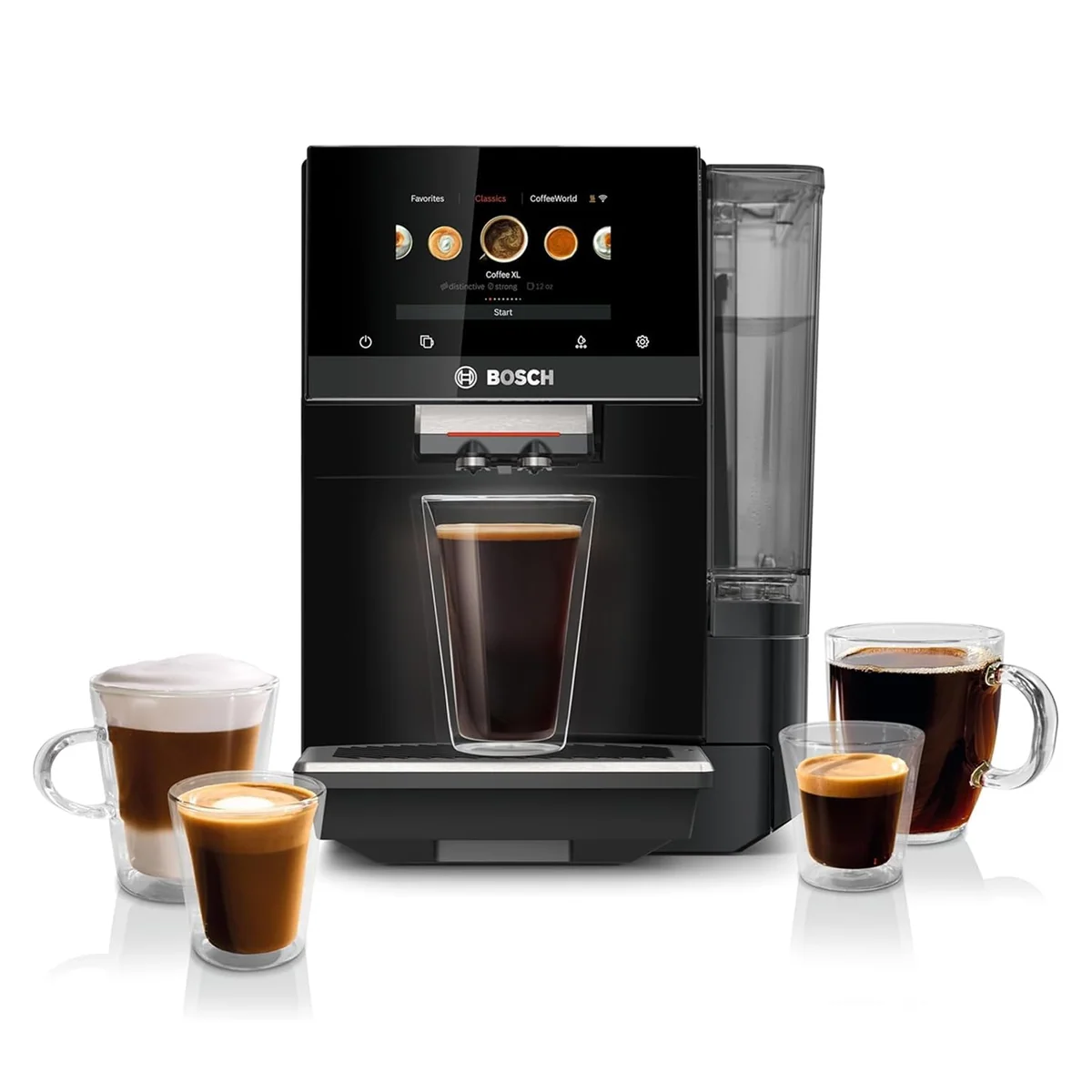
Buy the 800 Series only on a real discount and only if you take your milk warm rather than scalding: the coffee is the best thing in this price bracket, and nearly everything wrapped around it is either unfinished, undocumented or missing.
Based on 100 owner ratings, 9 owner discussions and 1 other source. We have not tested this machine ourselves.
We earn a commission if you buy through our links, which does not affect what we say.
Read how this site works →
So who should actually buy one
Buy the black machine with the hose if you drink your coffee mostly black or mostly at European milk temperature, if you enjoy a machine with a menu worth exploring, and if you are catching it on a promotion at a retailer that will take it back after six weeks rather than four. You will get the best cup available at this level from a machine that is a pleasure to clean, and you will spend your first week in the customisation screens getting there, which is true of every machine in this category and not a Bosch failing.
Do not buy it if you want scalding lattes, if anyone in the house drinks decaf, if you need per-person temperature settings, or if you cannot absorb the possibility of a service call that Bosch may not be able to staff where you live. Those are not small exclusions, and they cover a lot of households. If two of them apply to you, start instead from our roundup of the best super-automatics and work back toward this one.
Buy the 800 Series only on a real discount and only if you take your milk warm rather than scalding: the coffee is the best thing in this price bracket, and nearly everything wrapped around it is either unfinished, undocumented or missing.
Best for: Owner after owner rates the cup above the machine they traded in, then mentions in the next breath that the milk is only warm, the hopper takes one bean and nothing else, and they bought theirs on a deep discount.
Start with the thing the listings bury, because it changes what arrives in your kitchen. The black machine and the stainless machine are not the same product in two colours. The black one is model TPU60309, and its box contents run to a water filter, a microfiber cloth, a hardness strip and a single connection hose for the milk frother. The stainless one gives its own model number as TQU60307 in the box list while Amazon's catalogue files it as TQU60703, and it ships with a milk adapter and an integrated milk container, then adds a Coffee Pot Function and a cup warmer to its feature list. Autocomplete for this machine is a swamp of TIU20109, TIU20307, TPU60706 and TQU60706, and the confusion is not the buyer's fault.
Espresso Den has not used either machine. What follows is built from the two listings, every Amazon review on the black unit, and the handful of first-hand owner accounts that exist anywhere, which is a smaller pile than a machine at this level deserves. When we captured the listings, the black one showed 3.9 stars across a hundred ratings and the stainless one 3.8 across fifty-four. Fifty-four ratings is not a consensus; it is a rumour.
The single most useful piece of advice on this page is about where you buy, not which finish you pick. Two of the unhappiest Amazon reviews describe machines that failed at roughly one month and a little over one month respectively, which is either side of a thirty-day return window, and buyers in the wider community argue for retailers with longer windows precisely because a super-automatic takes a week or two to set up and judge. Whatever else you take from this review, do not buy this machine somewhere you cannot walk it back after six weeks. And do not buy it open-box: one Amazon buyer ordered "like new" twice, got the wrong model the first time and a unit stuck on "preparing your beverage" the second, while another suspected a returned unit because the protective plastic was missing. If you are tempted by a refurbished route, our guide to renewed and refurbished super-automatics explains where that gamble is usually safe, and this listing is not it.
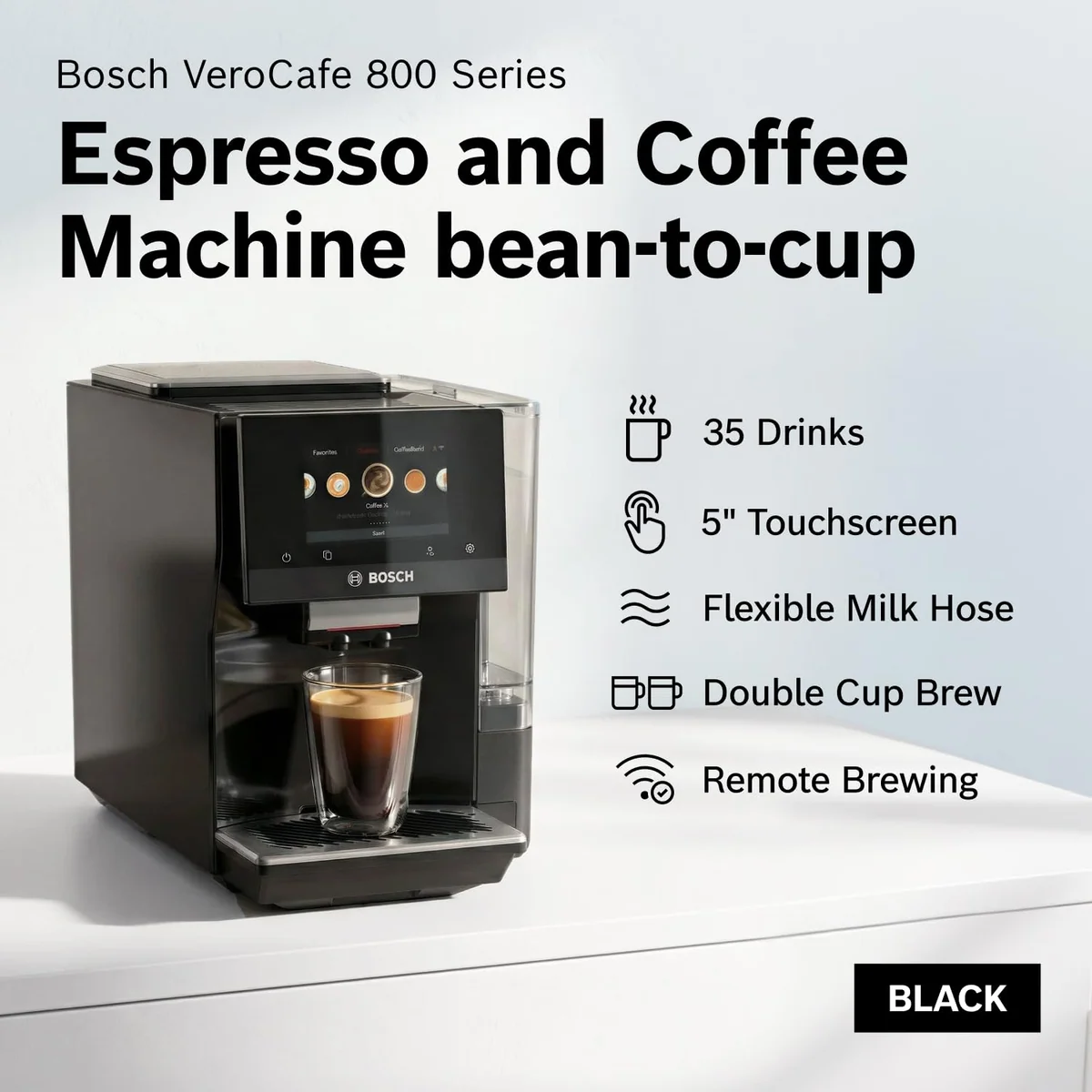
Key Specifications
One screen, thirty-five drinks, one kind of bean
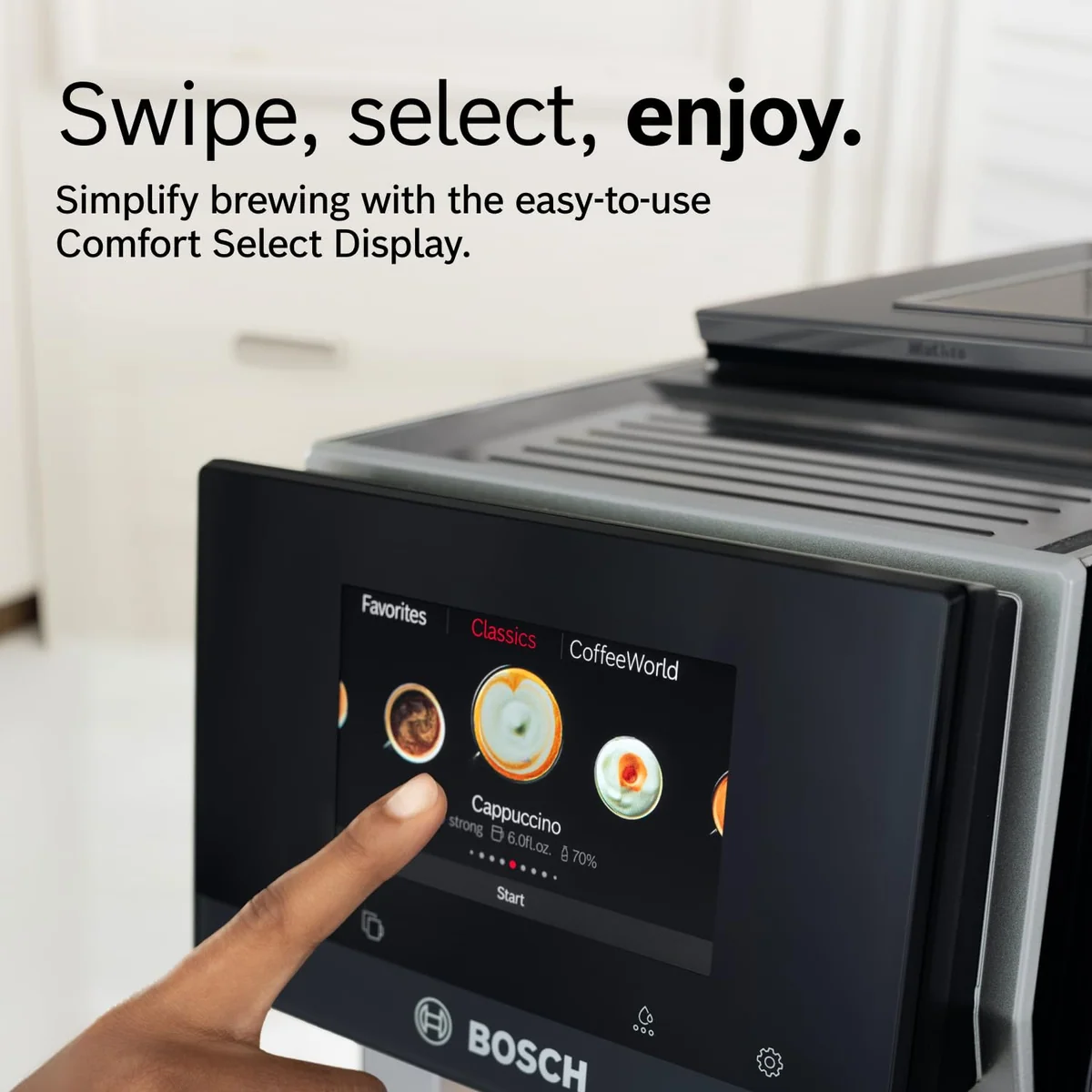
The display is the reason people fall for this machine in the shop. It is a five-inch colour panel that swipes like a phone, with real photography and drink names rather than the hieroglyphic warning lights that make a De'Longhi owner reach for the booklet. One owner counted out the full Coffee World list by hand and found thirty-five named drinks including Koffie Verkeerd, Kleiner Brauner, Galão and Verlängerter, and concluded that nothing else on the market matches the range. That matters, because most manufacturers pad their drink counts by billing a latte with oat milk as a second recipe. Bosch mostly does not, though it does count Doppio and Espresso Doppio separately, and it counts Red Eye and Dead Eye as two ideas.
Two caveats came from owners rather than from Bosch. The machine's own menu does not show the whole list, so a chunk of those drinks are only reachable through the Home Connect app, and one owner reasoned that most buyers will never see them. The published split between what lives on the machine and what lives in the app is also wrong in places, with drinks appearing on the panel that the website says are app-only and the reverse. And the drink descriptions, which are the genuinely charming part, are hidden behind tapping the drink's name inside the customisation screen, a detail one buyer called important but not obvious after finding it nowhere in the manual or on Bosch's site.
The two omissions that would make me hesitate
There is no bypass chute. Three separate owners say so plainly, and one of them called it a miss for anyone who wants a decaf at night. Whatever is in the hopper is what you get, there is no second hopper to swap, and your only route to decaf is emptying and refilling. The sting is that Bosch's own cheaper 500 Series has the chute, along with an automatic milk rinse after every milk drink, while the owner of an 800 reports having to trigger the milk clean by hand. Our page on using pre-ground coffee and decaf in a bean-to-cup machine covers what you lose when a machine has no chute at all.
| Feature | 800 Series | 500 Series |
|---|---|---|
| Drink list | Around 35 named, part of it app-only | 9 one-touch |
| Pre-ground / decaf chute | None, per three owners | Yes, a separate chute |
| Milk rinse after a milk drink | Manual, per its owner | Automatic, per Bosch's own material |
| Wi-Fi and app control | Yes, and it is the best thing here | Not established in what we read |
| Water tank | Owners report roughly 2.2 to 2.4 litres, fillable in place | 64 oz, removable |
The second omission is smaller but it will nag daily. The lowest milk ratio you can set for a latte is thirty percent, which one owner still finds too milky, with no drink offering less; support told them Bosch might change it in a future update, and twelve months on it had not. Their workaround is to pull an extra espresso into the finished drink, which works, and which is also not what a one-touch machine is for.
The parts that are quietly very good
The water tank fills from a jug without being lifted out, so you can top it up mid-drink, and at over two litres it comfortably outlasts a Philips or a De'Longhi between refills. The brew unit pulls out and rinses under a tap, which one former Jura owner treated as the headline improvement over a machine where you cannot even see the tamper. Cleaning is the one listing claim nobody argues with: the milk system is cleaned by dropping the hose into the drip tray and running a two-minute cycle, and the screen walks you through the rest with graphics. Calc'n Clean is genuinely guided, though nothing tells you in advance that the descaling tablet goes into the coffee bean container and that you need a 33 oz vessel under the spout. If you want the honest scale of the job across brands, we set it out in what cleaning and descaling really involves.
Skip the milk carafe. This is close to unanimous among owners: the hose is flexible, sits in its own holder, and drops straight into whatever carton you are using, which suits a household running dairy, oat and almond at once. One owner who did get a carafe abandoned it after finding the tube discharges a little warm milk back into the container, which is a spoilage problem dressed up as a design detail. That is the argument for the black listing over the stainless one, and it is a better argument than the finish. If you are still deciding between hose, carafe and wand, we compare the three in steam wand, milk hose or one-touch carafe.
Physical annoyances, in descending order of how often people mention them: the bean hopper is set back with an intrusive guard that makes beans bounce out while you pour, though one buyer discovered the lid slides off completely, which fixes most of it; the cup warmer, on versions that have one, is a decoration, with one owner leaving a cup on it for half an hour and finding the base barely warm; the spout does not clear a tall travel mug unless you pull the drip tray, per an affiliate video whose criticisms are the only part of it worth trusting. And the stainless listing advertises a Coffee Pot Function while the pot itself is not in the box, a point the one detailed video review of this machine makes with some feeling.

Strengths & Limitations
Strengths
- Nearly everyone who has used one rates the cup above the machine they replaced, including the reviewer who tells his audience not to buy it.
- The five-inch screen and the Home Connect app are the class act in this bracket, and one owner runs drinks by voice from another room.
- The water tank holds over two litres and tops up in place, so refilling stops being part of your morning.
- Cleaning is genuinely easy: the brew unit pulls out for a rinse and the milk system is done by dropping the hose in the drip tray for two minutes.
- Coffee World is a wide menu of real drinks rather than the same latte counted five ways, and each one explains itself on screen if you tap its name.
Limitations
- Milk arrives warm rather than hot, and no menu fixes it because the temperature setting is global while the frother sets the ceiling.
- There is no bypass chute, so one decaf at night means emptying the hopper, and Bosch's cheaper 500 Series has the chute this one lacks.
- The lowest latte milk ratio is thirty percent, and an owner who asked support was told only that a change might come in a future update.
- Two buyers hit hard faults within about six weeks, one a brew unit pouring warm water and one a screen that needed unplugging to wake.
- Bosch told one owner with a machine stuck in standby that it had nobody in their area who could service it.
- Every enthusiastic first-hand account we found came from a discounted purchase, and two owners volunteered that they would be harsher had they paid full price.
The coffee is excellent and the milk is warm
Take the good part first, because it is unusually well corroborated. The reviewer who ends his video telling people not to buy this machine also says it brings out more depth than the KitchenAid, the De'Longhi and the Philips machines he has run, and that if he had to pick a favourite on coffee quality it would be the Bosch, as much as he hates to say it. An owner who came from a Philips 3200 expected a pretty screen hiding a poor machine and wrote "boy was I wrong". A buyer replacing a failed Jura Z8 says the coffee is stronger and better tasting on fewer beans. Even the one-star reviewer whose machine broke opens with the line that when it works it makes great coffee. A Saeco Xelsis owner who bought this to test it and expected to send it back kept it as his number one machine instead.
Now the fault line. Milk is not hot. One owner measured about 110°F in the cup; another measured roughly 120°F leaving the machine and 110°F by the time it settled. A Costco buyer put it best: if you want milk hot enough to burn the roof of your mouth, this brand fails at that, and the fix is to warm the milk yourself before you start. The reconciling fact, and the one nobody tells you at the point of sale, is that the temperature setting on this machine is global rather than per drink, so black coffee can be turned up and genuinely runs hot, while milk is capped by the frother and no menu will rescue it. This is a class-wide problem more than a Bosch defect, and we go through the causes and the few real fixes in why the coffee and milk come out lukewarm. If hot, dense milk is the whole reason you are buying, read our pick for people who mainly drink lattes before you commit here.
Black coffee temperature is genuinely disputed. One Amazon owner measured 129°F and called it hot with slow brew at 158°F; another measured 135°F to 146°F across shots and named the temperature their main disappointment, wishing Bosch would let users set a preference. They were both right about their own machine and one of them had not found the setting. Which is the recurring shape of this product's problems.
Out of the box it can taste like water, and that is a settings problem
Two owners independently describe weak coffee on arrival and two owners independently describe the fix. One new buyer got watery coffee for days before working out that you tap the drink, enter its customisation screen, and set strength and shot count there; landing on extra strong, double shot, 1.5 fl oz and the Distinctive aroma for espresso, they said the real thing finally came out. On the other listing, a buyer complaining that long coffee was weak while espresso was great was told to raise the coffee to two shots, since the default is one, and to lift the aroma setting. Nobody in our reading found a published dose figure in grams for this machine, which is the one number that would settle whether the coffee is thin by design.
The bean economy is worth knowing before you fill the hopper. One owner found the machine gets through beans faster than expected and worked out that a grande at the third level on Distinctive uses a single shot and dispenses slowly for the strongest cup, then tops it with five ounces from the hot water spout; go to the fourth level, or choose the XL coffee, and it takes two shots. Feed it medium roast, not oily and not coated, which is the standing advice for every machine with an internal grinder and which we cover in which beans work in a bean-to-cup machine.
Two more things people ask about. Double Cup releases all the milk into both cups first, then pulls the espresso, so it is not one drink stacked on another, and it doubles as a way to make one larger drink than the single-cup maximum allows. And the app has one function that justifies its existence: starting the machine remotely lets you skip the startup rinse, so you can leave a cup in place overnight and have the drink land clean. One owner tied that to an Alexa routine and orders coffee by voice from bed; another owner shrugged, called the connectivity limited in practice and stopped using it. Both are telling the truth about their own mornings.

Nobody who loves this machine paid full price
This is the finding that organises everything else. Espresso Den could not locate a single enthusiastic first-hand account from anyone who paid the full asking price. The Jura refugee bought on a Prime Day promotion. The Saeco owner who kept it over the considerably more expensive Xelsis already on his counter bought it on a Black Friday deal at Costco and said in the same breath that it is a good buy at the regular number and a steal at what he paid. The owner with roughly 370 cups on the clock bought his used and volunteered, unprompted, that he would probably have more criticisms if he had paid full price. A different owner, on the other listing, wrote almost exactly the same sentence. When two strangers separately warn you that their approval is conditional on the discount, that is data.
The counter-case is made most forcefully by the one long-form video review of this machine, which lands on "good quality coffee, lacklustre everything else, overpriced" and argues that the KitchenAid KF7 beats it on build, features and overall design even though the Bosch makes the better cup. That is a fair summary of the trade, and it is exactly the comparison we run in detail on Bosch 800 Series against the KitchenAid KF7, with the individual machines covered in our KF7 review and KF8 review.
We do not quote prices on this site, because they move faster than we can publish, and both of these listings have carried numbers far above what any happy owner in our reading actually paid. What we will say is that this machine goes on promotion in cycles, that owners advise waiting for one, and that the price you are looking at right now is a legitimate reason to close the tab and come back later.
The rest of the Bosch range deserves a look before you commit at this level. The 300 Series is a much simpler machine with an in-cup frother and it has a contented owner base at a fraction of the money, with the standing advice from those owners being to descale when prompted and change the filters. We review it separately as the Bosch 300 Series VeroCafe and set the two side by side in Bosch 300 Series vs 800 Series. The 500 sits between them with the chute and the automatic milk rinse, though one buyer who put a 500 in a small office called it slow, thin on adjustment and cheaply made, and returned it. Nothing in our reading resolves whether that judgement transfers upward.
What breaks, and who fixes it
Be honest about the sample size: this machine has no long-run public record. The longest first-hand account we found runs to twelve months, from an Amazon buyer who says they love it more than ever and note only that the milk ratio limit is still unchanged. After that come a few months here, roughly 370 cups there. One buyer promised a six-month update and never posted it. Anyone telling you this is a ten-year machine is guessing, and so is anyone telling you it is not. Our page on how long these machines last and what breaks first is the honest baseline for the category.
What we do have is a short list of specific early failures. One buyer at about three weeks found the machine pouring warm water instead of coffee; Bosch sent a repair video, they opened the side panel, found a broken loose part inside, rinsed and dried the brew unit as instructed, and still got mostly water. Another, a little over a month in, had to press all over the screen to wake the machine and periodically found an error message that only a full power cycle cleared. On the community side, one owner's machine got stuck in standby and would not wake from either the panel or the app, and when they called Bosch they were told there was nobody in their area who could service it. That last sentence is the one that should give a buyer pause at this level, more than any individual fault.
There is one unresolved report worth flagging without dressing it up as a known fault: an owner on their second 800 said both machines made great coffee for two days and then turned sour and bitter with no change of beans or grind, and the thread produced sensible questions and no answer. Separately, an anonymous and since-deleted commenter argued that modern BSH machines use a drum brew unit prone to sticking, then said outright that they did not know how this one is built when asked whether the 500 and 800 share it. Espresso Den is repeating that because it is the only reliability testimony in existence for this line, not because we think it has been established.
The most concrete long-term objection came from someone who bought an 800, loved it, and returned it anyway: the monthly cleaning required getting pieces in and out that they found tricky and clumsy, which mattered because they have rheumatoid arthritis and had named ease of cleaning as their top criterion. They replaced it with a Jura and said the Jura does fewer drinks and is easier to live with. If dexterity is a factor for you, that is a warning worth more than any star rating, and our Jura E4 review and the running cost of owning a Jura are the two things to read next.
Frequently Asked Questions
Is the Bosch 500 or the 800 the better machine?
The 800 buys you the big screen, the app and roughly four times the drink list, while the 500 keeps the pre-ground chute and the automatic milk rinse that the 800 gives up, so the honest answer depends on whether you value breadth or daily convenience more.
What are the common problems with these machines?
The recurring complaints are warm rather than hot milk, weak coffee until you find the per-drink customisation screen, and a small number of early hard failures involving the brew unit and the touchscreen.
Can you brew a single decaf without emptying the bean hopper?
No, because there is no bypass chute on this model, so a decaf means swapping the whole hopper of beans.
Does the cold brew setting actually brew cold?
An owner describes it as a genuinely slow, low-temperature extraction rather than hot coffee poured over ice, but nobody in our reading has tested it properly, and our page on whether these iced modes really brew cold explains why that claim deserves scepticism generally.
Should I choose the version with the milk container?
Most owners say no, because the hose drops straight into any carton, cleans itself in the drip tray and avoids the carafe that one owner abandoned after finding warm milk pushed back into it.
Is it worth buying one open-box or renewed?
On the evidence here, no: one buyer received a wrong model and then a dead unit on two separate open-box orders, and another suspected a returned machine because the protective plastic was missing.
Sources (3)
- Amazon listings and customer reviews — Bosch 800 Series Espresso
- Owner reports across r/superautomatic threads
- Owner and reviewer video, 4 channels