The Breville wants ten minutes of your morning and the De’Longhi wants none, which is the whole comparison
Buy the De'Longhi Dinamica Plus if you want a finished drink to appear while you are doing something else and you can live with milk that lands warm rather than café-hot, and buy the Breville Barista Touch if you will give it a fortnight and a set of scales in exchange for a shot with a genuinely higher ceiling, because that ceiling is paid for by tamping every single one.
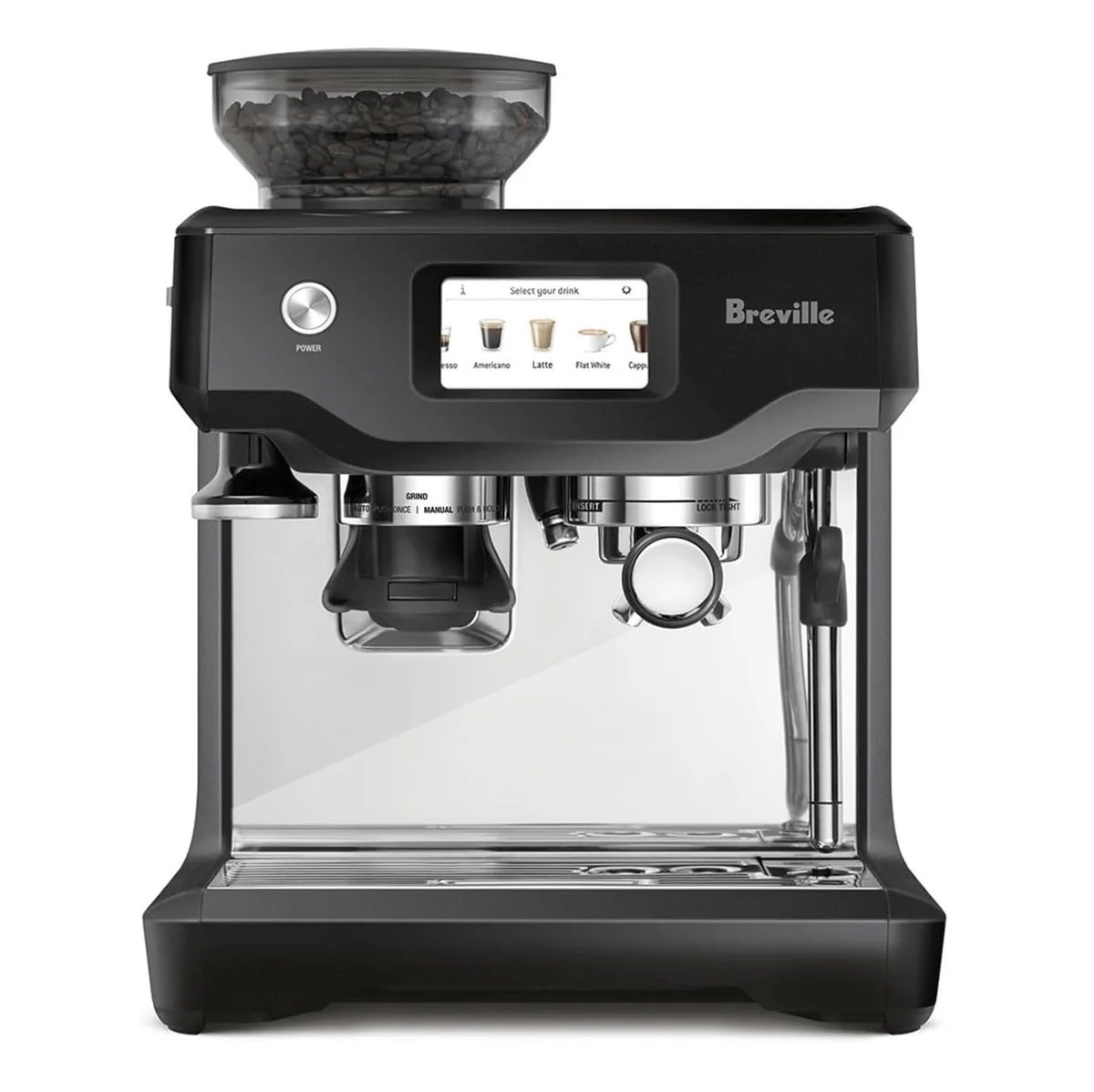
Breville Barista Touch
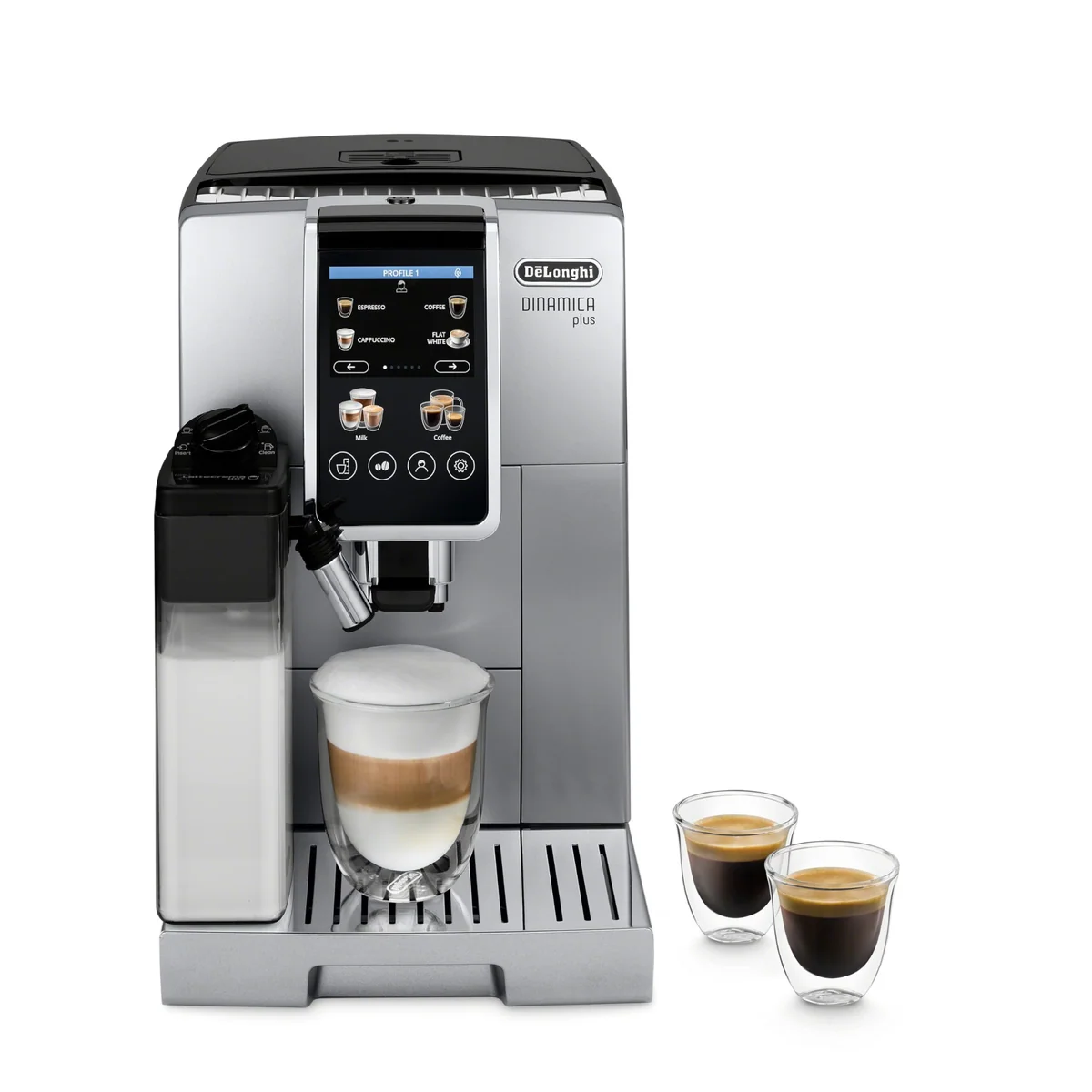
De'Longhi Dinamica Plus
Breville's own listing for the Barista Touch calls it a semi-automatic espresso maker in the same paragraph that promises café drinks in three easy steps, and both halves of that sentence are true at once. The three steps are grind, brew and milk, and the machine does a share of each of them. It does not do the tamping, and it does not carry the milk from the jug to the cup. The reviewer at Coffeeness, who bought one and worked it as a trained barista, puts the consequence more bluntly than any retailer ever will: this is very much a semi-automatic, tamping is on you, and for some buyers that is the end of the conversation.
The Dinamica Plus Connected is the machine most people arriving at that Breville listing are actually picturing. Beans in the hopper, a thermal carafe of milk that lives in the fridge and clips onto the front, thirteen grind positions behind a hatch, and a colour touchscreen that pours a cappuccino without you touching anything but the screen. If the distinction is new to you, our explainer on what a super-automatic actually is and the short answer to whether Breville makes one will save you a return.
So this is not a fight between two coffee machines. It is a fight between two theories of what a coffee machine is for, and the honest way to run it is to look at what each one asks of you before looking at what it gives back.
| The job | Barista Touch | Dinamica Plus |
|---|---|---|
| Grinding and dosing | Machine, straight into the portafilter | Machine, straight into the brew unit |
| Levelling and tamping | You, every time | Nobody, the brew unit compresses it |
| Choosing the grind | You, across 30 settings, re-chosen per bag | You, across 13 positions, then left alone |
| Shot timing | Machine, to a target you set | Machine, and you cannot change it |
| Texturing the milk | Machine, into a jug you hold under the wand | Machine, into the cup |
| Pouring the milk | You | Nobody |
| After the drink | Knock out the puck, wipe the wand, rinse the jug | Turn the carafe dial to Clean and put it back in the fridge |
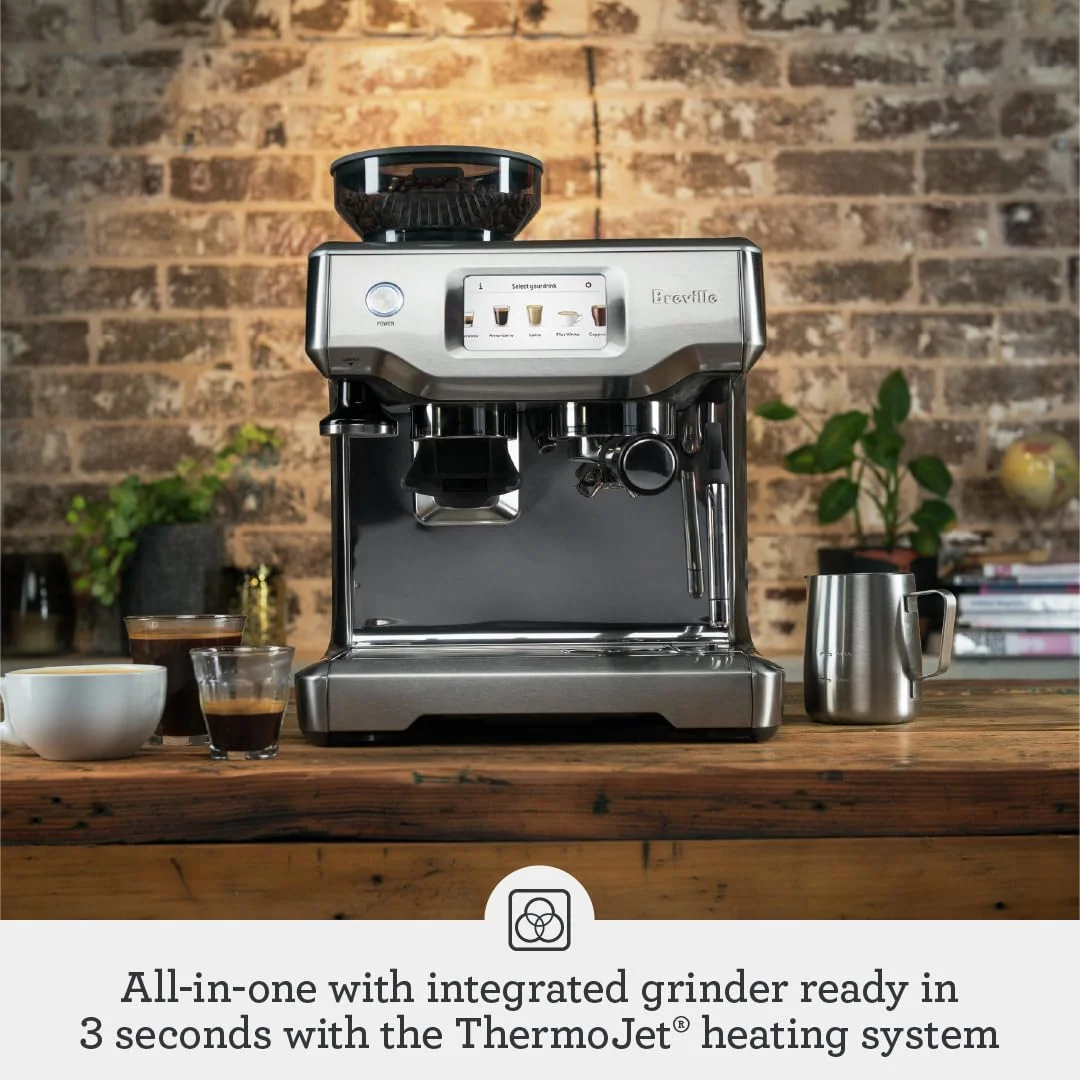
Breville Barista Touch
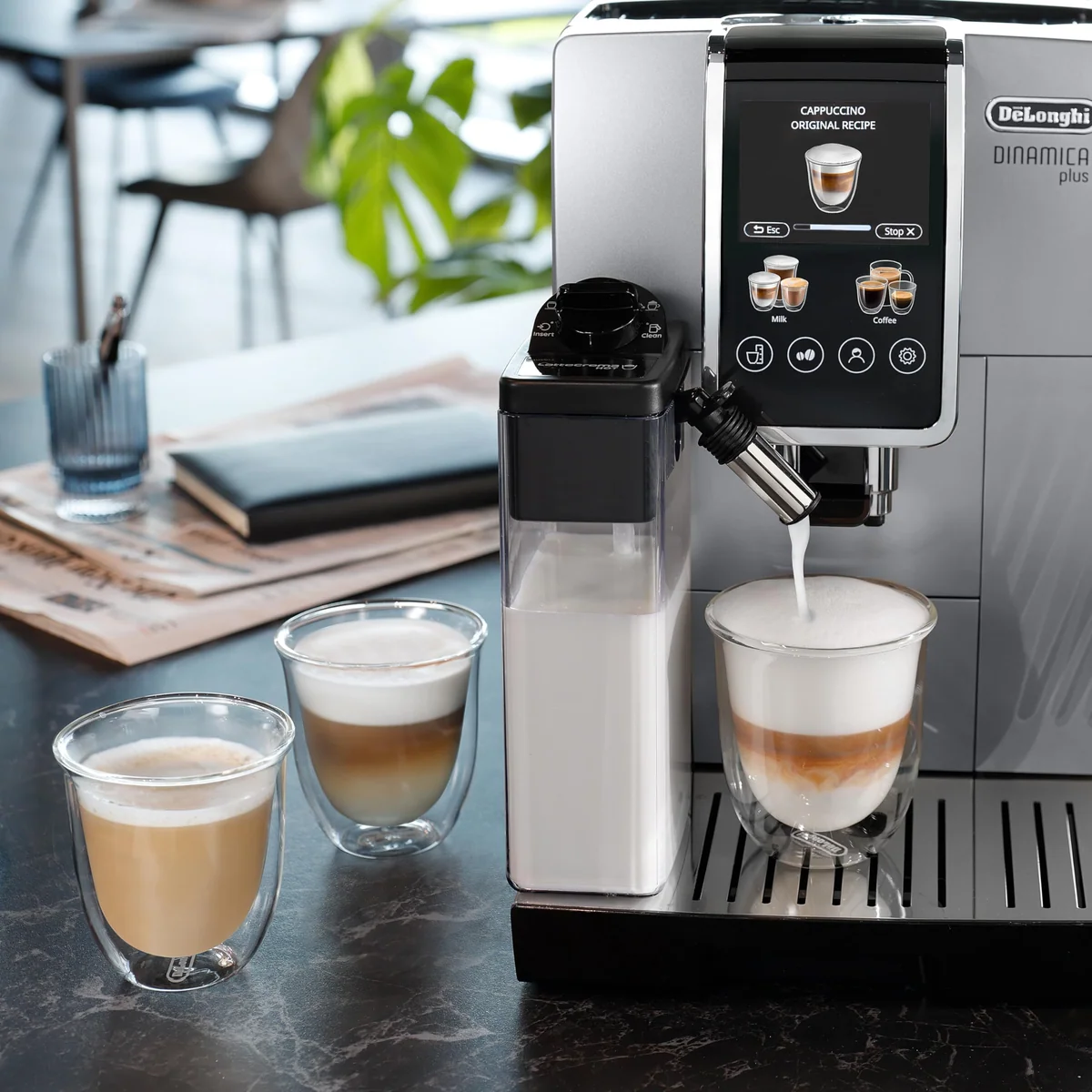
De'Longhi Dinamica Plus
At a Glance
| Feature | Breville Barista Touch Espresso Machine BES880BTR, Black Truffle | De'Longhi Dinamica Plus Fully Automatic Espresso Machine - Brew Personalized Coffee for up to 4 User Profiles, 24+ Recipes, Built in Grinder & Automatic Milk Steam Wand with 3 Frother Modes |
|---|---|---|
| Price Range | $500–$1,000 | $1,000–$1,500 |
| Configuration | Large | Pack of 1 |
| Finish | Black Truffle | Silver |
| Items In Box | 1 | 1 |
| Check Price on Amazon | Check Price on Amazon |
Two machines that both dose by the second, and only one of them tells you
Here is the thing nobody puts on either box: neither of these machines weighs your coffee. Both of them run the burr for a fixed number of seconds and call whatever lands in the basket a dose. On the De'Longhi that mechanism is drawn as a row of coffee beans on the screen, and the published mapping puts the top setting at roughly ten seconds of grinding for about fifteen grams, which is the ceiling that separates the Dinamica Plus from the cheaper machines in the same family. On the Breville the same mechanism is exposed to you as a dose time in seconds, which sounds like more control and is really more responsibility, because changing the grind size changes how much coffee falls in that many seconds and quietly invalidates the setting you spent last week finding. Breville's own trainer tells you never to move more than two or three grind steps at a time for exactly this reason. Espresso Den's advice on the Breville is the same as it is in our full review of it: buy a scale at the same time as the machine, because one Amazon owner has already concluded that he weighs his beans every time rather than trusting the timer, and he is right.
The Dinamica handles the same problem by taking it away from you. Pin the strength at maximum, leave the grind between three and four, and the machine will make the same drink for years. What it will not do is make a classical espresso, because it cannot be told how long to brew, so it pours fast and lands nearer a one-to-three ratio than a one-to-two. That is a very good turbo shot rather than a bad espresso, and the ratios that make it taste right are worth dialling in.
The ceiling and the floor are on opposite machines
Dialled in, the Breville is the better coffee. The Coffeeness reviewer, working with a rested medium-light blend, ended up with shots he described as consistent and full of citrus, red fruit and caramel, and he also admitted that finding that window took him a while even as a professional. The floor underneath that ceiling is genuinely low. One complete beginner pulled a latte better than her usual chain order on her first attempt, then got nothing at all out of the second and third, then got two good ones again. Two dead shots in the first five, on a machine that costs what this one costs, is the ordinary first evening rather than a fault.
Two traps make it worse than it needs to be, and both are worth knowing before you buy rather than after. The Breville ships with dual-wall baskets alongside the single-wall ones, and used with coffee you have just ground they produce impressive crema that collapses instantly and a flat taste nothing will fix, which cost one owner months of blaming his own technique. And the conical burr at this price does not enjoy dense light roasts, which is a ceiling rather than a defect and is printed nowhere. The De'Longhi has its own bean rule, which is that oily dark roasts gum up the chutes; between them the two machines want the same middle of the market, and which beans survive a built-in grinder covers the ground.
The fairest single line about the Breville's ceiling comes from an owner who gave it three stars and meant it kindly: if you always add milk you will love it, and if you drink your espresso straight and know what a specialty bar tastes like, you will not. Read that as the boundary rather than a complaint, because it applies with even more force to the De'Longhi.
The milk decides this for most people
Breville's automatic wand is the reason this machine costs what it does. The specification gives you milk temperature adjustable between 104 and 167 degrees Fahrenheit and eight levels of texture, with a sensor that stops the wand when the jug hits your number. A five-year owner writing for Food & Wine runs soy at 130, oat at 140, almond at 130 and dairy at 150, and those four numbers only exist because the temperature is a dial rather than a fixed setting. The Coffeeness reviewer went in expecting to beat the machine with his own hands and reported, with visible irritation, that he could not. You still hold the jug, you still pour, and if you want latte art you still have to learn it.
The LatteCrema carafe answers a different question. It comes out of the fridge, clips on, textures directly into the cup and goes back in the fridge, and it froths oat and almond as a matter of routine rather than as a party trick. What it will not do is get hot. Put a thermometer in it and the milk stalls around 59 °C, which a newer sibling in the same range beats. In a cortado you will never notice. In a sixteen-ounce latte it is the difference between a drink and a disappointment, which is why one owner's standing tip is to microwave the mug before pressing the button. That is a real cost, and it is the single most common reason people fall out of love with this family of machines; why they run lukewarm explains why it is a category norm rather than a broken unit, and the wider argument between a wand and a carafe is the one to settle before you spend anything.
The weekday morning, measured in what you have to be present for
Total time barely separates them. An owner of the Breville reckons the whole routine at under two minutes half asleep, including grinding, brewing, frothing, dumping the grounds and wiping the frother. The De'Longhi will hand you a cappuccino in roughly a minute and a half. The difference is that almost every one of the Breville's two minutes needs you standing there, and almost none of the De'Longhi's do. One or two drinks a day and the ritual is the point. Four drinks across two people before school, and it is a queue.
The De'Longhi's tax is different in kind. It rinses on power-up, after milk drinks and again on shutdown, so an owner keeps a glass permanently under the spouts to catch it and warns that the alternative is a tray of dirty water every day. The carafe dial has to go to Clean after every drink and back before the next one, and on some machines the carafe port grips hard enough that one owner bought an entire replacement jug, reproduced the fault exactly, and concluded the problem was on the machine side. Neither of these is a machine you can ignore. They just ask for the attention at different moments.
What actually breaks
The Breville's best-documented failure is cruelly well aimed: the temperature sensor behind the automatic milk wand, which is to say the exact feature you paid the premium for, and it tends to surface after the first year rather than in the first month. Around it sit the ordinary things. One Amazon owner had a unit stop dead at seven months and rated it one star for the support that followed rather than for the fault, while another had a defective machine replaced quickly and cheerfully. When it does need fixing, an owner facing a dead machine was quoted a repair amounting to well under half the price of buying another, and the owners who weighed in called that fair.
The De'Longhi's characteristic failure arrives at the opposite end of the timeline. Water-path faults out of the box are the most repeated complaint on the listing: one buyer's machine would not clear a water circuit alert from day one and the support thread went silent after two requests for the same video, and another's water tank arrived with the plastic locating lip snapped so the machine never registered it was fitted. That second owner also got a replacement tank shipped the same day with a tracking number, which is the pattern in miniature: ask De'Longhi for a part and it goes well, ask them to diagnose something and you get a script. Unpack this one and inspect the tank before you fall in love with it, and register the machine, because owners consistently report a third year of cover for doing so. Neither manufacturer has earned a clean bill here, and the shape of how long these machines last and what goes first holds for both.
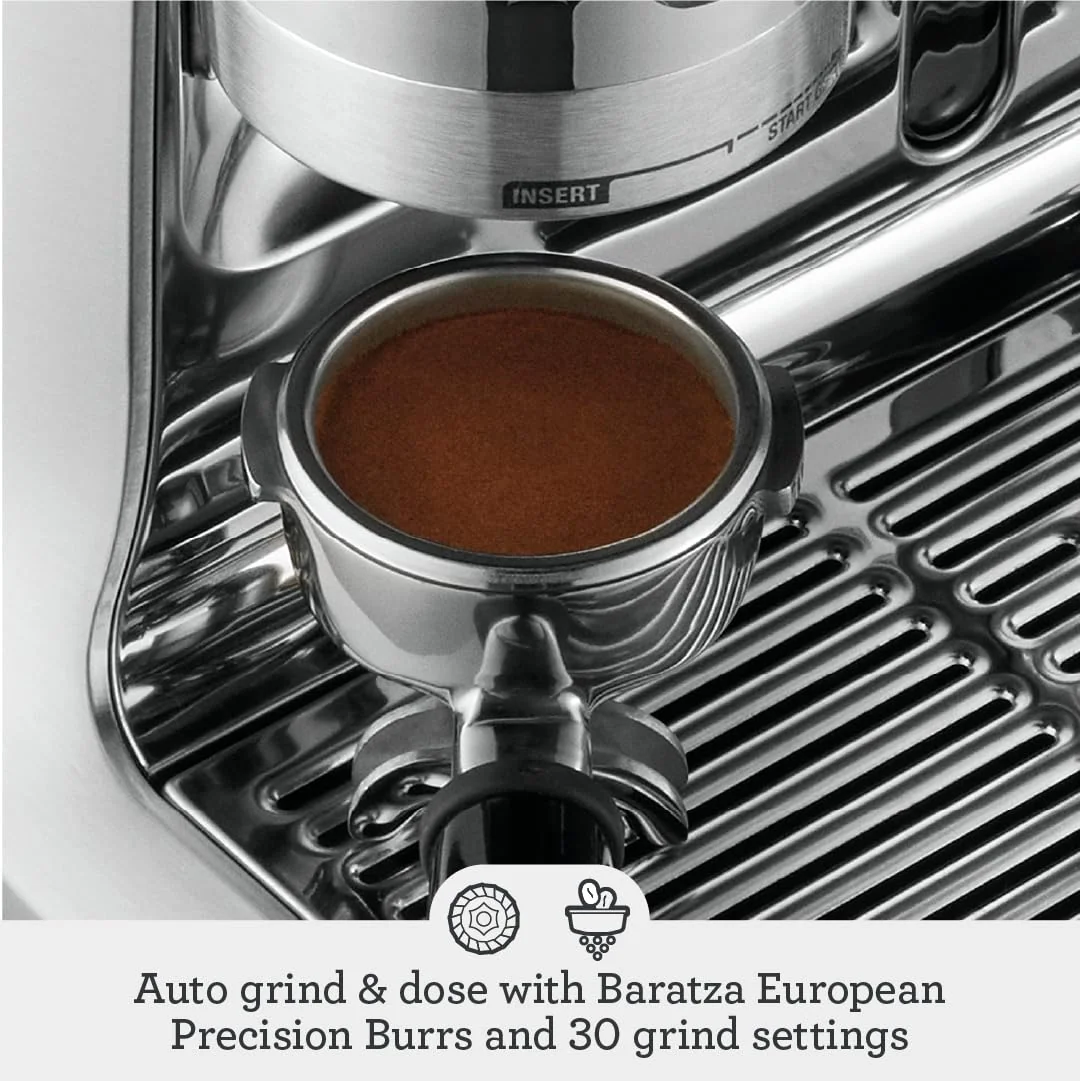
Breville Barista Touch
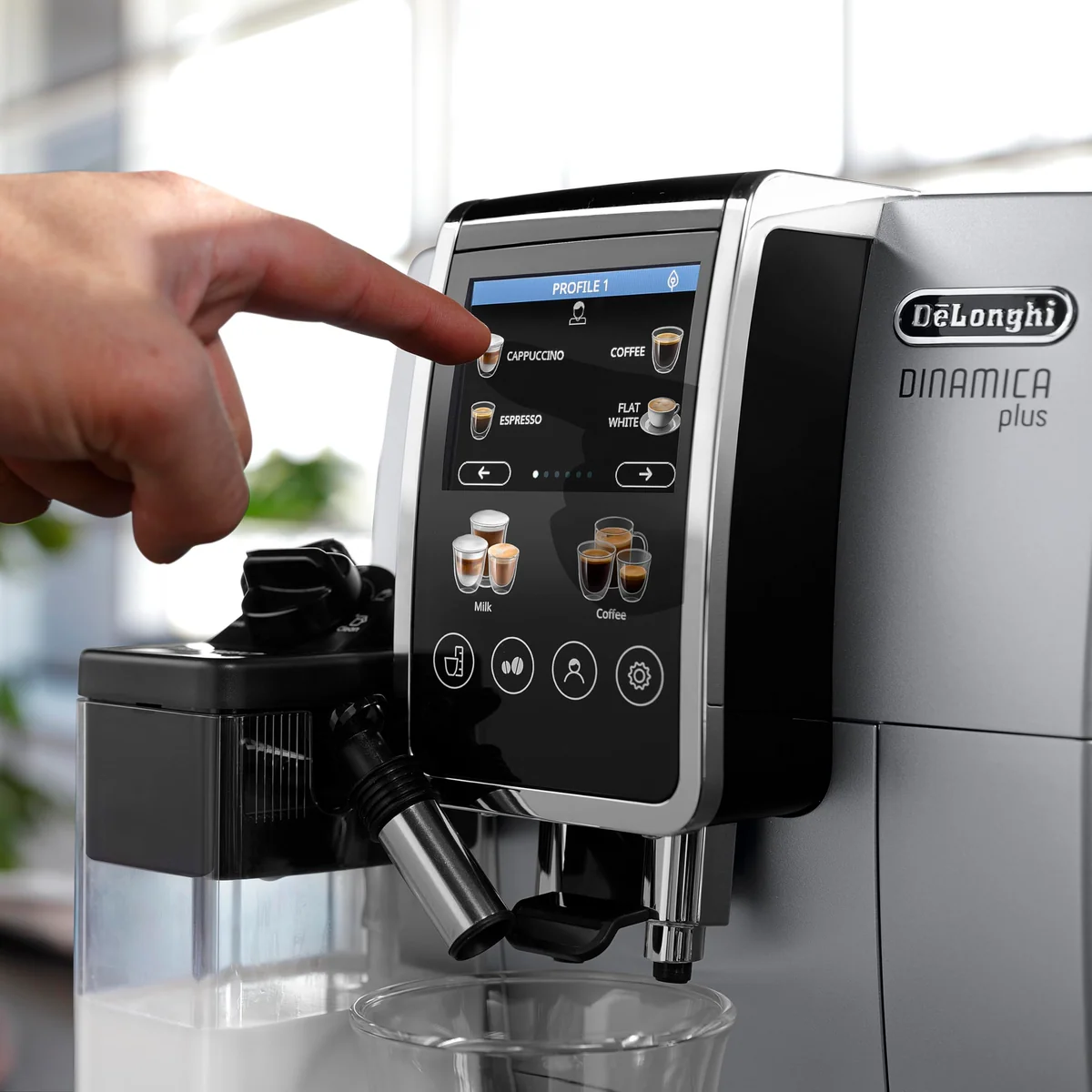
De'Longhi Dinamica Plus
Which one belongs on your counter
Whatever the two cost on the day you look, money is unlikely to decide this, because they land close enough together that the deciding factor is your own morning. Run yourself against this instead.
| If this is you | Then |
|---|---|
| One or two drinks a day and you like the ritual | Barista Touch, and budget for a scale |
| Three or four drinks across two people on a weekday | Dinamica Plus, because nobody queues |
| You drink your espresso straight and know what a good bar tastes like | Barista Touch, and even then only just |
| Your regular order is a sixteen-ounce latte | Barista Touch, because the De'Longhi's milk will not be hot enough |
| You want a flat white with real microfoam | Barista Touch, with practice you will have to do yourself |
| Someone else in the house will use it and will not learn it | Dinamica Plus, every time |
| Your beans are a dense light roast from a local roaster | Neither grinder is happy, so change one or the other |
One purchasing note before the buttons. This De'Longhi listing is the Connected model, and the app is the only thing separating it from the version without one. It is Bluetooth rather than Wi-Fi, pairing is a coin flip that had one owner connect instantly on one phone and call support for the second, and the same owner's verdict is the one to keep: you do not buy the machine for the app, you buy it for the coffee. The listing itself promises eighteen recipes in the title and sixteen four lines down in its own description, which tells you roughly how much weight to put on the recipe count. What the app genuinely buys is the ability to type a drink volume as a number instead of brewing and pressing stop, and if that does not sound like your problem, the non-connected model is the better buy.
For the person who wants the coffee to be partly their own doing
It hands you the grinding, the shot timing and a milk wand good enough that a trained barista publicly admitted he could not beat it, then leaves the tamp and the pour in your hands, which is the only route to a shot with a real ceiling at this level.
The grinder doses by time rather than weight, so every grind adjustment silently changes your dose until you reset the timer, and a scale is effectively part of the purchase price.
For the household that wants a cappuccino without a conversation
Fifteen grams of finely ground coffee at a single press, plus a fridge-cold carafe that textures oat as readily as dairy straight into the cup, is as close to a real drink as a walk-away machine gets.
The milk peaks around 59 °C, so anything larger than a cappuccino arrives warm rather than hot unless you preheat the cup or reprogram the drink with less milk.
Three honest exits. If the carafe idea appeals but the cleaning and the temperature worry you, the Philips 5500 LatteGo is far quicker to wash and doses smaller, and we set the two against each other in Philips 5500 against the Dinamica Plus. If you drink long milky mugs above all else, start from the machines built around milk rather than from either of these. And if you have read this far and the Breville's appeal is really the automatic milk wand rather than the touchscreen, a Bambino Plus with a proper grinder beside it gives you that same hands-off texturing and puts the rest of the money into the grind. The underlying question, which is whether a push-button machine is worth it at all, comes down to how many drinks a week you genuinely make rather than how many you intend to.
Frequently Asked Questions
Is the Barista Touch a fully automatic machine?
No, it grinds and textures for you but you tamp the coffee and pour the milk yourself, which is why Breville's own copy calls it semi-automatic.
Which one makes the better espresso?
The Breville, once you have dialled it in, because the Dinamica Plus cannot be told how long to brew and pours a fast shot at a longer ratio no matter what you do.
Which one is better on a busy weekday morning?
The De'Longhi, because the two machines take roughly the same total time but only one of them needs you standing in front of it for all of it.
Can the De'Longhi make a proper flat white?
Not really, because its foam is firm rather than silky and its milk tops out below café temperature, so the drink on the menu is a flat white in name only.
Do I actually need a scale for the Breville?
Yes, because the grinder doses by seconds rather than grams and every grind change moves your dose without telling you.
Which one handles oat milk better?
Both do it properly, the De'Longhi by design through the carafe and the Breville because its wand lets you set a lower target temperature for plant milk instead of scalding it.
Can either of them use decaf or pre-ground coffee?
Both can, the De'Longhi through a pre-ground chute that takes several button presses to reach and the Breville simply by putting pre-ground into a dual-wall basket, which is what those baskets are for.
Is the Connected version's app worth choosing over the plain one?
Only if you want to set drink volumes as exact numbers, because the app is proximity-only Bluetooth that most owners stop opening after setup.
Ready to Choose?
Sources (7)
- Amazon listings and customer reviews — Breville Barista Touch and Delonghi Dinamica Plus
- Owner reports across r/espresso, r/BrevilleCoffee threads
- Owner and reviewer video, 2 channels
- Coffeeness — Article — www.coffeeness.de
- Tomscoffeecorner — Article — tomscoffeecorner.com
- Breville — Article — www.breville.com
- Foodandwine — Article — www.foodandwine.com