The built-in grinder is the right idea, and usually the wrong grinder
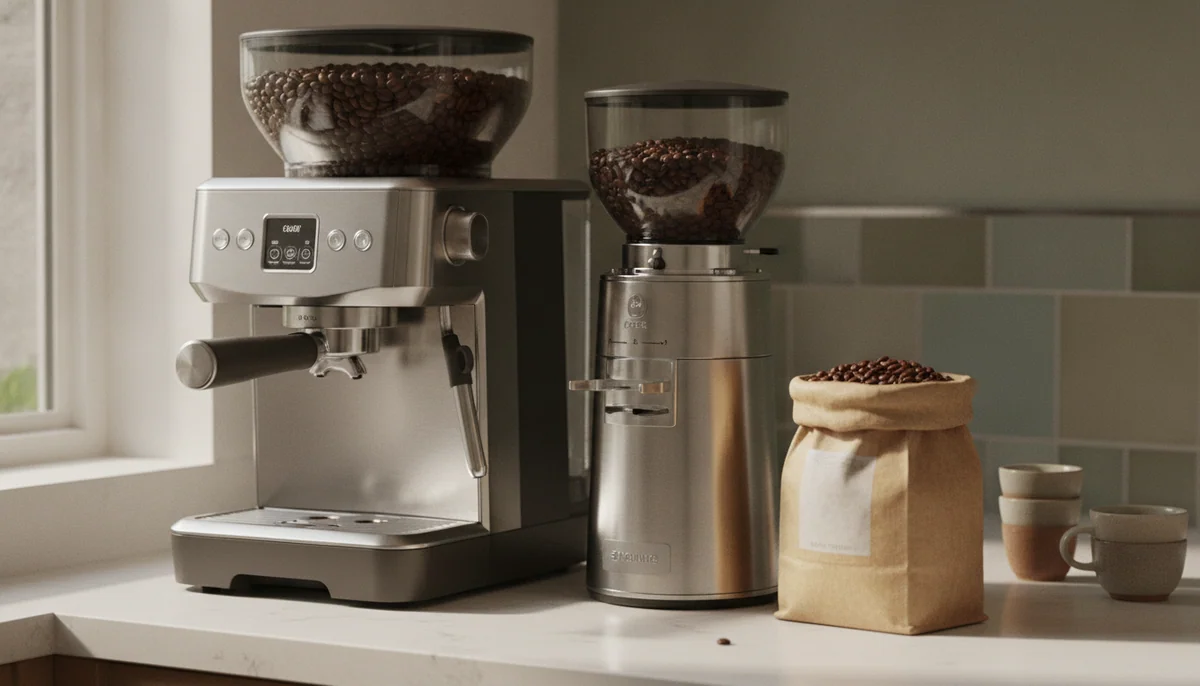
The argument for an all-in-one is almost impossible to lose on paper. Fresh beans instead of a bag of dust that was ground in a warehouse, one plug, one footprint, one purchase, and none of the awkward business of shopping for a second appliance whose job you do not yet understand. It also happens to have the priorities in the right order. Ask the people who care most about espresso which half of a setup deserves the money and the answer comes back monotonously: the grinder, first, ahead of the brewer.
The gap this fills is real and it is wider than most sellers admit. Turn up in r/espresso with a couple of hundred dollars and a request for a first machine and you will get a hundred replies, and a good share of them are people gently explaining that the budget has to cover two appliances rather than one. Serious Eats, reviewing one of the most recommended beginner machines on the market, put the same thing in its list of drawbacks in six words: you have to buy a grinder too. An integrated machine looks like the answer to that problem, and sometimes it is.
What it is really doing, though, is choosing your grinder for you and then bolting it to something you cannot sell it away from. Under a fixed total price, every dollar the grinder gets is a dollar the boiler, the pump and the case do not, and the grinder is the component a buyer is least able to judge from a product page. That is why the interesting question is not whether to have a grinder built in. It is whose grinder it is, where its steps land, and what happens to the rest of the machine on the day it stops.
The number on the box is the cheapest thing in the box
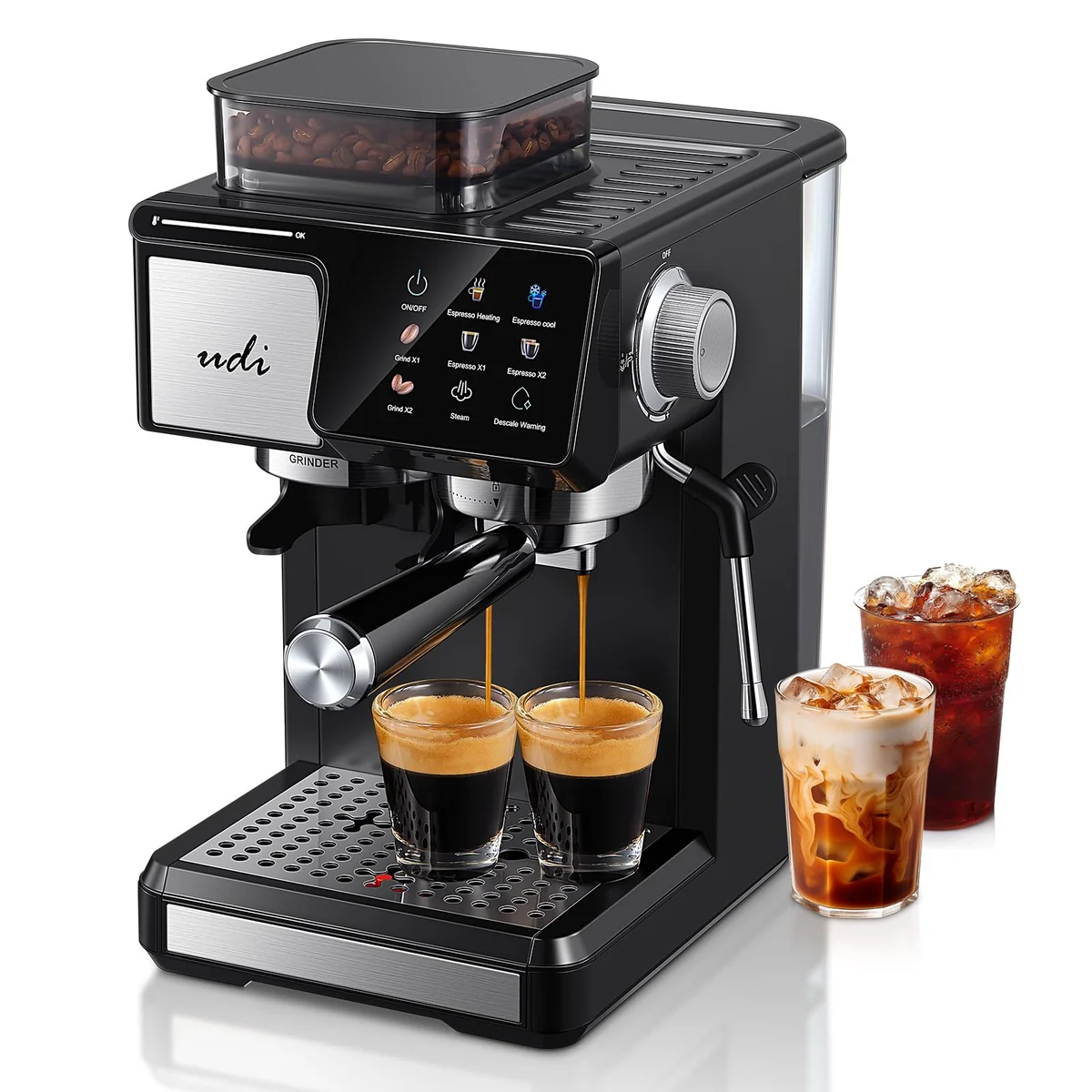
Grind settings are the specification manufacturers inflate first, because adding detents to a collar costs nothing and reads like precision. UDI sells twenty of them, fine to coarse, with automatic measurement for single and double shots and the promise that no barista skills are needed. Gevi's combo advertises thirty-five. Kndko does not publish a count at all, only a knob and a conical burr set. Breville, selling a machine and a Baratza Encore ESP as one purchase, quotes forty, and then does the thing none of the others do: it says where they are.
| Machine | Settings claimed | Where the steps actually land |
|---|---|---|
| UDI 20 Bar | 20, fine to coarse | Unconfirmed by anyone hands-on; the listing's most exacting reviewer describes a wheel on the left side and "several options" rather than a numbered scale |
| Gevi 20 Bar with burr grinder | 35 | Spread across every brew method, and an owner reports the finest of them still is not fine enough for espresso |
| Kndko grind and brew | Not published | A knob you turn by feel, with no stated range and no stated dose |
| Breville Bambino Plus with Encore ESP | 40 | Numbers 1 to 20 reserved for espresso alone, with 21 to 40 given over to filter and press |
Read that column on the right and the counts stop mattering. A grinder that spans French press to espresso in thirty-five clicks is spending most of them somewhere you will never brew, and what you actually need is resolution in a band perhaps two millimetres wide, where one step can be the difference between a shot that gushes in fifteen seconds and one that runs properly. Twenty steps covering the same span is worse arithmetic wearing a better number. Espresso Den's rule for reading these listings is simple: a manufacturer that has genuinely engineered the espresso end of the range will tell you which settings are the espresso end, because it is the only thing worth bragging about, and a manufacturer that has not will give you a total and hope.
The ceiling is real, and one owner measured exactly where it is
The most useful thing anyone has published about a bundled grinder was written by a Gevi owner with a kitchen scale. Their portafilter holds fourteen grams, so a normal shot should weigh about twenty-eight grams in the cup. They were getting seventy-two. They bought a bottomless portafilter to escape the pressurised basket that was causing it, and hit the wall: the grinder, on its finest setting, does not grind fine enough to hold back water without that basket's help. Cutting the shot short at twenty-eight grams did not rescue it either, it just made the coffee bitter, which is what truncating an under-extracted shot always does. Their conclusion was blunt and correct: the machine makes lungo.
That is the whole failure mode of a cheap integrated grinder in one paragraph, and it is worth understanding why it is a design decision rather than a defect. Machines in this band ship pressurised, dual-walled baskets, which manufacture back pressure through a small restriction so that the puck does not have to. That makes any grind work, produces crema from almost any coffee, and quietly caps the drink. The trap is that the crema looks right, which is why an owner who ran dual-wall baskets for months titled their eventual write-up around having been fooled by them. The high pressure figure on the front of these boxes is a consequence of the same choice rather than a feature: what reaches the coffee is set by the puck, and one r/espresso regular's response to somebody with a twenty bar machine was to ask whether they were really getting ten. We took that apart separately in what the bar number actually tells you, and the thin, fast, over-long shot it produces has its own page in why the espresso comes out watery.
So the standard upgrade path for a cheap semi-automatic, which is to fit a proper basket and dial the grind in, is closed to you from the day it arrives. Not difficult. Closed. That is the specific thing an integrated grinder takes away, and no listing mentions it.
One appliance, two things to break, and only one of them worth keeping
The question of whether these combined machines are a good idea gets asked directly and repeatedly by people about to buy one. The strongest structural answer against them has nothing to do with coffee: it is that you have doubled the number of moving assemblies behind a single serial number, with bespoke fittings, and no way to retire half of it.
Here is what that looks like in practice. Among the retained reviews on the Gevi combo, one owner is nine months into daily use with the machine working as well as it did on arrival, and another had the grinder stop grinding at four months, wrote to the seller, wrote to Gevi, and got no reply from either. The second one is a two-box set, so at least the espresso machine survives its own grinder. Put that same failure inside a single case and the whole appliance is scrap. Kndko's own alarm list is quietly instructive on how much machine is in there: it warns separately about the brewer, the residue tray, the brewing door and the grinder knob being fitted wrongly, which is four assemblies an owner is expected to take apart and put back.
| Arrangement | What you gain | What a dead grinder means |
|---|---|---|
| Grinder inside a cheap portafilter machine | One footprint, one purchase, no decision to make | The brewer goes in the bin with it, and no better grinder can rescue the basket anyway |
| Grinder inside a true bean-to-cup | Genuine one-touch coffee, with dosing and tamping handled behind a door | A service job on a sealed machine, which is affordable or fatal depending entirely on whether parts exist |
| Grinder as its own appliance beside the machine | Either half can be replaced, upgraded or sold without the other | You make coffee with pre-ground for a week and buy one box |
Breville's own bundle is the clearest admission of which column it believes in. It sells the machine and the grinder together, in one transaction, at roughly what the two cost apart, and it still ships them as two boxes with two different warranty periods, two years on the machine and one on the grinder. A company that could put those burrs inside the case chose not to. That asymmetry is also worth noticing before you buy, because nobody reading a single price expects two coverage windows inside it. If you want the general shape of what wears out and when, we keep that in how long these machines last and what breaks first, and the case for buying a known brand refurbished rather than an unknown one new is in our page on renewed machines.
What integration is genuinely good at
None of the above touches the thing an integrated grinder does better than any separate one, which is the fifteen centimetres between the burrs and the basket. That short journey is where a separate grinder loses grounds, and it is the single most common daily complaint from people who own one. Two of the eight retained Gevi owners raise it unprompted, in a listing whose own copy promises a comfortable and relatively quiet grinding experience: the grinder does not deliver into the centre of the portafilter, it makes a mess, and it is loud. Nobody returns a machine over this. Everybody wipes the counter every morning for years.
Watch how differently each design answers it. UDI's cheap machine fits a shield over the filter basket while the grinder runs so the grounds do not spray, and the reviewer who found it says you should tamp gently before lifting the shield off so they do not fall out; that is a genuinely thoughtful piece of design in a machine we recommend against for other reasons. Breville includes a dosing cup that drops the grind straight down into a fifty-four millimetre portafilter. Kndko, being a real bean-to-cup, does not have the problem at all, and claims a straight-drop powder channel with no residual grounds, which is at least a claim you can falsify with a torch in your first week.
The other honest prize is retention, and it goes the same way. Grounds left in a chute are yesterday's coffee in today's cup, and a sealed short path beats a separate grinder with an angled exit for both freshness and mess. If your reason for wanting a grinder in the machine is that you will otherwise never own one, that reason is good enough on its own. Just do not confuse it with a reason to expect better espresso.
A flawless grind in front of a cold brewer is still a bad coffee
The grinder-first rule is right, and it is also frequently misread as the only rule. Everything downstream of the burrs still has to work, and the cheapest all-in-ones fail there rather than at the grinder. The UDI is the cleanest example on this site: its grinder is praised outright by the most demanding voice on its listing, and the same reviewer put a thermometer in the machine and found the brew water peaking at 140 to 142°F, a finished drink reaching about 160°F and falling below 150°F, and the shot itself coming out very quickly and tasting thin at three stacked shots. Espresso wants water near 200°F. No grind setting raises the temperature of the water, and no amount of patience does either.
It happens at the good end of the market too, in milder form. Coffeeness, reviewing a machine whose paired grinder is beyond reproach, marked it down mainly for espresso arriving in the cup cooler than it should, because the heater warms water in seconds without warming the group head or the part-plastic portafilter it falls through. That one is fixable with a hot flush before you brew. The cheap thermoblock version is not, and our page on lukewarm coffee is largely a list of what you can and cannot do about it.
There is one thing that hides all of this, and you should know whether it applies to you before you spend anything. Milk forgives thin extraction almost completely. An owner of a comparable Amazon-brand machine said plainly that if they had only ever drunk milk drinks the machine would have been fine, and made the sharper observation underneath: every positive review they had watched was demonstrating a latte, which is exactly the drink that cannot expose the fault. If your daily cup is a flat white, a cheap grind-and-brew is a far better buy than this page has so far made it sound. If your daily cup is a straight double or an americano, it is a much worse one. That single question decides more here than any specification does, and if the milk half is the point, our comparison of the three milk systems is the more useful page.
Which of these to actually buy
Start with the category error, because a large share of people reading this arrived expecting push-button coffee. Amazon files several of these machines among the super-automatics and most of them are nothing of the kind: on the UDI and the Gevi you dose, tamp, lock in a portafilter and steam the milk yourself. If a machine that grinds, doses, tamps, brews and dumps the puck behind a door is what you pictured, read what that category actually is first and then the cheapest genuine examples of it, because no amount of learning turns a portafilter machine into one.
If you have decided to learn espresso properly, the Bambino Plus and Encore ESP bundle is the setup this whole page has been arguing towards, because it puts the grinder question beyond doubt and keeps the two halves separable. It is also the one that will disappoint anybody who bought it for the word bundle: it saves you almost nothing over buying the boxes apart, it is not automatic in any sense, and owners consistently report the machine losing its composure by the third drink in a row. Breville's own range answer to the automation question is covered in what its machines actually automate.
If you are leaving pods behind, drink cappuccinos, have a small counter and do not own a grinder, the Gevi 20 Bar combo arrives as a complete working setup with every tool in the two boxes and a steam wand its owners genuinely like. Buy it knowing the ceiling described above is permanent, that the bundled grinder cannot reach espresso-fine, and that the one owner in the retained record who needed support did not get an answer.
If you want a true grind-and-brew with an automatic brew group and you specifically want a manual wand rather than a milk carafe, the Kndko is the cheapest honest version of that machine we have found. The drawback is not the coffee, it is the record: a rating built from ten ratings, no published dose, wattage, tank size, warranty or grind count, and no independent test by anyone, which means whoever buys one is the tester. Read it on a clock and measure it inside the return window.
And the UDI is where the argument of this page turns into a warning. It has the best evidence of any machine here that its grinder works, and it is the one we would steer you away from, because a working grinder in front of water that never gets hot buys you nothing. If the budget is the immovable constraint, the balanced case for cheap espresso machines is worth ten minutes, and the same corner of Amazon holds the GarveeTech under the same rules. Whichever you land on, feed it something it can handle: our notes on which beans jam these grinders will save you a bag or two of learning.
Frequently Asked Questions
Is an espresso machine with a built-in grinder worth it?
It is worth it if it stops you buying a machine with no grinder at all, and it is a poor trade if you were always going to buy a real grinder anyway, because the one in the box sets a ceiling you cannot lift later.
Do more grind settings mean a better grinder?
No, because what matters is how many of the steps fall inside the narrow espresso band rather than how many exist between French press and espresso.
Why does my all-in-one produce a big, weak shot instead of espresso?
Almost always because the pressurised basket and a grind that cannot go finer are together forcing water through too fast, which is a design limit rather than a mistake you are making.
Can I fit a bottomless portafilter and fix it?
Only if the grinder can reach espresso-fine, and on the cheap combos an owner who tried found that it cannot.
Is a grind-and-brew the same thing as a super-automatic?
Not usually, since most of the cheap ones still require you to tamp a portafilter and steam milk yourself, and only a machine with an automatic brew group that ejects its own puck belongs in that category.
What happens when the built-in grinder dies?
On a two-box set you replace the grinder, and on a single-case machine from a brand with no parts supply you generally replace the machine.
Can I still use pre-ground coffee or decaf in one?
Many of them accept it through a bypass or straight into the basket, and our guide to pre-ground and decaf covers how to do it without wasting a scoop.
Does an integrated grinder need cleaning of its own?
Yes, the chute and burrs hold stale grounds and coffee oil, and that maintenance sits on top of the descaling routine covered in our cleaning schedule .
If I only drink lattes, does any of this matter?
Much less than it does for anyone drinking espresso straight, because milk conceals the thin extraction that defines this class of machine.
Sources (5)
- Amazon listings and customer reviews
- Owner reports across r/espresso, r/BrevilleCoffee, r/superautomatic threads
- Seriouseats — Article — www.seriouseats.com
- Breville — Article — www.breville.com
- Coffeeness — Article — www.coffeeness.de