A 20 bar espresso machine is not a better 9 bar espresso machine
Walk the cheap end of the espresso shelf and almost every box shouts a pressure figure at you. Fifteen, nineteen, twenty. The implied argument is arithmetic: more bar, more extraction, more coffee. The people who have actually put gauges on these machines do not read it that way at all. When somebody turned up on r/espresso with an unbranded 20 bar machine, the first reply was a question rather than congratulations: "Are you actually getting 20 bar? The pressure is determined by the puck resistance (grind) and the pressure drop across the portafilter. I suspect you are less than 10." Someone else in the same thread called the printed figure "likely a very optimistic number that the marketing department drove more than the actual system capability."
They are describing two different measurements that have been allowed to share a word. One is what the vibratory pump can generate when it is pushing against something closed. The other is the pressure that arrives at a bed of ground coffee while water is moving through it, which is the only pressure that has ever changed how anything tastes. The target for the second one is about nine bar, and higher is not a stretch goal. "You don't need 15-20 bar espresso machine. 9 bar is fine," runs the plainest version of it.
So why does the number appear on every listing in this price band? Because printing it costs nothing. The GarveeTech one-touch machine puts "20 Bar Pressure" in its title and then again in all five of its bullet points, one of which also argues that 1350 watts makes the machine quiet, which is not something wattage can tell you.
What follows is not a takedown of cheap espresso machines. Espresso Den has recommended several of them to specific people for specific reasons, and two of the five machines on this page are decent buys for somebody. It is a takedown of one number, and an argument about what you should be reading instead, because once you know what the twenty is actually advertising you can shop this shelf properly rather than by loudness.
The figure is measured where your coffee is not
A pump rating is a bench specification. It is the ceiling of a component, taken with nothing in the way, in the same spirit as a car's redline rather than its cruising speed. Between that pump and your cup sits a valve whose entire job is to throw away the surplus, so that the group head sees something in the region of nine bar no matter what the pump is capable of. A machine advertising twenty is not delivering twenty; it is advertising the size of the number it is about to discard.
You can watch this happen on a machine that has a gauge. Gevi's stainless model sells itself on a 20-bar pump alongside NTC temperature control, pre-infusion and a front pressure gauge, which is a more informative feature list than most of its neighbours manage.
An owner of that machine then reports what the gauge does in practice: grind a little finer, tamp a little harder, and the needle swings into the red. They also note that water is still sitting in the basket afterwards, because the machine does not vent pressure at the end of a shot. Read that sequence again, because it is the whole argument in miniature. The needle in the red is not a scoreboard rewarding your technique. It is the system telling you that resistance has risen past what the design wants, on a machine whose headline promise was that it could push harder than anything else on the shelf.
Regulars in the one substantial Reddit thread about these machines treat the figure as a tell rather than a specification. One called it "a weird flex", and read it as a manufacturer either trying to sound over-engineered or "catering to an audience that thinks more is always better". That is an unkind way to describe a marketing decision and it is also, on the evidence of five listings, accurate.
What the twenty is actually advertising is the basket
Here is the part that makes the number genuinely useful, just not in the direction the box intends. A machine designed around a very high pump rating is almost always a machine shipped with a pressurised basket, sometimes called a dual-wall basket: a filter with a single small hole beneath a second floor, so that the back-pressure required to build crema is produced by the hardware rather than by the coffee. The same thread describes the alternative precisely. Better machines and bottomless portafilters lack that hole, the ground coffee itself provides the resistance, the drink tastes better, and the cost is that your grind has to be right and your grinder has to be good enough to get there.
A pressurised basket is not a scandal. It is a deliberate act of forgiveness: it will make a passable, foamy drink out of supermarket pre-ground and a careless tamp, which is exactly what a first-time buyer needs. What it also does is sever the link between how a shot looks and how it tastes, and that severance explains the single most confusing thing about reviews of cheap espresso machines.
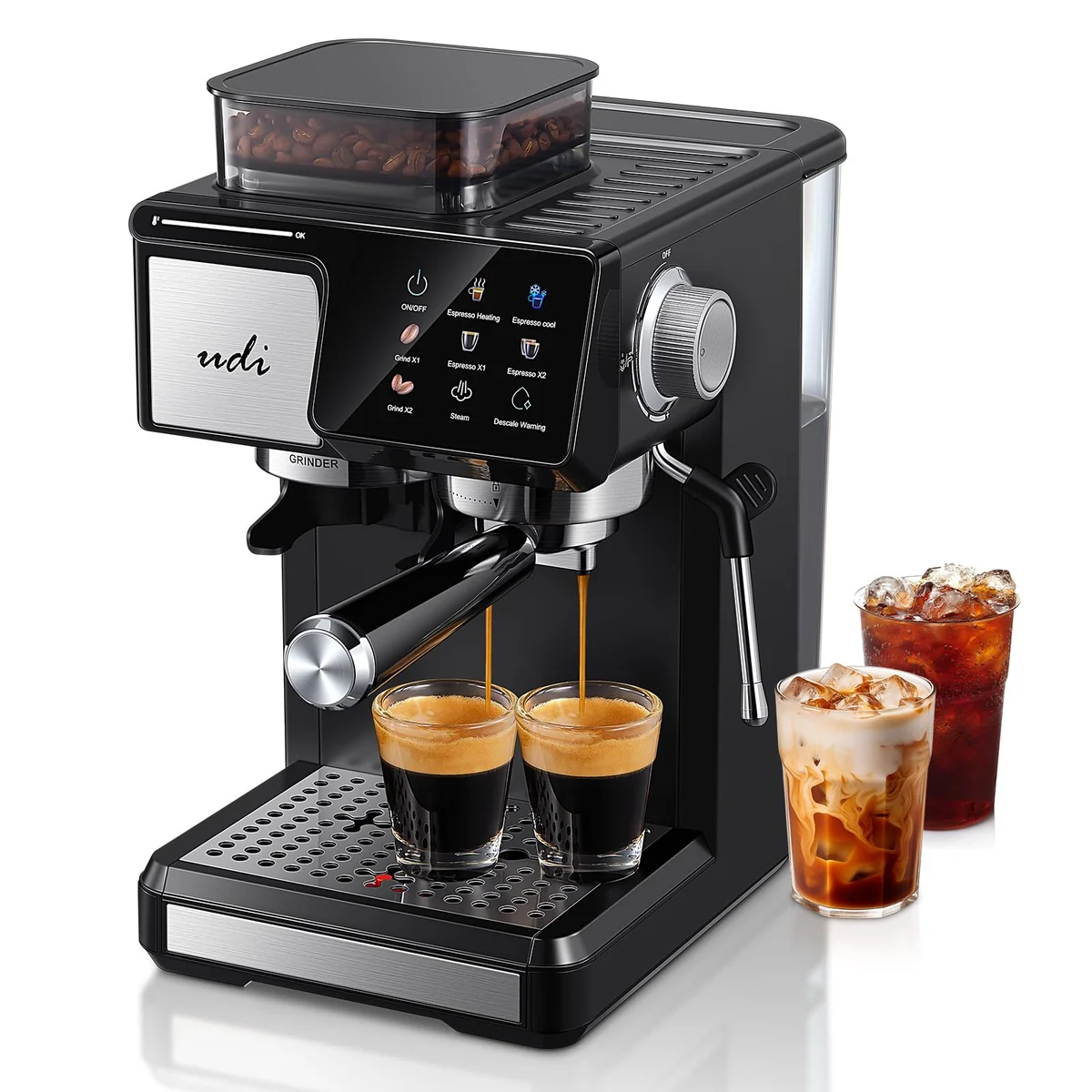
Look at the UDI listing. One owner reports "a nice, thick crema every time". Another, the most careful reviewer on the page, likes strong coffee, pulls three shots instead of two, still finds it weak, and reports that her husband finds it weak too. Those two people are not arguing. Aerated foam and extracted coffee are separate outputs, and a pressurised basket produces the first while the second depends on grind, dose and temperature that nobody has controlled.
An owner of a comparable Amazon-brand 20 bar machine described the same effect from the inside, saying it "basically made coffee with an airy foam 'crema' on top, and it was never hot though. It struggled with finer grinds." They then made the observation that should reframe every clip you have watched about this class of product: the positive reviews they had seen were all demonstrating milk drinks, which forgive everything, and none of them were testing the thing that fails.
The obvious escape is to fit a proper unpressurised basket and let the coffee do the work. On a pump rated this high that is the wrong move, since an unpressurised basket wants a lower brew pressure and a dedicated espresso grinder standing behind it.
And even where a listing invites the upgrade, the rest of the box can close the door. One Gevi grinder-combo owner bought a bottomless portafilter to escape exactly this, and found that the bundled grinder on its finest setting does not grind fine enough to use it. The ceiling was welded shut at the factory, not by the pump but by the burrs.
The numbers that would have told you something
Notice which figures appear when somebody actually tests bean-to-cup machines against each other rather than describing them. A six-machine comparison of this category measured dose, grind fineness, brew ratio, temperature and extraction percentage, and every machine that failed in it failed on one of those. Pressure is not among the things it bothers to report.
The two most useful sentences ever written about the machines on this page are both measurements taken by owners with cheap equipment. One Gevi owner put a scale under the cup, found the portafilter held fourteen grams, expected roughly twenty-eight grams of liquid, and got seventy-two. That is a ratio near one to five, which is a lungo, and cutting the pour short at twenty-eight grams did not rescue it; it just turned the drink bitter, which is what truncating an under-extracted shot does.
The other put a thermometer in a UDI and found brew water peaking at 140°F, "142º at best", with the finished milk drink reaching about 160°F before falling to 150°F and below. Espresso wants water at the puck somewhere around 195 to 205°F. No pump rating on earth compensates for a thermal system that undersized, and the manufacturer's own troubleshooting instructions for lukewarm, weak coffee reportedly changed nothing when followed.
| The question | Why it decides the cup | What this shelf usually admits |
|---|---|---|
| How many grams per shot? | Dose sets the strength ceiling before anything else happens; a café double is eighteen to twenty grams. | Rarely published at any price, and never on the cheapest listings. |
| What ratio comes out? | Weight in against weight out is the difference between an espresso and a long black wearing its name. | One owner measured fourteen grams in and seventy-two out. |
| How hot is the water at the puck? | Under-temperature water under-extracts regardless of pressure, and cold milk drinks are the most common complaint in this band. | One measured example sat around 140°F; most listings say nothing. |
| How fine will the grinder actually go? | It sets whether you can ever leave the pressurised basket behind. | Settings are counted proudly; fineness is never specified. |
| Pressurised basket or not? | It decides whether crema means extraction or aeration. | Almost always pressurised, almost never stated. |
| How long between brewing and steaming? | A single thermoblock has to change temperature between jobs, and that gap is where a milk drink goes cold. | One machine's support desk quotes three to five minutes. |
Every one of those is measurable in your own kitchen inside a return window with a scale and a thermometer, which is the practical reason to buy this class of machine on a clock rather than on a star average. If the coffee lands thin, our piece on why espresso from these machines comes out watery covers the mechanism, and if it lands lukewarm, the temperature page covers what is and is not fixable from your side of the counter.
Five machines that print the number, and what each one really is
Because the pressure figure is shared across machines with almost nothing else in common, it is worth being blunt about what the box contains. Two of these five require you to tamp coffee by hand. Two are genuine bean-to-cup machines with automatic brew groups. One is sold in the wrong Amazon aisle entirely, and so is another. If the distinction is new to you, start with what a super-automatic actually is, because the shelf a machine sits on is not evidence of anything.
| Machine | What you are mechanically buying | Amazon files it under |
|---|---|---|
| UDI CM5530 | A portafilter machine with a built-in grinder, a touchscreen and a manual steam wand. | Super-Automatic |
| Kndko grind and brew | A genuine automatic brew group that doses, presses, brews and ejects the puck, with a manual steam wand for milk. | Super-Automatic |
| Gevi grinder combo | Two boxes: a small semi-automatic machine plus a standalone conical burr grinder and a full set of tools. | Semi-Automatic |
| Gevi stainless auto-frother | A semi-automatic with no grinder at all, whose "automatic" milk frother is a sleeve over the steam wand. | Super-Automatic |
| GarveeTech grey one-touch | A genuine one-touch bean-to-cup with a removable brew unit and a milk tube you drop into a carton. | Super-Automatic |
UDI CM5530
Buy it only if you drink milky coffee, actively want to learn a portafilter, and will accept a drink that is warm rather than hot, because the grinder is the good part and almost everything downstream of it argues the other way. Its drawback is not a matter of taste: one owner measured brew water at 140 to 142°F and reported that following the manual's own remedies changed nothing, while a second owner, working from workflow rather than a thermometer, returned it because the espresso was cold by the time the milk was steamed. Two people, two methods, one answer. The full case is in our review of the UDI.
Kndko grind and brew
This is the most honestly shaped machine of the five for a milk drinker who actively wants a wand instead of a carafe, since the listing describes a real brew group rather than a portafilter dressed up as automation, and a wand hands you control of milk temperature and texture along with much less to clean than a hose-and-container system. The drawback is that nobody knows anything about it: the star average rests on ten ratings, no independent reviewer has published a test, and Kndko declines to state the dose, the wattage, the tank capacity, the warranty length or even how many grind settings the knob has. It also sells one-click cappuccino two bullets away from a manual steam wand, and only one of those can be true. Our review sets out what to measure in week one, and the milk systems page is worth reading before you decide a wand is what you want.
Gevi grinder combo
Of the five, this is the one Espresso Den would put in front of a first-time buyer escaping pods, because it arrives as a complete working setup rather than a machine you then have to fund a grinder for, its steam wand is the best-supported claim on the listing, and one owner is nine months into daily use with nothing gone wrong. Two drawbacks, both real: the bundled grinder cannot reach espresso-fine, which permanently closes the upgrade path described above, and among the retained reviews there is a grinder that died at four months whose owner wrote to the seller and to Gevi and heard back from neither. The listing also promises a relatively quiet grinding experience that two of eight owners flatly contradict.
Gevi stainless auto-frother
It is a pleasant single-person daily driver that looks better than its price band suggests, heats quickly, and lets you reprogram the shot volumes to whatever you actually drink, which fixes the most common early complaint about it. Its drawback decides the purchase for any household of two: it makes one drink and then wants three to five minutes before it will brew again, and when an owner phoned to find out what was wrong, Gevi's own support desk told them the machine is not professional, a word that is sitting in the listing title. Both Gevi machines are reviewed together, since they share a banner and almost nothing else.
GarveeTech grey one-touch
This one earns its place on a light drinker's counter: it is a real bean-to-cup with a brew unit that lifts out for cleaning, a feature owners treat as a quality marker on machines costing several times as much, and its six one-touch drinks include plain hot water for tea. The drawback is that there is no temperature adjustment of any kind, and the owner who spent a month chasing consistency ended up with "multiple funky tasting drinks" and a two-star review; separately, one of the eight written reviews is a milk frother that stopped working within a few weeks and went back. Our review works through what twenty-five ratings can and cannot tell you.
Who should buy one of these anyway
The split is not rich versus poor, and it is not snob versus normal person. It is what is in your cup. If your daily drink is a latte, a flat white, a cappuccino or an iced coffee, the espresso is a flavouring inside a much larger drink, and every fault this page has described is either hidden or survivable. Milk covers thin extraction almost completely, and a drink that arrives warm rather than scalding matters less when you have just poured cold milk into it. For that buyer a machine on this shelf is a genuinely good purchase and the number on the front is simply irrelevant, which is a different thing from being a lie. Our page for milk drinkers covers the tier above if the budget can move.
If you drink your coffee black, walk. A straight double, a cortado, an Americano built on one shot: these are drinks where the espresso is the entire product, and thin, fast, lukewarm extraction lands directly on the only thing you are tasting. No amount of grind adjustment, tamping practice or fresh beans raises the temperature of the water or narrows a one-to-five ratio, and the machines built for black coffee live several rungs up. If the budget is fixed, the cheapest genuine super-automatics and a renewed unit from a brand with a parts diagram are both better uses of the same money than a new machine from a brand with no service history at all. The wider question of whether a cheap machine from an unfamiliar name is a safe buy has its own page, and so does whether a grind-and-brew all-in-one is a good idea in the first place.
Whatever you buy, the beans do more work than the pump. Dark and medium roasts extract far more forgivingly on machines that run cool and cannot grind especially fine, and an oily bean will gum a cheap chute; our list of beans that work saves a bag or two of learning. If you expect to keep the thing for years rather than months, read what breaks first and what a repair costs before you commit, because at this end of the market a dead pump is usually a bin rather than a bill.
The short version has not moved. Twenty bar is a component's maximum, the coffee sees roughly nine whatever the box says, and the figure survives on listings because it is free to print and pleasant to read. Buy the machine for its dose, its temperature, its grinder and its milk system, and let the pump rating be the last thing you look at rather than the first.
Frequently Asked Questions
So does twenty bar beat nine bar?
No, because nine bar is roughly the pressure espresso is extracted at and twenty is a pump maximum the coffee never experiences, so the larger figure describes a component rather than a cup.
Then why does my machine make thick crema and thin coffee?
Because a pressurised basket aerates the drink on its way out instead of relying on the ground coffee for resistance, which produces foam that looks like a good extraction and tastes like a weak one.
Is a 15 bar machine therefore worse than a 20 bar one?
Not meaningfully, since both figures sit far above what reaches the puck and the same manufacturers sell near-identical hardware under either number.
Can I fit a bottomless portafilter and get proper espresso out of it?
Usually not, because an unpressurised basket wants lower brew pressure and a grinder that reaches espresso-fine, and the owner who tried it on a machine of this class found the bundled grinder could not go fine enough on its finest setting.
Do the fully automatic bean-to-cup machines print this number too?
Some of them do, including two of the machines on this page, and it tells you no more there than it does on a portafilter machine.
My shot pours in about fifteen seconds, is that the pressure?
Fast flow is under-extraction caused by grind, dose and puck resistance rather than by the pump, and stacking a third shot on top of a thin one gives you more thin liquid instead of a stronger drink.
What single number should I ask a seller for instead?
Ask for the dose in grams per shot, because it sets the strength ceiling before temperature, grind or pressure get a say, and a listing that will not publish it has told you something too.
Is a machine like this a mistake if I mostly drink lattes?
No, and that is the honest case for the whole category, since milk hides the thin extraction and the modest temperature that would ruin a straight espresso.
Sources (3)
- Amazon listings and customer reviews
- Owner reports across r/espresso, r/IndiaCoffee threads
- Owner and reviewer video, 1 channel