On a bean-to-cup machine the scoop of decaf goes in last, and the order is the whole trick
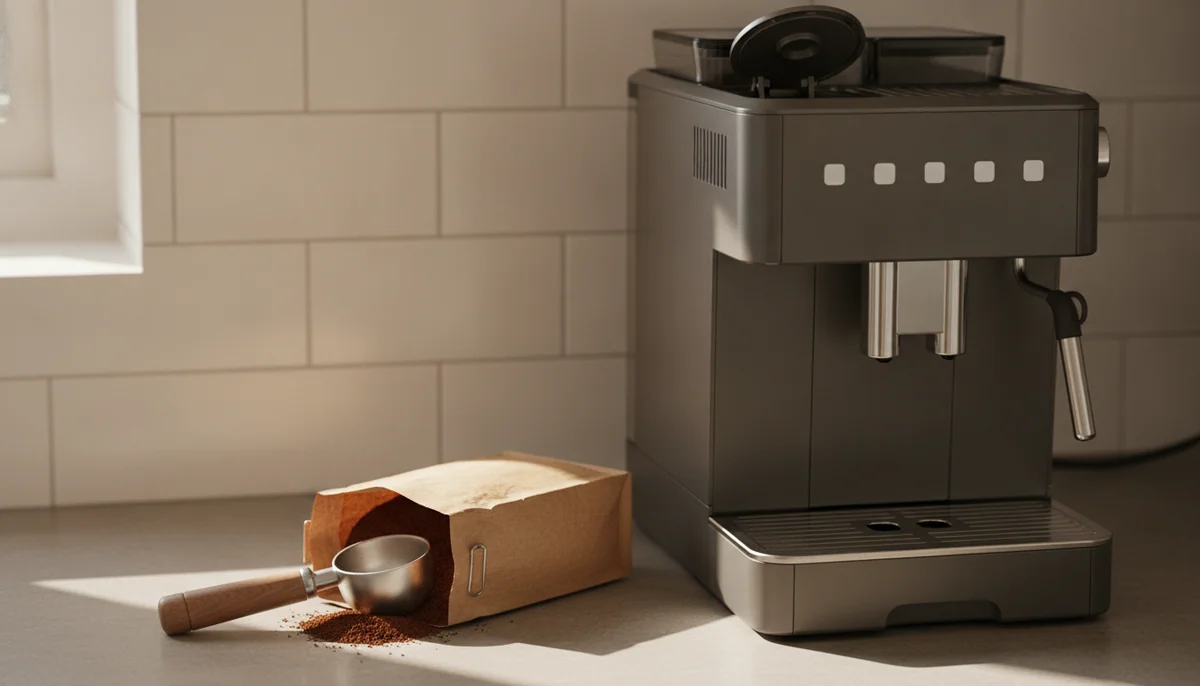
Every machine on this page has a small flap on the top plate beside the bean hopper, and behind it sits the one part of a super-automatic that behaves like a manual espresso machine. You put ground coffee in, you tell the machine to skip the grinder, and it brews that and nothing else. It is how a decaf gets made at nine at night without tipping a hopper of espresso beans into a jar, and it is how the one guest who cannot drink caffeine gets a cup at all.
It is also, on the evidence, the function owners fight with most, and the fight is almost never about the coffee. It is about sequence. A Philips 3200 owner who otherwise rates his machine highly writes that his took two or three goes to accept a scoop, and that what fixed it was procedural: power on, let the startup rinse finish, load one level scoop, close the lid, then choose the drink, after which it repeats happily for the rest of that power cycle. On the 4400, one owner could not get the function to work at all and concluded that a drip machine would serve her better. In the owner threads, the same chute collects reports of cancelled cycles, watery output and grounds going mouldy around the opening.
None of those people had a broken machine. They had a machine that expects to be asked in a particular order and gives no useful feedback when it is not. Philips has an entire published explainer devoted to what nobody tells you about the feature, which is a reasonable indication of how well the box covers it. Espresso Den's read of the whole record is that the chute is fine, and that its documentation is where the waste comes from.
It is a one-shot bypass, not a second grinder
The thing to understand before you open the flap is how little the chute is meant to do. It holds one dose. It brews one drink. It reverts to beans the moment that drink is finished, and on most machines it forgets you ever asked. There is no saving it to a profile, no doubling it, and no strength setting, because strength on a super-automatic is a grinder run-time control and the grinder is not running.
The dose matters more than people expect. Philips's own figures for the 5500 put the brew unit's charge between roughly six and nine grams depending on the strength step, and the measuring spoon in the box is sized to land in the same region. A level scoop is therefore not a suggestion, it is the specification. Heaping it does not give you a stronger drink, it gives you coffee sitting in the chute that the brew unit could never have taken, and a flap that needs wiping out afterwards.
Which leaves volume as the only lever you have. If the pre-ground cup tastes thin, shorten it rather than trying to force more coffee in, because the same arithmetic that makes these machines mild on beans applies with a scoop and no compensating grind adjustment. Our piece on why bean-to-cup espresso comes out watery works through the ratio properly, and it is the same problem wearing a different hat.
The order that keeps the scoop out of the waste bin
The failure everyone describes has one mechanism behind it. If the machine is still in bean mode when it starts, it runs the grinder, brews whatever the grinder gave it, and the coffee you tipped into the chute falls through the brew unit unbrewed and lands in the grounds container. You get a pale cup and a wet lump of decaf in the bin, and nothing on the panel tells you that is what happened.
- Turn the machine on and let it finish its startup rinse before you touch anything.
- Put it into pre-ground mode. On the 2200 that is a press and hold on the strength button for about three seconds, with no screen to confirm you managed it. On the LatteGo machines with a strength scale, it is one step below the lowest bean setting, where a small scoop symbol appears.
- Follow whatever the machine then asks, because this is where models genuinely differ. Some want the scoop loaded before you select the drink; the 5500 confirms the drink first and then prompts for the coffee.
- Add one level scoop, close the flap, and start.
- Expect the first attempt on a machine you have never done this on to fail, and try again before concluding anything.
If the control on your model is not where you expect it, our guide to the hidden Philips menus and what the warning lights mean covers the button holds that no printed sheet in the box will.
| Machine | How you tell it to skip the grinder | What to expect |
|---|---|---|
| Philips 2200 (EP2220/14) | Hold the strength button roughly three seconds | No display, so you are counting and watching icons rather than reading words |
| Philips 3200 LatteGo (EP3241/54) | Step the strength control below its lowest bean setting | Owners report a couple of refused attempts before it takes, then reliable repeats in the same power cycle |
| Philips 4400 LatteGo (EP4447/90) | Named in words on the colour screen | The clearest interface of the group, and still the machine's least reliable function |
| Philips 5500 LatteGo (EP5544/90) | Scoop icon below the lowest strength step | Confirm the drink first, then add the coffee when the machine asks for it |
| De'Longhi Rivelia | Not the intended route at all | The second removable hopper is De'Longhi's answer to this whole problem |
The chute is also a vent, which is why it smells
Here is the part that gets left out of every tutorial. On several Philips machines the pre-ground opening doubles as a steam vent for the brew chamber, which is why the manual tells you to use one scoop per drink and no more: the machine needs to breathe through that hole between cups. A 3200 owner spells the logic out and reaches the sensible conclusion that if mould worries you, whole beans behind the sealed hopper lid are the safer habit.
The same owner later found a mould smell coming from the cavity where used pucks drop, in one of the driest regions of the United States, and now cleans it monthly. A 2200 owner reports the mirror image on the other side of the machine: a steam vent that passes the grinder, wets any lingering grounds, and cakes the inside over time. Damp coffee dust in a warm plastic box is not a Philips design flaw so much as physics, but it does mean the chute has a chore attached. Wipe the flap and the funnel dry after you use it, and keep the weekly brew group rinse in our cleaning and descaling schedule rather than treating it as optional.
Occasional decaf and daily decaf are different purchases
Once a week, for one visitor, the chute is exactly the right tool and costs you nothing. Every day, for a household, it is a bad deal, and the reasons compound. You buy ground decaf, which starts going flat the day the bag opens and which a two-person household will not finish quickly. You get one cup per loading, with a flap to open and a funnel to wipe each time. You lose the grind and strength controls that make the rest of the machine worth owning. And the ground coffee on the supermarket shelf is cut for a drip basket, not for a fifteen bar pump, which is why a Rivelia owner who runs pre-ground as his second coffee on another machine says plainly that the taste is not as good.
The alternative is a second hopper, and it is the single best argument for the Rivelia. Two removable 8.8 ounce containers sit on the roof, you lift one off and drop the other on, and both coffees stay whole beans. Owners who bought it for exactly that reason describe keeping decaf loaded for the afternoon and evening and calling the swap the best thing about the machine. It is not free: roughly nine or ten grams of the previous bean are still sitting in the grinder chute when you swap, and you either purge them into the grounds drawer or brew them, which is why the neat move is to unlock the hopper before your own cup, drink the leftovers yourself, and then swap. One owner calls the waste a few cents and shrugs; another calls it wasteful and means it. Both are describing the same handful of beans.
If this is the fork you are standing at, our pick for households running decaf and regular is the fuller argument, and the 5500 against the Rivelia is where the scoop-versus-hopper decision gets priced out.
Which of these machines to put the scoop in
Espresso Den has not had any of these on a bench, and nothing above is our own measurement; what follows is our published verdict on each machine, restated for the reader who came here about decaf.
The Philips 2200 is the cheapest door into a Philips brew group, and it is the same grinder and brew unit fitted several rungs higher up the range, which makes it the sensible buy if you press one button for black coffee and steam your own milk. Its drawback is not the coffee: two owners on this listing independently report water pooling under a brand new machine, one of them across more than one unit, so unbox it near a sink and brew on day one. Note also that the listing sells it on three presets and never mentions ground coffee at all, which tells you how central Philips thinks the feature is.
The Philips 3200 LatteGo is the one machine here with a first-hand account of the pre-ground routine working reliably once its owner found the sequence, and the two-part milk carafe remains the best reason in the category to choose Philips. Its drawback is that the milk drinks pull a single shot each and cannot be set to double, so a cappuccino made from a scoop of decaf is a small amount of coffee in a lot of milk.
The Philips 4400 LatteGo has the best implementation of this feature on the page for one boring reason: the colour screen names the mode in words instead of asking you to interpret an icon. The drawback is blunt and it is the reason this section is not a recommendation. The chute is the least reliable function on that machine, with owners reporting cancelled cycles and brown water, and at least one who never got a usable cup out of it. Its listing sells twelve recipes and says nothing about the thirteenth route into the brew unit.
The renewed Philips 5500 is the one to want if a household of two to four each need their own saved settings and the milk-froth-only button matters, and the renewed units in this listing's review record read well, with buyers describing machines that show no sign of prior use. The drawback is the warranty rather than the machine: one buyer's arrived leaking on Christmas Eve and went straight back, and leaks are exactly the fault that tends to appear after a short renewed guarantee has expired. Our page on buying renewed covers what to check before that window closes.
The De'Longhi Rivelia is the buy if two people in the kitchen drink two different coffees, because the hopper swap does exactly what it claims and takes seconds. Its drawbacks are the ten grams stranded in the grinder on every swap, and milk drinks that arrive warm rather than hot, which raising the temperature setting mitigates without solving. Buy it for the hoppers or do not buy it, because everything else it does is matched by cheaper De'Longhi machines.
One last thing worth saying to anyone reaching for the scoop because the beans are the problem: if the coffee has been disappointing you, the chute is not the fix. Bean choice does far more work on these machines than most buyers expect, and our guide to what survives a bean-to-cup grinder is where that argument belongs. The chute is for the coffee you cannot put in the hopper, not for the coffee you wish tasted better.
Frequently Asked Questions
Can I use pre-ground coffee in a Philips LatteGo machine?
Yes, through the flap next to the bean hopper, one level scoop per drink, with the machine switched into its pre-ground mode before you press start.
Why did my machine dispense hot brown water with no real coffee in it?
Almost always because the machine was still in bean mode when it started, so your scoop fell through into the grounds container while a tiny ground dose brewed in its place.
How much ground coffee actually goes in?
One level scoop from the spoon in the box, which is sized to match what the grinder itself doses, and heaping it is the quickest way to block the funnel.
Can I put two scoops in to make it stronger?
No, the brew unit takes one dose per cycle, so the way to a stronger cup is a shorter volume setting rather than a bigger charge.
Does the strength setting do anything when I use pre-ground?
No, because strength on these machines controls how long the grinder runs and the grinder is not running.
Can I run decaf without emptying the bean hopper?
Yes, and that is precisely what the chute is for, though it gives you one cup at a time with no way to save it as a preset.
Is the chute good enough for a daily decaf habit?
Not really, because a bag of ground decaf goes stale long before a small household finishes it and every cup costs you a scoop, a flap and a wipe.
Why does the pre-ground opening smell after a while?
On several Philips machines that opening doubles as a steam vent, so grounds left sitting around it get damp and eventually go mouldy.
Should I buy a machine with two bean hoppers instead?
If decaf is a daily fixture rather than an occasional courtesy, yes, because the swap takes seconds and keeps both coffees as whole beans.
Will using the chute damage the machine?
Nothing in the owner record suggests it does, provided you stick to one level scoop of actual ground coffee and keep the funnel wiped dry.
Sources (4)
- Amazon listings and customer reviews
- Owner reports across r/superautomatic threads
- Owner and reviewer video, 4 channels
- Philips — Article — www.usa.philips.com