The Philips 5500 LatteGo is the easiest machine in the range to live with, and the same espresso as the cheap one
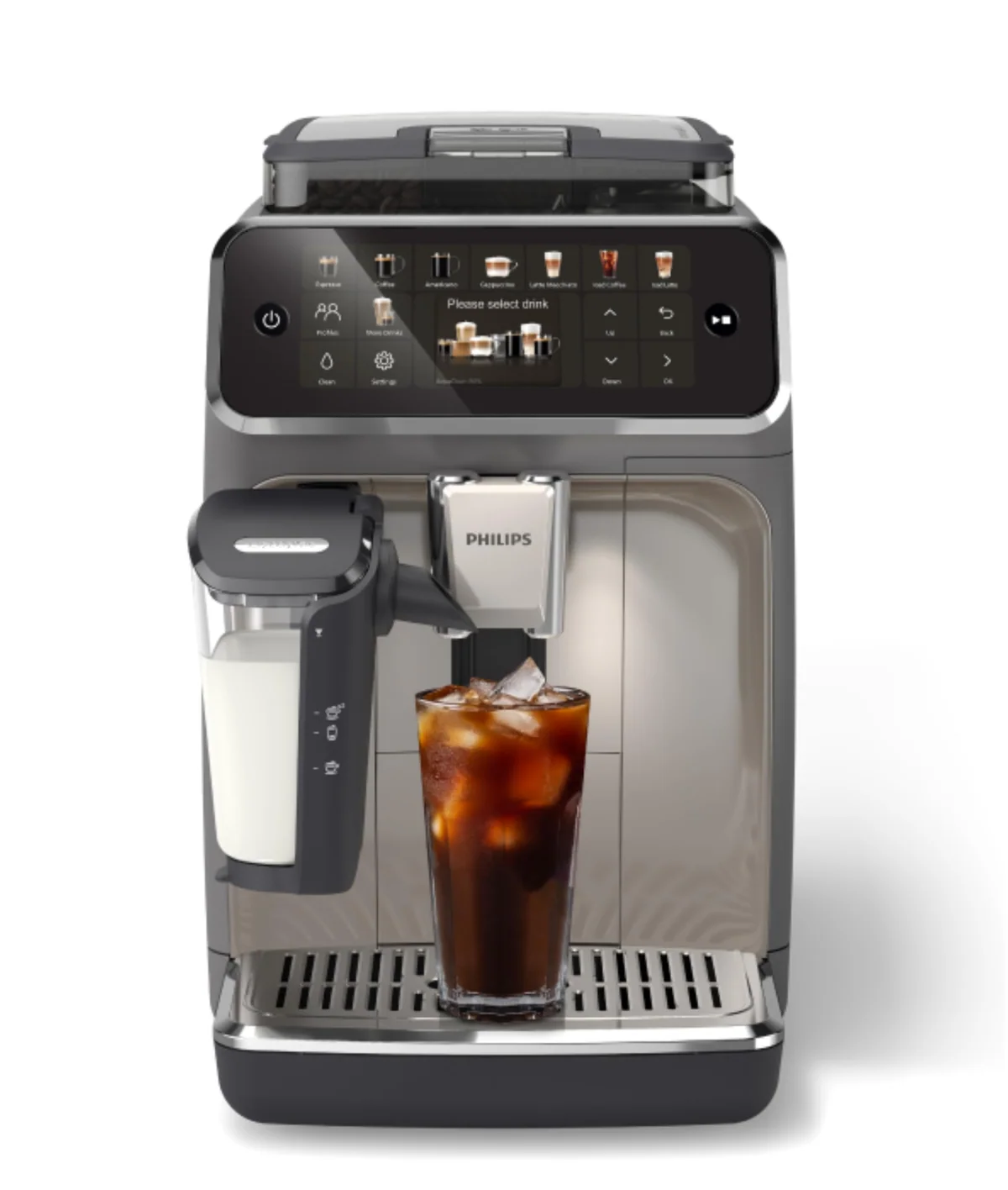
Buy the 5500 for the milk system, the profiles and the quiet, not for the espresso, because the brew unit inside it is the one Philips also fits to machines much further down the ladder.
Based on 354 owner ratings, 7 owner discussions and 9 other sources. We have not tested this machine ourselves.
We earn a commission if you buy through our links, which does not affect what we say.
Read how this site works →
Who should buy this, and who should not
Buy it if you drink cappuccinos and lattes, if you are leaving pods or drip behind, if two to four people in the house each want their drink their way, and if the thing that will actually determine whether you use the machine daily is how much washing-up it creates. On those terms the 5500 is very good and the LatteGo carafe is the best reason in the category to choose Philips over anyone else.
Do not buy it if what you want is a dense, intense espresso, a proper flat white, or genuinely cold coffee out of the spout. The dose will not support the first, the frother will not produce the second, and the third is a preset rather than a technology. And if you are buying renewed, be clear with yourself that the shortened warranty is the price of the discount, not an oversight: the failures owners describe are leaks and seals, and they turn up on a timescale the warranty does not cover. One five-year owner's four-word summary is still the fairest thing anyone has written about this machine, that the coffee disappoints, the cleaning is easy and it keeps working. Whether that is a good trade is a question about you rather than about the machine.
Buy the 5500 for the milk system, the profiles and the quiet, not for the espresso, because the brew unit inside it is the one Philips also fits to machines much further down the ladder.
Best for: Four listings, two colours and two conditions all wrap the same small brew unit, so the only question worth arguing about is what you are paying for the screen.
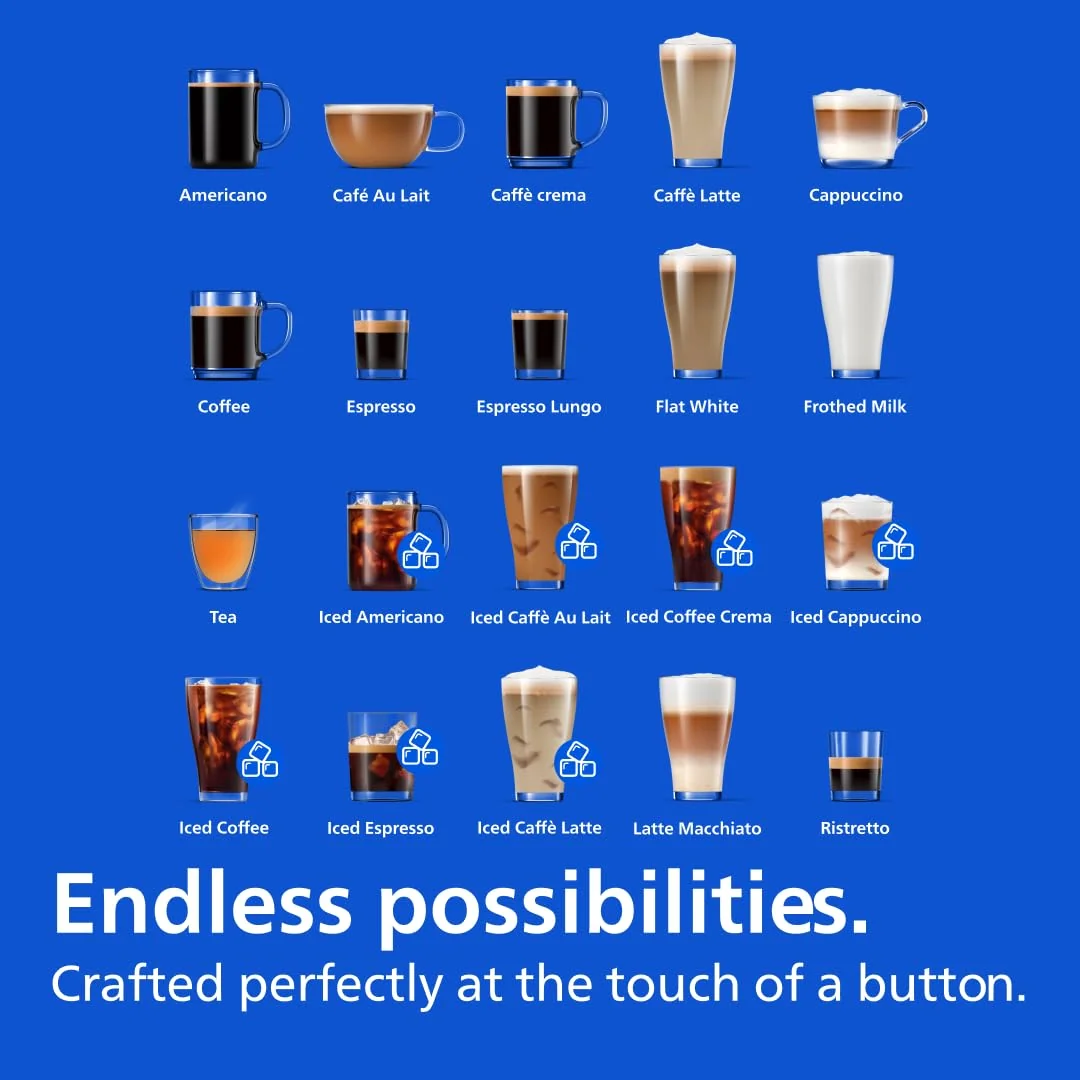
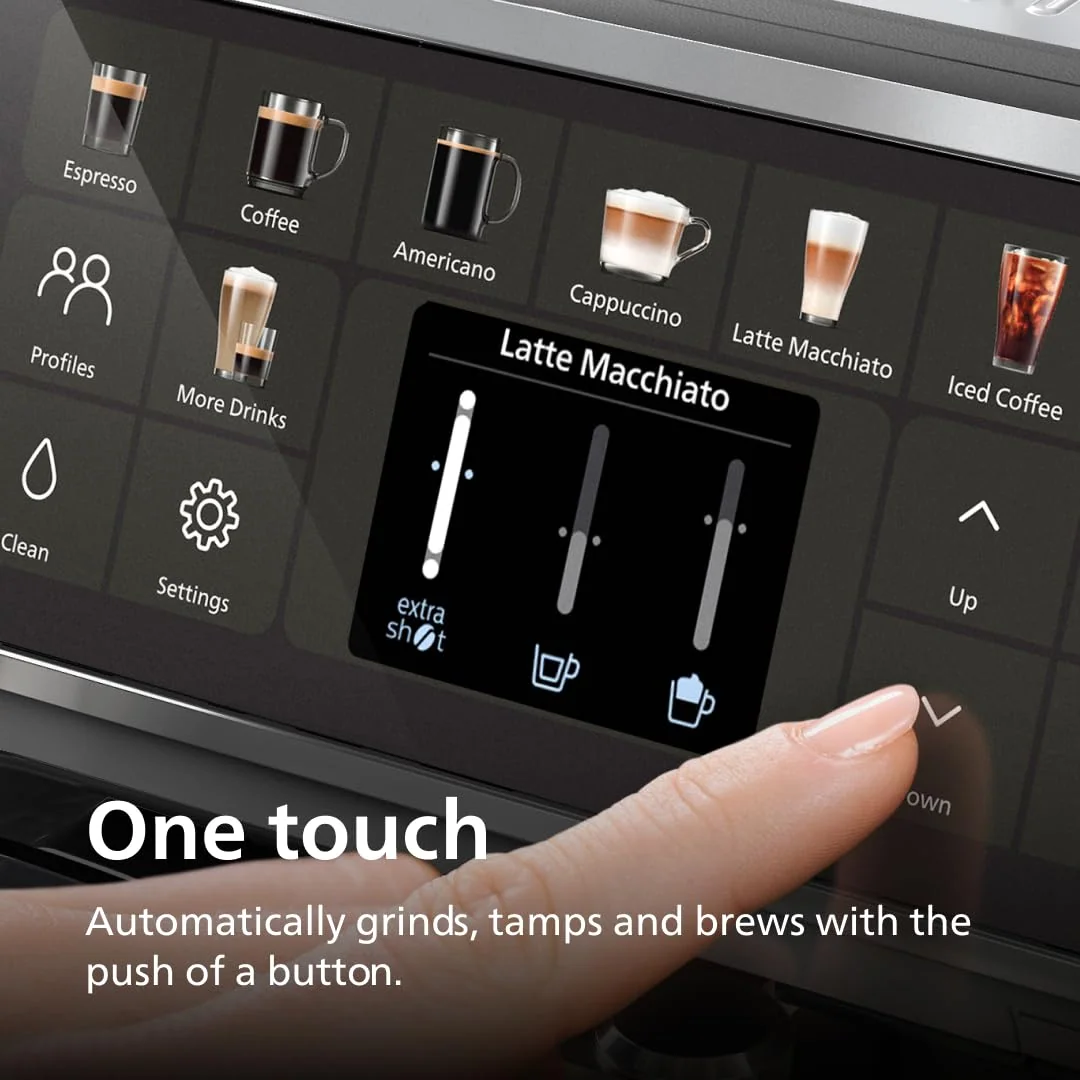
Philips sells the EP5544 as the top of the LatteGo range, and in one narrow sense that is true: it has the colour screen, the twenty presets, the four saved profiles, the milk-froth button and the Extra Shot key. In the sense buyers actually care about, it is not true at all. Seattle Coffee Gear put a 3300 and a 5500 side by side and reported the same grinder, the same heating element, the same brew unit and coffee of very similar flavour in comparable time, adding that the 5500's five strength settings do not get you more coffee than the 3300's three, only finer increments of the same ceiling. That is the spine of this review, and everything else hangs off it. If you want to see the two machines argued out properly, we have a full 3300 versus 5500 comparison; if you are trying to place this model in the whole Philips line, start with our guide to which LatteGo to buy.
Espresso Den has not had one of these on the bench, and this page does not pretend otherwise. What follows is built from the four Amazon listings themselves, from Philips's own product and support pages, from independent testers who measured noise, temperature and extraction, and from owners who have run these machines for months and in a couple of cases for years. Where those sources disagree, and they disagree a lot, the disagreement is reported rather than averaged away.
Which of the four listings you are actually looking at
The same machine appears here four times, and the ratings are wildly different in a way that has nothing to do with the coffee. The new black chrome EP5544/94 sits at 4.1 from 354 ratings and near the top of the category. The mirrored review pool for that unit is not mediocre, it is bimodal: roughly seven in ten five stars against better than one in ten one stars, with almost nothing in the middle. The one-star reviews are consistently the same complaint, which is that the coffee comes out thin. One buyer put it as bluntly as anyone has: the dosing in grams is very shy, the puck is small, and what lands in the cup is brown water rather than coffee. He returned it and moved to a De'Longhi. That is the machine's honest drawback and it is the same drawback on all four listings.
The new grey chrome EP5544/90 is the odd one out at 3.7 from 159 ratings, the lowest score of the four, and its listing copy is unreliable in two checkable places: it claims two user profiles when the machine has four plus a guest, and it states a power figure of 230 W for a machine every spec sheet puts at 1500 W. Nothing about the hardware differs from the black one. The suffix is a colour code, a point owners have had to work out for themselves because retailers could not explain it either.
The two renewed listings score highest of all, 4.4 from 71 ratings on the grey EP5544/90 and 4.3 from 43 on the black EP5544/94. Seven of the eight retained reviews on the grey renewed unit describe a machine indistinguishable from new, with phrases like spotless, perfect condition and no signs of prior use. The eighth arrived leaking, went back, and its owner bought a De'Longhi instead. That is not a freak event: Philips's own support index for this model lists a LatteGo frother leaking from the bottom as one of its headline problems, alongside a drip tray that fills quickly and a grounds container that reports itself full when it is empty. The renewed drawback is therefore specific and worth naming plainly. The black renewed listing carries a ninety-day limited warranty, and ninety days expires comfortably before the window in which owners actually report failures. If you are weighing that trade generally rather than for this machine alone, our piece on renewed and certified-remanufactured machines is the fuller argument.
Key Specifications
What the extra money actually buys
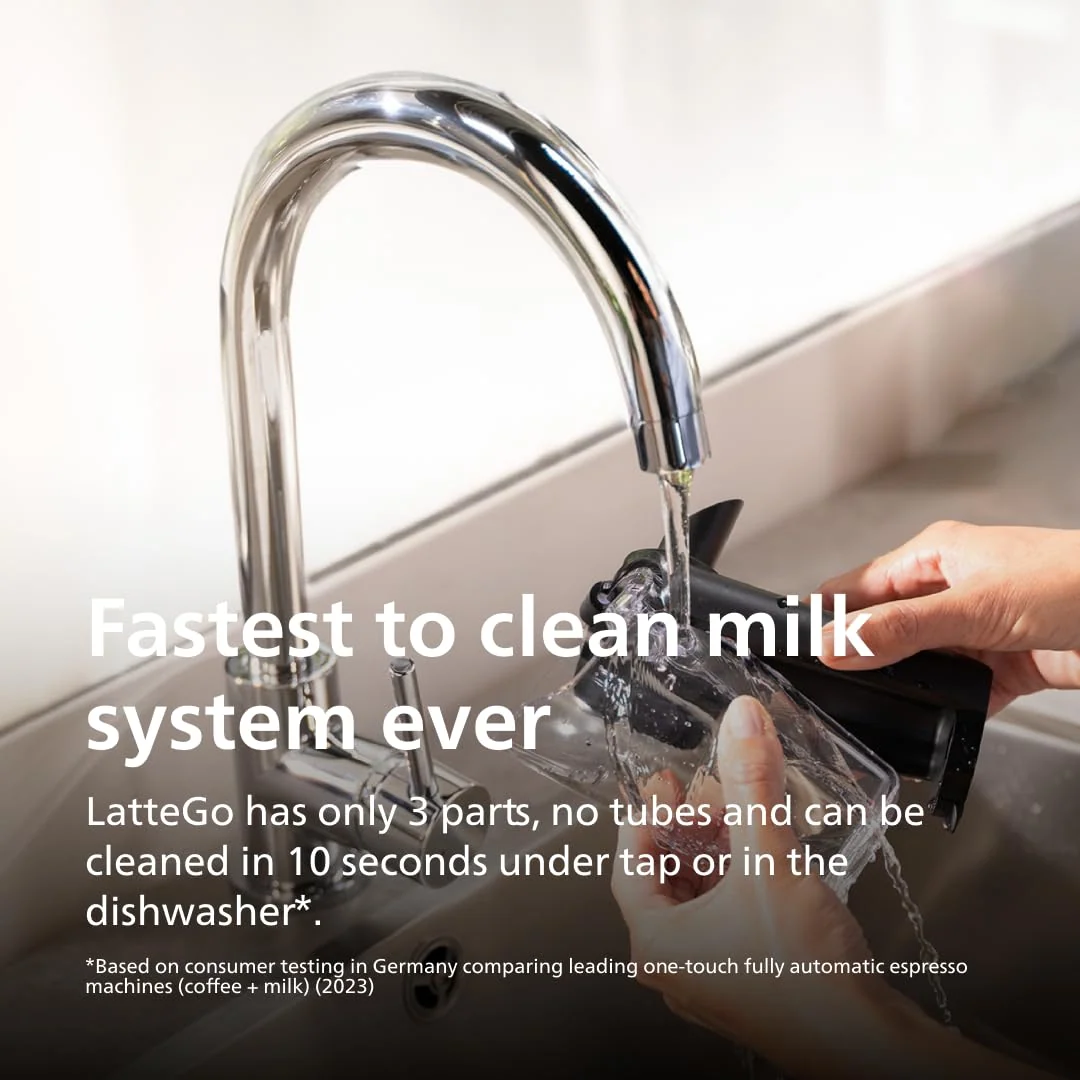
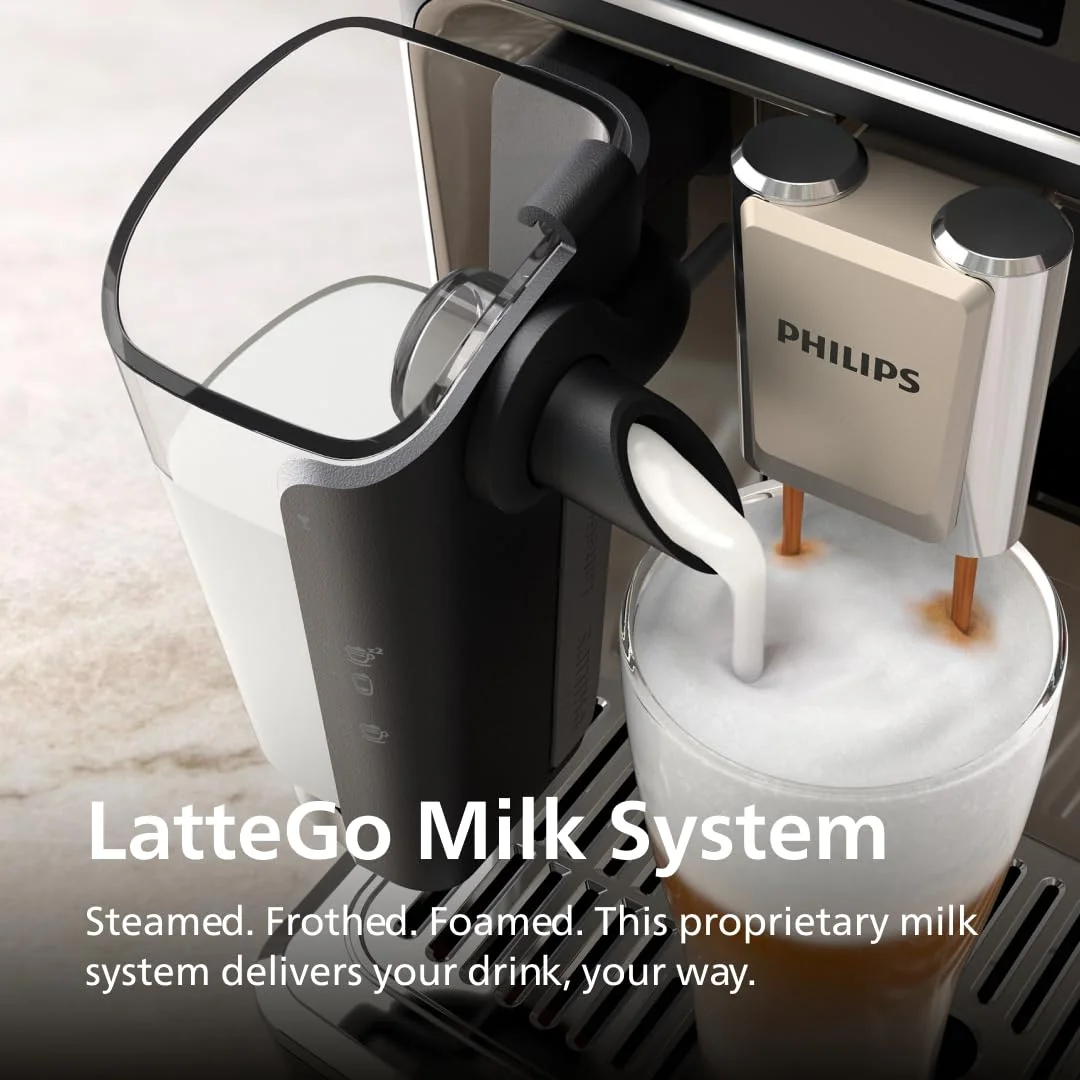
Start with the thing everyone agrees on, including people who dislike the coffee. The LatteGo carafe is two pieces that snap together with no internal tubes and no hidden channels, milk never enters the body of the machine, and the whole assembly rinses under a tap in seconds or goes in the dishwasher. Testers who otherwise prefer other brands call it the easiest milk system on the market and arguably the most hygienic. One owner of five years, who has nothing kind to say about the drink, still sums the machine up as coffee that disappoints, cleaning that is easy, and reliability that has held. If milk drinks are most of what you make, that trade may be the whole decision, and our latte-focused guide weighs it against the alternatives.
Where the LatteGo does not deliver is texture. Two independent reviewers describe the foam the same way: consistent, generous, hot enough, and noticeably bubbly rather than silky. Coffeeness found the foam firm enough that even a cappuccino keeps its layers and warned against expecting silky microfoam for a flat white; Home Coffee Expert lists milk that is too foamy for flat whites as an outright reason to skip the machine. A third tester measured the milk arriving in the cup at around 75 °C and called the bubbles frankly large. Cappuccinos and lattes are well served. Flat whites and cortados are approximations, and the presets that name them are marketing rather than technique. The general trade between a carafe and a wand is set out in our piece on which milk system you will actually live with.
The ladder, laid out
| Model | Presets | Strength steps | Profiles | Extra Shot | Brew unit |
|---|---|---|---|---|---|
| 3300 LatteGo | 6 | 3 | None | Espresso, coffee and iced coffee only | Same |
| 4400 LatteGo | 12 | 5 | 2 | No | Same |
| 5500 LatteGo | 20 | 5 | 4 plus guest | Almost every coffee drink | Same |
Read that table and the 5500's case narrows to four real things: a colour screen that tells you what is wrong in words instead of blinking at you, four saved profiles plus a guest slot so a visitor cannot overwrite your settings, a milk-froth-only option the 3300 lacks entirely, and Extra Shot on drinks the cheaper machines will not double. Those are genuine daily conveniences. None of them changes the cup, and the twenty presets are padded: eight of them are iced versions of drinks already on the list, plus hot water and milk froth counted as coffees. Only seven have a dedicated button, and everything else lives a menu down. Against the 4400 the gap is smaller than the model numbers suggest, which is why that particular comparison is worth reading before you decide, alongside the 4400 on its own terms and the 3300.
The iced presets are not iced coffee
This is the listing's weakest claim and the one a buyer is most likely to be misled by. The Amazon copy says the calibrated system ensures iced coffees deliver the same rich flavour as hot drinks. Coffeeness read the operating instructions for the same machine and found them saying something quite different: the coffee is prepared with warm water, and for best results you brew over ice cubes. He took half a star off his rating for the gap between those two sentences and said so in terms. A second tester put a thermometer on it and measured the iced setting delivering coffee at roughly 60 °C rather than the usual 80 °C, on what he believed were the same internal circuits, so the ice both cools and dilutes. A retailer demonstrating the machine claims the opposite, that the water bypasses the heating element altogether and arrives at room temperature. Two independent measurements against one seller's demonstration is not a close call.
The fair version is this: the iced modes brew cooler and slower than the hot modes, and then you pour that onto ice you supply. That can make a decent drink, and one reviewer thinks it makes a good one, but it is not cold extraction and it is not cold brew. If that is what you came for, our explainer on which machines actually brew cold will save you the disappointment, and our iced-coffee pick goes elsewhere for a reason.
Strengths & Limitations
Strengths
- The LatteGo carafe is two dishwasher-safe pieces with no tubes, and milk never enters the machine's body.
- The grinder is genuinely quiet, measured at around sixty decibels with the hopper lid seated.
- Four saved profiles plus a guest slot mean a visitor cannot overwrite the settings you spent a fortnight finding.
- Extra Shot works on almost every coffee drink and is the single most effective fix for a thin cup.
- Water, beans, grounds and brew group all load from the front, so the machine can live pushed back against a cabinet.
- There is a milk-froth-only option, which the cheaper LatteGo machines simply do not have.
Limitations
- The brew unit doses somewhere around nine grams, roughly half a café double, and no setting on the machine lifts that ceiling.
- The iced presets brew warm coffee over ice you supply yourself, which is not what the listing copy implies.
- The foam is stiff and bubbly rather than silky, so flat whites and cortados come out as approximations of the real thing.
- The milk spout angle is fixed, so any cup not pushed well forward will collect milk down its side.
- The first twenty to thirty cups are unrepresentative, and on a renewed purchase that can consume most of the return window.
- Both renewed listings carry warranties far shorter than the window in which leaks and worn seals actually appear.
Nine grams, and everything that follows from them
Every complaint about this machine's coffee traces to one number. Philips's own support page states that the brew unit handles between six and nine grams of ground coffee across its strength settings. Seattle Coffee Gear, weighing pucks from both a 3300 and a 5500, saw them come out at around nine and a half to ten grams and topped out at about ten and a half when pushing. A reviewer who killed power mid-cycle on the closely related 5400 and weighed the charge got 8.6 grams, against 12.7 grams from a De'Longhi Dinamica Plus on its double setting, roughly half again as much. A café double is sixteen to eighteen grams. The 5500 is brewing a single dose and, on its longer presets, pushing a lot of water through it.
The measured consequence is thin extraction. Caffè Lusta reported figures of 4.5 to 5.5 per cent on the 5500 and said the coffee lacked intensity and body; the same testing approach on the 3300 produced 4 per cent, against roughly a one to four ratio of grounds to yield where an espresso wants one to two. An owner watching a friend's 5500 on its finest grind clocked shots finishing in eight seconds, well under the twenty to thirty a properly resisted puck takes. The pucks themselves tell the story: on the Philips they crumble, on the machine with the larger dose they lift out intact. If you want the general mechanics rather than this machine's version of them, our piece on watery bean-to-cup espresso covers the causes and the fixes.
None of that means the coffee is bad. It means it is mild, and whether mild reads as pleasant or as failure depends almost entirely on what you drank before. People coming off pods and drip are consistently delighted; people arriving from a De'Longhi, a Jura or a portafilter are consistently not. Coffeeness, testing with fresh medium-roast beans, called both the coffee and the espresso really good and full-bodied with chocolate and nut notes. A twenty-year super-automatic owner who spent two years with the closely related 5400 said the opposite and added the sentence that reconciles both camps: if it is your first machine, you may never notice the difference.
The settings that actually recover the cup
| Control | Where to put it | Why |
|---|---|---|
| Grind | 2 to 4 of 12, changed only while the grinder is running, one step at a time | Finer resists the water; changing it stationary risks the burrs, and the finest setting can starve the chamber rather than help |
| Strength | Top of the scale, then Extra Shot | Extra Shot grinds and brews a second puck, which is the only thing on the machine that raises the dose |
| Volume | Shortest setting you can drink | Nine grams stretched over a long pour is where the wateriness comes from |
| Temperature | High | It ships mid-range, and owners who move it report a real difference |
| Beans | Medium-dark espresso roast, not oily, not light | The grinder cannot go fine enough to extract light roasts; oily dark roasts gum the chute |
Home Coffee Expert reached its best result with the second-finest grind, maximum temperature and a one-ounce volume, and was honest about the cost: that routine uses twenty to twenty-two grams of beans per drink, where a Jura would use fifteen or sixteen at full strength. That is the machine's real trade laid bare. Extra Shot is not a luxury feature; it is the correction for the brew chamber, and using it as standard roughly halves the bean-cost advantage the machine has over pods. Bean choice matters more here than on most machines, and our guide to what works in a bean-to-cup grinder is worth reading before you buy a kilo of anything expensive.
Nobody tells you about the first thirty cups
Home Coffee Expert flags this as a headline fault: expect at least twenty to thirty coffees before you get good results, buy the cheapest beans you can find to run them, and note that Philips does not explain this anywhere, which the reviewer believes gets perfectly good machines returned early. Owners bear it out with a spread of numbers. One was told by a helpful stranger to leave the grind alone and run about a hundred cups first, because the first five to ten pucks will be a watery mess. Another, convinced his brand-new 5500 was broken, got a replacement brew unit from Philips, found the manual online asking for a hundred to a hundred and fifty shots before adjusting the grinder, bought three pounds of cheap beans and ran fifty doubles over three days to get there. Asked months later whether the espresso had improved, his answer was that not really, and that he wished he had bought a cheaper machine.
That last data point is the one to hold onto, because it is the same person before and after doing exactly what the ritual asks. Break-in appears to be real and short for the puck forming properly, and it is also doing a lot of work as an explanation for a ceiling that break-in cannot lift. On a renewed unit the practical consequence is sharper still: a return window can easily be shorter than the period in which the machine is not yet representative of itself.
New, renewed, or a cheaper Philips
The reviewers who dislike this machine and the reviewers who love it are not disagreeing about the coffee so much as about the price they were quoted. Home Coffee Expert scored it well on components and still would not recommend it at Philips's list price, saying plainly that it is frequently discounted and is worth waiting for. Coffeeness, quoting a much lower street figure, called the same machine a bargain with an impressive price-performance ratio. Both are right about their own number. Philips's own store carries a list price that bears little relationship to what the machine sells for anywhere else, so any saving calculated against it is fiction.
That matters enormously for the two renewed listings, because the gap between renewed and new here is narrow rather than transformative. Judge a renewed unit against what the new one actually costs on the day, not against the sticker. If the difference is small, the renewed saving is buying you a shorter warranty on a machine whose characteristic faults, leaks and worn brew-unit seals, tend to appear after the first few months rather than in the first few weeks. If the difference is large, the renewed listings' own review record is encouraging: seven of eight retained reviews describe units that look untouched, and one buyer of six years' standing with a 3200 replaced it with a refurbished 5500 and reported no visible signs of prior use at all.
The other comparison the money invites is downwards rather than sideways. Given that the brew unit does not change, a new 3300 and a renewed 5500 are frequently in the same territory, and the 5500's advantage over it is the interface rather than the drink. Sideways, the standing recommendation in the owner forums is a De'Longhi, and the reason is the dose rather than brand loyalty: the machines people move to grind finer and hold more coffee. We have set that out at length in the 5500 against the Dinamica Plus and the 5500 against the Rivelia, and the Dinamica Plus review covers the machine that keeps winning those arguments on intensity.
What a renewed unit should be checked for on day one
Open the box against Philips's own contents list: machine, AquaClean filter, LatteGo storage lid, measuring spoon and water-hardness test strip. Run water through it and watch for leaks under the machine and at the base of the carafe, because both are documented faults rather than freak events. Check that the bean hopper lid seats fully, since the seal is a real part of why the machine is quiet. Then set temperature to high, strength to maximum, volume short, and accept that the first couple of dozen cups tell you nothing.
Living with it, and what breaks
The daily routine is genuinely light: empty the drip tray and the twelve-puck grounds bin, rinse the carafe. Weekly, the brew group comes out and goes under a warm tap with no detergent, then air-dries for a couple of hours. Every couple of months it needs a thin line of the supplied food-grade grease on its rails, and Home Coffee Expert puts the whole burden at maybe twenty minutes a week and probably less. One tester who liked almost everything about the machine named the brew-group maintenance as his single criticism. The greasing is the step people forget, and forgetting it is how a machine that was fine at four months starts refusing to pour hot water for an Americano.
The AquaClean filter is what carries the claim of five thousand cups without descaling, and Philips's own footnote qualifies it: that figure assumes eight filter replacements made when the machine asks, and actual cups depend on your drinks, your rinsing and your water. Buy the next filter before the counter reaches zero, because letting it hit zero forces a full descale you could have avoided. Our piece on Philips descaling and AquaClean unpacks what the five-thousand-cup number really means, and the settings and warning-lights guide covers the hidden menus, including the temperature setting that most owners never move.
Failures cluster in a recognisable pattern and, importantly, they cluster outside ninety days. One owner's brand-new 5500 spent six days in service in its third week because a tube came loose and it leaked while frothing. Another had a 5400 LatteGo start leaking at about a year and traced it to running the carafe through the dishwasher repeatedly, advising hand-washing instead, which sits awkwardly against Philips marketing the part as dishwasher-safe. Philips's own troubleshooting index treats a leaking frother as routine enough to headline. A buyer of the new black chrome unit had one arrive with the outer box opened and the milk container missing, and returned it.
Set against that, the best long-run account in the record is a 5400 owner at four years and roughly ten thousand coffees, still going, whose entire parts bill was a set of valve o-rings, a complete valve and a replacement milk carafe, and whose grinder needed a small manual adjustment at three years because it would no longer grind fine enough even at its finest setting. That is the honest ownership picture: cheap, available, user-serviceable parts, and a machine that rewards discipline. Our piece on how long these machines last sets that against the rest of the category.
Two things you will meet in week one
TechRadar's tester, an SCA-certified barista, named the fixed milk spout as her biggest complaint: you cannot change its angle, so the cup has to sit much further forward than you expect, completely covering the red level indicator on the drip tray, and a narrow cup will have one of the two spouts miss it entirely. Use a wide cup and push it forward. The second is height: the same review found the machine narrow enough to live against a cabinet with the tank pulling out from the front, but flagged that you fill the hopper from the top, so a machine under a wall unit has to be shuffled out to reload. A 5500 owner asked about a twenty-ounce tumbler answered that it fits at a slight angle and works daily, but is not pretty on milk drinks, and added the sharper point that the serving sizes are built for four-ounce European cups rather than the mugs he actually owns.
On noise, the marketing mostly survives, with one caveat nobody else will tell you. Coffeeness measured the grinder at 61 dB and called it the quietest Philips yet. Caffè Lusta got 59 to 60 dB with the hopper lid on, and 71 dB with it off, noting that the higher figure is what the previous generation sounded like. In other words, a meaningful share of SilentBrew is a gasket, and a lid that does not seat properly gives you the old machine back. The milk system is a different story: one tester recorded it peaking at 83 dB at the start of frothing before settling to 69, and an owner four months in wrote that the grinding is quiet but the milk and brewing are very loud. If silence is the whole point of the purchase, compare it against our quietest picks rather than taking the 40 per cent claim at face value.
Frequently Asked Questions
Is the espresso genuinely weak, or is that a dialling-in problem?
It is mostly the machine: the brew unit tops out somewhere between six and about ten grams depending on who measures it, which caps how intense a single shot can be, though maximum strength, the shortest volume, the highest temperature setting and Extra Shot together recover a good deal of it.
Does the iced coffee actually come out cold?
No, the machine brews cooler and slower than usual and pours that onto ice you add yourself, which one independent tester measured arriving at roughly sixty degrees Celsius.
How many cups does it take before the coffee is representative?
Reviewers who have set several of these up say twenty to thirty, one owner found the manual asking for a hundred to a hundred and fifty, and at least one person who ran that many reported no meaningful improvement afterwards.
What is the difference between EP5544/94 and EP5544/90?
Colour, as far as anyone in the owner forums or at the retailers has been able to establish.
Will a twenty-ounce travel tumbler fit under it?
Barely and at a slight angle, and it works less well for milk drinks because the milk spout sits lower than the coffee spout at its highest position.
Can I run decaf without emptying the bean hopper?
Yes, through the bypass chute, but you must scroll past the lowest strength setting to the scoop icon and confirm the drink before adding a single level scoop, or the coffee drops straight through into the waste tray.
Is the machine quiet in normal use?
The grinder genuinely is, measured at around sixty decibels with the hopper lid seated, but the milk system is the loud part and one tester recorded it peaking above eighty at the start of frothing.
Does it get the drinks hot enough?
On its highest of three temperature settings it does, with independent measurements putting espresso in the cup somewhere between sixty and eighty degrees Celsius, but it ships mid-range and most complaints about lukewarm coffee come from owners who never moved it.
Sources (11)
- Amazon listings and customer reviews — Philips 5500 Lattego
- Owner reports across r/superautomatic threads
- Owner and reviewer video, 5 channels
- Seattlecoffeegear — Article — www.seattlecoffeegear.com
- Woot — Article — home.woot.com
- Philips — Article — us.home-appliances.philips
- Philips — Article — www.usa.philips.com
- Coffeeness — Article — www.coffeeness.de
- Homecoffeeexpert — Article — homecoffeeexpert.com
- Tomscoffeecorner — Article — tomscoffeecorner.com
- Techradar — Article — www.techradar.com