KitchenAid KF7 vs De'Longhi Rivelia: two machines sold on the same trick, and only one of them puts both hoppers in the box
Buy the Rivelia if two different beans go through the machine every single day, because it ships both hoppers, has recipes that grind twice for a large cup and gives you foam you can actually adjust, and buy the KF7 if you want Swiss hardware you can pull out and inspect, a bigger tank and milk that lands a few degrees warmer, accepting on both sides that a minority of owners have had these machines fail early.
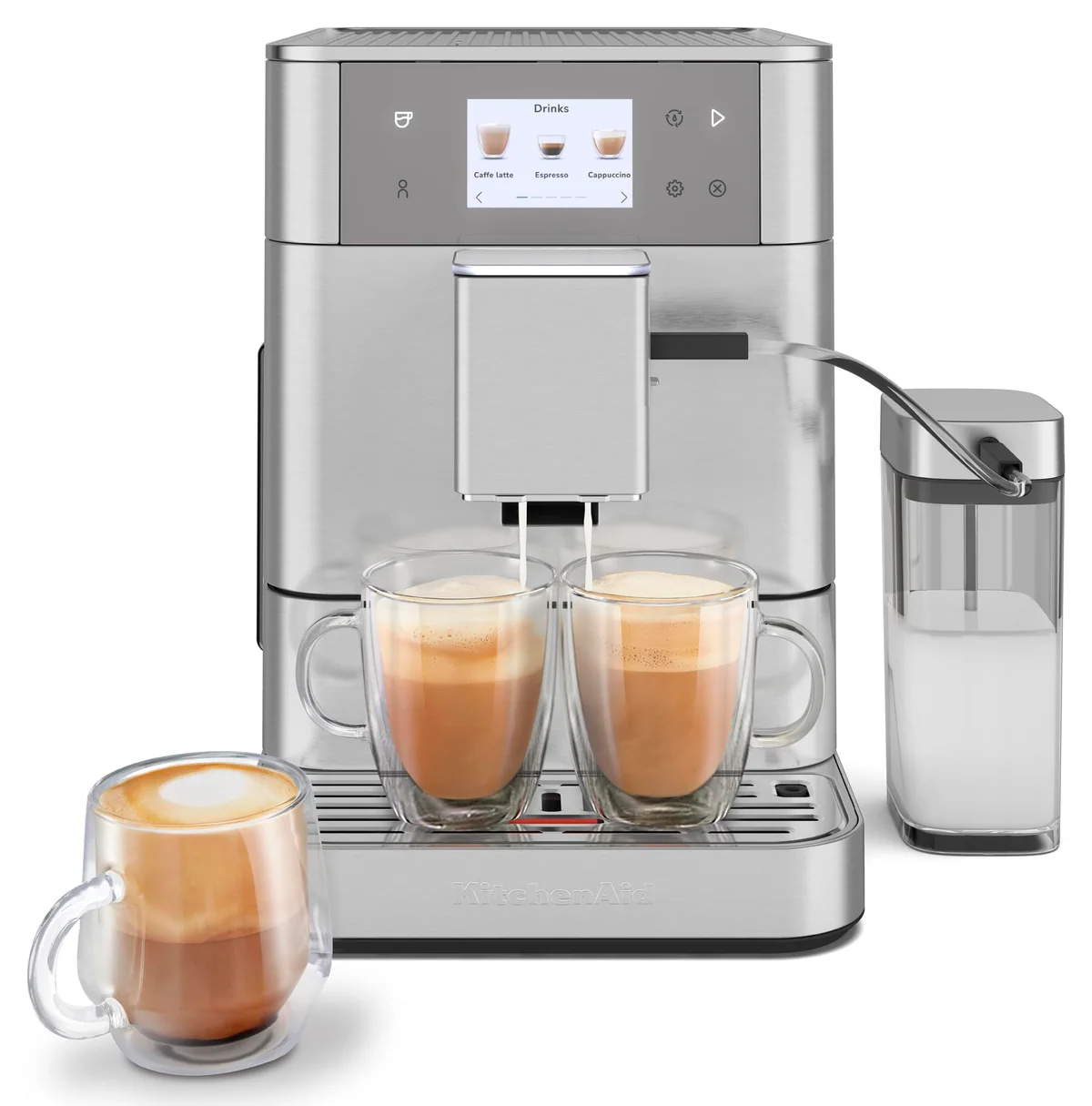
KitchenAid KF7
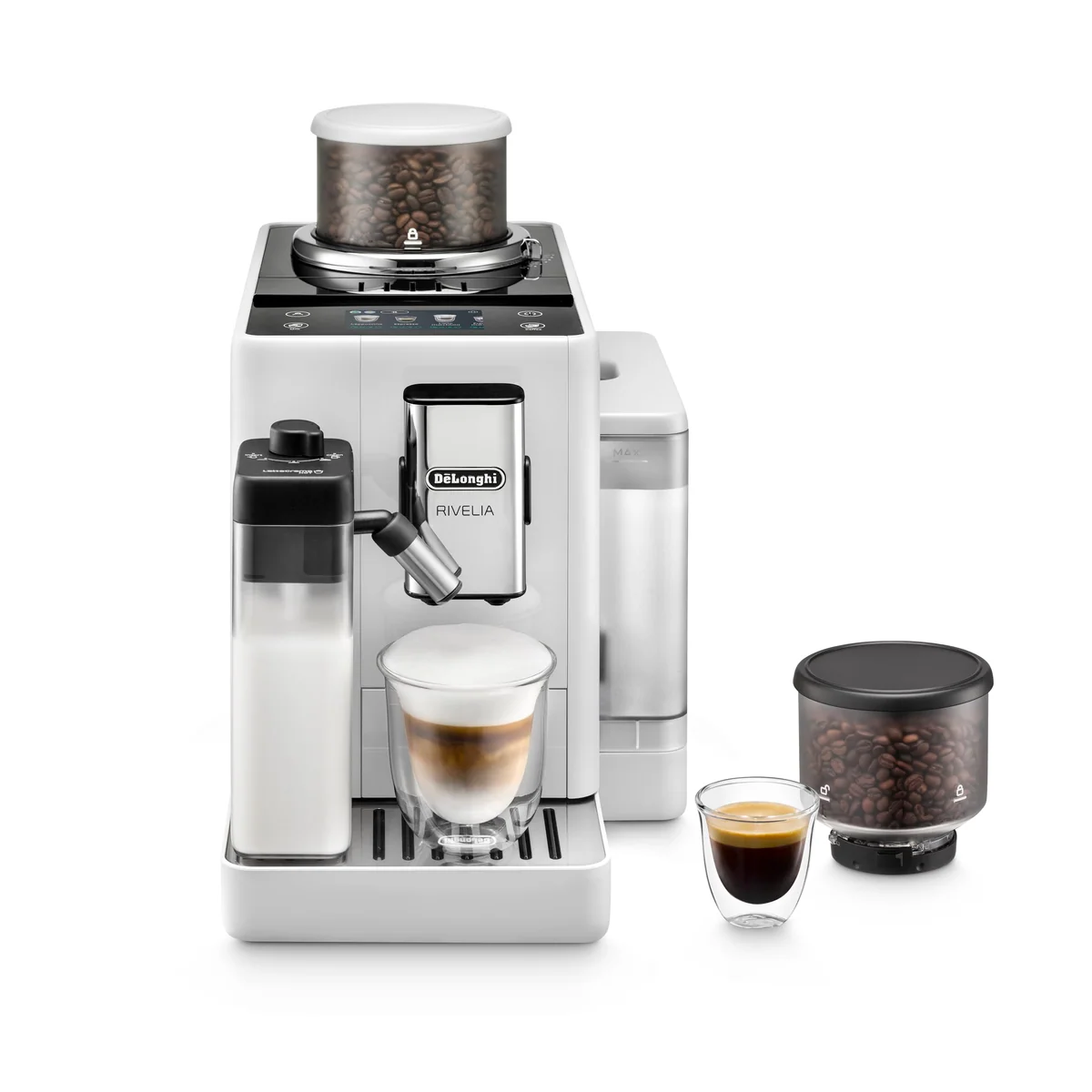
De'Longhi Rivelia
These two machines are on the same shortlist for one reason, and it is not the badge on the front. Both are sold on the promise that you can keep two coffees going at once: regular in the morning, decaf after four, or your bean in one container and your partner's in the other. Until very recently that trick lived on flagships costing several times either of these, which is why two very different companies arrived at it in the same year and why buyers keep putting them side by side.
They arrive at it from opposite directions. The KitchenAid is not a KitchenAid design at all: it comes out of Eugster/Frismag, the Swiss contract manufacturer that builds for Jura and Miele, and the most experienced owner in the public record reports that the KF7 and a Miele CM5300 share a brew unit outright. His summary of what KitchenAid added is still the best line written about the machine: "The best way to explain it is if Miele was Microsoft D.O.S., and Kitchenaid rolled up and installed windows."
The Rivelia comes at it as a De'Longhi, which means the brew group and the LatteCrema milk carafe are proven parts from a range you already know, wrapped in a narrower and quieter body with a touchscreen on the roof and two 8.8-ounce hoppers in the box. De'Longhi calls it the Bean Switch System and builds the entire product page around it.
So the honest framing of this comparison is not which machine is better. It is which compromise you would rather live with, because the swap works on both and each one gives something up to make it work.
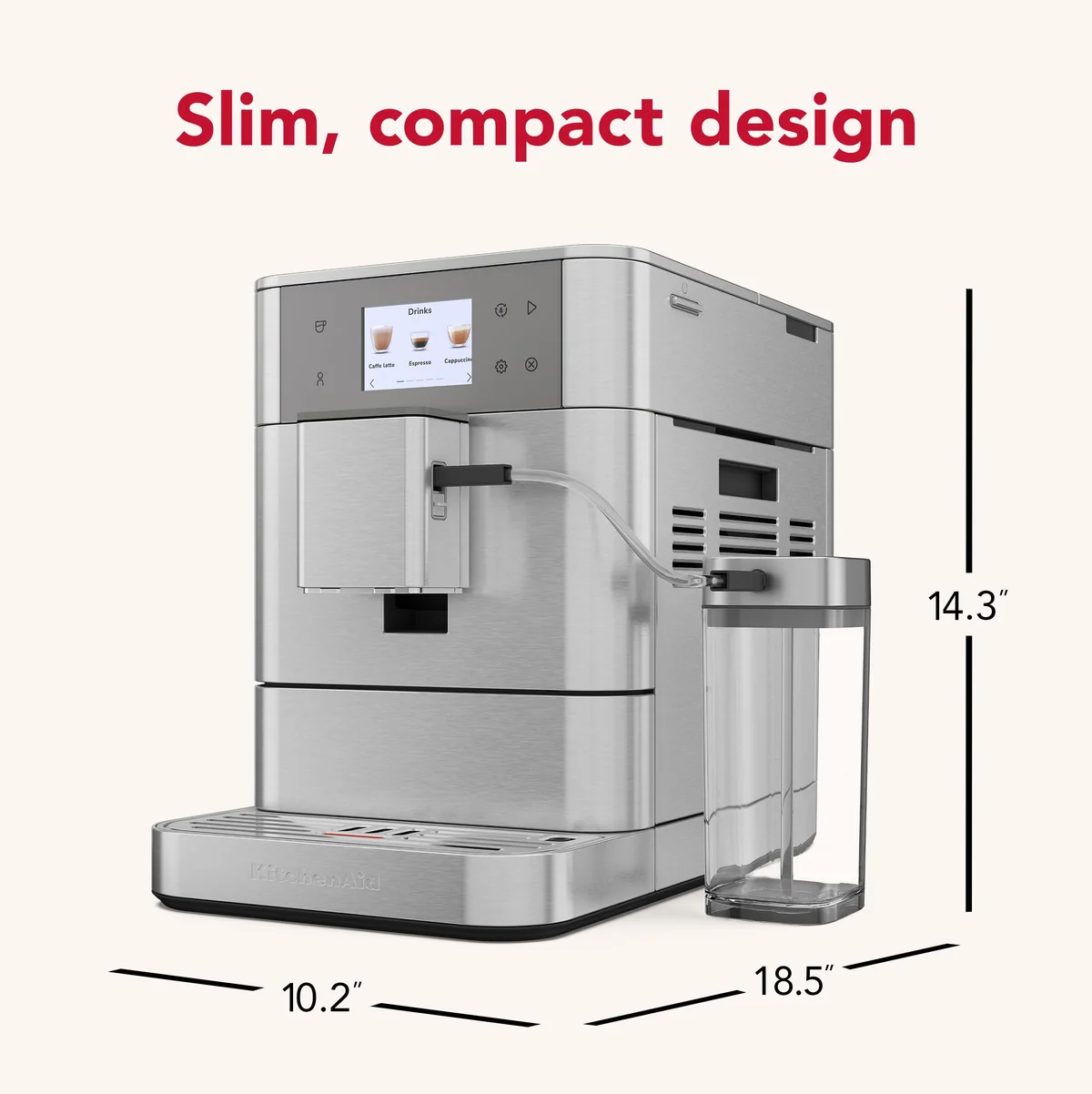
KitchenAid KF7
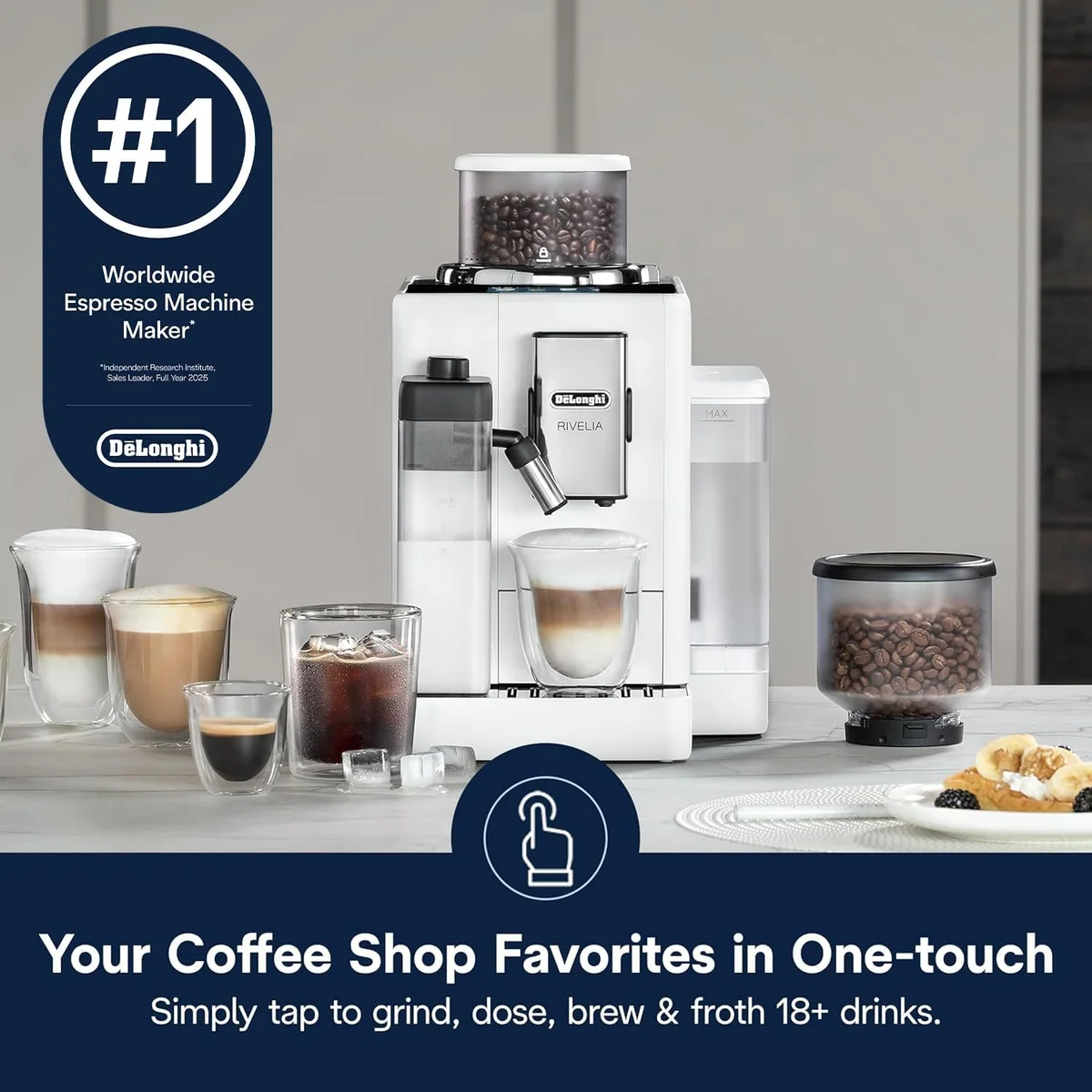
De'Longhi Rivelia
At a Glance
| Feature | KitchenAid Fully Automatic Espresso Machine KF7 with Milk Attachment, KES8557SX, Stainless Steel | De'Longhi Rivelia Automatic Espresso Machine with Grinder & Milk Frother – All-in-One Coffee Maker, Hot & Iced Latte, Cappuccino, Bean Switch System, Burr Grinder, Compact Italian Design, White |
|---|---|---|
| Price Range | Under $200 | $1,000–$1,500 |
| Configuration | 2.2L With Milk Attachment | Rivelia White |
| Finish | Stainless Steel | Arctic White |
| Items In Box | 1 | 1 |
| Listed Since | — | 2025-05-01T00:00:01Z |
| Check Price on Amazon | Check Price on Amazon |
Two hoppers in the box, or one hopper and a shopping list
This is the first real fork, and it is more consequential than the spec sheets make it look. The Rivelia ships with two hoppers, and the swap is exactly what the advertising says: lift one off the roof, drop the other on, answer the prompt about the beans still sitting in the grinder. The KF7's hopper twists out just as easily and the machine purges the grinder for you before the next bean goes through, but you get one hopper in the box. Owners who want the full trick buy a second one, the KESRBHF, and one of them describes keeping it permanently loaded with decaf for his wife.
Both machines charge you the same tax for the swap: coffee already sitting in the grinder chute has to go somewhere. Reviewers who weighed the Rivelia's residue put it at roughly nine or ten grams, and De'Longhi gives you two exits, purge it into the grounds drawer or brew it as a drink in switch mode. The KitchenAid purges roughly a shot's worth into the puck bin without asking. The neatest workaround belongs to a Rivelia owner who thought about it properly: unlock the hopper before your own coffee, brew the leftovers as your cup, then swap for the decaf, and nothing is wasted at all.
There is a subtler difference in what a swap costs you socially. The KF7's spare hopper does not have an airtight lid, so beans want a proper container between uses, and if two people in the house want two different things at the same moment nobody is swapping hoppers twice before work. The Rivelia has exactly the same problem and hides it better by giving you the second container up front. Neither machine solves simultaneous demand; both solve sequential demand very well, which is the actual shape of most households that run decaf alongside regular.
One grinder, one setting, on both sides
Here is the thing neither box mentions. Two hoppers do not mean two grinders. Both machines feed every bean through one set of burrs at one physical setting that you move by hand, so pair a dark Brazilian with a light Ethiopian and one of them is going to extract badly no matter which machine you bought. De'Longhi's Bean Adapt walks you through dialling in and stores temperature and dose against each bean, and then, at the crucial moment, tells you a grind number and asks you to turn the dial yourself.
The Rivelia gives you thirteen grind settings against the KitchenAid's seven, which sounds like an advantage and mostly is, with one caveat: go finer than about setting 4 on fresh beans and the Rivelia can choke, say so on the display and refuse to push water through the puck. The dial goes down to 1; the machine does not reliably go with it.
The practical conclusion is the same for both: two beans of similar roast, or one roaster's regular and decaf, is what these machines are for. A rotating shelf of single origins is not.
Milk is where they stop resembling each other
The KitchenAid gives you a hose. You drop it into any container you like, including the supplied one, and the machine draws what the recipe wants. That flexibility is genuinely useful and it comes with a locked-down recipe: you cannot control foam density, you cannot split the milk and foam volumes independently, and the container KitchenAid supplies has no measurement lines on it. The most detailed editorial to buy a KF7 and use it was polite rather than enthusiastic about the result, calling the foam "acceptable without being anything special. Let's just say it's not quite up to DeLonghi or Jura standards."
The Rivelia gives you a sealed LatteCrema carafe with a three-position texture dial, and this is the one contest that is not close. The middle setting suits most drinks, the densest is really only right for a traditional cappuccino, and the whole assembly comes apart for the dishwasher after an auto-clean cycle. An engineer reviewing the machine on Amazon singled out the frother's disassembly as the best-designed thing on it.
Temperature is where both machines disappoint the same buyer, and where the KitchenAid claws something back. KF7 owners consistently report frothed milk arriving around 135 to 140°F. Rivelia reviewers put the carafe output at roughly 60 to 65°C, one owner with an instant-read thermometer measured milk alone at 121.6°F on the light froth setting, and one Amazon reviewer had the frother stop frothing altogether after a few months and just deliver milk. On both machines the fixes are identical and only partial: set drink temperature to maximum on day one, run the hot water function first to warm the pipework, and preheat the cup, because espresso poured onto milk that is fifteen to twenty degrees cooler loses the argument instantly. If a scalding latte is non-negotiable, the honest answer is that neither an automatic carafe nor a milk hose is the machine you want, and the reason these machines run cool is structural rather than a fault in either one.
If you drink it black in a big mug, this is not a tie
The KF7's dose is fixed and its water is not, which is exactly the wrong way round for a large cup. The Americano will not go below about 2.7 oz of water, regular coffee tops out around 7.4 oz, and owners filling an American mug describe the result as weak, correctly. The fix from the most experienced owner in the record is to stop asking it for a mug: keep the cup under about 3.5 oz and the KF7 is excellent.
The Rivelia starts from the same place and then offers a way out. Its standard large coffee and Americano also stretch one puck with more water, and a month-in owner described enlarging an Americano and getting murky water. But the recipe called Long grinds twice, so a large cup gets two pucks rather than one puck and a flood, and every drink has an extra shot function on top of that. One long-time De'Longhi owner writing about Coffee Bold worked out precisely why this matters and called it brilliant, which it is. There is also a trap worth knowing: a button appears near the end of a brew that looks like an extra shot and only adds water.
So for espresso and short milk drinks these two are closer than the price gap suggests, and one reviewer who weighed and timed the Rivelia landed on grind 3, maximum strength, about 16 grams and a 22-second extraction to get there. For anyone whose actual daily drink is a big black coffee, the Rivelia has a mechanism and the KitchenAid has a ceiling, and what any bean-to-cup can do with filter-style coffee is the wider context for both.
Neither one brews cold, and only one pretends to
The KF7 has no iced or cold mode at all, which in 2026 is a real absence rather than a quibble, and it is made stranger by KitchenAid's own newer compact line launching below the KF7 with a setting that brews cooler over ice.
The Rivelia has iced recipes on the touchscreen, and what they do is brew hot coffee at a somewhat lower temperature into ice you added yourself. There is no cold extraction, and cold milk foam is not in the box either: it needs the LatteCrema Cool carafe De'Longhi sells separately, and an owner who bought both says flatly that he would not recommend it because the cold drinks are worse than the ones his Eletta Explore makes. If iced coffee is a daily habit rather than a summer novelty, what these iced modes actually are should be read before either machine, and the machines that genuinely extract cold are a different shortlist.
The reliability picture, which is uncomfortable on both sides
Most owners of both machines are having a fine time, and that has to be said first. The minority experience on each is bad enough to change the arithmetic.
For the KF7, the numbers themselves disagree. The Amazon listing sits at 4.1 from 165 ratings, which is mediocre for an appliance in this class. KitchenAid's own page shows 4.6 from 245, and the shape matters more than the average: 188 five-star reviews and then a fat tail of 13 one-stars with almost nothing at two, which is not a curve that says "slightly disappointing" so much as two separate populations, one delighted and one whose machine died.
The most detailed KF7 warranty account sits on an Australian brand-level review page that attracts complaints by design, and it needs that caveat stated plainly, but the owner documented his fault by name. His machine threw "Bean hopper is not in position", spent six weeks with an authorised repairer waiting on parts approval, came back without its milk hose, took another ten days of arguing to get the hose returned, and threw the identical error two days later. A separate owner on the same page is on his third KF7. Fairness cuts both ways: KitchenAid replaced that man's machine three times, and several owners describe service that was outstanding once it reached the right person.
The Rivelia's failures are fewer in the public record and just as ugly when they land. In an owners' group, a buyer making around ten coffees a week had the machine dead at roughly ten weeks; De'Longhi declared the internal motor unrepairable and sent a replacement, and the replacement then developed a fault where neither hopper would engage properly. Her summary goes to the heart of the purchase, because they chose the machine for the ability to switch hoppers and it could not switch hoppers.
Two structural points sit underneath that. The Rivelia's screen runs everything, so a screen fault is a dead machine rather than a degraded one, while the KF7's brew unit slides out for inspection with no grease to reapply, which is a real advantage in a category where sealed groups are common. And a one-star Amazon reviewer of the Rivelia describes the well-known grounds-and-door sensor complaint, a machine insisting it needs emptying when it does not, plus a customer service process she found disjointed enough to run past her return window.
Both carry two-year warranties, both are built in Europe, the KitchenAid in Switzerland and the Rivelia in Italy, and neither line is old enough for anyone to tell you honestly what year four looks like. What actually breaks first on these machines is the best available proxy for both.
| KitchenAid KF7 | De'Longhi Rivelia | |
|---|---|---|
| Hoppers in the box | One, spare sold separately | Two, 8.8 oz each |
| Grind settings | Seven | Thirteen, with a practical floor around 4 |
| Cost of a bean swap | Auto-purge of roughly a shot's worth | About nine or ten grams, purged or brewed |
| Milk system | Hose into any container you like | Sealed LatteCrema carafe, dishwasher safe |
| Foam control | None, locked per recipe | Three texture positions |
| Large black coffee | Caps around 7.4 oz from one fixed dose | Long and Coffee Bold grind twice |
| Iced drinks | None at all | Hot coffee over your ice, cold foam needs a separate carafe |
| Water tank | 2.2 L, removable or fillable in place | 1.4 L, side-mounted and fillable in view |
| Brew unit | Slides out for inspection, no grease | Lifts out for a rinse, roughly monthly |
| Interface risk | Low-resolution screen, no wifi, drink list cannot be reordered | Touchscreen runs everything, so a screen fault stops the machine |
One line from the KF7's record explains why anyone buys either of these. A Breville owner of five years who switched counted his old routine at about seven minutes of standing there per drink, grinding, tamping, pouring, knocking out the puck, steaming, washing the jug. His KitchenAid routine is switch on, plug the hose into the milk, press two buttons, walk away. Then he multiplied that seven minutes by three for when friends are over, and pointed the budget-conscious person asking him at the KF7 rather than his own machine.
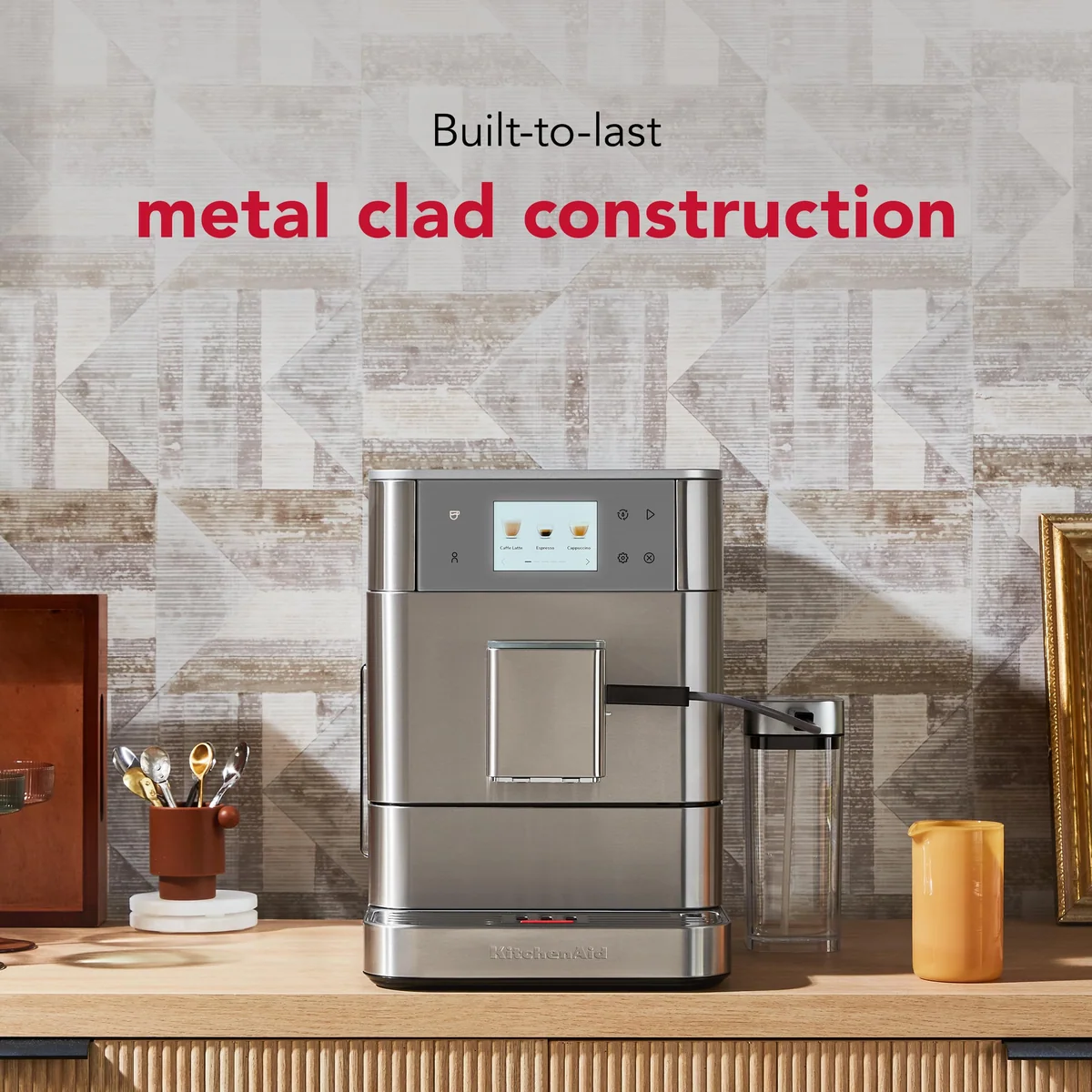
KitchenAid KF7

De'Longhi Rivelia
Which one belongs on your counter
If the second bean is real, meaning you would genuinely alternate day to day, the Rivelia is the better buy and it is not particularly close: both hoppers are in the box, the large coffee has a mechanism instead of a ceiling, and the foam is adjustable. If the second bean is aspirational, you are paying for a hinge you will never open, and at that point the KitchenAid's build, its bigger tank and its serviceable brew unit are the more valuable things, especially bought on KitchenAid's discount channel rather than at sticker. At list, the KitchenAid is the dearer of the two, and both of them discount often enough that patience is worth something.
The one to buy if you want Swiss hardware you can take apart, and an interface the whole household will actually use
It is Eugster/Frismag underneath with a brew unit reportedly interchangeable with Miele's, the group slides out so you can see what is growing in your machine, and it is ready to brew in around 45 seconds including the startup rinse.
Black coffee tops out around 7.4 oz from a fixed dose so anyone filling a mug will call it weak, and there is no iced setting at all.
The one to buy if two beans really do go through the machine every day
Both hoppers come in the box, the Long and extra shot routes grind twice so a large cup is coffee rather than water, and the three-position foam dial is the best milk control on either machine here.
Milk drinks land warm rather than hot even with the temperature setting at maximum, and one Amazon owner had the frother stop frothing entirely after a few months.
The same Rivelia in sand beige, for a kitchen that does not want another silver box
Component for component this is the Arctic White machine in a different shell, same carafe, same brew unit, same grinder, so the colour is the entire decision.
The touchscreen sits on the roof, which one owner found unusable at a standard-height counter until she moved the machine to a lower island, and no colour fixes that.
Two other exits are worth naming honestly. If you are drawn to the Rivelia but would not actually swap hoppers, the community verdict is close to unanimous that the Eletta Explore is the better machine for the money, with more capacity, more drinks, hotter output and real cold extraction, and we take that fork on its own page. If you are drawn to the KitchenAid but flinch at the failure reports, the Bosch 800 Series comparison covers the nearest alternative in that style, and the KF6 against KF7 against KF8 question is worth settling before you assume the KF7 is the right rung. Cheaper again, the Philips 5500 against the Rivelia is the cross-shop most people should at least look at, and the 5500's LatteGo carafe is the easiest milk system in the category to clean.
Full working for each machine sits in our own reviews, the KF7 review and the Rivelia review, including the detail that at least two owners in the threads Espresso Den read returned a Rivelia and bought a KF7, and that one of them then said his main criticism of the KitchenAid was that it could be hotter. The temperature complaint follows you around this whole category, which is the most useful thing anyone can tell you before you spend this much money on either.
Frequently Asked Questions
Does the KF7 swap beans as easily as the Rivelia?
The mechanism is just as quick and the grinder purges itself, but the KF7 comes with one hopper and the spare is a separate purchase, where the Rivelia gives you both in the box.
Can either machine grind two different beans correctly?
No, because both feed every bean through one set of burrs at one hand-set position, so the pairings that work are two coffees of similar roast such as a roaster's regular and its decaf.
Which one makes hotter milk?
KF7 owners generally report frothed milk around 135 to 140°F against Rivelia measurements nearer 121°F on light froth and 60 to 65°C in reviews, so the KitchenAid has the edge while neither is a scalding latte machine.
Which is better for a large black coffee?
The Rivelia, because its Long and Coffee Bold recipes grind a second puck instead of adding more water, while the KF7 stretches one fixed dose to a ceiling around 7.4 oz.
Does either one make real iced coffee?
Neither extracts cold, the KF7 has no iced setting whatsoever, and the Rivelia brews hot coffee into ice you supply with cold foam requiring a carafe sold separately.
Which one is more reliable?
Neither record is clean, with the KF7 showing a fat one-star tail on KitchenAid's own product page and a detailed six-week repair saga, and the Rivelia showing rarer but severe failures including a motor dead at ten weeks.
Is the Arctic White Rivelia different from the Sand Beige one?
Only in colour, since both listings are the same machine with the same carafe, brew unit, grinder and specification.
Will a tall travel tumbler fit under either machine?
The Rivelia's clearance tops out around 13 cm so most flasks will not fit, and the KF7's spout adjusts to roughly five and a half inches, which is why owners of both brew into a mug and pour across.
Which one is quieter?
Both are rated as quiet for the category by their owners, with the grind being the loud moment on each, and Rivelia owners who moved from a Magnifica are especially emphatic that it is a step quieter without being silent.
Ready to Choose?
Sources (9)
- Amazon listings and customer reviews — Kitchenaid Kf7 and Delonghi Rivelia
- Owner reports across r/superautomatic threads
- Coffeeness — Article — www.coffeeness.de
- Webstaurantstore — Article — www.webstaurantstore.com
- Thekitchn — Article — www.thekitchn.com
- KitchenAid — Article — www.kitchenaid.com
- Au — Article — www.productreview.com.au
- Facebook — Article — www.facebook.com
- Oakvilleappliance — Article — oakvilleappliance.com