The Bosch makes the better coffee and the KitchenAid makes the better machine, and that trade is the entire decision
Buy the KitchenAid KF7 unless the taste of the coffee outranks every other thing a machine does for you, in which case buy the black Bosch 800 Series and only on a real discount.
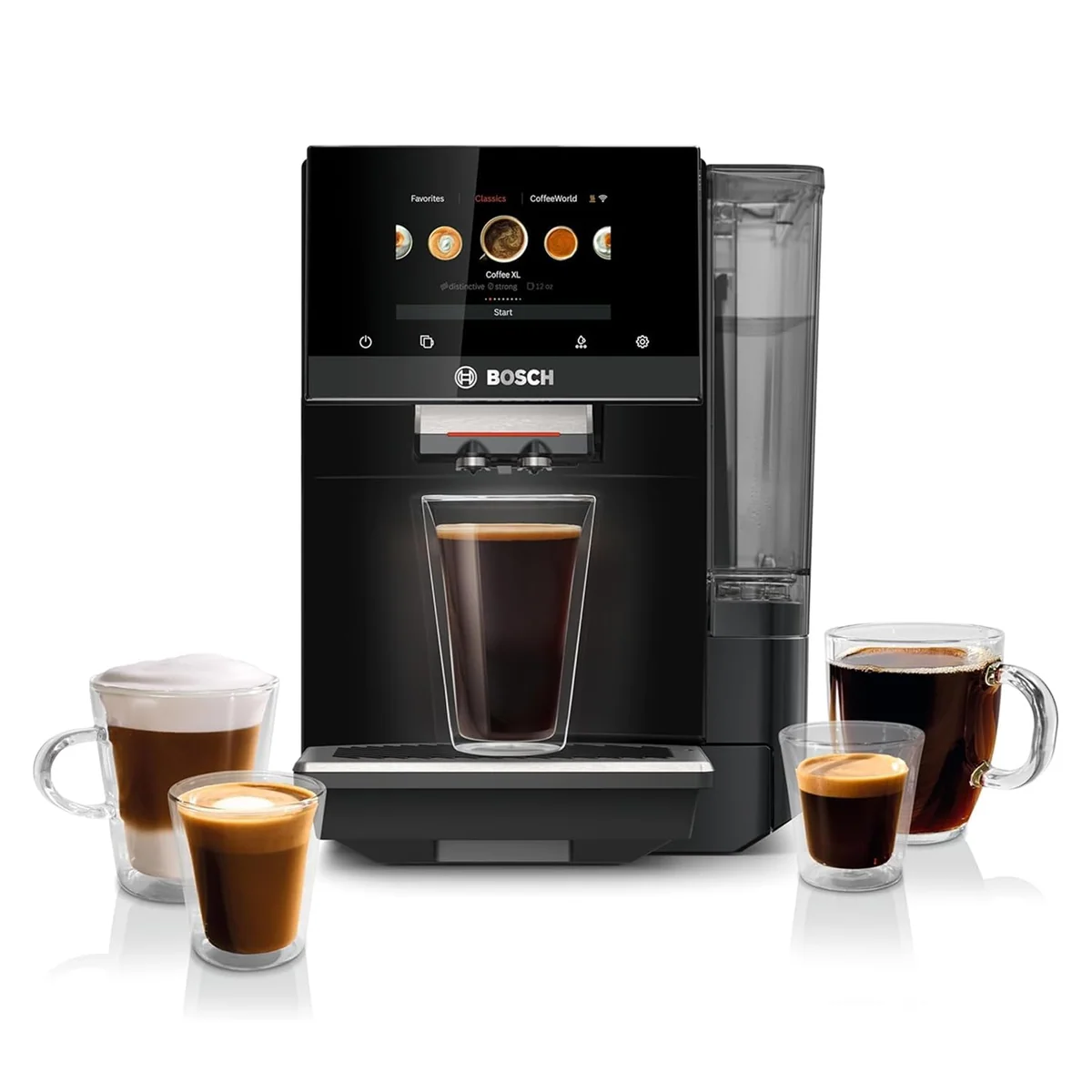
Bosch 800 Series espresso machine
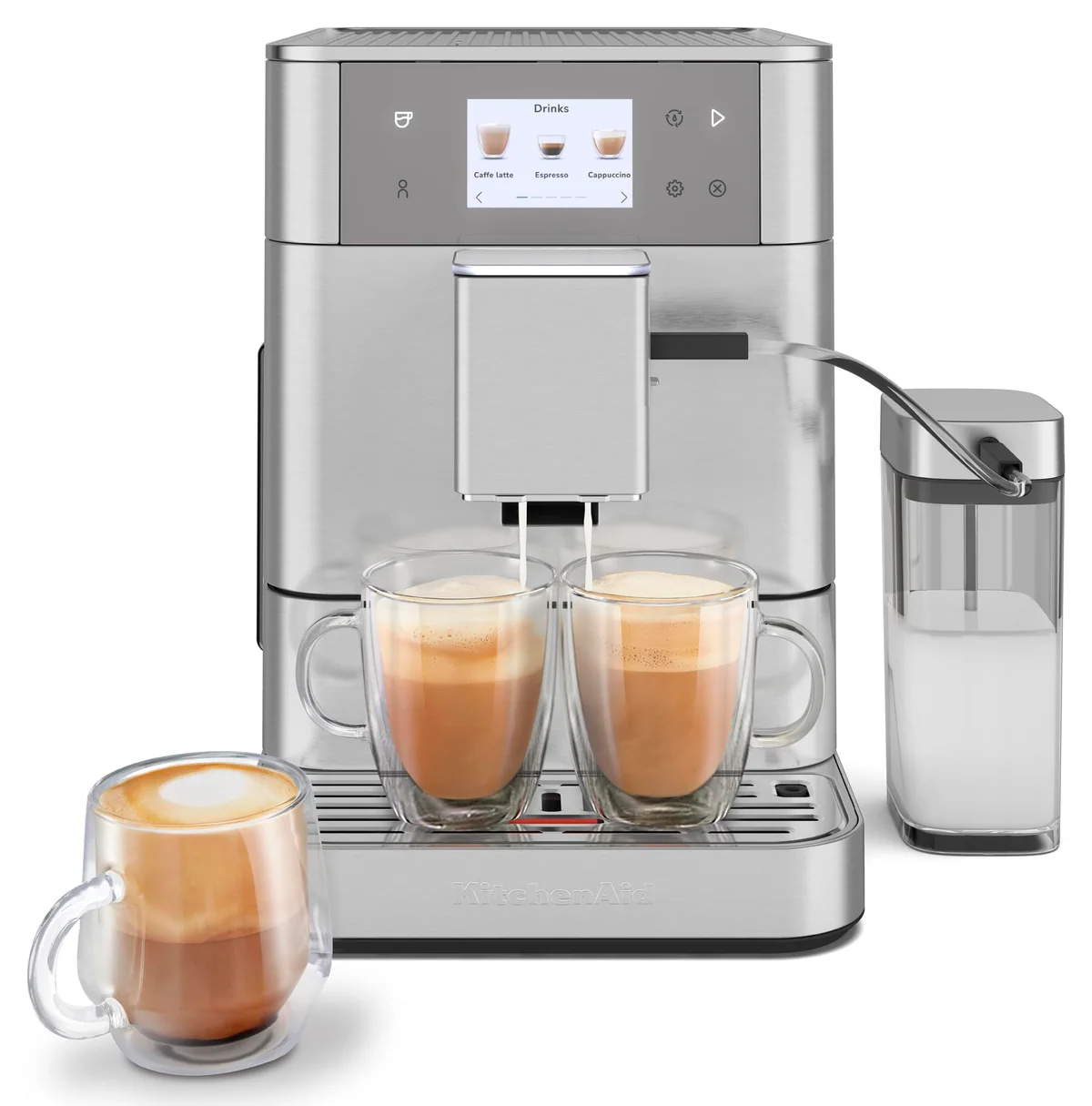
KitchenAid KF7
This comparison exists because of a single, unusually honest piece of video criticism. The reviewer who spent the most time with the Bosch 800 Series lands on a verdict of good quality coffee, lacklustre everything else, overpriced, and says in the same breath that the KitchenAid beats it on build, on features and on overall design. He is not hedging. He thinks the Bosch pours the better drink and he still would not buy it. That is a strange result for a category where the cup is supposed to be the point, and it is the result Espresso Den kept arriving at independently while writing the Bosch 800 Series review and the KF7 review.
Before anything else, a warning about which Bosch you are actually looking at, because the two listings are not one product in two colours. The black machine is the TPU60309, and what comes in the box is a water filter, a microfiber cloth, a hardness strip and a single connection hose for the milk frother. The stainless machine calls itself the TQU60307 in its own box list while Amazon files it as TQU60703, and it arrives with a milk adapter and an integrated milk container, then adds a Coffee Pot Function and a cup warmer to the feature bullets. The KitchenAid has no equivalent confusion: KES8557 is the body, and the suffix is a colour.
Neither machine has been on a bench here. What follows is built from the customer reviews on both listings, both manufacturers' own material, the long-form video review of the Bosch, the editorial that bought and used a KF7, and the owner accounts that exist in public, which for two machines this expensive is a thinner pile than either brand should be comfortable with.
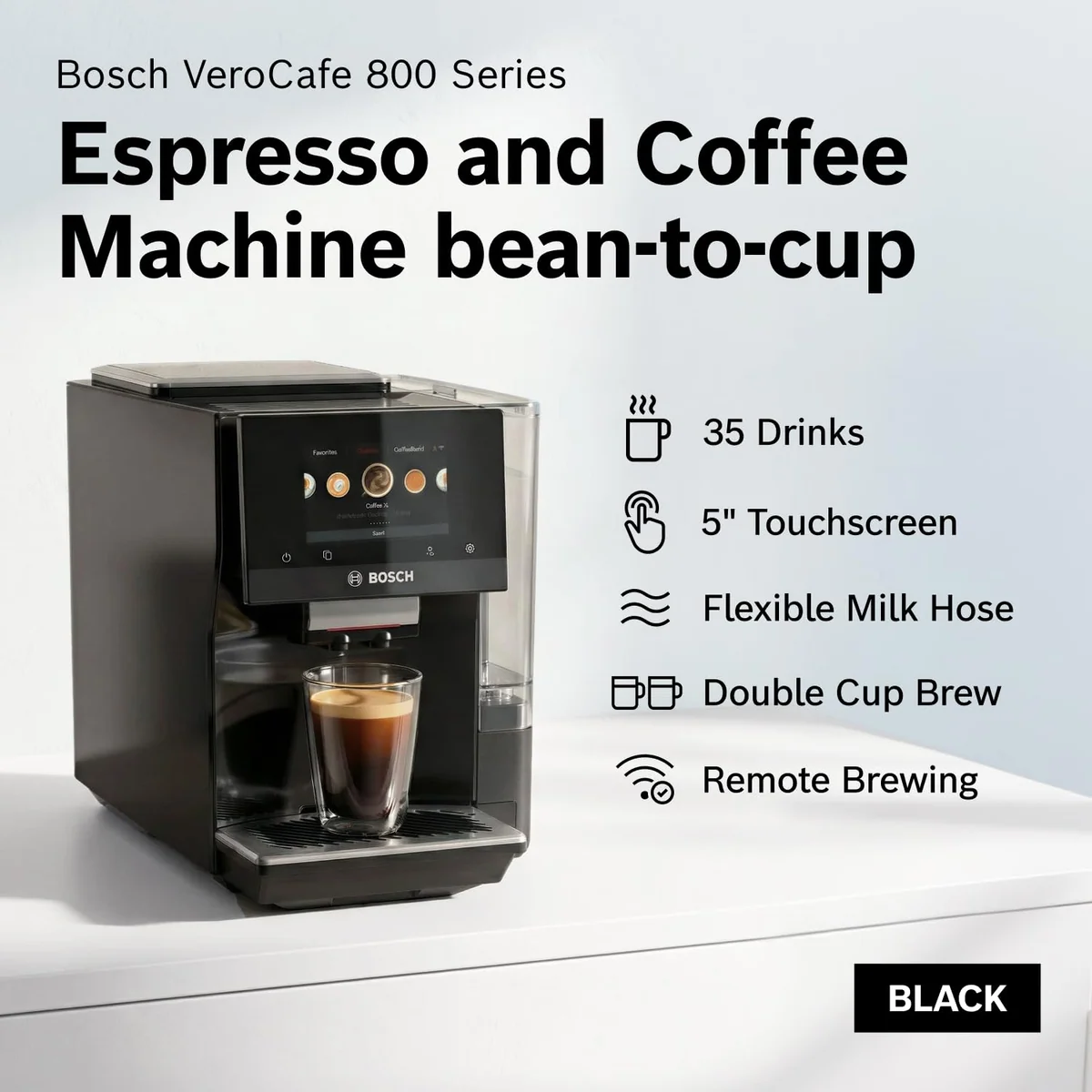
Bosch 800 Series espresso machine
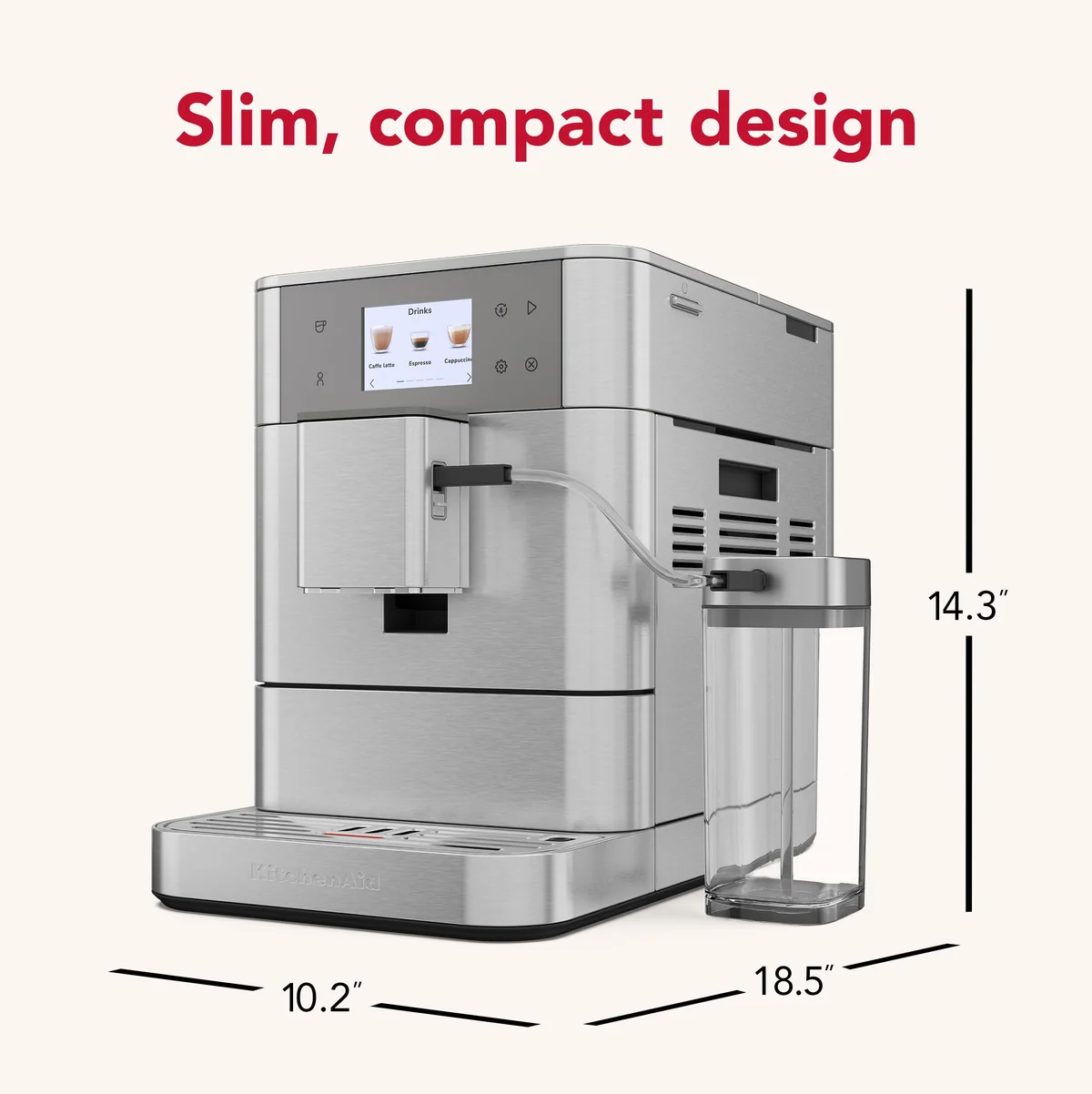
KitchenAid KF7
At a Glance
| Feature | Bosch Fully Automatic Coffee and Espresso Machine - 35 Drinks, Double Cup Barista Style Super Coffee Maker - Touchscreen, Large Bean Capacity - Easy Clean, Maintenance - Black - TPU60309 | KitchenAid Fully Automatic Espresso Machine KF7 with Milk Attachment, KES8557SX, Stainless Steel |
|---|---|---|
| Price Range | $1,500–$3,000 | Under $200 |
| Configuration | Without Milk Container | 2.2L With Milk Attachment |
| Finish | Black | Stainless Steel |
| Items In Box | 1 | 1 |
| Check Price on Amazon | Check Price on Amazon |
The cup goes to Bosch, and it is not close enough to matter
Take the Bosch's strongest claim at full strength, because it is well corroborated. Owners who arrived from a failed Jura say the coffee is stronger and better tasting on fewer beans. An owner two and a half years into a Gaggia Accademia found the Bosch the better daily experience with identical beans. Even the one-star reviewer whose machine ended up going back to Amazon opened by saying that when it works it makes great coffee. The KF7's ceiling is lower and better documented: sweet, chocolatey espresso under a thick crema once the grind is dialled in, from a reviewer who also called its milk foam acceptable without being anything special and put it below De'Longhi and Jura for texture.
So the Bosch wins the tasting. The problem is what you pay for that win in the other twenty-three hours of the day, and the honest version of this comparison is a list of the things the Bosch either cannot do or does worse.
| Bosch 800 Series | KitchenAid KF7 | |
|---|---|---|
| Coffee in the cup | The best in this bracket, per every reviewer who has had both | Good, a clear step below a machine you tamp yourself |
| Milk temperature | Owners measure roughly 110°F in the cup | Owners measure roughly 135 to 140°F frothed |
| Decaf or pre-ground | No bypass chute, so you empty the hopper | Twist-off hopper plus a bypass chute, with an auto-purge between beans |
| Screen and connectivity | Five-inch colour panel, Home Connect app, remote start | Small non-networked screen, three drink icons at a time, no app ever |
| Drink list | Up to 35 named drinks, part of it reachable only through the app | A shorter fixed list you cannot reorder or filter |
| Milk hardware | Hose into any carton on the black unit, carafe on the stainless | Hose into a container of your choice, carafe supplied |
| Cold drinks | Cold brew options owners actively enjoy | Nothing cold, at all |
| Brew unit access | Pulls out and rinses under a tap | Slides out, and is reportedly the same part Miele uses |
The decaf question decides this for a lot of households
The Bosch has no bypass chute. Whatever is in the hopper is what you get, and one decaf at night means emptying and refilling a hopper of beans, which is why a five-star owner on the black listing still wrote that she wishes she could change beans easily enough to switch to decaf sometimes. The KitchenAid answers that from two directions at once: it has the chute for a scoop of pre-ground, and the whole bean hopper twists off and lifts away, after which the grinder purges itself of what is left before the next bean goes through. Buy a second hopper, keep decaf in it, and the swap takes seconds.
That is not a spec-sheet flourish. It is the difference between one machine serving one drinker and one machine serving a house, and if your household splits between caffeinated and not, our page on machines built for two beans and the practical limits set out in using pre-ground and decaf in a bean-to-cup are both worth reading before you weigh a tasting note against them. The KitchenAid's version costs you about a shot's worth of ground coffee at each purge, which is a small tax on a real feature.
Both run their milk cool, and one runs it cooler
Neither of these machines will hand you a scalding latte, and anyone telling you otherwise is selling something. The gap between them is still material. Bosch owners land near 110°F in the cup and the fix that circulates among them is to warm the milk in the microwave first, which is a peculiar instruction to be following on a flagship. The reason it cannot be tuned away is structural: the temperature setting on the Bosch is global rather than per drink, so black coffee genuinely runs hot while the frother caps the milk and no menu rescues it. KitchenAid owners measure frothed milk in the mid-to-high 130s, which is still under what a steam wand gives you and is noticeably closer to a drink you would order out.
If milk is the entire reason you are spending this much, neither machine is the answer to that question, and our pick for people who mainly drink lattes plus the causes laid out in why these machines run cool will save you a return. Preheat the cup either way. On the milk hardware itself, both makers let you drop a hose straight into a carton, which is the arrangement almost every owner of either machine prefers over a carafe, and the hose against carafe against wand question is settled the same way on both.
The Bosch has the better interface and the KitchenAid has the better morning
This is where the Bosch earns its reputation and then squanders it. The five-inch panel swipes like a phone, the drink list runs to thirty-five named beverages with descriptions hidden behind tapping the name, and the Home Connect app has one genuinely excellent trick, which is starting the machine remotely so it skips the startup rinse and your cup catches only coffee. One owner ties that to a voice routine and orders coffee from bed. The KF7 has no wifi and a low-resolution screen showing three drinks at a time in an order you cannot change, so a favourite can sit one scroll off screen forever, permanently.
And yet the Bosch is the machine that arrives tasting like warm water. More than one buyer describes days of thin coffee before working out that you must tap the drink, enter its customisation screen, and set strength and shot count there, because the default is one shot on a long drink. The manual does not tell you. Bosch's website does not tell you. The KitchenAid needs four or five throwaway brews and a grind adjustment and then behaves. A machine with the better screen that hides the setting which makes it work is not, in the way that counts, the easier machine.
If it breaks, and this is the part that should decide it
Neither of these lines has a long-run public record, and both have a visible cluster of early trouble. On the Bosch, one buyer at about three weeks found the machine pouring warm water instead of coffee, opened the side panel on Bosch's instruction, found a broken loose part inside and still got mostly water; another, a month in, had to press all over the screen to wake it and periodically needed a full power cycle to clear an error. The black listing sits at 3.9 stars from a hundred ratings and the stainless at 3.8 from fifty-four, and fifty-four ratings is a rumour rather than a consensus. Worse than any single fault is the owner whose machine got stuck in standby and was told by Bosch that there was nobody in their area who could service it.
KitchenAid's record is not clean either, and its shape is the interesting part. Amazon has the KF7 at 4.1 from 165 ratings, which is mediocre for the money. KitchenAid's own page shows 4.6 from 245, but the distribution is 188 five-star reviews and then a fat tail of thirteen one-stars with almost nothing between, which is two populations rather than one average: people who are delighted, and people whose machine died. The most detailed warranty account on the record belongs to an owner whose machine threw a bean hopper error, spent six weeks with an authorised repairer, came back without its milk hose, and threw the identical error two days later; a separate owner is on his third KF7. Those accounts are Australian and they are individual experiences rather than a failure rate, and they still describe a service queue you should price in.
The difference is what happens next. KitchenAid replaced that third machine, replies to complaints publicly, and runs coffee through its own service group rather than the appliance chain. Bosch, on the one account we have, could not find anybody to send. Both are gambles; only one of them has a documented habit of paying out. Our baseline for the category, which applies to both, is what actually breaks first on these machines.
Neither is worth buying at sticker
We do not quote prices here, because they move faster than we publish, and in this case the movement is the whole story. Espresso Den could not find one enthusiastic first-hand account of the Bosch from anybody who paid the asking price: the happy owners bought on Prime Day, on a Black Friday deal, or used, and two of them volunteered without being asked that they would have been harsher had they paid full. The KF7 behaves the same way in reverse. At sticker its own owners start naming Juras; on KitchenAid's discount channel the same people call it obvious, because at a discount you are buying Eugster/Frismag hardware and a brew unit reportedly interchangeable with Miele's for less than the Miele costs.
Both go on promotion in cycles. If the number in front of you is the full one, closing the tab is a legitimate strategy for either machine. What is not a strategy is buying the Bosch open-box, which failed twice for one buyer who tried it, and our guide to renewed and refurbished super-automatics explains where that gamble is usually safe and why this listing is not one of those places.

Bosch 800 Series espresso machine
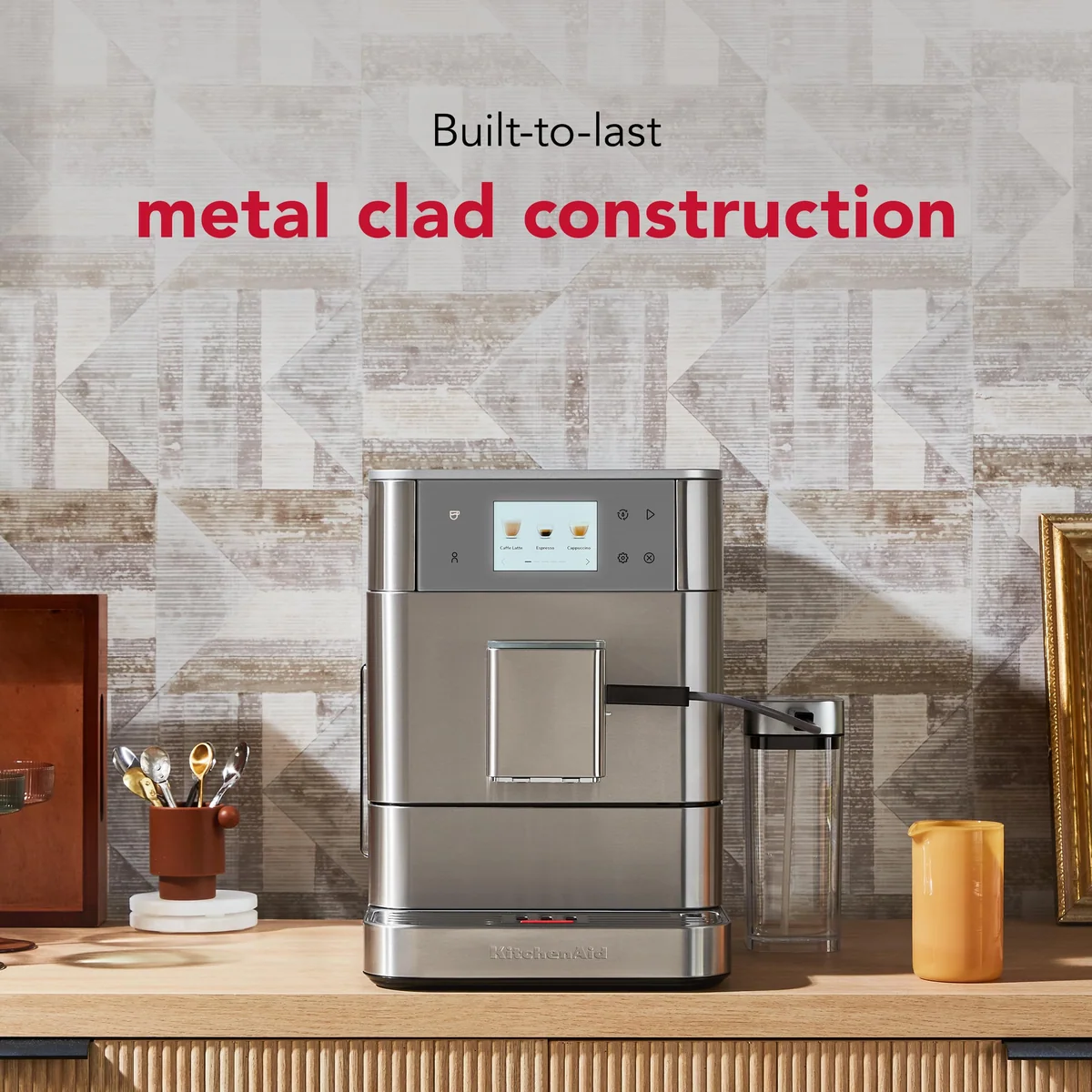
KitchenAid KF7
Which one to actually put on your counter
Buy the KitchenAid if the machine has to work for more than one person, if anyone drinks decaf, if you want to be able to see inside the brew unit, or if the possibility of a repair matters more to you than the last ten percent of flavour. Buy the black Bosch if you drink your coffee mostly black, at a hot temperature the Bosch genuinely can hit, if you enjoy a menu deep enough to explore for a month, and if you have caught it on a promotion from a retailer that will still take it back after six weeks rather than four. Buy the stainless Bosch only if the finish is worth the milk container to you, which for most people it will not be.
The Bosch for a kitchen where the finish has to match everything else
Same excellent coffee and same five-inch screen as the black machine, plus the integrated milk container, the cup warmer and the Coffee Pot Function on the feature list.
Owners abandon the carafe because the tube pushes warm milk back into it, the cup warmer barely warms a base, and the advertised coffee pot is not in the box.
The Bosch to buy if you are buying a Bosch at all
The hose drops straight into whatever carton you are using, which suits a house running dairy, oat and almond, and it costs you nothing that the stainless unit actually delivers.
No bypass chute means a single decaf involves emptying the hopper, the lowest latte milk ratio is thirty percent with no way down, and the milk arrives warm rather than hot.
The one most households should buy
Swiss hardware behind the friendliest interface in the category, with a twist-off hopper and a bypass chute that let two people drink two different things without negotiating.
The record carries a real cluster of failures inside the first four months, and the best-documented warranty case ran six weeks at a repairer and then failed again two days after it came home.
If neither answer satisfies you, the honest neighbours are on this site already. The Bosch 300 Series is a far simpler machine with a contented owner base at a fraction of the money, and we set the two Bosches against each other in the 300 against the 800. If it is the hopper trick you want rather than the badge, the KF7 against the De'Longhi Rivelia is the comparison to read. If you want the drinks hotter and are willing to pay for it, Jura against KitchenAid makes that case, and the KF6 against KF7 against KF8 question covers the ladder either side of this machine. Anyone who needs iced drinks should start from the machines that actually brew cold, because the KF7 does not, and our wider shortlist has options with longer track records than either of these.
Frequently Asked Questions
Which one makes better coffee?
The Bosch, by the account of every reviewer and owner who has run both, including the one who tells his audience to buy the KitchenAid instead.
Can either make a decaf without emptying the bean hopper?
The KitchenAid can, through either its bypass chute or a twist-off hopper that purges the grinder behind it, and the Bosch cannot do it at all.
Does the KitchenAid KF7 have an app?
No, it has no wifi of any kind, so every limit of its small screen is permanent in a way the Bosch's is not.
Should I get the stainless Bosch or the black one?
The black one, because the milk hose that comes with it is what nearly every owner ends up using anyway and the stainless unit's extra features are the weakest things on its list.
Does either of them make iced coffee?
The Bosch has cold brew options its owners genuinely like, and the KitchenAid KF7 has no cold or iced mode whatsoever.
Which is the safer purchase if something goes wrong?
Neither is safe exactly, but KitchenAid has a documented record of replacing machines under warranty while one Bosch owner was told there was nobody in their area who could service theirs.
Is the KF8 worth the step up from the KF7?
Only for two extra strength levels and the plant-milk presets, because the brew unit, grinder, dose and milk terminal are the same parts, as our KF8 review sets out.