De'Longhi Eletta Explore vs KitchenAid KF8: the espresso is a draw, so buy the machine for what it does around the coffee
Buy the Eletta Explore if cold-extracted coffee and a 16 oz travel mug are things you will genuinely use most weeks, and buy the KF8 if near silence, a hopper you can change roasts in and a heavier chassis matter more, on the understanding that it wants a brew-unit rinse under the tap every week that its manual never asks for.
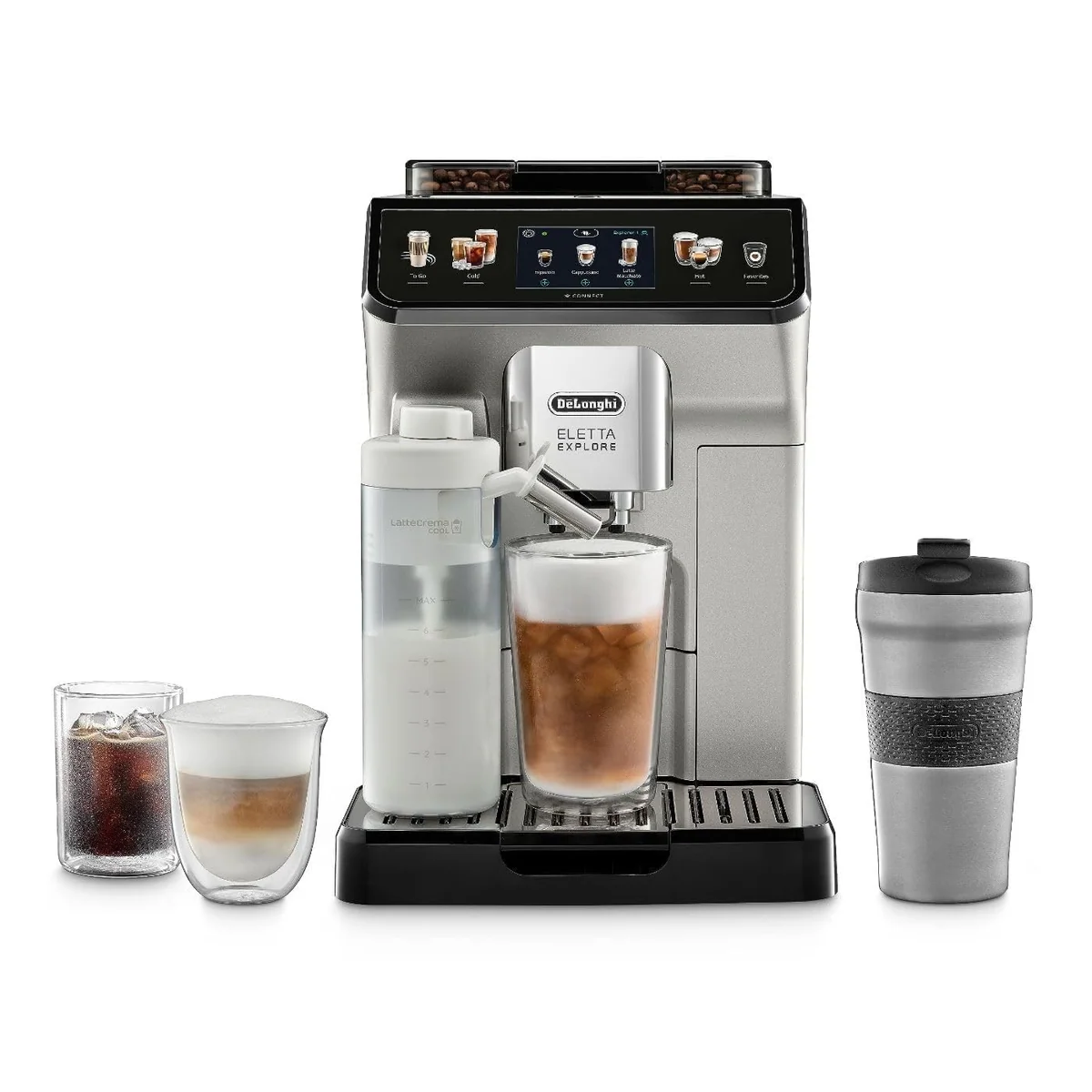
De'Longhi Eletta Explore
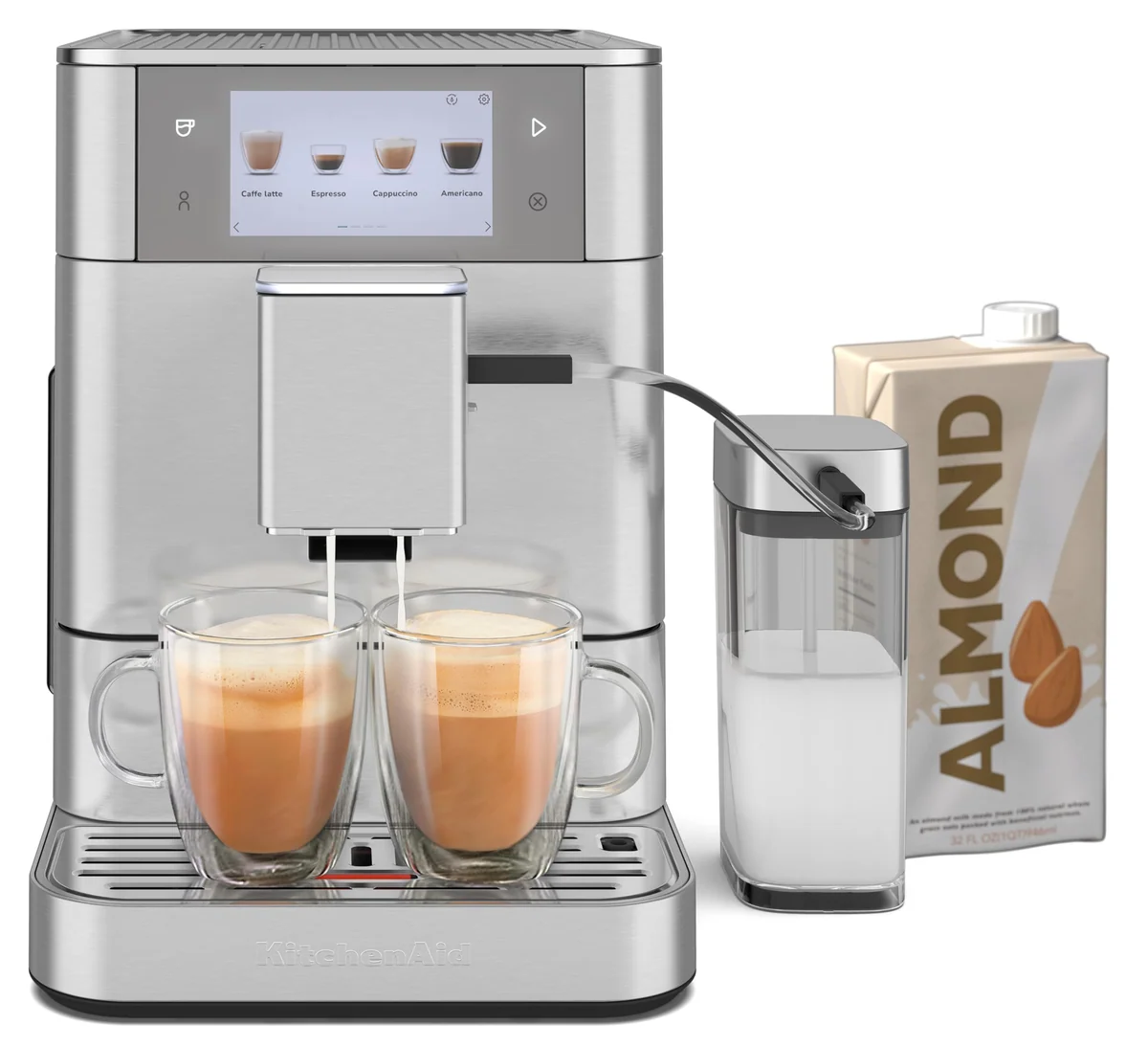
KitchenAid KF8
This is one of the few comparisons at this level where the coffee is not the deciding factor. Both machines put a real double shot in the cup, both grind fine enough to make espresso that tastes like espresso rather than the thin brown water cheaper bean-to-cup machines produce, and both fall short of what a person tamping their own basket can pull on a good morning. Owners of each have said as much on the record, and Espresso Den's own reviews of the Eletta Explore and the KitchenAid KF8 landed in the same place independently. If you are hoping one of them makes better espresso than the other by a margin you could taste blind, the honest answer is that nobody has produced evidence of it.
What differs is everything wrapped around the shot. The De'Longhi is the machine that brews cold coffee properly, counts your ice cubes for you, connects to an app and will take a travel mug under its spouts. The KitchenAid is the machine you can run while somebody sleeps in the next room, built in Switzerland by the contract manufacturer that also supplies Jura and Miele, with a bean hopper that twists off in your hand. Neither of those descriptions is a compromise version of the other. They are two different ideas about what a two-thousand-dollar coffee machine is for, and the good news is that the question they put to you is easy to answer about your own kitchen.
One more thing before the argument starts. These two sit close enough together on price that money is not the tiebreaker, which is unusual and slightly liberating: you can pick on merit rather than on budget. The place where money does come back into it is at the end of this page, because both of these machines have cheaper siblings that make the same coffee, and for a lot of readers that is the real finding.
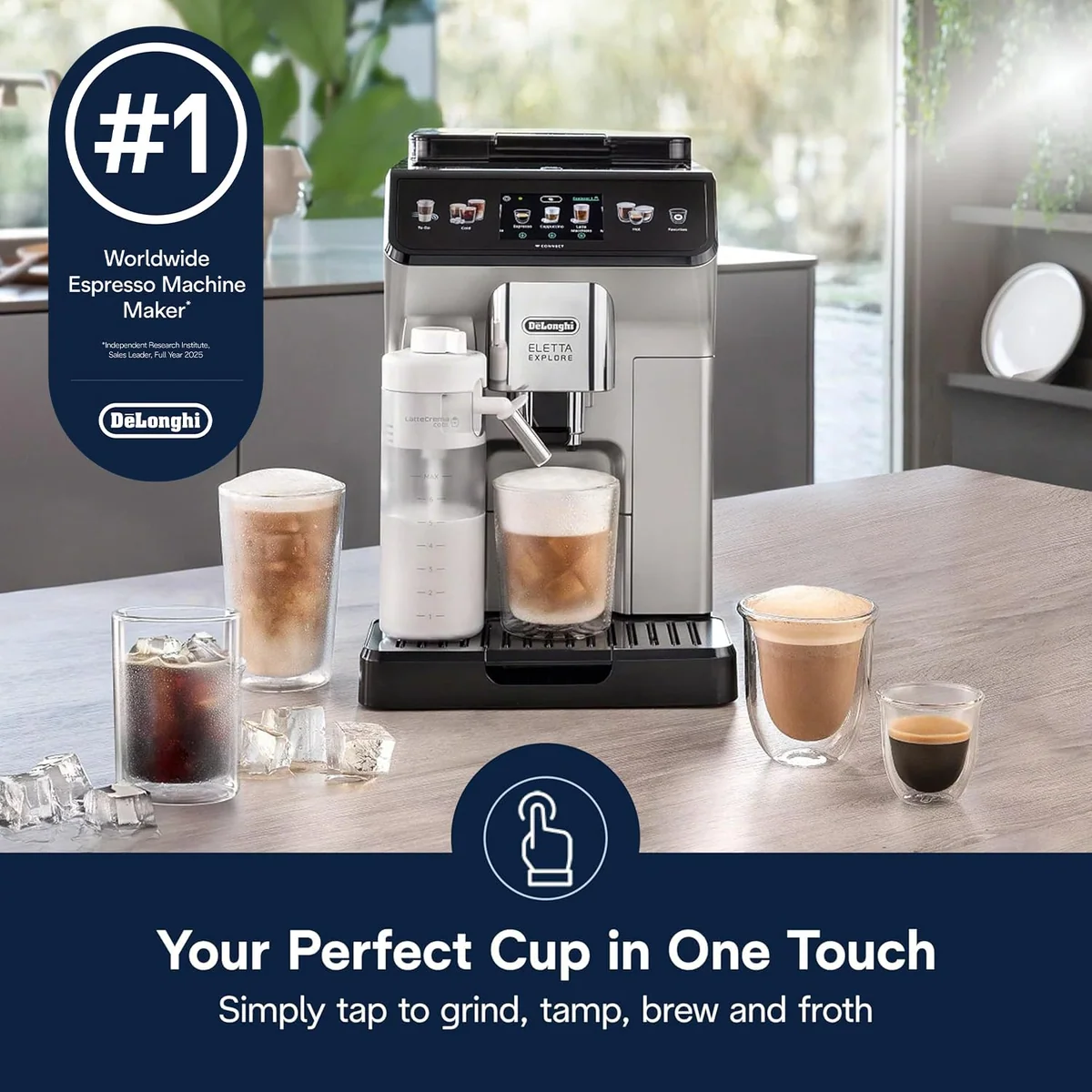
De'Longhi Eletta Explore
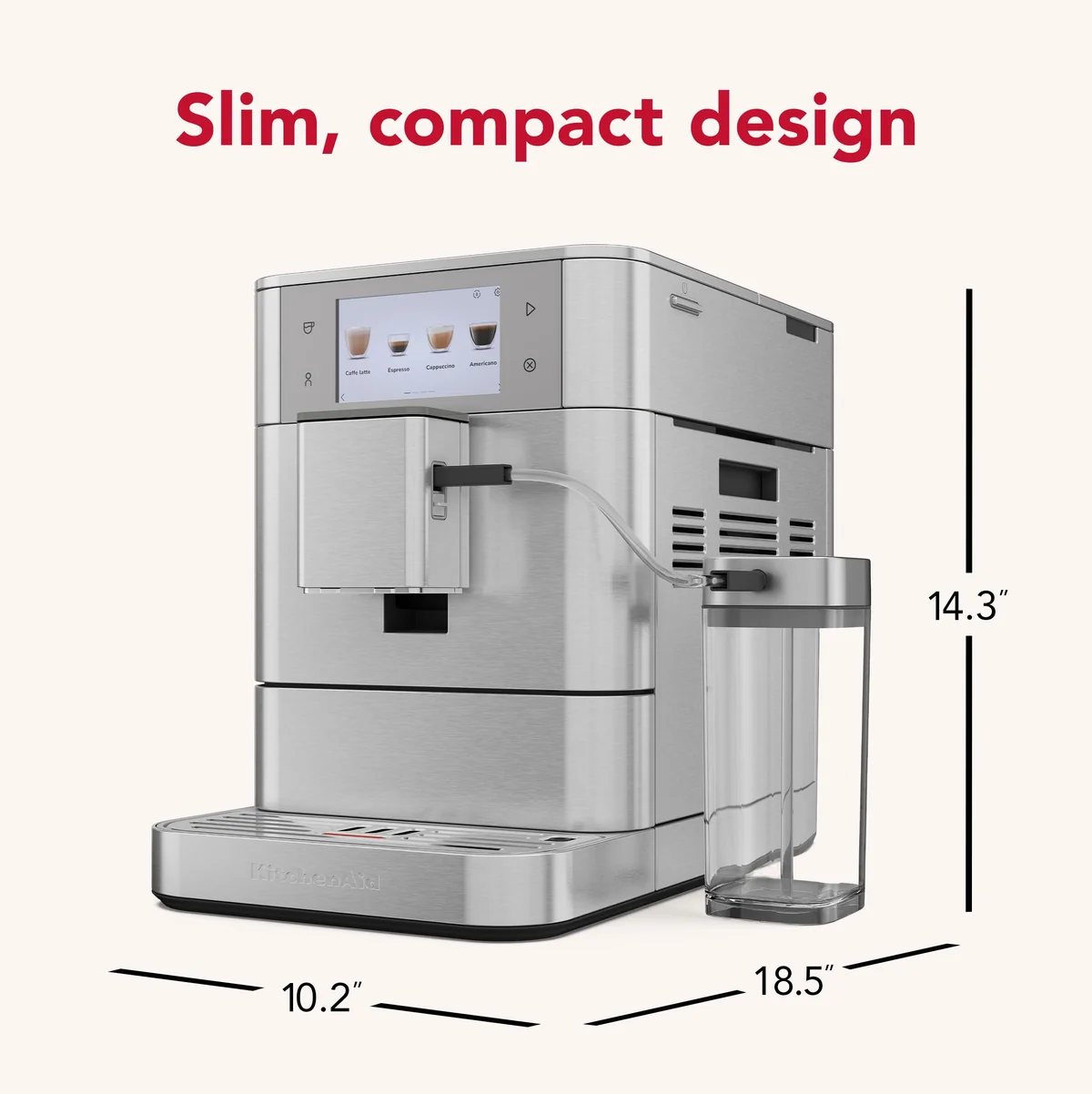
KitchenAid KF8
At a Glance
| Feature | De'Longhi Eletta Explore Espresso Machine with Cold Brew, Hot & Cold Milk Frother - 50+ Recipes, Built in Grinder, Smartphone Compatible with Bean Adapt Technology for Ideal Extraction, 3.8 Pounds | KitchenAid Fully Automatic Espresso Machine KF8 with Milk Attachment and Plant Based Milk Options, KES8558SX, Stainless Steel |
|---|---|---|
| Price Range | $1,500–$3,000 | Under $200 |
| Configuration | — | 2.2L With Plant Based & Milk Attachment |
| Finish | Stainless Steel and Black | Stainless Steel |
| Items In Box | 1 | 1 |
| Check Price on Amazon | Check Price on Amazon |
Where the two machines actually diverge
Start with the grinder and the dose, because that is where a super-automatic either has headroom or does not. Owners weighing the KF8's puck put it around 15 g, which is Miele territory and above where De'Longhi's cheaper machines top out. The Eletta ranges from roughly eight to fifteen grams depending on the intensity you ask for, and one reviewer who weighed it repeatedly at a fixed setting got anywhere from 9.4 to 11.3 g, with the highest intensity not reliably producing the most coffee. The listing calls that grinder "precise, consistent"; the scales disagree with the second word.
The Eletta wins one thing outright here, and it is worth understanding why it matters. Two independent reviewers managed to choke the machine by grinding too fine, which sounds like a fault and is actually a certificate: a machine you can stall is a machine with grind range left in reserve, and the buyer who cross-shopped these two and chose the De'Longhi named exactly that, along with more grind settings, as his reason. The KF8 answers with steadier dosing and a bigger floor. If your beans are dark, oily and awkward, more grind range is real money; if you buy a decent medium roast and never think about it again, it is a spec you will never touch. Our guide to which beans survive a bean-to-cup machine covers the ones that cause the trouble in the first place.
| If this is your morning | The machine that fits it | Because |
|---|---|---|
| Iced coffee and cold brew for half the year | Eletta Explore | Cold extraction is the only genuinely cold brewing on either machine |
| Coffee before anyone else is awake | KF8 | The whole machine is built around being inaudible from the next room |
| Decaf for one person, regular for the other | KF8 | The hopper twists off, so a roast change takes about a minute |
| Coffee in the car on the way out | Eletta Explore | Rare travel-mug clearance, plus a mode that rescales the recipe to fill it |
| Two people who disagree about milk volume | Eletta Explore | Four profiles, each with its own stored milk and coffee amounts |
| Milk drinks that must be properly hot | Neither | Both target sweetness and safety over heat, and both land cooler than a café |
Cold coffee is the De'Longhi's entire argument, and it is a real one
Cold extraction pumps cold water through an espresso-fine grind at very low pressure and lets contact time do the work heat normally does. A reviewer with a thermometer measured the liquid leaving the spout at 37 °C, roughly half a normal brew temperature, and called it as close to real cold brew as a super-automatic gets. The under-appreciated consequence is not the flavour, it is the physics: because the coffee is already cold, your ice stops melting into it, so the drink does not dilute itself while you carry it to the sofa. The KF8 has no equivalent at all, and KitchenAid's answer to cold coffee arrived after this machine, on the smaller line that now sits beneath it in the range and adds a lower-temperature iced mode of its own.
Two honest deductions before you buy the Eletta for this. First, only the cold brew setting brews cold. Iced espresso, iced cappuccino and the rest of the cold menu are brewed hot and dropped onto ice cubes the screen counts out for you, with one reviewer measuring the coffee hitting the glass at about 85 °C before the ice arrives. Second, "cold brew in under 3 minutes" appears twice in the marketing and a timed run took four minutes forty seconds for 100 ml, before you count the rinse the machine performs to cool itself down. It is a good feature undersold by an unnecessary exaggeration, and our explainer on what iced modes really do applies the same test to every other brand.
Silence is the KitchenAid's entire argument, and it is also a real one
Reviewers who have covered the KF8 lead with the quiet before they lead with anything else, and the most telling observation is not a decibel figure at all: on this machine, the milk system is louder than the grinder. That inverts the normal experience of owning one of these, where the grinder announces to the whole floor that somebody wants a flat white.
The Eletta is not loud on a meter. One reviewer recorded under 65 dB while grinding and called it among the quietest machines she had tested, which is a fair reading. The complaints against it are about pitch rather than volume: one reviewer calls the grinder screechy enough to set his teeth on edge, another says its high-pitched note drives his migraine-prone wife out of the room, and a retailer's own crew review admits you can hear it from a room or two away. Both things can be true, and if a quiet kitchen is the constraint that brought you here, the quietest super-automatics guide puts this whole class against the field.
Milk: the best foam in the category, or the least fuss in the category
On texture the De'Longhi is the stronger machine and it is not close. Reviewers describe LatteCrema hot foam as creamy rather than airy, noticeably sweeter for it, and good enough for a rough go at latte art, with more than one rating De'Longhi above its rivals on milk specifically. The KF8's froth is reported as consistently fine, which is a compliment with a ceiling attached, and the recipes lock the milk-to-foam ratio so you cannot ask for two ounces of steamed milk and four of foam. Foam density is not adjustable on it either.
Then the drawback that applies to both, stated plainly because it is the single most common regret in this category. Milk drinks come out cool. An Eletta owner measured a flat white at 125 °F with a calibrated thermometer while black coffee from the same machine read 157 °F, called De'Longhi, sent them a video, was shipped a replacement unit, and measured the replacement at 125 °F as well. On the KF8, the owner reports that agree with each other put frothed milk somewhere around 135 to 140 °F and warm-milk recipes near 120 °F. Neither machine is broken; both are built on the view that milk tastes sweetest below scalding. Preheat the cup and most people stop noticing, and if you cannot live with that, the milk system you actually want is a steam wand, for reasons our piece on why these machines run cool goes into properly.
Where the KitchenAid takes the round is the part that happens after the drink. A hose drops into the supplied container or into any jug you like, and when you are done you plug the hose into a port in the drip tray and let the machine flush it. Nothing lives in your fridge. The Eletta asks for two separate carafes, one for hot foam and one for cold, and the machine refuses to brew if the wrong one is fitted. One reviewer calls that the absolute worst part of the machine, because a household that drinks both hot and cold ends up with two jugs of milk slowly going off in the fridge door, the lids do not clip on, and for no reason anyone can identify the two jugs are not even the same size. A reviewer with a real household confirms the shape of it: he wants a hot coffee, his wife wants a cold one, so there are two milks on the go.
Both of them lie about the recipe count, in the same arithmetic
De'Longhi advertises more than fifty recipes. One reviewer sat down and counted fifty-one, arriving there by treating the hot, cold and to-go versions of one drink as three drinks; another site's spec table counts twenty-two distinct specialty drinks. KitchenAid advertises more than forty. An owner three months in explains how that number is reached: the same drink made with dairy and again with plant milk is counted twice, and a chunk of the balance is a printed booklet of espresso martinis you assemble yourself. A dealer reading the KF8's on-screen menu tile by tile counted sixteen programs. Sixteen genuine one-touch drinks is plenty, and around twenty on the De'Longhi is plenty, and neither of these machines needed the padding.
What owning each one is actually like
The Eletta's daily friction is water. It rinses on start-up, on shutdown and between modes, which is good for flavour and means the 1.8 L tank empties and the drip tray fills faster than owners expect, and that tray has no spout or tipping point, so carrying a full one to the sink slops it over itself every time. The bean hopper is awkward enough that several owners pull the machine out from under the wall cabinets to fill it. The touchscreen, by way of compensation, is the least frustrating interface anybody in this class has built, and the four user profiles are the genuinely domestic feature: two people who disagree about milk volume both get their own drink from one button.
The KF8's daily friction is a maintenance job that is not in the manual. The most useful review on its listing is a five-star one whose author's first unit began clogging after a week, sometimes delivering almost nothing during extraction before letting go with a loud pop and venting steam out of the side of the machine. KitchenAid replaced it on one phone call, the replacement clogs less often, and he keeps it healthy by pulling the brew unit and rinsing it in the sink weekly. His diagnosis of the wider review pile is the part worth printing: the smoke, the steam, the leaking water and the missing espresso volume that other reviewers report are, in his experience, all the same fault, a clogged brew head causing overpressure, and the machine's own automated cleaning cycle does not fix it because that cycle flushes lines rather than clearing grounds. A separate owner reports mold around the brew unit after a long weekend away, which is one report rather than a pattern, and plausibly the same root cause: wet grounds sitting in a closed compartment. Two minutes a week under the tap is cheap insurance, and our cleaning and descaling guide sets out what the rest of the routine costs you.
Both machines have an aftercare story with a good day and a bad day in it. On the KitchenAid side, one owner had a replacement shipped on a single call, while another making two lattes a day had a unit fail at three months, waited three weeks, had the replacement fail at three months, and was then told KitchenAid could not supply their brushed metal finish, leaving them to wait indefinitely or accept a different colour, with nobody having contacted them proactively. On the De'Longhi side, one one-star owner had his machine replaced after De'Longhi accepted his video evidence, and the other says his milk function never worked, that the warranty process was impossible, and that two years and several self-funded repairs later it is dead. Neither listing's average score is the whole story: both are strongly liked machines with a small, specific minority of failures, and the failures on both cluster early rather than late. Nobody in the public record has run a KF8 much past a year, which is worth knowing before you treat build quality as a proxy for longevity, and how long these machines last is the category answer in the absence of a KF8 one.
One last asymmetry that decides it for some people. The Eletta has Wi-Fi and an app, and the app is a liability on this generation: slow to start, needs re-pairing, logs you out, and its remote brew feature is unusable because the machine runs a rinse the moment it powers on, so a drink started from your phone lands in a cup of rinse water or in no cup at all. You need it exactly once, to build a Bean Adapt profile, after which most reviewers stop opening it. The KF8 has no Wi-Fi at all, which means its interface annoyances are permanent, including being unable to reorder drinks on the home screen and a backlight that never sleeps. Take your pick between a connected feature that does not work and no connected feature to be disappointed by.
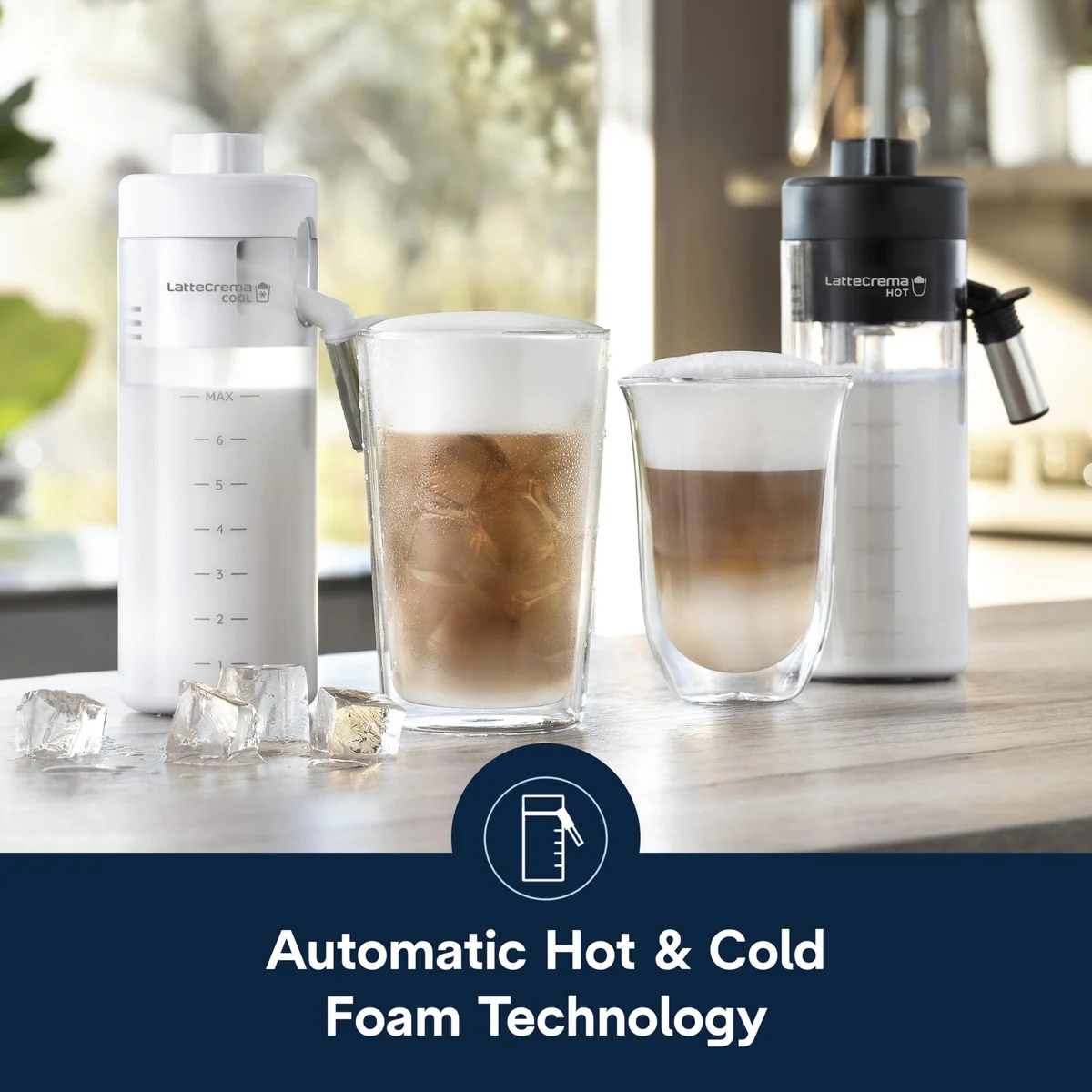
De'Longhi Eletta Explore
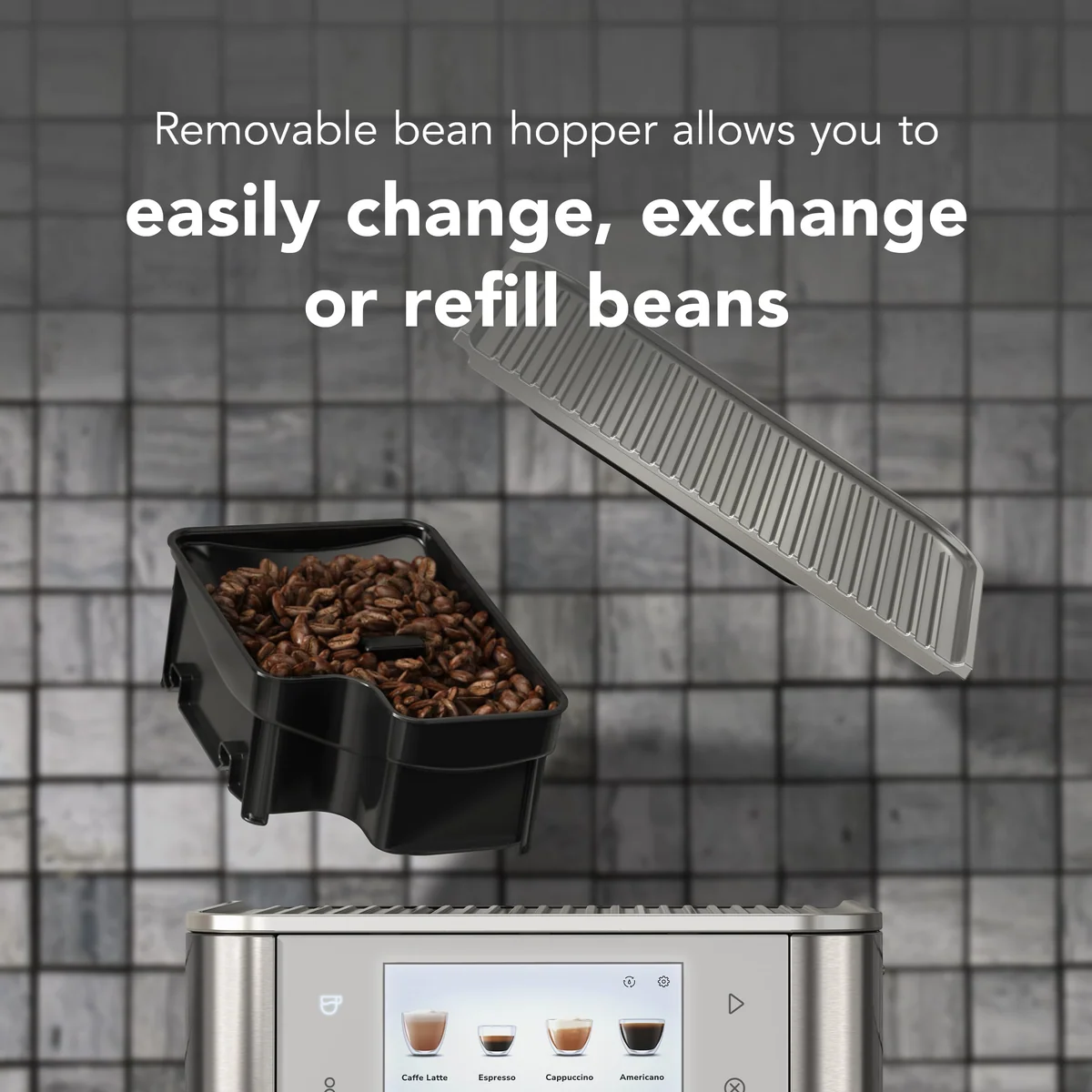
KitchenAid KF8
Which one belongs on your counter
The clean version of the decision is this. If you drink iced coffee for a good part of the year, or if a travel mug is part of your morning rather than an occasional thing, the Eletta Explore is doing something the KitchenAid cannot do at any setting, and no amount of build quality closes that gap. If your kitchen is open-plan, if somebody in the house sleeps later than you, or if you buy beans often enough that changing roasts is a routine rather than an event, the KF8 solves problems the De'Longhi will keep handing you every single morning. Everybody else is choosing on temperament: the De'Longhi is the more entertaining machine and the KitchenAid is the more restful one.
The one to buy if half your year runs on cold coffee
It is the only machine in this pair that genuinely brews cold rather than pouring hot coffee over ice, and it pairs that with the best hot milk foam in the category, rare travel-mug clearance and a touchscreen nobody has to be taught.
Milk drinks land around 125 °F, measured on two separate units by the same owner after De'Longhi replaced the first one, so a preheated cup stops being optional.
The one to buy if the kitchen has to stay quiet
It is a Swiss-built machine wearing a mixer company's badge, quiet enough that the milk system is louder than the grinder, with a hopper that twists off for a roast change and a milk hose that leaves nothing in your fridge.
The brew unit needs pulling out and rinsing under the tap roughly weekly, which the manual never tells you and the machine's own cleaning cycle does not do, and skipping it is what produces the clogging, the loud pop and the steam venting from the side of the machine that fill the angriest reviews.
The cheaper answer that applies to both of them
Neither of these is the machine most readers should buy, and it costs us nothing to say so. Reviewers who own the Eletta Explore alongside a Rivelia or a Dinamica Plus report that the espresso is effectively identical across all three, because the brew group and the grinder are shared; the premium buys cold extraction, the second carafe and the cup clearance, and nothing else. If those three do not excite you, drop down and keep the money, which is the argument we lay out across the range in which De'Longhi to buy and head to head in Rivelia against Eletta Explore.
The same trap sits under the KitchenAid, and it is sprung by the machine's own most knowledgeable advocate, who recommends the KF7 instead. There is no evidence the KF8 doses more coffee than the KF7 or the KF6; the step up buys five strength increments instead of three, a wider screen holding one or two more drink thumbnails, and a dairy-or-plant-milk selection that the same owner believes is a menu label rather than different hardware. Our KF6 against KF7 against KF8 page takes that apart properly. It is also fair to note that KitchenAid's newer compact line is smaller than the KF8, adds an iced mode and adjusts grind and dose automatically when you change roast, which is a genuine argument against buying the flagship of an outgoing generation.
If this whole comparison has mostly persuaded you that two thousand dollars is a lot of money for a button, that is a reasonable conclusion and there are honest places to spend less: the Philips 5500 LatteGo is the machine one KF8 owner reached for when he wanted to say the drinks were not a lot better on the expensive one, and the best machines under a thousand dollars is the wider field. If you are cross-shopping upward instead, Jura against KitchenAid is the next argument along, and whether a super-automatic is worth it at all is the question underneath all of them.
Frequently Asked Questions
Does either machine make noticeably better espresso than the other?
No, and nobody has produced evidence that they do, which is why this decision turns on cold brew, noise, milk handling and maintenance instead.
Can the KitchenAid KF8 make cold brew?
No, it has no cold extraction mode, and the only genuinely cold-brewed coffee in this pair comes from the Eletta Explore.
Is the Eletta Explore's iced coffee actually cold?
Only the cold brew setting is, measured at 37 °C leaving the spout, while everything else on the cold menu is brewed hot at around 85 °C and dropped onto the ice cubes the screen tells you to add.
Which one is quieter?
The KF8, clearly, and reviewers keep noting that its milk system is louder than its grinder, which is not something you can say about most machines.
Which handles milk better?
The De'Longhi makes better foam and gives you more control over it, while the KitchenAid is far less trouble to live with because a hose flushes itself instead of two carafes taking up fridge space.
Will either give me properly hot lattes?
Not without preheating the cup, since both are designed around milk that stays under scalding and owners of each have measured drinks in the 120s Fahrenheit.
Which is better if two people in the house drink different beans?
The KF8, because its hopper twists off and a purge cycle clears the grinder, though the purge wastes about a shot's worth of coffee so it suits switching roasts on a Tuesday rather than alternating cup by cup.
Do I need the De'Longhi's app?
You need it once to create a Bean Adapt profile, and after that most reviewers stop opening it, not least because its remote brewing feature drops your coffee into a cup of rinse water.
How much maintenance does each one really need?
The KF8 wants its brew unit pulled and rinsed weekly to avoid the clogging fault, while the Eletta wants both milk carafes washed every couple of days and a drip tray emptied more often than you would guess.
Is there a cheaper machine that makes the same coffee as either of these?
Yes on both counts, since the Dinamica Plus and Rivelia share the Eletta's brew group and grinder, and the KF7 shows no evidence of dosing less coffee than the KF8.