De'Longhi Rivelia vs Eletta Explore: the espresso is a tie, so buy the feature instead
Buy the Rivelia if two people in your kitchen drink two different beans, buy the Eletta Explore if iced coffee or a travel mug is part of your week, and if neither describes you, buy a cheaper De'Longhi and keep the difference.
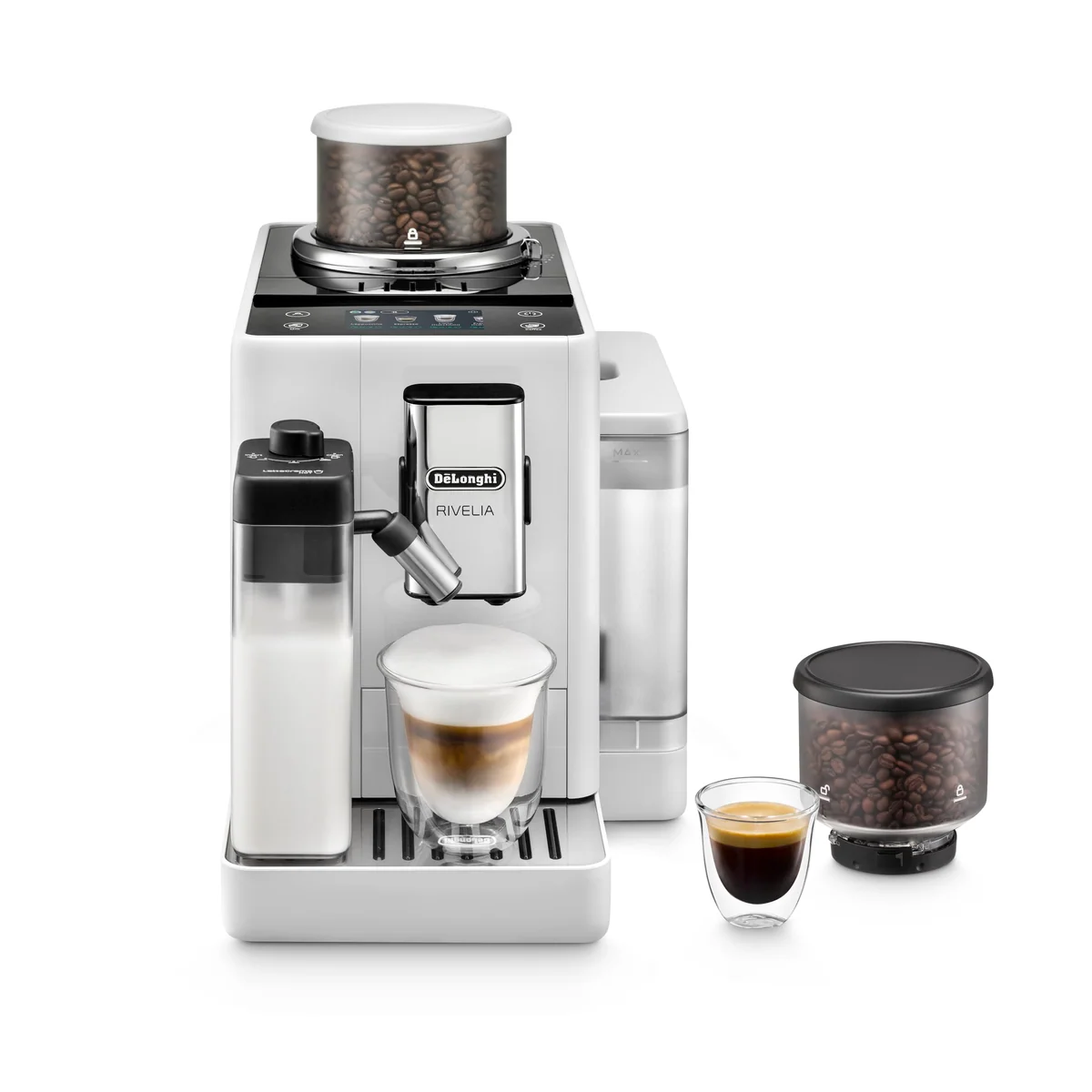
De'Longhi Rivelia
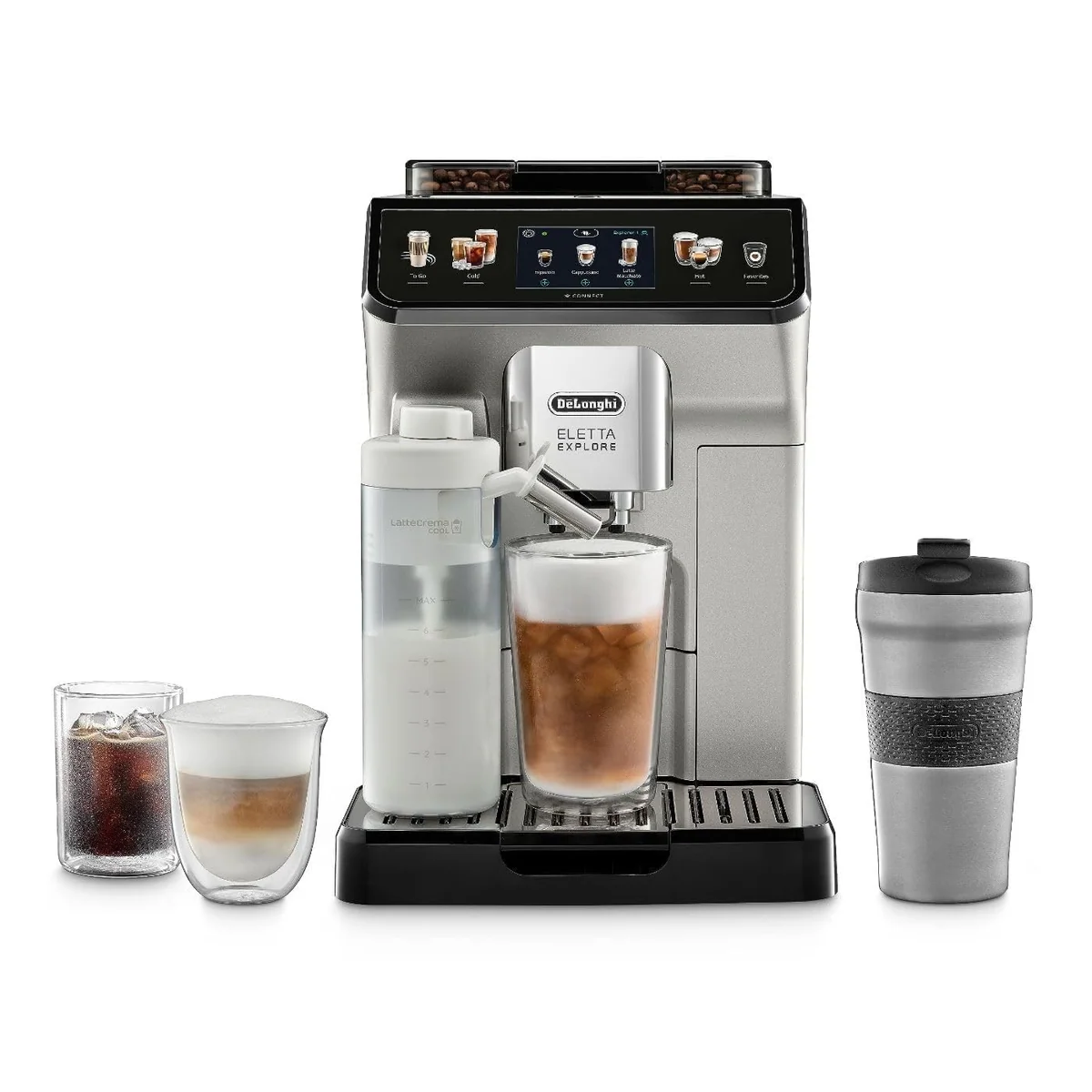
De'Longhi Eletta Explore
The instinct with two machines from the same brand is that the dearer one makes better coffee. That instinct is wrong here, and the people best placed to know are the ones who say so loudest. The most useful witness in the whole record is an owner who bought an Eletta Explore, then bought a Rivelia as well, put them side by side and reported that the internal brew group is essentially the same between them, which you can taste because the hot drinks come out the same. A reviewer who bought three De'Longhi super-automatics with his own money and ran them against each other reached the same conclusion about the brew groups and the conical grinder they share. A third comparison, covering the Magnifica Plus, the Rivelia and the Eletta Explore together, treats the differences as features bolted around a common core rather than a ladder of coffee quality.
Espresso Den has not had either machine on a bench, and nothing on this page is presented as our own measurement. What it is built from is the public record read against itself: owner reviews on all three listings, the owner threads where people report back at six months and two years, and the hands-on reviews from people who weighed pucks, timed extractions and put thermometers in milk. On this particular comparison that record is unusually consistent, which makes the decision cleaner than most.
So the question is not which machine pulls the better shot. It is which of two features you will actually use, every week, for years. One machine lets you swap the beans. The other one brews cold and takes a tall cup. When somebody put exactly this choice to owners on r/superautomatic, the replies were close to unanimous and not especially kind to the Rivelia: if you are not going to swap hoppers, buy the Eletta.
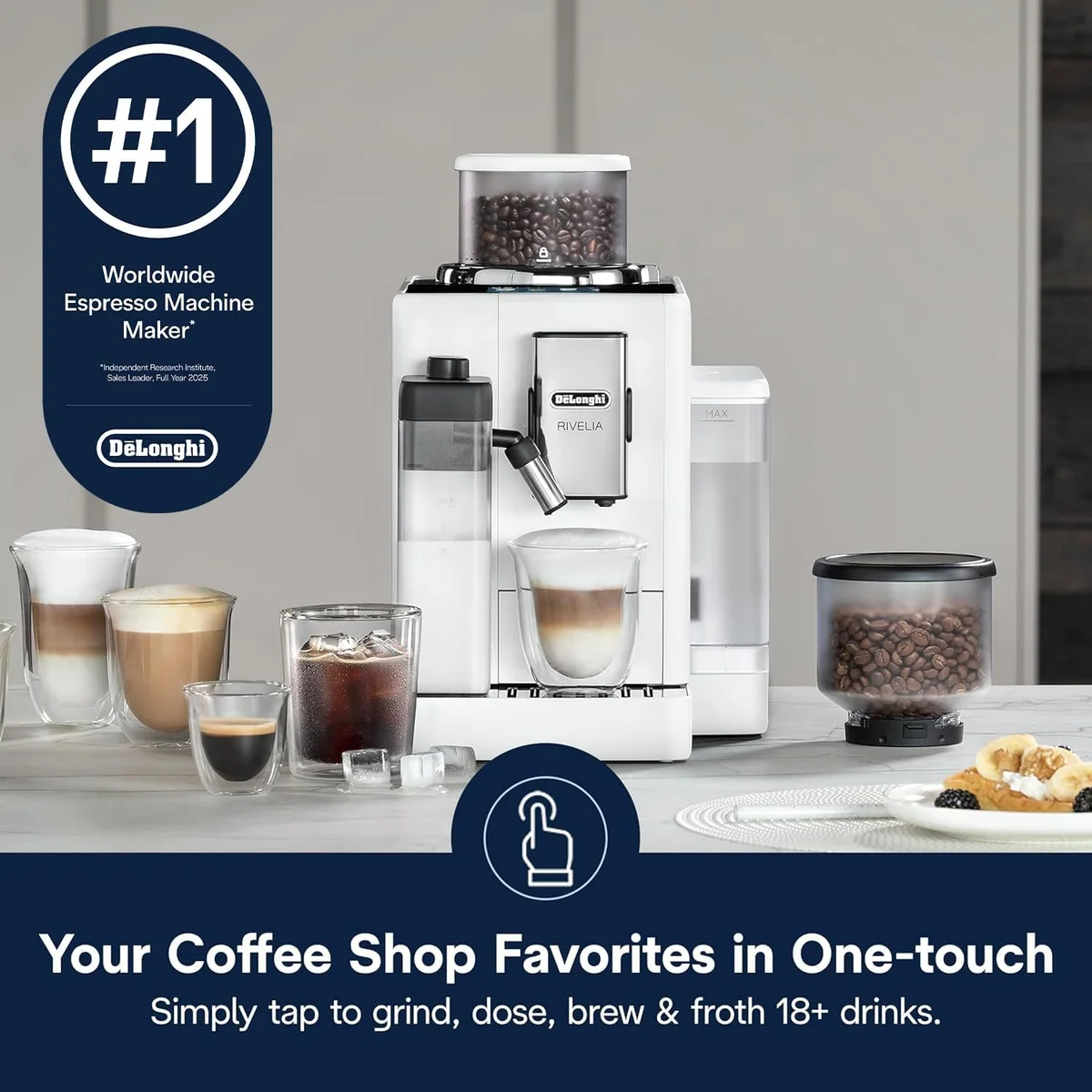
De'Longhi Rivelia
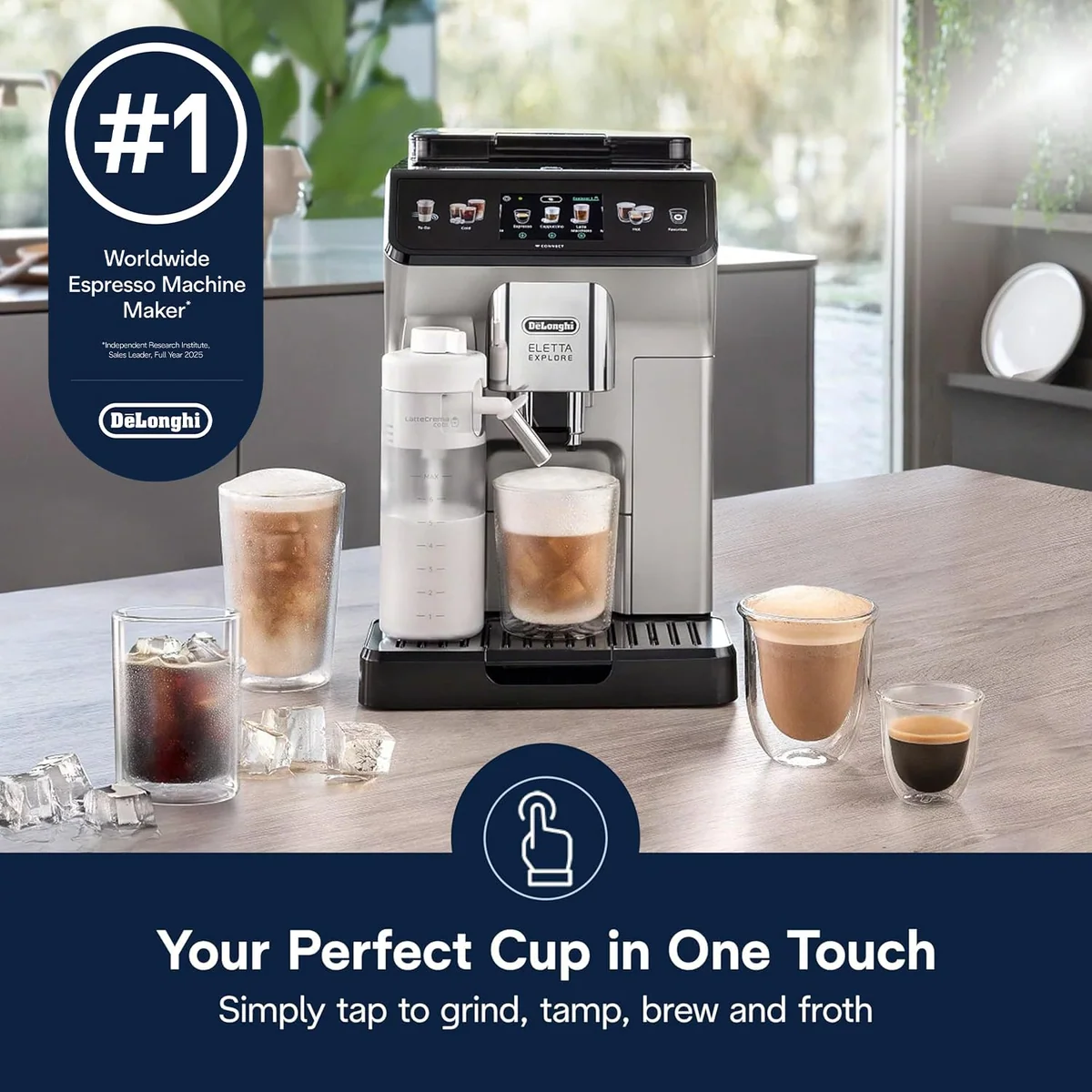
De'Longhi Eletta Explore
At a Glance
| Feature | De'Longhi Rivelia Automatic Espresso Machine with Grinder & Milk Frother – All-in-One Coffee Maker, Hot & Iced Latte, Cappuccino, Bean Switch System, Burr Grinder, Compact Italian Design, White | De'Longhi Eletta Explore Espresso Machine with Cold Brew, Hot & Cold Milk Frother - 50+ Recipes, Built in Grinder, Smartphone Compatible with Bean Adapt Technology for Ideal Extraction, 3.8 Pounds |
|---|---|---|
| Price Range | $1,000–$1,500 | $1,500–$3,000 |
| Configuration | Rivelia White | — |
| Finish | Arctic White | Stainless Steel and Black |
| Items In Box | 1 | 1 |
| Listed Since | 2025-05-01T00:00:01Z | — |
| Check Price on Amazon | Check Price on Amazon |
Where the money actually goes
Both listings claim a thirteen-position burr grinder, and both machines are set up at the factory to make a disappointing cup until you go finer and turn the strength up. A reviewer who weighed and timed the Rivelia landed at grind setting 3, maximum strength, roughly sixteen grams of coffee and a twenty-two second extraction, and rated the result well clear of what cheap super-automatics produce. Testers who did the same on the Eletta Explore found a comparable dose and, more tellingly, could choke the machine outright by grinding too fine, which is the mark of a grinder with headroom rather than a defect. The Rivelia will choke too, at around setting 4 with fresh beans. Two machines, one ceiling, one floor, one cup.
| Rivelia | Eletta Explore | |
|---|---|---|
| Beans | Two interchangeable 8.8 oz hoppers you lift on and off the roof | One larger fixed hopper, plus a bypass chute for pre-ground |
| Cold coffee | Hot coffee poured over ice you add yourself | True cold extraction, plus hot-over-ice for everything else |
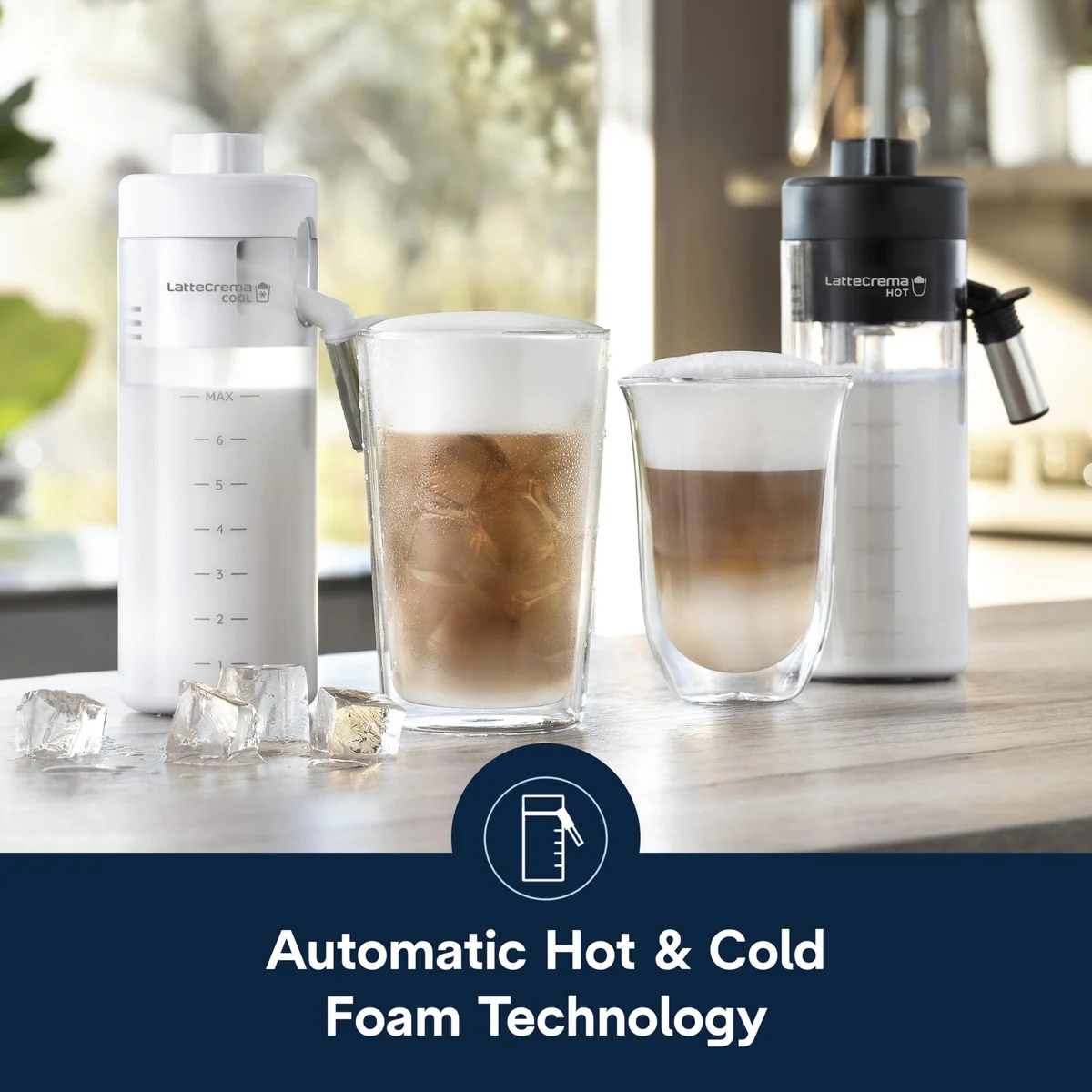
| Cold milk foam | Needs a carafe De'Longhi sells separately | Second carafe included, and it lives in your fridge |
| Cup clearance | About 13 cm, so no travel tumbler | Around 17 to 18 cm with the grille flipped up, mug included |
| Water | 1.4 L, side-mounted, refillable in place | 1.8 L, and it still empties faster than owners expect |
| Guided dial-in | Bean Adapt runs on the machine's own screen | Bean Adapt profiles have to be created in the phone app |
| Footprint | Narrow, low, screen on the top surface | Noticeably bigger, screen angled at the front |
Two hoppers, one set of burrs
The Rivelia's headline feature is not marketing. You lift one 8.8 oz hopper off, drop the other on, and the machine asks what to do about the beans already sitting in the grinder chute. Reviewers who measured that residue put it at roughly nine or ten grams a swap, which you either purge into the grounds drawer or brew as a drink. The tidy routine, from an owner who thought it through, is to unlock the hopper before your own coffee, brew the leftovers as your cup, then swap and make the decaf, so nothing is wasted and nobody drinks a throwaway.
The limitation is quieter and it matters more. Two hoppers do not mean two grinders. Both feed the same burrs at the same physical setting, so pairing a dark Brazilian with a light Ethiopian guarantees that one of them extracts badly, because those coffees want different grinds and the machine will not move the burr gap between cups. Bean Adapt narrows that gap without closing it: it sets temperature and dose against a named bean, then tells you to turn the grind dial yourself. The Rivelia's real home ground is regular and decaf from the same roaster, or two medium blends for two people, and our page on households running decaf and regular is where that case is made in full.
The Eletta's answer to the same problem is worse in the way you would expect. The owner with both machines describes filling the Eletta with one bean and using pre-ground for everything else, and says plainly that the taste is not as good. There is a small irony here worth noting: the cheaper machine has the better version of the shared dial-in feature, because on this generation of the Eletta you cannot build a Bean Adapt profile without the Coffee Link app, and reviewers are not fond of the app.
Only one of these brews cold, and it is the one you think
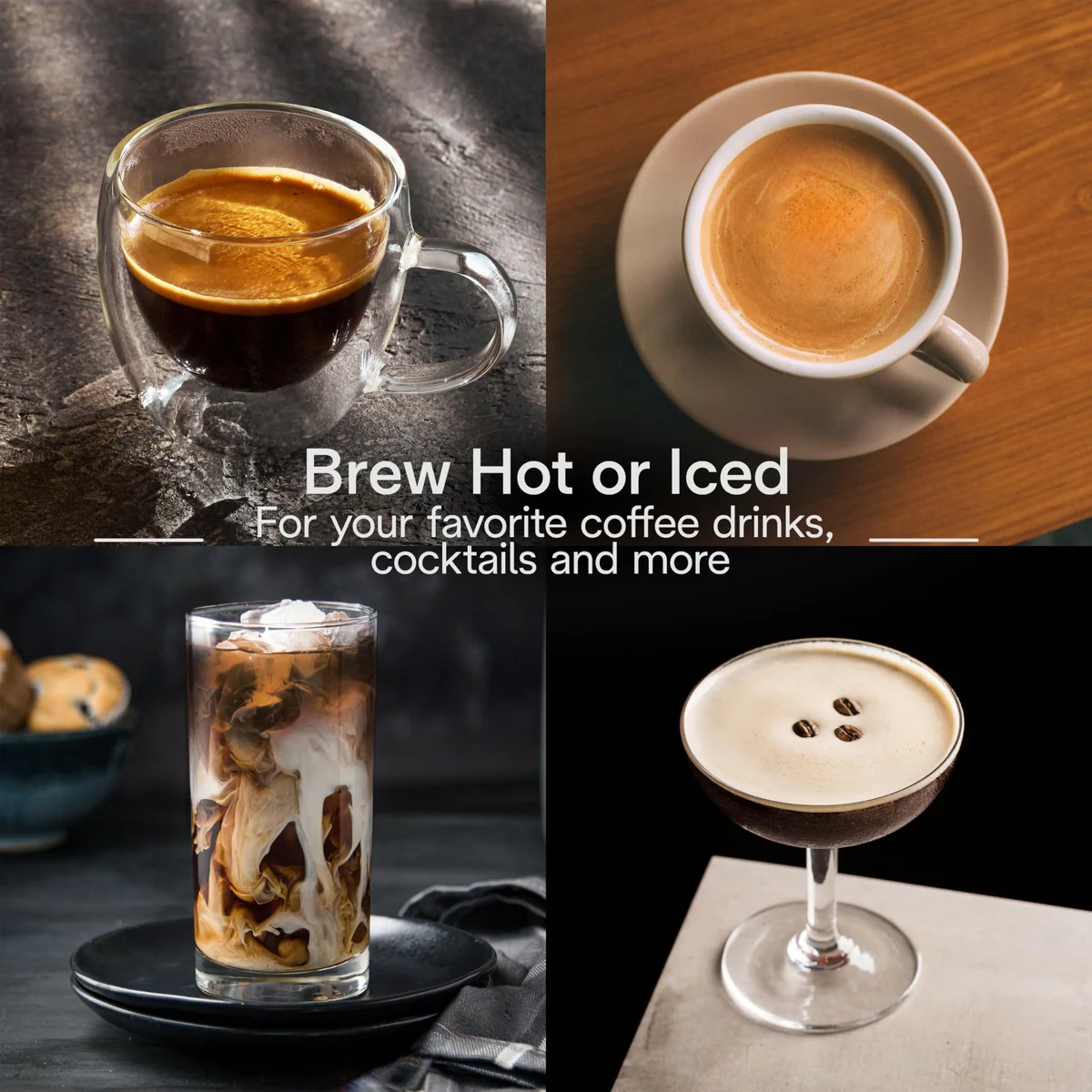
The Rivelia's touchscreen offers iced coffee and iced espresso. What those recipes do is brew hot coffee at a slightly lower temperature into a glass of ice you supplied. Cold milk foam is not in the box at all: it needs the LatteCrema Cool carafe, sold separately on De'Longhi's own site. The owner who bought both machines also bought that accessory, and his verdict on it is the most damning line available, because he is describing a thing he paid for: the cold extractions are not the same as the Eletta's, so you are paying up for inferior cold drinks. A workaround circulates on r/superautomatic to the effect that the Eletta's cold carafe unlocks the cold menu on a Rivelia for less money, which Espresso Den has not verified with De'Longhi and would not order on the strength of.
The Eletta's cold extraction is the real thing. It trickles cold water through an espresso-grade grind at very low pressure and lets contact time do the work heat normally does, and a reviewer measured the liquid leaving the spout at about 37 °C, roughly half the temperature of a normal brew. Because the coffee is already cold, the ice stops melting into it, which is the difference between a cold brew and a watery americano in a tall glass. Owners weighing the two machines have said the cold brew alone decided it for them.
Two honest caveats. Everything else on the Eletta's cold menu is still hot coffee meeting ice cubes that the screen counts out for you, so the cold section is one genuine feature wearing a dozen names. And the listing's promise of cold brew in under three minutes did not survive a stopwatch, which is a shame, because a four-and-a-half-minute cold brew would still be a remarkable thing to get out of a countertop appliance. If cold coffee is the reason you are here at all, read what these iced modes actually do first, then the machines we rate for iced coffee.
Both run cool, and the cheaper one runs cooler
This is the complaint that follows De'Longhi's automatic frothers around, and neither machine escapes it. Reviewers testing the Rivelia's LatteCrema carafe put the milk at 60 to 65 °C, with the froth level and the temperature coupled, so lighter foam gets you cooler milk. On the Eletta, an owner with a calibrated digital thermometer measured a flat white at 125 °F while black coffee from the same machine measured 157 °F, called De'Longhi, followed their instructions, sent them a video, was sent a replacement unit, and measured 125 °F again. Two machines behaving identically is a design decision, not a fault, and the design decision is that milk tastes sweeter below scalding.
Within that, the Eletta wins, and it wins according to the person with the least reason to say so. The owner of both reports that the Eletta is hotter, offers the three fixes that help on either machine, and is honest that they help rather than solve: set drink temperature to maximum in the menu, run the hot water function first to warm the pipework, and pre-warm the mug. That last one does more than people expect, because very hot espresso poured onto foam that is fifteen to twenty degrees cooler loses its heat instantly. If piping-hot milk is the thing you will not compromise on, neither of these is your machine, and the steam wand comparison and our page on why these machines run cool explain why.
The Eletta charges you for its milk advantage in fridge space. Hot foam and cold foam are separate physical carafes, the machine refuses to brew with the wrong one fitted, and owners describe both jugs taking up room with milk slowly going off in them. There is a small sting in the tail too: one owner dropped the cold carafe, found the frothing head perfectly intact and the plastic jug shattered, and had to buy a complete replacement assembly including electronics he did not need.
The counter, the cup and the screen
The Rivelia is the machine for a tight kitchen, and its wins there are specific rather than cosmetic. It is narrow, the water tank sits on the side where you can top it up with a jug without moving anything, and the hopper lifts off the roof, so an owner whose machine lives under a wall cabinet can refill beans without dragging the whole unit out. The Eletta reverses that exactly: owners report having to pull it forward to fill the hopper because the lid is on top and the cabinets are in the way.
Cup clearance runs the other way and it is the second real reason to spend more. The Rivelia tops out around 13 cm, which rules out most travel tumblers. Flip the Eletta's grille up and you have room for a 16 oz mug, one is included in the box, and To Go mode rescales the recipe and grinds twice, so you get a proportioned large drink rather than what one owner memorably called a tiny sad coffee in a huge cup.
One physical detail nobody mentions until it bites: the Rivelia's touchscreen lies flat on the top surface, so on a standard-height counter a shorter person cannot see it, and one owner rearranged her kitchen around that fact. The Eletta's display is angled at the front. If counter space is the binding constraint rather than either feature, the compact machines we rate will serve you better than either of these.
Cleaning, failures and what the ratings do and do not tell you
Neither machine is low-maintenance, and both are honest about it in different registers. The best line about the Rivelia came from a four-star owner who loves the coffee and says the machine is "a diva when it comes to cleaning," with the disassembling, soaking, rinsing, drying and reassembling giving back the time the automation saved. The Eletta's version of the same tax is water: it rinses on start-up, on shutdown and between modes, so the tank empties and the drip tray fills faster than owners expect, and the single best tip in its whole record is to use the hardness strip in the box so the machine stops nagging you to descale on a schedule it invented. A nine-month owner adds a quirk worth knowing rather than fearing: after every descale the milk system splutters for a day or two before settling, every time, regardless of which descaler he used.
On reliability, both have a small ugly tail and it is not fair to hide either. Rivelia owners have reported a motor declared unrepairable at around ten weeks, with the replacement machine then failing to engage its hoppers, which is a bleak outcome on a machine bought for its hoppers. Another reports the screen dead at nine months and the machine still sitting in a repair shop three months later, and since the screen runs everything, a screen fault is a dead machine rather than a degraded one. On the Eletta side, one of the two one-star owners on the listing describes a milk function that never worked from day one, a warranty process he could not get through, and a dead machine two years later, while the other one-star owner had De'Longhi take his calls, accept video evidence and replace the unit.
The star ratings are worth reading with their sample sizes attached rather than as a scoreboard. The Eletta Explore's 4.2 rests on several hundred ratings. The Rivelia's white listing sits at 4.3 across a much smaller pool, and the beige listing at 4.6 across a smaller pool still, on retained reviews that skew heavily to five stars. None of those gaps is large enough to decide anything, and the critical tail on both machines lives in owner threads rather than on product pages. Our guide to how long these machines last puts the failure reports in category context, and the cleaning and descaling guide covers the routine both machines put you on.
De'Longhi Rivelia
De'Longhi Eletta Explore
So which one, and should it be neither
Answer one question honestly and the rest of this page becomes academic: what two coffees would you genuinely alternate between, day to day, for years? If you have a real answer, the Rivelia's hinge earns its premium every morning and the Eletta's cold brew is a party trick you will use twice. If your honest answer is that one bag of beans would live in the machine permanently, you are being asked to pay for a hinge you will never open, and the cold extraction and the travel mug are the only features left on the table that a cheaper De'Longhi does not already give you.
| If this is you | Buy |
|---|---|
| Caffeine has to stop at lunchtime, or two people want two beans | The Rivelia, in whichever colour suits the counter |
| Iced coffee most days, or a travel mug most mornings | The Eletta Explore, and nothing else here comes close |
| One bean, hot drinks, best cup for the money | Neither, and see the Dinamica Plus or the rest of the range |
| Scalding lattes are non-negotiable | Neither, because both target sweetness over heat by design |
| Cross-shopping outside De'Longhi at this money | The KitchenAid KF8, or the Philips 5500 for a cheaper carafe you will not resent washing |
The one to buy if two people in your kitchen want two different beans
The hopper swap takes seconds, works exactly as advertised, and is the only thing on this page that no cheaper De'Longhi will do at any price.
Milk drinks arrive warm rather than hot, and the owner who has both machines says flatly that the Eletta pours hotter from what is essentially the same brew group.
The same machine in beige, for a kitchen that is not white
Same carafe, same burrs, same screen and same firmware as the Arctic White listing, so the only honest reason to pick between the two is which one you want to look at every morning.
Every hopper swap strands roughly ten grams of the previous bean in the grinder, which you either purge into the drawer or drink as a small compromise coffee.
The one to buy if iced coffee or a travel mug is a weekly habit
Cold extraction genuinely brews cold instead of dropping hot coffee onto ice, and To Go mode grinds twice so a 16 oz cup gets a real drink rather than a diluted one.
You will keep two milk carafes in the fridge with milk going off in both, and the milk still lands cooler than a steam wand would deliver.
Neither of these is a machine to buy on the drink count printed in the bullet points. The Rivelia's eighteen recipes come down to about eleven things that contain coffee and are not near-duplicates of each other, and the Eletta's fifty-plus is the hot, cold and to-go versions of a smaller menu counted three times. Buy the hinge, or buy the cold water, or buy neither. Everything else in the cup is the same, and the full arguments for each machine on its own terms are in our Rivelia review and our Eletta Explore review.
Frequently Asked Questions
Does one of them actually make better espresso than the other?
No, and the owners and reviewers who have used both report the same brew group, the same grinder and the same taste in the cup.
Which one makes hotter drinks?
The Eletta Explore, according to the owner who has both, though neither machine will satisfy someone who wants milk above about 60 °C.
Can I add cold brew to a Rivelia by buying the cold carafe?
You can add cold foam and unlock the cold menu, but the owner who bought that accessory says the resulting cold drinks are worse than the ones his Eletta makes and he would not recommend it.
Can the Rivelia's two hoppers hold a light roast and a dark roast?
Not well, because both hoppers feed one set of burrs at one setting, so the pairings that work are two beans of similar roast such as regular and decaf from the same roaster.
Do I need the phone app for either machine?
The Rivelia runs its guided dial-in on its own screen, while on this generation of the Eletta you need the app once to build a Bean Adapt profile and most reviewers stop opening it afterwards.
Will a travel mug fit under either of them?
Under the Eletta yes, with a mug in the box and a recipe that scales to fill it, and under the Rivelia only if the mug is short, because clearance stops at around 13 cm.
Which one is better under wall cabinets?
The Rivelia, because it is narrower and its bean hopper lifts off the top rather than needing the machine pulled forward to fill.
Is either worth it for a one-coffee-a-day household?
Honestly no, since at this money the machine has to earn its cost back against café coffee inside the warranty window and a single daily cup will not do it.
Ready to Choose?
Sources (7)
- Amazon listings and customer reviews — Delonghi Rivelia and Delonghi Eletta Explore
- Owner reports across r/superautomatic threads
- Owner and reviewer video, 6 channels
- Espressorabbithole — Article — espressorabbithole.com
- Coffeeness — Article — www.coffeeness.de
- Homecoffeeexpert — Article — homecoffeeexpert.com
- Facebook — Article — www.facebook.com