The Bosch 800 Series answers almost every complaint owners make about the 300, except the two they actually make
Buy the 300 Series unless you drink your coffee black and want it genuinely hot, or you want a wide drink menu on a screen worth reading, because the 800 sits in an entirely different price bracket and still hands you warm milk and a single hopper you have to empty for an afternoon decaf.
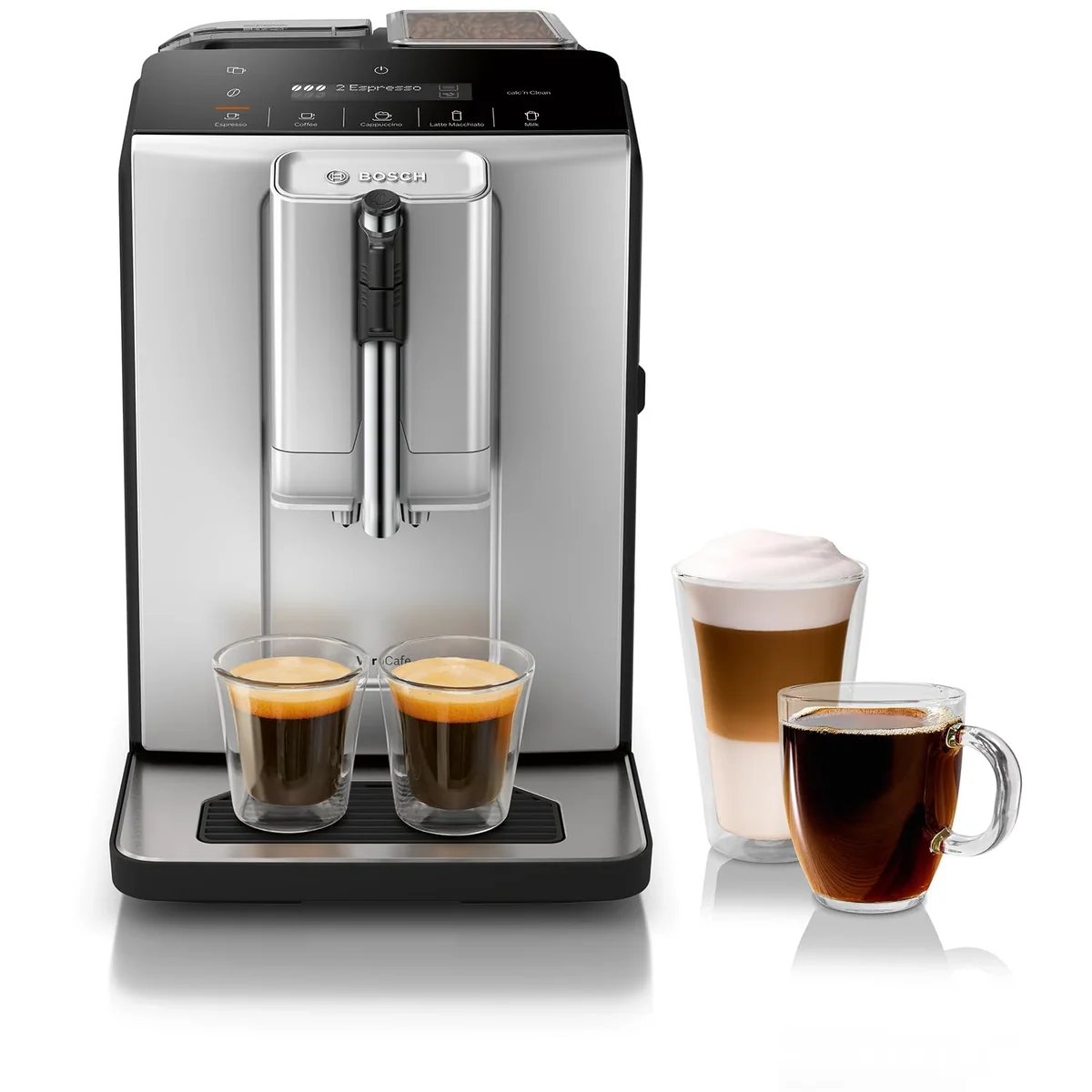
Bosch 300 Series espresso machine
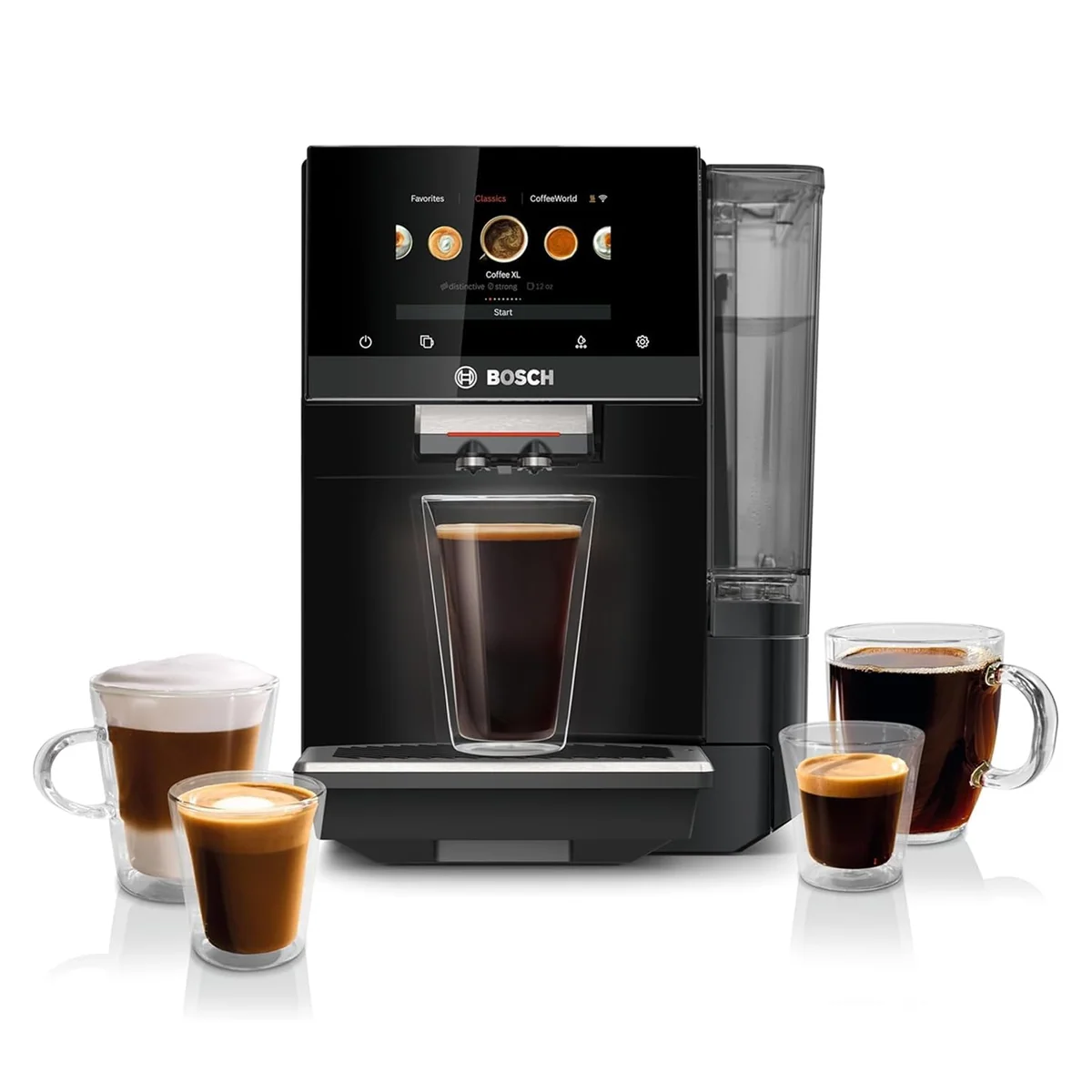
Bosch 800 Series espresso machine
Start with what the money does not buy, because it is the part every comparison of these two machines skips. The 800 Series has a five-inch colour touchscreen you swipe like a phone, a Home Connect app, a published list of thirty-five named drinks, a water tank you top up without lifting it out, and a brewing temperature setting. What it does not have is hotter milk. What it also does not have is any way to make one decaf without emptying the bean hopper. Those are the two complaints that dominate the owner record for the cheaper machine, and Bosch charges a bracket and a half more for a flagship that answers neither of them.
On the 300 Series, four of the thirteen retained Amazon reviews raise milk temperature, and it shows up in the five-star reviews as often as the critical ones: one owner says flatly that if you like your drinks really hot you will not like this machine, because there is no way to adjust it. On the 800, two owners went and measured: roughly 110°F in the cup for one, about 120°F leaving the machine and 110°F once it settled for the other. Same brand, same disappointment, two very different receipts.
Espresso Den has not brewed on either machine. This page is built from both listings, the customer reviews on the 300 and on the black 800, the small pile of first-hand owner threads that exist for a range almost nobody discusses, and the single long-form independent video review of the flagship. Where the two machines are described by different people with different priorities, we have said so rather than flattened it into a scoreboard. And the honest headline finding of that reading is not about specifications at all: nobody who is enthusiastic about the 800 paid full price for it, and the 300 turns up through warehouse-club channels at a number that makes its value argument stop being close.
So before anything else, the practical instruction. Buy whichever of these you choose somewhere that will take it back after six weeks rather than four. The hard failure in the 300's own review set arrived at four months, the two worst 800 accounts landed at about three weeks and a little over a month, and buyers in the wider community make the same argument for a reason: a super-automatic takes a week or two just to set up and judge, so a thirty-day window closes before you know what you own.
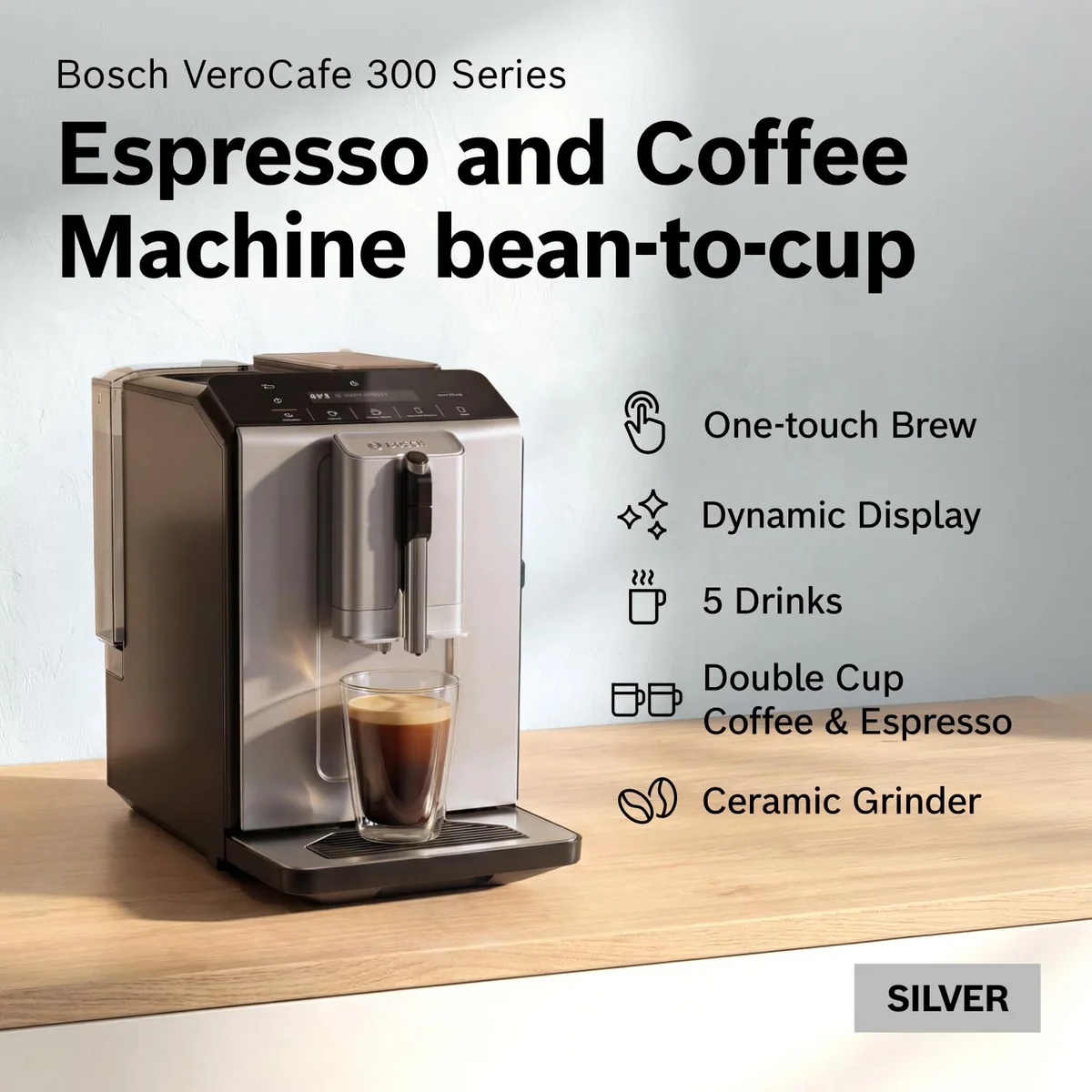
Bosch 300 Series espresso machine
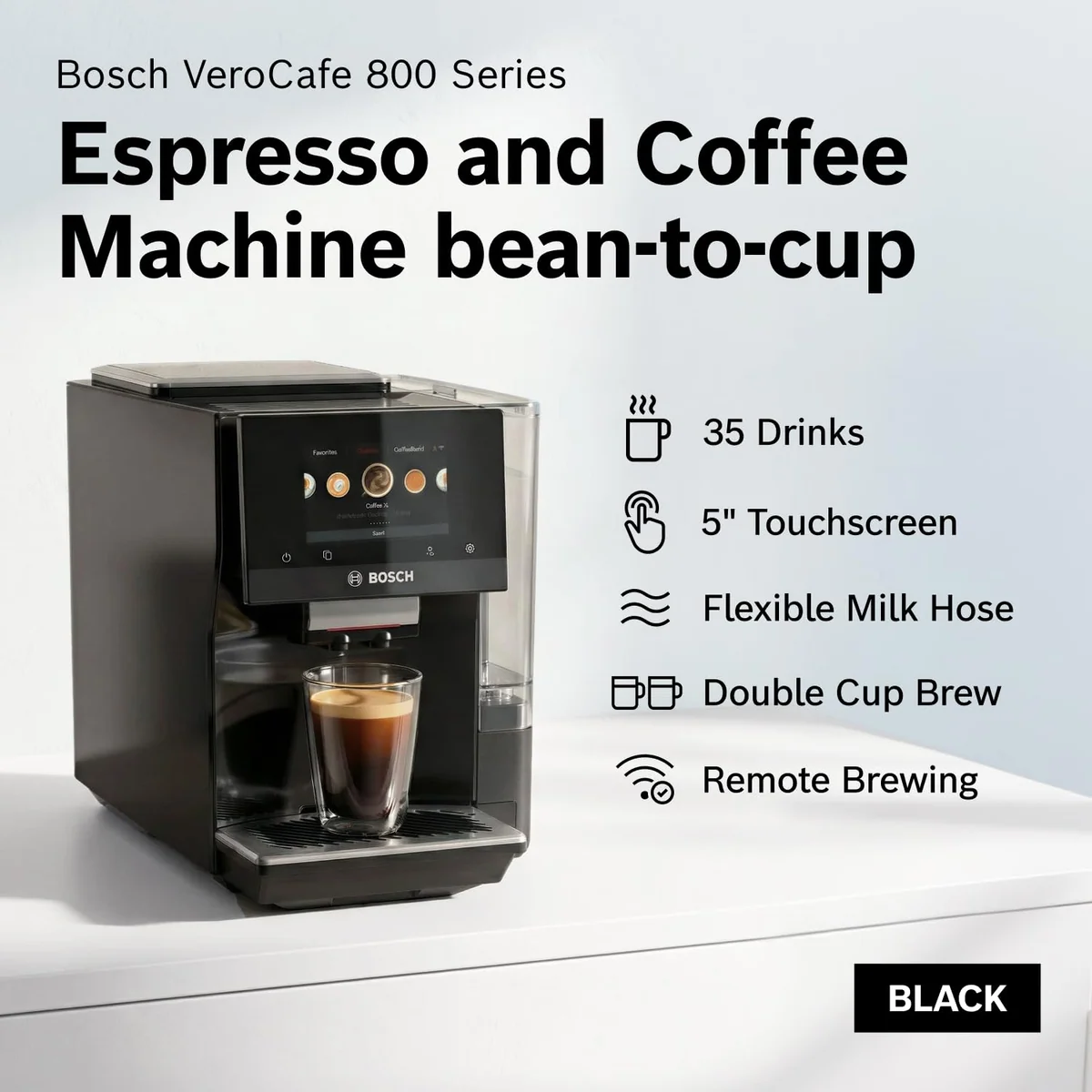
Bosch 800 Series espresso machine
At a Glance
| Feature | Bosch Fully Automatic Coffee and Espresso Machine - One-Touch Drinks, Barista Style, Double Cup Super Coffee Maker - Large Bean Capacity - Easy Clean, Maintenance - Silver- TIU20307 | Bosch Fully Automatic Coffee and Espresso Machine - 35 Drinks, Double Cup Barista Style Super Coffee Maker - Touchscreen, Large Bean Capacity - Easy Clean, Maintenance - Black - TPU60309 |
|---|---|---|
| Price Range | $500–$1,000 | $1,500–$3,000 |
| Configuration | without Cup Warmer | Without Milk Container |
| Finish | Silver | Black |
| Items In Box | 1 | 1 |
| Check Price on Amazon | Check Price on Amazon |
What the bracket jump buys, and what it leaves exactly where it was
Set the two side by side on the things you touch daily and the pattern is clear. The 800 wins on interface, capacity and control over black coffee. The 300 wins on width and on the simple fact that it costs a fraction as much to be wrong about. On milk and on beans, they are the same machine with different lighting.
| The thing | 300 Series | 800 Series |
|---|---|---|
| Controls | LCD panel, illuminated sensor keys, five strength levels | Five-inch colour touchscreen, app control, three aroma options plus four strength levels |
| Brew temperature | No setting at all | Adjustable, but one global setting rather than per drink |
| Milk system | Magnetic Milk Express arm frothing straight into the cup | Hose that drops into any carton, or an integrated container on the stainless listing |
| Milk temperature | Warm, per repeated owner reports, with no way to change it | Warm, measured at roughly 110°F to 120°F by two owners |
| Milk drinks | Cappuccino and latte macchiato locked to a single shot | Strength, size and milk ratio adjustable, with a floor of thirty percent milk on a latte |
| Second bean, decaf, pre-ground | One hopper, no bypass, empty it or tilt the machine | One hopper, no bypass, empty it |
| Water | Small removable tank, two self-rinses per power cycle | Roughly 2.2 to 2.4 litres, fillable in place, rinse skippable from the app |
| Footprint | 9.7 in on its narrow side, per Bosch's listing | 12 1/6 in wide, per Bosch's listing |
| Public record | 3.8 across 197 ratings | 3.9 across 100 on the black unit, 3.8 across 54 on the stainless |
The one difference that will change what is in your cup
Brew temperature is the real upgrade, and it is worth understanding precisely, because it is narrower than the marketing implies. The 800's setting is global rather than per drink, so you can turn the whole machine up and black coffee genuinely runs hot: one owner measured 129°F on a standard cup and 158°F on slow brew, and called that a priority they were not disappointed on. Another owner, on the same model, measured 135°F to 146°F across shots and named temperature their main frustration while asking Bosch to let users set a preference. They were both telling the truth about their own machine, and one of them had not yet found the setting, which is the recurring shape of this product's problems.
None of that reaches the milk, because the frother sets its own ceiling and no menu overrides it. That is why the temperature setting is not a fix for the complaint you probably arrived with, and it is why our page on why the coffee and especially the milk come out lukewarm applies to both machines equally. On the 300 there is no dial to find in the first place: the closest thing is dwell time, since one owner reports that setting a longer frothing time with the milk button, and running the latte macchiato cycle twice for a large glass, puts more steam into the same milk. That is a workaround, not a control, and it is worth calling it what it is.
The screen is not a gimmick, and the app has exactly one good trick
Where the 800 earns its bracket is the interface. The panel carries real photography and drink names rather than warning-light hieroglyphics, the customisation screen holds strength, size and milk ratio for each drink, and tapping a drink's name inside that screen produces a description of what it actually is, which one buyer called important but not obvious after failing to find it in the manual or on Bosch's site. Coffee World runs to thirty-five named drinks including several you will have to look up, though part of that list lives only in the app, so the count on the box is not the count on the machine.
The app's one genuinely useful function is starting the machine remotely, because a remote start skips the start-up rinse: leave a cup under the spout overnight and the drink lands in a dry cup instead of a puddle. That matters more than it sounds, since the rinse is exactly the mechanism that confuses 300 owners, one of whom opened the door to a drip tray full of water he had never poured and had no idea where it came from. It comes from the machine rinsing itself at power-on and again before shutdown, about a cup of water each time by another owner's reckoning, and the 300 gives you no way to switch it off.
Nobody has actually compared the coffee, and it would be dishonest to pretend otherwise
The 800's cup is the best-documented thing about it. The reviewer who ends his video telling his audience not to buy the machine also says it brings out more depth than the KitchenAid, De'Longhi and Philips machines he has run, and that on coffee quality alone the Bosch would be his favourite, as much as he hates to say it. Owners arriving from a Jura Z8 and a Philips 3200 both rated the cup above what they traded in.
The 300's record is genuinely split. One experienced buyer returned it because crema and coffee quality were lacking at the price. Another titled her review "Crema! At Last!" and said previous espresso machines she has owned do not come close. A household replacing a fourteen-year-old Jura judged the coffee just as good and concluded that at a fraction of the price of those units it is simply not worth paying more. What does not exist anywhere is a side-by-side: no one in the public record has pulled the same beans through both Bosch machines on the same morning. The 800's coffee is better documented, not proven better, and anyone telling you the gap is worth the bracket is guessing along with the rest of us.
One warning applies to both, and it explains a lot of early disappointment. The 800 can taste like warm water out of the box until you go into each drink's customisation screen and raise the strength and shot count, since the default on a long coffee is a single shot. On the 300 the equivalent trap is structural rather than fixable: cappuccino and latte macchiato take one shot and only one, so a large milky glass is thin by design and the only lever is running the cycle twice or using Double Cup.
The bean problem is identical, and it is the clearest reason to buy neither
This is where Bosch's own range embarrasses both machines. Neither has a bypass chute. On the 300, one owner taught himself to deliberately under-fill the hopper each morning so he could swap to decaf at lunchtime, and another described the alternative as finishing what is in there or tilting the whole machine on its side. On the 800, three separate owners confirm there is no chute, and one called it a miss for anyone who wants a decaf at night. The sting is that Bosch's cheaper 500 Series has the chute, and an automatic milk rinse after every milk drink into the bargain.
If two beans in one kitchen is your situation, the answer is not further up this range: read how the pre-ground route works on machines that support it properly, or go straight to the machines built for decaf and regular in the same house.
Two thin records, both with a failure in the first six weeks to four months
Neither machine has a long-run public history, and you should treat anyone claiming otherwise with suspicion. The 300's own review set contains a machine that started throwing a "Restart Appliance" message at four months and then stopped dispensing coffee entirely while making a squeaking noise, with the milk frother and the start-up rinse both still working: water path fine, milk path fine, brew path dead, and two Calc'n Clean cycles did not touch it. A second, independent sighting turns up on Bosch's own subreddit, where a 300 owner posted an error code and asked whether it was time to get a technician involved.
The 800's failures are earlier and, in one respect, worse. One buyer at about three weeks found the machine pouring warm water instead of coffee, opened the side panel on Bosch's instructions, found a broken loose part inside, and still got mostly water after rinsing the brew unit. Another, a little over a month in, had to press all over the screen to wake the machine and periodically found an error that only unplugging cleared. And one owner whose machine got stuck in standby was told by Bosch that there was nobody in their area who could service it, which is the sentence that should give you the most pause at this level. Set against all of that, an owner twelve months in says they love the machine more than ever. Both things are in the record, and what usually breaks first in this category is the right baseline to judge them against.
Living with them day to day is more similar than different. Both use Calc'n Clean, both have a brew unit that pulls out from the front for a rinse, and both are the kind of machine where the real cost of ownership is interaction rather than money. The 800 is the easier of the two: its milk system cleans by dropping the hose into the drip tray for two minutes, and the screen walks you through the rest with graphics. The 300 asks you to remember something it never prompts for, which is a weekly rinse and dry of the brew unit, because the coffee dust gets everywhere inside.

Bosch 300 Series espresso machine

Bosch 800 Series espresso machine
Which one belongs on your counter
The clean way to decide is to ignore both feature lists and answer one question: what do you drink? If it is milky and you want it hot, neither of these is your machine and you should start from our pick for people who mainly drink lattes. If it is milky and you take it European-warm, the 300 does that at one press in less counter space and for a great deal less money. If it is black, strong and hot, the 800's temperature setting is a real answer and the 300 has nothing to offer you.
The one to buy if a cappuccino at the touch of a button is the entire job
It grinds, doses, brews and froths into the cup at a single press inside a footprint under ten inches on its narrow side, and the owners who bought it for exactly that are the most contented people in this comparison.
There is no temperature setting anywhere in it and the cappuccino and latte macchiato programmes are locked to one shot, so a large milky glass arrives both weak and merely warm unless you run the cycle twice.
The flagship as most of its happy owners actually configured it
This is the 800 with the flexible milk hose that drops straight into whatever carton the household is drinking, which is the arrangement owners running dairy, oat and almond at once consistently prefer to a carafe.
Milk still lands warm rather than hot, a decaf still means emptying the hopper, and the service network told one stranded owner it had nobody in their area who could look at the machine.
The same machine in stainless, with the milk container most owners tell you to skip
It matches a stainless kitchen and adds a cup warmer, a Coffee Pot Function and the integrated milk container to the flagship's feature list.
It sits a tier above the black listing to add a carafe one owner abandoned after finding it pushes warm milk back into the container, a cup warmer another owner found barely warmed a cup in half an hour, and a coffee pot that is not in the box.
Two honest exits before you commit to either. If the 800's money is genuinely on the table, the strongest case against it comes from the reviewer who prefers its coffee and still says the KitchenAid KF7 beats it on build, features and design, which is the argument we run properly in Bosch 800 Series against the KF7. And if the 300 appeals but the in-cup frother does not, the same money buys a completely different milk philosophy, set out in the 300 against the Philips 2300 LatteGo and in the 300 against the Magnifica Start, whose owner-cited advantages are iced coffee and hot water against the Bosch being quieter with fewer parts to lose.
For the full context on each machine, our Bosch 300 Series VeroCafe review and Bosch 800 Series review go through the owner record in detail, and the shortlist under a thousand dollars is where the 300 has to earn its place against everything else.
Frequently Asked Questions
Is the 800 Series worth the jump from the 300?
Only if you want a temperature setting for black coffee, app control and a drink list worth exploring, because on milk temperature and bean swapping the two machines behave identically.
Does either machine froth milk hot enough for a scalding latte?
No, and owners of both report milk that arrives warm, with two 800 owners measuring roughly 110°F to 120°F.
Can I make one decaf in the afternoon on either machine?
Not comfortably, since neither has a pre-ground bypass chute or a second hopper, so a decaf means emptying the beans out first.
Does the 300 Series really have a steam wand, as its title says?
No, and Bosch's own description on the same listing calls it a Milk Express in-cup frother, which is a different appliance for a different buyer, as our guide to wand, hose and carafe milk systems explains.
Which one suits a narrow counter?
The 300, whose published narrow dimension is 9.7 inches against 12 1/6 inches of stated width for the 800, which puts it on the shortlist for a kitchen where counter width is the constraint .
What about the 500 Series that sits between them?
It keeps a pre-ground chute and an automatic milk rinse that neither of these two offers, which makes it the only machine in the range that answers the decaf question properly.
Is either one safe to buy open-box or renewed?
On this evidence no, because the 300's one-star reviews include a used unit that arrived broken and missing a main part, and one 800 buyer received the wrong model and then a dead machine on two separate open-box orders, which is exactly the risk our guide to renewed and refurbished machines tells you to price in.
Which one is quieter?
Neither has been measured, though a 300 owner who normally buys De'Longhi found the Bosch noticeably quieter with fewer parts to break, and an 800 owner said its grinder is far quieter than the super-automatic it replaced, which is as much as anyone can honestly say about noise here .
Which machine actually makes the better cup?
Nobody in the public record has run the same beans through both on the same morning, so the fair answer is that the 800's coffee is better documented rather than demonstrably better.
Ready to Choose?
Sources (3)
- Amazon listings and customer reviews — Bosch 300 Series Espresso and Bosch 800 Series Espresso
- Owner reports across r/superautomatic, r/bosch threads
- Owner and reviewer video, 2 channels