The cheap part of owning a Jura is the coffee
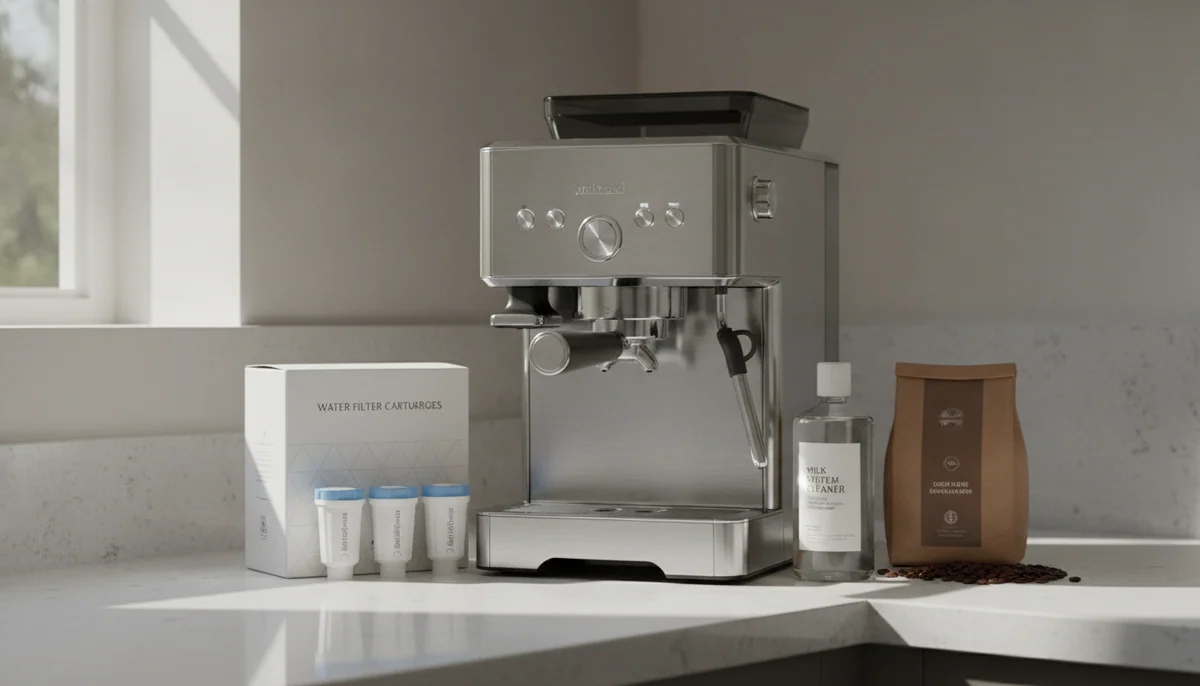
Jura sells these machines on an economy argument, and it puts that argument high in the listing: always freshly ground, not capsuled, fresh taste with very limited waste. The same bullet appears word for word on both finishes of the E4, and something very like it sits on every machine in the range.
Against a pod habit the argument is sound, and owners who did the sums agree with it. What it quietly leaves out is that the capsule was not removed so much as replaced. In its place you get a water filter with a chip in it, a branded cleaning tablet, a descaling routine you can only dodge by buying more filters, and a service department that is the sole route to the inside of a machine you are not allowed to open. None of that is hidden, exactly. It is simply never added up in one place, which is what this page is for.
Two ledgers run in parallel here, and confusing them is why the internet cannot agree on whether a Jura is expensive to keep. The first is small, weekly and mostly under your control. The second is rare, large, and mostly not. Espresso Den has not owned or bench-tested any of these machines, so every figure below belongs to the owner, dealer or listing it came from, and is labelled that way.
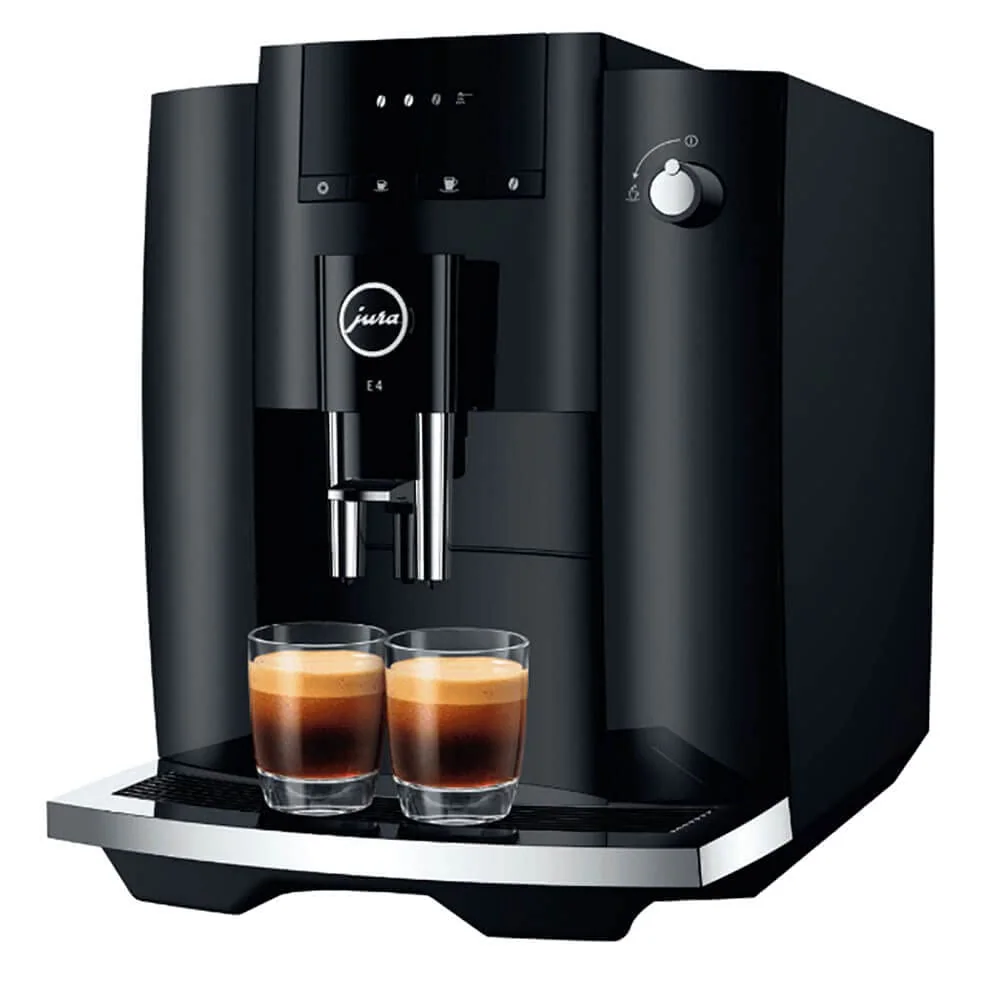
The five things that actually take money off you
| The line | What owners report | Can you refuse it? |
|---|---|---|
| Chipped water filter | Around twenty dollars a cartridge, changed every couple of months, with nothing third-party or refillable recognised | Yes, if you descale instead |
| Cleaning tablet | Dropped through the ground-coffee chute when the machine asks, described by owners as the easy part | No |
| Descaler | The alternative to the filter rather than an addition to it | Only by buying filters forever |
| Milk detergent and five minutes a day | Applies only to machines with a milk circuit, and it is the chore owners resent most | Yes, by buying a coffee-only machine |
| Repair out of warranty | Quotes of four hundred dollars on an E4 and five hundred on an ENA 4, for one fault each | Partly, through the seller you buy from |
Read down that table and the shape of Jura ownership is clear enough. Four of the five lines are pocket money spread across a year. The fifth is not, and it is the one that arrives without warning.
The chip in the filter is the part that makes people cross
The cartridge is not simply a filter. It carries a chip, and the machine reads it, so changing the filter needs no programming and no menu diving. That is genuinely convenient. It is also a lock, and the lock has teeth: an E4 owner reports that a non-Jura cartridge can leave the filter light showing, or make the machine behave as though no filter is fitted at all and drop itself into descaling mode.
What that costs, on the only detailed account Espresso Den could find, is around twenty dollars a cartridge on a roughly two-month cadence, with no third-party or refillable alternative the current machines will recognise.
The cadence is the running complaint rather than the price. One Amazon buyer who otherwise liked his E4 and would buy it again docked a star for exactly one reason: the machine calls for a filter replacement far more often than his usage seemed to justify.
Here is the decision nobody presents to you at the point of sale, because both halves of it are visible only in owner reviews. One ENA 4 owner buys the filters deliberately, saying she uses Jura's cartridge specifically so she never has to descale, and calls it worth the money.
A J8 twin owner went the other way and pulled the filter out of a brand new machine, on the reasoning that her house water is already filtered and there is no sense filtering filtered water.
Both are defensible. What matters is that they are the same decision seen from opposite sides, and only one of them is usually stated out loud. Buy the filters and you are paying a subscription to skip a chore. Skip the filters and you have quietly signed up for descaling on the machine's schedule, whether or not anybody told you so. Over five years the gap between those two choices is real money, and it is the single largest lever you control. The general shape of that chore, on any bean-to-cup machine, is set out in what cleaning and descaling actually involves week by week, and if the filter-instead-of-descaling trade interests you as a principle, Philips runs a version of the same bargain that we unpick in the AquaClean claim and what it really means.
Tablets are cheap; the attention is the tax
Nobody complains about the tablets. An ENA 4 owner calls cleaning pretty easy using their little tablet things, and an Amazon buyer's account of a sixteen-year-old Jura at a former workplace is the cheapest maintenance story in this entire file: no issues at all, other than occasionally running some tablet things through the machine.
The cost that hides here is not money, it is knowing what the machine is asking for. On the coffee-only Juras the front panel speaks only in symbols, and a five-year owner wrote that he still reaches for the manual before cleaning and descaling, calling the icon menu cryptic beyond all belief.
The prompts are also a schedule rather than a measurement, at least in part. The same ENA 4 owner emptied the grounds container proactively and got the empty-the-grounds message again within a cup or two, and concluded it simply runs on a count.
That is worth internalising before you own one. The machine is not observing your household. It is counting, and you are paying against its count.
The repair is the only number that really moves
Start with the structural fact everything else follows from: you cannot take a Jura's brew group out. It is fixed inside the case, cleaned by a tablet, and never available for inspection. One buyer returned an E8 almost immediately over this alone, having cleaned the brew group weekly on every machine he had previously owned, and admitted he did his research and still had no idea a sealed brew group was a thing until the box was open.
The counter-evidence deserves equal billing, because the anxiety is worse than the reality for most owners. A reviewer who has followed this brand for years reports a fellow obsessive who used a Jura daily for a year, then dismantled the brew group out of curiosity and found it spotless inside.
We have argued that question at length in whether anything really grows inside a sealed machine. For the purposes of a budget, the point is narrower: what you cannot reach, somebody else invoices you for. The one negative Amazon review of the E4 is that invoice in miniature. Something broke internally after five months, a piece of white plastic turned up in the collection tray, and Jura quoted four hundred dollars to fix it.
What turned that into a one-star review was not the failure. It was that he had bought from a third-party seller who was not an authorised dealer, which meant no warranty existed to argue with. The identical story appears one model down: an ENA 4 buyer who did all the prescribed maintenance had the machine fail inside a year, was told there was no warranty because Amazon is not a certified dealer, and was quoted five hundred dollars, adding that a local shop would have given two years.
And on that same ENA 4 listing, another buyer whose machine arrived defective describes Jura's warranty process as a breeze, prompt and easy to navigate. Both experiences are real. The variable is not the manufacturer's mood, it is which seller filled the order, and Jura's dealers describe two years of comprehensive parts and labour across the range as the cover you are supposed to be getting.
So on a marketplace listing, the warranty is a property of the seller box rather than of the machine. That is the most valuable sentence on this page and it costs nothing to act on: read who is shipping it before you press buy, and if the answer is a name you have never heard of, the saving is not a saving.
There is a genuinely encouraging version of the service story too, and it is worth holding alongside the horror. One owner of a 2010 flagship had the machine fully overhauled at a US service centre for a flat fee, with brew group, grinder, thermoblocks and tubing replaced, and expects it to outlast him.
The reason a rebuild is even possible at that price is the thing an ex-dealer who spent his days doing warranty checks explained about the range: the brew unit is basically the same across the line, the grinder is the same, and the same amount of coffee goes into every shot, with the model differences living in software, the second spout, the frother and the expensive ceramic valve that steers water and steam between them.
Which is to say the machine you paid least for contains most of what the service department will ever touch. The most sober estimate in print is that a well-maintained Jura should last at least ten years, and the operative words are the middle two.
Plan for one intervention before then rather than being blindsided by it. The slow failure is the one nobody budgets for: an owner of the small coffee-only A1 found after six years that his coffee had drifted into tasting like bad work coffee despite following every prompt the machine ever gave him, with worn burrs and a brew unit wanting seals and lubrication the likely culprits, neither of which a front panel will ever mention.
Somewhere in years five to seven, a machine that still works will start making worse coffee, and that is a service rather than a fault. Our wider account of that pattern across brands is in how long these machines last and what breaks first.
The cheapest Jura to run is the one with the least plumbing in it
Where does the money go inside the range? Not into the shot, on the evidence above. A Z10 owner talking a black-coffee drinker out of the flagship put it plainly: the bells and whistles and the cost are centred on the milk drinks.
Milk is also where the daily minutes go, and the sharpest testimony on that comes from someone who bought the milk version and wishes he had not. An E8 owner among Jura enthusiasts wrote that his only regret was not buying the model without the cappuccino option, because the milk system is painful enough to clean that he avoids making cappuccinos with it.
That is a running cost as surely as a filter is, and it is the one you should price before you price anything else. If you have not settled that question, which milk system you would actually live with is the argument underneath this one.
| Machine | What you keep buying | The daily chore | The drawback that costs you |
|---|---|---|---|
| Jura E4, Piano Black or Piano White | Filters and tablets, nothing else | Empty the puck bin and the tray | A symbol-only panel, and no cup much over eight ounces |
| Jura ENA 4 | Filters and tablets, on a smaller tank that you refill more often | Empty the puck bin, swirl the hopper | About ten grams of coffee per shot, so long drinks thin out |
| Jura J8 twin | Filters, tablets, milk detergent, and the accessories owners buy afterwards | A real milk clean, roughly five minutes, on any day you made a milk drink | Two hoppers of beans staling at different rates, and the same eight ounce ceiling |
Taking those in turn, and honestly. The E4 is the least expensive Jura to keep running that Espresso Den can recommend to anyone, for the simple reason that there is no milk circuit inside it to clean, and the two finishes are identical in everything that ever costs you money. The price of that frugality is the icon panel a five-year owner still cannot read without the manual, the filter prompts that irritated an otherwise happy buyer, and a machine that will not fill an American mug in one press. Our full account is in the E4 review.
The ENA 4 asks for the same consumables in a smaller box, which is a fair trade if your counter is the constraint. What it does not do is brew as much coffee per shot, and its own partisans are the harshest witnesses: one heavy user with several machines behind him said he could not imagine dropping to the small dose, and that buying it struck him as buying the badge.
Its listing record carries a second warning that belongs in a costs article rather than a taste one. Among the reviews retained on that listing are a water tank that arrived cracked, another that arrived half broken and leaking, a technician's confirmation that the grinder was dead by the time the buyer got home to find the thirty-day window expired, and the machine that failed inside a year with the warranty disputed.
That is not a failure rate and Espresso Den will not present it as one, but the pattern is worth the ten minutes it takes to unbox the machine the day it lands rather than the week after. The two Juras side by side are set out in the E4 against the ENA 4, with the machine's own page at the ENA 4 review.
The J8 twin is the expensive one in every sense, and it earns its keep for exactly one household. Two bean containers with two grinders means a decaf drinker and a caffeine drinker stop tipping beans out of a hopper at each other, which is what the listing's two-grinder claim actually delivers, and it is the thing the happy owners on that listing talk about first.
It is also the machine that adds every optional line in the budget back in. The milk circuit brings the daily clean and the detergent, and the most detailed owner review on the listing describes buying a milk chiller to escape the fridge shuttle, an auto-fill valve for the water, and spouted espresso cups because large travel mugs do not fit under the spouts. Her other warning is the eight ounce ceiling, which turns a large Americano into three presses of a beautiful touchscreen. And one buyer's machine on that listing was simply broken after a month. If two beans in one kitchen is your actual problem, the J8 twin review and our page on decaf and regular households are the two places to settle it; if it is aspirational rather than daily, buy less machine and spend the difference on beans. The whole ladder is mapped in which Jura to buy.
The cheapest maintenance decision you will ever make is at the supermarket
One habit does more to keep a Jura out of the service queue than every tablet you will ever buy, and it costs nothing. Keep dark, oily beans out of the grinder. It is the single point every source in this file agrees on, and the failure mode on a machine with a sealed brew group is gumming up internals nobody can reach without a shipping label.
The best owner testimony for it is also the most specific. An E4 buyer a year in reports that her sister runs three Juras, one at home, one at an office, one at a holiday house, and that the home machine has made over thirty thousand cups and is still going, on the advice she passed on: use a less oily bean and you will never have a clogging problem.
Thirty thousand cups is not a promise and one household is not a study. But it is the shape of the good outcome, and the ingredients in it are unglamorous: a non-oily blend, the tablets when asked, and either the filter or the descaler rather than neither. Which beans survive a hopper is covered properly in what actually works in a bean-to-cup machine.
If, having read all of that, the objection is the closed ecosystem rather than the arithmetic, that is a coherent position and there are answers to it on this site. KitchenAid's machines come up constantly in the same conversations where Juras get recommended, at meaningfully less money, from people who have tasted both.
We take that challenge seriously in Jura against KitchenAid, with the range itself in which KitchenAid to buy. If instead the sums are what worry you, the argument for the whole category is in whether a super-automatic is worth it at all, and Jura's own factory-serviced route is a real way in, provided you read what a renewed machine actually buys you and get the warranty terms in writing first.
The verdict at the top holds after all of it. Week to week, a Jura is a cheap machine to feed and an easy one to keep clean. The money is not in the tablets. It is in the day the sealed box needs opening by somebody else, and the two things that decide how much that day costs are whose name was on the seller box and whether you kept oily beans out of the grinder.
Frequently Asked Questions
How much is a Jura water filter, and how often does it want changing?
A long-time owner puts the chipped cartridges at around twenty dollars each on a roughly two-month cadence, and the machine rather than your calendar decides when it asks.
Can I fit a cheaper third-party filter instead?
In practice no, because the cartridge carries a chip the machine reads, and an unrecognised one can leave the filter warning showing or drop the machine into descaling.
What happens if I skip the filter entirely?
You descale on the machine's schedule instead, which is the trade one ENA 4 owner made in one direction and a J8 twin owner made in the other.
What does an out-of-warranty repair actually cost?
Owners report quotes of four hundred dollars on an E4 and five hundred on an ENA 4 for a single fault each, which is the one line in this budget large enough to change the verdict on the purchase.
Does buying on Amazon affect the warranty?
It can, because buyers on these listings got opposite answers depending on whether the seller filling the order was an authorised dealer.
Can I service the brew group myself and save the bill?
No, it is sealed inside the machine and your only access is a cleaning tablet dropped through the ground-coffee chute.
Which Jura is cheapest to live with day to day?
The one without a milk circuit, since milk is where the daily cleaning, the extra detergent and most of the price difference in the range all sit.
Do the two E4 finishes cost anything different to run?
No, the Piano Black and the Piano White carry the same hardware, the same consumables and the same prompts.
What is the single cheapest thing I can do to keep the bills down?
Stay off dark, oily roasts, because the grinder and the brew unit you cannot reach are exactly what they gum up.
Sources (5)
- Amazon listings and customer reviews
- Owner reports across r/superautomatic threads
- Owner and reviewer video, 2 channels
- Homecoffeeexpert — Article — homecoffeeexpert.com
- Coffeeness — Article — www.coffeeness.de