The Bosch says steam wand and the De’Longhi says milk frother, and the boxes have it backwards
Buy the De'Longhi Magnifica Start if you want hotter milk, a real wand and a much lower price and will spend a fortnight learning the machine; buy the Bosch 300 Series if a narrow, quiet, one-button machine is worth paying a great deal more for and you can live with milk that arrives warm rather than hot.
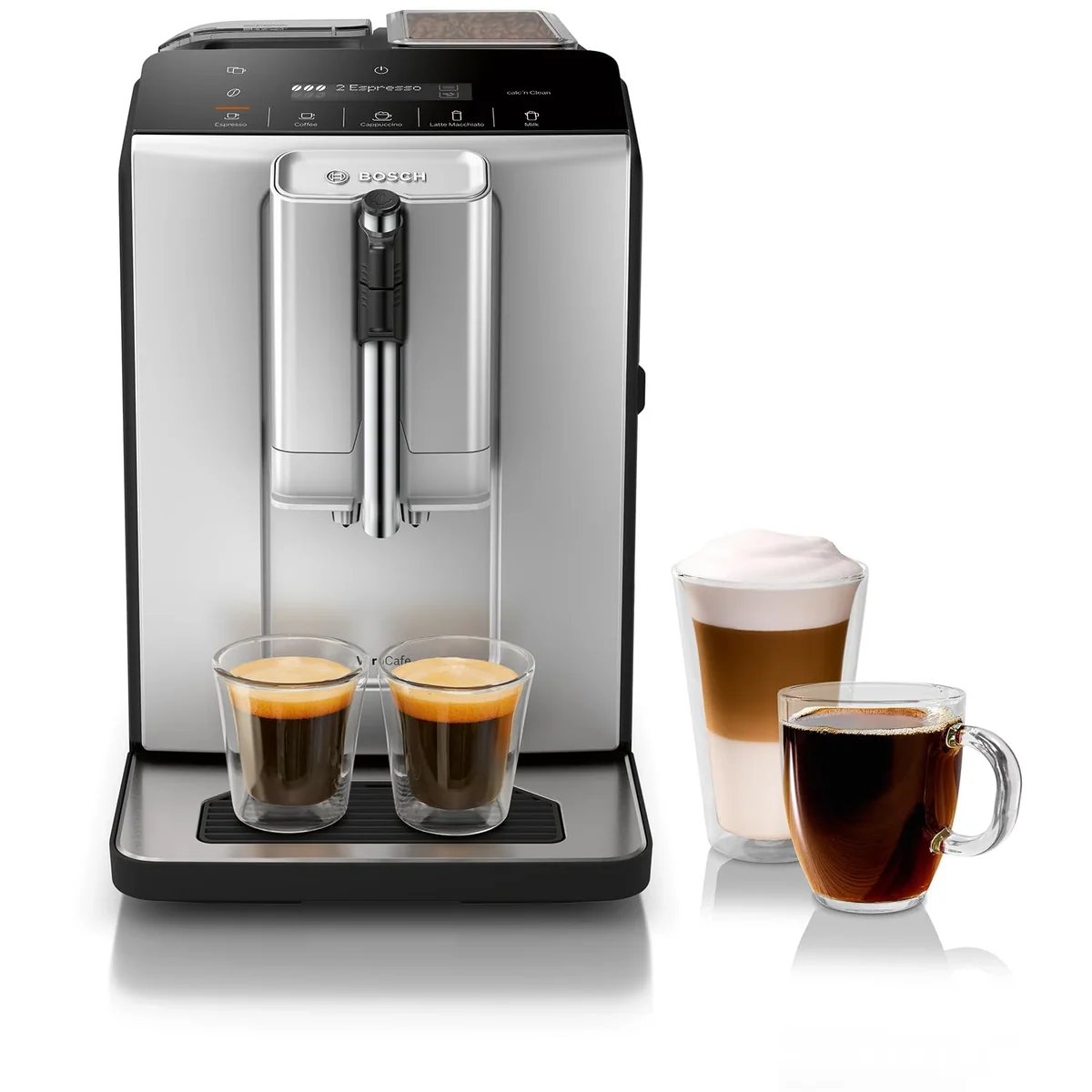
Bosch 300 Series espresso machine
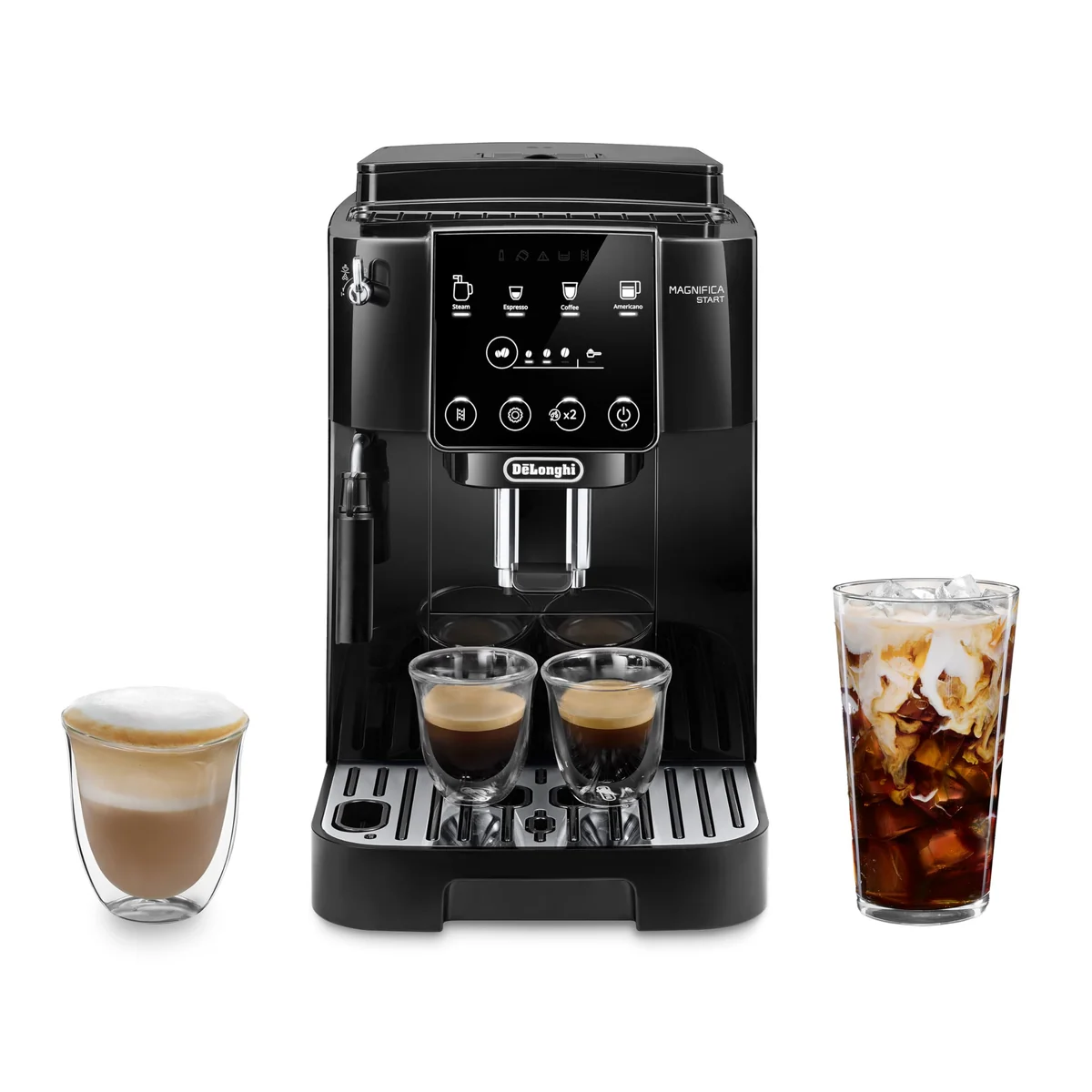
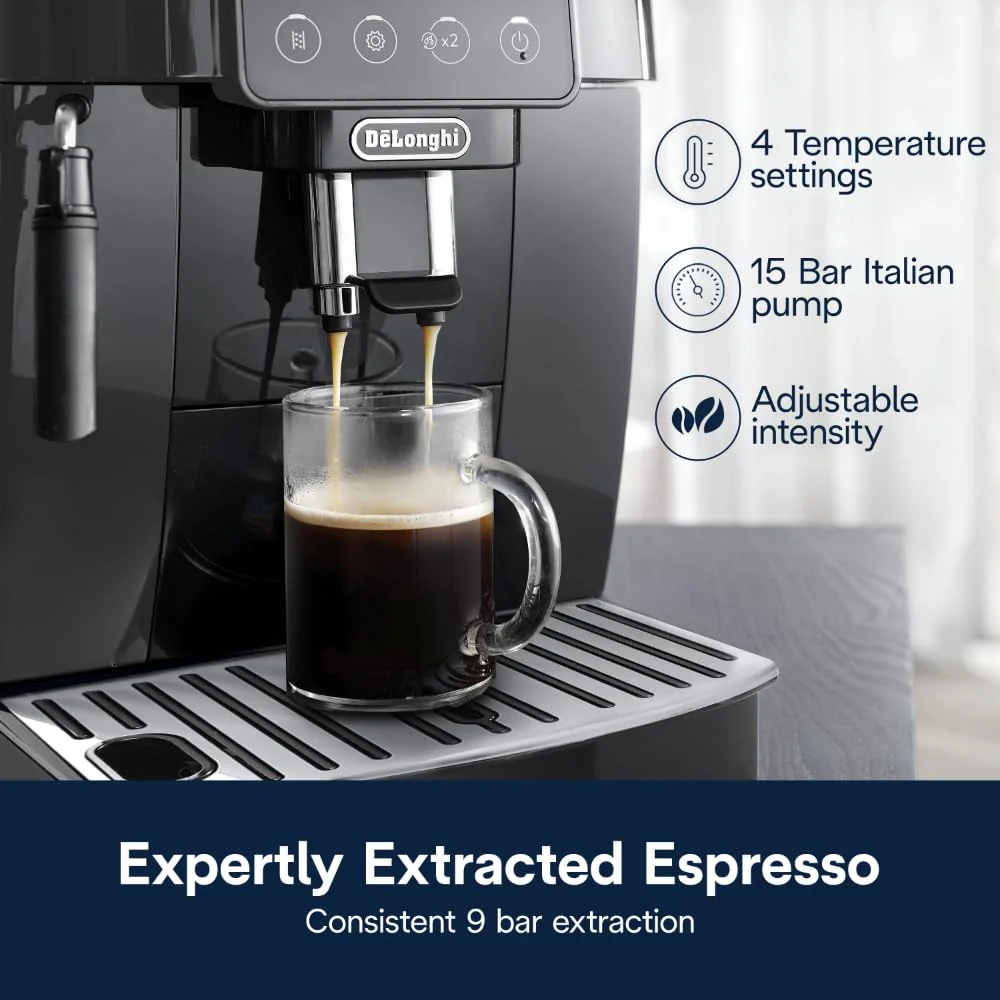
De'Longhi Magnifica Start
Start with the labels, because they are wrong in a way that matters. Bosch sells this machine as a "Fully Auto Espresso Machine with Grinder and Steam Wand," and then its own description, written by the same company about the same appliance, calls the fitting a "Milk Express in-cup frother" that makes "silky milk froth made directly in your cup." De'Longhi sells the Magnifica Start as an "Automatic Espresso Machine, Milk Frother," which sounds like the automatic kind, and what is bolted to the right-hand side is a traditional frothing wand you open with a knob and aim into a jug yourself.
So the machine advertising a wand does not have one, and the machine advertising a frother does. Espresso Den has written both of these up at length, in the Bosch 300 Series review and the Magnifica Start review, and the naming muddle is the single most common reason a buyer ends up with the wrong one of the two.
Underneath the labels these are close relatives: one grinder, one brew group, one bean hopper, grounds captured internally, a front door you open to pull the brew unit out and rinse it. Neither has a screen worth the name, neither has user profiles, neither will wake up before you do. What separates them is the milk, the dose, the noise, whether you can run two different beans, and a price gap that is not small. Everything below is those five things.
One caveat about the evidence before any of it. The Bosch super-automatic line is barely discussed anywhere: a buyer on r/superautomatic listing exactly the priorities this machine serves, quiet running, easy cleaning, no smart features, noted that the Bosch range is something they never see mentioned. The closest thing to a public head-to-head between these two families is a single video pitting a Magnifica Evo against a 300 Series. This page is built from both listings, the customer reviews each one has retained, published testing of the De'Longhi platform, and our own two reviews. Nobody here has had either machine on a bench.
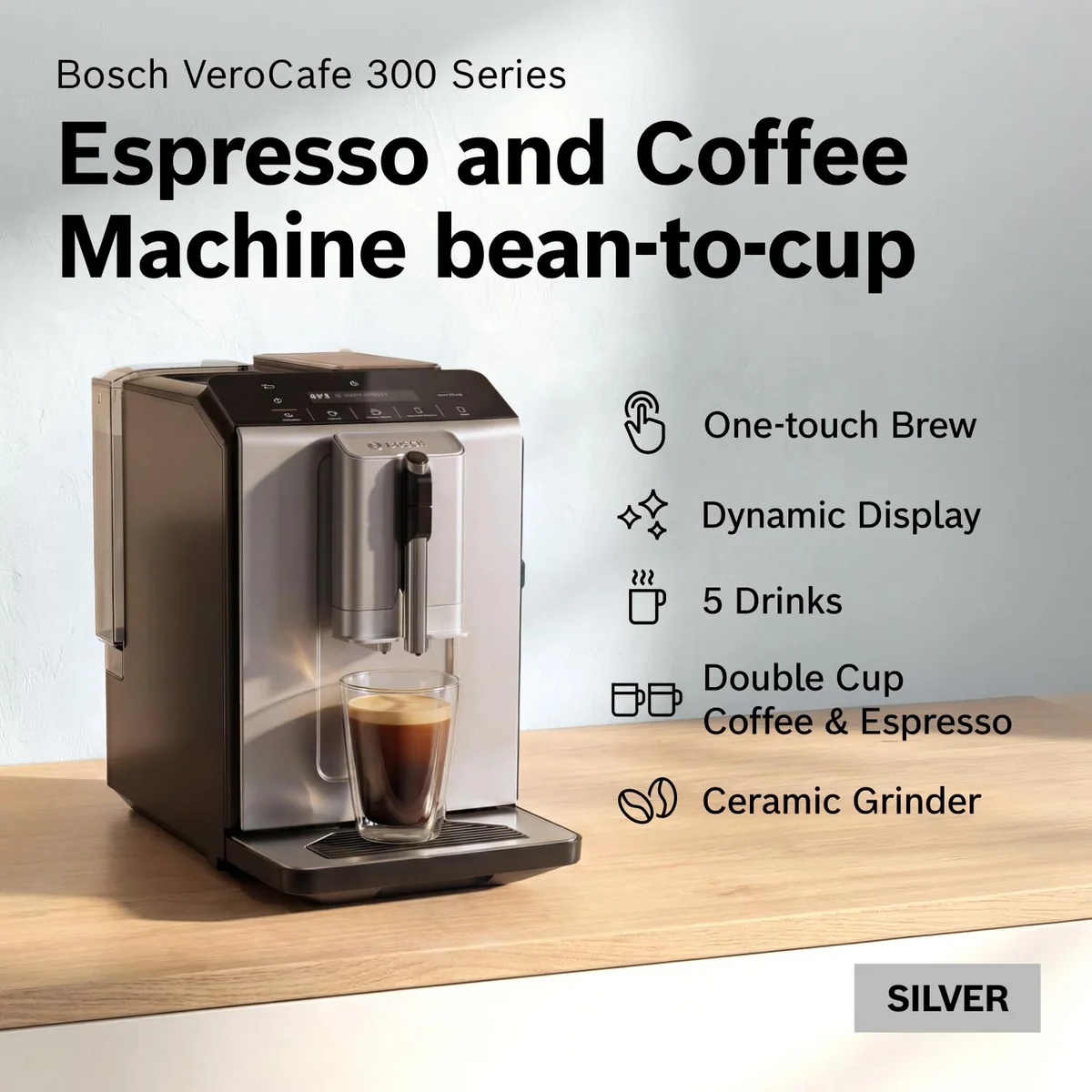
Bosch 300 Series espresso machine
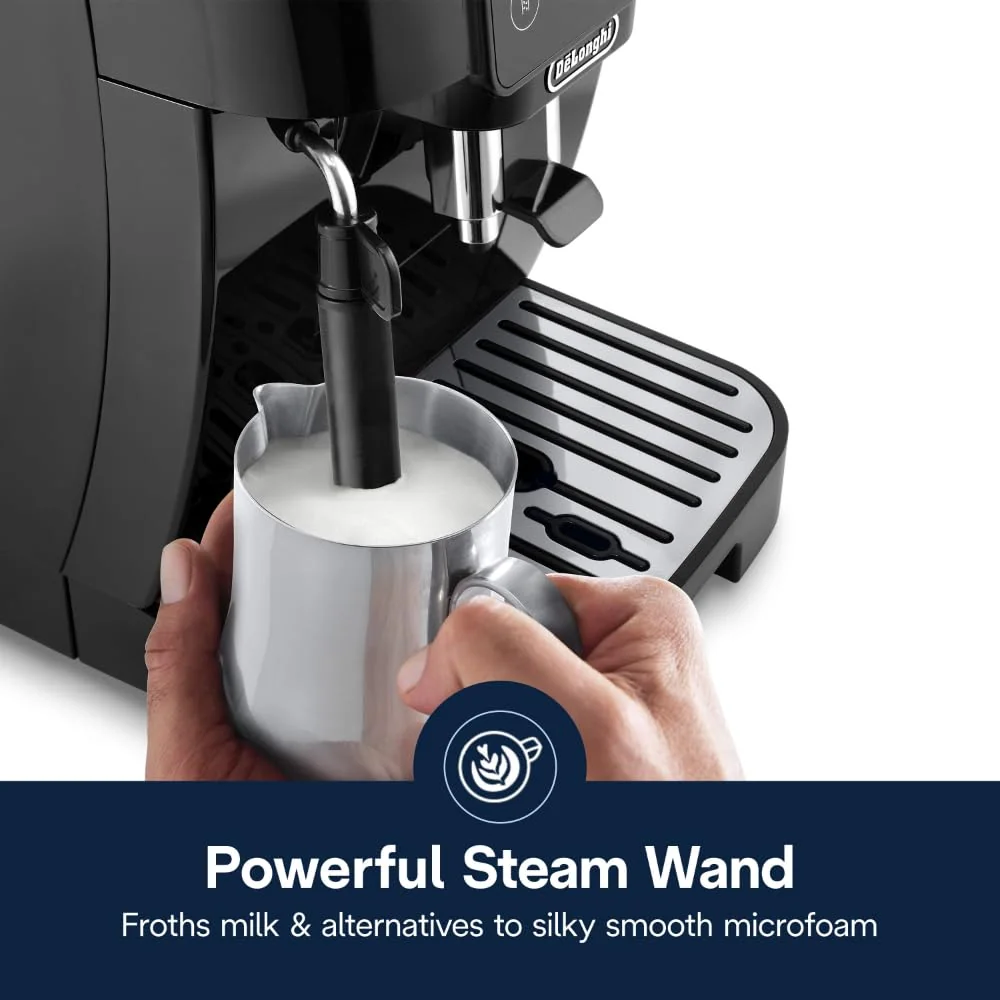
De'Longhi Magnifica Start
At a Glance
| Feature | Bosch Fully Automatic Coffee and Espresso Machine - One-Touch Drinks, Barista Style, Double Cup Super Coffee Maker - Large Bean Capacity - Easy Clean, Maintenance - Silver- TIU20307 | De'Longhi Magnifica Start Automatic Espresso Machine with Manual Milk Frother & Built in Grinder - 3 One-Touch Recipes, Easy-to-Clean, Home Barista Coffee Maker for Lattes, Cappuccino, Iced Coffee |
|---|---|---|
| Price Range | $500–$1,000 | $200–$500 |
| Configuration | without Cup Warmer | Magnifica Evo with Automatic Milk Frother |
| Finish | Silver | Silver |
| Items In Box | 1 | 1 |
| Check Price on Amazon | Check Price on Amazon |
The milk is the whole argument, and neither of them wins it cleanly
The Bosch does exactly what people buy a super-automatic for. Press cappuccino or latte macchiato and the frother arm, which clips on magnetically and comes off in a second to be rinsed, delivers foam straight into the cup with a shot behind it. Owners praise that arm unprompted, including one who went in convinced she wanted a machine with a milk vessel and changed her mind entirely. Nobody in that review set is holding a pitcher, which is why the word "wand" on the box does real damage.
The cost of that convenience is heat. Four of the thirteen retained reviews raise milk temperature, and they turn up inside the five-star reviews as often as the critical ones: one owner says flatly that if you like your drinks really hot you will not like this machine, because you cannot adjust the temperature; another went back to a separate standalone frother for lattes and kept the Bosch for coffee. There is a partial workaround from a longer-term owner, who sets a longer frothing time with the milk button and runs the latte macchiato cycle twice for a big glass, and it works because more dwell means more steam into the same milk. It is not a temperature control, and calling it one would be doing Bosch's marketing a favour it has not earned.
On the De'Longhi the temperature is simply yours. You steam until the jug is too hot to hold comfortably and then you stop, which is the standard answer to the complaint that dogs one-touch machines and which we set out in full in why these machines run cool. What you pay for that is skill and about ninety seconds every morning, plus one honest flaw: the plastic panarello sleeve over the steam pipe drags air in for the whole cycle and produces stiff, big-bubbled foam rather than glossy microfoam. The widely repeated fix, which our Magnifica Start review goes into, is to pull the sleeve off and treat the bare pipe as a proper wand. That is a fix, not a feature, and if you have never met a steam wand then the guide to which milk system you will actually live with is worth ten minutes before you spend anything.
| Bosch 300 Series | Magnifica Start | |
|---|---|---|
| What is fitted | In-cup automatic frother arm, magnetic mount | Steam wand with a removable panarello sleeve |
| Effort per drink | One button, walk away | Hold the jug, judge it by hand |
| Temperature | No setting, warm by owner consensus | Whatever you steam it to |
| Foam quality | Consistent, praised by owners | Bubbly with the sleeve on, good once it is off |
| Daily cleaning | Detach the arm and rinse it | Purge and wipe the wand |
| Who it suits | Households where several people make drinks | One person who will learn it once |
Where each one runs out of coffee
Both machines are limited in the cup, and it is worth understanding that they are limited differently, because the fix for one is not the fix for the other.
The De'Longhi's ceiling is the puck. Tom's Coffee Corner, timing the grinder across the range, puts the Start's strongest setting at roughly seven seconds of grinding, somewhere near ten grams, where the machines two rungs up keep going. Ten to twelve grams into a small cup is a good ratio and the espresso is genuinely well regarded. The same ten to twelve grams stretched across a mug is thin, which is the mechanical cause behind almost every complaint about weak, anonymous coffee from this platform, and which we unpack at why bean-to-cup espresso comes out watery. The trap is the 2x button: it runs twice the water through the same puck rather than grinding twice, so people pressing it to get a stronger drink are diluting one. Pull two separate espressos instead.
The Bosch's ceiling is the program. On espresso you can take one shot or two, but cappuccino and latte macchiato are locked to a single shot no matter how large the glass, and the coffee setting stretches to about a twelve-ounce cup without the dose scaling to meet it. The one real lever is the Double Cup function, which will either make two drinks at once or double the size of a coffee or espresso. So the Bosch's owners run the milk cycle twice for a grande, and the De'Longhi's owners cut the volume down until the ratio comes back. Different levers, same underlying honesty: a small dose does not make a big drink.
Which means neither of these is the machine for a household whose main drink is a mug of black coffee. That is not a knock on either manufacturer so much as the shape of the category, explained properly in what a super-automatic can and cannot do with filter-style coffee. If that is your drink, start instead from the machines we would pick for black coffee drinkers and save yourself the disappointment.
The one person who actually cross-shopped these two
Buried in the Bosch's own review set is a buyer who did this exact comparison with her own money. She normally buys De'Longhi and still likes them, naming their advantages precisely: more features, including iced coffee and hot water. Against that, she found the Bosch much quieter with fewer parts to break or go missing, and said she would buy it again. That is the fairest summary of this page written by someone who was not trying to write one.
Two of her points need adjusting for this specific De'Longhi, though. Hot water is here: the wand knob gives you it, and one Start owner lists it among the things she likes. Iced coffee is not, because this model's preset menu is three items long, espresso, coffee and americano. The reviews on that listing mention iced modes and self-cleaning milk nozzles because Amazon pools them with an automatic-carafe sibling, which is a trap we will come back to.
The noise point, though, stands up from both directions. Coffeeness measured the Start's grinder at 75.9 dB, several decibels above the older Magnifica it replaces, with a shrill note on every cycle that would not survive a sleeping baby. Its owners agree without much resentment: loud, brief, worth it, is roughly the consensus, with one calling it noisy and adding "but who cares?" The Bosch's grinder is loud too, for a few seconds a drink, but the cross-shopper's comparative judgement is the only direct evidence anyone has published, and it favours the Bosch. If a silent kitchen at six in the morning is a hard requirement rather than a preference, the quietest machines we know of are a different shortlist. At under ten inches wide the Bosch also has a real claim on a counter where width is the constraint, which the De'Longhi does not.
Two beans in one kitchen, which decides it outright for some people
If your household drinks regular in the morning and decaf after four, this comparison is already over. Bosch owners describe a single hopper with no comfortable swap: one taught himself to deliberately under-fill it each morning so he could empty it at lunchtime, and another said you either finish what is in there or tilt the whole machine on its side to get the beans out. Neither mentions a pre-ground bypass, which on rival machines is the standard answer to precisely this problem.
Magnifica Start owners do report a ground coffee option, one listing it plainly among the machine's features and another noting that pre-ground works but that freshly ground tastes noticeably better. That is not a second hopper, and it is one cup at a time, but it is the difference between an afternoon decaf being a minor faff and being a chore you stop bothering with. How the pre-ground route actually works is worth reading first, and if two beans is the whole reason you are shopping, the machines built for it do the job better than either of these.
What living with each one is really like
Both machines let you pull the brew unit out from the front, which is the feature that keeps mould out of the part you cannot otherwise reach, and both punish you for ignoring it. On the Bosch the cadence owners report is a grounds bin every seven to nine drinks, a drip tray every second bin, and a weekly rinse and dry of the brew unit that the machine never prompts for, because the coffee dust gets everywhere inside. On the De'Longhi the brew group comes out the same way, though part of it stays behind in the machine, so the cavity needs attention too.
Both also dump more water than new owners expect. The Bosch rinses itself at power-on and again before shutdown, roughly a cup a time by one owner's reckoning, which is why the tank empties fast and why another owner opened the door to a tray full of water he could not account for. The De'Longhi spits at the start and end of each drink, and at least one owner keeps a saucer on the grate to catch the overflow. None of that is a fault. It is the price of the machine keeping its own brew path clean, and the real cost of owning one of these is interaction rather than money.
Where they genuinely diverge is the interface. Bosch's Calc'n Clean walks you through descaling on screen, and owners describe an arc from "a bit involved but worth the effort" at three weeks to "easy" by seven months. De'Longhi's settings live behind held buttons and icon combinations with a manual that explains first-time setup and maintenance but not how to make or configure a drink, and the water hardness setting, which decides how often you are nagged to descale, is buried in there. That is the Start's real weakness: right hardware, unfriendly software.
Reliability, and what those two star ratings are not telling you
The Bosch carries 3.8 from 197 ratings, which is soft for this category. The retained reviews run rosier than that average implies, but they contain one hard failure described in useful detail: a machine that began throwing a "Restart Appliance" message at four months and then stopped dispensing coffee entirely with a squeaking noise, while the milk frother and the start-up rinse both still worked. Water path fine, milk path fine, brew path dead, two Calc'n Clean cycles no help, and no follow-up telling us how Bosch resolved it. It does not stand entirely alone either: a 300 Series owner on Bosch's own subreddit posted an error code and asked whether it was time to call a technician.
The De'Longhi shows 4 from 249 ratings, and that number should be trusted less than the Bosch's, not more. Amazon pools this black manual-frother model with an automatic-carafe sibling, so several of the warmest reviews name the Evo outright, praise an automatic frother, or describe a self-cleaning milk nozzle, and one one-star review complains about a frother the machine beeps at but never recognises, which is a sensor this model does not have. Read the words and discard anything mentioning a carafe. What is left includes two failures worth knowing about: one machine dead ten days in, and one dead out of the box with a fast-flashing steam light and a silent pump.
So the honest reading is that both have a visible early-failure tail and neither rating settles anything. The broader pattern in this category is set out in how long these machines last and what breaks first, and the practical response is the same for both: buy somewhere with a generous returns window. The smartest thing anyone said about this whole category came from a first-time buyer who pointed out that thirty days is not long enough, because it takes a week or two just to work out where the machine lives and how to set it up. Given that the Bosch's own worst failure arrived at four months, that is not timidity.
The money, which is where this stops being close
The Bosch is the dearer machine by a wide margin, not by a little. What the gap buys is the automatic frother, the narrow body and the quiet. What it does not buy is dose control, hot water, a pre-ground bypass, a temperature setting or a second bean route, all of which the cheaper machine either has or does not need. Stated that plainly, the Bosch is asking a lot.
Two things complicate it. The first is channel: this Bosch turns up through warehouse-club outlets at a considerably lower level than its Amazon listing, and at that end the value argument stops being lopsided. The second is that not everyone rates the manual-frother De'Longhi at all. Coffeeness wrote flatly that there is no reason to buy the manual milk frother version of the Magnifica Start, and that dissent deserves quoting rather than burying. Espresso Den's disagreement is about what it is being judged against: measured against a carafe machine costing much more, the wand looks like a subtraction, but measured against a Bosch at roughly twice the band whose own milk system runs warm, the wand is the version with fewer parts to fail and hotter milk at the end of it.
If the warm milk is the thing putting you off the Bosch rather than the price, note that Bosch itself solves this further up its own range: the 800 Series adds a screen with brewing temperature among its settings, which is exactly the control the 300 lacks. That is the argument laid out in the 300 against the 800, and it is a real decision rather than an incremental one.

Bosch 300 Series espresso machine
De'Longhi Magnifica Start
Which of these is actually yours
The test is short. Count how many people in your house make drinks, and count how many of those will learn to steam milk. If the answer to the first is three and the second is one, the Bosch's frother arm is worth real money. If the answer to both is one, the De'Longhi does everything the Bosch does, does the milk hotter, handles decaf, and leaves a substantial amount of money in your pocket.
The one-button machine for a narrow counter and a quiet house
It grinds, brews and delivers frothed milk into the cup at a single press in a body under ten inches wide, and the owners who wanted an appliance rather than a hobby are mostly delighted with it.
There is no temperature setting anywhere on the machine, and milk that arrives warm rather than hot is the most repeated complaint in its own review set.
The cheaper machine that actually hands you the wand the other one advertises
It puts De'Longhi's shared brew group and thirteen-step conical burr in the plainest box the range comes in and gives you back the milk temperature and texture that one-touch machines take away.
Its maximum dose is small enough that anything longer than a short americano comes out thin, and the grinder is measurably louder than the machine it replaced.
If neither answer sits right, the sharpest alternative is the one-touch carafe route, where the milk is automatic and the cleaning is two pieces rather than seven: that is the ground covered in the Bosch 300 against the Philips 2300 LatteGo. If you have decided on De'Longhi and are only choosing which one, the Evo against the Start is the comparison people actually search for, and the whole De'Longhi line untangled covers the rest of the ladder. To widen the field entirely, the shortlist under a thousand dollars is where the Bosch has to earn its place.
Frequently Asked Questions
Does the Bosch 300 Series really not have a steam wand?
It really does not, and Bosch's own description gives the game away by calling the fitting a Milk Express in-cup frother, which owners describe as an arm that clips on magnetically and delivers milk into the cup rather than a pipe they texture milk with.
Which one makes hotter milk?
The De'Longhi, because its milk temperature is decided by how long you hold the jug under the wand, while the Bosch has no temperature setting at all.
Which one is quieter?
The Bosch, on the only comparative evidence anyone has published, from an owner who normally buys De'Longhi and found the Bosch much quieter with fewer parts to lose.
Can either of them make a large mug of black coffee properly?
Not really, since the Bosch stretches its coffee setting to about twelve ounces without scaling the dose to match and the De'Longhi's puck tops out around ten to twelve grams, so both dilute rather than grow.
I drink decaf in the afternoon, does that settle it?
It settles it for the De'Longhi, whose owners report a ground coffee option, while Bosch owners describe a single hopper you either drain by lunchtime or tilt the whole machine to empty.
Is the Bosch worth the extra money?
Only if a narrow footprint, quiet running and hands-off milk are worth more to you than dose control, hot water and hotter foam, which in most kitchens they are not.
Should I be looking at the Bosch 800 Series instead?
Worth a look if warm milk is your objection rather than price, because the 800 adds a screen with brewing temperature among its settings, which is the control the 300 does not offer.
Why are the two star ratings so close when the machines are so far apart on price?
Partly because the De'Longhi's average is pooled with an automatic-carafe sibling and therefore describes two different products, so it should not be read as a verdict on the manual-frother model at all.
Ready to Choose?
Sources (5)
- Amazon listings and customer reviews — Bosch 300 Series Espresso and Delonghi Magnifica Start
- Owner reports across r/superautomatic, r/espresso, r/bosch threads
- Owner and reviewer video, 2 channels
- Tomscoffeecorner — Article — tomscoffeecorner.com
- Coffeeness — Article — www.coffeeness.de