The Bosch 300 Series and the Philips 2300 both froth the milk for you, so the real question is what you are left holding afterwards
Take the Philips 2300 LatteGo if cappuccinos are most of what you drink and you want the milk system to be a rinse rather than a ritual, and take the Bosch 300 Series if espresso and a proper mug of coffee are the drinks, the counter is narrow, and you can live with milk that comes out warm.
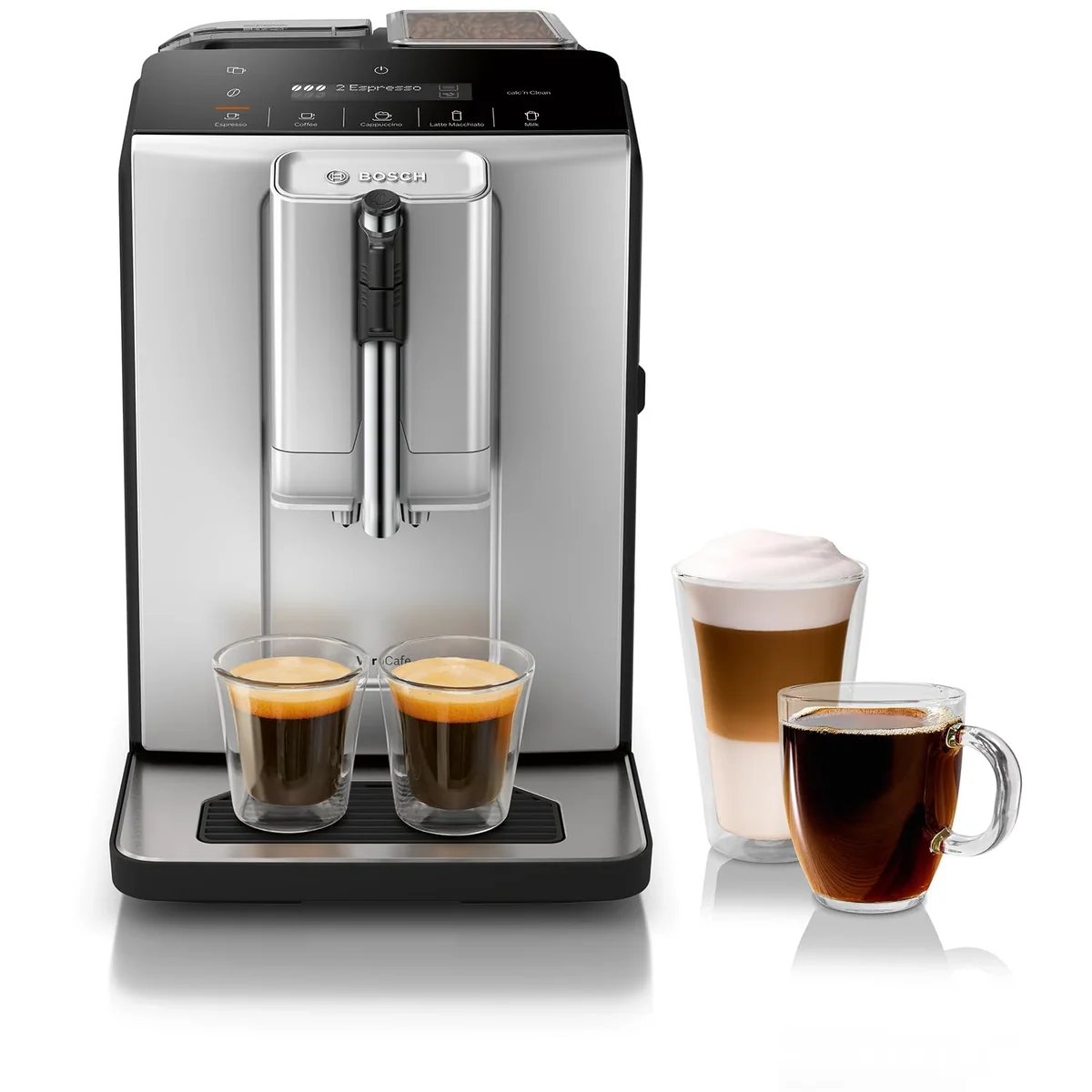
Bosch 300 Series espresso machine
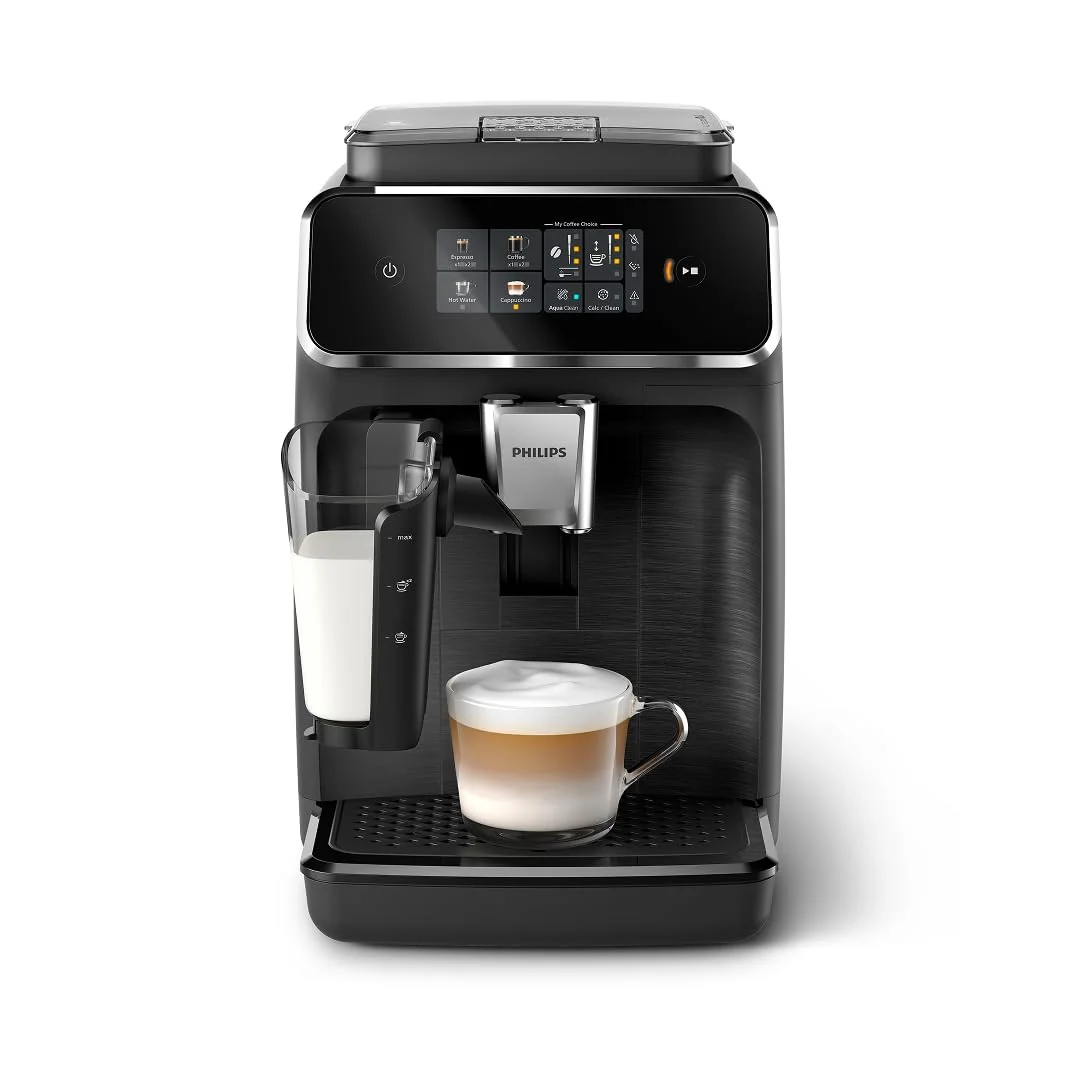
Philips 2300 LatteGo
This comparison usually gets framed as steam wand against one-touch carafe. That framing is wrong before the argument even starts, and correcting it is the single most useful thing this page can do for anyone about to spend several hundred dollars. Neither of these machines has a steam wand. Only one of them has a carafe.
The confusion is Bosch's own doing. The product title sells the 300 Series as coming "with Grinder and Steam Wand," while the description underneath, written by the same manufacturer about the same appliance, calls it a "Milk Express in-cup frother" and an "adjustable milk frother" producing "silky milk froth made directly in your cup."
The owner record settles which half is true. Buyers describe a frother arm held on magnetically, which they connect before a cappuccino and pull off afterwards to rinse. One reviewer who went in convinced she would prefer a machine with a milk vessel changed her mind entirely and still described the thing as a frother she connects and cleans, not a wand she textures milk with. Nobody in that record is standing at the machine with a pitcher in their hand, and if a pitcher is what you actually wanted, our guide to which milk system you will genuinely live with should come before either of these, along with the Bosch against the De'Longhi Magnifica Start, which is where the manual frother in this price bracket actually lives.
So the honest version of the question is this: do you want your milk textured inside a detachable carafe that Philips claims is three parts with no internal tubes and rinses in ten seconds, or delivered straight into the cup by an arm you clip on and take off again? That is a real choice with real consequences, and it is not the choice the search results promise you.
One caveat on the money, because the whole premise of shopping these two against each other is that they cost about the same. That is true in some places and not in others. On Amazon the Bosch sits near the top of its band while the Philips sits well below it, and the two only meet when the Bosch turns up through warehouse-club channels, where owners have reported it dramatically cheaper than its listing. If you are looking at the Bosch at full Amazon money, you are not comparing like with like, and the Philips wins a value argument the Bosch never gets to have.
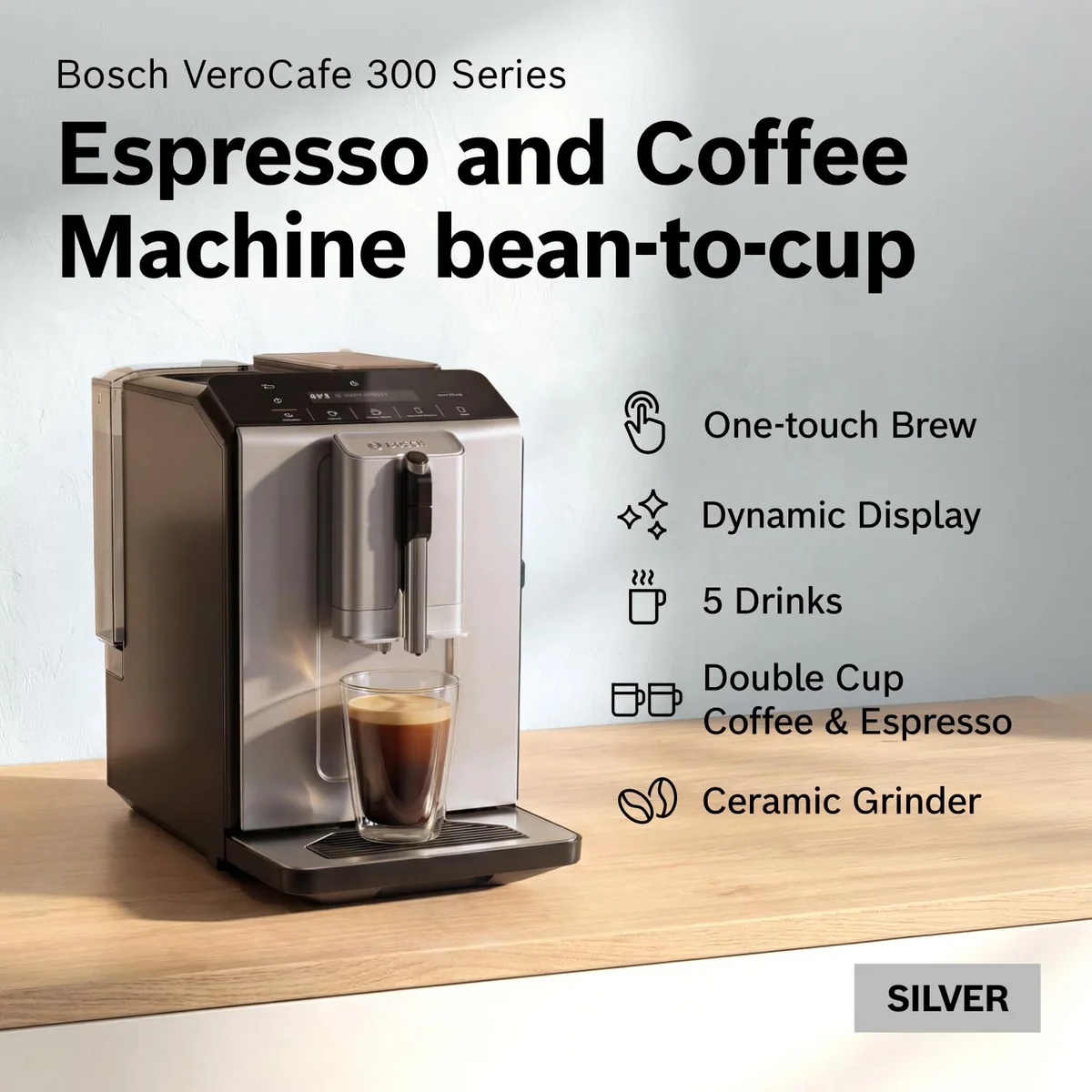
Bosch 300 Series espresso machine

Philips 2300 LatteGo
At a Glance
| Feature | Bosch Fully Automatic Coffee and Espresso Machine - One-Touch Drinks, Barista Style, Double Cup Super Coffee Maker - Large Bean Capacity - Easy Clean, Maintenance - Silver- TIU20307 | Philips 2300 Series Fully Automatic Espresso Machine with LatteGo milk system and integrated grinder, 4 Coffee Pre-Sets & Hot Water, 40% Quieter SilentBrew, 15-Bar Pressure, Matte Black (EP2330/10) |
|---|---|---|
| Price Range | $500–$1,000 | $200–$500 |
| Configuration | without Cup Warmer | 4 Beverages |
| Finish | Silver | Matte Black |
| Items In Box | 1 | 1 |
| Listed Since | — | 2025-05-28T00:00:01Z |
| Check Price on Amazon | Check Price on Amazon |
Start with the milk, because it is the only place these machines genuinely diverge
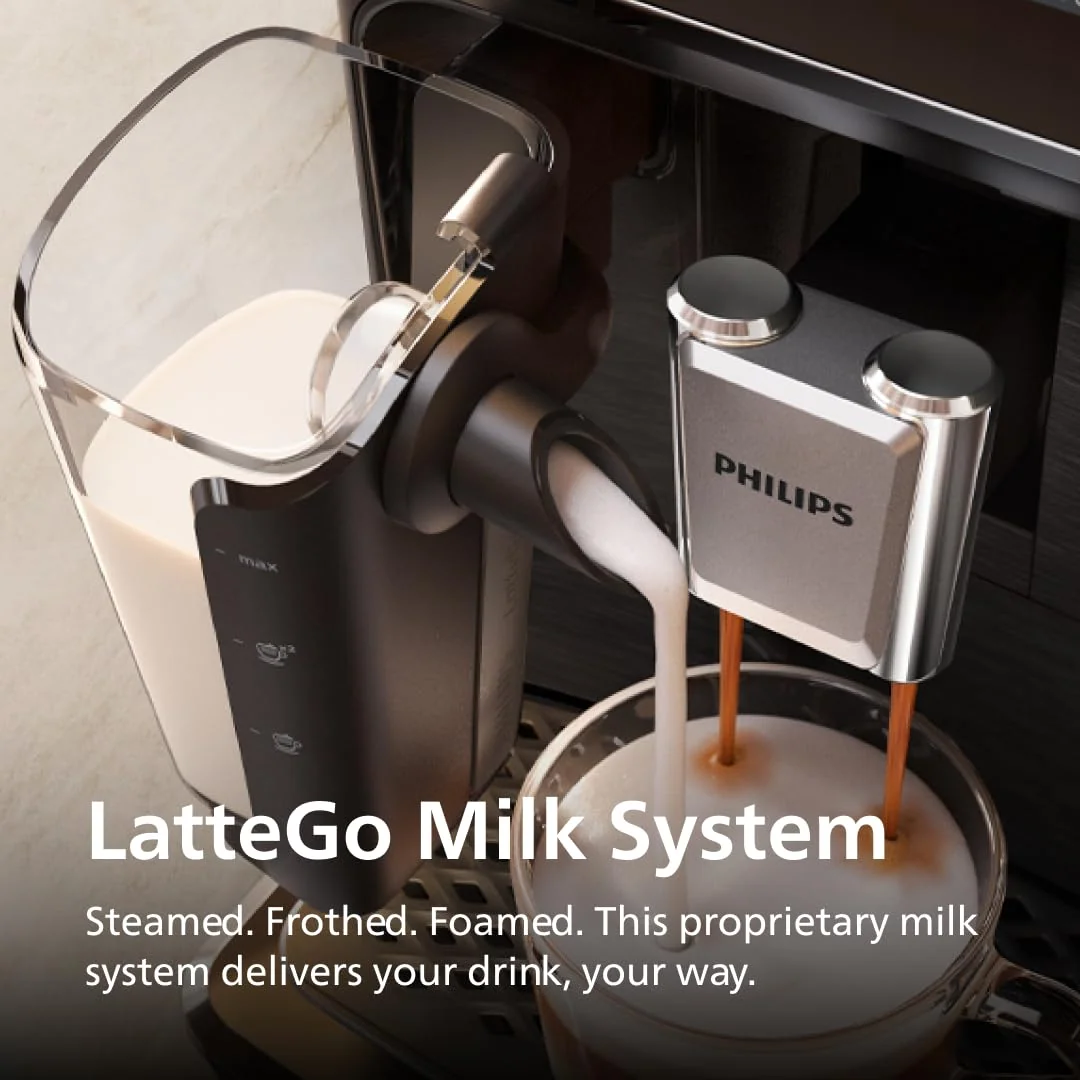
The LatteGo carafe is the reason people put up with everything else Philips does. It comes off the front, splits into its pieces, goes under the tap and goes back in the fridge with the leftover milk still sitting in it. One owner on this listing described exactly that habit, taking it off, parking it in the fridge and washing it every other day, and said she could not believe how easy it was compared with the tube frother on a machine she had owned before. If the thing keeping you away from bean-to-cup machines is a story about mould growing somewhere you cannot reach, this is the direct answer to it.
Bosch's answer is different rather than worse. There is no carafe to fill, no vessel to store, and nothing to reassemble; the arm attaches magnetically, comes off in a second and is dishwasher-safe along with the other removable parts. Two separate owners praised that attachment unprompted, which is unusual for a component nobody buys a machine for. What you give up is the fridge trick: with the Philips, yesterday's leftover milk lives in the part you already washed, and with the Bosch, milk handling is your problem again.
| Bosch 300 Series | Philips 2300 LatteGo | |
|---|---|---|
| What it is | An in-cup frother arm that clips on magnetically | A detachable carafe Philips states has three parts and no internal tubes |
| Cleaning | Pull the arm off and rinse it, or put it in the dishwasher | Split it, rinse it, or put it in the dishwasher |
| Leftover milk | Yours to deal with | Stays in the carafe and goes in the fridge |
| Texture control | Frothing time is adjustable with the milk button | One fixed behaviour, tuned around cappuccino |
| Temperature control | None on the machine | None for milk specifically |
Which brings up the thing both of them do badly. Warm milk is the standing disappointment of this entire category, and neither machine escapes it. Four of the thirteen retained Bosch reviews raise milk temperature, and it appears as often in the five-star reviews as in the critical ones; one owner puts it flatly, saying that if you like your drinks really hot you will not like this machine because you cannot adjust the temperature. Philips LatteGo owners describe theirs the same way, warm rather than hot. There is a partial Bosch workaround, reported by an owner four months in: longer frothing time via the milk button, and running the latte macchiato cycle twice for a large glass. That is dwell time, not a temperature dial, and Espresso Den would rather name it as a workaround than let "adjustable milk frother" do a thermostat's job. What makes the omission a mark against the Bosch specifically is that Bosch puts brewing temperature on the screen further up its own range, so the 300 lacking it is a product decision rather than a limit of physics. If scalding milk is the point, read why these machines run cool and then look at the 300 against the 800 Series instead.
The shot is the same complaint twice over
The reputation problem that follows Philips super-automatics is watery espresso, and it has a physical cause rather than a mythical one. An owner of a sibling machine timed and weighed it: sixteen seconds from pre-infusion to finish, forty grams in the cup, and a puck that dried out at around 11.7 grams. Roughly eleven grams is where people who actually measure these machines keep landing, against fourteen to sixteen in a De'Longhi or a Jura. Nothing in the settings menu adds coffee that is not in the chamber, so the entire art of living with the Philips is not diluting the small dose you have: strength to maximum, volume to its lowest, temperature high, and the grind brought two or three notches finer while the grinder is actually turning. Our piece on why the shot comes out pale and thin works through the diagnosis properly.
Here is the part nobody mentions when they recommend one of these over the other: the Bosch has the identical problem for the identical reason. Its cappuccino and latte macchiato settings froth the milk and add a single shot, and that is the ceiling. The Philips cappuccino button also pulls one shot. Both machines therefore make a milk drink that tastes weaker than the café version you were copying, and on both of them the fix is manual. On the Philips you press espresso again into the finished cup. On the Bosch you use Double Cup, which doubles the size of a coffee or espresso, or you run the milk cycle twice. Neither is difficult, and neither is what a one-touch machine was supposed to require of you.
On the espresso itself the records refuse to agree, and pretending otherwise would be dishonest. One Bosch owner returned the machine because crema and coffee quality were lacking at the price, while another wrote a review headed "Crema! At Last!" and said previous machines she had owned do not come close; both are experienced buyers, so the usual dismissal does not apply. On the Philips side, an owner replacing a ten-year-old Gaggia reported more crema than the old machine produced, and a restaurant owner who had returned several other machines kept this one. What you can take from that is a probability rather than a promise, which is why the return window matters more here than the spec sheet does.
Black coffee, and the drink each one cannot make
This is where the two machines finally stop mirroring each other. The Philips carries four presets: espresso, coffee, cappuccino and hot water. There is no Americano among them, and a 2300 owner posting in the super-automatic community loves his machine, uses it for espresso daily, and still told someone else in the thread to buy the 3200 instead because that one has the button his does not. You can get there in two presses and a moved cup, but you bought one-touch. The Bosch, by contrast, has a coffee setting that owners report adjusting up to roughly a twelve-ounce cup, which is the closest thing to a normal mug either of these will produce without being asked twice.
| Drink | Bosch 300 Series | Philips 2300 LatteGo |
|---|---|---|
| Espresso | One shot or two | Yes, single shot |
| Cappuccino | Yes, on one shot | Yes, on one shot |
| Latte macchiato | Yes, on one shot | Not a preset |
| Mug of coffee | Adjustable to about twelve ounces | A coffee preset, small by mug standards |
| Americano | Use the coffee setting | Espresso, then the hot water setting |
| Two at once | Double Cup does two drinks or one double | Not offered |
Read that table with your own week in mind rather than a wish list. If four of your seven mornings are a large black coffee, the Bosch answers the question and the Philips makes you work for it, which is the argument laid out in what we recommend for people who drink it black. If four of your seven mornings are a cappuccino handed to someone else in the kitchen, the carafe wins and the missing Americano button never comes up.
What the owner records say actually goes wrong
Both machines have a failure sitting inside an otherwise cheerful review set, and the failures are different in kind, which is genuinely useful.
The Philips fails wet. The pattern owners describe is water escaping from the back of the machine during the steam cycle and again at the end-of-brew purge, which means the drip tray never sees it. One owner discovered this only after the water had soaked through a rubber mat and ruined a wooden coffee bar installed a year earlier, and gave the machine one star while still calling the espresso it makes great. Another had a seal go at seven months and coffee spray out of the casing mid-cup. A third was two months in and five weeks into an unresolved support conversation. The same review set also reports beans failing to feed into the grinder, and a grounds sensor that asks to be emptied when the tray is empty and stays quiet when it overflows. Espresso Den's advice on this one is free and unglamorous: nothing bare or wooden underneath, something waterproof behind it, and pull it forward once a week to look.
The Bosch fails dry, and in the one documented case it failed cleanly. An owner's machine started throwing a "Restart Appliance" message at four months, cleared it by pulling the power cord, watched it come back, and then found the machine making a squeaking noise and dispensing nothing. The diagnostic detail is what makes it worth reporting: the milk frother still worked and the start-up rinse still pushed water through, so the water path and the milk path were fine and the brew path was dead. Two Calc'n Clean cycles did not fix it, and the review ends before Bosch's answer, so how it was resolved is a hole in the record. It does not stand entirely alone either, since a 300 Series owner on Bosch's own subreddit posted an error code and asked whether it was time to call a technician.
Weigh those honestly and the Philips has the more common and more expensive failure mode, because a leak damages the thing the machine is standing on, and the Bosch has the more alarming one, because a dead brew path is the whole machine. Neither is a reason to avoid the category, since what breaks in bean-to-cup machines is fairly predictable and clusters around seals, scale and the brew unit. It is a reason to buy where you can send it back late. The smartest thing anyone in this category said came from a buyer weighing a first machine: thirty days is not long enough, because a fortnight goes on working out where the machine lives and how to set it up, and doubts that arrive afterwards arrive too late. Both of the hard failures on this page landed at two, four and seven months.
One asymmetry in the evidence should be stated rather than smoothed over. Philips LatteGo machines are discussed endlessly, so the failure reports and the fixes are both plentiful. The Bosch super-automatic line barely registers: a buyer on r/superautomatic listing exactly the priorities this machine serves, quiet operation, easy cleaning, no smart features, noted that the Bosch range is something they never see discussed anywhere. A quiet record is not a clean record, and a 3.8 average across a couple of hundred ratings is not a strong one.

Bosch 300 Series espresso machine
Philips 2300 LatteGo
Four questions that decide it, and then the machines themselves
Does anyone in the house drink decaf after lunch? Then the Philips, and it is not close. It has a bypass chute for pre-ground coffee, and an owner of this listing uses the scoop and the grinder interchangeably day to day. The Bosch has one hopper and no comfortable way out: one owner deliberately under-fills it each morning so he can swap at lunchtime, and another says you either finish what is in there or tilt the whole machine on its side. Our notes on running pre-ground and decaf properly cover the grind-size trap, and the machines built for two beans in one kitchen go further than either of these.
Is counter width the constraint? Then the Bosch, which Bosch lists at 9.7 inches across, genuinely narrow for a machine with a grinder inside it and a real point in its favour for a kitchen where the cabinets decide what you can own.
Are you filling a travel mug? Neither, and the Philips is emphatic about it: an owner who wanted exactly that found the latte press delivering around three ounces and needed four goes to fill her cup, could not find a way to increase the size in the manual or the videos, and was refilling the tank every second drink. The coffee and the milk also leave from separate points, so a tall narrow vessel cannot catch both.
Is somebody asleep? Probably the Bosch, with a caveat. A cross-shopper who normally buys De'Longhi found this machine noticeably quieter with fewer parts to break or go missing, and Bosch owners describe the grinder as loud only for a few seconds per drink. Philips claims SilentBrew cuts noise by forty per cent against its previous models, and owners of this exact listing flatly contradict each other, one calling it noisy and another calling it very quiet. Nobody has published a measurement of either, which is why our quiet-machine page does not lean on this pair.
Both machines share the same domestic annoyance, so it should not sway you either way: each rinses itself at power on and again before shutdown, which is why the tank empties faster than expected and why the drip tray fills with water nobody poured. One Bosch owner measured that at roughly a cup per rinse; one Philips owner is draining the base every second day for four drinks. It is the machine keeping its own brew path clean, and it is a fair trade.
If reading all of that has made the four-preset list feel thin rather than simple, the next rung up is a better answer than either half of this comparison, and we have set it out in the 2300 against the 3300. If it has made you want an actual pitcher and an actual wand, go and read the Magnifica Start review. And if the budget has room to move, the full shortlist under a thousand dollars is where both of these have to earn their place.
The one to buy if the drinks are espresso and a proper mug of coffee, made in a kitchen with no room to spare
It is the only machine here that will hand you a twelve-ounce cup on one press, the grounds stay in an internal bin so nothing lands on the counter, and a household replacing a Jura that had lasted fourteen years judged the coffee just as good at a fraction of the money.
There is no temperature setting anywhere on it, so the milk arrives comfortably warm rather than hot and no amount of menu-digging will change that.
The one to buy if two cappuccinos a day are the whole reason you are shopping
The LatteGo carafe turns the part of a bean-to-cup machine that puts people off owning one into a ten-second rinse and a container you park in the fridge with the leftover milk still in it.
Owners report it leaking from the rear during the steam cycle and the end-of-brew purge, where the drip tray cannot catch it, and one of them found out only after the water had soaked through a mat and ruined a new wooden counter.
Two machines, then, that agree about almost everything except where the foam is made and what happens next. Espresso Den's own long-form verdicts on each sit at the Bosch 300 Series review and the Philips 2300 LatteGo review, and neither of them softens what is above.
Frequently Asked Questions
Does the Bosch 300 Series really have a steam wand?
Not in the sense anybody means by the phrase, since Bosch's own description calls it a Milk Express in-cup frother and owners describe a magnetically attached arm rather than a wand they use with a pitcher.
Which one is genuinely less work to clean?
The Philips wins on the milk system because the carafe splits into three parts with nothing hidden inside, while the Bosch wins on the coffee side because grounds fall into an internal bin and there is nothing to knock out.
Which makes the stronger espresso?
Neither, on defaults, because both pull a single shot into their milk drinks and the Philips dose has been weighed by owners at around eleven grams, so the stronger cup on either machine is the one you add a second shot to.
Which one is better if I mostly drink black coffee?
The Bosch, because its coffee setting stretches to roughly twelve ounces on one press while the Philips has no Americano preset and needs an espresso followed by its hot water setting.
Can I run decaf in the afternoon?
Only comfortably on the Philips, which takes pre-ground coffee through a bypass chute, since Bosch owners report a single hopper they either drain early or tip out by tilting the machine.
Are these two actually the same price?
Only in some channels, because the Bosch sits near the top of its band on Amazon and has been reported far cheaper through warehouse clubs, so check what you are being asked before assuming the comparison is even.
Which is more likely to still be working in three years?
The evidence does not support a confident answer either way, since the Philips record contains leaks at two, six and seven months alongside owners years into daily use, and the thinner Bosch record contains one machine whose brew path died at four months.
What should I do on the day either one arrives?
Put something waterproof under and behind it, register the warranty, and judge the coffee on corrected settings inside the first fortnight rather than waiting out a break-in period that outlasts your right to send it back.
Ready to Choose?
Sources (3)
- Amazon listings and customer reviews — Bosch 300 Series Espresso and Philips 2300 Lattego
- Owner reports across r/superautomatic, r/espresso, r/bosch threads
- Owner and reviewer video, 1 channel