Philips 4400 LatteGo (EP4447/90): a brilliant milk carafe bolted to an ordinary shot
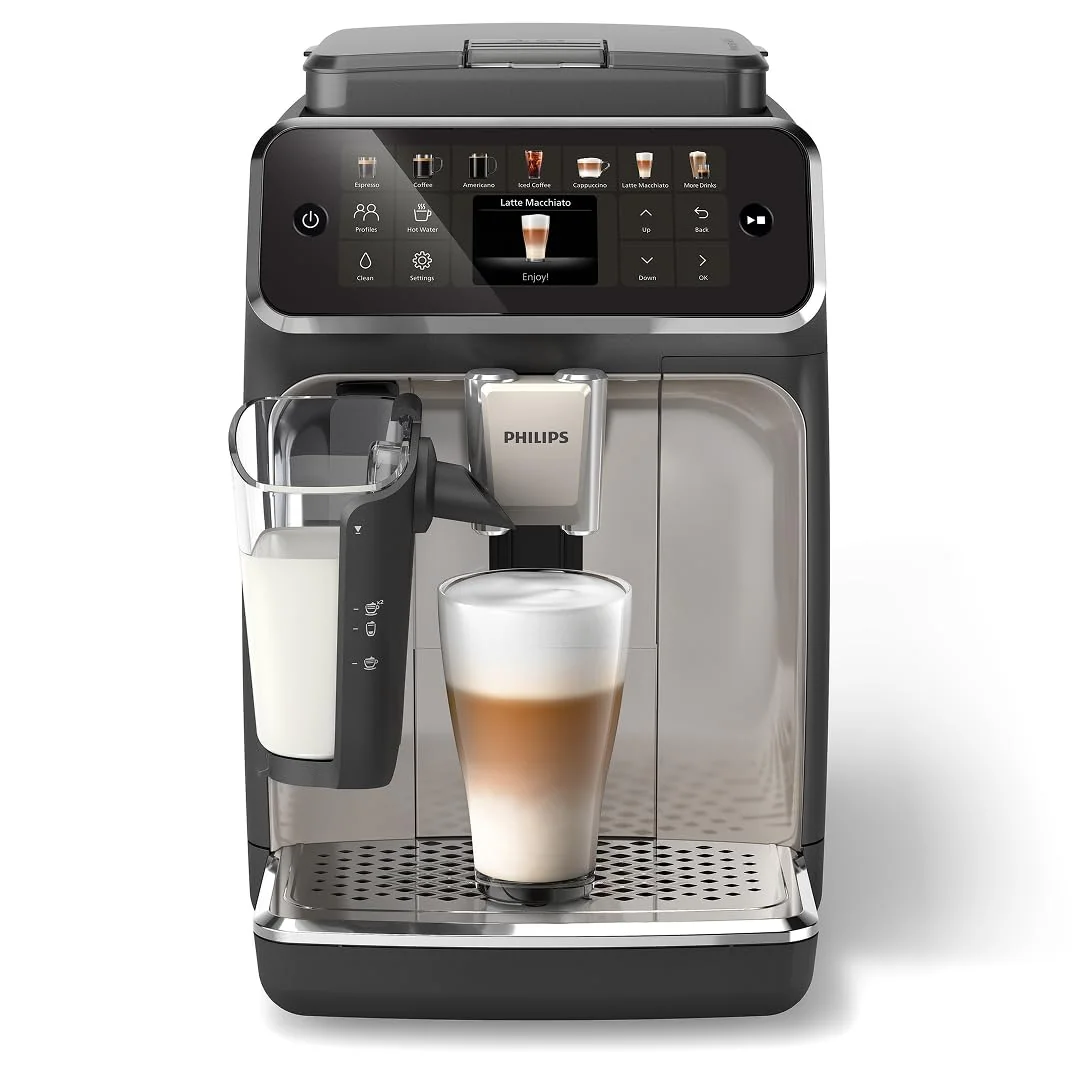
Buy the 4400 if a two-part milk carafe you will actually rinse and a screen anyone in the house can read are worth real money to you, and look elsewhere if you want a shot with weight, because the small dose and the twenty-to-a-hundred-cup break-in are the same here as on every LatteGo beneath it.
Based on 583 owner ratings, 13 owner discussions and 3 other sources. We have not tested this machine ourselves.
We earn a commission if you buy through our links, which does not affect what we say.
Read how this site works →
So which one, and should it be this one at all
Buy the new EP4447/90 if you want the screen, the profiles and the iced presets, you are coming from pods rather than from a portafilter, and you can absorb a break-in without losing your nerve. Buy the renewed one only if the saving is large enough to fund your own insurance policy, because that is what you are doing: trading years of manufacturer cover for a discount, on a platform whose known faults mostly arrive after the ninety days run out. Check the product counter the day it lands, run twenty cups through it fast, and make the keep-or-return call early rather than politely.
And do not buy either one because of the number twelve. That is the closing argument, and it is not ours; it comes from the people who own these machines and were asked which to buy. The coffee is the same all the way up the ladder. What the 4400 sells you is a machine your household will use without complaint and a milk carafe you will actually clean, and if those are worth the premium to you, this is a good buy at a fair discount and an indifferent one at full price.
Buy the 4400 if a two-part milk carafe you will actually rinse and a screen anyone in the house can read are worth real money to you, and look elsewhere if you want a shot with weight, because the small dose and the twenty-to-a-hundred-cup break-in are the same here as on every LatteGo beneath it.
Best for: The colour screen, the five strength steps and the twelve presets are real, but they sit on exactly the same grinder and brew group as the cheaper 3300, so what the extra money buys is the interface rather than the espresso.
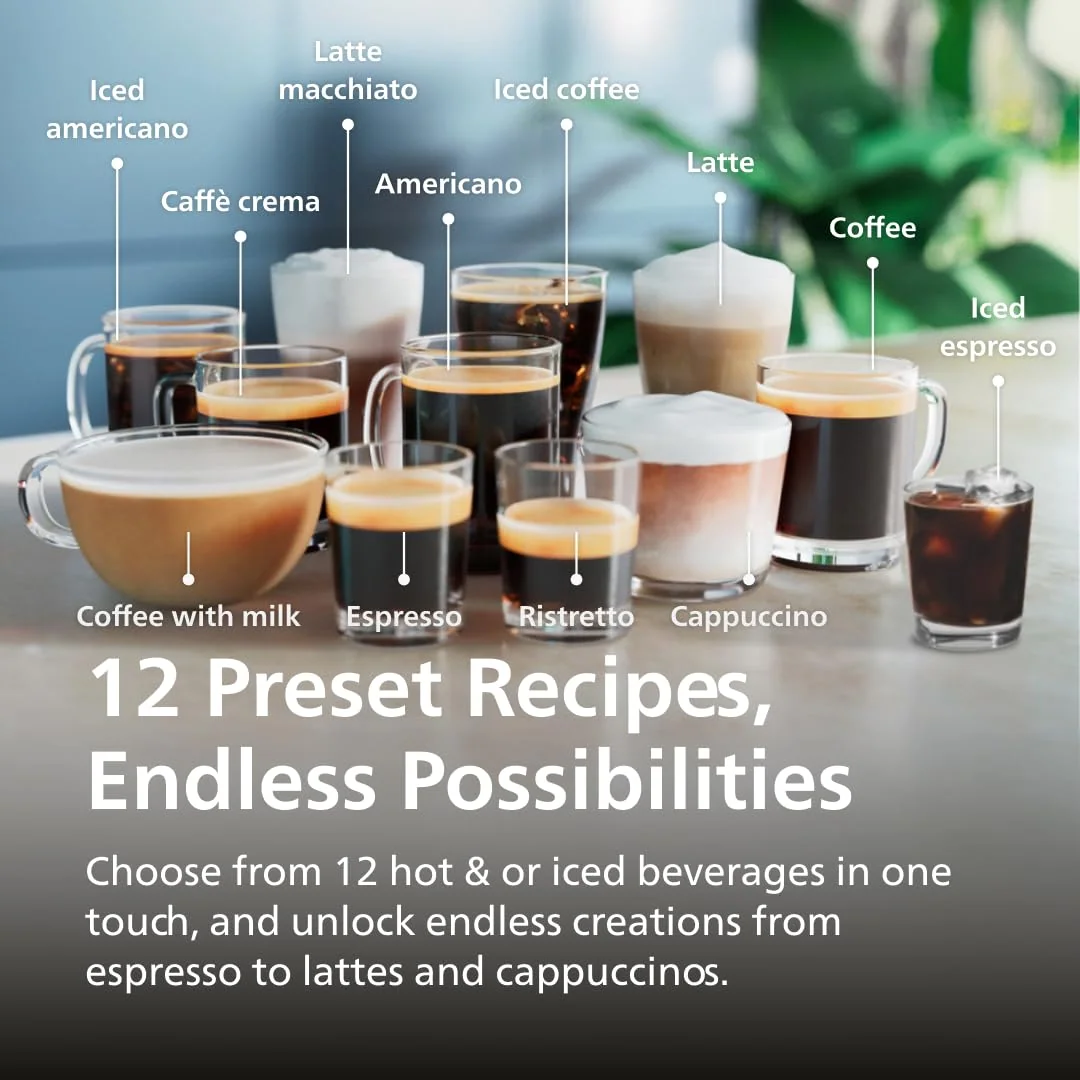
The EP4447/90 is Philips' 2025 refresh of the 4400, and the three words on the box that were not there before are SilentBrew, QuickStart and iced. The listing leads with twelve hot and iced recipes, a milk system that comes apart into two pieces and rinses in ten seconds, a claim of forty percent less noise than earlier models, and an AquaClean filter that Philips says will carry you five thousand cups before you need to descale. Four of those five claims survive contact with owners. The fifth, the one about twelve recipes, is the one the whole machine is sold on, and it is the one that deserves the most suspicion.
Here is the fact that governs everything else on this page, and the reason the argument below is not a list of features. Every Philips LatteGo from the 2300 up to the 5500 uses the same Saeco brew group and the same twelve-position ceramic grinder. Somebody who owned a 5400 and set up several 3200s put it as plainly as anyone: the grinder and brew group are identical across the range, so basic shots will be the same on all of them, and what changes as you climb is the number of preset recipes, the interface and the trim. That is not a hostile reading. It is what a Philips owner tells other Philips owners when they ask which one to buy.
So the 4400 is not a better-tasting machine than a 3300. It is a more pleasant machine than a 3300, which is a different and perfectly legitimate thing to spend money on. Amazon owners of this listing say so in their own way. One arrived from a grinder and a pod machine, discovered that a latte and a latte macchiato are not the same drink, and reported that he was glad he paid extra for the choices. Another waited six months before writing and called the espresso consistent and the frother easy. A third, two months and more than twelve hundred coffees in, described dry spent pucks and burn-your-mouth-hot coffee. And a fourth returned it, under the heading "Very expensive brown water." Espresso Den's view is that all four of those people are describing the same machine accurately, and the rest of this review is about why.
Key Specifications
What the twelve drinks are actually made of
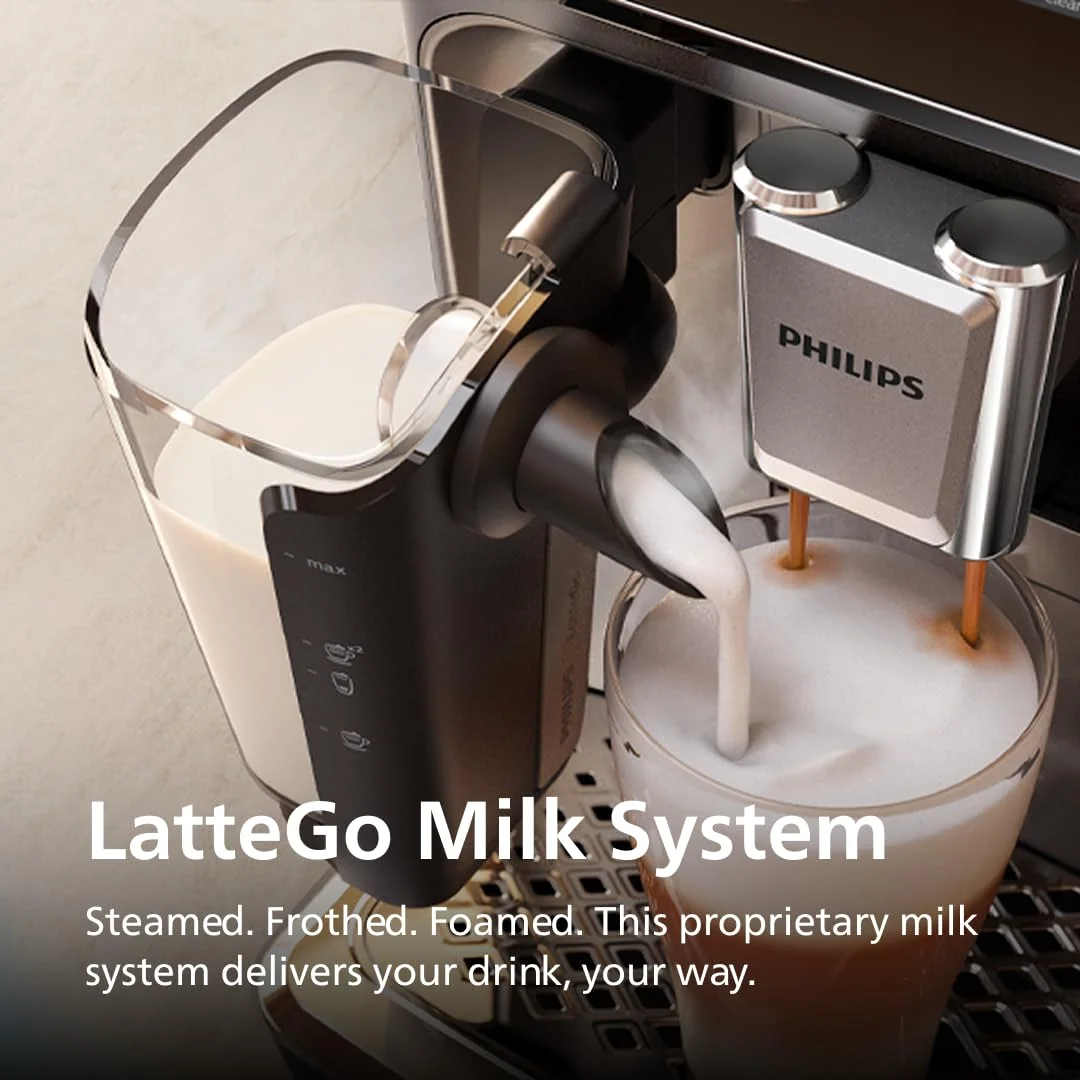
Start with the thing nobody disputes. LatteGo is two pieces of plastic that snap together, with no tube, no hose and no hidden milk path, and it goes under the tap or into the dishwasher. That is not a specification, it is a behaviour change: one reviewer's account of daily use put it better than the marketing does, saying that because there is nothing to flush, he rinses it immediately instead of letting it sit and regretting it later. Every milk system that is a pleasure on paper becomes a chore in month three. This one does not, and if you are weighing a steam wand against a one-touch carafe, that is the strongest single argument in the carafe's column.
Now the cost of that design. LatteGo produces one milk texture, and it is tuned for cappuccino. It cannot give you the thin, glossy layer that distinguishes a flat white from a latte, which means the presets that promise those distinctions are producing the same foam at different volumes. The most experienced Philips owner in the research said it without hedging: the preset recipe is more about marketing than drink quality, and the number of recipes is, in his words, marketing BS. Two independent long-form reviews reached the same place from the other direction, describing the foam as fine for a home cappuccino and airy rather than tight if you care about latte art. Plant milk is genuinely contested; a retailer demo reports good results across almond, cashew and oat, while an owner-style review found oat foam thin and unstable. If milk drinks are the entire point of the purchase, read our machine picks for people who mainly drink lattes and flat whites before committing.
SilentBrew is a grinder number, not a machine number
The forty percent is real and it was measured. A reviewer with all four current LatteGo machines in front of him put the grinder at roughly seventy decibels before and around fifty-eight after, and then added the correction the box does not make: SilentBrew acts on the grinder, not the pump, so during extraction you still hear the pump at around sixty decibels. Owners split along exactly that line. One checked whether the machine was grinding at all because it was so much quieter than expected; another says the grinder is quiet but the frother is loud; a third says it is loud when it grinds and heats and worth it anyway. Dark oily beans make the grinder louder again. If silence is the deciding factor, our page on the quietest super-automatics weighs this against machines that attack the pump noise too.
The iced settings are not cold brew, and you supply the ice
Four of the twelve presets are iced, and this is the 4400's clearest advantage over a 3300 in the Amazon buyer's mind. It is also the claim most likely to produce a disappointed owner. The machine brews hot, at a lower temperature and slower flow, and pours into the cup of ice you have already made. Reviewers who understood that liked it; one found the iced coffee held its flavour against melt better than expected, and a retailer demonstration singles out iced espresso as needing about half the ice a normal shot would. Reviewers who expected refrigerated coffee called the labelling misleading, and that is a fair gripe. We go through the mechanics on whether these iced modes brew cold at all.
Strengths & Limitations
Strengths
- The milk carafe is two pieces with no tubes, which is the difference between rinsing it now and finding it tomorrow.
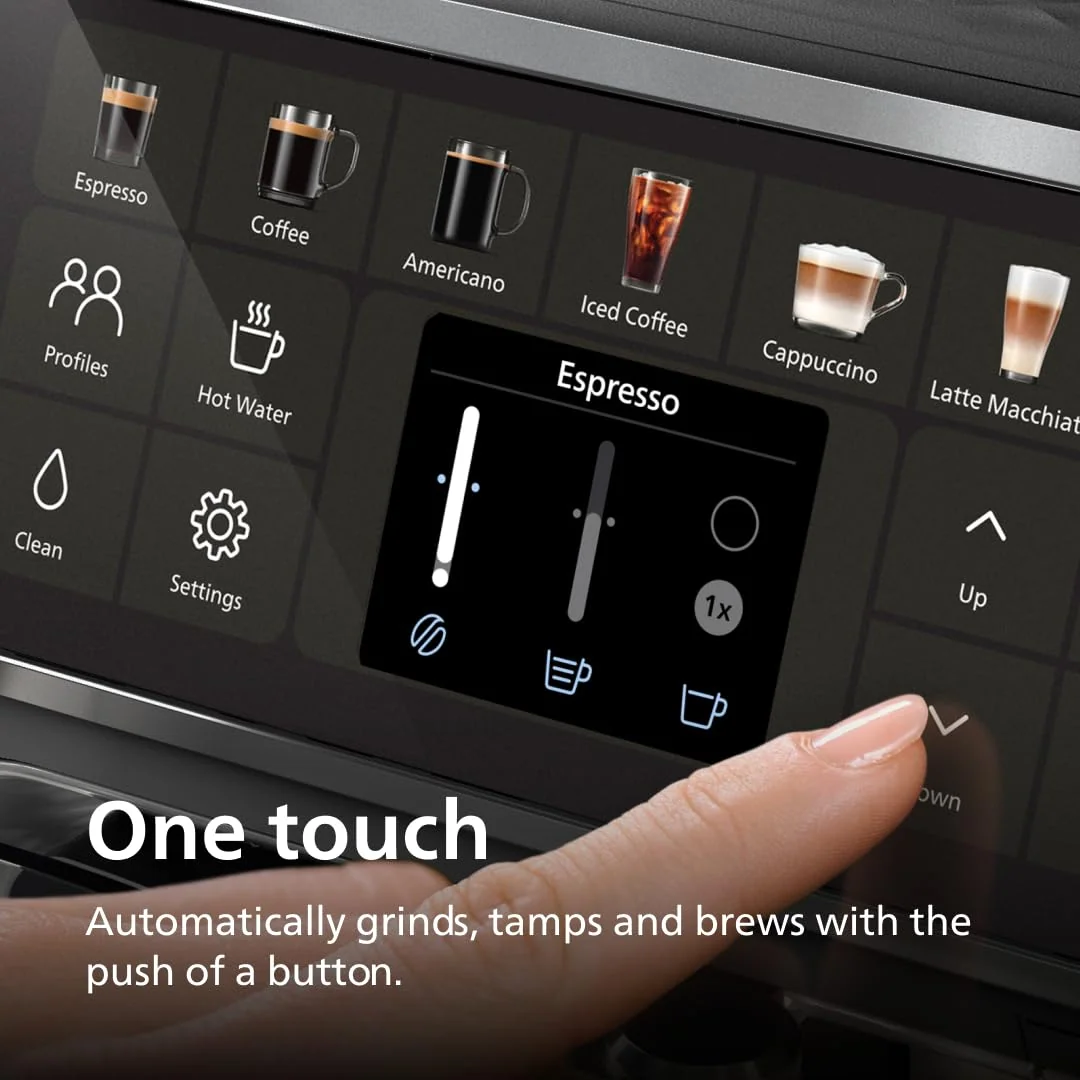
- The colour screen with named drinks means guests and reluctant housemates operate the machine without a tutorial.
- Five strength steps rather than three give a real dose range, roughly six or seven grams at the bottom and eleven or twelve at the top.
- The americano is a single press, brewing the shot and then running hot water through the same spout.
- Grinder noise is genuinely lower than earlier Philips machines, around fifty-eight decibels against roughly seventy.
- Tank, drip tray and grounds bin all pull out from the front, which matters if the machine lives under a wall cabinet.
- The hot water function is fast and properly hot, enough to retire a kettle for tea and to preheat a cold mug.
- Parts and service manuals for this platform are widely available, and most of what fails is cheap.
Limitations
- The first twenty to a hundred cups are thin and pale while the machine calibrates itself, and that window can outlast your return window.
- The maximum dose is small, so the espresso reads light and stretched next to anything pulled on a portafilter.
- LatteGo makes exactly one milk texture, tuned for cappuccino, so the finer milk-drink presets are names rather than distinct drinks.
- The iced settings brew hot coffee cooler and slower and pour it over ice you supply, which is not cold brew.
- Serving sizes are small enough that a normal mug means running two cycles and combining them.
- The pre-ground chute is unreliable, with owners reporting cancelled cycles, watery output and mould around the opening.
- Rinse cycles at startup and shutdown fill the drip tray faster than new owners expect.
- The renewed listing's ninety days of cover expires well before the failure points owners actually report.
- Nothing you pay over a 3300 improves the coffee, and the machine's own owners say so.
Why your first cups taste like nothing
This is the dominant complaint about this exact model, it has its own dedicated forum threads, and it is entirely absent from the listing. Philips' own support line, quoted by an owner, concedes it: the first brewed coffees can be a bit watery because the system needs time to adjust, and you should brew more so the machine can optimise extraction and the compactness of the puck. The machine is calibrating itself, iteratively, from your beans, and until it finishes you get pale liquid and soupy grounds.
The problem is that nobody agrees how long it takes. The manual says around fifty coffees before you touch the grinder. Owners variously report ten to fifteen, twenty to thirty, "the first hundred or so sucked," and one who says the flavour kept improving for months. Espresso Den's blunt reading is that a break-in with a range that wide functions as an unfalsifiable excuse, and it has one practical consequence you must plan around: a return window is often thirty days, and a hundred-cup break-in can eat it. If you buy this machine, drink from it hard in week one with cheap beans, and decide before the window closes rather than after.
And sometimes the break-in never arrives. One owner bought the 4400 specifically for its flat white preset, spent three months on it, and rated the result several notches below McDonald's coffee, which he says he actually enjoys; asked ten months later whether he had cracked it, he answered that it gives meh coffee, barely better than instant. Another owner, two years in, took the machine apart, cleaned it out and replaced O-rings, and still called it average at best. Those are not first-week complaints, and they belong on the page next to the happy ones.
The settings that actually change the cup
Nearly everything that fixes thin coffee on this machine is a menu setting, not a repair. The single most useful post found anywhere in the research is from an owner who thought his machine was unusable and then found three switches.
| Setting | Where owners landed | Why |
|---|---|---|
| Water temperature | High | Default is the middle step, and several owners say decent shots only started at the top step |
| Pre-rinse / initial rinse | On | Heats the group before the first drink; De'Longhi machines do this by default and Philips does not |
| Grind | 2 or 3 of 12, from a factory 6 | Slows the flow through a small puck, the most common single fix reported |
| Aroma strength | Highest, then back off | Five steps on the 4400 against three on a 3300, roughly a gram of coffee per step |
| Drink volume | Small or medium, twice | Stretching one small dose over a big cup is the mechanism behind most "watery" reports |
Two mechanical warnings go with that table, because getting them wrong is expensive. Turn the grind dial only while the grinder is actually running, and move it one position at a time, or you risk seizing the plates. Give the machine one or two shots after any change before you judge it. There is also a genuine minority who argue the opposite direction, on the grounds that a superautomatic doses by grinder run-time rather than by weight, so going too fine under-fills the chamber and you should go coarser instead. Both camps are present in the same threads about the same machine, which tells you the window is narrow. Our fuller treatment of why bean-to-cup espresso comes out watery works through the whole diagnosis, and the Philips settings guide covers where these menus hide.
The ceiling you cannot dial past
Beyond a point, settings stop helping, and the reason is the size of the chamber. The five aroma steps run from roughly six or seven grams at the bottom to eleven or twelve at the top depending on bean and grind, on a brew screen measured at thirty-six millimetres. One reviewer put the 5400 on maximum dose and the shortest espresso setting and weighed forty-six grams into the cup, which is somewhere near four and a half to one against the two to one a proper espresso wants; he got a better drink out of the ristretto preset, because the ratio is tighter. That is the most useful trick on any Philips: order the smaller drink to get the stronger one, then lengthen it with hot water if you want an americano.
And if you doubt that the ladder is really one machine, there is a direct test. The same reviewer pulled espressos on a 2200, a 3200 and a 5400 with the same beans, the same grind and the same settings, weighed thirty-seven, thirty-two and thirty-five grams out, and concluded he could not determine much of a difference at all between the three shots. The Philips house style is smooth and light across the whole range. Coming from pods or drip you will find it round and easy. Coming from a portafilter you will find it thin, and no menu will fix that.
Beans matter more than settings, and the window is narrower than most buyers expect. Light roasts are too dense for a grinder that cannot go truly fine, and produce exactly the under-extracted, watery cup people complain about; very dark oily beans gum the chute and bridge in the hopper, and one Amazon owner reports stirring oily beans to keep them feeding. Medium to medium-dark, not shiny, is the target, which is the same conclusion we reach in our guide to beans for bean-to-cup machines.
Volume, and the three-sips problem
The single most under-covered complaint about this machine is how little liquid it puts in a cup. A two-star reviewer measured the maximum dispensed from the latte and latte macchiato presets at 2.7 ounces, called Philips, and was walked through the menu on a video call only to be told that was the maximum; his verdict on the listing photography is that the pictures are very deceiving. A five-star reviewer of the same machine names quantity as his only complaint and works around it by brewing a latte and then a macchiato on top of it into the same mug. Owners of the wider Philips family say the same in blunter terms, that the serving sizes are European and nobody in North America drinks from four-ounce cups. If you drink from a large mug, budget two cycles, and check cup clearance before you buy if a travel tumbler is involved.
What you are actually paying for
Against the 3300, the honest ledger is short: a colour screen with named drinks and text prompts instead of pictographs, guided LatteGo cleaning on that screen, five strength steps instead of three, two saved profiles plus a guest slot, QuickStart, and twice the presets including the iced ones. Nothing on that list changes the coffee. The reviewer who has all four machines calls the 3300 the sweet spot of the lineup and the Philips most people should buy, and says the 4400 makes sense if there are two of you at home and you want profiles. Our 3300 review and the whole-ladder guide from the 1200 to the 5500 take that question apart properly, and if you are looking upward instead, the 5500 against the 4400 is where the extra profiles and the extra-shot button live.
The most persuasive evidence for the 3300 comes from a happy 4400 owner. He loves the machine, has had no issues, broke it in properly, and then says the 4400 is probably more than he needed, that he does not see himself needing twelve types of drink, and that he could have got away with the 3300; the reason he bought up was the delivery date. When the satisfied customer volunteers that the headline feature was surplus, believe him.
There is one counter-argument that keeps the screen honest, and it is about households rather than coffee. Owners repeatedly buy the screen tier because a partner refused to decipher blinking lights, and guests can walk up and use it unsupervised. That is worth money in a real kitchen even though it is worth nothing in the cup.
The comparison everyone actually makes
Ask a forum whether to buy this or a De'Longhi Magnifica Evo and the answer arrives fast and one-sided. In a forty-six comment thread posed in exactly those terms, by a buyer whose reasoning matched this listing's pitch almost word for word, the top reply was "Delonghi over Philips - it's not even a debate," and not a single comment recommended the Philips; the only person who had owned a 4400 and then bought a De'Longhi said the De'Longhi is much better. A separate thread weighing the two at a small price gap went the same way. Our own Magnifica Evo review and the head-to-head on Philips LatteGo against the Magnifica Evo lay out where each one wins.
Espresso Den does not think that verdict is the whole truth, and here is the fair correction. Forums self-select for grievance, and the aggregate ratings do not agree with the forum's tone. The most balanced Philips buyer in the whole research set says it best: he grants that the people saying De'Longhi pulls better espresso are probably all correct, and reports that with his own limited expertise he has not been disappointed and would make the same choice again without hesitation. Two things also go in the Philips column against the Evo. The americano is a single press, brewing the shot and then running hot water through the same spout, which Evo owners say they wish they had. And no De'Longhi milk carafe is as simple to clean as LatteGo, though the Evo's does go in the dishwasher.
Who this machine is genuinely for
The dominant persona in the owner reports is unmissable: people leaving pods. Keurig, Nespresso, a pod habit that became a chore to supply. One buyer's reason is the sharpest statement of the value proposition anywhere in the research, that he had bought his wife a Breville Bambino and she wanted absolutely nothing to do with puck prep or manual steaming, because she works non-traditional hours and they have two young kids. For that household this machine is a straightforward win. The calibration a critic wants and the calibration this machine offers are different things, which is the argument in whether super-automatics are worth it at all. The single most useful expectation-setting sentence an owner wrote: if you are used to amazing hand-made espresso this will not mimic it, and if you like Starbucks this should work for you.
Rubber, and the renewed listing
The maintenance routine is not optional and it is not onerous: rinse the brew group weekly under warm water, grease its rails periodically with the tube in the box, empty the tray and grounds bin when prompted, replace the AquaClean filter on schedule, and descale with Philips' own product. Skip the greasing and a specific thing breaks: two owners independently report that the americano stops dispensing hot water through the spout, and a few dabs of lubricant fixed it both times. Our Philips descaling and AquaClean page covers what the five-thousand-cup claim depends on, and the general cleaning schedule covers the rest.
Then there is the failure nobody warns you about. An owner whose machine stopped dispensing coffee entirely worked through every official fix, every video, the filter, the oil clean, the descale, the brew unit, the shower head, the grease and a service-mode pump test, found nothing, and finally swapped the steam-valve-outlet and brew-head gaskets as a last resort even though he could see nothing wrong with the old ones. That fixed it, and his conclusion was to get spare gaskets ready because it will happen eventually and almost no troubleshooting tip ever mentions it. His lasted eighteen months. A reply in the same thread reports gaskets that lasted twenty years. The parts cost a couple of dollars each at source, which is the good news, and they are invisible when they fail, which is the bad news.
The best longevity document available is a four-year, ten-thousand-coffee log from a LatteGo owner: a misbehaving grounds-tray sensor in year one solved by shimming the tray, O-rings on the valve in year two, a manual grinder adjustment in year three when twelve positions were no longer fine enough, and a fifteen-euro valve and a thirty-five-euro milk carafe in year four. That is a machine kept alive by cheap, available parts and a willing owner. Against it sits the most honest summary anyone wrote about this family: the plastics are cheap, the carafe wears fast, the O-rings are easy to replace, but the sensors and electronics can fail early, and best case the machine lasts four or five years while worst case you get errors and leaks at four or five months, so it is a gamble. There is a mould question too, with owners of smaller LatteGo models reporting growth in the brew group if it is not cleaned every two or three weeks, and one reporting mould they could not reach without dismantling the machine. We put numbers around all of this in how long these machines actually last.
Keep one corrective in view while you read all that. As a forum regular put it, for every person posting about a problem there are fifty enjoying their machines with nothing to post about. The new listing carries a 3.8 average across 583 ratings, which is soft for the category but not a catastrophe.
Reading the renewed listing carefully
The renewed EP4447/90 shows a 4.5 average from a sample small enough that you should treat it as a rumour rather than a rating. Its bullets are also looser than the new listing's in two checkable ways: it advertises a colour touch screen when the 4400 has a colour TFT with physical buttons around it, and it says save up to three profiles when the real count is two user profiles plus a guest slot. Neither is a lie you would notice in use, but a listing that rounds up twice is a listing to read slowly. It also carries no description field at all, so capacities, dimensions and the actual drink list are absent.
The specific risk with a renewed unit is the one this review has just spent three paragraphs on. The parts that fail on this platform are rubber, cheap, buried and invisible when perished, and nothing in the listing says whether a refurbisher replaced them. Meanwhile the failure calendar owners report starts at around five months for leaks and errors, hits the heating element and warranty disputes around a year, and reaches solenoids and O-rings at two. A ninety-day renewed guarantee expires before most of that. Buyers of new machines can register for extra cover and some buy an extended warranty outright; a renewed buyer usually cannot.
Two things to do on arrival, because the machine will tell you its own history if you ask. Open the settings menu and read the product counter, which lists every drink the machine has made by type, and you will know immediately whether "renewed" meant open-box or meant a year of somebody's mornings. Then reset the grind to the factory position, because a previous owner almost certainly moved it and most people move it too early and too far. Our page on whether renewed and refurbished machines are a safe buy covers what to check before the return window closes.
Frequently Asked Questions
Is the 4400 worth it over the 3300?
Only if you want the colour screen, the two profiles and the iced presets, because the grinder, the brew group and therefore the coffee are the same on both.
Does it make a real flat white?
No, because LatteGo produces one cappuccino-optimised texture and cannot make the thin glossy layer that defines the drink, whatever the preset is called.
Why is my espresso pale and watery?
Almost always because the machine is still calibrating in its first few dozen cups, or because the grind is on the factory setting, the temperature is on the middle step and the volume is stretching a small dose over a big cup.
Which grind setting should I use?
Most owners of this platform settle around two or three of twelve from a factory six, moved one position at a time while the grinder is actually running.
Do I need to descale it if I use the AquaClean filter?
Philips' five-thousand-cup claim depends on replacing the filter on schedule and on your water hardness being what you told the machine it was, so treat it as a long interval rather than a reprieve.
Can I use pre-ground coffee or decaf in the bypass chute?
You can, but it is the least reliable function on the machine, with owners reporting cancelled cycles, brown water and grounds left to go mouldy around the opening.
Will it froth oat milk?
It will froth it, though barista-formulated oat holds structure far better than standard, and results are visibly less stable than with whole dairy.
How do I tell how much use a renewed machine has had?
Open the settings menu and read the product counter, which lists every drink the machine has ever made by type.
Philips or De'Longhi at this money?
De'Longhi generally wins on the shot and Philips wins on the milk carafe and the one-press americano, so the answer depends on whether you drink your coffee black or milky.
Sources (5)
- Amazon listings and customer reviews — Philips 4400 Lattego
- Owner reports across r/superautomatic, r/Coffee threads
- Owner and reviewer video, 6 channels
- Coffeedant — Article — coffeedant.com
- Coffeeness — Article — www.coffeeness.de