Philips 3300 LatteGo: the quietest machine Philips has built, wrapped around a brew group that holds eight grams of coffee
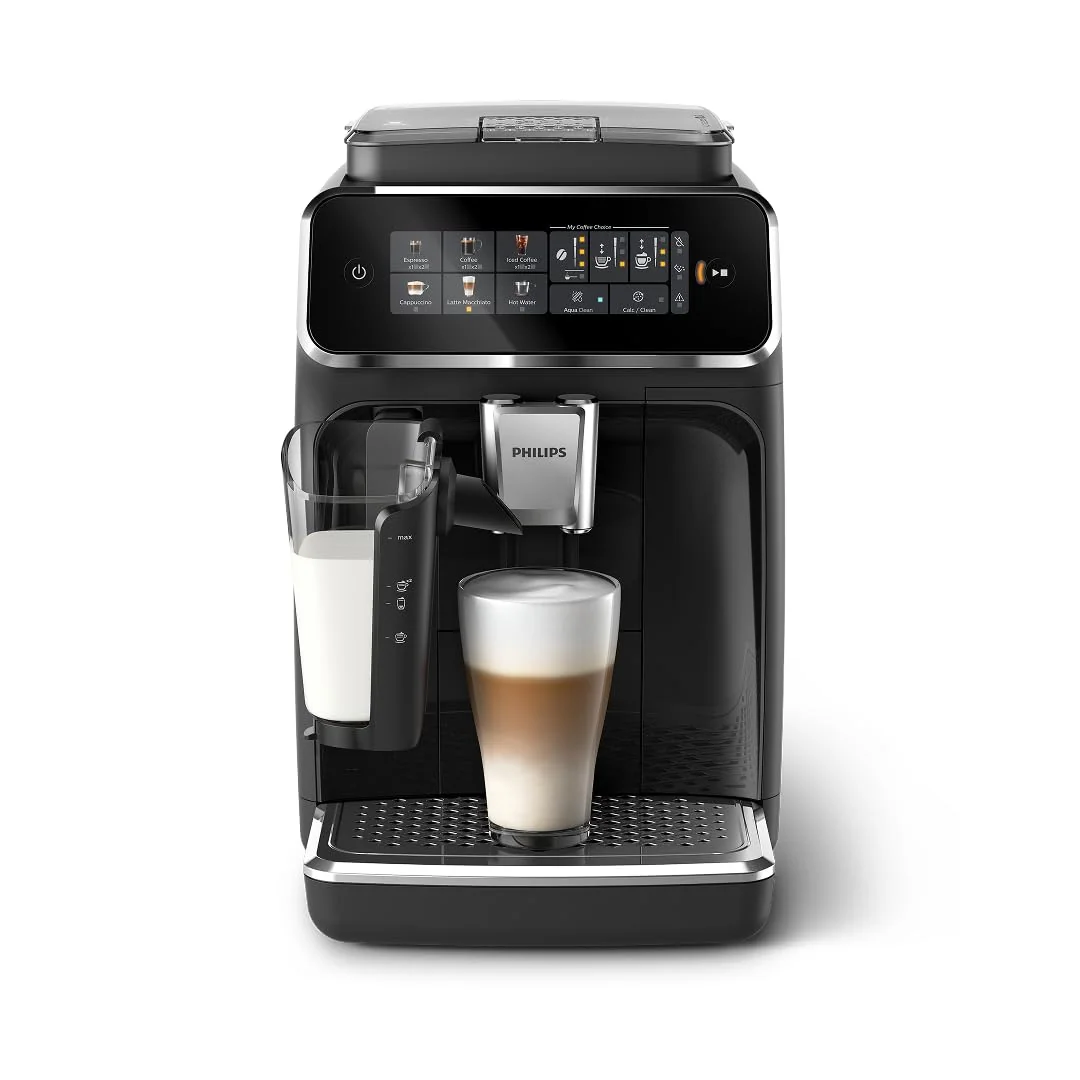
Buy the 3300 if you drink cappuccinos and want them without ever touching a steam wand, buy it discounted rather than at list, and go in knowing the espresso underneath the milk is mild by design and not by accident.
Based on 1200 owner ratings, 12 owner discussions and 8 other sources. We have not tested this machine ourselves.
We earn a commission if you buy through our links, which does not affect what we say.
Read how this site works →
Who should buy this, and who should walk
Buy it if you are one or two people who want a cappuccino before work without cleaning a steam wand, who are willing to run twenty throwaway shots with cheap beans before forming an opinion, who will set the grind to three, the strength to maximum, the volume to minimum and the temperature to high on day one, and who are buying it at a discount rather than at list. That person is going to be very happy, and the record is full of them: five years and three or four brews a day, four years and ten thousand coffees, an owner who worked out it had paid for itself in a couple of months. This is also, quite specifically, an excellent first machine for somebody coming off pods, which is why it turns up so often in the case for a milk-drink machine.
Walk away if you mainly drink your coffee black and want it strong, because eight grams stretched into a mug is where this machine is weakest and other machines answer that question better. Walk away if you want a flat white with real microfoam, if you want actual cold brew, if two people in the house take their coffee differently, or if you are shopping at list price with a De'Longhi on the next shelf. And walk away if the weekly brew group rinse sounds like something you will skip, because on this platform skipping it has consequences you will taste.
What the 3300 is, in the end, is a machine whose marketing is worse than the machine. Strip out the touchscreen that is a set of buttons, the app that is a manual, the cold brew that is warm coffee over ice, and the descaling-free promise that costs eight filters, and what is left is quietly good: the hushest grinder Philips has made, a milk carafe nobody has beaten for cleaning, a brew group you can hold in your hand, and coffee that is mild but consistent. Bought at the right price by the right person, that is a genuinely likeable appliance. Bought at list by someone who reads "espresso" and expects espresso, it is one more one-star review on a 3.8.
Buy the 3300 if you drink cappuccinos and want them without ever touching a steam wand, buy it discounted rather than at list, and go in knowing the espresso underneath the milk is mild by design and not by accident.
Best for: The milk carafe is the easiest in the class and the grinder is genuinely hushed, but the puck underneath is about half the size of a café double, and no setting on the machine changes that.
The Philips 3300 LatteGo carries a 3.8 star average across more than twelve hundred ratings while sitting near the top of its category by sales. That combination is unusual, and it is the whole story of this machine. A 3.8 is not the score of a mediocre appliance. It is the score of an appliance that either delights people or fails them, with very little in between. Read the reviews in order and you can watch the two populations form: the owner who calculates that it paid for itself in a couple of months, and the owner who ran two separate units and got what he described as dirty water out of both.
Espresso Den's reading of the record is that both populations are telling the truth, and that the thing separating them is almost never luck. It is a brew group that grinds a small dose, a factory grind setting that is too coarse for it, a break-in period Philips does not advertise on the box, and a thirty-day return window that expires roughly when the machine starts making good coffee. Sort those four things out and the 3300 is a quiet, tidy, genuinely likeable machine. Fail to sort them out and it makes something an owner in one of the buying threads described, without much exaggeration, as barely better than instant.
So here is the drawback stated plainly before anything else, because it is structural and it does not go away. Independent bench weighings of a 3300 puck put the maximum dose at 8.8 grams on the highest strength setting and 6.1 grams on the lowest. A second reviewer weighed his repeatedly and landed on about 8.4 to 8.5 grams. A café double is 16 to 18 grams. At the machine's shortest espresso volume you are looking at roughly eight grams in and thirty-two grams out, which is a lungo ratio, not an espresso ratio, and the dissolved-solids readings that follow from it sit around four to five percent against the eight-and-a-half to ten percent a pump machine delivers. That is physics rather than a defect, and it is the reason so many owners describe the black coffee as thin while the same owners rate the milk drinks highly.
Key Specifications
What Philips genuinely improved, and what it only claims to have improved
The 3300 replaced the 3200, which has been discontinued, so anyone still finding the older machine is looking at old stock that is often priced as though it were current. On paper the two are nearly the same appliance: same ceramic flat burr grinder with twelve settings, same removable brew group, same LatteGo carafe, same three strength levels, three volume levels, three temperature levels. The visible differences amount to colour options and a dispensing spout with more travel.
The invisible difference is the one that matters, and it is the only Philips marketing claim on this page that survives independent measurement intact. SilentBrew is advertised as a forty percent reduction against previous models, with a Quiet Mark certification attached. A reviewer with a sound meter recorded the 3300's grinder at 63 decibels, the quietest Philips he had measured and among the quietest of any machine he had put on the bench, against the seventy-plus decibels every earlier Philips grinder produced. Another measured 61 to 62 decibels with the hopper lid on and 72 to 73 with the lid removed, which tells you exactly where the improvement lives: a thick rubber gasket around the bean hopper. An owner who upgraded from a 3200 confirmed the mechanism from the other direction, noting the new seal and reporting that grinding was significantly quieter while the frother made exactly the same racket as before. A reviewer holding a microphone to a new unit had the same reaction on camera.
Take the win, then read the boundary. SilentBrew acts on the grind. During extraction the pump runs at around sixty decibels and one tester found it more unpleasant than the grinder, which is the reverse of the usual order. Frothing is untouched. If you are buying this to make a latte at six in the morning without waking anyone, you are buying on half a promise. If you want the whole promise, the quietest machines in the category is a different question with a different answer.
Three claims that do not survive contact
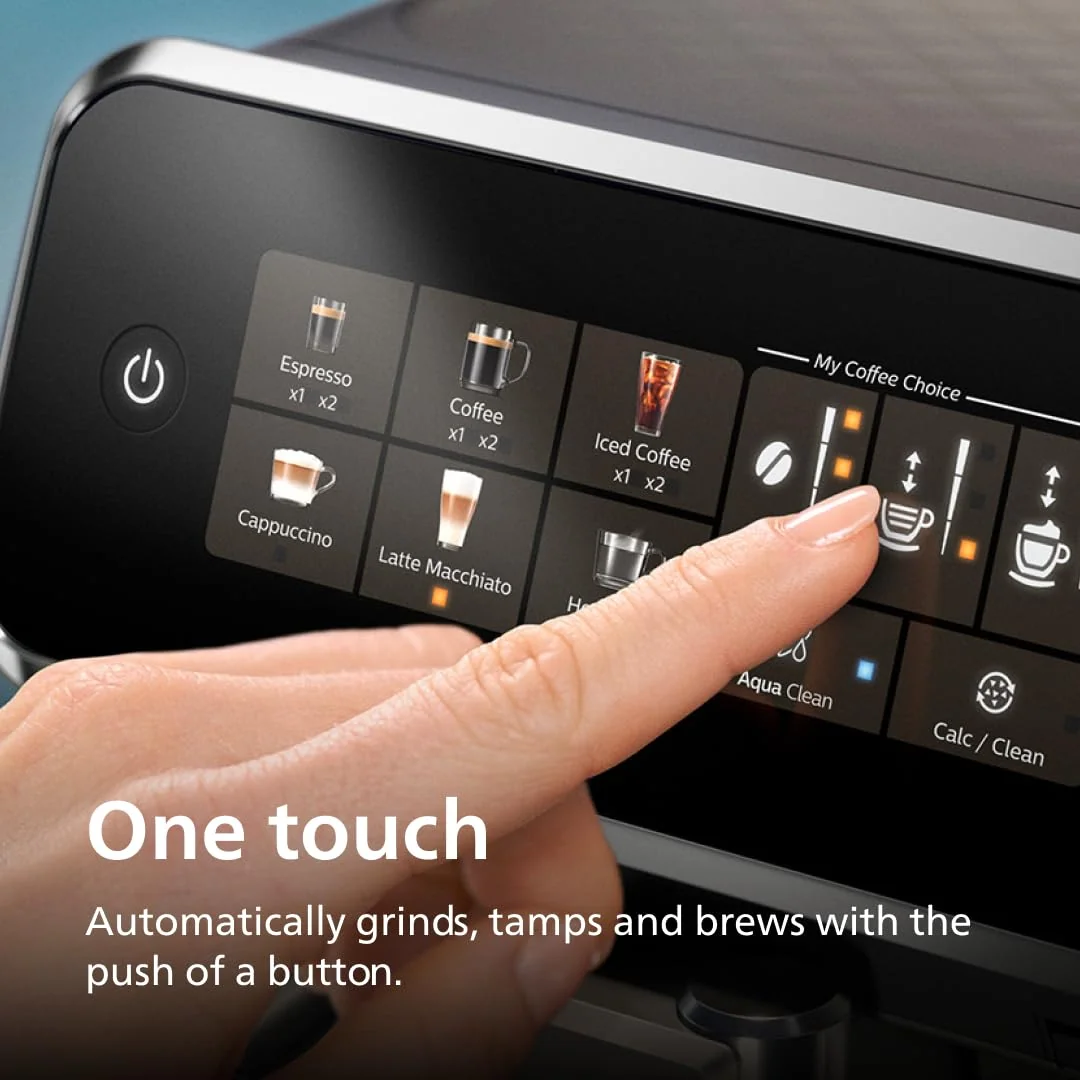
The listing describes an intuitive full colour display. Elsewhere in Philips's own materials the same control panel becomes a touch display, and a reviewer who went through the marketing line by line was blunt about it: there is no touchscreen here, only the usual capacitive buttons now backlit in colour, and the companion app is a library of manuals and recipe tips rather than anything that controls the machine. The proof is that Philips applies the same phrase to its two-button budget machines, where nobody would call the panel a screen.
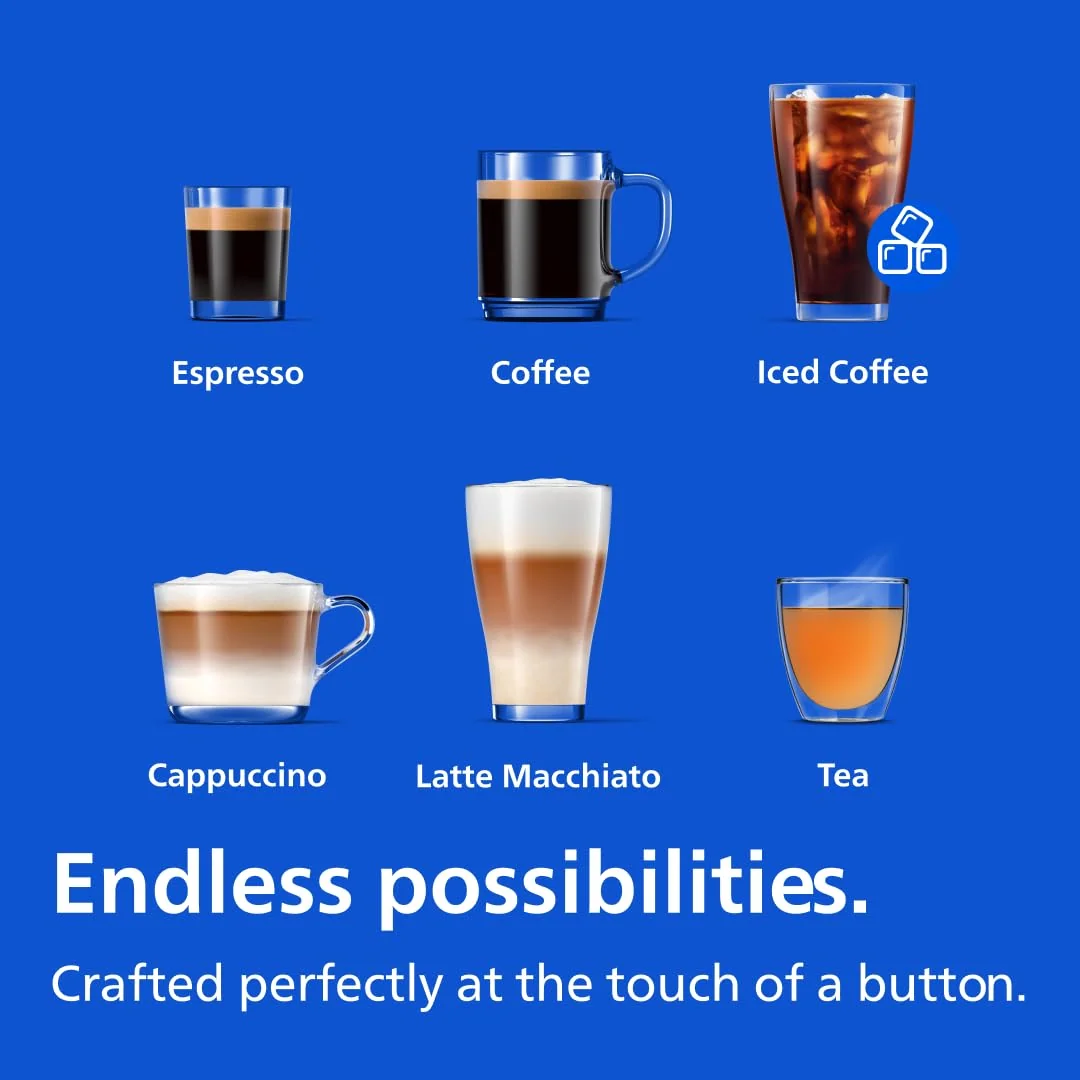
The iced coffee preset is the second. It is not cold extraction. The machine brews at a reduced temperature with a slowed flow and asks you to pour it over ice, and one tester measured the liquid arriving in the cup at 155°F. Another described the setting flatly as hot coffee that comes with an instruction to add ice. It is not nothing, because the lower temperature and slower flow do change the extraction, but if cold brew is why you are here, read what these iced modes actually do before you spend anything.
The third is the five thousand cups without descaling. That figure carries a footnote in Philips's own small print: it is based on replacing the AquaClean filter eight times as prompted. Eight filters is a real recurring cost, and the machine will push you into a descaling cycle anyway if you let the counter run to zero before fitting a new one. The claim is not a lie. It is a subscription described as an absence. We unpack the whole arrangement in our guide to descaling a Philips and living with AquaClean.
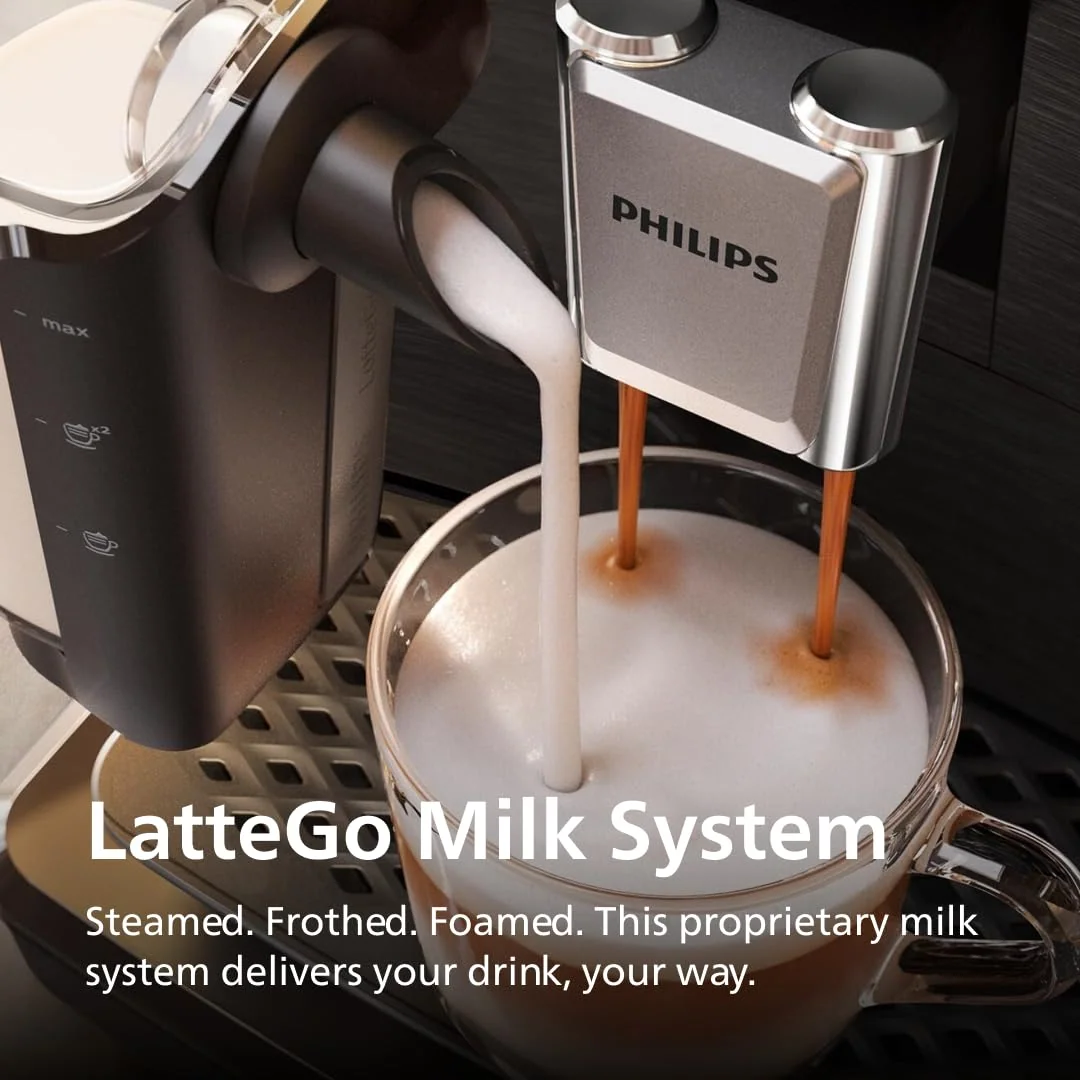
LatteGo, which is the actual reason to buy this machine
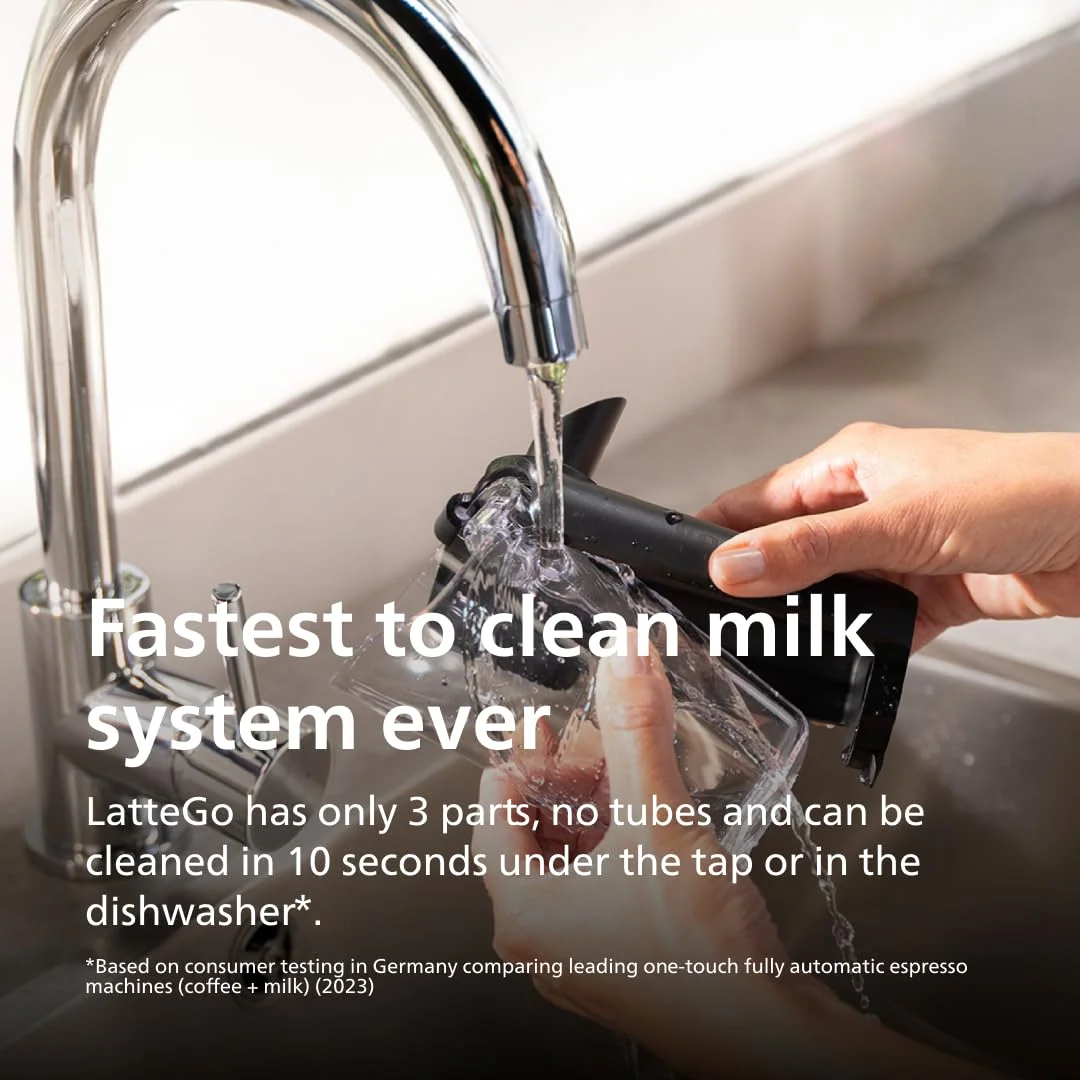
Everything above is Philips overselling a decent product. LatteGo is the opposite: a genuinely clever design that the marketing somehow makes sound cheaper than it is. The carafe clips onto the front of the machine and froths by drawing milk into an open chamber, which means there are no internal tubes and milk never enters the body of the machine at all. That last point is the hygiene argument, and it is the strongest one anybody makes for any automatic milk system. The pieces come apart and go under a tap or into a dishwasher.
The praise for it is close to unanimous and comes from people who dislike other things about the machine. The two-star reviewer who returned his unit over watery coffee still volunteered that the latte was good and the milk frothed nicely. If you have ever cleaned a milk system with a hose in it, the comparison in steam wand versus automatic frother will tell you what you are being spared.
Two honest limits. The foam is a cappuccino foam: thick, stable, airy, and not the microfoam a flat white or a cortado wants, which is why one reviewer lists flat white drinkers as people who should skip this machine entirely. Latte art is off the table. And on the LatteGo machines the cappuccino is built milk first and coffee second, so it comes out looking and drinking like a strong latte macchiato rather than a cappuccino. Also note the part count: the listing for this machine says three parts while Philips's line-wide marketing says two. Nobody is being defrauded, but it is a small sign of how carelessly the copy is written.
One omission that catches people out: there is no milk-only button. If you want hot frothed milk for a hot chocolate you have to start a cappuccino and cancel it before the coffee arrives, a workaround two separate reviewers flag as an irritation. The 5500 has the dedicated option; the 3300 does not.
Strengths & Limitations
Strengths
- The grinder is measurably the quietest Philips has produced, at 63 decibels against the seventy-plus of every earlier model, thanks to a gasketed hopper lid.
- LatteGo is the easiest automatic milk system in the class to clean, with no internal tubes and no milk entering the body of the machine at all.
- The brew group comes out, so you can see, rinse and grease the part that actually makes your coffee instead of trusting a sealed unit.
- Interface is genuinely approachable, with six labelled buttons and three-step adjustments you can use without reading anything.
- It is narrow enough for a cramped counter and light enough to move when you need to get at the hopper.
- An Americano is a single button press rather than a two-step, which is more than the direct De'Longhi rival offers.
- It is the value point of the Philips range, since the machines above it share the same brew group and grinder and make the same coffee.
Limitations
- The maximum dose is around 8.8 grams weighed, roughly half a café double, and every setting on the machine works around that ceiling rather than lifting it.
- The first ten to twenty drinks are poor and Philips does not warn you, which sends perfectly good machines back inside the return window.
- The iced coffee preset is warm coffee poured over ice at a reduced temperature, not cold extraction.
- The foam is a cappuccino foam, so flat whites, cortados and latte art are out of reach.
- There is no meaningful user profile, so a second person with different taste overwrites your saved settings.
- The cappuccino and latte buttons pull a single shot, which is why milk drinks taste weaker than the espresso button and why you end up brewing twice.
- The five thousand cups without descaling depends on buying and fitting eight filters on schedule.
- There is no printed manual, and two owners of this model found the factory labels left residue that took soaking to remove.
- Internal leaks past the drip tray are a documented failure on this platform, reported on this model at three weeks old.
- Skip the weekly brew group rinse and mould will grow where you cannot reach it without dismantling the machine.
Eight grams, and everything that follows from it
Here is where the sources disagree, and the disagreement is worth showing rather than smoothing over, because the number is the argument.
| Source | Figure | How it was arrived at |
|---|---|---|
| Bench weighing of a 3300 puck | 6.1 g at lowest strength, 8.8 g at highest | Brew group pulled and weighed repeatedly |
| Second reviewer's 3300 | about 8.4 to 8.5 g maximum | Weighed across multiple cycles |
| Philips | 6 g to 9 g | Manufacturer statement, with an auto-dose caveat |
| Retailer selling the machine | 9.5 g to 10 g | Observation of pucks in store |
| Owner consensus on the wider Philips line | 9 g to 11 g | Reported, not weighed |
The weighed figures cluster below the claimed ones, which is the pattern you would expect. The retailer's own written comparison concedes the underlying point regardless of the number, describing the Philips brew chamber as relatively small and the resulting shots as correspondingly smaller than commercial practice. Set against a De'Longhi Magnifica Evo at around twelve grams or a Jura at fifteen to sixteen, this is the least coffee per cup in its price bracket.
The consequence is not that the coffee is bad. It is that the coffee is mild, and mild in a specific direction: light in body, quick to run, short on crema, and prone to tasting thin the moment you stretch it into a mug. Every complaint in the record is a variation on this. A 4300 owner had the brew group replaced under warranty and the coffee did not change, which is about as clean a demonstration as you could ask for that the flavour is the design rather than a fault. If watery espresso is what brought you here, the wider diagnosis is here, and much of it applies to machines other than this one.
The break-in period nobody puts on the box
The first shots out of a new 3300 are bad, and this is normal. One reviewer's very first extraction was essentially water and he dumped two more before the machine settled. Another told viewers on camera that the first espresso would look gross because the machine had never been used and was not yet calibrated. Written estimates for how long this lasts run from ten to twenty cycles for the 3300 specifically to fifty or a hundred on the wider line. Owners land all over that range: eight to ten shots for one 3300 owner, about twenty for an Amazon reviewer who says the espresso became excellent after that, and a hundred for an owner who tried three brands of beans and never got a crema layer at all.
Espresso Den's honest reading is that "break-in" is doing two jobs at once, and only one of them is real. Part of it is genuine settling as the grinder and the brew group bed in. The larger part is that the machine ships with the grinder set coarse, around five or six on a twelve-point scale, and only about the finest half of that scale is useful in the first place. Most of what people experience as break-in is the slow, undirected discovery that the factory settings are wrong for them. Which is why the fastest route through it is not patience but a method.
The settings that actually change the cup
| Control | Setting | Reason |
|---|---|---|
| Grind, 1 to 12 with 1 finest | 2 to 4, adjusted one step at a time and only while the grinder is running | Ships too coarse; going all the way to 1 risks choking or clogging rather than strengthening |
| Strength, 3 levels | Maximum | Buys you roughly 8.8 g instead of 6.1 g, which is the largest single lever you have |
| Volume | Lowest | Shortens a 1:4 ratio toward something with body; add hot water afterwards if you want length |
| Temperature, 3 levels | Highest, or one below with dark roasts | Ships in the middle, and it is set with the machine plugged in but switched off, which is why owners miss it |
| Beans | Medium to medium-dark, not oily or flavoured | Light single origins go sour at this dose; oily dark roasts gum the grinder and chute |
| Milk drinks | Run a separate espresso alongside | The cappuccino and latte buttons pull one shot only, which is why they taste weaker than the espresso button |
Two of those deserve their own sentence. The grind adjustment must be made while the burrs are turning, one increment per change, and then given two or three discarded shots to take effect; owners who force the dial with a full hopper are how grinders get damaged, and one Amazon reviewer complained that the knob was simply too hard to turn, which is exactly the situation that leads to forcing it. And the last row is the single most common unforced error on this machine: an owner who spent weeks convinced his milk drinks were weak eventually discovered the preset pulls one shot, added a second manually, and the problem evaporated.
The temperature setting is buried behind a button-hold sequence rather than a menu, which is a direct cost of having lights instead of a screen. One 3300 owner says flatly that without setting the water temperature to high you do not get a good shot, a good coffee, or anything. If the lights and holds have you stuck, the hidden settings and what each warning light means covers the sequences. And if the drinks still arrive lukewarm after all that, note that double-walled cups appear independently in owner accounts as the fix, and that running cool is a category-wide trait rather than a Philips one.
There is one more lever, and it is a slightly desperate one. The pre-ground bypass chute physically holds around twelve grams, and a tester who filled it and brewed the same volume measured dissolved solids at just over seven percent instead of five, with the brew group audibly straining to tamp it. That is a real demonstration that the ceiling is the grinder's dose, not the pump or the basket. It is also not a way to live, since the chute takes one scoop at a time and every reviewer who mentions it advises against routine use. Its proper job is the occasional decaf, which matters because this machine holds one bean at a time and has no second hopper.
Bean choice is not a cop-out here, it is most of the remaining variance. Owners who report good results are overwhelmingly running medium to medium-dark espresso blends, and the ones fighting sourness are usually running something light and third-wave that this grinder cannot take fine enough. Our note on which beans work in a bean-to-cup machine is worth five minutes before you buy an expensive bag.
Why paying more for a Philips does not buy you better coffee
This is the most useful thing anyone can tell a Philips shopper, and it is unusually well corroborated. The entire LatteGo range shares one Saeco-derived brew group and one ceramic grinder. The retailer that sells both machines says the 5500 has the same brew unit as the 3300, so there is not more espresso or less, only more fine-tuning. A reviewer who weighed pucks from both got identical dose tables. An owner four years and roughly ten thousand coffees into a 5400 concluded that a cheaper LatteGo would have served him just as well, because mechanically they are no different.
| Going up from the 3300 | Does it change the coffee? |
|---|---|
| A real colour screen with volumes in millilitres and readable alerts | No, but it makes the hidden settings visible |
| Four saved profiles plus a guest slot | No, and it is the strongest reason to step up in a shared kitchen |
| Automated extra shot on milk drinks | Yes in effect, though the 3300 can do the same thing with a second button press |
| Five strength levels instead of three | Unresolved, and nobody in the record has confirmed the top level dispenses more than the 3300's |
| A milk-only option, quick milk rinse, twenty-odd recipes | No |
Take those in order. The extra shot is real: the 5500 adds it to any coffee drink at a touch, and the retailer concedes that on the 3300 you can achieve the same result by brewing a second espresso yourself, so what you are buying is automation rather than capability. The strength-level question is genuinely open; owners have asked whether the fifth level on a 4400 or 5500 grinds more than the third on a 3300 and nobody has ever answered it with a scale. The profiles are not open at all: Philips's own comparison table gives the 3300 zero, a reviewer's spec sheet gives it one, and either way the practical position is that a second person with different taste will overwrite your settings. If you want the full accounting, the 3300 against the 5500 is the comparison that decides most Philips purchases, and the whole range from 1200 to 5500 lays out the rungs.
Which leads to the money. Every expert who reviewed this machine reached the same conclusion independently and without much hedging: at list price the competition makes better coffee, and at a discount it becomes one of the better upgrades available from a pod machine. One reviewer called the 3300 the best value in the entire Philips range and the one most people should buy. The 3300 lists high and sells low, routinely, and the gap is wide enough to change the verdict. So the test is simple: judge it against the discounted number, not the sticker. Judged against the sticker, several machines below a thousand dollars beat it on the cup.
The payback claim on the listing deserves the same treatment. It rests on you buying two coffee-shop lattes every single day and is anchored to the manufacturer's own list price rather than the price anybody pays. Bought at a discount by someone who really was buying two lattes a day, it is comfortably beaten. Bought by someone who drank one coffee at home already, the saving is mostly imaginary once beans, milk, filters and descaler are counted.
The De'Longhi question, which cannot be dodged
Ask any owner forum whether to buy a Philips at this price and the answer arrives fast and lopsided. In one 4400-versus-Magnifica-Evo thread the top reply was that De'Longhi over Philips is not even a debate, and the replies underneath ran the same way on espresso strength, temperature and maintenance load. The mechanical reason is the one you have already read: about twelve grams against about eight.
The Philips counter-arguments are narrower but they are real. The milk carafe is easier to live with than anything De'Longhi ships. The Americano is a genuine one-touch drink rather than a two-step. The footprint is narrow. And a De'Longhi will clog if you grind it too fine, which a Philips will not. The fairest summary in the whole record came from an owner who bought a Philips, loved it, then compared it side by side with an Eletta Explore and said the coffee was night and day, before adding that if you are not a coffee snob you will love the Philips and would never have known what you were missing. That sentence is the purchase decision. If you want the head-to-head, LatteGo against the Magnifica Evo is the closest match on price, and our Magnifica Evo review covers the machine that keeps winning these threads.
One more piece of context on the ratings themselves. Philips's own product pages carry noticeably higher scores than Amazon's, and reading them explains why: nearly every displayed review is tagged as collected as part of a promotion, and the review pools mix several different model numbers into a single star average. The 3.8 is the less flattered figure, and it is the one to reason from.
What owning one is like once the novelty wears off
This machine asks for more attention than its marketing implies, and the attention is not optional. The brew group comes out, which is a genuine structural advantage over sealed designs, and it wants a rinse under warm water once a week with no detergent and a few hours to air dry. Do not scrub it, because that is how the main o-ring dies. It also wants food-safe grease on the rails every few months, and the machine itself prompts for it around every five hundred cups.
The grease is the sort of detail that decides whether someone keeps a machine. One reviewer's spec sheet lists lubricant in the box for this model; an owner of this model says his did not come with any and that he was glad he still had some from his previous Philips. Check the box before you need it, because skipping the greasing is how Americanos start half-brewing and how the brew group motor starts complaining. Owners who stay on top of it describe the whole routine as ten or fifteen minutes a week, which is not much. Owners who do not describe it as a nightmare. Both are the same machine. The week-by-week and month-by-month reality of cleaning a bean-to-cup machine is worth reading before you decide which of those two owners you are going to be.
Two failure modes end ownerships early, and both are worth knowing about in advance.
The first is mould in the brew group. This is not a defect claim, it is a maintenance contract. Philips owners across several models report mould forming inside if the group is not rinsed every week or two, in places you cannot reach without dismantling the machine, and one owner who sold his after two years put it bluntly: unless you are committed to cleaning it fortnightly, it is bound to happen. The LatteGo carafe is not the problem here; the milk path never enters the machine. The brew group is.
The second is a leak, and it is on this model. An owner three weeks in reported warm water pouring out of the bottom of the unit during the brew cycle, bypassing the drip tray entirely and reaching the counter, and returned it. The warmth matters, because it places the source past the boiler rather than at the tank. A repair-side voice in the owner community independently describes the two failure points on this platform as the drainage valve seals, which wear and hurt extraction, and the boiler connection, which develops microcracks. Two independent accounts converging on the same mechanism is about as good as this evidence gets. This is a family trait rather than a 3300 trait, and it is not universal, but the volume of Philips leak reports is disproportionate.
Against that, the survivors are real and they are not rare. One 5400 owner is four years and roughly ten thousand coffees in, having replaced valve o-rings at two years for a few euros, the whole valve at four, and the milk carafe at four; he considers the machine still going strong. The LatteGo carafe itself is a wear part: one owner's started leaking after about a year and blamed regular dishwasher cycles, and recommends hand rinsing instead. That is a cheap, sensible adjustment to make from day one. Our note on how long these machines last and what breaks first sets the distribution out properly.
The small daily frictions
The tank is 1.8 litres and the machine rinses itself on startup and shutdown, so both the tank and the drip tray empty and fill faster than new owners expect. One 3300 owner using a large mug found a half cup of water going to waste before each brew and resented the refills. Another owner of the same machine reports grounds ending up loose inside the body in quantities he called insane. A 3300 owner posting a list of grievances complained that the buttons only worked sporadically and that water kept appearing in the tray, and a second owner of the same machine replied point by point to say the buttons were fine on his and that the tray filling is the documented rinse cycle doing its job. Both are useful. The first tells you the frustrations are real; the second tells you a chunk of them are documentation failures rather than hardware ones.
Which brings us to the documentation, because it is genuinely poor. There is no printed manual in the box, only pictograms and a QR code, and one owner sat through a thirty-minute phone maze to be emailed a PDF because a fault light turned out to be a drip tray that was not fully seated. Two separate owners of this model independently complained about the same two labels, on the water tank and the bean hopper lid, refusing to peel and leaving white residue that took soaking and scraping to remove, with one noting explicitly that his 3200 had not had this problem. That is a small thing to lead a review with and a very annoying thing to meet on your first evening.
One physical quirk from the sibling machine is worth carrying over with a caveat. On the 5500 the milk spout angle cannot be adjusted, so the cup has to sit further forward than instinct suggests or milk runs down the outside, and a wide cup helps. That was tested on the 5500 rather than this machine, but it is the same carafe geometry, and if you find milk on your counter in week one this is the first thing to try. The carafe lid also does not clip on, which a reviewer of the 3300 flagged as the sort of thing you will drop repeatedly.
Finally, warranty. Coverage is two years as standard with longer terms on the brew unit, and the length varies by region and by whether you register the machine, so registering is free money and should be done in the first week. Support experiences in the record are consistently poor, from failed collection appointments to a refund that a customer's bank had to force, so the practical advice is to buy where returns are generous rather than to rely on the manufacturer being helpful. That advice compounds with the break-in period: a machine that takes twenty to fifty drinks to judge, sold against a thirty-day window, is a structural trap, and the smart move is to start the throwaway shots the day it arrives rather than the week the window closes.
Frequently Asked Questions
Why is the espresso weak even at maximum strength and the finest grind?
Because the brew group takes around 8.8 grams at most against the 16 to 18 grams of a café double, so the strongest setting produces a roughly 1:4 ratio that reads as a lungo rather than an espresso.
How many drinks before it starts making good coffee?
Reviewers of this model put it at ten to twenty cycles while owners of the wider line report anywhere from eight to a hundred, so start the throwaway shots with cheap beans on day one rather than at the end of your return window.
Is the 3300 actually quieter than the 3200 it replaced?
Yes for grinding, measurably so at around 63 decibels thanks to a gasketed hopper lid, but the pump during extraction and the frother are unchanged.
Does the iced coffee button make cold brew?
No, it brews at a reduced temperature with a slowed flow and expects you to pour it over ice, with one measurement putting the liquid at 155°F as it leaves the spout.
Is it worth paying more for the 4400 or the 5500 to get better coffee?
No, because those machines use the same brew group and grinder, so the extra money buys a screen, saved profiles, more recipes and an automated extra shot rather than a better cup.
Can it make a proper flat white?
Not really, since LatteGo produces one thick cappuccino-style foam rather than microfoam, which is why reviewers list flat white drinkers among the people who should choose something else.
Do I really never have to descale it?
You do have to descale it eventually, and the five thousand cup figure carries a footnote saying it assumes you buy and fit eight AquaClean filters on the machine's schedule.
Which way do I turn the grind dial, and when?
Turn it toward the smaller dots for finer, one step at a time and only while the burrs are actually turning, then discard two or three shots before judging the change.
Why does the drip tray keep filling with water I did not brew?
The machine runs an automatic rinse at both startup and shutdown, and that water goes straight into the tray, which is documented behaviour rather than a leak.
How do I tell a normal rinse from an actual leak?
A leak on this platform shows up as warm water reaching the counter from underneath the machine during the brew cycle, bypassing the tray entirely, and it is a reason to return the unit rather than to troubleshoot it.
Can I put decaf and regular beans in it?
Only one bean at a time, since there is a single hopper, so the second coffee has to go through the pre-ground bypass chute a scoop at a time.
Is the LatteGo carafe dishwasher safe?
Philips says yes, but one owner traced a carafe that began leaking after about a year to regular dishwasher cycles and now recommends rinsing it by hand instead.
Sources (10)
- Amazon listings and customer reviews — Philips 3300 Lattego
- Owner reports across r/superautomatic threads
- Owner and reviewer video, 7 channels
- Tomscoffeecorner — Article — tomscoffeecorner.com
- Homecoffeeexpert — Article — homecoffeeexpert.com
- Coffeeness — Article — www.coffeeness.de
- Philips — Article — www.usa.philips.com
- Techradar — Article — www.techradar.com
- Philips — Article — us.home-appliances.philips
- Seattlecoffeegear — Article — www.seattlecoffeegear.com