UDI’s 20 bar machine gets the grinder right and the temperature badly wrong
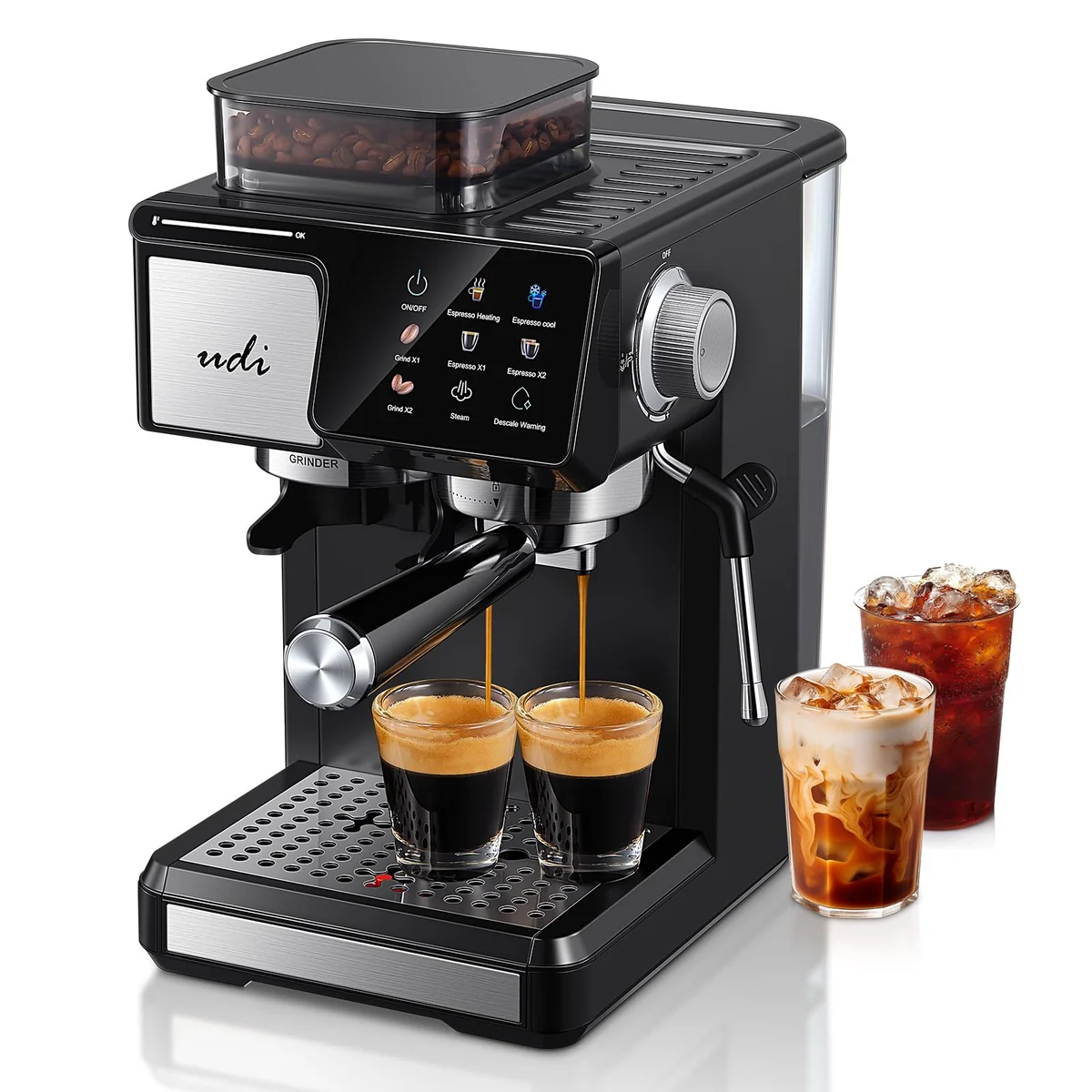
Buy the UDI CM5530 only if you drink milky coffee, are content for it to arrive warm rather than hot, and actively want to learn a portafilter, because almost everything else on this page argues against it.
Based on 22 owner ratings, 5 owner discussions and 1 other source. We have not tested this machine ourselves.
We earn a commission if you buy through our links, which does not affect what we say.
Read how this site works →
Who this is actually for
There is a real buyer here, and it is worth describing them precisely rather than dismissing the machine outright. They drink lattes, flat whites or iced coffee, not straight espresso. They want a grinder in the house and do not have one. They are willing to spend a week learning grind size and tamping pressure, and they will not be upset when the first dozen attempts go down the sink. They accept a drink that is warm rather than properly hot, either because they add cold milk anyway or because they drink it fast. For that person, this is a functional way into home espresso, and the grinder is a better one than the price suggests.
Everyone else should walk. If you drink your coffee black, the two faults that define this machine, low temperature and fast, thin extraction, land directly on the only thing in the cup. If you wanted to press a button, this is the wrong category of machine entirely and no firmware update will change that. And if the thing that sold you was the number on the front of the box, the number does not mean what the listing wants you to think it means.
The verdict Espresso Den keeps returning to is the one the Vine reviewer wrote themselves before rounding their stars up: fine for the casual user, and if you are a stickler, look elsewhere. We would only remove the rounding. On the evidence available, this is a three-star machine with a five-star grinder attached to it.
Buy the UDI CM5530 only if you drink milky coffee, are content for it to arrive warm rather than hot, and actively want to learn a portafilter, because almost everything else on this page argues against it.
Best for: The most careful reviewer on the listing measured the brew water at 140°F, gave the machine five stars anyway, and told anyone fussy about espresso to look elsewhere.
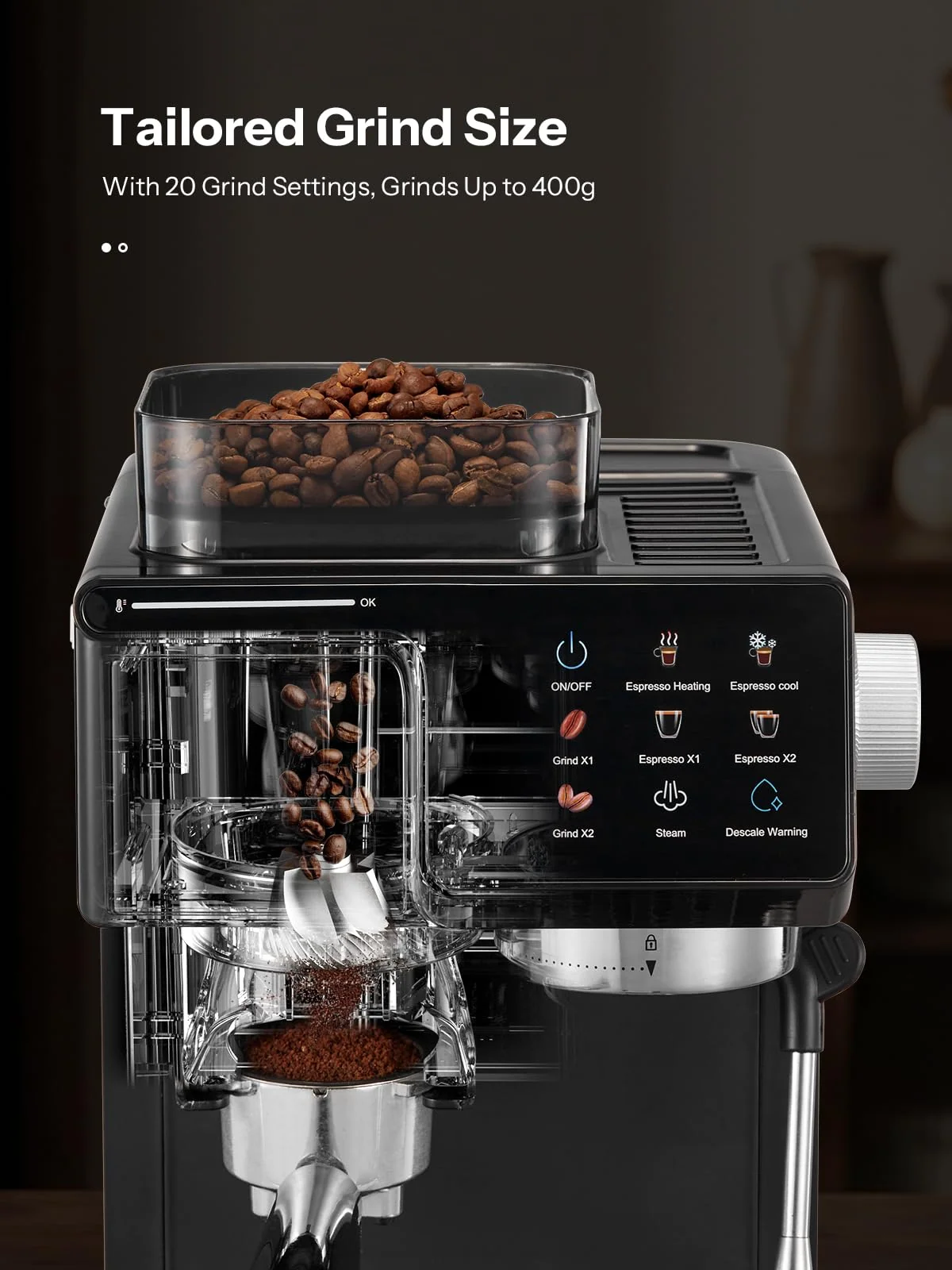
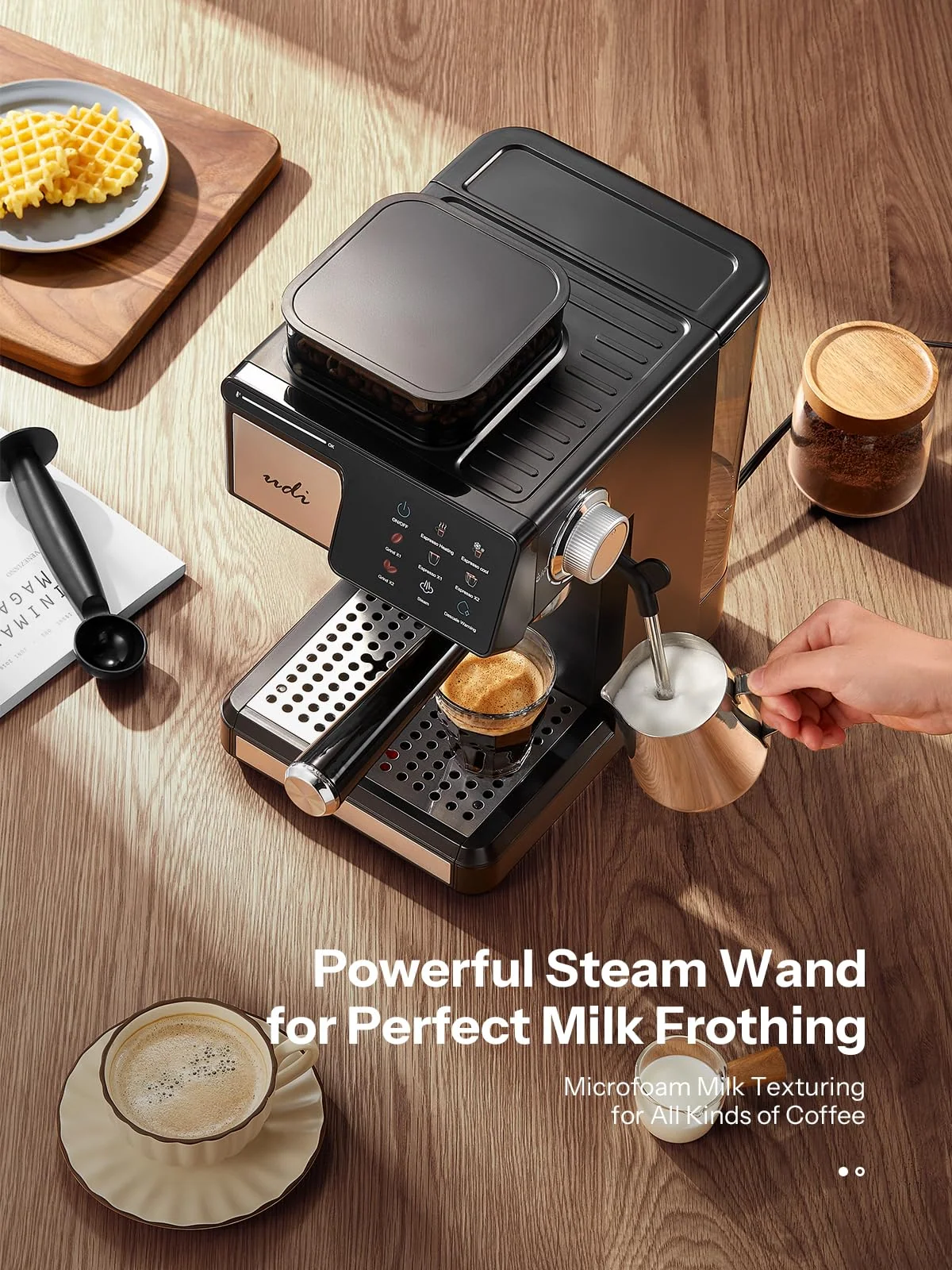
Start with the shelf it is sold on, because that is where the confusion begins. This machine is listed among super-automatic espresso machines. It is not one. There is no brew group, no bean-to-cup one-touch cycle, no milk carafe doing the work for you. What UDI has built is a portafilter machine: you dose, you tamp, you lock the handle in, you steam your own milk with a wand on a rotary knob. Every owner who describes actually operating it describes tamping. One of them describes a shield that sits over the filter basket while the grinder runs, so the grounds do not spray across the counter, and advises tamping gently before you lift it off so they do not fall out either. That is a genuinely thoughtful piece of design, and it is also a complete answer to the question of whether this is a push-button appliance.
The other thing to understand before you look at the star rating is how little is behind it. The listing carries a four-star average from a small pool of ratings, and only eight written reviews are retained. Five are five stars, one is three, two are one star. That means a quarter of the written record is a machine that did not work or went back to Amazon. On a listing with thousands of reviews you can shrug that off as the tail. On this one, it is the tail and a good part of the body.
And the five-star reviews do not all say what a five-star rating implies. The most detailed of them is a disclosed Amazon Vine copy, written by someone who calls themselves a demanding coffee drinker, lists three separate faults, explains that they rounded up because giving it three or four stars "really wouldn't be fair" at the price, and then closes with the line that ought to be on the box: recommended for the casual user, but "if you're a real stickler for near-perfect espresso and lattes, look elsewhere." Espresso Den takes that reviewer more seriously than anyone else on the page, because they give numbers, photograph the manual, describe the mechanism and disclose where the machine came from. The rest of this review is largely an argument that they were right and that their star rating was wrong.
If what you actually wanted was a machine that grinds, doses, tamps, brews and froths on one button, stop here and read what a super-automatic espresso machine actually is, then look at something like the Philips 2200 or the De'Longhi Magnifica Start. Those ask for meaningfully more money and they do a fundamentally different job.
Key Specifications
What UDI says it built
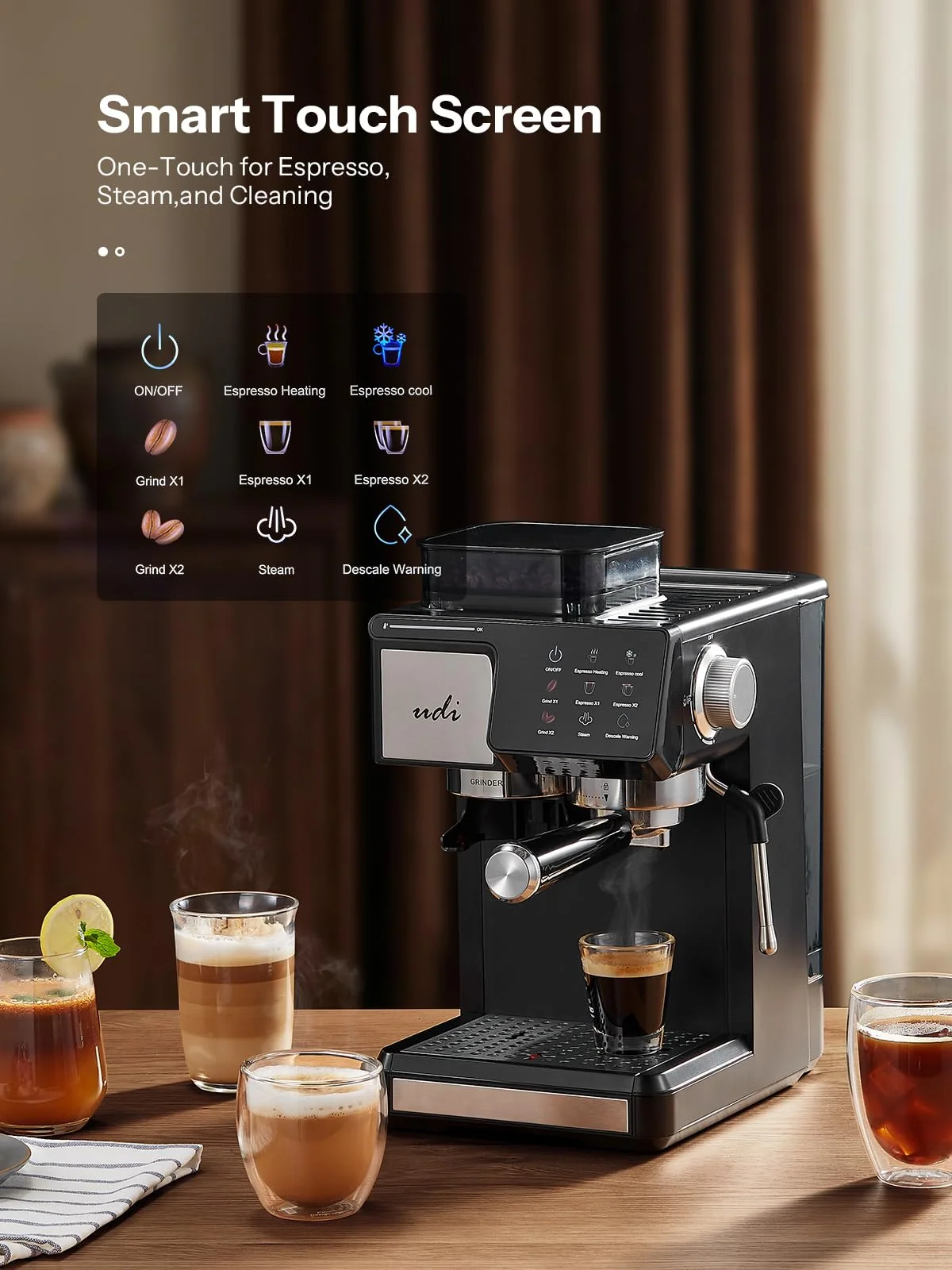
The listing makes five promises, and they are worth taking one at a time, because a couple of them are real and a couple of them are doing more work than the hardware can support. Twenty grind settings from fine to coarse, with automatic measurement for single and double shots. A large touchscreen that selects single espresso, double espresso, steam and a self-cleaning cycle with one tap. A 20 bar pump and a quick preheat. An adjustable steam wand plus that self-clean function, which the copy says "extend[s] machine life". And a compact all-in-one body combining grinder, brewer and steamer.
The listing's own description is where the tone slips. UDI describes itself as having spent "decades" as "the silent architects of exceptional espresso" and "a specialized manufacturer of premium espresso machines". There is no findable public record of the company behind any of that, and the description text is visibly broken partway through. Espresso Den is not calling it untrue; it is unverifiable, which for a buyer amounts to much the same thing. It is worth knowing that a search on the brand name returns an AI music service, a disc golf app, a gluten-free bakery, an Italian football club and a type of computer memory before it returns anything about espresso. Whatever else you are buying here, you are not buying a reputation.
The grinder is the good part, and that is not faint praise
The Vine reviewer, the fussiest voice on the listing, says the grinding works very well and describes adjusting it with a wheel on the left-hand side of the machine. A second owner calls the grinding process easy to use. That matters more than it sounds, because the near-universal advice in the espresso world is that the grinder matters more than the brewer, and that a machine paired with pre-ground supermarket coffee is a waste of the machine. A working burr grinder attached to the front of a budget brewer is the strongest argument this product has.
The specific number is shakier. Nobody who describes using the machine confirms twenty steps; the reviewer with the wheel in their hand says "several options". The one review that repeats "20 different settings" reads like it was written with the product title open. Twenty stepped positions spanning coarse to fine is also, in practice, a fairly blunt instrument for espresso, where the difference between a fifteen-second gusher and a proper twenty-eight-second shot can be smaller than one click. If you want the longer version of that argument, we have written it up in whether a grind-and-brew all-in-one is a good idea.
Check which UDI you are actually buying
UDI sells several near-identically named 20 bar machines, and the video coverage of the range does not describe one machine. One walkthrough of the same chassis, badged under a different brand name entirely, shows a silver unit with a touchscreen offering single espresso, double espresso, Americano, a cold espresso mode and steam, a water tank at the back with max and min lines, a warming tray on top, a steam knob on the side, and a body the presenter describes as stainless steel "and plastic casing". No grinder appears anywhere in it, and the coffee goes into the basket with a scoop.
Meanwhile the machine-narrated clips that call themselves reviews describe a dual boiler that lets you brew and steam simultaneously "without any waiting time", and one of them claims a cappuccino or latte in fifteen seconds. Neither claim appears in this listing's own bullets, and neither survives contact with the one person who actually pressed the buttons, who brewed a shot, then pressed steam, then waited for the indicator to stop blinking before the wand would work. That is single-thermoblock behaviour. Treat the fifteen-second figure as noise and read the ASIN, not the brand name, before you buy.
Strengths & Limitations
Strengths
- The integrated burr grinder genuinely works, and the most demanding reviewer on the listing says so outright.
- The shield that sits over the basket while the grinder runs is a real piece of design thinking that keeps loose grounds off the counter.
- The feature set for the money is unusually complete: grinder, touchscreen, one-tap single or double, manual steam wand and a self-clean cycle in one compact body.
- It is small enough to suit a cramped kitchen, an office or a dorm, and owners consistently say so.
- For milky and iced drinks, where espresso is a flavouring rather than the drink, the machine's weaknesses are largely hidden.
Limitations
- The drink is not hot: one owner measured brew water at 140 to 142°F and a finished drink peaking near 160°F before falling to 150°F and below, and a second owner independently found the espresso cold by the time the milk was steamed.
- The manufacturer's own troubleshooting instructions for lukewarm, weak coffee reportedly change nothing.
- The shot runs fast and tastes thin, to the point that one owner found three stacked shots still weak and a second person in the same household agreed.
- The printed manual does not match the machine, showing different icons from the display with one missing entirely.
- It is sold on the super-automatic shelf but is a portafilter machine you dose, tamp and steam by hand, which is not what a large part of its audience is shopping for.
- Two of the eight retained written reviews describe a machine that never worked or that went straight back.
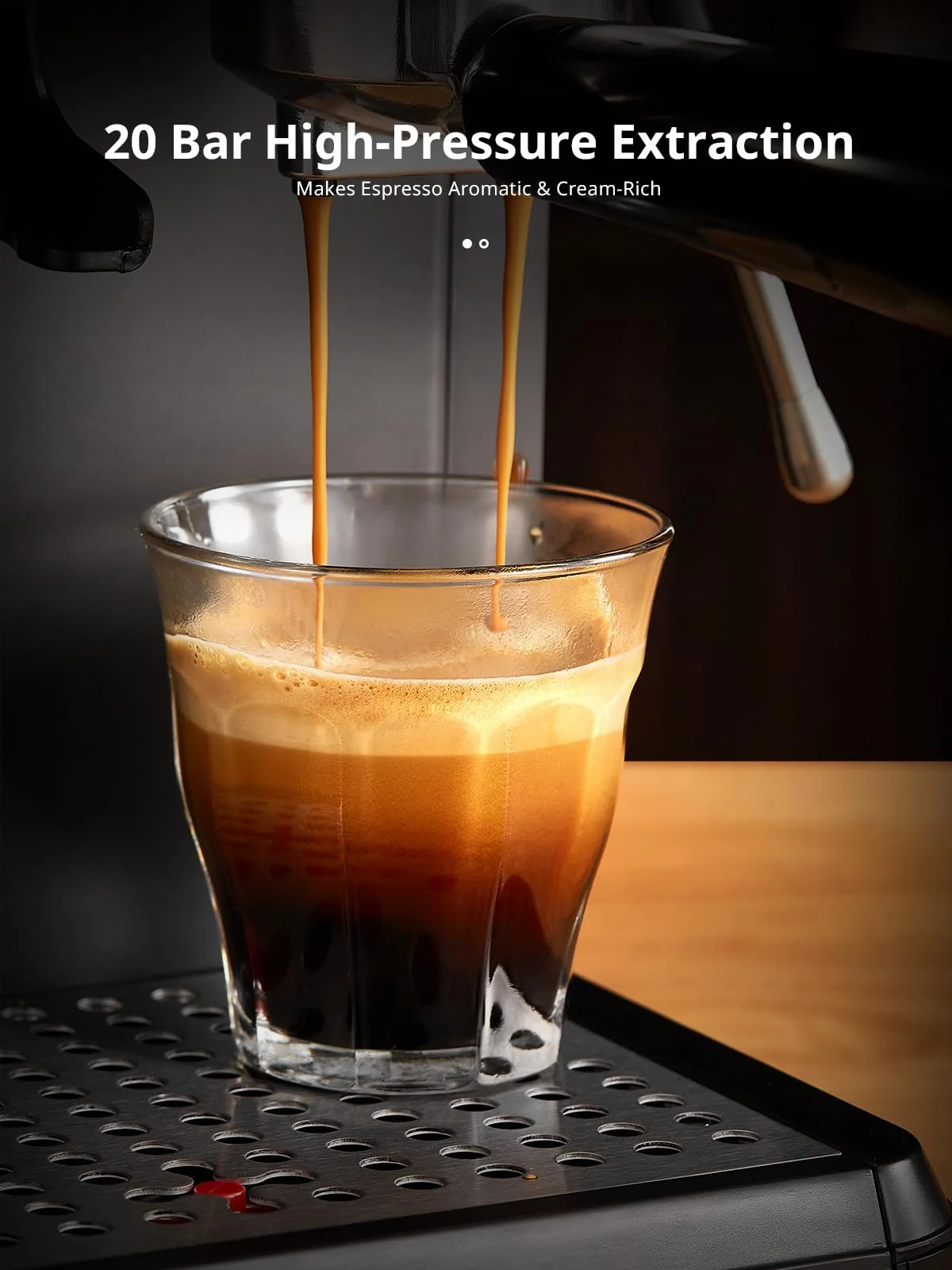
- The "20 bar" headline is a pump maximum rather than brew pressure, and at that rating you are effectively locked into a pressurised basket that makes crema look better than the coffee tastes.
- There is no durability record, no verified warranty, no service history and no independent coverage of the brand to fall back on.
The temperature problem decides everything else
Here is the finding this whole review turns on. The Vine reviewer put a thermometer in it and reports that the water reaches a high of 140°F, "142º at best". Steaming milk into it lifts the drink to roughly 160°F, which then "quickly decreases to 150º and below". Espresso wants water at the puck somewhere around 195 to 205°F. A latte served at 150°F is not hot coffee; it is coffee you drink quickly before it becomes unpleasant.
Two things make that worse rather than better. The first is that UDI evidently knows: the same reviewer notes the manual contains troubleshooting instructions for weak coffee and for water that is not hot enough, and reports that following them does nothing. A troubleshooting entry is a manufacturer conceding a symptom in advance. The second is that a completely different owner, working from workflow rather than a thermometer, reached the same conclusion from the other end: the machine "[t]akes to long to do any of the settings. Your espresso is cold by the time you get the milk warmed up." They returned it. Two owners, two methods, one answer, and it is the answer that matters most in a cup.
The likely mechanism is a single thermoblock that has to change temperature between brewing and steaming, which is also why one owner can honestly say it heats up in one to two minutes while another honestly says it is slow. The initial warm-up is quick. The recovery between functions is not, and that gap is exactly where a milk drink goes cold. Our general write-up on machines that will not serve a hot drink covers what you can do about it, and the short version is that nothing on the user's side fixes a thermal system that is undersized.
The shot itself runs fast and tastes thin
Separately from the heat, the same reviewer reports that the espresso is weak. They normally pull three shots rather than two for a larger cup, and even three come out weak; their husband, who does not want strong coffee, also finds it weak. And then the diagnostic detail: "The brew comes out very quickly." Fast flow is under-extraction. Stacking more shots on top of an under-extracted shot gives you more of the same thin liquid, not a stronger drink. If you have hit that before on another machine, our piece on why espresso comes out watery explains what is actually happening in the basket.
This is where the headline number on the box collapses. Twenty bar is what the pump can generate against a closed valve. It is not what the coffee experiences. As one r/espresso regular put it to somebody with an unbranded 20 bar machine, "Are you actually getting 20 bar? The pressure is determined by the puck resistance (grind) and the pressure drop across the portafilter. I suspect you are less than 10." Another in the same thread called the claimed figure "likely a very optimistic number that the marketing department drove more than the actual system capability."
The target for espresso is around nine bar, and higher is not better. "You don't need 15-20 bar espresso machine. 9 bar is fine," runs the plain version. Worse, past about fifteen bar you are effectively locked into a pressurised, dual-wall basket, because an unpressurised basket needs a lower pump pressure and a proper espresso grinder behind it. A pressurised basket is also the reason a machine like this can produce a thick-looking crema and a thin-tasting shot at the same time: the foam is aerated by the basket rather than emulsified by extraction. That reconciles the sharpest disagreement on the listing, where one review reports "a nice, thick crema every time" and another reports weak coffee at three shots. Both can be true at once. We take the argument apart properly in is a 20 bar espresso machine good.
What you drink decides whether any of this ruins the machine
An owner of a comparable Amazon-brand 20 bar machine put the split better than we could: if they only ever drank milk drinks, it "honestly would've been fine", but they preferred plain espresso, and the machine "basically made coffee with an airy foam 'crema' on top, and it was never hot though. It struggled with finer grinds." They then made the point that should reframe every video you have watched about this class of product: the positive reviews they had seen were all demoing milk drinks, which are forgiving, and none of them were testing the thing that fails.
So split your own decision on the same axis. A large iced latte, a flavoured cappuccino, anything where the espresso is providing coffee flavour to a much bigger drink, will survive this machine. A straight double, a cortado, an Americano, anything where the espresso is the drink, will not, and the lukewarm serving temperature will finish off whatever the fast shot left standing. If milk drinks are the whole point of the purchase for you, our guide to machines for latte drinkers is the more useful page.
Claim by claim, against what owners report
| The listing says | The record shows |
|---|---|
| 20 precision grind levels, fine to coarse | The grinder is praised by the fussiest reviewer on the page, who describes a side wheel and "several options" rather than twenty; the number is unconfirmed by anyone hands-on. |
| 20 bar pressure for thick crema and bold flavour | A pump rating, not brew pressure, and one owner reports weak coffee even at three stacked shots because the brew runs out very fast. |
| Quick preheat, bean to cup in minutes | One owner reports one to two minutes from cold, another reports the machine is slow enough that the espresso is cold before the milk is ready. |
| Extract rich espresso every time, no barista skills needed | One owner gave up after four days with a kitchen that looked like "a coffee explosion", and another lists a learning curve for grind size and tamping among the cons. |
| Pre-set programs ensure consistent results | The printed manual shows different icons from the machine's actual display, with one icon missing entirely. |
| Self-cleaning removes residue and extends machine life | The function exists and is liked, but nothing in the record establishes what it does beyond a flush, and no owner describes descaling. |
The manual is worth a paragraph of its own, because two separate owners hit it from different directions. One photographed the discrepancy between the booklet's icons and the machine's screen and noted, reasonably, that the booklet ought to match the machine "so as to eliminate confusion." Another wrote simply that the instructions "are not clear or complete", used it for four days hoping to get the hang of it, and rated it three stars. A machine that requires you to learn a technique, shipped with documentation that does not describe its own controls, is a machine that will be returned by people who would otherwise have kept it.
Against all that, put the fair case. A cheap machine with a real burr grinder and fresh beans, in the hands of someone patient, beats what most people drink at home, and starting cheap makes the eventual upgrade cheaper rather than more expensive. Nobody at Espresso Den thinks a budget machine is a mistake by definition, and we have written the balanced version at are cheap espresso machines worth it. The problem with this specific one is not that it is cheap. It is that the fault owners report is a thermal fault, and no amount of patience, technique or fresh beans raises the temperature of the water.
If the budget is the fixed constraint, the honest comparison set is other Amazon-native 20 bar machines rather than a true bean-to-cup, and we have looked at several of them: the Gevi 20 bar pair, the Kndko and the GarveeTech. If the budget can stretch, our roundup of the least expensive true super-automatics is where the genuinely automatic machines start, and a renewed unit from a known brand is often the better use of the same money than a new unit from an unknown one.
Nobody can tell you what year two looks like
This is the part where a review normally reports how the machine holds up, and Espresso Den cannot, because the evidence does not exist. Every owner report available is from the first days of ownership: a unit that heated but never brewed, a four-day surrender, a first-week return, a Vine sample. There is not one account of this machine at six months. There is no teardown, no measurement of the grouphead or portafilter material, no stated warranty length in what we could verify, and no record at all of anyone contacting UDI for support, spare parts or a repair.
That silence is not the same as good news, and it is not the same as bad news either. It is an absence, and it is unusually complete here because the brand name has no independent footprint to search: there are no long-term owner threads, no lab tests, no publication that has run this machine. Buyers looking for reassurance before ordering hit the same wall we did. The category-level pattern we can point at is thin but consistent in direction: on the same style of white-label 20 bar machine, one person reporting a friend's experience said it "worked but overall wasn't the best. The steam isn't that strong and takes a good bit to heat up." That is a different brand and a different unit, so treat it as a description of the class rather than a finding about the CM5530.
What we would say plainly: budget for this being a machine you might replace rather than repair, and read how long these machines last and what breaks first before you decide whether that is acceptable. Cheap plastic groupheads and unrepairable pumps are where this price band tends to die, and an unknown brand with no parts supply is where a dead pump becomes a bin rather than a bill.
Frequently Asked Questions
Is a 20 bar espresso machine better than a 9 bar one?
No, because espresso is extracted at roughly nine bar at the coffee and the twenty is a pump maximum that the puck never sees, so the bigger number tells you about marketing rather than about the cup.
Is the UDI a super-automatic, given where it is listed?
It is not, because you dose and tamp the portafilter yourself and steam the milk yourself on a manual wand, which is a semi-automatic workflow regardless of which Amazon category it sits in.
Does it really have twenty usable grind settings?
The grinder is adjustable by a wheel on the left side and is praised by the machine's most exacting reviewer, but nobody describing hands-on use confirms the number twenty, and a stepped range spanning coarse to fine leaves only a handful of clicks in the espresso zone anyway.
Why does the coffee come out lukewarm?
One owner measured the brew water at 140 to 142°F and found the finished drink falling below 150°F, which points to an undersized thermal system rather than anything you are doing wrong.
Will it make a decent latte even if the espresso is weak?
Probably yes, because milk drinks are forgiving of thin extraction in a way that straight espresso and cortados are not, though you should expect the finished drink to be warm rather than hot.
Can I swap in a proper unpressurised basket to improve the shot?
On a pump rated this high it is the wrong move, since an unpressurised basket wants a lower brew pressure and a dedicated espresso grinder behind it, and nothing in the record establishes that this machine's basket can even be changed.
Is the steam wand strong enough for latte art?
One owner calls the wand basic rather than professional and says it takes practice, and on the same class of white-label machine another report described the steam as not being that strong, so treat microfoam as an ambition rather than a feature.
Should I trust the four-star average?
Read the reviews rather than the number, because the pool is small, the shape is split between five-star and one-star with almost nothing between, and the most thorough five-star review explains that its author rounded up while advising particular buyers to look elsewhere.
Should I buy this or save for a real bean-to-cup machine?
If a one-touch cappuccino is what you actually pictured, save, because no amount of learning turns this into that machine and the cheapest genuine super-automatics do the job this one only appears to promise.
Sources (3)
- Amazon listings and customer reviews — Udi 20 Bar Espresso
- Owner reports across r/espresso, r/IndiaCoffee, r/JamesHoffmann threads
- Owner and reviewer video, 3 channels