Gevi 20 Bar: two machines that make very good milk drinks and something that is not quite espresso
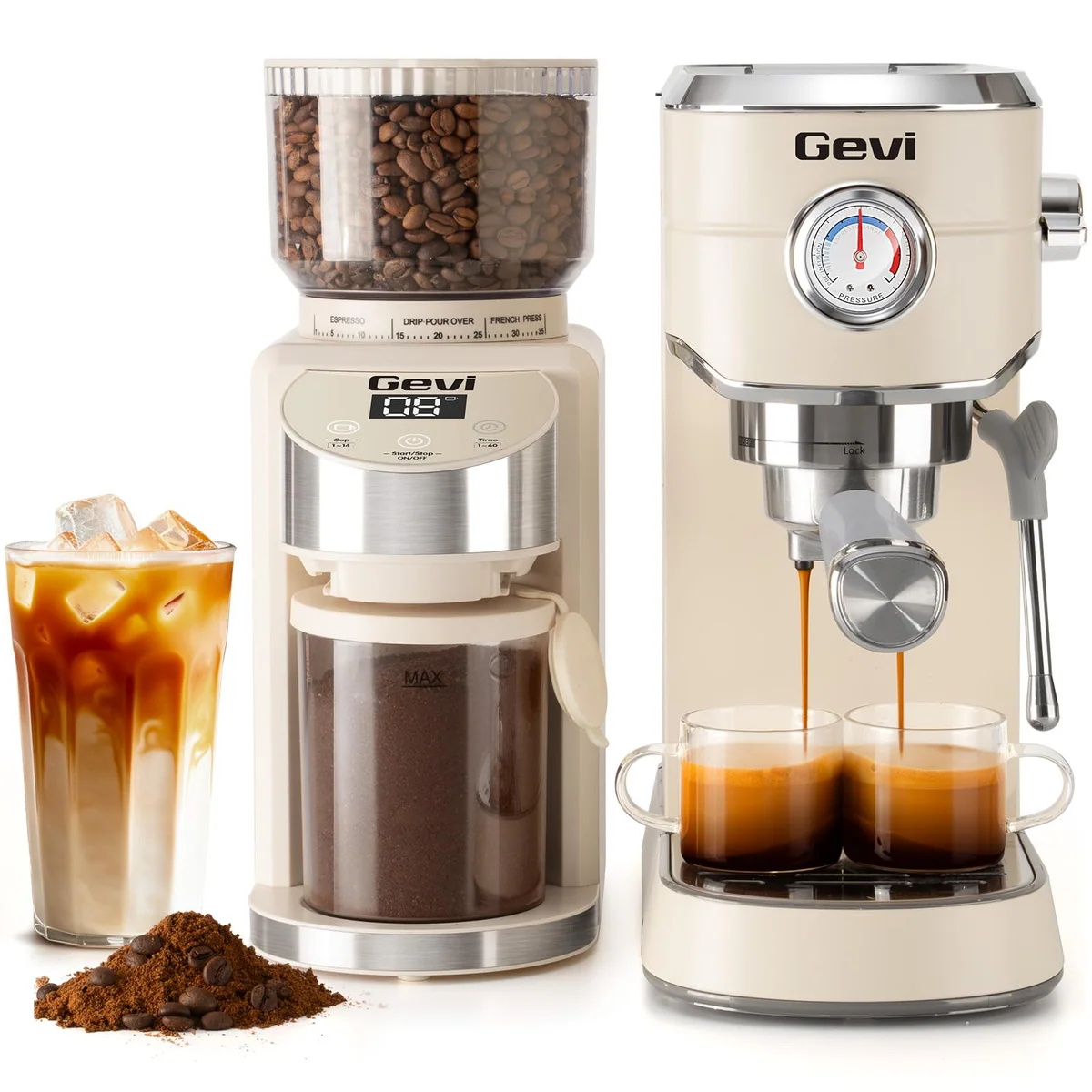
Buy the grinder combo if you are escaping pods and want cappuccinos on a small counter, buy the stainless auto-frother model only if you already own a grinder and drink alone, and buy neither if you weigh your shots.
Based on 1900 owner ratings, 4 owner discussions and 2 other sources. We have not tested this machine ourselves.
We earn a commission if you buy through our links, which does not affect what we say.
Read how this site works →
Who each of these is actually for
The grinder combo is for the person leaving pods behind who wants milk drinks on a small counter and does not own a grinder, and who will be happy drinking long coffee. Everything they need is in the two boxes, the machine looks better than it costs, and the thing that will eventually frustrate them is a ceiling they will not notice for six months.
The stainless model is for one person who already grinds, drinks alone, and values a fast heat-up and a machine that will fit anywhere. The cooldown makes it a poor host, the frothing sleeve makes it a poor route into latte art, and the reprogrammable buttons make it a genuinely pleasant daily driver once you set them to your cup.
The best sentence anyone has written about either of them belongs to an owner of the stainless one, who said it is not meant for the espresso snobs who want or need to spend thousands on an Italian import, and that this is a working person's machine. That is fair, and it is also the boundary. Inside it, these are good buys. Outside it, no amount of pressure on the gauge is going to change what comes out of the spout.
Buy the grinder combo if you are escaping pods and want cappuccinos on a small counter, buy the stainless auto-frother model only if you already own a grinder and drink alone, and buy neither if you weigh your shots.
Best for: One owner put a scale under the grinder combo, got 72 grams of liquid out of 14 grams of coffee, and stopped calling it espresso, which is the single most useful thing anyone has written about either of these machines.
Gevi sells two very different things under the same 20 Bar banner. One is a two-box set: a small semi-automatic espresso machine in ivory beige, plus a separate conical burr grinder, sold on a single listing. The other is a compact brushed stainless machine with no grinder at all, whose headline feature is an "automatic milk frother" that turns out to be a sleeve over a steam wand. Neither is a bean-to-cup machine, whatever Amazon's category tree says, and the difference between them is not a trim level. It is the difference between buying a coffee setup and buying a coffee machine.
The grinder combo is the one Espresso Den would point most first-time buyers at, and the reason is unglamorous: it arrives complete. Machine, burr grinder, portafilter, two baskets, tamper, milk pitcher, brushes, and a pair of double-walled glasses. Owners who came from Keurig and pods describe it doing exactly the job they bought it for, one of them nine months into daily use with nothing gone wrong, another buying it specifically because a full-size machine would not fit their counter. Its honest drawback is a real one and it is not cosmetic: the bundled grinder's finest setting is not fine enough to run a non-pressurized basket, so the machine's ceiling is welded shut at the factory.
The stainless auto-frother model is the narrower buy. It looks better than its price suggests, it heats fast, its shot volumes can be reprogrammed to whatever you actually drink, and one owner a year into daily cappuccinos calls it flawless. Its drawback is the one that decides purchases in a two-person household: it needs three to five minutes to cool down between drinks, and when an owner rang to ask why, Gevi's own support desk told them the machine is not professional despite the word sitting in the listing title.
If you already read r/espresso, if you own a scale, if you drink light roasts, or if a dead appliance at four months with no reply from anyone would ruin your year, close this page. There are honest answers further down for all four of those people.
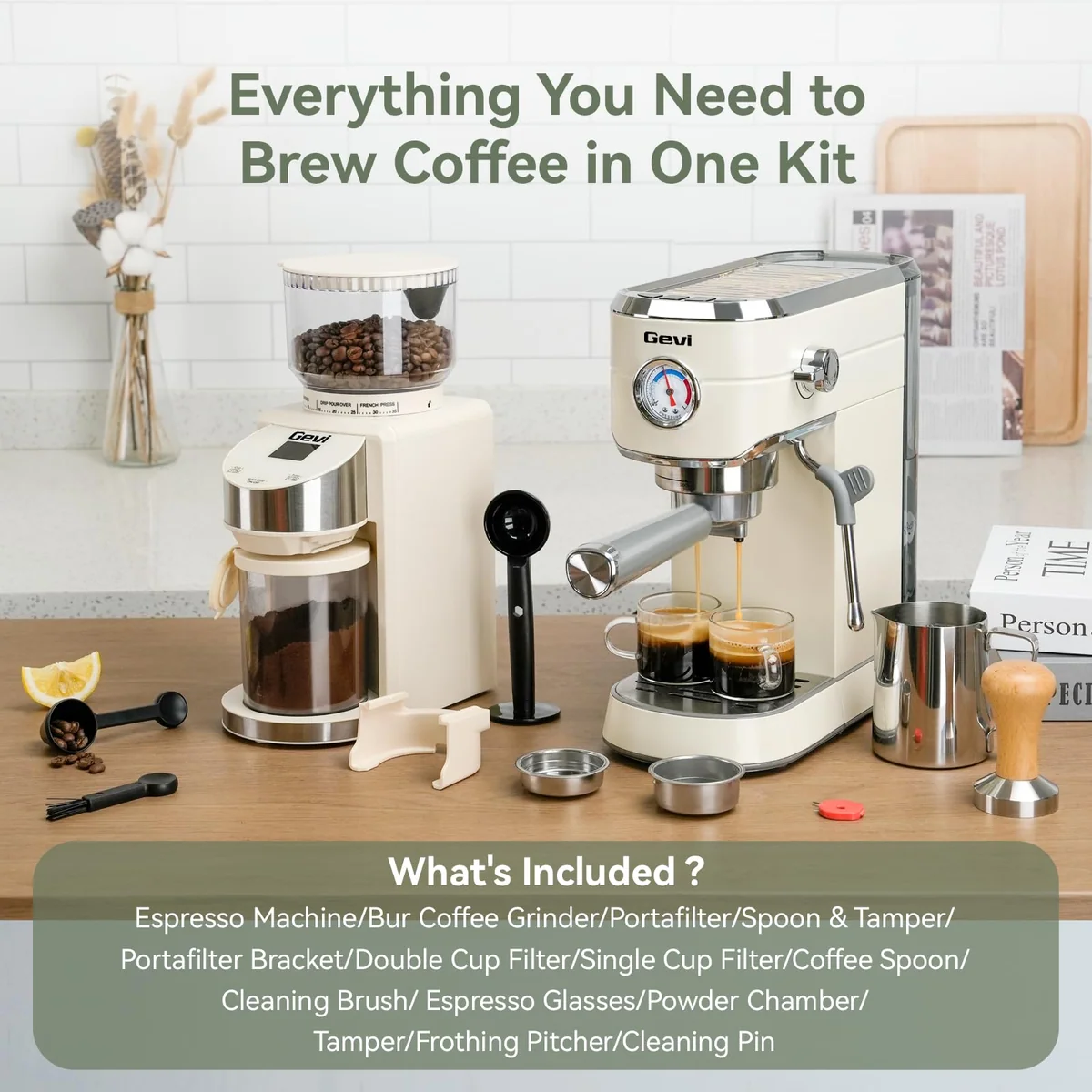
Key Specifications
What Amazon calls these, and what they actually are
Start with the category error, because a large share of the people reading this arrived from a search for a super-automatic. Amazon files the stainless model under Super-Automatic Espresso Machines. It has a portafilter, a plastic scoop, a plastic tamper and a steam wand. You grind or buy ground, you dose, you tamp, you lock in, you steam the milk yourself. That is a semi-automatic, and if what you actually want is a machine that grinds, doses, tamps, brews and dumps the puck behind a closed door, the category you want is a different one entirely and the entry ticket is several times higher. Ask the budget question on r/superautomatic and the cheapest answers that come back are refurbished Juras, a Gaggia Brera, a Magnifica Start. Nobody names anything in Gevi's territory, because nothing in Gevi's territory belongs to that category.
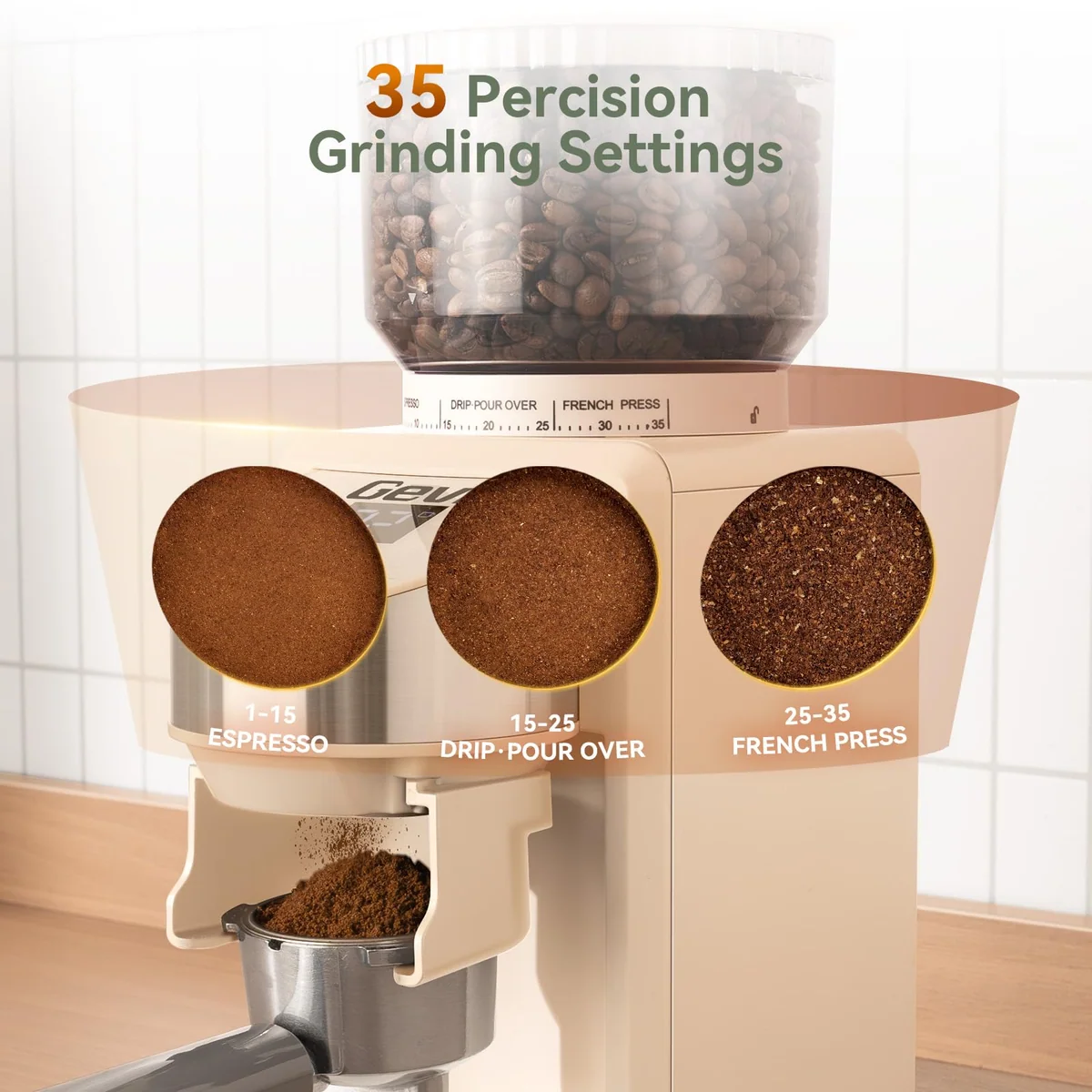
The grinder combo is filed correctly, as a semi-automatic, and it is the more interesting product of the two precisely because of what comes in the second box. Everything the espresso internet believes about priorities says the grinder matters more than the machine; ask which to upgrade first and the loudest answers are variations on grinder, always grinder, the machine can wait. Bundling one is therefore the smartest decision on this listing and the source of its worst limitation, in that order.
| Grinder combo (GECME418E-U + GECGI406B-U7) | Stainless auto-frother (ECMA0-SS0A1) | |
|---|---|---|
| Sold as | Two appliances on one listing: espresso machine plus standalone conical burr grinder | One machine, no grinder, no beans handled |
| Milk | Bare steam wand, praised by nearly every owner who mentions it | Steam wand under a removable frothing sleeve, which is what "automatic" means here |
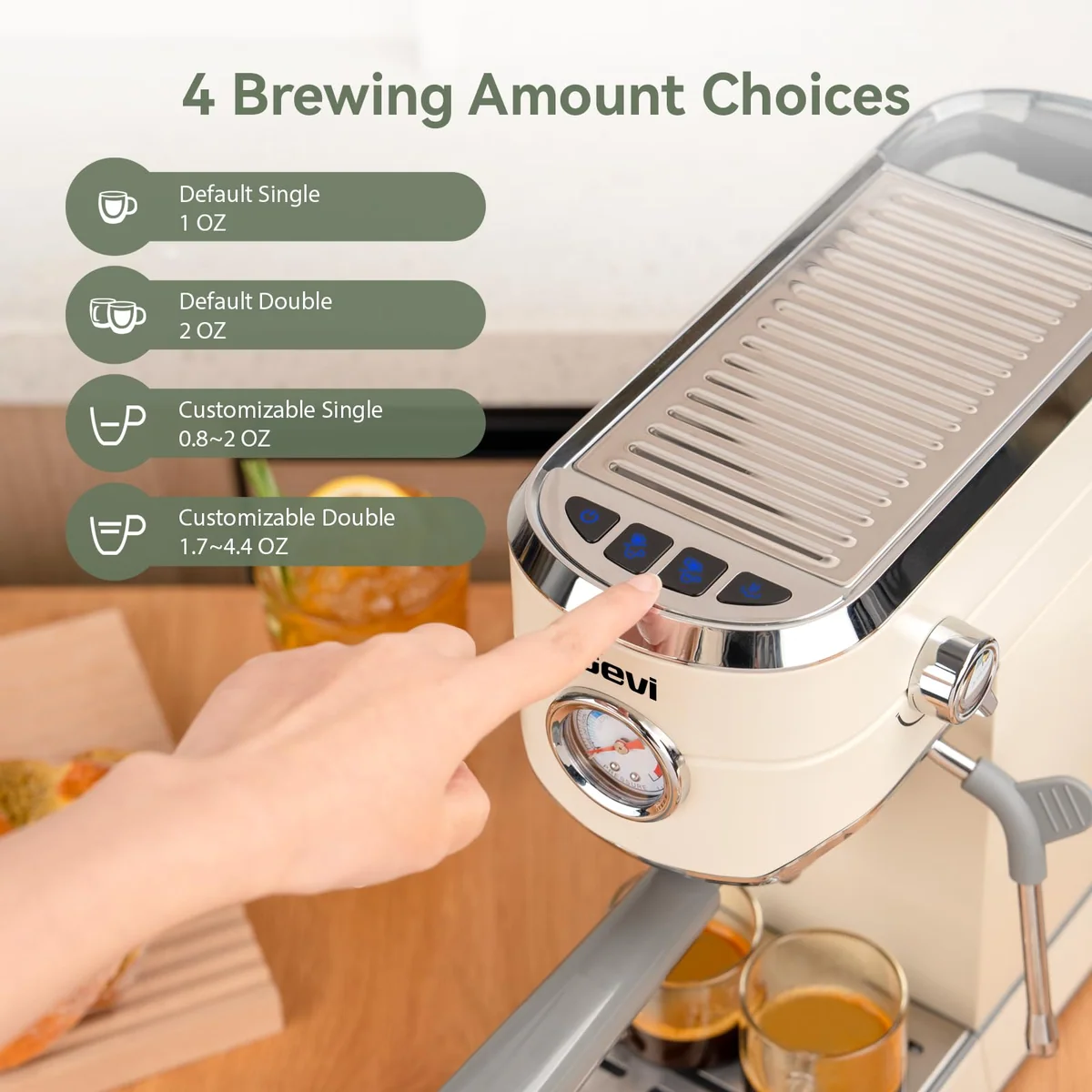
| Controls | Front pressure gauge, manual shot | Four illuminated buttons, reprogrammable shot volumes, front pressure gauge |
| Finish | Ivory beige, retro, repeatedly the reason people bought it | Brushed stainless, one owner's stated upgrade over an older Saeco's looks |
| Amazon rating when captured | 4.4 from 1,901 ratings | 4.0 from 566 ratings |
| Amazon's own category | Semi-Automatic Espresso Machines | Super-Automatic Espresso Machines, which it is not |
| The complaint that matters | Grinder's finest setting will not reach espresso-fine | Three to five minutes of cooldown between drinks |
Both listings carry the same product description, and both of them promise a removable water tank with a visible water level. On the stainless model, an owner reports there is no water meter at all, the tank sits at the back where a counter usually meets a wall, and the only warning you get is a light on the front panel. That is a small thing that becomes a daily thing.
Strengths & Limitations
Strengths
- The grinder combo arrives as a complete working setup, machine and burr grinder and every tool including two double-walled glasses, so there is no second purchase before your first coffee.
- Milk is the thing both machines do well, with owners of the combo consistently praising the steam wand and one household making daily cappuccinos on the stainless model for a year.
- Both machines are genuinely small, and several owners bought theirs specifically because a full-size machine would not fit under their wall cabinets.
- The pressurized baskets are forgiving, which means supermarket pre-ground coffee and an imperfect tamp still produce a drink with crema on it.
- The stainless model's shot volumes are reprogrammable by holding two buttons and stopping the pour where you want it, which fixes the most common complaint about it.
- Gevi's support has replaced hardware on video evidence for at least two owners of the stainless model, one of them without any hassle at all.
Limitations
- The grinder combo's own owner measurement is 14 grams in and 72 grams out, which is a lungo rather than an espresso, and stopping the shot early makes it bitter instead of fixing it.
- The bundled grinder cannot reach espresso-fine, so buying a bottomless portafilter to escape the pressurized basket does not work.
- The stainless model needs three to five minutes between drinks, and Gevi's own support desk contradicted the word "professional" in its title when an owner asked about it.
- One combo owner's grinder died at four months and neither the seller nor Gevi replied to them at all.
- The listing claims a relatively quiet grinding experience and two of the eight retained owners describe it as loud.
- The stainless model has no water gauge you can read in normal use, shakes cups out of position while extracting, and will not fit a regular mug unless you remove the drip tray.
- Both machines ship with a light plastic tamper that owners recommend replacing immediately.
The 20 bar number, and the basket it is hiding
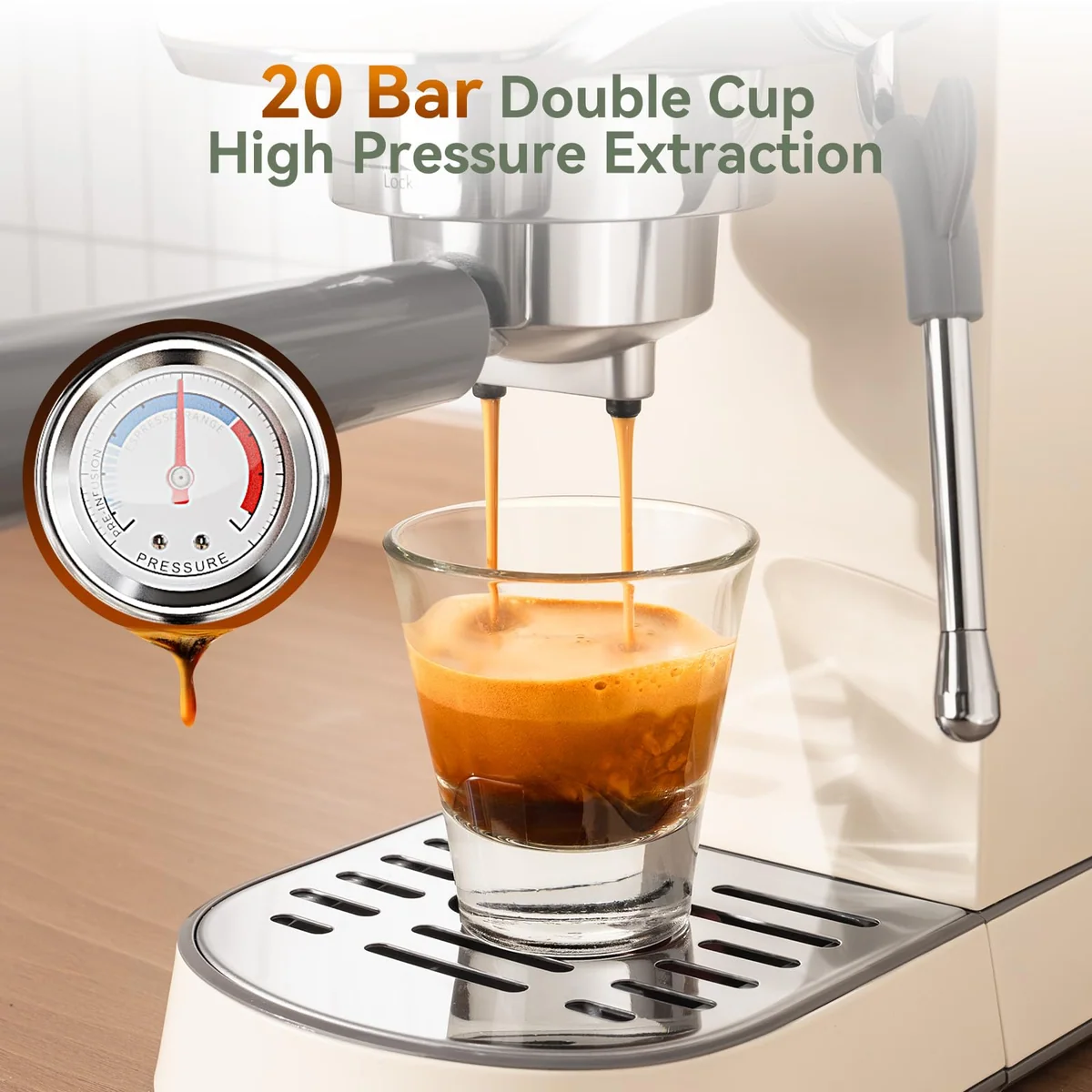
Espresso is brewed at roughly nine bar. Twenty is not a better nine. On the Gevi thread that most buyers eventually find, one regular calls the figure a weird flex and explains it as marketing aimed at people who assume more is always better, which is an unkind way of putting something that happens to be true. A video reviewer who put a gauge on a sibling Gevi could not read the top of the shot because the needle went past the maximum on the meter, and their own conclusion was that this is more pressure than a conventional extraction wants. If you want the long version of why the number is on the box at all, we have written it out separately.
The pressure and the basket are the same design decision. These machines ship with pressurized baskets, which have a small hole underneath that manufactures back-pressure so that the puck does not have to. The clearest description of it in the wild comes from the same thread: better machines and bottomless portafilters lack that hole, the coffee itself creates the resistance, the coffee tastes better, and the price is that the grind has to be exactly right and the grinder has to be good enough to get there. A pressurized basket is forgiving of a bad grind, produces crema from almost any coffee including supermarket pre-ground, and quietly caps how good the drink can get. One owner of the stainless model praised the basket without knowing the word for it, writing that it is not just a straight-through shot and that the crema is perfect. They were right about both halves.
Which brings us to the finding that should decide this purchase for anyone who cares about espresso as opposed to coffee. A grinder-combo owner who bought a scale wrote that the portafilter holds 14 grams, that a 1:2 shot should therefore weigh about 28 grams, and that what they get instead is 72 grams. That is roughly 1:5, which is a lungo, and they said so plainly: this is not a true espresso machine, it makes lungo. Cutting the shot at 28 grams did not fix it, it just made the coffee bitter, which is what happens when you truncate an under-extracted shot. They then bought a bottomless portafilter to escape the pressurized basket and hit the wall this page keeps returning to: the grinder on its finest setting does not grind fine enough. An owner of an older Gevi described the same failure without any numbers, saying it does not extract rich enough espresso and feels like drinking coffee.
Espresso Den's reading of that is not that the machine is broken. It is that the machine's native drink is the long one. Americanos, lungos and anything with milk in it are what this thing is genuinely built to produce, and the listing's own drink list quietly agrees with that assessment everywhere except the word espresso. Buy it to make cappuccinos and you will be delighted. Buy it to chase a ristretto and you will be filing a return.
Milk is the part that actually works
On the grinder combo the steam wand is the best-supported claim on the whole listing. Owners call it strong and easy to use, say the frother works well, single it out for cappuccinos, and one household makes lattes on it daily. There is no serious dissent in the retained reviews.
On the stainless model, "Automatic Milk Frother" means a panarello sleeve, the perforated tube that slides over a steam wand and pulls air in for you. An owner confirms it, describing a sleeve that slips off for cleaning, and gets good foam from both coconut milk and half-and-half. A long-form review of a sibling Gevi is blunter about the trade: the sleeve makes foam easy for beginners and makes the fine microfoam latte art needs genuinely difficult. Owners of this one split further than that. One says the wand does not heat milk much and has given up on it entirely, adding that using steam and then trying to brew requires purging first, which is more babysitting than they want. Another calls the frothing design amazing. If you have not decided which milk system you want to live with, that argument has its own page here.
The cooldown, and other things nobody mentions until you own one
The stainless model can make one drink at a time, then wants three to five minutes before it will brew again. The owner who documented it called support to find out what was wrong, spoke to a knowledgeable person, and was told that the machine is not professional and the wait is normal. Two people wanting coffee at the same time is not an edge case, and this is the fact most likely to make somebody regret the purchase. Other reported irritations from the same set of owners: the machine shakes hard enough during extraction to walk a cup out of position, a regular mug will not fit under the group unless you pull the drip tray out, the pressure gauge swings into the red if you tamp firmly, water sits in the basket afterwards because the machine does not vent pressure at the end of a shot, and the power button turns on with a tap but needs a long hold to turn off. The tamper is plastic and light, and the most useful sentence any owner wrote about it was to just buy a real one.
The grinder combo has a shorter list. Two of the eight retained owners raise the same specific complaint unprompted: the grinder does not deliver grounds into the centre of the portafilter, and it makes a mess. Two describe it as loud, which directly contradicts the listing's claim of a relatively quiet grinding experience, and both of them forgive it, one noting they have a baby in the house and have never had a problem. One owner would like a bigger water tank. None of this is disqualifying, and all of it is the texture of living with the thing.
The case for buying one anyway, and the case against
The single best argument for the grinder combo was made by a stranger on Reddit defending it against people recommending better machines: those recommendations are all machine-only, and you still need a grinder. A Bambino or a Gaggia Classic is the right advice on the machine, and then quietly adds a few hundred dollars of grinder before you can use it. The Gevi set is not a machine at its price, it is an entire setup at its price, and comparing it to machines rather than to setups is how people talk themselves into spending three times more than they meant to.
The case against is that the grinder in the box is the part that limits the whole thing. It is adjustable, owners call it easy to set, and it still will not reach the fineness a non-pressurized basket needs, which means the standard upgrade path for a cheap semi-automatic is closed to you. Buy a better grinder later and you have paid twice for the same function. That is the honest arithmetic, and it is the arithmetic behind most cheap espresso machines, not just this one.
A useful piece of advice that transfers from an older Gevi: these machines struggle with light roasts because the water does not get hot enough for a good extraction, and do fine with darker roasts. If your coffee tastes thin and sour, change the beans before you blame the machine, and if it is coming out lukewarm, that has its own set of causes. Owners of that older model also flagged that the body is light enough that locking the portafilter in can take a second hand to hold the machine down.
What to buy instead, honestly
If push-button coffee is what you actually wanted, stop shopping in this price bracket. The cheapest genuinely automatic machines in any serious roundup sit several times higher, and the trade you make there is control and cleaning rather than skill. The sane entry points on this site are the Philips 1200 Series if you want the smallest real bean-to-cup, the Gaggia Brera if compact matters more than features, and the shortlist we keep for the lowest rung of that category if you want the whole field at once.
If you want espresso as a hobby rather than as a drink, the money is better spent on a machine with a decent grinder beside it, which is what the Bambino Plus and Baratza Encore ESP bundle exists to solve. And if you are specifically shopping this format, meaning a 20 bar semi-automatic with a grinder attached or included for around two hundred dollars, Gevi did not invent it and is not alone in it: we have looked at the GarveeTech, the Kndko and the UDI under the same rules.
What breaks, when, and whether anyone answers the phone
This is where the two listings diverge most sharply, and where the sample size is smallest, so read the numbers as what they are.
Among the retained grinder-combo reviews there is exactly one failure and it is a bad one: the grinder stopped grinding four months in, the buyer wrote to the seller and got nothing, wrote to Gevi and got nothing, and posted the review saying so. Set directly against it, another owner reports nine months of every-single-day use with the machine working as well as it did on arrival. Eight reviews is not a failure rate and Espresso Den will not pretend otherwise, but a purchase at this price, covering two separate appliances, lives or dies on whether somebody replies when one of them stops, and on this listing the only person who needed a reply did not get one.
The stainless model's record is stranger, because support there is demonstrably real. One owner lost pressure after a few months, sent video, and had a replacement machine shipped with what they describe as no hassle at all, naming the representative who handled it. Another had the pressure gauge die at eleven months, sent video, and was offered a replacement unit on condition they disable the old one. A third had support reach out and, in their account, conclude the problem was their fault; they dropped their rating to one star. So: responsive, video-driven, and capable of telling you no. Note also what failed in both cases, which is the pressure system, and note that eleven months is inside a twelve-month window by four weeks.
Warranty terms were not measured for either listing, so this page will not tell you what you are covered for. Ask before you buy, keep the box until you are confident, and be aware that a returns window closes faster than a fault appears. If you want the general shape of how long these machines survive and what usually goes first, that is covered separately, though most of that evidence comes from machines several rungs up the ladder.
Frequently Asked Questions
Is the Gevi 20 Bar espresso machine any good?
It is good at milk drinks, Americanos and long shots, and it is not good at the short concentrated espresso the name implies, which is a design decision rather than a defect.
Is Gevi a good brand for espresso machines?
Gevi is a broad appliance brand rather than a coffee company, and the honest summary from people who have owned its machines is that they are beginner-friendly and unremarkable.
Does 20 bar of pressure make better espresso than 9 bar?
No, because roughly nine bar is the target and the extra pressure exists mainly so a pressurized basket can push water through any grind at all.
Is either of these a super-automatic espresso machine?
Neither one is, despite Amazon filing the stainless model in that category, because both require you to dose, tamp, lock in a portafilter and steam milk yourself.
Can I use pre-ground supermarket coffee in these?
Yes, and with a pressurized basket that is a perfectly legitimate way to run the stainless model rather than a compromise you should feel bad about.
Why does my shot come out watery and long?
On the grinder combo it is the pressurized basket and a grind that cannot go finer, which is why the same fault shows up in every machine that brews this way .
Which of the two should I buy if I only drink cappuccinos?
Take the grinder combo, because its bare steam wand is better regarded than the stainless model's frothing sleeve and you get fresh grinding without a second purchase.
What do people on Reddit say about Gevi machines?
Very little and not much of it warm: the one substantial thread is titled around not being impressed, and the most common advice in it is to buy a modifiable De'Longhi or a used Gaggia instead.
Sources (4)
- Amazon listings and customer reviews — Gevi 20 Bar Espresso
- Owner reports across r/superautomatic, r/espresso threads
- Owner and reviewer video, 2 channels
- Coffeeness — Article — www.coffeeness.de